The Imagined Wars of the Heart

In an earlier post, I wrote of the similarity of Brian Van Reet’s “Big Two-Hearted Hunting Creek” and Siobhan Fallon’s “The Last Stand.”  In each story a badly wounded Iraq war vet confronts the fact that his wife has chosen to leave him.  In Fallon’s story, the vet and his wife are so tenderly portrayed that the reader is left gasping with sympathy for both of them.  We want them each to somehow be happy again, if not together then in their now separate lives.  In Van Reet’s story, the soldier and his wife are monsters, albeit colorful ones.  They have not been just buffeted and damaged by the war, but ruined by it.

Both stories are great, just in case that needs saying.

As up-to-the-minute as they are, “Big Two-Hearted Hunting Creek” and “The Last Stand” also belong to a tradition of stories about wounded male vets being jilted by wives and girlfriends.  Alice Fahs remind us of that in The Imagined Civil Wars when she describes a Civil War tale called “A Leaf From a Summer” published in Harper’s Weekly in November 1862.  Fahs writes:

“In that story a soldier faced an amputation hopefully because he had a letter from his beloved ‘next to his heart’; afterward, contrary to the surgeon’s expectations, he indeed ‘began to rally.’ But after receiving a letter telling him that his shallow lover had changed her mind and would not ‘marry a cripple,’ the hour quickly came ‘when they lowered him into the earth, and fired their volleys over him.’  As the narrator commented, ‘his enemy had struck him unarmed and unaware.’  As such the popular fiction revealed, the war only intensified a long-standing literary connection between love and war:  numerous stories claimed not only that women’s love was vital to a successful war but that love itself equaled war in its power to kill men.”

Below is a link to a web reprint of the story as it appeared in the 8 November 1862 Harper’s Weekly, for those who can’t get enough of that breathless, clichéd, one-sided 19th-century narration.

A Leaf From A Summer

“A Leaf From A Summer” is laughable, while the strength of Fallon’s and Van Reet’s stories is their ability to convey marital breakup with a sense of perspective, balance, nuance, and realism.  Examined in isolation, however, the pain of a soldier’s heartbreak is real and consequential.  A chapter called “Dear John” from Matt Gallagher’s excellent war memoir Kaboom:  Embracing the Suck in a Savage Little War describes the carnage wrought on the soldiers in his cavalry scout platoon when they were jilted while deployed.

“Dear Johns crushed men of otherwise unquestionable strength and total resoluteness.   In the time they most needed something right and theirs, it was taken away from them.  It wasn’t like getting dumped—it had a far more resounding impact on the soldier.  He became rougher, harsher, crueler…. Truthfully, it usually made him a better soldier, but he lost some vital slivers of his humanity in the process.”

Gallagher also explains that Dear Johns “didn’t just impact the recipient.  They affected the psyches of teams, sections, platoons, and troops, bringing home to everyone the recognition that the same thing could happen to them and forcing them to wonder if it was going to.  Or if it already had and they just didn’t know about it yet.  This mind fuck was the worst part for many.”

Gallagher points out that a soldier’s romantic interest represents his (or her) hope that an ideal or at least better world awaits his return and thus makes the misery of the war endurable and grounds his conduct while deployed.  But he also reminds us that many soldiers are shitty boyfriends or husbands.  Neglectful and needy by turns, they might be outraged and hurt by unfaithfulness even while being unfaithful themselves.  Gallagher doesn’t do much more to explain Dear Johns from a woman’s point of view, but Kit, the protagonist of “The Last Stand” and Sleed, the protagonist of “Big Two-Hearted Hunting Creek,” also present their spouses with many issues even without the problem of their dismemberment and disfigurement.  The implication seems to be that women are attracted by the idea of loving a soldier, but find the reality very difficult to deal with.  Perhaps they also suspect that male soldiers love war and the military more than they do their wives and girlfriends, and thus determine to make their men pay.

Brian Van Reet’s “Big Two-Hearted Hunting Creek” can be found in Fire and Forget:  Short Stories, published by De Capo Press in 2012.

Siobhan Fallon’s “The Last Stand” can be found in You Know When the Men are Gone, published by Amy Einhorn Books-Putnam in 2011.

Matt Gallagher’s Kaboom:  Embracing the Suck in a Savage Little War was published by De Capo Press in 2010.

Alice Fahs’ The Imagined Civil War:  Popular Literature of the North and South 1861-1865 was published in 2001 by the University of North Carolina Press.
Toni Morrison: “Words and War at West Point”

Toni Morrison Speaks at West Point

The link takes you to a New York Times article on Nobel Prize-winning author Toni Morrison’s visit to West Point, where she discussed her latest novel Home with cadets and faculty.  The article makes a great case both for the relevance of Home as a text concerned with the Iraq and Afghanistan wars and for the value of literature in helping future officers understand war.

The Imagined Wars

Alice Fahs’ The Imagined Civil War: Popular Literature of the North and South 1861-1865 (2001) offers many ways to put current Iraq and Afghanistan war literature in focus. Just taking her nine chapters in order, I’ll quote two sentences from each that make claims about Civil War literature that may still ring true today.  I’ve also added comments of my own that I hope begin to help us sort out the truth and relevance of Fahs’ ideas.

Popular Literary Culture in Wartime: “From the start of the war many readers, writers, and publishers in both the North and South assumed that the war was a literary as well as military event, one that would inspire a new linking of individual and nation within poem, song, and story. Few would have admitted that market considerations played an important role in both encouraging and limiting expressions of patriotism in poetry and prose.”

Comment:  There really hasn’t been a “popular” Iraq and Afghanistan war literature in the way Fahs describes poems, songs, and stories saturating the Civil War print marketplace.  Entertainment/artworks about the current wars have appeared only intermittently, and their artist-creators from what I can tell have expressed themselves sincerely in ways that have seemed most suitable to the ideas they’ve been trying to convey.  The high regard of veterans, their fellow artists, and most intelligent, loyal readers seems to drive them more than the dollar.  Now if there was actually any kind of money to be made by telling contemporary war stories, things might change.

The Early Spirit of the War: “Increasingly, the lived, personal experience of war became the subject of war literature. Although ‘war-songs’ and ‘battle-calls’ were published throughout the conflict, they were supplemented with an extensive literature that insisted on the primacy of the individual experience of war.”

Comment:  I think this is true.  It’s a long way from Toby Keith’s “Courtesy of the Red, White, and Blue (the Angry American)” in 2002 to Kevin Powers’ The Yellow Birds and Ben Fountain’s Billy Lynn’s Long Halftime Walk in 2012.

The Sentimental Soldier: “Yet by 1862, and then in increasing numbers as battle deaths mounted during 1863 and 1864, popular poems that asserted the importance and individuality of the ordinary soldier began to act as a counterpoint to poetry that stressed the subordination of individual interests to the needs of country. Sentimental stories and songs also focused intently on the individual experiences of the ordinary soldier on the battlefield and in the hospital, especially imagining that soldier’s thoughts at the moment of death.”

Comment:  This one’s hard to figure out.  Certainly death, killing, injury, pain, and loss are front-and-center subjects of contemporary war literature, but what is Fahs driving at by calling such business “sentimental”?  That has the ring of a sneer to it, and yet for most of us (I would say), exploring the human experience of mortality and suffering are exactly what literature should be doing.

The Feminized War: “In both the North and South throughout the conflict, a feminized war literature put white women center stage in the war, demanding recognition not only of women’s contributions to the war effort but also, as the war wore on, of their intense suffering. In doing so, such literature did not displace the importance of men in the conflict, but it did sometimes ask for equal recognition of women’s sacrifices, thus contributing to the diversity of claims to the war’s meanings to be found in the pages of popular literature.”

Comment:  Women are starting to appear in contemporary war literature, too, both as fighters and as spouses, friends, lovers, and family members affected by war.  But one of Fahs’ points is that Civil War literature was intensively market-driven, and that authors shaped stories to appeal to a huge female readership.  Is this still true today?

Kingdom Coming: “As in so many other Northern stories and novels of the war, the achievement of black heroism was, ironically, most easily imagined through sacrificial death. Nevertheless, the imagination of black heroism within popular literature marked a new phase in representations of African Americans.”

Comment:  Seemingly not an issue in contemporary war literature, but the absence or token inclusion of minorities in current war art and literature is curious, as I discussed in my post on Toni Morrison’s Home.

The Humor of War: “Instead of merely reaffirming the values of patriotism, discipline, obedience, and endurance, war humor acknowledged that sloth, laziness, cupidity, disobedience, and negligence were also among the values associated with the war. Most of all—and most transgressive of the heroic norms of patriotic literature—war humor made the simple but profoundly subversive point that war was ridiculous.”

Comment:  Bring it on!  More Colby Buzzell, more Ben Fountain, more David Abrams, please!

The Sensational War: “Although it has often been suggested that the war acted as an impetus for the development of realism in American letters, popular wartime literature reveals that the experience of war acted just as much—if not more—as the impetus for the development and wide dissemination of adventurous romance, the domain of ‘cheap’ novels…. Strongly linked to melodrama in language, plot, and characterization, sensational literature emphasized a world of moral certainty composed of dastardly villains and spotless heroes, and of pure good and evil.”

Comment:  Not such a problem today, but that’s because there really isn’t even a low-brow, pulp, popular, or “cheap” war literature market anymore. Everything that I’m aware of aims high; no one’s writing stories that gleefully depict the warzone as a realm for the uncomplicated killing of bad guys and other adventures.

A Boys’ and Girls’ War: “Yet war-related novels written for and marketed to children were subversive of antebellum familial ideals in several respects. They were attuned to patriotism and entertainment, nationalism and individualism, obedience and adventure.”

Comment:  How have the Iraq and Afghanistan wars been explained, represented, and marketed to youths?  Now that would be an interesting subject for study.

The Market Value of Memory: “As these shifts in popular literary culture remind us, memories of wars are far from static or permanent…. Whereas during the war Northern women’s experiences on the home front or African American soldiers’ exploits had been imagined as a form of participation in the war, increasingly only men’s experiences in battle counted as the ‘real’ war.”

Comment:  Too early to tell, but Hollywood’s interest in SEAL Team 6 and other special forces might be an indication that this dynamic hasn’t changed.

I hope these snatches of Fahs’ book intrigue you like they do me. Her “provocative-but-plausible” idea per page index is off the chart, in my opinion.  I have a little bit more to say about Fahs in a future post, and also plan to look at some of the scholarly work on the literature from other wars to see what they have to offer.

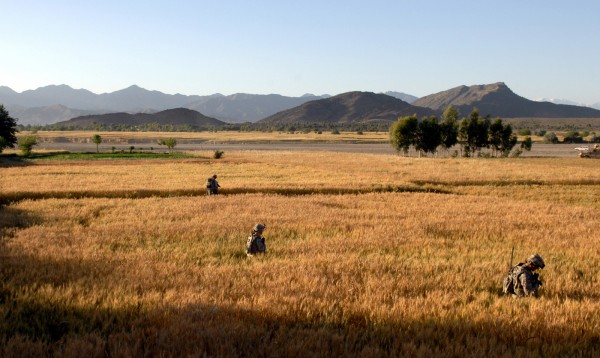
Wheat fields, Khowst Province, Afghanistan.

Will Mackin’s “Kattekoppen”: Surreal War Fiction

Will Mackin’s Kattekoppen

If this link works, it will take you to a story in this week’s New Yorker called “Kattekoppen.”  Written by a vet named Will Mackin, it is told from the point-of-view of a SEAL Team 6 member in Logar Province, Afghanistan.  The subject is the team’s effort to recruit a trustworthy artillery liaison from the battery of regular army artillerymen on their compound.  One of the candidates is of Dutch descent; his mother routinely sends him care packages full of a Dutch licorice called Kattekoppen, which accounts for the story’s title.

Mackin’s story is true to my own fleeting experiences dealing with ODAs, OGAs, Ranger task forces, and other special operators in eastern Afghanistan.  My FOB, Camp Clark, was also home to two 155mm howitzers, so “Kattekoppen”’s portrait of its “cannon-cockers” brings back fond memories, too.  One of the funny aspects of the war in Afghanistan was how ad hoc it all was.  You’d think a SEAL Team 6 would have its own organic highly-trained artillery liaisons, and wouldn’t have to go recruiting among the Joes in whatever unit had recently rotated in.  Mackin’s account of the pick-up team nature of the Afghanistan fight is humorous, but also a little scary to contemplate.

Great sentence, describing artillery rounds arcing out toward their target:  “And, soon enough, I saw iron scratches against the clear blue sky.”  Yes, yes, a hundred times yes.

Realistic touches aside, though, what’s most notable about “Kattekoppen” are its surreal, fantastical, supernaturalistic, and hallucinogenic moments.  Midway through the tale, the first-person narration comes unhinged, as if the narrator had suddenly ingested a psychological stimulant. The veneer of verisimilitude tears and the reader is left to contemplate passages such as the following:

“Outside, covering everything was a pristine layer of snow, which dawn had turned  pink. I started the pink HiLux. I honked the horn and it made a pink noise. Levi  emerged from his pink tent with his pink ruck. I drove him down a pink road to  the pink L.Z. The rotator came in sideways, and its thumping rotors kicked up a  thick pink cloud.”

Shortly after, not just the narration, but the events themselves grow increasingly strange.

Coming hard on the heels of Brian Turner’s “The Wave That Takes Them Under” in Fire and Forget, “Kattekoppen” suggests that war authors are now pushing beyond the literal and verisimilar to tell their stories.   In an earlier post, I made fun of a weird 2008 movie called The Objective, which combined special forces derring-do in Afghanistan with science-fiction and horror elements.  But perhaps The Objective was on to something.  Looking backward, the precursor texts for this magical war realism must be Tim O’Brien’s 1978 novel Going After Cacciato and 1990 short story “How to Tell a True War Story.” Thinking about it all, my working hypothesis is that nitty-gritty detail and “explaining how it really was” are fine in theory and as far as they go, but that’s not quite enough for our most imaginative and anarchic war writers and artists.

Camp Clark, Khowst Province Afghanistan, 2009.
Camp Clark, Khowst Province, Afghanistan, 2009.

Toni Morrison’s Home: The Africanist Presence in War Literature

2012 may prove to be the annus mirabilis for Iraq and Afghanistan war fiction. A year that saw the publication of Ben Fountain’s Billy Lynn’s Long Halftime Walk, Kevin Powers’ The Yellow Birds, and David Abrams’ Fobbit is not to be sneered at. Many years may go by before we see even one more war novel as good as any of those three.

Also published in 2012 was Home by Pulitzer and Nobel Prize winner Toni Morrison, the author of acclaimed novels such as The Bluest Eye, Song of Solomon, and Beloved. Home is an odd one whose inclusion in a discussion of Iraq and Afghanistan war literature is not an easy fit. The story of a traumatized African-American Korean War vet who returns to a racist 1950s United States, it invites the question why this novel now? What is Morrison asking us to think about? The only thing that seems to recommend it as an interjection in the national conversation about the current wars is the date of its publication.

I don’t know exactly what Morrison is up to, but I think the answer lies in a long non-fiction essay she published in 1992 called Playing in the Dark: Whiteness and the Literary Imagination. In Playing in the Dark, Morrison chides literary scholars for not recognizing the “Africanist presence” in American literature and culture. By the “Africanist presence,” Morrison does not mean just black characters in American fiction, such as Jim in Huckleberry Finn. Nor does she indict American authors for not including more black authors or addressing racial issues. Rather, she claims that American letters (and culture, too), start to finish everywhere is informed consciously and unconsciously by the nation’s five-hundred year history of a biracial existence. In Morrison’s view, über-American concepts such as individualism, preoccupation with evil and sin, and anxiety about our nation’s social cohesion owe their distinctiveness and power to white misgivings about the black American presence in the midst of their lived lives and imaginations.

So, according to Playing in the Dark, the Africanist presence is always already everywhere in literature, even in novels where there are no black characters.

Which brings us to Iraq and Afghanistan war literature, which by and large features few African-Americans and presents itself as not particularly concerned with racial matters. Whatever is important to note about the war, it suggests, it certainly is not America’s tortured history of race relations. If anything, we should applaud ourselves that whatever the hell has happened in Iraq and Afghanistan, black-white issues haven’t been the problem.

Morrison wouldn’t have it, I feel. If we think we have written race out of our national narrative of war and its aftermath, she suggests, we should probably think again. Home asks us to think that a whites-only story of Iraq and Afghanistan is much less than the truth, the whole truth, and nothing but the truth.