Special Ops Bro-Hymn: Ross Ritchell’s The Knife

The KnifeUS special operations in Iraq and Afghanistan have been given fictional portraiture in Lea Carpenter’s Eleven Days and Aaron Gwyn’s Wynne’s War, but Ross Ritchell’s novel The Knife is the first to depict in detail the nighttime raids that have emerged as the signature American military tactic of the wars. Ritchell, a US Army 75th Ranger Regiment veteran, has placed his story about a special operations squadron in a mythical War on Terror battlespace called “Afghanipakiraqistan”—the scenes set in urban areas recall Iraq, while those set in desert mountains evoke Afghanistan. The unit—also vaguely described, but by some clues perhaps a US Army Special Forces “Green Beret” team–deploy on a moment’s notice to avenge the massacre of a sister unit. Immediately upon arrival in theater they are propelled into action to kill-or-capture the leaders of a terrorist enemy cell called al-Ayeelaa. Most of the narrative is told through the perspective of an operator named Shaw, but the thoughts and actions of several other members of Shaw’s unit as well as a variety of local Afghanipakiraqistan minor characters are also portrayed independently. Shaw and his team are full of swagger, confident and righteous in their certainty that they are just the men to eliminate the “[b]ad fuckers” of al-Ayeelaa. “Well, now they’re fucked,” Shaw’s commander briefs the men, speaking of their insurgent foe, but as events play out the special operators underestimate al-Ayeelaa, and Shaw’s faith that he is mentally tough enough to withstand the vicissitudes of the warrior “way of the knife” is undermined.

Many aspects of The Knife caught my eye in regard to my own experience in Afghanistan’s Khost and Paktya provinces. There, at least three Special Forces “Operational Detachment Alphas,” a Ranger regiment task force, a CIA-sponsored Afghan militia, and who-the-hell-knows how many other operator-as-fuck contingents vastly complicated my life as an advisor to the Afghan National Army. Explaining to my ANA counterpart why a mullah had been snatched in the middle of the night or the cousin of an ANA officer had been killed on a raid on a suspected bomb factory were several-times-a-week occurrences. The conversations were never pleasant and rarely did I have enough information to be convincing. I was high enough up the chain-of-command to gain some insight on the missions of the special operators in sector, but definitely not on the inside of their decision-making processes. The little I saw, unfortunately, convinced me that their actions were not very integrated in a comprehensive and united effort to support the legitimate government of Afghanistan and defeat its enemies in my area of operations. But I knew far more about their screw-ups—and I was privy to a few doozies—than I did their successes–they may well have saved my life many times over–so I was and remain relatively sanguine about the fact that the dark-side half of the wars has emerged as their most compelling storyline. It’s not as if the efforts of those of us who rambled around Khost and Paktya in the daylight trying to do good—Embedded Transition Teams, Provincial Reconstruction Teams, Agribusiness Development Teams, Brigade Combat Teams, battalion battle-space-owners, and the like—amounted to much, right? So why not give props to those who attacked very directly men-and-women in possession of guns and bombs and with malice toward Americans on their minds?

The Knife confirms the methodology of the midnight raiders: Pass the day pumping iron, shooting at the range, and watching videos while waiting for higher headquarters to send down cell-phone intercepts that confirm the location of evil-doers. Raids based on tips by so-called reliable, friendly informants could easily go awry, but phone intercepts were very precise. When one suspected insurgent called another to say, “Bring the cabbages and the carrots to my house now,” you knew they were talking about bombs and rifles, not produce. The operators would get the word at 0-dark-thirty, jump on helicopters, fly into the night, and execute a raid to kill-or-capture “high value targets” and grab all the weapons, cell phones, and hard-drives they could find: “Jackpot!” and “Touchdown!” in military code word terminology. Then back to base in time for omelets-to-order breakfasts at the team house or camp dining facility.

One scene in The Knife makes a pointed statement about the new way of special operator war. An old-school mission that has Shaw’s team walk dozens of miles through the mountains by night and sleep in their own piss and shit in hide positions by day in order to recon a remote village is a fiasco. On the infil Shaw kills a young boy who compromises the team’s hide position, and when they get to the village they find it abandoned. The boy’s death and the fruitless mission stand in contrast to the less wasteful, less complicated economy of midnight ops. Raids demand little preparation—actions on the objective are by SOP or improvised—and the teams themselves do little to collect, collate, or disseminate intel that contributes to a clearer picture of the enemy situation in sector. The operator way-of-war also requires no engagement with local populaces other than at the point-of-a-gun and little interaction with host-nation military forces save for token efforts to put a “local face” on missions by bringing along a few host-nation soldiers given limited roles. It is waging war reduced to simplicity, and as I’ve suggested above, possibly its most effective, nervous-nelly fretting about “collateral damage” aside.

No wonder men love it so. The last fifth of Ritchell’s novel casts a gloomy pallor on the first four-fifths, but for the most part The Knife is a big, fat wet kiss celebrating special operator culture and tactics. The operators seem enormously pleased with their self-images as swashbuckling rogues who have killed many times with impunity. Huge quantities of dip—the American soldier’s khat—and whatever meds the team doctor supplies keep them completely jacked or pleasantly buzzed or sedated, as needed. Freedom from equal opportunity briefing political correctness, reflective safety belt idiocy, guard duty boredom, and other regular Army horseshit allows Shaw and his team plenty of time for uninhibited sexist banter and horseplay, as well as weight-lifting and target shooting, which is a good thing, because those pastimes are part-and-parcel of the special operations way-of-the-knife. Ritchell’s narrative implies that all the conventional Army soul-of-the-warrior-killing-stuff is directly related to the tactical feebleness of conventional unit presence patrols, key leader engagements, and host-nation development missions: a military and a means of waging war for women and sissies and a waste of time. If an operator momentarily succumbs to thoughts of home or misgivings about shooting a child, there’s always another team member with whom he can exchange a few platitudes such as “I’m getting too old for this shit” and then bro-hug it out. A riotous squad-bay practical joke and another big chaw later, the warrior is right as rain and back in the fight. In this light, the death of friends and remorse about killing are not brutal consequences, but as beloved an element of the way-of-the-knife as dip, night vision devices, and bushy beards.

Ritchell tells his story briskly. Early scene efforts to paint Shaw’s team as colorful raconteurs and masters of insult stumble, but Ritchell’s ear improves noticeably as the novel progresses. A line delivered by an operator before the final mission, “Well. This’ll be an interesting night. I’m gonna go take a shit,” seems to channel the right measure of soldier linguistic flair—it made me laugh, anyway. Descriptions of team work-and-living spaces are detailed and interesting, and descriptions of combat are page-turners. The Knife is narrated in that terse, just-the-facts style that gets the job done of writing a novel from start to finish without being absolutely horrible, if falling far short of the highest levels of imagination and insight the novel also makes possible. Note the short sentences and extremely basic sentence patterns of the following passage:

Shaw shot out of bed, rattled. He hadn’t even felt the beeper vibrate in his pocket. It glowed with a 1 and headlamps started popping off in the tent. They hadn’t been in bed for more than a few hours. Shaw looked at his watch. Not even 0900 hours yet. He still hadn’t brushed his teeth from the long walk. He could taste too many days of chaw and dirt and Skittles and filth. His breath smelled like something had died in his gut.

Ritchell either idolizes Hemingway, or his prose has been hammered into lean, mean fighting shape by his MFA instructors and publishing house editors. Not that that’s a bad thing; it stands a better chance of being popular than any prose style I would favor more. My thoughts about The Knife—subject, theme, and style—it seems clear, then, are as ambivalent and conflicted as my thoughts about the real-life special operators I met in Khost and Paktya. Honestly, however, in the new world of war, anything’s better than asking conventional line units to battle highly motivated irregular enemy forces while simultaneously trying to prop up feeble nation-states, and the only other option, short of not fighting, is to bequeath the effort to those who believe whole-heartedly in the idea that they are “special.” The Knife offers a pretty clear picture of what we’re going to get when we do.

Ross Ritchell, The Knife. Blue Rider Press-Penguin, 2015.
Randy Brown’s Welcome to FOB Haiku

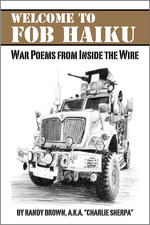
FOB HaikuRandy Brown, aka “Charlie Sherpa,” is the keeper of Red Bull Rising, a popular web compendium of information and commentary about the seemingly incongruous subjects of war literature and the Army National Guard. The title of Brown’s website refers to the 34th Infantry  Division “Red Bulls,” a storied Iowa Guard unit with whom Brown served for many years. Having known a fair number of Red Bulls on my deployment to Afghanistan, I recognize qualities I associate with them in Red Bull Rising‘s voice and ethos, such as job pride and team focus. The Iowans I knew were congenial, but also quiet and serious, guarded I felt about their emotions and true thoughts, their humor manifesting itself in acerbic wit aimed at absurdity of circumstance. No Iowa soldiers I knew were poets, but now Brown’s new volume of verse, Welcome to FOB Haiku: War Poems from Inside the Wire, puts the Midwestern blend of earnestness and cleverness I saw in Afghanistan to work on behalf of poetry about service, deployment, and war.

Brown’s title foregrounds his attraction to haiku—the 17-syllable, three-line Japanese predecessor of the Tweet—as a compressed, minimalist way to comment on military language and experience. Great examples abound in FOB Haiku; veterans will recognize in the example below how Brown imaginatively engages with an acronym—SPORTS—taught to all basic trainees about how to calmly resolve a weapon malfunction in the heat of combat:

Your weapon is jammed?!
Slap. Pull. Observe. Release. Tap.
Then squeeze the trigger.

Many poems in FOB Haiku, not just the haikus, similarly riff on military lingo to strike short, sharp, and reasonably hard at sources of anxiety inherent to life in the Army. Besides haikus, Brown often employs the sonnet form, or references literary touchstones such as Hamlet and “Dulce et Decorum.” These poems might be said to appeal to readers who are already poetry lovers and point to Brown’s fusing of martial and literary registers to make each apprehensible to readers of all stripes. The poems’ military tones portray the contortions the Army inflicts not just on its members’ language and lived lives, but their identities and emotions, while the literary playfulness makes the contortions palatable by inflecting them with humor and historical connection. Brown says as much in an afterword:

In all of this my objective is to clearly communicate across military branches, experiences, generations, and the civil-military divide.  I hope that the techniques described and used here will bridge potential gaps in understanding and make these stories accessible to new audiences.

The word “stories” is key here, for while few FOB Haiku poems are narratives, all point to the fact that what we feel to be true about military service is in fact imaginatively constructed. It’s not the stories we tell so much, but the stories in our minds that define who we are and what we hope to be. The idea that the words we use to process experiences and observations are themselves imaginative creations with histories and implications becomes clear in a poem titled “we are the stories”:

we are the stories
we tell ourselves
especially
the ones we’ve worn out
and broken in
like boots,
for now we can march on for days
where once we would get blisters
on our souls

The best FOB Haiku poems forego playfulness and academic learnedness to make more serious calculations in a more plain-spoken voice of the cost of service and war. In these the adherence to form is looser, but image, word, and line are more precise, more personal, and more independently conceived, and as a result more arresting. “love note from a drone,” for example, addresses the postmodern way of war. It starts:

I had been watching you for days,
fingers hovering above the button,
waiting for release.
I am sorry I crashed your wedding….

“fighting seasons” explores the dissonance felt by soldiers, Iowa men and women of the land and sky, transported halfway around the world to battle an enemy equally tied to the turning of the Earth. It begins:

Even a city boy from Eastern Iowa
follows the markets, like sports, on the A.M. radio
and have a vague sense of the harvests to come….

Among other positions in the Iowa Guard, Brown served often in his unit’s Tactical Operations Center, the command post headquarters responsible for tracking actions of subordinate units and relaying radio reports higher and lower. The duty clearly played to Brown’s strengths as an alert observer of people and events, as well as a wielder of words, and in fact probably honed them. In “static” Brown uses military radio-speak to tersely drive home the broken-and-distorted (a military radio-speak pun of my own) effect of military duty and its associated language on the life of home and family.

Turns out, the psychiatrist
is a former Navy Corpsman.
He says your 5-year-old problem is
That some signals can’t get through.

I learned brevity on Army radios,
pushing-to-talk in 5-second bursts,
waiting a beat to hear the response,
always thinking one phrase ahead.

Instead of speaking louder, I’m told
I should dial into your distance,
Quietly fine-tuning our conversations
As if I am cracking a safe.

How was your day, “over.”

Did you make any new friends, “over.”

Daddy loves you, “out.”

The Iowans I knew were committed to job performance and organizational goals, and were reluctant to say mean things about other people. Their dry wisecracking, I’m thinking, helped reduce pressure to perform and conform. Wise counsel and communication might be said to be another means to understand pressure-laden situations. Judging from his online persona and Welcome to FOB Haiku‘s cover blurbs, Brown seems to have served a valuable dual role as an Iowan citizen-soldier: part court-jester and part seasoned voice-of-experience. His excellent poetry does much the same for military, veteran, and civilian readers of war literature.

Randy Brown, aka “Charlie Sherpa,” Welcome to FOB Haiku:  War Poems from Inside the Wire.  Middle West Press, LLC, 2015.  The limitations of WordPress have caused me to slightly modify the quoted passages.

The War on Drugs: Brandon Caro’s Old Silk Road

Old Silk RoadThe narrator of Brandon Caro’s novel Old Silk Road is a junior enlisted Army medic named Norman “Doc” Rogers. Assigned to an Afghan National Army advisor team in Nangarhar Province, near Jalalabad, Doc is a competent medic—someone you want nearby in combat. When it comes to soldiering, that’s the quality that matters most, which is fortunate because Doc’s other human virtues are questionable. He’s irritable, arrogant, impatient, selfish, scornful, lazy, emotional, and contemptuous of authority, and none of these defects come close to being the main problem. Addicted to the opiates in his aid bag and those he can wangle from Afghans in exchange for downloaded pornography, Doc surreptitiously shoots-up on the FOB and while on mission. When not nodding out, he hallucinates wildly. Visions of the ghost of Pat Tillman and a cast of doomed Afghanistan invaders dating back to Genghis Khan’s Mongol warriors remind him of his own mortality, but Doc’s over-stimulated imagination, it turns out, is no match for the incredible reality he encounters in Afghanistan: evidence that his military chain-of-command is massively involved in an opium-and-heroin cultivation and smuggling operation.

Or maybe not, for Doc’s story is so enveloped in dream, vision, flashback, flashforward, and other narrative trickery that exactly what’s real and what’s not is often hard to determine. Clearly and defiantly, though, Old Silk Road places soldier drug use on the Iraq and Afghanistan war-writing table, much as Jesse Goolsby’s I’d Walk With My Friends If I Could Find Them asks us to think about male-on-male rape in the military. American soldiers, or at least some of them, smoked hashish in Afghanistan when they had a chance, and the few stories I’ve read about American military complicity in Afghanistan drug smuggling rings makes me think we’ve only yet heard about the culprits who have been caught. Caro writes in detail of the mechanics of shooting up and the allure of druggy bliss. I don’t know if the authority comes from experience or not, but it wouldn’t surprise me if the contemporary national issues of traumatized veterans and record levels of white middle-and-upper-class heroin addiction are more tightly entwined than we have so far considered. Old Silk Road gives these possibilities imaginative portraiture, and I for one am inclined to believe that if an author can envision something, it’s probably already happening.

True to its title, the plot of Old Silk Road is that of the picaresque travel narrative. Doc Rogers’ Embedded Training Team has decided to convoy from FOB Mehtar Lam near Jalalabad to Camp Cobra near Kabul to partake of the Camp Cobra dining facility’s awesome Thursday night Mongolian barbecue. The advisors know the “Con-Op” is a boondoggle that might get them killed, but they are infected by a screw-it-all attitude generated by boredom and contempt for their fruitless mission trying to train the hapless Afghan army. Adventures ensue along the way; Doc has in mind a quick fling on Camp Cobra with a fellow medic named Gomez, but a suicide bomber attack kills a team member named Mortin and forestalls the hook-up. Worse, or almost as bad, Doc believes the Afghan army is complicit in his friend’s death. Doc is not the most reflective of young men, as illustrated by the following passage describing his thoughts as he mans the gun on his Humvee while spaced out on morphine:

Doing my best to keep an eye on potential troublemakers, I allowed my mind to drift carelessly into the abstract. I thought about Gomez. It was just as well we were foregoing our visit to Cobra. No need to encounter the legion of Joes she was probably sucking off in the aid station after dark.

And as much as I tried to avoid thinking about it, my thoughts inevitably wandered back to Mortin. He was so young. And why had it been him up in the turret and not me? Dumb luck, I suppose.

And I thought once again about the Embedded Training Team’s advisory mission and how futile it had become, if ever it had been a justifiable use of resources. It was hard enough to get the ANA soldiers to form a line for chow or sick call or God forbid clean their weapons, let alone execute complex tactical maneuvers or practice battlefield medicine. We couldn’t even count on them to show up on time for our convoy from Cobra to Bagram some two weeks earlier. And now we couldn’t trust them not to turn their weapons on us.

Doc, and maybe Caro, too, is also not much of a literary stylist. Passages careen between overwrought and under-nourished emotional responses to events, Doc never misses a chance to write “imbibe” for “drink” and “procure” for “take,” and he lards his narrative with chunks of insider technical explanation. It’d be interesting to compare the passage above with John Bartle’s similar portrait of an aid-station cutie and a dead soldier-friend in Kevin Powers’ The Yellow Birds–the last thing Doc’s interested in or capable of is Bartle’s melancholy lyricism. As for the ANA, Doc’s opinion is lower-than-low. If only those lazy, lousy ingrates were more like their heroin-addicted and joyriding American mentors they might actually defeat the Taliban! The Taliban in fact hardly figure in Old Silk Road—who needs them when the Afghan army is treacherous enough? Doc reports a troubled relation with his father, but the Oedipal juices have not stewed long enough to transform him from angry to thoughtful, let alone allow him to see his story as comic farce. For all that, Doc is perhaps representative of many male junior enlisted soldiers, if they were permitted to openly voice their thoughts. Chris Kyle somewhere said that the ghostwriters and lawyers who helped him write American Sniper made him look not too crude, but too nice. Left to his own authorial devices he might have sounded much like Doc Rogers: the kind of guy who figures if you don’t like him it’s your problem, not his. That sentiment may be close to the true spirit of American soldiers, no better and no worse than they should be. But Doc also reminds me of the apocryphal veteran described by Karl Marlantes in What It is Like to Go to War. Ask a young vet how hard it was to kill in combat, Marlantes writes, and he’ll probably tell you it was easy. Ask him again when he’s 60, and if he’s sober enough to answer….

Kudos to Caro for replacing one traditional soldier obsession—alcohol—with a fresher, more modern, equally depressing one–drugs. Also for giving his contemporary story an historical consciousness that includes the Russian, British, and Mongol failed takeovers of Afghanistan. I also like how Caro incorporates Pat Tillman—the doomed patron saint of our collective mishap in Afghanistan—into a personalized story of deployment tragedy. As an ex-Afghanistan ETT myself, I enjoyed Caro’s descriptions of places and events I too have experienced. My regard for the mission was far higher than Doc Rogers’, who hates it and thinks it is stupid. I was an old officer, though, and so were most of the other advisors on my team. I’m sure the mission baffled and the Afghans rankled our junior enlisted members just as much as they do Doc.

My real point of connection with Old Silk Road, however, is literary, not military. A few years back, I wrote a PhD dissertation on pre-Civil War popular fiction, the stuff everyone was enjoying except for the few who actually read Melville and Hawthorne in their time. Reading Old Silk Road brought back in spades styles, themes, and characters I encountered in early American stories. The hyper-skittishness about honor and slights exemplified by the berserk protagonists of novels by Charles Brockden Brown and John Neal. The picaresque road trip of Hugh Henry Brackenridge’s Modern Chivalry. The odd ruptures of the time-space-body continuum and racial paranoia of Robert Montgomery Bird’s Sheppard Lee. The sensational booze-induced hallucinations of temperance author T.S. Arthur’s Six Nights with the Washingtonians and Ten Nights in a Bar-Room. The exposé of extravagantly sinister and corrupt power à la George Lippard’s The Quaker City. Read Old Silk Road alongside Paul Gutjahr’s anthology Popular American Literature of the 19th Century and David Reynolds’ Beneath the American Renaissance if you don’t believe me. Judging by the fiction, people circa 1835 walked around half-addled by bad water or bad whiskey. Old Silk Road has the same manic, crazy-quilt energy. It’s not interested in propriety or what’s come before and it’s capable of anything. Alarming as it is to think of the drugs that are doing the damage today, especially against the backdrop of military duty, in the great war-writing game Old Silk Road asserts the value of raw idiosyncrasy in the face of more mannered and nuanced approaches.

Brandon Caro, Old Silk Road. Post Hill Press, 2015.

2015: An Updated War Literature and Art Compendium

Soldier with mine detector, Iraq, 2005, by Bill Putnam.
Soldier with mine detector, Iraq, 2005, by Bill Putnam. Used with permission.

I’ve updated the list of fiction, poetry, memoir, criticism, photography, and film I compiled last year about this time–new entries are bolded. 2015 was a busy year for contemporary war literature, with at least six novels published and four volumes of poetry. Also notable were new books by Colby Buzzell and Roy Scranton, two veterans who made their names as war writers but who are now expanding their reach to subjects far beyond their experiences as junior enlisted soldiers in Iraq.

Not many Iraq and Afghanistan titles are making year-end “best of” lists in major media venues so far in 2015, I’m sorry to observe. Critics–the “beadles of literature,” as they were called by early American novelist John Neal–apparently are not as impressed by this year’s offerings as they have been in past years by war-writers such as Phil Klay, Ben Fountain, and Kevin Powers. Or, perhaps they’ve decided “Mission Accomplished” in terms of what needs to be said artistically about fighting in Iraq or Afghanistan. Let’s hope that novels by Roy Scranton, Matt Gallagher, and others to be published next year reverse the trend. Movies about Iraq and Afghanistan also seemed scant in 2015—what am I forgetting?—but in 2016 film versions of Billy Lynn’s Long Halftime Walk and The Yellow Birds will be released.

I’ve added a list of major theatrical, dance, and operatic performances that address war in Iraq or Afghanistan.

If you think I’ve missed an important or interesting work, please let me know.

Iraq and Afghanistan War Fiction:

Nadeem Aslam: The Wasted Vigil (2008)
Siobhan Fallon (Army spouse): You Know When the Men Are Gone (2011)
Helen Benedict: Sand Queen (2011)
David Abrams (Army): Fobbit (2012)
Ben Fountain: Billy Lynn’s Long Halftime Walk (2012)
Kevin Powers (Army): The Yellow Birds (2012)
Joydeep Roy-Bhattacharya: The Watch (2012)
Sinan Antoon, The Corpse Washer (2013)
Nadeem Aslam: The Blind Man’s Garden (2013)
Lea Carpenter: Eleven Days (2013)
Masha Hamilton: What Changes Everything (2013)
Hilary Plum: They Dragged Them Through the Streets (2013)
Roxana Robinson: Sparta (2013)
J.K. Rowling (aka Robert Galbraith): The Cuckoo’s Calling (2013)
Katey Shultz: Flashes of War (2013)
Fire and Forget: Short Stories from the Long War, edited by Roy Scranton (Army) and Matt Gallagher (Army) (2013)
Paul Avallone: Tattoo Zoo (2014)
Greg Baxter: The Apartment (2014)
Hassan Blasim, The Corpse Exhibition (2014)
Aaron Gwyn: Wynne’s War (2014)
Kara Hoffman: Be Safe, I Love You (2014)
Atticus Lish (USMC): Preparation for the Next Life (2014)
Phil Klay (USMC): Redeployment (2014)
Michael Pitre (USMC): Fives and Twenty-Fives (2014)
Eliot Ackerman (USMC): Green on Blue (2015) 
Eric Bennett, A Big Enough Lie (2015)
Brandon Caro (Navy): Old Silk Road (2015)
Jesse Goolsby (USAF): I’d Walk With My Friends If I Could Find Them (2015)
Carrie Morgan, The Road Back from Broken (2015)
John Renehan (Army): The Valley (2015)
Ross Ritchell (Army): The Knife (2015)
Christopher Robinson and Gavin Kovite (Army): War of the Encylopaedists (2015)
Matt Gallagher, Youngblood (2016)
Matthew Hefti, A Hard and Heavy Thing (2016)

Iraq and Afghanistan War Poetry:

Juliana Spahr: This Connection of Everyone with Lungs (2005)
Brian Turner (Army): Here, Bullet (2005)
Walt Piatt (Army), Paktika (2006)
Sinan Antoon, The Baghdad Blues (2008)
Jehanne Dubrow (Navy spouse): Stateside (2010)
Elyse Fenton (Army spouse): Clamor (2010)
Brian Turner (Army): Phantom Noise (2010)
Paul Wasserman (USAF): Say Again All (2012)
Colin Halloran (Army): Shortly Thereafter (2012)
Amalie Flynn (Navy spouse): Wife and War (2013)
Kevin Powers (Army): Letter Composed During a Lull in the Fighting (2014)
Sylvia Bowersox (Army):  Triggers (2015)
Randy Brown, aka “Charlie Sherpa” (Army): Welcome to FOB Haiku (2015)
Colin Halloran (Army): Icarian Flux (2015)
Philip Metres: Sand Opera (2015)
Washing the Dust from Our Hearts: Poetry and Prose from the Afghan Women Writing Project (2015)

Iraq and Afghanistan Memoir and Reportage (selected). I’ve greatly reduced this list from last year—I’m only including works that seem supremely artistic, imaginative, conceptual, or literary in their approach. Or, those that seem uniquely alert to new possibilities for publication, such as Colby Buzzell’s and Matt Gallagher’s memoirs, which originated in blogs begun in Iraq.

Colby Buzzell (Army): My War: Killing Time in Iraq (2005)
Sebastian Junger: War (2010)
Matt Gallagher (Army): Kaboom: Embracing the Suck in a Savage Little War (2010)
Benjamin Busch (USMC): Dust to Dust (2012)
Brian Castner (Air Force): The Long Walk: A Story of War and the Life that Follows (2012)
Adrian Bonenburger (Army): Afghan Post: One Soldier’s Correspondence from America’s Forgotten War (2014)
Jennifer Percy: Demon Camp (2014)
Brian Turner (Army): My Life as a Foreign Country (2014)
Colby Buzzell (Army): Thank You For Being Expendable (2015)
Roy Scranton (Army): Learning to Die in the Anthropocene (2015)

Iraq and Afghanistan War Photography:

Sebastian Junger and Tim Hetherington: Infidel (2010)
Benjamin Busch (USMC): The Art in War (2010)
Michael Kamber: Photojournalists on War: The Untold Stories from Iraq (2013)

Iraq and Afghanistan War Film:

In the Valley of Elah, Paul Haggis, director (2007)
Lions for Lambs, Robert Redford, director (2007)
The Hurt Locker, Kathryn Bigelow, director (2008)
Standard Operating Procedures, Errol Morris, director (2008)
Stop-Loss, Kimberly Pierce, director (2008)
Generation Kill, David Simon and Ed Burns, executive producers (2008)
Brothers, Jim Sheridan, director (2009)
Restrepo, Sebastian Junger, director (2009)
The Messenger, Oren Moverman, director (2009)
Green Zone, Paul Greengrass, director (2010)
Return, Liza Johnson, director (2011)
Zero-Dark-Thirty, Kathryn Bigelow, director (2012)
Lone Survivor, Peter Berg, director (2013)
American Sniper, Clint Eastwood, director (2014)
Korengal, Sebastian Junger, director (2014)
The Last Patrol, Sebastian Junger, director (2014)
Fort Bliss, Claudia Myers, director (2014)

Iraq and Afghanistan War Theater, Opera, and Dance 

Exit 12 Dance Company, directed by Roman Baca (USMC), New York City (2007)
Duty, Honor, Profit:  One Man’s Struggle with the War in Iraq, written and directed by D. Richard Tucker/ACT Theater, Seattle (2008)
The Telling Project (participatory staged readings), founded by Jonathan Wei (2008)
Theater of War (staged reading of Greek drama and interactive cast-and-audience discussion), directed by Brian Doerries (2008)
The Great Game: Afghanistan (drama), directed by Nicolas Kent and Indhu Rubasingham, New York City (2009)
Bengal Tiger at the Baghdad Zoo (drama), written by Rajiv Joseph, directed by Moises Kaufman, starring Robin Williams, New York City (2011)
Home of the Soldier (musical drama), written by Ben Cunis, directed by Paata Tsikurishvili/Synthetic Theater, Arlington, VA (2012)
You Know When the Men Are Gone (drama), based on stories by Siobhan Fallon, directed by Joel Mullennix and Amy Kossow/Word for Word Performing Arts Company, San Francisco (2013)
Goliath (drama), written by Takeo Rivera, directed by Alex Mallory/Poetic Theater, New York City (2014)
Dijla Wal Forat: Between the Tigris and the Euphrates (drama), written by Maurice Decaul (USMC), directed by Alex Mallory/Poetic Theater, New York City (2015)
The Lonely Soldier Monologues, based on Helen Benedict’s The Lonely Soldier: The Private War of Women Serving in Iraq, Concept Theater, London (2015)
The Long Walk (opera), based on Brian Castner’s memoir of the same name, music by Jeremy Howard Beck, libretto by Stephanie Fleischmann/American Lyric Theater, Saratoga, NY (2015)

Iraq and Afghanistan War Criticism:

Elizabeth Samet: Soldier’s Heart: Reading Literature Through Peace and War at West Point (2007)
Stacey Peebles: Welcome to the Suck: Narrating the American Soldier’s Experience in Iraq (2011)
Elizabeth Samet: No Man’s Land: Preparing for War and Peace in Post-9/11 America (2014)
Brian Doerries: The Theater of War: What Ancient Greek Tragedies Can Teach Us Today (2015)
Ikram Masmoudi: War and Occupation in Iraqi Fiction (2015)

The lists are subjective and idiosyncratic, neither complete nor authoritative. Still, they might help those interested more clearly and broadly view the fields of contemporary war literature and film. My lists do not reflect hundreds of stories, poems, and photographs published individually in anthologies, magazines, and on the web. Some of my favorite stories, by authors such as Mariette Kalinowski, Maurice Decaul, Will Mackin, and Brian Van Reet, and photographs, such as the one by Bill Putnam published here, thus do not appear. Another deficiency is the lack of works by international authors and filmmakers, particularly Iraqi and Afghan artists. That project awaits completion.