The War Writing Rhetorical Triangle

The concept of a “rhetorical triangle” is well-known to graduate students of composition, rhetoric, and communications. A way of imagining any particular act of communication, but especially that of public speakers and authors in the act of argument and persuasion, the rhetorical triangle attempts to depict the relationship between speakers and authors, their subjects, and their audiences. Graduate students ground their academic interest in the rhetorical triangle in Aristotelian definitions of ethos, pathos, and logos, each linked to a specific corner of the triangle, and put their understanding to practical use in undergraduate composition classes. There, the rhetorical triangle helps students understand the importance of author and speaker subject positions and the notion of intended audiences. Often, the rhetorical triangle is embellished in textbooks and slide presentations with the addition of circle that envelops the triangle, meant to represent “context”—why a particular subject is under discussion at all, what outside pressures bear on it, what underlying assumptions impact the effort being made at communication, etc. Figures A and B below depict the rhetorical triangle and the rhetorical triangle + contextual circle as they typically are represented.

Slide1

Slide2

All good, but I’ve long thought that the typical rhetorical triangle, as it exists as a visual metaphor, was a little too rigid, unsubtle, and unimaginative to portray the complexity of any “communicative situation,” to borrow another phrase from the rhetoric-and-composition world. My misgivings crystallized as I began thinking about how the rhetorical triangle might apply to war writing, by which I mostly mean fiction and poetry about war authored by veterans of war, though not without application to memoir, non-fiction, and veterans-in-the-classroom scenarios, as well as works written by journalists, historians, and civilian authors of imaginative literature who have studied war closely. Still, if we retain the basic equilateral triangle and round circle shapes of the standard rhetorical triangle + contextual circle, we might enhance it as follows in Figure C to portray what traditionally might be said to be the relationship of veteran-writers, war, and civilian readers who have not been to war:
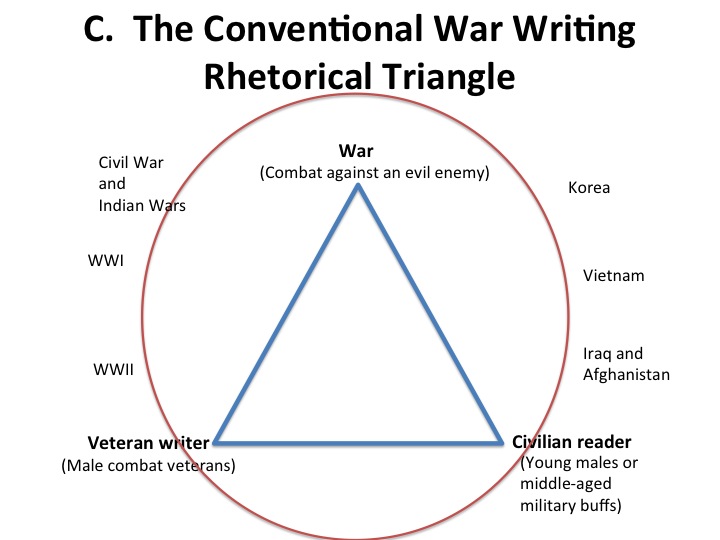
Slide3

As my thinking about this pictorial representation of war writing dynamics proliferated, or perhaps festered, I began to question whether the circle representing context adequately conveyed what is most salient about the attempt to render the experience of war to readers who had not seen combat. Rather than a benign circle hovering on the outskirts of the acts of writing and reading, I thought that a grid imposed over the top of the triangle might better depict how war writing as a genre is forcibly shaped by an array of recurring events, attitudes, themes, tropes, scenes, and expectations, as well as reliance on a short list of time-honored antecedents as literary models, that together harmfully solidified the relationships of writer, subject, and reader into hardened positions, perilously close to cliché, stereotype, “confirmation biased” patterns of cause-and-effect, and self-prophecizing conclusions. Figure D shows my effort to portray context as an imposed grid:
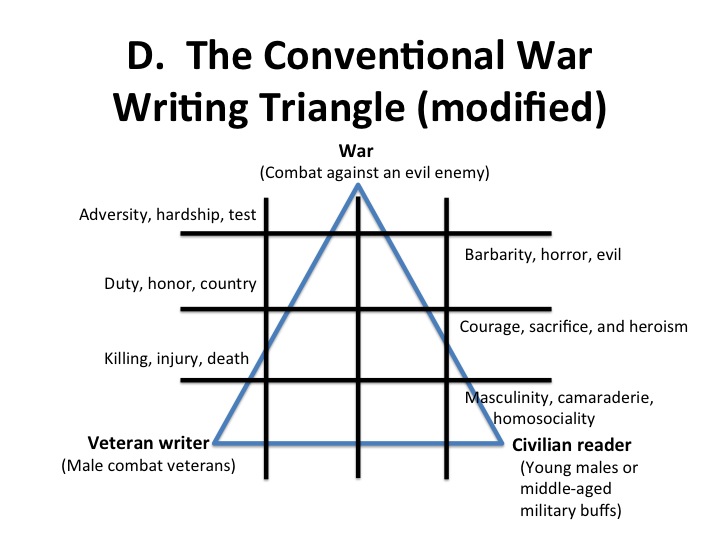
Slide4What might be a work of literature, or a movie, that could be given as an example of war writing that conforms to the Figure D model? There’s no perfect example—the diagram is a cartoon, after all—but let’s for the sake of argument posit works such as Stephen Crane’s The Red Badge of Courage and Erich Maria Remarque’s All Quiet on the Western Front as the ur-novels of modern warfare: stories that concern themselves not just with describing the “horrors of combat” and the possibility of transcending them, but the psychological effect of witnessing and enduring the horrors. Yes, I know Crane was not a veteran, but he ventriloquized one admirably, and like I said, the examples are not perfect. What’s important is that many many works of fiction, as well as memoirs and movies, have repeated, with various amounts of skill, motifs and manners-of-treatment originating or advanced in exemplary fashion by Crane and Remarque.

But as war writing evolved and permutated over the course of the 20th century, differences in style, perspective, and approaches also emerged. A very common refrain found in Vietnam War writing is the idea that “the truth of war cannot be conveyed,” sometimes expressed as “you had to be there to understand it,” notions that would seem to undermine the whole effort of writing about war. They didn’t, however, and in practice the sentiment seems to operate more as a marker of authenticity than a confession of ineptitude. The arch-expression of the idea is Tim O’Brien’s well-known “How to Tell a True War Story,” which compellingly dramatizes a veteran-author’s difficulty in conveying to civilians the essence of what fighting in Vietnam was all about. O’Brien’s famous last line, “It’s about sisters who never write back and people who never listen,” drives home the point that in the narrator’s mind at least one corner of the rhetorical triangle, that of the audience, is drastically estranged from both the veteran-author and whatever might be said to be the truth and reality of war.

A post-9/11 war reiteration of the fractured war-writing rhetorical triangle appears in Matt Gallagher’s novel Youngblood. In the Prologue, the narrator-veteran describes several instances of difficulty connecting with civilians who ask him what Iraq was like. He ends by stating,

What was it like? Hell if I know. But next time someone asks, I won’t answer straight and clean. I’ll answer crooked, and I’ll answer long. And when they get confused or angry, I’ll smile. Finally, I’ll think. Someone who understands.

Here, Gallagher’s narrator’s hoped-for “communicative situation” is marked by frustration and distortion, which, if only those miserable qualities could be attained, would stand as a great improvement on the incomprehension and indifference that have so far governed his attempt to describe war.

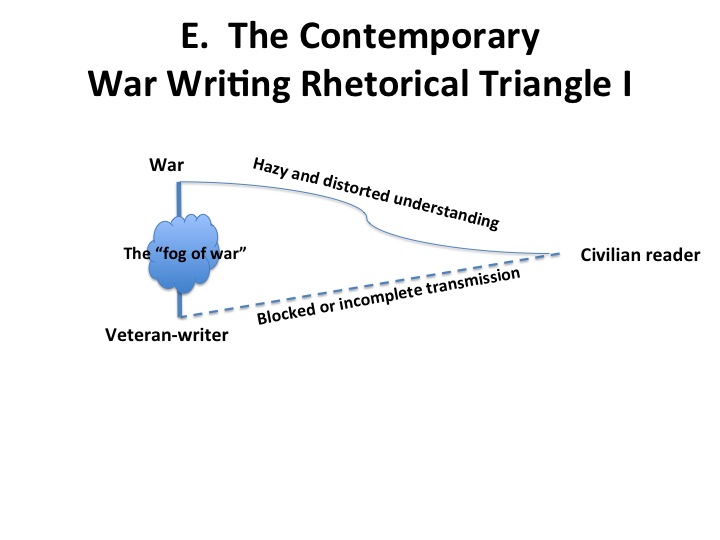
The contemporary emphasis on “failure to communicate” might be reflected in the following variation on the war-writing rhetorical triangle (Figure E):
Slide5

Features of the contemporary model include:

  1. The veteran-author’s personal relationship to his or her subject of war is intense and intimate, as represented by a thickened, shortened line, but the connection is obfuscated by that very closeness, as well as the more general difficulty of apprehending the truth or reality of combat described as “the fog of war.”
  2. The civilian reader’s relationship to the veteran-writer, and vice-versa, is distant and beset by communication difficulties, as portrayed by the long, broken line.
  3. The civilian reader’s understanding of war is also remote, indistinct, and untrustworthy, as depicted by the thin, wavering line.

In Figure F below, I have added in a contextual circle that names what I think are the most important contemporary social, political, cultural, and technological influences on war, the men and women who go to war and then write about it, and the nation-at-large. I’ve also noted some changes in the composition of the corners of the triangle to reflect modern trends.

Slide6

I won’t take time here to explain these factors or how they put pressure on the legs and corners of my war writing rhetorical triangle. Many are obvious or self-explanatory, and none are beyond the ken of readers who have made it this far and who now choose to roll them around in their minds to consider their relevance. I might well have portrayed them as a grid, as in Figure D above, but for the sake of clarity, mostly, I haven’t. Taken together, the diagram suggests a contemporary war writing field characterized by multiple variables, full of complexity, ambiguity, perspectival variations, and tenuous, arguable intersections joining war, writing about war, and readers.

Might the broken-and-distorted contemporary war writing rhetorical triangle be as much a trope, or even a cliché, as anything that’s come before? Some very good veteran-authors have taken up the question. Benjamin Busch, in “To the Veteran,” his introduction to the veteran writing anthology Standing Down: From Warrior to Civilian, states, “We often feel there is a certain authenticity lost somewhere, that language cannot completely express our experience to those who do not share it,” but ultimately he concludes that the stories in Standing Down “prove that transference of experience is possible with language.” Similarly, Phil Klay in a New York Times essay titled “After War, A Failure of Imagination,” writes, “Believing war is beyond words is an abrogation of responsibility — it lets civilians off the hook from trying to understand, and veterans off the hook from needing to explain.” Busch and Klay are formidable writers, but I’m not sure everyone, including many veterans, agrees that veterans can express the reality of war in a way that is perceived as meaningful and reasonably fulsome by civilians. The fact that Busch and Klay have to assert their case proves the sentiment they hope to rectify is both real and a problem. Whether their perception is an enduring and truly true structural feature of war writing or merely a passing truism-of-the-day remains to be seen.

Many thanks to the organizers and participants of the 2016 Veterans in Society seminar at Virginia Tech, where I first presented on the “War Writing Rhetorical Triangle.”
War Songs: Khost, Afghanistan in the Western Musical Imagination

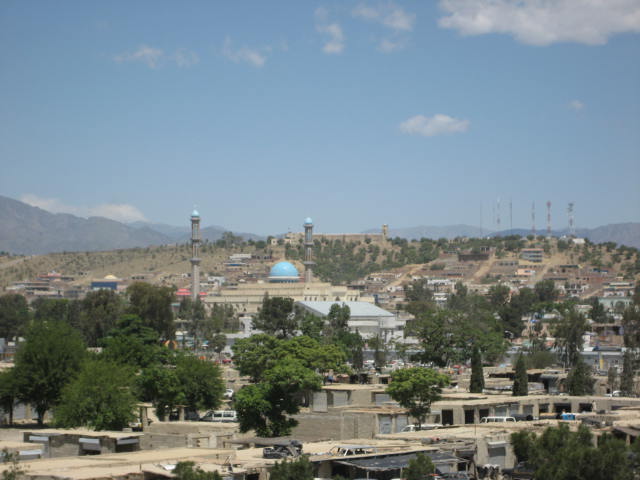
Khost City, Afghanistan
The Great Mosque, Khost City, Afghanistan, 2009

The seven months I served in Khost province were certainly the most interesting and intense part of my year in Afghanistan. A small place, as Afghan provinces go, about the size of a fair-sized American county, ringed by peaks ranging up to 12,000 feet high, Khost (sometimes spelled “Khowst”) is tucked up against the Pakistan border about four hours from Kabul, accessible by road only through a treacherous mountain pass. Though not as well-known as storied battleground provinces such as Kunar, Helmand, or Paktika, Khost has been the site of many important episodes relevant to the Global War on Terror and Operation Enduring Freedom. Osama Bin Laden, for example, is said to have first fought Russian infidel occupiers in Khost and later to have been in Khost when the Twin Towers fell on 9/11. In 2004, Pat Tillman was killed in Khost and in 2009 FOB Chapman, located just outside of Khost city, was infiltrated by an Al Qaeda operative who detonated a suicide vest in the presence of CIA agents, killing seven of them—an event portrayed in the movie Zero Dark Thirty.

My job in Khost, as an advisor to the Afghan Army, took me throughout the province and brought me in constant contact with Khost residents of every station, experiences that preoccupied me then and now in terms as much sociological as military. Overall, there were some successes, some defeats, a lot of wonderment, and a great deal of ambiguity about what it all amounted to. Through it all, the very name Khost, whose etymology I do not know, struck me with an almost mystical power of suggestiveness, and still today it conjures up memories and emotions that, try as I might to contain them within the realm of the factual and rational, remain infused with the aura of dream, nightmare, romance, epic, and odyssey.

Apparently, I’ve learned in the last week, Khost has also generated evocative associations in the minds of musically-minded young men in places as far afoot as Vancouver, Canada; Birmingham, England; and Austin, Texas, places where Khost or derivations of Khost are being used as band names. As far as I can tell, no one in any of the groups has served in Khost or is Afghan, but each of the far-flung musical Khosts is making distinctive, idiosyncratic music, not for the masses, perhaps, but informed by a unique artistic vision that we can assume they hope their band name helps transmit.

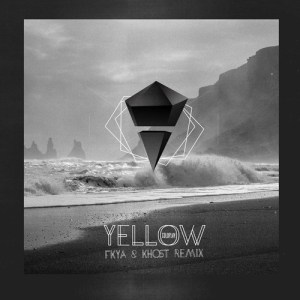
First up is Khøst, a Vancouver, Canada, DJ duo who specialize in Electronic Dance Music remakes of popular songs such as Coldplay’s “Yellow.” I’m not sure where the “slashed-o” comes from, but band member Tyler Mead describes how his partner Grayson Repp chose their name:

The name was a spontaneous idea really… After having already tried to build to different aliases, this one seemed to stand out. Originally, Grayson had seen the word in a movie [Zero Dark Thirty?] and liked the sound of it. It wasn’t until about a month later that we realized the potential, having the sound “khost” be representative of the west coast where our sound had originated.

Khost Yellow

Over in Birmingham, England, Khost has also been appropriated by Andy Swan and Damian Bennett, a duo whose musical genre is metal industrial noise. This Khost musical enterprise’s sonic landscape is brutal to the extreme, as described in the following review:

The end result is akin to an apocalyptic machine devouring all traces of humankind from the face of the earth before setting its sights on the planet itself. The tracks grind, rumble, strain and teeter on the brink of collapse to create an all-out sense of stifling claustrophobia.

Khost UK

I’m fine with music that’s both weird and tries to be dangerous, but I couldn’t find an explanation for why Swan and Bennett chose “Khost” as the name of their band. For all I know it’s also some Scandinavian or German word for “land of the underground where people wear helmets with horns, drink blood, and play detuned electric guitars.” One review I read, however, posits that the sound of the band’s name is as harsh as the music the duo make, with connotations of “cost” and “ghost.” That take was interesting to me, because I never thought the word “Khost” sounded ugly, even given a few horrific experiences I endured in the province. In fact, contra to both the Canadian and English bands’ usage, Khost as far as I know is pronounced with a very soft emphasis on the “k,” so that it is pronounced more like “host,” but with a small hitch in the throat at the beginning of the word and a larger push of air on the “h” that doesn’t come naturally to English speakers, an effect that softens the word’s clipped terseness as it is written.

Be that as it may, the third appropriators of Khost, a band in Texas who call themselves The Khost, would also probably be surprised at the English reviewer’s opinion.  A post-rock band in the mode of their fellow Texans Explosions in the Sky, but with vocals, The Khost’s aural impact is as mellow and gentle as the industrial Khost’s is abrasive, though not without its own sense of drama. I texted back-and-forth with a member of The Khost, who informed me they were inspired by stories of military service in Khost province told by a friend of the band’s. I asked if any of their songs addressed militaristic subjects, and The Khost member replied, “All the songs are pretty much about more inner psych and personal revelations so nothing directly about war. Does our music remind you of Khost?”

Good question….

The Khost Stella MarisKhost Waking Indigo


EDM doesn’t do a lot for me, though I salute its impulse toward ecstatic celebrations of collective dance. I’m more intrigued by the heavy duty sounds of industrial-metal, and I thoroughly enjoy post-rock. I listened to a ton of Explosions in the Sky while in Afghanistan, have composed many Time Now posts with their music playing in the background, and I was glad to see the band’s music featured prominently in the movie version of Lone Survivor. So, in answer to The Khost’s question, well, yeah.

All told, here’s to the Canadian EDM Khøst, the English industrial-metal Khost, and the Texan post-rock The Khost. None of their songs, as far as I know, reference Afghanistan or things military, nor do they channel the Pashtun spirit or musical signatures of the real Khost, but that’s OK. An academic argument could be made that their use of Khost is somehow inappropriate in an Orientalism kind-of-way, but that’s an argument I wouldn’t support. If the name of an exotic dot-on-the-map halfway around the world has somehow inspired Western musicians to be more imaginative and adventurous, that’s the greater good. That a word important in their artistic dreamworld is also huge in my personal lexicon of suggestive terms is so much the better.

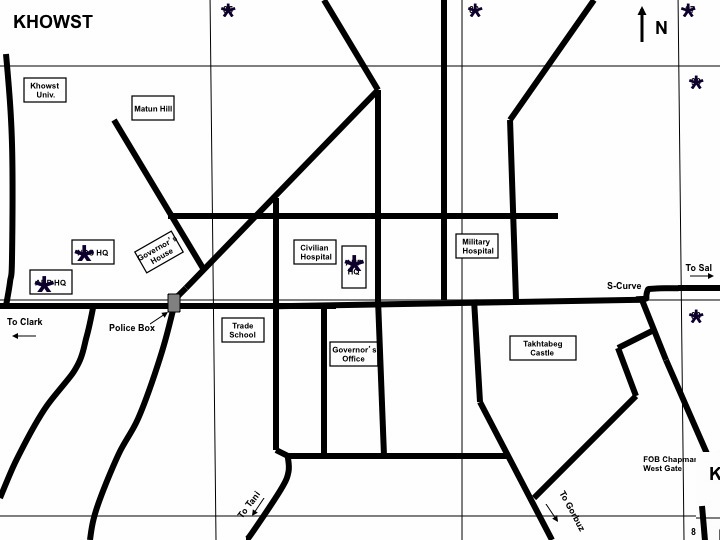
Map of downtown Khost that I made in 2009

LGBT MIA in War Lit No More: Scott D. Pomfret’s You Are the One

YouThe contemporary war lit corpus of poetry, fiction, and memoir has covered a lot of ground, but has had little to say so far about the presence of gay men and women in uniform. Jesse Goolsby’s I’d Walk With My Friends If I Could Find Them contains a gruesome male-on-male rape scene, and Matt Gallagher’s Youngblood features a cameo appearance by a closeted company commander, but that’s about it in terms of fiction published by big-name publishing houses. Poetry, nothing comes to mind, either, though an exhaustive search of vet writing anthologies and web publishing sites would surely turn up something. Jeffrey McGowan’s memoir One Gay Man’s Life in the Don’t-Ask-Don’t-Tell Military, published in 2005, is interesting, but McGowan left the Army in 1998. Playing by the Rules, by gay former Marine Justin Elzie, was published in 2010, but Elzie was out of the Marines long before 9/11. Amazingly, as far as I can tell, no book-length memoir by a gay or lesbian Iraq or Afghanistan veteran has yet appeared. Please, somebody, tell me that I’m wrong.

Maybe what I’m describing is a good thing. Everyone’s more accepting now, right, and Don’t Ask Don’t Tell has been repealed and gay Americans can finally serve openly. There’s nothing about a service member’s sexual orientation that would by itself make it an interesting subject for fiction, verse, or memoir, correct? No war writer I know is a homophobe (or misogynist or racist), so I’ll bet if you asked them about the absence of gay characters in their works they would say it just didn’t occur to them, given the story they were trying to write. Heck, hetero-normative soldier sexuality has barely been touched in published fiction, save for, on the crude side, passing references in a number of works to FOB port-a-pottie coitus, and on the deft side, the short fiction of Siobhan Fallon and the under-the-grandstand quickie flamboyantly described by Ben Fountain in Billy Lynn’s Long Halftime Walk. Maybe that’s fair—too much relationship and erotic stuff and a war novel becomes something other than a war novel, the way these things are probably understood by those most interested in writing and reading war stories. Romance, maybe, or erotica, or least interesting of all, women’s fiction, whatever that phrase means in the minds of book buyers and readers.

Whether all the above is a result of publisher decision-making or authorial disinclination to address Don’t Ask Don’t Tell-related issues, I don’t know. But these musings bring us to Scott D. Pomfret’s You Are the One, which came out earlier this year. Pomfret is a many-times-published author in the thriving gay literature underground; You Are the One is one of six books he’s written for gay-oriented publishers. You Are the One contains thirteen stores published in gay literary journals between 2005 and 2015, four of them directly portray gay military members before, during, and after deployment to Iraq or Afghanistan and all interestingly open up heretofore unexamined vistas on the lives and worldviews of soldiers that both help describe modern sexual behavior and transcend the merely prurient sexual. In “You Are the One,” a super-femme civilian narrator finds himself in strange cahoots with his lover’s company commander to guard the sexual orientation of the narrator’s lover. In “Transport,” a battle-hardened sergeant preys on one of his junior enlisted soldiers while on mission in Iraq. “Swagger” describes a bar hook-up between a special operator and the son of a Vietnam veteran. In “The Casualty Assistant,” a gay casualty assistance officer consoles the widow of a soldier killed overseas.

All are interestingly conceived and plausible enough, given what I’ve seen and read over the years. Though Pomfret is not a veteran, he gets the details right and his stories engage on many levels beyond the erotic; he is a fine writer in terms of his eye for nuance and ability to craft a quality sentence. All the stories, save “The Casualty Assistant,” contain graphic sexual scenes, which though cool in terms of frankness and cheap voyeurism, distract somewhat from the larger tales being told. In “The Casualty Assistant,” on the other hand, we learn that the narrator is gay, and it matters in terms of his perspective on things, and because the story is not about seduction and getting off, it speaks more clear-mindedly to what gay soldiers must have always already been noticing about the hetero-dominant culture in which they furtively served during the days of Don’t Ask, Don’t Tell. As such, it hints at what insights we might garner from other LBGT-authored stories, should they ever make it into print.

Scott D. Pomfret, You Are the One. Ninestar Press, 2016.