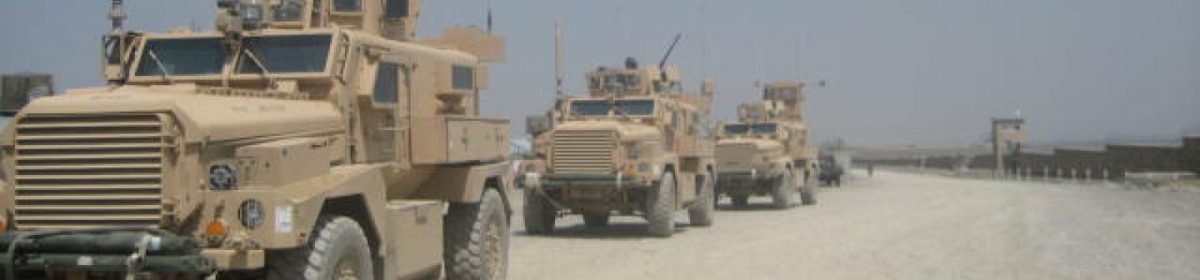
Kosovo: Quiet Prelude to the War on Terror

In 1999 US Army forces deployed to the Serbian province of Kosovo as part of a peacekeeping mission to halt the killing and forced relocation of the region’s majority Muslim Albanian population by Christian Serbs. In the two years prior to the American-led intervention, Kosovo Serbs, backed by the Serbian army, used violence to halt a demographic makeover they feared would sever the region’s political and cultural allegiance with greater Serbia. Some 1,500 Albanians were killed and 400,000 driven from their homes by Serbian military, police, para-military forces, and local zealots.
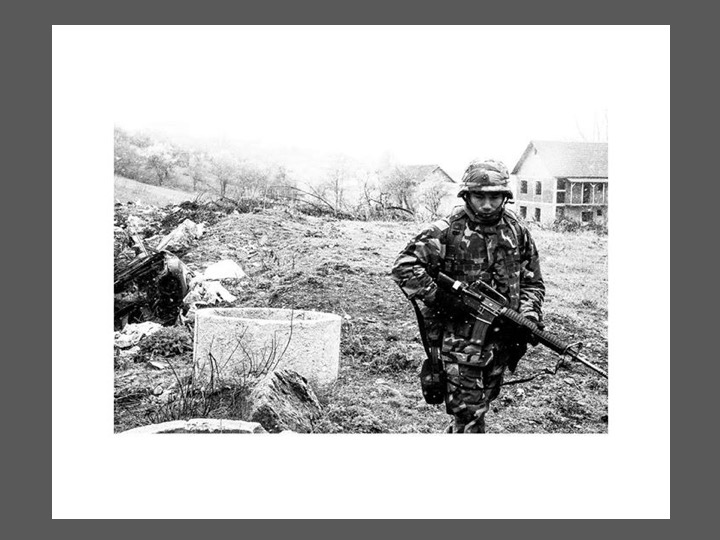
The American intervention, part of a NATO-led task force known as “KFOR,” was largely successful, in that Serbian-Albanian violence quickly diminished. The province began to develop a political identity as an Albanian-dominated independent state that culminated in a declaration of sovereignty in 2008. The KFOR mission, on the heels of and modeled after the bigger US and NATO peacekeeping effort in Bosnia-Herzegovina earlier in the decade, continues today, but consists of less than 700 US soldiers in Kosovo at any time. By another measure of bottom-line cost—American casualties—the mission has also been successful. In the years since American forces first put “boots on the ground,” fewer than twenty Americans have died in Kosovo, most as a result of illness or accident. For whatever reasons, the “Global War on Terror” following 9/11 has been able to quell or ignore Christian-Muslim tension in the Balkans. While war raged and then dragged-on in Iraq and Afghanistan, KFOR has also continued, largely peaceful and out-of-the-spotlight. As early as 2001, when the infantry battalion I was part of rotated into the US sector and took up residence at Camp Monteith near the northeastern city of Gnjilane, the KFOR mission had a decided side-show quality in the Army at large and the world’s mind as well. A sister battalion from our brigade was already fighting in Afghanistan, and many of us were jealous of them beyond words because they were where the action was, and we weren’t.

Photographer Bill Putnam was a soldier in the Public Affairs unit of the infantry task force of which I was the executive officer, or second-in-command. Putnam would return to Kosovo in 2002 and go on to take striking photographs in Iraq while still in the Army and later as an embedded photojournalist in both Iraq and Afghanistan.
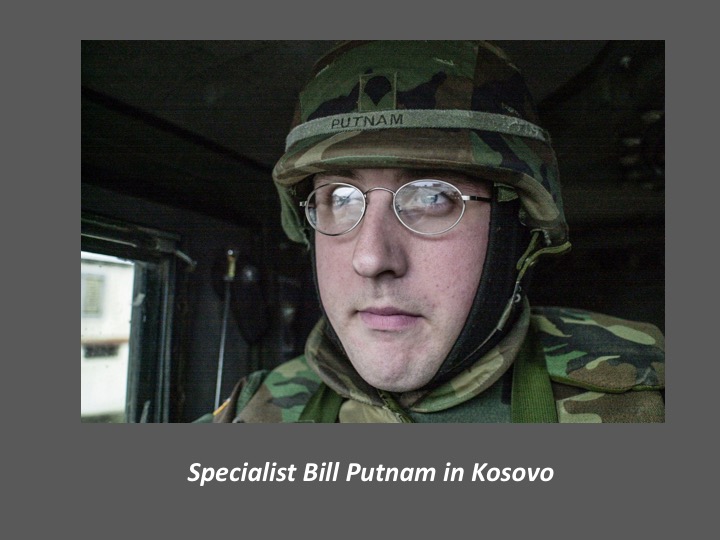
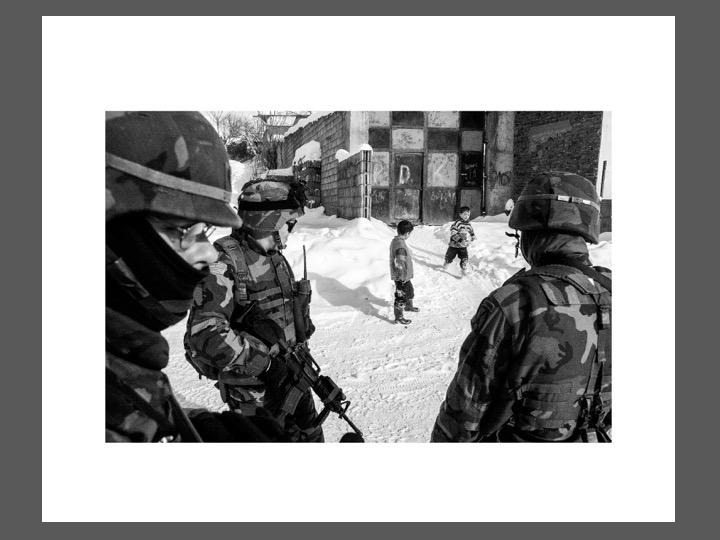
Only recently I returned to look closely at Putnam’s archive of Kosovo pictures. My sense was that Army operations in Kosovo foreshadowed and rehearsed similar approaches the US military would employ in Iraq and Afghanistan. As late as 2001, though, the material appearance of American soldiers was different from what it would soon come to be. But if one looks closely one can see not traces of a vanished past, but a soon-to-be-present future in the process of its emergence.

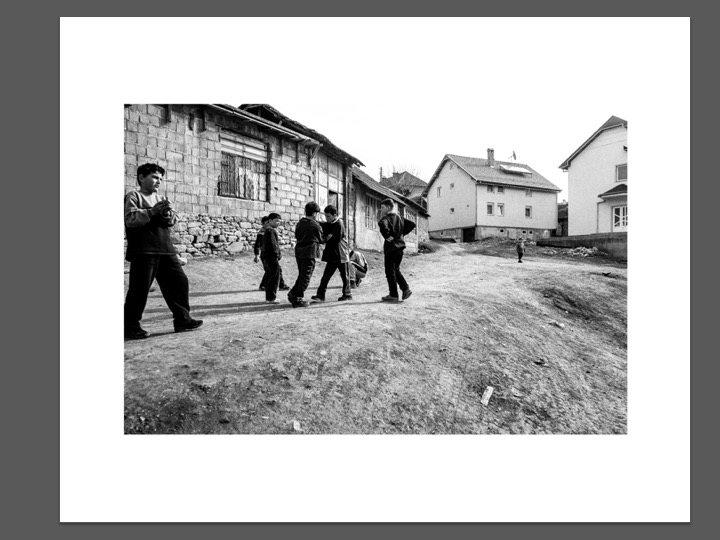
Putnam’s photographs for the most part have a long-ago and far-away feel that sets them apart from his war photography of Iraq and Afghanistan. Part of it is the landscapes are different—European farms-and-forests, not southwest Asian cities and desert. So, too are the white faces of the Kosovars and their Western dress.

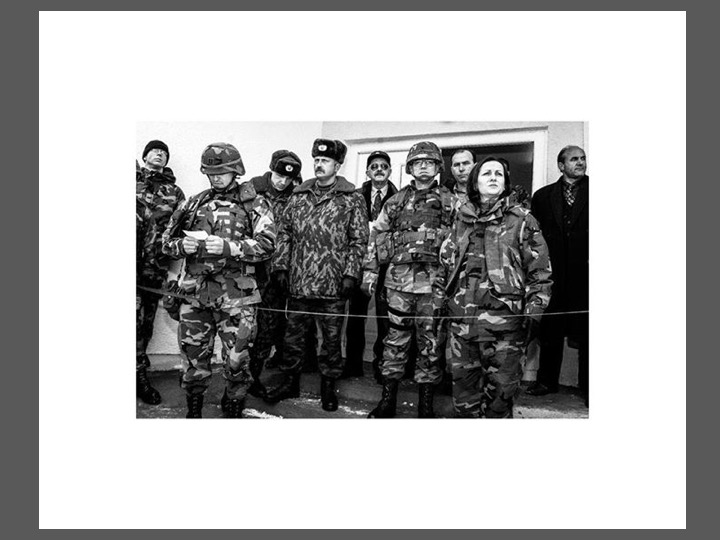
It is also the uniforms—US soldiers are dressed in their dark-green “Battle Dress Uniforms” just prior to giving them up for the desert camouflage of “chocolate chips” and  “Army Combat Uniforms.” Not only are the uniforms of an older vintage, but so too is the equipment—load bearing web-gear, canteens, and M16 rifles, not armored vests, Camelbacks, and M4s. The visages of officers and enlisted men reflect purposefulness and enthusiasm, not anxiety, doubt, or confusion.
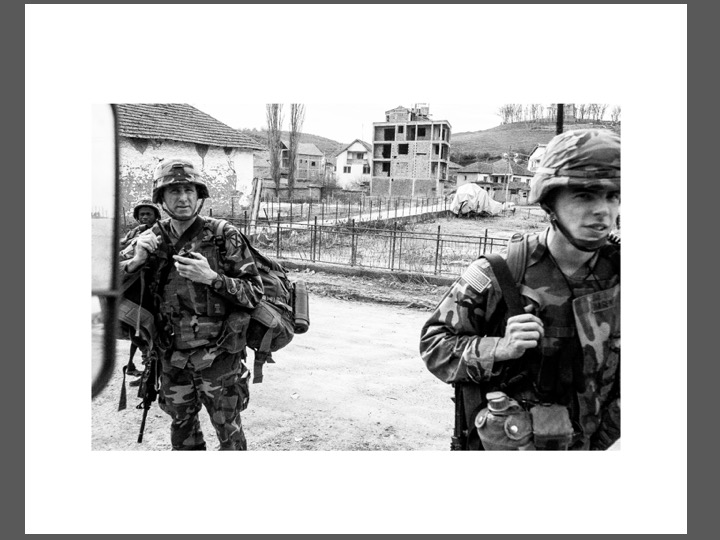
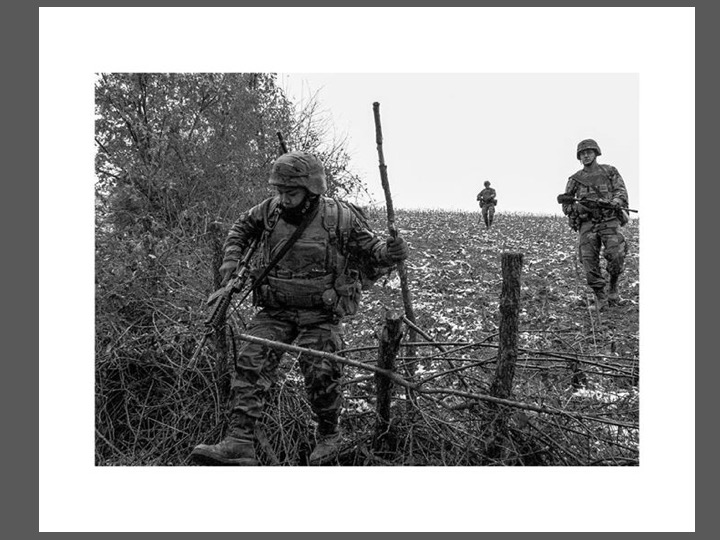
American forces patrolled in unarmored vehicles, usually in pairs but often individually. IEDs were unheard of and ambushes only a remote concern. The biggest danger was sliding off the narrow roads, especially in winter, when they were very icy. US KFOR forces often interacted with other members of the coalition, such as the two Russian soldiers standing at a checkpoint in the picture second below.
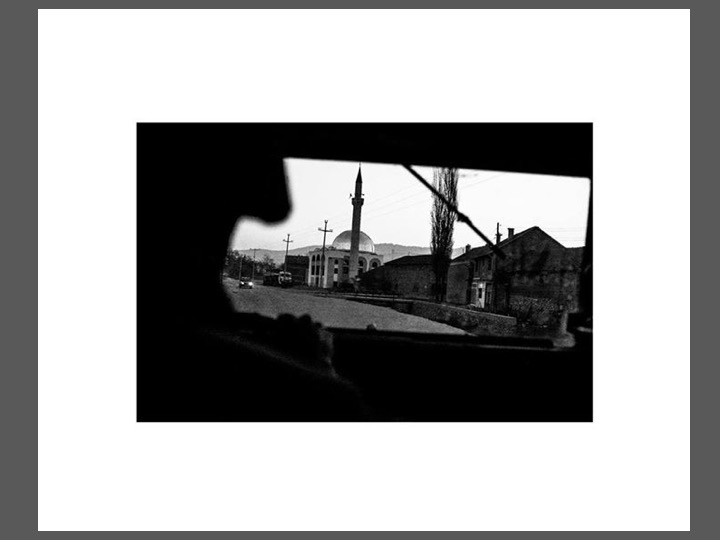
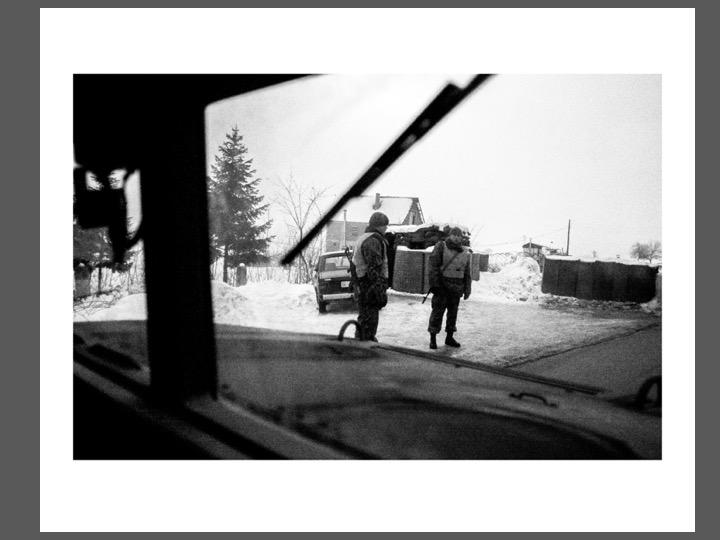
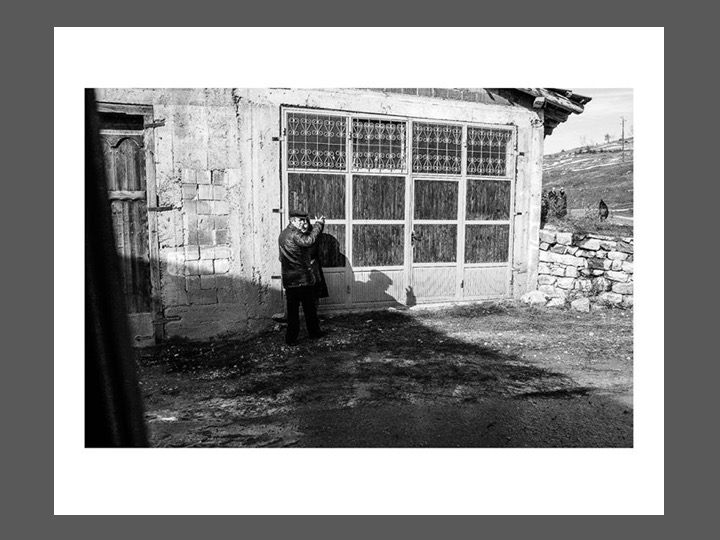
Cramped, impoverished villages built of shoddily-constructed concrete blocks vaguely resembled picture-postcards of European life. They conveyed a sense of provincialism and backwardness that would easily acquiesce to superior American ways of dealing with problems.
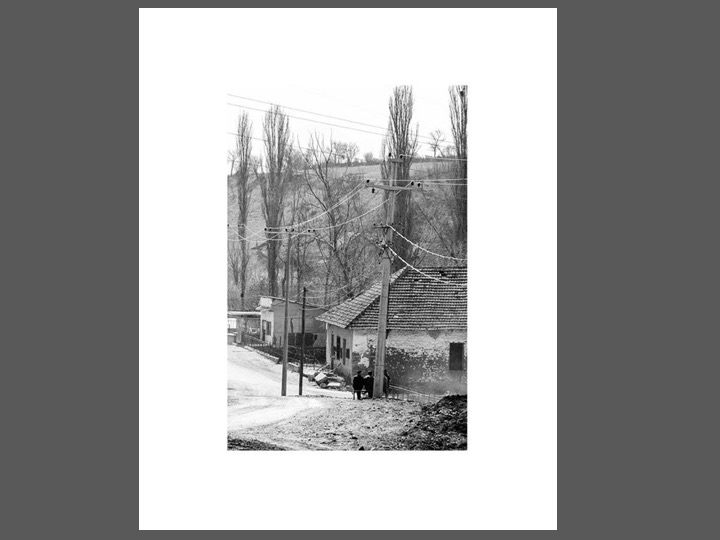
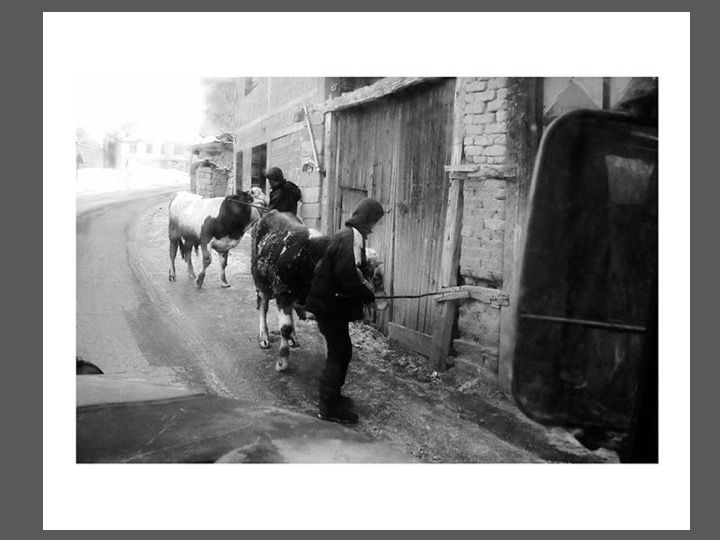
Cities were more bustling. Residents seemed too preoccupied by everyday life to kill in the name of politics and religion. But by the time we arrived, the Albanian makeover was nearly complete. Serbs huddled forlornly in their own neighborhoods and enclaves, and we protected their churches, not Muslim mosques, from destruction.
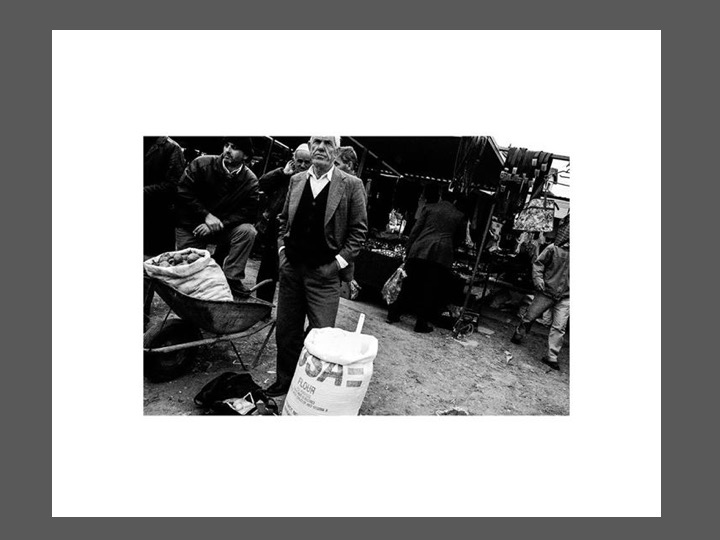
Overall, though, violence was rare, and could be handled with “crowd control” techniques, not combat.
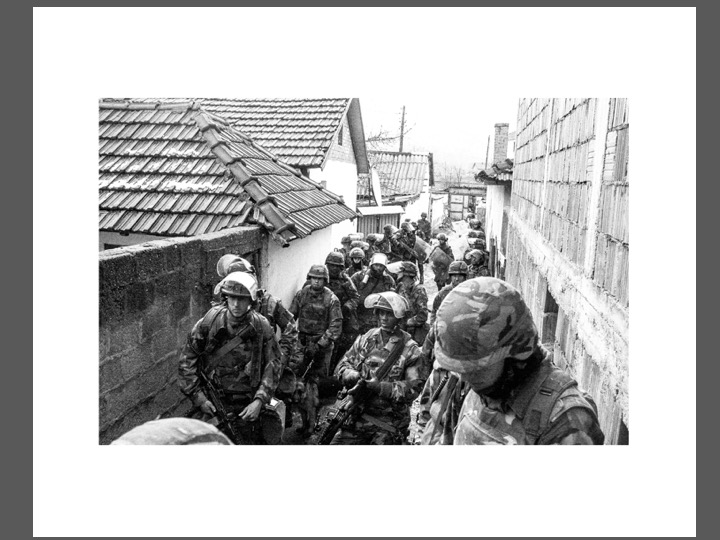
Serbians and Albanians eager to fight were seen as hooligans with local agendas and grievances, not as operatives in a larger nationalist movement or global jihadist conspiracy. Detaining a troublemaker required extensive chain-of-command coordination, but the feel of such operations was that of locking up a small-town punk in the county jail for a few days until his anger subsided.
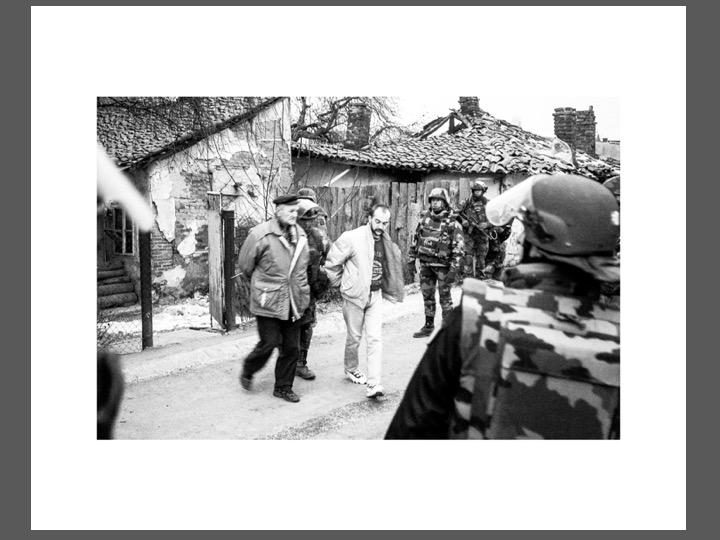
Most missions were “key leader engagements” with local officials, always negotiated with the help of interpreters, many of them women, wearing US Army camouflage.
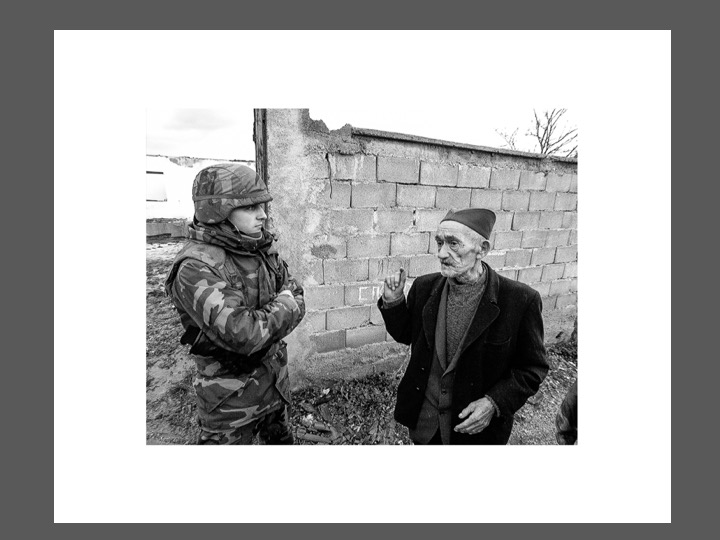
American forces lived on Camp Monteith, an old Serbian Army base, and Camp Bondsteel, a proto-FOB magically construed out of nothing in an abandoned field by well-paid contractors. Many soldiers never left Monteith and Bondsteel, encampments complete with pizza parlors and Morale, Welfare, and Recreation centers. Mortar and rocket attacks that threatened the lives of soldiers on the camps just didn’t happen.
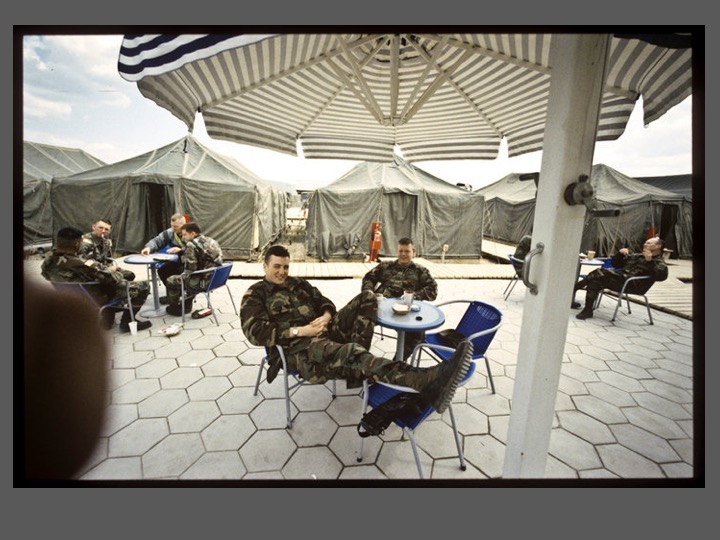
Kosovo allowed the US military to rehearse deployment, peacekeeping, and counterinsurgency tasks that would later characterize Operations Iraqi and Enduring Freedom. FOB life, vehicle patrols, religious conflict, security operations, interpreters, and key leader engagements seemed manageable and relatively benign. Very often though, KFOR approaches, such as traveling in one or two vehicle convoys, would prove inadequate for dealing with far-deadlier threats to come. Missions that were routine in KFOR  metastasized in Iraq and Afghanistan and become much more fraught. What came peacefully and relatively easily in Kosovo might have inspired a false confidence in US capability that quickly unraveled in Iraq and Afghanistan. Hints of all this, I believe, can be found in Putnam’s photographs, if one knows where and how to look.

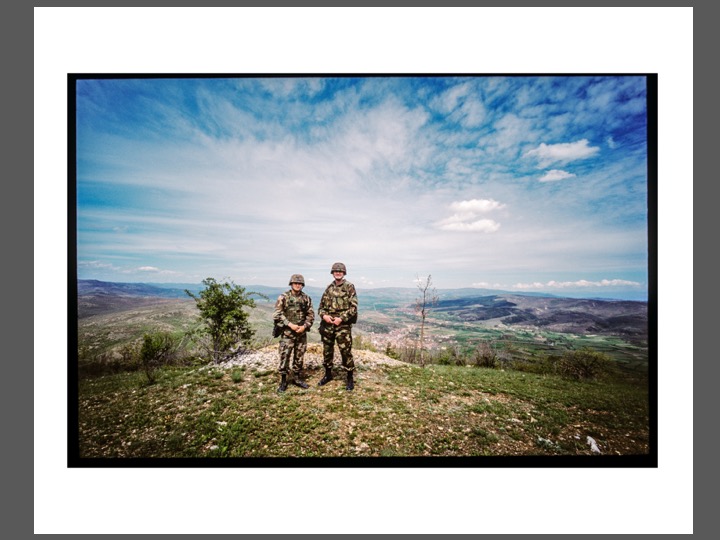
On the right of the picture below is Captain David Taylor, a company commander in our infantry task force. The picture is taken on Hill 874 outside Gnjilane, Kosovo in 2002. In 2006, Major Taylor was killed by an IED in Baghdad, Iraq.
More Bill Putnam photography can be found here.

War Film: Thank You For Your Service

Thank You For Your Service and The Yellow Birds, two movies released in 2017 about traumatized Iraq veterans, are so much alike that one wonders if they were the result of an Apprentice-style contest in which two film-making teams were assigned the same set of ingredients and tasks and told to do their best. Among the similarities:

Source and title: Well-regarded books about war in Iraq (The Yellow Birds by Kevin Powers, Thank You for Your Service by David Finkel).
Characters: Male soldiers distressed by survivor’s guilt, and women (moms, wives, and girlfriends) upset by the men’s behavior.
Setting: Rural places and small towns in Red State America (Virginia for The Yellow Birds and Kansas for Thank You For Your Service; both movies were filmed in Georgia).
Cast: Pleasant-looking young up-and-comers in the leading roles, with minor roles featuring big-name female stars (Jennifer Aniston in The Yellow Birds and Amy Schumer in Thank You For Your Service).
Pivotal scenes: Suicide and suicide attempts.
Closing soundtracks:  Plaintive laments by classic-rock elder statesmen (John Mellencamp in The Yellow Birds and Bruce Springsteen in Thank You For Your Service).

All the above might be coincidental, but other shared attributes can’t be denied: both films flopped at the box office and critics didn’t seem to like them too much, either. Why? Grueling portraits of soldier trauma and family dysfunction, punctuated by graphic scenes of suicide and attempted suicide, are probably never box-office dynamite, no matter how grippingly they are dramatized. The movies’ lack of success is also certainly linked to public indifference to the ongoing war-on-terror, reflected in the irony of Thank You For Your Service‘s title and in the oft-cited phrase “civil-military divide.” But the real problem is probably more aesthetic than cultural: Thank You For Your Service especially has a heavy-handed feel, as if its makers tried too earnestly to make a significant statement and forgot about making their movie entertaining. Kudos to them for caring-and-sharing, but even I, in a position more than most to like and respect such efforts, can at best give each movie a B, and even then for different reasons. The Yellow Birds, quirkier and more artistic, blends A moments (its cast and pictorial look) with C moments (plot and production values). Thank You For Your Service, on the other hand, is a pretty solid drive down the middle of the fairway. More firmly constructed than The Yellow Birds, it makes no major mistakes, but neither does it excel, excite, or generate the outrage that would seem to be its intent.

It’s been a while since I read Finkel’s book, a non-fiction work about veterans of the Army’s First Infantry Division in the years after they exited the service, so I won’t dwell too much on aspects that did or did not make it into the film version. Directed by Jason Hall, the screenwriter of American Sniper, Thank You For Your Service the movie elaborates on the parts of American Sniper in which supersniper Chris Kyle mopes about his home in Texas after his final deployment. The central figure in Thank You For Your Service the movie is Staff Sergeant Adam Schumann, an infantry squad leader wracked by guilt over the death of his platoon sergeant in Iraq, a bungled effort to rescue one of his men wounded-in-action, and the suicide of another shortly after the unit returns to the States. That’s an awful 1-2-3 punch, and out of the military, Schumann drifts moodily. His deep silences are a source of refuge for him but severely rattle his wife Saskia, with whom he has a daughter he barely knows. Not working and struggling to obtain benefits and help, Schumann bonds with another former soldier, Specialist Solo Aeiti, who is in even worse shape than Schumann due to traumatic brain injury caused by multiple IED blasts. Their friendship is not immediately fruitful, however, as each man slides deep into depression and erratic behavior, their marriages dissolving and the men haunted by flashbacks to battle in Iraq and hallucinations of their now-dead platoon sergeant, Sergeant First Class Doster. An added torment for Schumann is that he and Saskia have been forced to rent out their beloved home while taking residence in a cheaper, dumpier place. Grating Schumann to no end is that his wife unbeknownst to him has rented the old home to Sergeant Doster’s wife—a move that constantly reminds him of his guilt over Doster’s death, complicates efforts to evict Mrs. Doster, and contributes greatly to friction between Schumann and Saskia.

Miles Teller as Sergeant Schumann and Beulah Kole as Specialist Aeiti try hard, but they are less charismatic actors than the two male leads of The Yellow Birds, Alden Ehrenreich and Tye Sheridan. Amy Schumer, as Mrs. Doster, also does not compare favorably with Jennifer Aniston, though credit to Schumer for being brave enough to play a very dowdy, undesirable woman (in The Yellow Birds the chemistry between Ehrenreich and the smoking-hot Aniston is palpable, while in Thank You For Your Service Schumann physically recoils from Mrs. Doster in a way that seems beyond “just acting”). More galvanizing on-screen than Teller and Kole are the minor male characters: Joe Cole as a dopey manchild who kills himself in front of the wife who abandons him while he is overseas; Brad Byer in very brief scenes as Sergeant Doster, Omar Dorsey as a drug-dealer who takes an interest in Aeiti, and, most of all, Scott Haze, who channels his inner-Christian Bale/Heath Ledger to portray a badly-disabled and manically-crazed fellow veteran of Sergeant Doster’s platoon. Also strong are the women who (along with Schumer) play the wives of the soldiers: Erin Darke, Keisha Castle-Hughes, and especially Haley Bennett as Saskia. Frankly, the movie picks up steam when any of the supporting cast joins Teller and Kole on-screen, and it subsides to a well-meaning trudge when it’s just one or both of them on display, which unfortunately is a lot of the movie.

Thank You For Your Service is a serious movie about difficult subjects: suicide, PTSD, TBI, physical disability, family turmoil, an uncaring Army, Department of Veterans Affairs ineptitude, and the plight of struggling veterans. Hall’s intent to treat his subjects with gravity and dignity comes through loud-and-clear, but he overdoes it. The movie is daintier about showing the soldiers’ warts than the book (as I remember it) and the characters’ reserve and docility drains the movie’s energy; Schumann and Aeiti just seem too old and well-behaved, even for “good” soldiers who value order and discipline and desire to do the right things. Several scenes gesture toward the raunchy dishevelment, emotional neediness, and chaotic, often ugly thought-processes of 20-something veterans in full meltdown mode, but for all the anguish and violence it depicts, Thank You For Your Service comes off as chaste, sedate, and tasteful, as if it were afraid of making its protagonists unsympathetic. Sexual infidelity is never an issue, for example, and the characters’ bad behavior flirts with but stops short of actual crime and physical abuse of loved ones–three omnipresent elements in the annals of veteran breakdowns. Well, good, but the only character in Thank You For Your Service who seems truly out-there and dangerous, the Scott Haze character, makes you wish for an entire movie entirely about him. And, go figure, though severely disabled and living in poverty and squalor, he’s still doing better emotionally and psychologically than Schumann and Aeiti.

Finally, the movie Thank You For Your Service concludes by suggesting that both Schumann and Aeiti eventually find the help they need through a private charity. That’s tying a happier bow on things than (once again) I remember from Finkel’s book, which ends with the protagonists’ fates in doubt (The Yellow Birds movie also concludes with a smilier face than Powers’ novel). I suppose the hopeful ending is meant to be an uplifting bone thrown to audiences who have come to love Schumann and Aieti and now want only the best for them and their families. The conclusion feels a little pie-in-the-sky, however, in keeping with the movie’s overall too-mannered dramatization of the titanic fury of soldiers’ lives spinning out of control while in the military and after. As of 2018, the movie that captures that spirit while also capturing an audience still awaits making.

***

Thank You For Your Service is also the name of a documentary about veterans’ mental healthcare released in 2016.

Two Songs, Ten Years: Music, Memories, Going to War

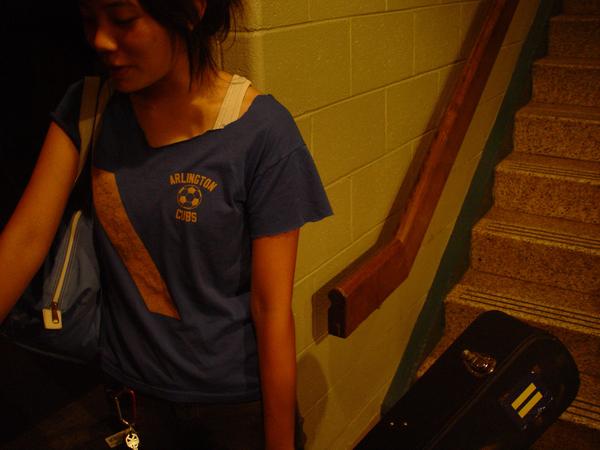
A couple of nights before flying from Fort Riley, Kansas, to Afghanistan in August 2008, I saw the folk-rock artist Thao Nguyen and her band The Get Down Stay Down in a bar on Massachusetts Avenue in Lawrence, Kansas. I already knew Nguyen’s music a little, and a little about her biography, which interested me as much as her music. Raised in the Vietnamese immigrant neighborhoods that surrounded my parents’ house in northern Virginia, Nguyen in an early publicity shot appears wearing a jersey adorned with the logo of the “Arlington Cubs,” a sports club for whom my brothers and I played on countless baseball, basketball, and football teams in our youth. Later, Nguyen attended William and Mary college, which is a very good school but not one known for producing rock stars. By 2008, though, she had a couple of albums out and a hit—a girl-power anthem titled “Swimming Pools”—playing frequently on my local indie-alt station.

The pre-flight concert in Lawrence was just what the doctor ordered in terms of a night out before heading into the unknown. The Get Down Stay Down were tight-and-rocking, and all the songs, even the ones I didn’t know, were accessible and engaging. While singing, Nguyen appears possessed to the point of being spastic, and her voice sometimes hits atonal notes as if her Vietnamese were in contest with her English. It’s all good, though, and in-between songs, she charmed with funny anecdotes and quips delivered in the mid-Atlantic-coast tones and cadences I knew growing up. Before she went on, Nguyen ordered whiskey at the bar and watched the warm-up band play a couple of songs, and then wandered out to the sidewalk to hang with the smokers for a while. After the show, at the merch table, I don’t think I said anything to Nguyen about Afghanistan—I mean, I hope I didn’t, it would have been too obvious—but I do remember asking her where she went to high school. She told me she had attended Thomas Jefferson High School for Science and Technology—a northern Virginia magnet-school for super-smarties. I thought about asking her if she had known the baseball coach, who was one of my best friends growing up, but that seemed kind of insipid. This inconsequential exchange brought our interaction to a close, save for my purchase of her second album, Like the Linen, which I listened to often on the long flight to Afghanistan and in the year that followed.

Like the Linen is good, but it was the album that Thao & The Get Down Stay Down released next that spoke to me personally. Called Know Better, Learn Faster, it’s the post-deployment record I’ve probably listened to more than any other, and certainly more often start-to-finish than any other. For me, it’s a unique swirl of appealing sound, beat, voice, and words, never more so than in the title song, whose chorus beguiles like a mantra reflecting something of my own sense of self-reproach, felt sharply in the two-to-three years just after deployment and only somewhat diminished now.

That first flight to Afghanistan was part of an Army-thing called a “Pre-Deployment Site Survey,” or, in words barely more comprehensible, a brief leaders’ reconnaissance of the area to which we would later bring our troops. In November 2008 I began the first leg of the journey that would take my advisor team and me to Afghanistan for a year. Catching a plane at LaGuardia in NYC back to Kansas I stood in the early-morning TSA line next to a scruffy dude whose mussed hair and road-worn attire proclaimed a rock-and-roll lifer. I don’t remember who started the conversation, but the guy was a gabby type who told me that he was the sound tech for a group called The Walkmen and he had come straight to the airport from a gig. I gulped, because The Walkmen, a band I already knew, play the kind of literate rock music that’s catnip to me—something like a combination of two other bands I like a lot, The Strokes and Interpol. Thanks to the slow-moving long line, we had plenty of time to talk and our conversation ranged wide-and-far. After I told him I was in the Army, he told me that he had grown up in Arlington, where his father had been a two-star Special Forces general at the Pentagon. Well damn, I thought then and now, and I suppose, since we exchanged emails and he still appears in my Facebook and LinkedIn feeds as a suggested contact, I could find out if he was pulling my leg or not. The Walkmen, I’ve since learned, are from DC, so maybe it checks out. Whatever, I like the story as is, especially since I enjoy The Walkmen’s music so much, and, like Thao Ngueyn and her band, they are bound to my memories of going to war. Below’s a good one by them. It’s my favorite kind of song, a fast-sad one, about friends, remembering, and fighting for things that are worth fighting for.


Toni Morrison’s Home: A Different War Story

WLA Poster

At the War, Literature & the Arts conference in Colorado last month I read a paper titled “The Black Aesthetics of War Trauma:  Toni Morrison, Larry Heinemann, and Contemporary War Fiction.”  In it, I compared Toni Morrison’s 2012 novel Home, about a black Korean War veteran’s post-war ordeal, with Larry Heinemann’s 1987 Vietnam War novel Paco’s Story, about a white veteran adrift after coming home. Here’s part of it:

Home unites Morrison’s interest in black veterans and her interest in personal healing and national coping strategies for dealing with trauma, almost as if she had deliberately taken characters, plot points, and narrative styles from Heinemann’s Paco’s Story and merged them with the ideas and ethos of her own 1987 novel Beloved.  Points on which Home and Paco’s Story resemble each other include:

-the plight of the war-torn-and-haunted veteran dramatized by means of a long journey, with many scenes set on public transportation or in diners and rooming houses.

-a heavy emphasis on survivor’s guilt, brought about by having outlived friends and comrades in combat.

-an even-more intense trigger involving sexual desire for a young Asian woman followed by actively taking the woman’s life or being complicit in murder.

-the interest in the ability of small-town America to accept and nourish returning veterans.

-the inadequacy of the medical, legal, and policing apparatuses, which effectively criminalize erratic behavior by veterans.

-the wise counsel of fellow veterans, especially elders, who are portrayed as the only ones who can connect with other veterans.

-a similarity in tone, particularly in the italicized interludes in Home, in which Frank Money cajoles and taunts the reader/writer in a bristling street/folk-idiom very much like that of used by Heinemann in Paco’s Story, which is narrated by the collective ghosts of Paco’s now-dead fellow soldiers.

Does it matter the stories resemble each other, and that Morrison composed her story after Heinemann and may have consciously drawn plot-and-style points from it?  I don’t think so, and more importantly, I don’t care; in fact, I’m glad it has happened….

I went on to suggest that Morrison is not just interested in Heinemann but the corpus of war-fiction published about the same time as Home and featuring psychologically distressed white veterans of Iraq and Afghanistan:

What Morrison has done is excavate the pre-history of the troubled, war-torn veteran and relocated it from the domain of white veterans of the contemporary era to that of black veterans in the 1950s, whose alienated wandering was more fraught than modern white veterans might imagine. Mindful that the Korean War is often called “The Forgotten War,” as well as being the first American war in which blacks fought in integrated front-line units, and also mindful that African-Americans fought and suffered casualties out of proportion to their population, Morrison uses Home to make a strong statement about the centrality of black Americans in the American history of war, as well as the American history of trauma.  In so doing, Home serves as a prism that refracts present-day understandings of war trauma through an historical race consciousness that challenges assumptions, adds detail, and expands context….

I continued by suggesting that in retelling the story of the psychologically distressed veteran from an African-American perspective, Morrison has not only related an overlooked chapter in American history, her book itself constitutes an historical event that might well be looked back on in the future as game-changing. I used the conference keynote speaker, African-American playwright Suzan-Lori Parks, to explain:

As such, they reflect Suzan-Lori Parks’ formulation of a black theatrical aesthetics, in which she states, “Since history is a recorded or remembered event, theater, for me, is the perfect place to “make” history—that is, because so much of African-American history has been unrecorded, dismembered, washed out, one of my tasks as playwright is to … locate the ancestral burial ground, dig for bones, find bones, hear the bones sing, write it down.”

The same sentiment of “made history” is afoot in Home, I feel.  Home asserts that a whites-only story of return-from-war is at best a partial truth, true only so far as it goes.  Not only does it exclude black veterans, but its entire premise is built on and borrowed from one of the nation’s ur-trauma narratives:  500-years of racial oppression the result of which has forged an African-American population scarred physically, mentally, and emotionally, individually and collectively.

Finally, I considered what I call the “intriguingly upbeat ending” of Home:

But rather than imagining a downward trajectory for her war-torn veteran protagonist and an irredeemably debilitating social-political milieu Morrison in Home (as she does in Beloved) transcends the trap of victimhood by offering a more resilient version of the traumatized survivor.  Morrison suggests that for poor African-Americans in the Deep South in the 1950s, embracing family and community, not running from them, is a means for surviving poverty, racism, and the persistent squelching of individual dreams and opportunities.  Within that embrace, failings and sins can be forgiven and made secondary to the collective endeavor to maintain dignity and fellow-feeling.

Home thus stands as a counterpoint to the generic convention of the veteran psychologically-damaged by war on behalf of a nation that doesn’t know what to do with the victims it has created.  It’s not to blame white veteran-authors for writing works that don’t acknowledge the Africanist presence in the American history of war-trauma I speak of.  Instead, it is for alert readers and the authors of the future to understand the full range of possibilities and stakes.  One such reader and author, Jesse Goolsby, one of our hosts here at the conference and the author of an excellent post-war novel himself, reminds us:

            “There are blank pages in front of all of us.  If one wants a different war story then go write it, and I wish you well.”

Home is a great example of the “different war story” Goolsby speaks of, not one that merely confirms or rebukes familiar tropes and themes, but offers a variation on them from the point-of-view of an author as perceptive and as uniquely marked by her life and times as is Morrison.

Thank you to my fellow panelists Liam Corley, Hilary Lithgow, and Lydia Wilkes, as well as to our moderator Gregory Laski.  Special thanks to the United States Air Force Academy and the Department of English and Fine Arts there for sponsoring the conference.  Reading  lots of Toni Morrison, Larry Heinemann, Jesse Goolsby, and Suzan-Lori Parks (as well as the other conference keynote speaker, Robert Olen Butler) over the summer has been a pleasure.  I previously wrote about Home here.

Suzan-Lori Parks’ quote can be found in an essay titled “Possession,” published in The America Play and Other Works (1995).

Jesse Goolsby’s quote can be found in an AWP Roundtable conversation published on the Sundress Publications website as “Duty and Dilemma: 100 Years of Writing About War” (2018).