Before Time Now: Military Review Book Reviews, 2001-2009

Between 2001 and 2009, I reviewed five military-themed books for the Military Review, a professional journal associated with the Army’s Combined Arms Center at Fort Leavenworth, Kansas. As I remember, I chose the books from a list of titles offered by the book review editors. I enjoyed all the books and appreciated the chance to write about them. Looking back at them now, I like to think my writing holds up, as well as my judgments. The books I reviewed are all non-fiction, not the fiction and poetry that Time Now specializes in, but reviewing them sowed some of the seeds that would eventuate in Time Now when I began it a few years later.

Below are short synopses of each review, along with a pull-quote from my review (not the book being reviewed). Most of the reviews are available in the Military Review archive here, but in most cases you’ll have to scroll through the back issues to find them. That’s not a bad thing, actually; my own scroll reminded me how interesting and trenchant were so many of the articles and book reviews written during the peak years of the wars in Iraq and Afghanistan. Good job Military Review–noted and appreciated. In a couple of cases, I’ve provided a direct link or a picture.

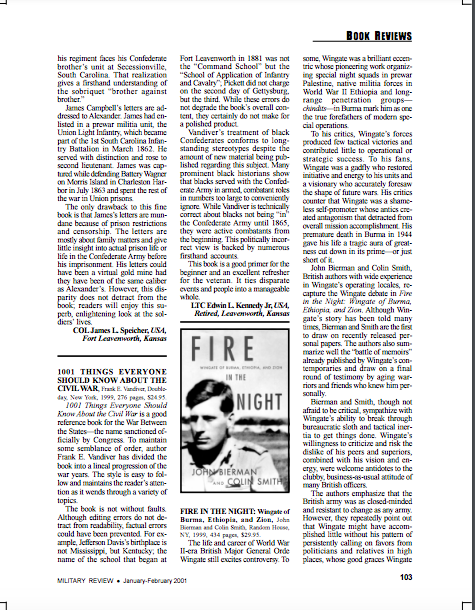
1. Jan-Feb 2001 FIRE IN THE NIGHT: Wingate of Burma, Ethiopia, and Zion, by John Bierman and Colin Smith (1999)

My first Military Review article was on a biography of the charismatic World War II British commando Orde Wingate. The focus on this proto- special-operator proved prescient, as the role of Special Forces in the GWOT wars-to-come expanded in controversial ways. A pull-quote speaks to the tension:

To his critics, Wingate’s forces produced few tactical victories and contributed little to operational or strategic success. To his fans, Wingate was a gadfly who restored initiative and energy to his units and a visionary who accurately foresaw the shape of future wars. His critics counter that Wingate was a shameless self-promoter whose antics created antagonism that detracted from overall mission accomplishment. His premature death in Burma in 1944 gave his life a tragic aura of greatness cut down in its prime–or just short of it.
Screen Shot 2023-01-14 at 2.24.58 PM

Screen Shot 2023-01-14 at 4.29.04 PM

2. May-June 2001 THE BOER WAR GENERALS, by Peter Trew (1999)

My second Military Review review also pointed forward to the upcoming wars, as I pinpointed the difficulty faced by conventional armies fighting against a fully-mobilized insurgent force.

The Boer War Generals suggests just how determined an army has to be to defeat an opponent totally mobilized for self-defense, fighting on its own turf and reliant on unconventional tactics.

3. Nov-Dec 2007 BUDA’S WAGON: A Brief History of the Car Bomb, by Mike Davis (2007)

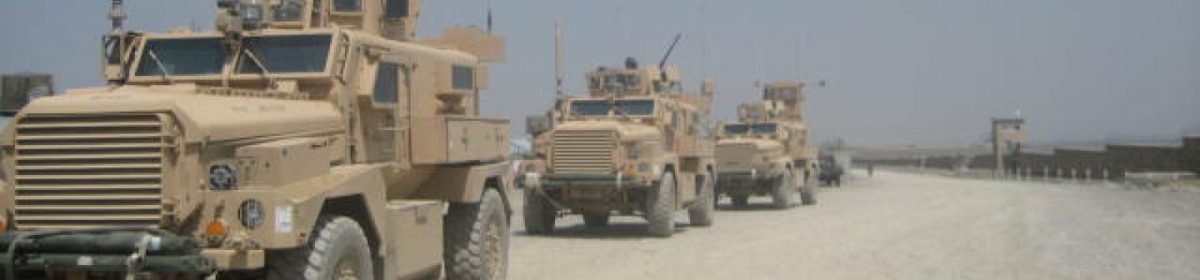
My third review came a few years later, just before my own deployment to Afghanistan. Buda’s Wagon was written by the noted radical historian Mike Davis (who recently died, RIP). It brings back the horrible memory of how defenseless were US forces against the IED and Vehicle-Borne IED threat in Iraq:

For the serving military professional, Buda’s Wagon places into historical and contemporary focus a weapon that, along with the roadside bomb and the sectarian execution, has shaped the face of battle in Iraq and Afghanistan.

Implicit in his commentary is that American political and military leaders might have better anticipated that our enemies would employ these readily available and profoundly modern weapons to disrupt our plans and operations.

4. Sep-Oct 2008 SECURING THE STATE: Reforming the National Security Decisionmaking Process at the Civil-Military Nexus, by Christopher P. Gibson (2008)

Securing the State was written by US Army Colonel Chris Gibson, who was then a brigade commander in the 82nd Airborne Division, later was a two-term US Congressman, and is now president of Sienna College in New York. In 2002, I replaced then-Major Gibson as the Executive Officer of 2-14 Infantry Battalion, 10th Mountain Division.

Colonel Gibson argues that the U.S. government lacks sufficient institutional structures and protocols to ensure that its “civil-military nexus” functions efficiently and effectively.

As war with Iraq loomed, for example, Gibson claims that the Joint Chiefs of Staff found themselves in such a subordinate and deferential position vis-à-vis Secretary of Defense Donald Rumsfeld that they were unable to communicate wise military advice, unfiltered by the Secretary’s political and personal biases, to the president and the Congress, the nation’s elected leaders. Nor were military leaders allowed to develop plans as prudent, detailed, or as fully resourced as required for success in Iraq.

Here is a direct link to my review of Securing the State.

5. Jan-Feb 2009 TERRORISM  FINANCING AND STATE RESPONSES: A Comparative Perspective, edited by Jeanne K. Giraldo and Harold A. Trinkunas (2007)

This review explored a wonky and still murky and still important subject.

…the book plumbs the murky financial infrastructures and processes of terrorist organizations such as Al-Qaeda and the Taliban. Therein lies the book’s value, as well as tactical and strategic possibilities.

Military PowerPoint Storyboards

I was invited to speak as part of a 2023 American Historical Association panel titled “Toward an Illustrated History of a Global War on Terror” because the panel organizer, vet scholar-and-playwright John Myer, liked my short story, “The Brigade Storyboard Artist,” as it was published by The Wrath-Bearing Tree.

John thought that should I approach the subject of military storyboards from an academic perspective my ideas would interest an audience of historians.

So I did. Here’s how my presentation “PowerPoint Rangers: The Aesthetics and Historical Significance of Military Storyboards” began:

By now, the use of PowerPoint presentations as an institutional communication medium in education, business, and the military has been widely studied. Here, though, I’m interested in one facet of PowerPoint that has not been widely-considered: the use of one-slide PowerPoints known as “storyboards” in the United States military, particularly in Iraq and Afghanistan, to plan and document activities and operations at battalion and brigade level. Storyboards, whether viewed on individual computers, projected on screens in meeting rooms, or printed out in paper copies, were a fact of life for officers at these levels of command; their use was ubiquitous and ability to create coherent storyboards in-line with command expectations and conventions a necessary skill for staff-officers and unit leaders. Typically storyboards were created by operations and intelligence officers—30-year-old captains, 35-year-old-majors and 40-year-old lieutenant colonels—and then circulated up-and-down the chain-of-command. In my own one-year tour as an advisor to the Afghan National Army I was asked to prepare dozens of storyboards (in addition to longer PowerPoint presentations) and read hundreds of them. Neither I nor my peers received training in their preparation, nor were there handbooks or guides; in my experience I was expected to get the hang of their creation quickly as I realized they were the informational coin-of-the-realm, supplanting other established military genres such as operations orders and after-action reports, as well as longer multi-slide PowerPoint presentations. My purpose here today is to explain various aspects of their use and suggest some implications for historians. My argument is that they represent an archive of information about how the military, particularly the Army, communicated internally about events as they happened and were meant to be understood and remembered, and yet they remain difficult, if not impossible to access, and, once obtained, must be handled with care.

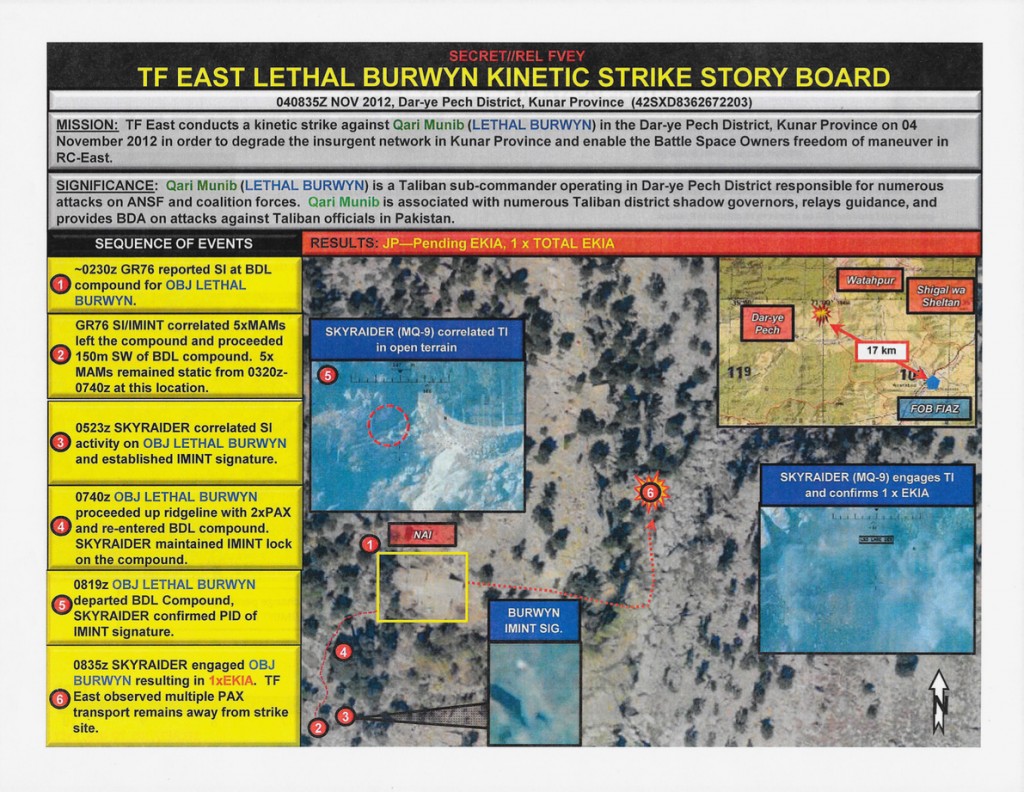
Here are two examples of storyboards, both taken from a 2015 Intercept article written by Ryan Devereaux titled, “The Drone Papers: Manhunting in the Hindu Kush” and then republished on the Transcend Media Service website here.

The first storyboard documents a request to kill a Taliban insurgent named Qari Munib (code-named “Lethal Burwyn”) in Pech District, Konar (Kunar) Province in 2013.  

The second storyboard documents the successful completion of the mission:

Here is how I concluded my presentation:

My argument has been that the challenges of recovering and interpreting storyboards is a goal well worth pursuing for historians writing on war in Afghanistan or Iraq. More so than command post logs, operation orders, official assessments, and command statements, they constitute the official-unofficial, or unofficial-official diary of the war. When studied carefully, in conjunction with other means of collecting evidence and doing primary research, they will add granular real-time detail to personal testimony, authorized accounts, and broader-brush journalistic and historical narrations. One thing I am sure of is that if anything occurred in Afghanistan or Iraq that the military was significantly involved in, PowerPoint storyboards were built in regard to it, and those storyboards might still exist somewhere.   

*****

We also included in our panel a “flash” round in which each panelist presented an image and offered a short comment. I chose this famous image:

Here’s what I said about it:

My image first came to public light in a 2010 New York Times article about the use, overuse, and abuse of PowerPoint in the military in the conduct of the wars in Iraq and Afghanistan. It is an intelligence assessment that purports to illustrate the complicated tangle of factors that underwrote the military operating environment in Afghanistan. The image in fact is not a stand-alone PowerPoint, nor taken from a longer PowerPoint presentation. Rather, it was an illustration extracted from a 31-page report prepared by the PA Consulting Group for the highest-level of military command in Afghanistan. In terms of genre it is a “causal loop diagram,” as prepared by specialists in the field of System Dynamics. Be that as it may, in the NY Times article and afterwards, the image was widely derided as an exemplary example of form over substance and product over action—evidence that the military was so caught up in over-analyzation of the political-military situation at the headquarters level that it had lost sight of the clear focus and directives necessary for effectively doing something about winning the war in Afghanistan. I won’t deny any of that, and speaking from experience, have a special level of commiseration with the officers and troops on the ground who were supposed to translate any of it to an actual military operation. But I will note, that within the rarified air of headquarters staffs there is a way that this slide makes sense to the highly-literate senior officers and officials who were the intended audience. In fact, it perhaps can be said that it provides the necessary level of connected detail that might be a necessary first step to developing strategies and tactics that could actually help the US help Afghanistan government defeat the Taliban while attending to the real needs of the Afghan people. Perhaps.

GWOT Soldier Art

The instinct and talent to paint pictures is mysterious to those of us who possess neither. I suppose the inclination and some of the talent is god-given and then is nourished by training and practice. When it comes to soldier-and-veteran artwork, many of the same questions arise as in regard to writing about war: What story does the painting tell? What were the circumstances of its production? What were the artists trying to achieve? How do we measure quality and achievement? What constitutes a “beautiful” war painting? Can a war painting be an “anti-war” painting? How are stock scenes transformed and transcended? Can they be, or should they even try? Who are the artists, and what is their story? What makes them tick? Do paintings romanticize or glorify war? Can creating art about war experience be therapeutic?  

From the viewer’s perspective, paintings, far-more-so than writing, are instantaneously apprehensible. An emotional response and aesthetic judgement is formed as soon as a painting is viewed. And yet, lasting cultural presence is harder to establish for art than for writing: The mechanisms of cultural memory so at-hand in book publication and book sales and preservation in libraries are diffuse when it comes to art. Exhibitions are acclaimed in the moment, but pictures are viewed quickly and easily moved-on from. The exhibit is soon over, paintings are sold or not, and most will never be publicly viewed again. No one bats an eye at reading a reproduction of an author’s narrative, but paintings somehow imply that contemplating anything but the original artwork is a necessarily diminished experience. And even if saved on the Internet, paintings can languish unnoticed for years and decades, orphaned from all but most determined of curious observers, the sites buried more deeply in digital obscurity than even the dustiest of books on a library shelf.

Such were my sobering thoughts as I dedicated a few days to exploring contemporary soldier art available on the  Internet. An interesting aspect of war-art is that the military itself sanctions and supports it, through official “combat-artist” programs and also links to artwork featured on military museum and archive websites. Search-term entries took me first to a book published by the U.S. Army Center for Military History called Army Artists Look at the War on Terrorism, 2001 to the Present, and available in full online in PDF and HTML. Army Artists Look at the War on Terrorism features eight artists, all of whom served in the Army or were associated with it on deployments to Iraq, Afghanistan, and Kuwait, as well as train-ups for deployment in the US. The volume is silent about what “the Present” date is that it refers to in the title, but I am guessing it was published sometime around 2010.

Over 90 paintings are included, in a variety of mediums such as oil, watercolor, pencil, etc. All the pictures are representational rather than figurative, with the most obvious artistic effect being heightened coloring and various ways of situating the paintings’ principal subjects. The collection clearly intends to represent different facets of a soldier’s experience—from pre-deployment to combat to camp life to interaction with locals to various maintenance and support activities. Below are three pictures I enjoyed contemplating:

Stopping for Directions
Darrold Peters, “Stopping for Directions”
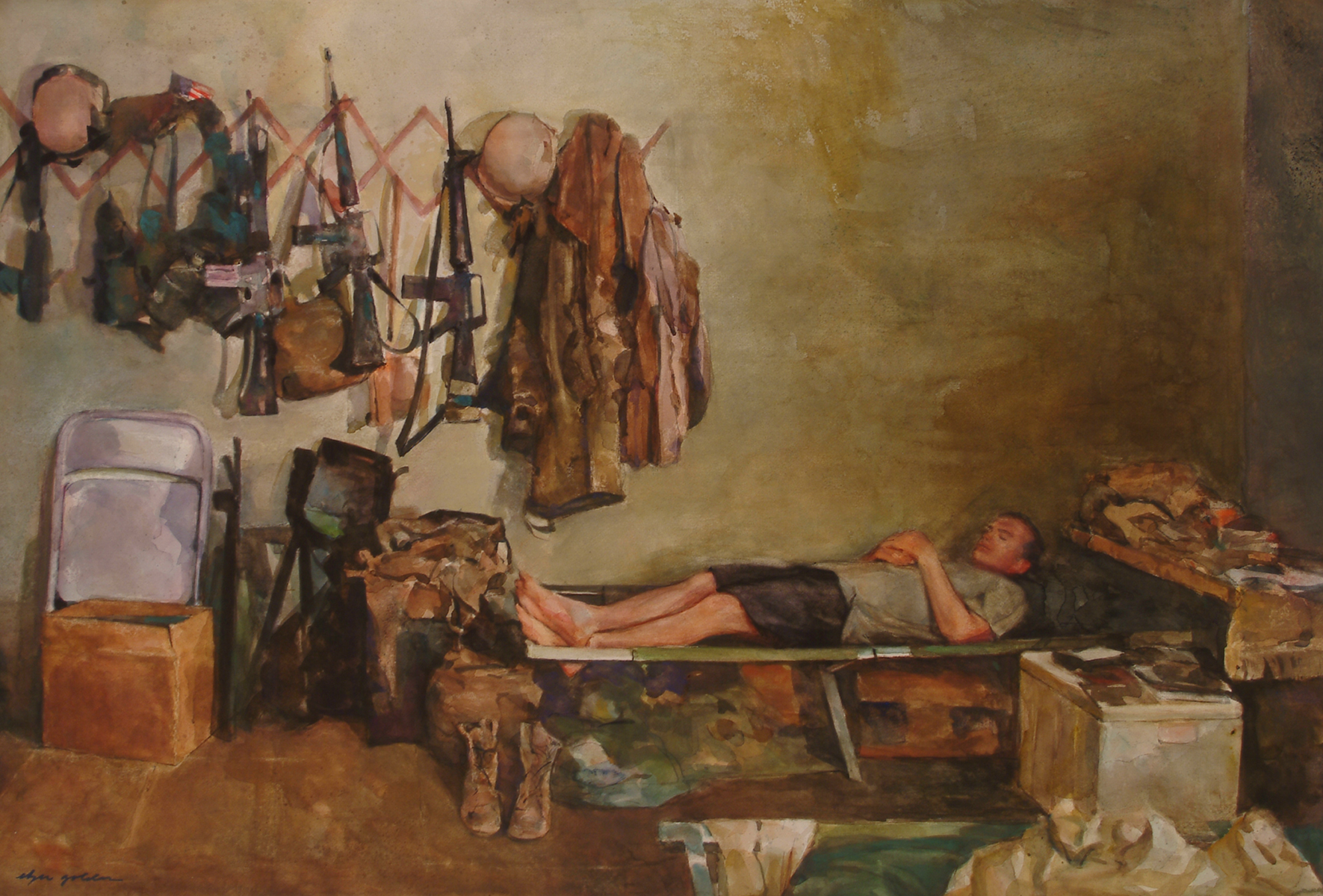
Fallujah Elzie Golden1
Elzie Golden, “Fallujah”
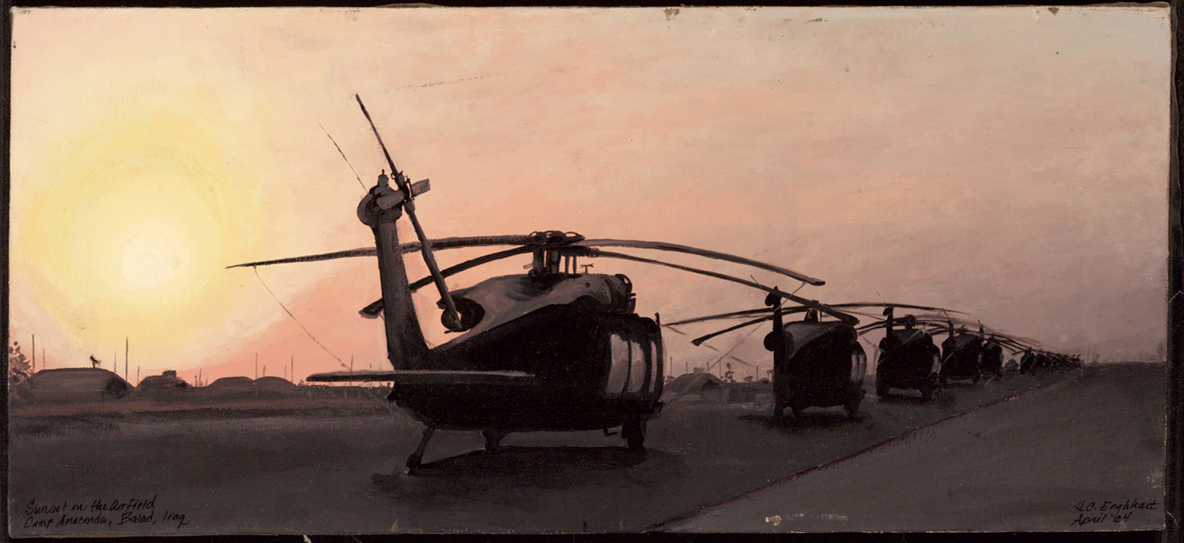
Sunset on the Airfield Heather Englebert
Heather Englebert, “Sunset on the Airfield”

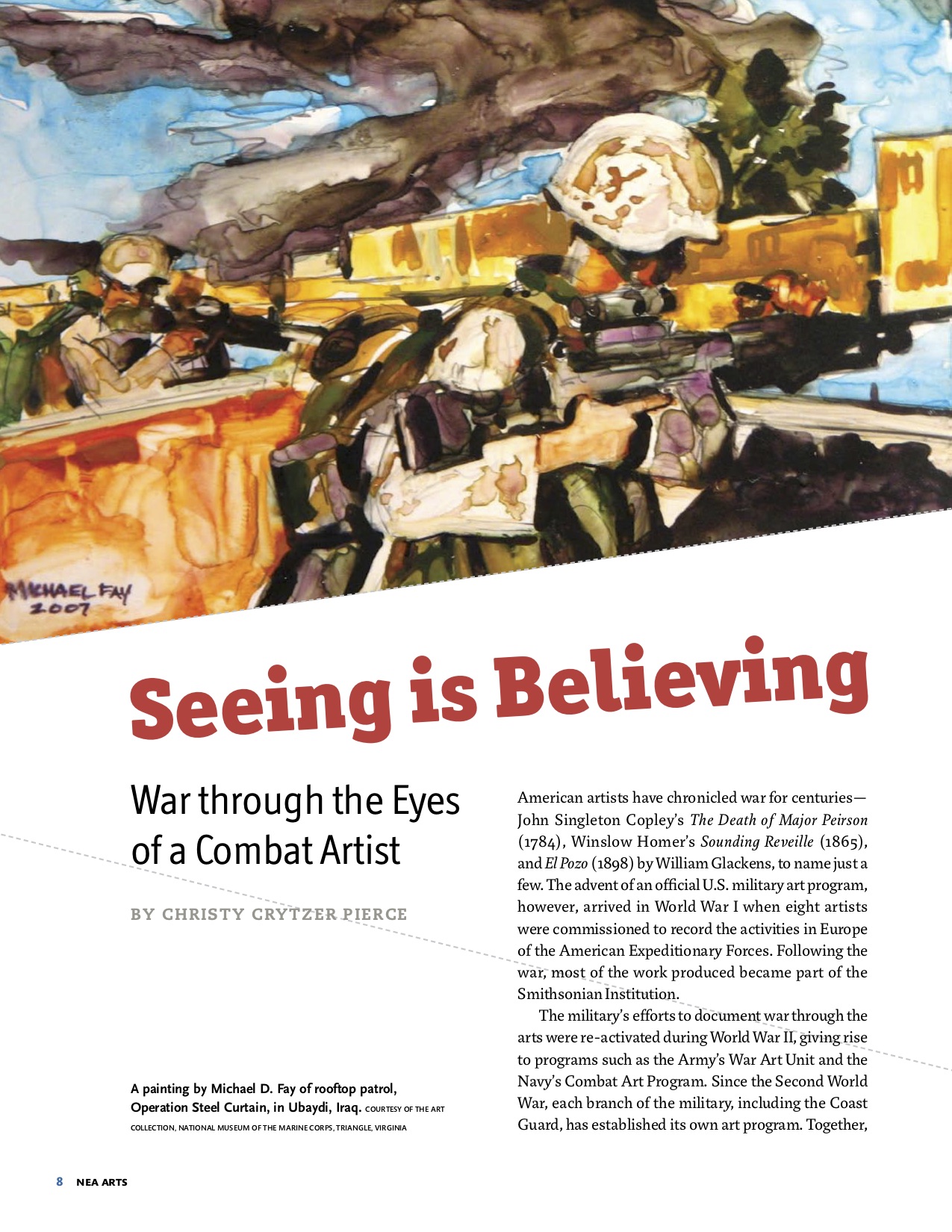
A second stop on the Internet journey was an issue of the National Endowment of the Arts journal NEA Arts published in 2012 themed “The Soul of America: The Arts and the Military.” All the articles in the issue connect artistic expression to contemporary soldiering. A particular emphasis is on art as a means of understanding complicated war experiences; one article, for example, profiles Veterans Writing Project founder Ron Capps. An article titled “Seeing is Believing: War Through the Eyes of a Combat Artist” zeroes in on former-Marine combat-artist Michael Fay and his project to honor wounded veterans The Joe Bonham Project (named after the war-wounded quadriplegic protagonist of Dalton Trumbo’s novel Johnny Got His Gun), which is affiliated with the National Museum of the Marine Corps. Fay’s painting below is striking, but far more startling are the others that accompany the article, featuring badly wounded soldiers and Marines:

Seeing is Believing (dragged)

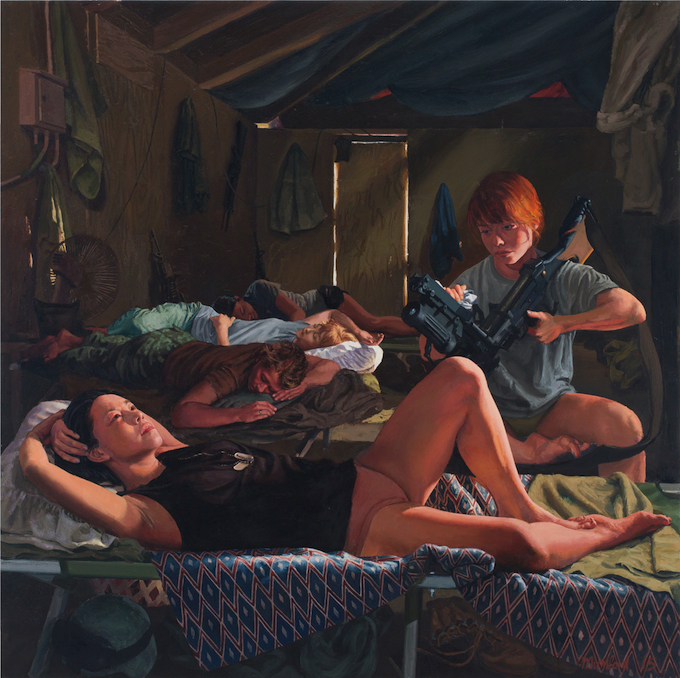
My search next took me to the work of civilian painter Steve Mumford. Mumford has a large presence on the web, and a solid introduction to his work is an article he himself authored titled, “Fifteen Years Into the War in Afghanistan, an Embedded Artist Looks Back.” In it, Mumford describes how many of his paintings were inspired by multiple tours as an embedded artist with US military forces. In several pictures Mumford captures the deployment experience of female soldiers, such as this one:

Steve Mumford Female Barracks in Samarra
Steve Mumford, “Female Barracks in Samarra”

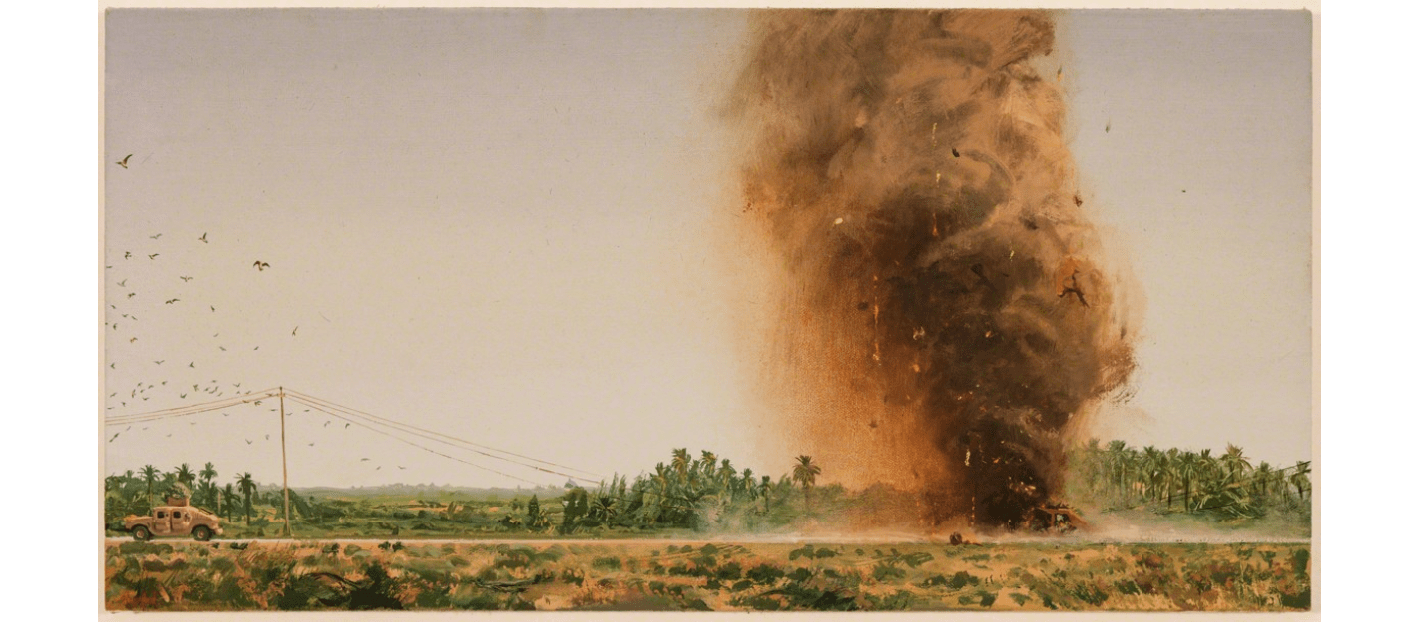
Mumford also painted this stunner of a picture, which is perhaps my favorite of all the paintings I discovered over several days of searching:

Steve Mumford Large IED
Steve Mumford, “Large IED”

A final stop on this Internet tour was an article that explored in detail the use of painting as therapy: “Creating Battle Signs: Iraq/Afghanistan, War Veterans, Art Therapy, and Rehabilitation.” As the title suggests, the article takes seriously the idea that grievously wounded veterans (physically and psychologically) might find expression for or escape from their pain by making art. The paintings offered for contemplation are by far the most non-representational, obviously figurative of any I’ve mentioned so far:

Joshua Ferguson Modified Pain Scale
Joshua Ferguson, “Modified Pain Scale: Three Canvases”

So, much art, all interesting and all to my eye accomplished. All put to different purposes: to document, to honor, to shock, to evoke, to help, to express. I invite you to spend more time with the artists, paintings, articles, and books I have canvassed here.