Rendering respect for bravery and sacrifice and aiding our memory of the military members who embody them are arguably the most important functions of war artistry. Fallen soldier ceremonies, military funerals, public memorials, and national days of remembrance are shot through with artistic arrangements of space, time, sound, experience, idea, emotion, and memory, and all the better for it. Those whom they honor and those who pay their respect deserve it and demand it.
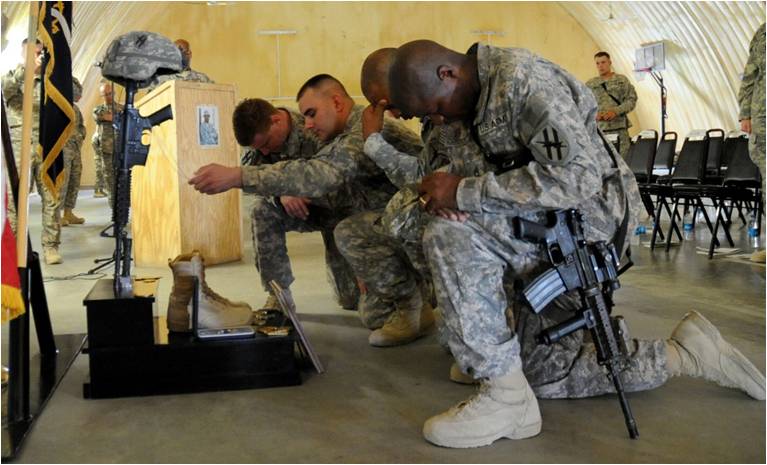
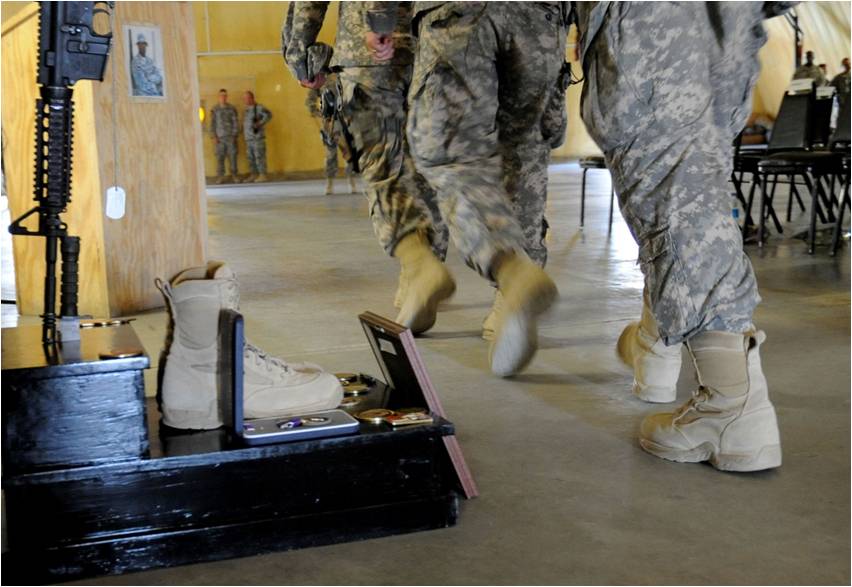
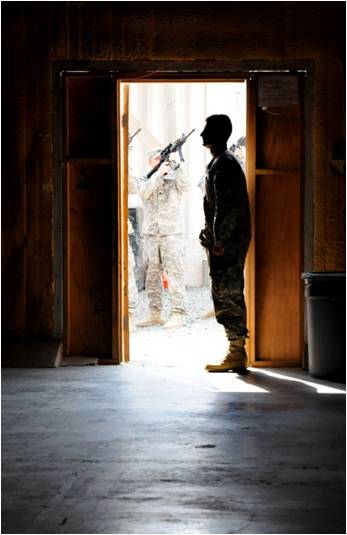
I’m very interested in the aesthetics (and politics) of memorialization and remembrance, and will write about these subjects in posts to come. Today, though, let’s just pay tribute to soldiers, marines, airmen, and sailors killed in action in Iraq and Afghanistan. Above are pictures taken at a fallen soldier ceremony held at Camp Clark, Afghanistan, in October 2009. The ceremony honors SSG Alex French, a member of the Georgia National Guard who was killed by a suicide bomber while on patrol in Khowst province. The photographer was Senior Airman Evelyn Chavez, a member of an Air Force public affairs detachment covering the ceremony.
In memoriam 1SG John Blair, SFC Kevin Dupont, SSG Alex French, CPL Peter Courcy, and PFC Jason Watson, all Camp Clark, Afghanistan, soldiers with whom I lived and fought. RIP many other friends American and Afghan, former students, and all those killed in action in Iraq and Afghanistan.
The title of this post cribs from a 1942 Wallace Stevens poem, “Notes Toward a Supreme Fiction.” Stevens writes:
     So poisonous are the ravishments of truth, so fatal to
     The truth itself.…
He also writes:
     The poem refreshes life so that we share
     For a moment, the first idea….
Elsewhere, in Stevens’ “On Modern Poetry,” also from 1942, we read:
     It has to think about war
     And it has to find what will suffice.
Such thoughts give entrée to a meta-critique of war literature. What does it think it is doing? What are the possibilities? Timothy O’Brien’s magnificent “How to Tell a True War Story” offers superb contemporary expression of the issues involved. O’Brien dramatizes and suggests their impossibly tangled complexity. What is more important, realistic truth or emotional truth? How is the truth related to the credibility of the speaker? How does truth relate to the individual perspective of the witness/participant and the reader? These issues are inherent in all discussion of literary aesthetics, but they are magnified in war literature by the sensational nature of the subject matter, the intensity of the emotional involvement, and the important moral and political consequences at stake.
Sometimes it seems like the best answer might be that of the chorus of Of Monsters and Men’s hit “Little Talks”:
      Hey!
      Don't listen to a word I say
      Hey!
      The screams all sound the same
      Hey!
Probing deeper, critic Laura Brandon, writing about war art, looks to redefine the subject “internationally through time” as more than “battle pieces, an aspect of national history, or military illustration.” She establishes a typology of war art: “propaganda, memorial, protest, and/or record.” That’s helpful. Riffing off Brandon’s suggestions, I came up with ten questions pertinent to the aesthetics of war literature and art. Read through them and let me know if they work for you:
1. “There is no document of civilization which is not at the same time a document of barbarism.” -Walter Benjamin, Theses on the Philosophy of History (1940). In what ways is Benjamin’s quote particularly true of war literature? Is there a way that war literature evades or transcends being a “document of barbarism”?
2. Is war literature inherently “anti-war” literature?
3. Does war literature celebrate war or perpetuate ways of thinking about war that increase, rather than decrease, the prospects for future war?
4. Is war literature written by veterans inherently more valuable, credible, or interesting than that written by those who haven’t served or even deployed (as a journalist, aid worker, contractor, etc)?
5. Heroism, fear/courage, guilt, shame, camaraderie, adventure, horror, shock—are these common tropes of war literature beyond critique? Why or why not? If not, then what about them invites investigation?
6. How does the war literature complicate the desire of the American public to “support the troops”?
7. What is enjoyable about war literature?
8. What does the war literature help us understand better?
9. How does war literature complicate the relationship between remembering and reporting?
10. What is beautiful about war literature?
Happy six-month anniversary of the Time Now blog. Thanks for reading and your support so far. My goal is a post a week for a year, more if I can keep it up. I’ve covered a lot of ground already, but there is much left to say. The summer writing season is here, so let’s go.
At last, contemporary war fiction from the other side–a chance to see how the Iraqis think about us. Only it’s not that simple, because the Iraqis portrayed in Iraqi author Hassan Blasim’s great “The Green Zone Rabbit” are so caught up in their internal Iraqi-only machinations and subterfuges that the American presence barely registers, save for a number of references to Facebook. Apparently, even sectarian infighters in the Baghdad warzone lived from status update to status update. And who needs Americans, anyway, when the Iraqis in “The Green Zone Rabbit” kill each other just fine in the most brutal ways?
The first person narrator describes the death of two of his brothers: “The Allahu Akbar militias took them away to an undisclosed location. They drilled lots of holes in their bodies with an electric drill and then cut off their heads. We found their bodies in a rubbish dump on the edge of the city.” And that’s not the worst of it in, in story that manages to be graphic without being sensational. According to critic Yasmeen Hanoosh, Blasim’s fiction consists of “at once peremptory and incredulous accounts of human violence.” That seems about right.
What is the context for such laconic treachery and death? According to Hanoosh, Iraq’s war with Iran and Saddam Hussein’s dictatorship set the conditions for latent Shia-Sunni tensions to catalyze, not the Americans’ overthrow of Saddam and their subsequent occupation. In other words, post-2003 civic degeneration is only the latest manifestation of the contemporary historical nightmare from which Iraq is still struggling to awake. Within the literary realm, Hanoosh tells us that the emergence of authors such as Blasim represents an intellectual revolt against state-and-church sanctioned official speech. The import is a distrust of triteness and cant, formula and convention.
This historical-cultural stew generates a fictional texture unlike anything I’ve seen in American war fiction. One thing immediately noticeable in “The Green Zone Rabbit” is that the protagonists are grown adults, with richer personal histories and more complex worldviews than the boyish and girlish heroes of American fiction. There seems to be a lack of sentimentality and emotional gush, too; Hajjar, the narrator of “The Green Zone Rabbit,” is hyper-aware of the dangerous world he inhabits, but the story isn’t all about his feelings toward killing and dying in the way that, say, it is for the protagonists of Billy Lynn’s Long Halftime Walk or The Yellow Birds. Nor is it moralistic. For Hajjar, the problem of the war is as much intellectual than it is emotional or political or ethical or even religious. “The Green Zone Rabbit” emphasizes how quick of mind one must be merely to survive in an environment where motives are always obscure and loyalty in jeopardy.
“The Green Zone Rabbit” can be found at the Words Without Borders website, whose April 2013 issue is dedicated to Iraq, Ten Years Later. The biography of Blasim therein tells us that a collection of his stories called The Corpse Exhibition will come out next year, translated from Arabic by Jonathan Wright. Yasmeen Hanoosh’s overview of Iraqi literature is also worth reading: “Beyond the Trauma of War: Iraqi Literature Today”. So too is Polish journalist Mariusz Zawadzki’s “A Vacation in Basra”, which is excerpted from his book Brave New Iraq. Zawadzki, among other things, is remarkably generous about the American occupation. He writes:
You can accuse the Americans of a lot of things, but one thing you have to give them: they have never been economical in Iraq. They have sacrificed masses of energy, billions of dollars and thousands of dead to carrying out the impossible and absurd task that they have set for themselves. I have gotten to know many of them; some I have considered stupid or arrogant, but all of them—from the privates to the generals—have performed their Sisyphean labor with real commitment.
That’s why you could even love the Americans, in a way.
Not sure if that’s what Hassan Blasim would say about the matter, but it’s a perspective worth thinking about, or even better, given fictional representation and made available for critique.
Thanks to Sean Case for alerting me to the Words Without Borders website.
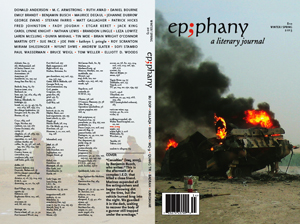
The winter/spring 2013 edition of Ep;phany: A Literary Journal is guest edited by poet Brian Turner. Not fooling around, Turner has solicited and selected quality work from a who’s who of contemporary war literature. A roll call of contributors begins with Benjamin Busch, Roy Scranton, Bruce Weigl, Donald Anderson, Matt Gallagher, Jehanne Dubrow, and Paul Wasserman. Turner’s also reached out internationally to include Israeli poet Etgar Karet, Myanmar poet Tin Moe, Irish author Fred Johnston, and others.
Everything I’ve read so far is wonderful, but here I’ll just offer a few initial impressions. A poem by Army veteran Martin Ott called “Blanket Party” caught my eye with its reference to Fort Leonard Wood, Missouri, where Ott, as I did, underwent basic training:
      In Fort Leonard Wood, our rooms were windowless
      the days began in the dark for pushups on fields of rock.
      We were calorie-starved with only minutes to shovel
      chow, and set against other squads by barking sergeants..
Brian Wright O’Connor’s “Appointment at Bu Dop” explores his father’s service in Vietnam as the commander of an infantry battalion. The essay concerns itself with treatment of enemy dead and body counts, but Lieutenant Colonel Mortimer O’Connor is in the news this week for other reasons: he has just received a posthumous PhD in English Literature from Penn. He was weeks away from completing his dissertation in 1968 when he deployed to Vietnam, where he was killed in action.
The cover photo by Benjamin Busch is a stunner. Called “Casualties,” it was taken in Iraq in 2005. It portrays the aftermath of an IED attack that killed a close friend; Busch describes the event at length in his memoir Dust to Dust. In Ep;phany, Busch writes, “…the vehicle burned long into the night. We guarded it in the dark, waiting to recover the body of a gunner still trapped under the wreckage.”
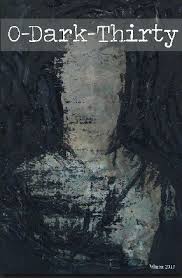
O-Dark-Thirty is a literary journal and website associated with the Veterans Writing Project. The VWP is a non-profit based in Washington, DC that provides no-cost writing seminars and workshops for veterans, active and reserve service members, and military family members. Its founder is Ron Capps, an Afghanistan veteran who has published widely. He’s passionate about bringing as many veteran writers into print and publication as possible.
More power to him.
Volume 1 Number 2, the winter 2013 edition, of O-Dark-Thirty is out now. It features non-fiction, fiction, poetry, and art by and about veterans from World War II onward. Of special interest is Capps’ profile of William Zinsser, a U.S. Army sergeant in WWII and the author of On Writing Well, a best-selling and authoritative guide to writing non-fiction. Zinsser is 84 and still teaching at New York’s New University. Clearly, he has been inspirational to Capps, and why not?
Forums dedicated to war writing by vets are cool. Forums that bring together veterans of Iraq and Afghanistan with those of earlier wars are cooler still.
Below I’ve reposted a slightly-edited post from my old blog, 15-Month Adventure, that I also published on Time Now last year on Mother’s Day.
To the Moms, the Whole Love
Moms come up quite a bit in writings about the war, I’ve discovered. Not surprisingly, authors are sensitive to how military service touches those whose children do the fighting. For example, here’s how Benjamin Busch in Dust to Dust describes his mother’s reaction to the announcement that he has joined the Marine Corps:
“My mother took a deep breath, her hands clamped to the edge of the table as if she were watching an accident happen in the street. Her father had been a Marine, had gone to war and almost not come back.”
How to describe a mother’s anxiety about her child’s deployment? Kaboom author Matt Gallagher’s mom, Deborah Scott Gallagher, writes:
“’I will be stalwart,’ I had said to myself on the drive home from the airport the morning I said goodbye to him. “I will be steadfast. I will read and listen to the reputable war reporters, and I will write my senators and congressmen, but I will not lose faith in my country. I will concentrate on sustaining my son rather than myself, and I will not confuse self-pity with legitimate worry and concern over him and his men. I will be proud, justifiably proud, but I will not be vainglorious! And I will never, never, never let him know how frightened I am for him.’
“But, within moments of returning home, I had broken all but one of these promises to myself. I was doing laundry and, as I measured detergent into the washer, the Christmas carol CD I was playing turned to Kate Smith’s magnificent contralto, singing, ‘I Heard the Bells on Christmas Day.’
“‘And in despair, I bowed my head,’ she sang. ‘There is no peace on earth, I said. For hate is strong and mocks the song of peace on earth, good will to men.’
“And, at that moment, for only the third time in my adult life, I began to sob — not cry, not weep — but sob uncontrollably, sitting on the floor of my laundry room, surrounded by sorted piles of bed linens and dirty clothes.”
And if the child comes back wounded? Siobhan Fallon, author of You Know When the Men Are Gone, describes a trip to Walter Reed to meet injured soldiers and their families:
“And there were mothers. Unlike the military members and their spouses, who somehow all seemed in great and hopeful spirits, the mothers looked stunned. They seemed to be trying to grip their emotions tightly, but their faces hid nothing. Their faces said: ‘Why did this happen to my beautiful boy?’”
And how does a veteran describe his mother, a lover of language and books and authors and ideas, as he watches her fade late in life? Benjamin Busch again:
“She had been a librarian. All of the books and conversations about the importance of written words swelling inside her head like a star undergoing gravitational collapse into a black mass, its light still traveling out into space but its fires already burned out. Nothing left but ash.” Then he recounts her last words: “‘Oh my baby boy.'”
So much hurt. So much damage. So many memories. So much love.
My mother, Ann Castle Boswell, Athens, Ohio, 1958, the year I was born
References:
Benjamin Busch, Dust to Dust: A Memoir (2012).
Matt Gallagher, Kaboom: Embracing the Suck in a Dirty Little War (2010)
Ongoing in Washington DC this week is the GI Film Festival, an event that since 2007 has showcased films by soldiers, veterans, and civilian-artists interested in war and military-related issues. As I look over this year’s schedule, two films, The Making of Fallujah and The Hornet’s Nest, catch my eye.
The Making of Fallujah documents the production of an opera about the bloody battle fought in the titular city in 2004 and 2005. In particular, Fallujah the opera portrays the war and post-war experience of a Marine named Christian Ellis, who fought and was wounded in Fallujah, while also incorporating the points-of-view of American family members and Iraqi citizens. As far as I can tell, Fallujah has never been staged live, but the movie about its making can be viewed online, along with a trailer and assorted behind-the-scene clips, at The Making of Fallujah. The film offers large swaths of what appear to be near-full-dress workshop performances. The musical snippets are gorgeous and the storyline and backstory compelling.
The Hornet’s Nest is the feature attraction of the GI Film Festival this year. From the trailer, it’s hard to tell whether the subject is a 101st Airborne operation in eastern Afghanistan or the father-son embedded journalist team (Mike and Carlos Boettchner) who get caught in the thick of the action, but it definitely promises plenty of human drama and up-close-and-personal small unit bang-bang.
IEDs and suicide bombers
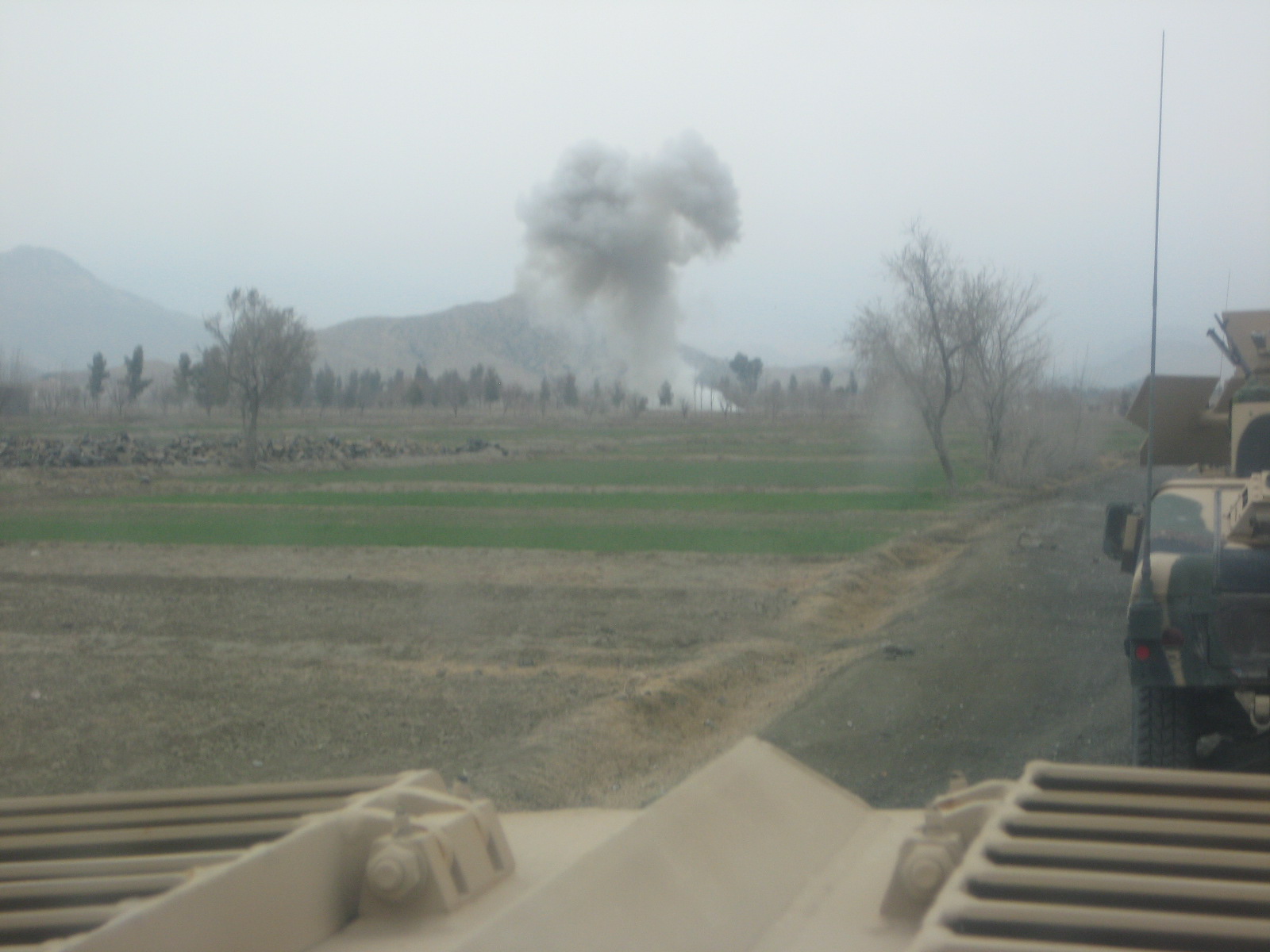
Random rocket and mortar attacks
Year-long unit deployments
Real-time communication with friends and family back home
Social media and blogs
Women in frontline units
Married couples in theater
General Order #1
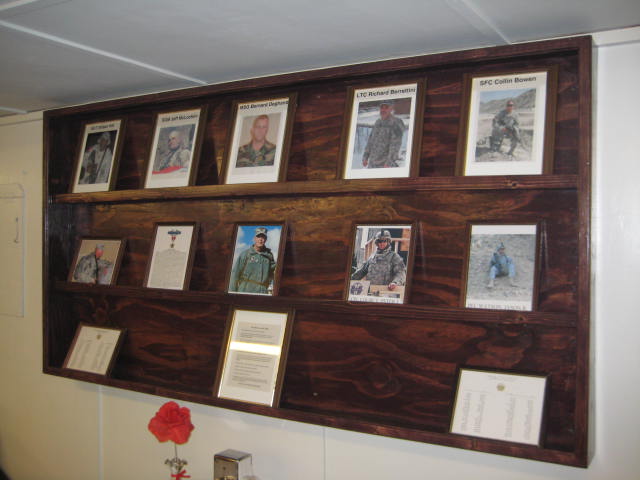
Fallen Soldier walls
Noncombatants, rules of engagement, nation-building, counterinsurgency, host-nation forces
FOBs and COPs
Body armor, eye protection, night vision devices, improved first-aid kits, laser aiming devices, assault packs, Camelbacks, Army Combat Helmets
Combat application tourniquets
Nasopharyngeal airway tubes
Combat weapon slings
Personal Locator Beacons
Stack formations, room clearance drills
Entry Control Points
Storyboards
BUBs
Battlefield Circulation
Contractors
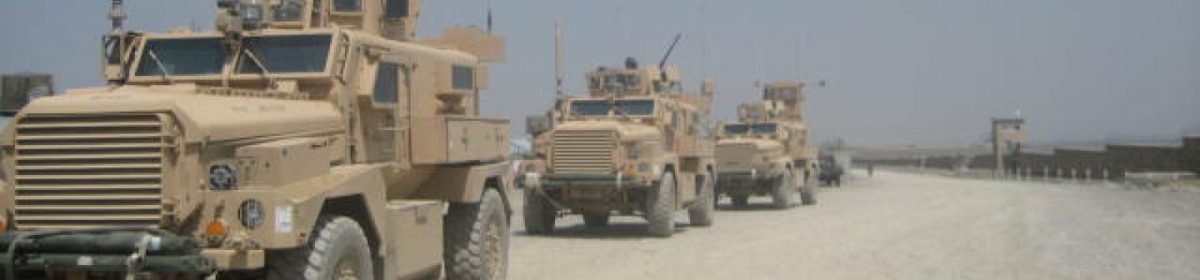
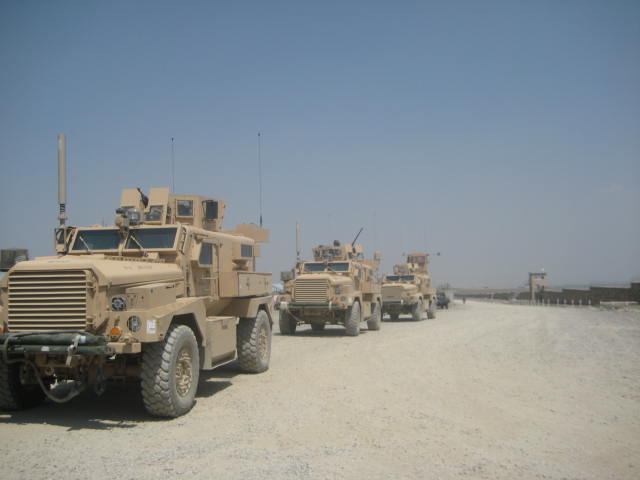
Up-armored Humvees, MRAPs, Cougars, TCs, gunners, guys in back
National Guard unit deployments
Ranger task forces
Navy and Air Force embedded in ground units
Deserts
Mid-tour leaves
Interpreters
UAVs, drones, Ravens
FLIR imaging systems
mIRC tactical chat
Blue Force Tracker
Signal intelligence and surveillance
Personal computers
Other Government Agencies
High Value Targets
Personal Security Detachments
Key Leader Engagements
Kuwait and Kyrgyzstan
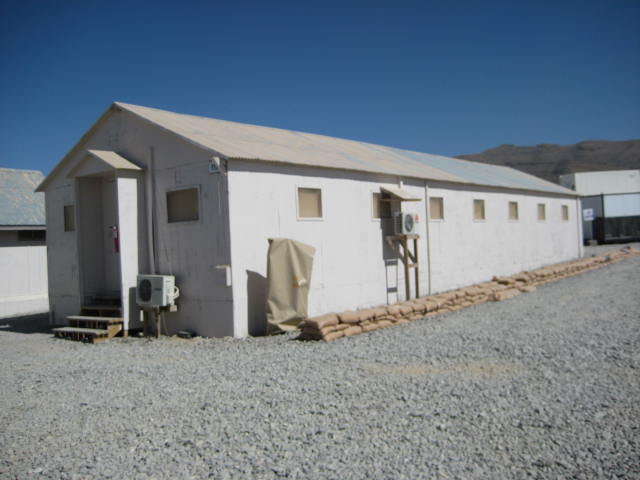
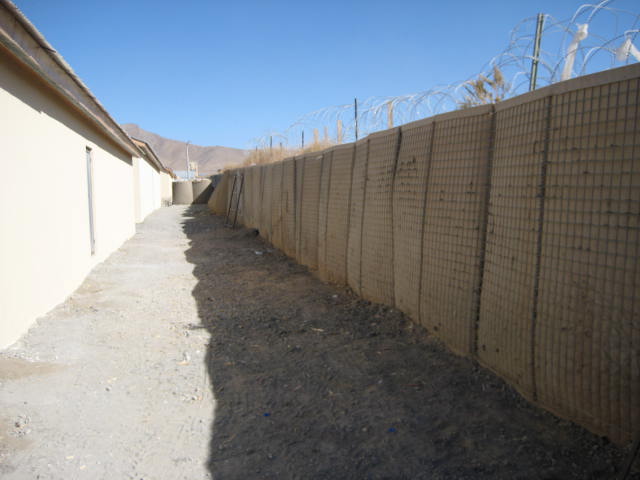
Jersey barriers, HESCOs
Bottled water
Sports and energy drinks
Wilms and Chigo HVAC systems
B-huts
Gators
Concrete bunkers
Gravel
(or only relatively new, but more widespread and with added emphasis and urgency than in past wars)
((on the lookout for representations of any and all of the above in art, film, and literature))
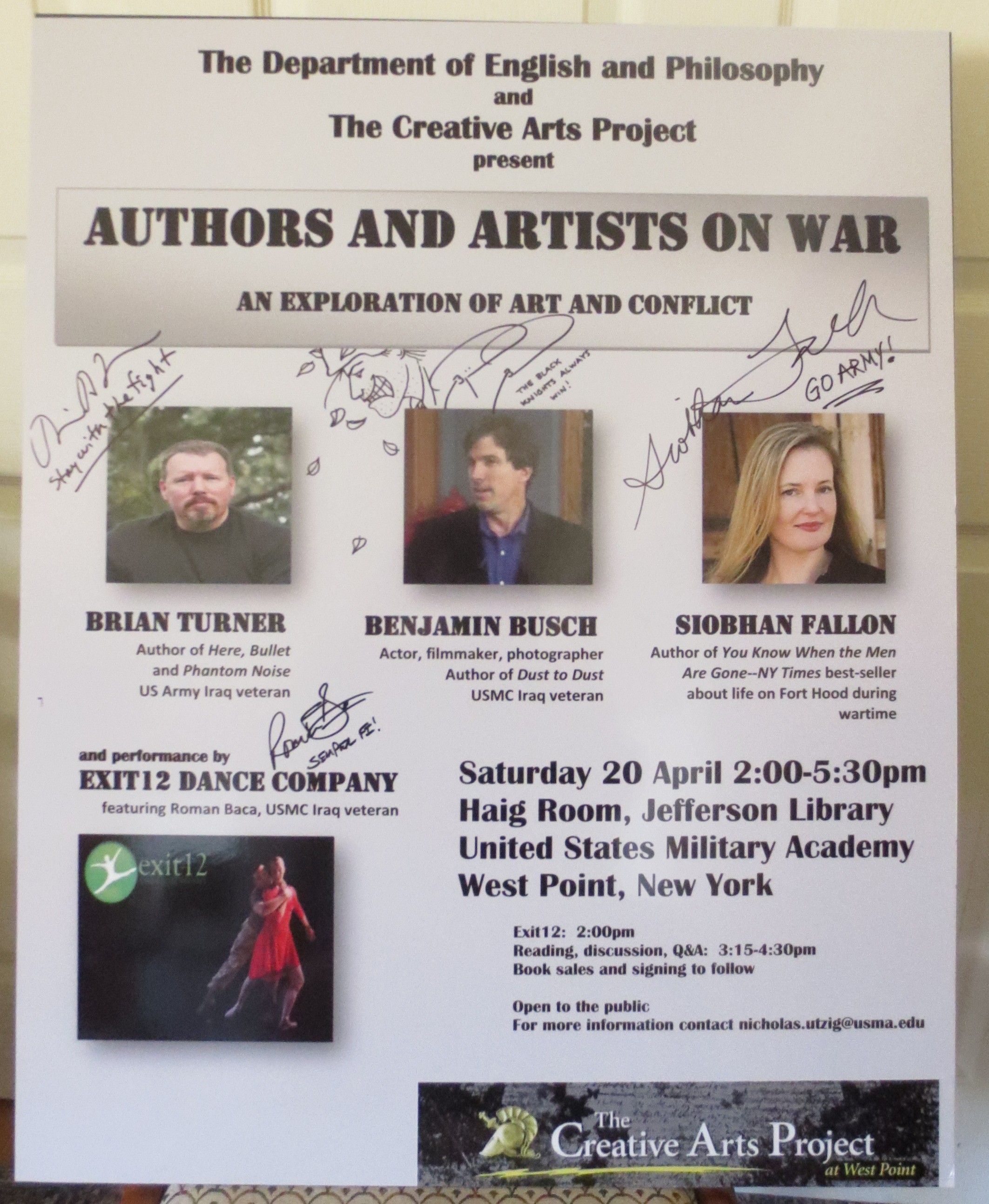
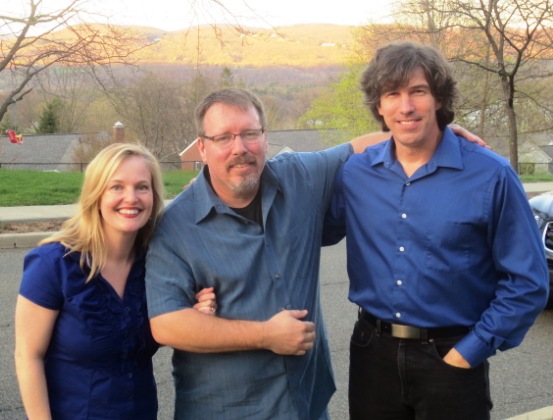
This event brought together three great authors–Brian Turner, Siobhan Fallon, and Benjamin Busch–to speak about their efforts to portray the turmoil of war. As each of them had been profoundly affected by the war in Iraq, it seemed fitting a decade and a month after the invasion to ask about their whereabouts in March 2003 and then have them describe when the war became manifest in their art. The remarks subsequently ranged over many subjects, but focused most specifically on the damage enacted on individuals and relationships by deployment and exposure to death and killing.
Asked to read selections from their works that generated strong audience reactions, Turner read “At Lowe’s Home Improvement Center” from Phantom Noise, Fallon read from her story “Leave” from You Know When the Men Are Gone, and Busch read passages from Dust to Dust that described his decision to join the Marines and his first few days of training at Quantico.
Later, each of the authors read passages or poems that had been written pre-2001 that had influenced them then or seemed important now. Siobhan Fallon read from Tim O’Brien’s “The Things They Carried.” Benjamin Busch read Joe Haldeman’s Vietnam War poem “DX,” which he had copied into a green military-issue notebook and carried with him in Iraq. Finally, Brian Turner recited from memory Israeli poet’s Yehuda Amachai’s “The Diameter of the Bomb”—an especially appropriate poem in light of last week’s Boston Marathon bombing:
      The diameter of the bomb was thirty centimeters
      and the diameter of its effective range about seven meters,
      with four dead and eleven wounded.
      And around these, in a larger circle
      of pain and time, two hospitals are scattered
      and one graveyard. But the young woman
      who was buried in the city she came from,
      at a distance of more than a hundred kilometers,
      enlarges the circle considerably,
      and the solitary man mourning her death
      at the distant shores of a country far across the sea
      includes the entire world in the circle.
      And I won’t even mention the crying of orphans
      that reaches up to the throne of God and
      beyond, making a circle with no end and no God..
Amazing.
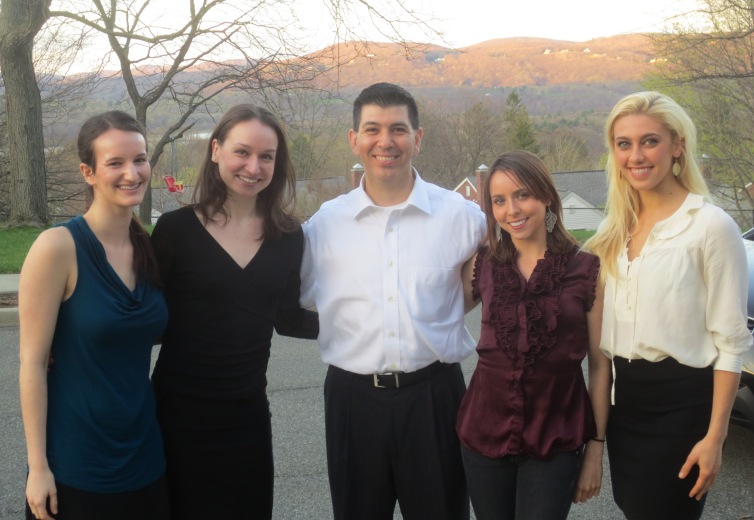
Exit12 performed two dances: “Aggressed/This is War” consisted of two solo pieces that together depicted the story of a returned vet struggling to reintegrate into peacetime life. “Yarjuun,” which means “We hope” in Arabic, was a piece written by Exit12 director Roman Baca in Iraq in collaboration with an Iraqi dance troupe. Both dances were in turn playful, sad, sexy, and politically-charged, with inspired music, props, and choreography that dramatized the effects of war without being either too obvious or too elusive.
I had a hand in organizing this affair so I definitely want to thank the artists, all those in the audience, and all those helped make it happen. Wish everyone reading could have been there, too!
Below left to right: Siobhan Fallon, Brian Turner, Benjamin Busch:
Exit12 below–Adrienne de la Fuente, Joanna Priwieziencew, Roman Baca, Chloe Slade, and Paige Grimard:
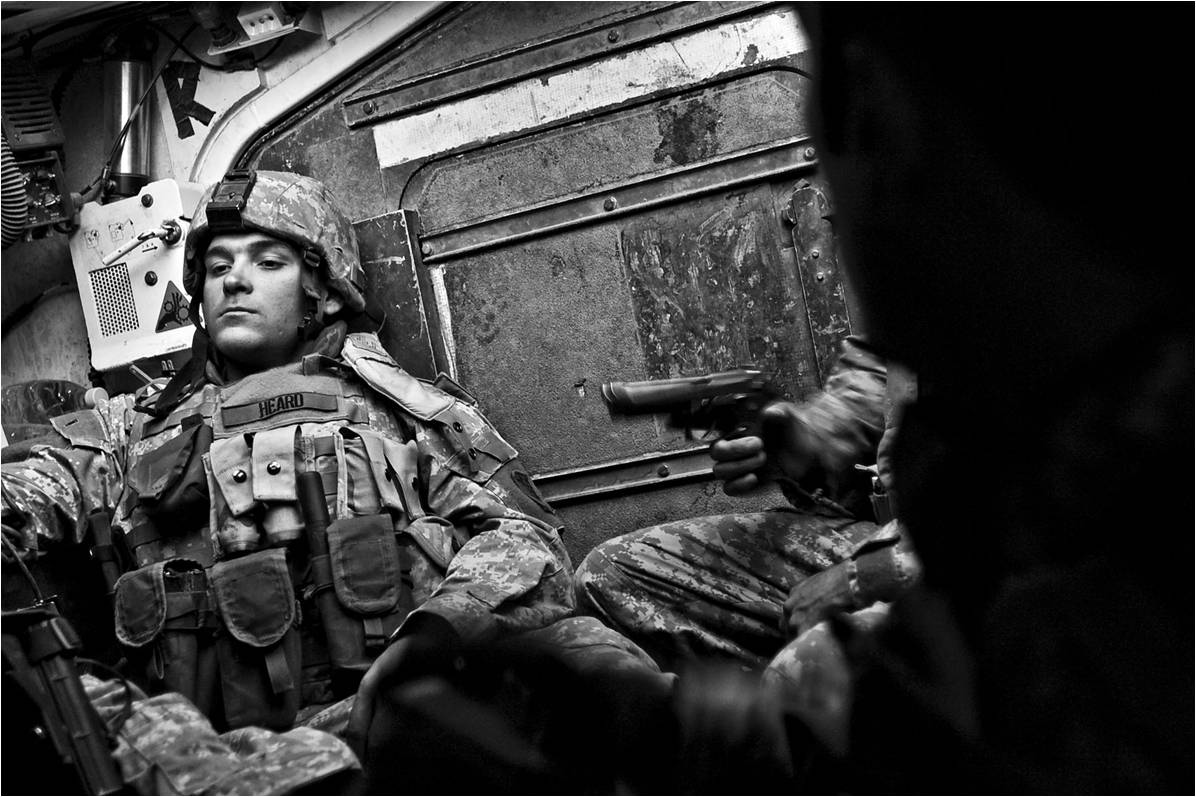
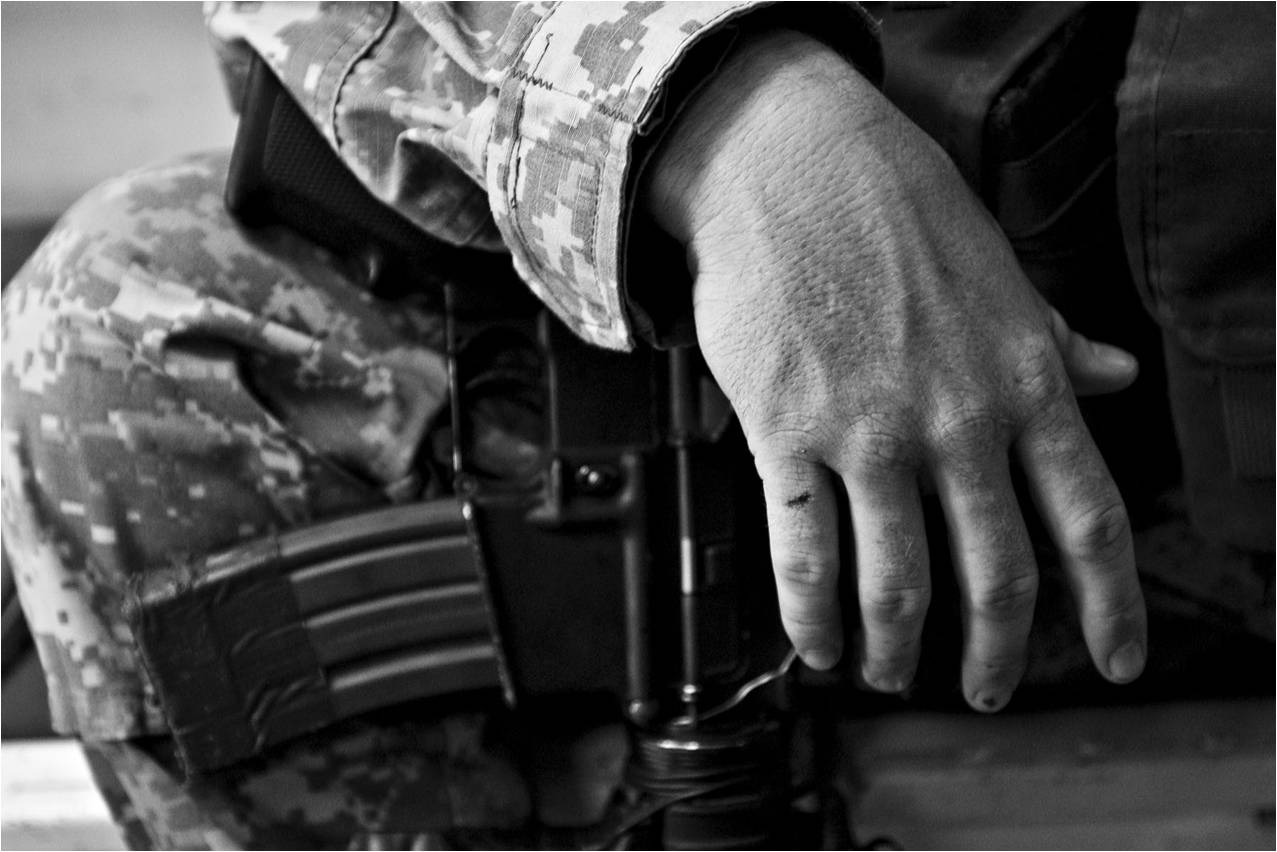
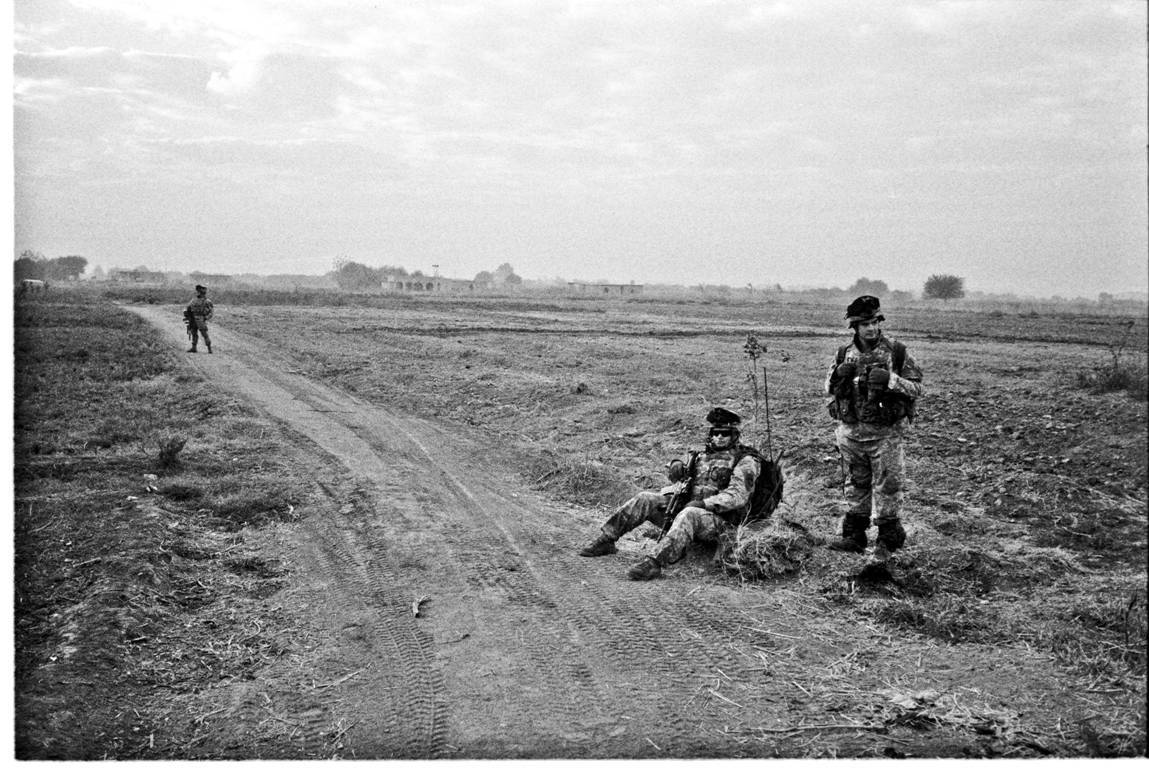
I’m bringing these pictures back to the top because Bill Putnam has emailed me information about them that is worth sharing. Earlier I had written that they were from 2007-2008. As you will read, I was off by several years. I wrote that they were grim-but-beautiful artifacts from a grim, not-beautiful time. I wasn’t wrong about that. Below are Bill’s comments:
The photos were taken in Iraq during my time there as a freelancer between September and November 2005. The top two were shot during a stay with a Stryker company in eastern Mosul, around the walls of Ninevah. The bottom was made on Bayji Island near Bayji, Iraq.
A bit about each… It’s funny you picked three of my favorites from that time.
The top one was made fairly early in the morning after an all-night raid. The unit, Centurion Company, 2-1 Infantry, had been sent out with an SF team and bunch of Iraqi Army to hunt down a car bomb builder. They didn’t find him. This was early in the unit’s deployment (they were the guys who were extended in 2006 for three months during an early and not so effective “surge” into northwest Baghdad). To me it says a lot, not really about that war, but just war in general, especially war down at the nasty end of the spear. Hunter, the guy pictured, just looks exhausted. War is exactly that – exhausting in every sense – but this is physical exhaustion. The kid waving the gun (it was unloaded) was actually playing with a newly-installed laser pointer.
The middle photo was made in a Stryker as the company was heading back from a meeting with an Iraqi police colonel in a precinct. I liked the detail of this kid (I’ve forgotten his name, sorry) as we ride back to the FOB.
The bottom photo was made during my first week of a two-month embed with Abu Company, 1-187th Infantry. Unlike the first two which were shot digitally, this was shot with black-and-white film on a Leica rangefinder camera. It was early in the morning of the op’s second day. The two guys on the right are Bill and Michael, the platoon’s RTO and doc. The guy off in the distance is Tim, the platoon sergeant. The whole battalion was out there looking for weapon caches, doing what all grunts do in a counter-insurgency (even if we weren’t calling it that back then). If I remember it was cold that morning. We’d spent that night huddled in an abandoned house. The guys were tired and you can see that in Bill and Mike’s body language.
Thanks, Bill, for your photos and your comments. We look forward to seeing the best of your current work documenting the transition of military responsibility in Afghanistan from US to Afghan control.











 Time Now: The Wars in Iraq and Afghanistan in Art, Film, and Literature