Time Now Live in Seattle: Association of Writers and Writing Programs Conference

AWPThis week I’ll be presenting at the Association of Writers and Writing Programs conference in Seattle.  Thanks to Roy Scranton for the invite; it’s an honor to be part of a panel with Roy, Joydeep Roy-Bhattacharya, and Phil Klay. If you’ll be at AWP, too, check us out at 10:30 on Friday morning.

Sterling review of Phil Klay’s short-story collection Redeployment here, just out today 26 February in the New York Times.  Congratulations, Phil!

Another 26 February update: Joydeep Roy-Bhattacharya will not be able to make it, but we will be joined by novelist and essayist Hilary Plum.  Check out this interview with Hilary on the Full Stop website.  It appeared shortly after the release of her 2013 novel They Dragged Them Through the Streets, which I haven’t read but am now eager to check out.

The AWP blurb for our panel:

F160. War Stories: Truth, Fiction, and Conflict. Roy Scranton, Phil Klay, Joydeep Roy-Bhattacharya, Peter Molin. Room 301, Western New England MFA Annex, Level 3. The truth of war is always multiple. Homer’s Iliad gives us both Achilles and Hector, just as Tolstoy’s War and Peace opens up a panorama of perspectives. Fiction offers an unparalleled medium to explore the conflicting truths of war, yet also offers dangers. How do we negotiate politics, witnessing, and voyeurism? How can we highlight war’s ugliness and still write a compelling story? How do we portray war’s beauty and still write an ethical one? Our panel explores these age-old problems.

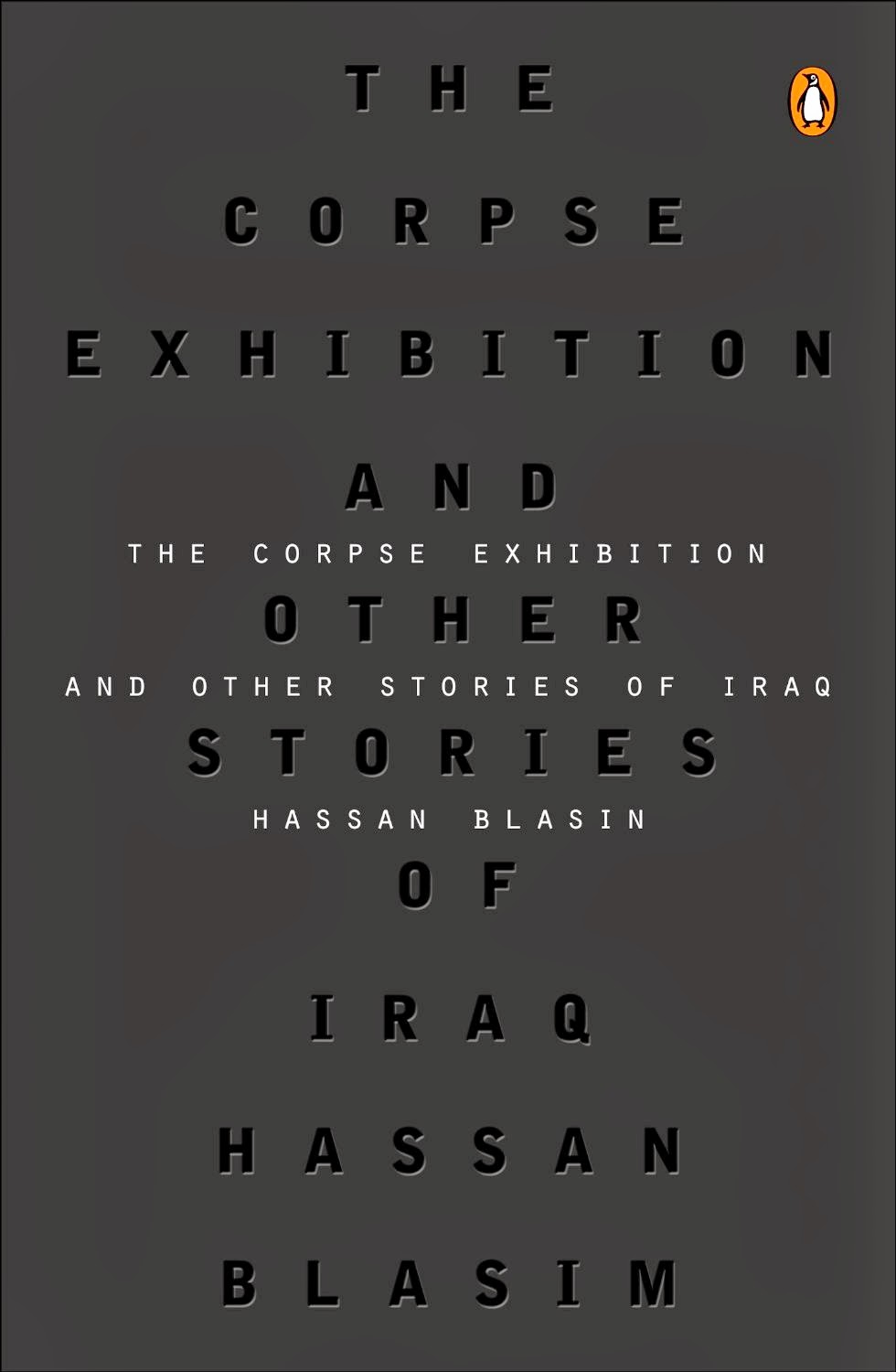
The Corpse ExhibitionTo give you an idea of what’s on my mind, here’s an excerpt from Iraqi short-story writer Hassan Blasim’s “An Army Newspaper.”  Blasim’s narrator is the cultural editor of a military newspaper during the Iraq-Iran War. He writes of the submissions that he would receive from soldier-authors:

But I do admit that I would often interfere in the structure and composition of the stories and poems, and try as far as possible to add imaginative touches to the written images that would come to us from the front.  For God’s sake, what’s the point, as we are about to embark on war in poetry, of someone saying, “I felt that the artillery bombardment was as hard as rain, but we were not afraid”?  I would cross that out and rewrite it:  “I felt that the artillery fire was like a carnival of stars, as we staggered like lovers across the soil of the homeland.”  This is just a small example of my modest interventions.

Now why would Blasim write that?  What was his narrator thinking?

Hassan Blasim, The Corpse Exhibition and Other Stories of Iraq. Penguin, 2013.  Translated by Jonathan Wright.

On Stage: Theater of War, Beyond the Wall, Goliath

“Thus with imagined wing our swift scene flies…
…and the nimble gunner
With linstock now the devilish cannon touches,
[Alarum, and chambers go off]
And down goes all before them.  Still be kind,
And eke out our performance with your mind.”
–Shakespeare, Henry V

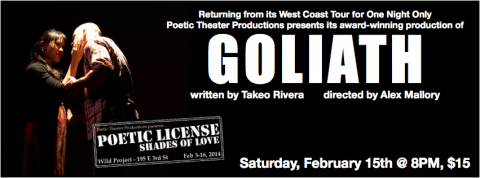
In the past few months I’ve attended three stage performances that portray contemporary war subjects and themes.  Theater of War, staged by a troupe called Outside the Wire, combines veterans and theatrical actors to read scenes from Sophocles’ plays Ajax and Philoctetes.  Both plays concern an anguished veteran’s return from the Homeric wars in ways that are relevant to contemporary redeployment issues.  Beyond the Wall, a work-in-progress product of a student vet at Vassar College named Jack Eubanks, is an ensemble dramatic reading that explores the pre- and post-deployment life of its lead character, while also making connections between the Iraq and Afghanistan conflicts and the Vietnam War.  Goliath, a production of a New York City experimental company called Poetic Theater, dramatizes the heinous acts of a soldier responsible for war crimes in Iraq.  Like Beyond the Wall, it shows us its hero before the war and then again afterwards.  A common thread of all three is their focus on traumatizing events while deployed and troubled relationships at home.  The plays are not especially subtle.  They go for characterization that borders on stereotype, on plot lines that, as I’ve reported, seem to be similar, emotions that tend toward the histrionic, and politics that indict and condemn.  They assume that war mangles its participants’ psyches, while implying that even more interesting than whatever takes place overseas are the altered-for-the-worse relations of vets with friends, family, lovers, and spouses upon redeployment.

Which just might be the stuff that makes good theater.  All three plays were galvanizing to watch and contemplate, and the shared excitement and common cause of the actors and audience palpable.  Each performance blended vets and non-vets both on stage and behind the curtain, with the audiences of each similarly mixed.  Everyone involved seemed like they were very glad to be in the company of so many like-minded performers and audience members, all committed to thinking just as hard and as well as they could about the impact of the wars.  Something about the plays—and dramatic performance at large–must be central to how the wars are being processed culturally.  Theater of War, Beyond the Wall, and Goliath each featured opportunities for audience members to engage in post-play Q&As with actors and directors.  Contemplating the melodrama of the plays and the earnestness of the post-play discussions, I mused about how the blurring of boundaries separating lighted stage and darkened seats united veterans and non-veterans, actors and audience in a warm balm of curiosity and sharing. The spirit of discovery and reflection may be as good as anything else we’ve got going today in terms of bridging the much talked about civil-military divide.

I encourage all to see productions of these plays if you get the chance, or even mount productions of your own as scripts become available.  And please join me in anticipation of new plays about the wars, which I am sure are forthcoming.

Outside the Wire/Theater of War

Beyond the Wall

Poetic Theater/Goliath

GoliathFB
I saw this production of Goliath at the Wild Project theater in New York City.

War Poetry: Brian Turner’s “A Soldier’s Arabic”

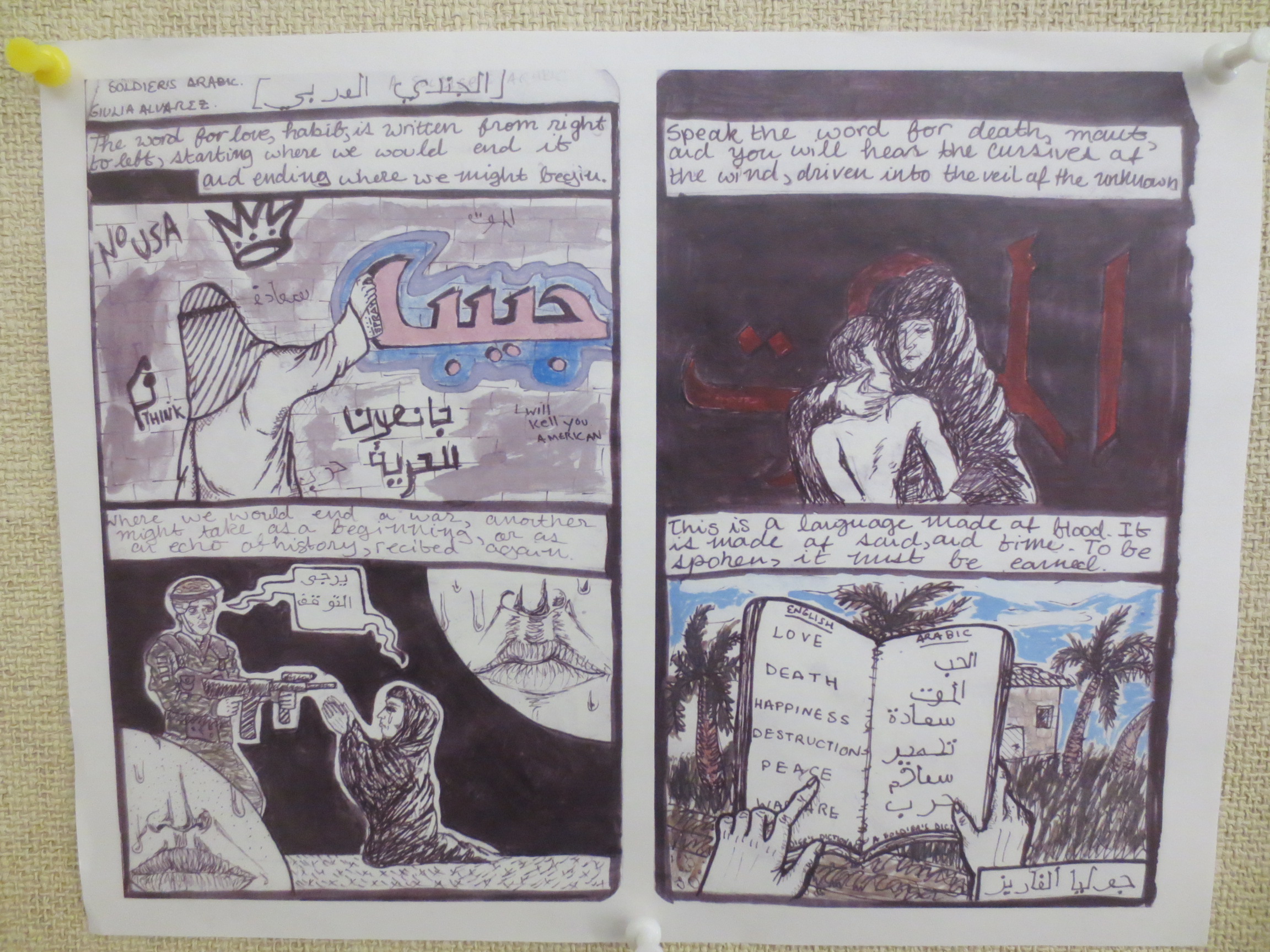
Brian Turner's "A Soldier's Arabic," as adapted by Giulia Alvarez
Brian Turner’s “A Soldier’s Arabic,” adapted by Giulia Alvarez. Click to enlarge!

“A Soldier’s Arabic”

This is a strange new kind of war where you learn just as much as you are able to believe.  –Ernest Hemingway

The word for love, habib, is written from right
to left, starting where we would end it
and ending where we might begin.

Where we would end a war
another might take as a beginning,
or as an echo of history, recited again.

Speak the word for death, maut,
and you will hear the cursives of the wind
driven into the veil of the unknown.

This is a language made of blood.
It is made of sand, and time.
To be spoken, it must be earned.

The great artwork by Giulia Alvarez at the top of the page illustrates the first poem in Brian Turner’s 2005 volume Here, Bullet.  Nine years after publication, not all might remember the force with which Here, Bullet shook the poetry world and inaugurated our contemporary war literature tradition.  No one in either the war or the lit business saw Turner coming–a poet with such skill, imagination, and empathy married with front-line experience, so devoid of amateurish stylistic flourishes or naïve or polemical thinking.  Even now, it’s hard to point to another war poet who comes close to the mark established by Turner in Here, Bullet and his subsequent 2010 volume Phantom Noise.  He practically defined the range of concerns and characteristic attitudes that almost all war lit writers would later echo, and in most cases he did so with more interesting imagery and emotional nuance than those that followed him.

Turner was also onto from the beginning subjects that others have overlooked or haven’t been prepared to deal with.  For example, the last line of “A Soldier’s Arabic”—“To be spoken, it must be earned”—seems to imply something about veteran-authors hoarding the right to speak with authority about war.  This sentiment remains strong today, but I don’t think it’s what Turner really feels, or what the poem is really about.  To me the line and the poem reach beyond the poet’s bond with fellow soldiers to embrace the Arab-Islamic world into which he and other Operation Iraqi Freedom participants were plunged.  Turner, more so than most American authors, has determinedly and persistently tried to measure the war in terms of the language, culture, and history of those on whose land it was fought.  Even a simple thing like learning the Arabic words for “love” and “death” is telling.  Not to underestimate anyone, but I’d be willing to bet less than 1% of Americans deployed to Iraq learned these most basic of words.  “Why would we?” they might ask, pragmatically enough from their perspectives, but short-sighted in its implications.

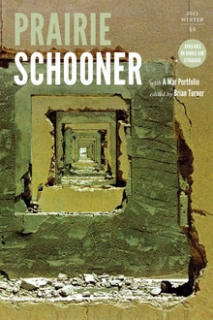
In this New York Times essay titled “After War, A Failure of the Imagination,” Marine vet Phil Klay asserts the power of fiction to make accessible foreign (in every sense of the word) experiences.  He pleads for readers who have not served or fought to sympathetically embrace the imagined worlds of war authors as acts that blend courage and curiosity.  Klay speaks mainly of efforts to bridge the divide between American civilian and military cultures, but pace Turner, I would extend Klay’s argument to the poetry and fiction written by Iraqis and Afghans. Turner as always leads the way.  In the current issue of Prairie Schooner, Turner as guest editor includes work by Iraqi, Afghan, Iranian, Pakistani, and Sudanese authors in near-equal numbers alongside American and European writers on war and conflict.  I look forward to opportunities to write about these authors and in the spirit of Turner offer notice of the following works of fiction authored by Iraqi writers:

Hassan Blasim’s The Corpse Exhibition and Other Stories of Iraq, recently published by Penguin.  I have written about Blasim here and will write more about him soon.

Abdel Khaliq al-Rikabi’s The Sad Night of Ali Baba.  Not yet translated into English, a short description is here and an interview with al-Rikabi is here.

Ahmed Saadwi’s Frankenstein in Baghdad.  Also not yet translated into English, but an intriguing review is here.

Thanks to Sean Case for alerting me to the Arabic Literature (in English) website.  Big thanks to Giulia Alvarez and all the other students in Rebecca Bahr’s War and Literature class at Horace Mann School in the Bronx, New York City.

War Film: Lone Survivor

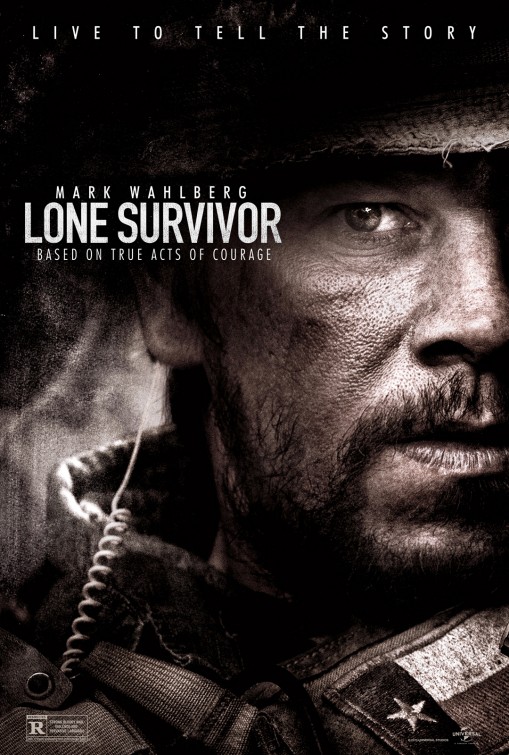
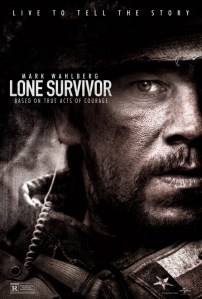
lone_survivorLone Survivor joins a number of recent movies that portray unique or elite units at war in Iraq and Afghanistan:  The Objective, Zero Dark Thirty, and The Hurt Locker, for starters, and you might throw in Act of Valor and Delta Farce, too.  The last two aren’t set in Iraq or Afghanistan, but promote and capitalize on the allure special operations units and missions have for Hollywood filmmakers and American audiences.  Perfectly understandable—special operators exude that same allure within our actual fighting forces, too.  Anyone who served on a FOB that was home to a special forces outfit knows exactly what I’m talking about—the burly, bearded men swaggered about their compounds exempt from penny-ante rules about uniforms and grooming, owned the coolest weapons and trucks, and seemed to get all the bad-ass missions.

This micro-level schism played out at the higher strategic levels, too, as recorded in numerous memoirs and histories.  What made the biggest contribution to achieving our war aims?  The endless grind of counterinsurgency operations to win the hearts-and-minds of the populace and their leaders, or the dashing midnight raids to kill or capture insurgent “high value targets”?  Even line soldiers who got their full fill of danger and fighting on daily operations basked in the opportunity to brush shoulders with the Operational Detachment-Alphas, Ranger task forces, and Other Government Agencies that saturated the warzones.  Machine gunner Colby Buzzell writes in My War of a raid his unit conducted with an elite force:  “Doing a joint mission with Task Force 121 in Iraq was every infantryman’s wet fucking dream…. And of course we all wished that we were them.”

Filmmaker Peter Berg gets the ultra-competent insouciance of the Navy SEALs right in the early scenes of Lone Survivor, the story of a four-man SEAL team mission to track a high-level Taliban leader.  The opening shots of would-be SEALs going through selection training in Coronado were very inspiring.  Speaking as someone who joined the Army almost solely for the chance to go to Ranger School, I did my own basking in sympathetic admiration for other men who sought out the hardest tests of strength and stamina they could find.  That Lone Survivor’s opening montage of abjectly brutal training played, unexpectedly, to the spacey post-rock of Explosions in the Sky sealed the deal for me.  Explosions in the Sky was a key component of my personal Afghanistan soundtrack—a friend gave me a compilation CD just before deploying—and now to see the band’s music used prominently in Berg’s movie excited me to no end.

“Lone Survivor” by Explosions in the Sky

The long first two-thirds of Lone Survivor sustained the strong positive impressions of the opening scenes.  Berg appears to have composed the portraits of the SEALs at home in their Bagram Air Force Base camp and the first phases of their doomed reconnaissance mission with an eye toward realism and authenticity both to Marcus Luttrell’s memoir and what he could glean of what these things actually looked like.  But as the SEAL’s mission goes awry and the big battle that took the lives of three of Luttrell’s teammates begins, minor quibbles with both the SEAL team tactics and Berg’s movie-making strategy began to intrude.

Why didn’t the SEALs bring an interpreter?

Why didn’t they take the Afghan goatherders with them back to their helicopter pick-up zone and then release them when they were extracted?

Couldn’t they find hide positions that gave them better fields of fires from which they might defend themselves when attacked ?

I’ve got my own combat decisions to be second-guessed, so let’s leave those questions alone and concern ourselves with Berg’s moviemaking choices.  Once the outnumbered SEALs begin to battle the Taliban, authenticity in Lone Survivor takes a backseat to jazzed-up razzmatazz action movie-making.  Luttrell’s book, which I love, describes the SEAL team being pushed backwards from their hilltop defensive position, with the men alternately leaping or being blown off a series of mountainside ledges.  To film these tumbles down the mountainside, Berg employs a telescopic close-up/slow motion/ground-level tracking/stereophonic thudding sensational film style that portray the falls from perspectives unattainable by any human in real time.  But to what end?  As filmed, it appears the falls would be impossible to survive without concussions or broken bones, but none of that happens to Luttrell and his mates.  With each successive leap and tumble, then, Lone Survivor begins to morph from near-documentary biopic to war-movie fantasy-thriller.

So it was with a slight foreboding I waited for Berg’s rendition of the best scene in Luttrell’s memoir:  his account of team leader Lieutenant Michael Murphy’s courage in exposing himself to enemy fire to make one last satellite phone call for help.  Luttrell writes,

“I could hear him talking. ‘My men are taking heavy fire… we’re getting picked apart.  My guys are dying out here… we need help.’

“And then Mikey took a bullet straight in the back.  I saw the blood spurt from his chest.  He slumped forward, dropping his phone and his rifle.  But then he braced himself, grabbed them both, sat upright again, and once more put the phone to his ear.

I heard him speak again.  “Roger that, sir.  Thank you.’”

Continuing, Luttrell writes,

Roger that, sir.  Thank you.  Will those words ever dim in my memory, even if I live to be a hundred?  Will I ever forget them?  Would you?  And was there ever a greater SEAL team commander, an officer who fought to the last and, as perhaps his dying move, risked everything to save his remaining men…. If they build a memorial to him as high as the Empire State Building, it won’t ever be high enough for me.”

The scene is the emotional centerpiece of the book—Luttrell’s awed recognition that Lieutenant Murphy is not just brave and competent and fiercely dedicated to his sailors, but that he also possesses an uncrackable sense of military deference and personal politeness in regard to his superiors.  Later in the book, Luttrell learns of the pashtunwali codes of hospitality that bind the Afghan villages who rescue him.  But here, watching Lieutenant Murphy he attains a similar glimpse into another foreign culture—that of his officers, or at least one of them, who insists on human decency and the importance of respectful communication in the most dire conditions.

Berg downplays much of this.  In the midst of movie that guns for big emotional buy-ins, the scene is hurried over.  If I recall correctly, we don’t even get the “Roger that, sir.  Thank you” remarks, nor is the scene portrayed from a perspective clearly identifiable as Luttrell’s—who according to his book was the only one who saw it.  Try if you can to find a YouTube clip of the scene–it’s not in any of the trailers.  Can we speculate that perhaps Berg didn’t know how to manage its portrayal, or perhaps even that he didn’t want to?  The filmmaking logic here would be that emphasizing Murphy’s heroism and Luttrell’s response would shift the focus from Luttrell and the team to Murphy.  I get that, and am sure Murphy would agree, too.  But the decision might also reflect Berg’s opinion that Murphy made the wrong decision to let the goatherders go and thus doesn’t deserve heroic portrayal.  I don’t want to think the worst, so let’s let it remain a curiosity that a cinematic portrayal of a Medal of Honor-winning moment gives it such short shrift.

Also hurried over are the book’s entire last third, which tells of Luttrell’s rescue by the villagers of the anti-Taliban town of Sabray and their efforts to deliver Luttrell to American search parties.  These events get about 10 minutes of screentime in the movie, and that which is portrayed deviates from Luttrell’s gripping and sensitive account to tell a far more Hollywood-y story so packed with action-movie clichés to be almost laughable.  In his review of Lone Survivor for The Daily Beast, Benjamin Busch argues that Berg missed a chance to make a better movie by sticking closer to the book.  Or, a better movie by leaving out the Sabray scenes entirely and keeping the focus on combat.  I agree that something more powerful lurks behind the scenes that Berg cartoonishly renders. At movie’s end, the Luttrell character says goodbye to his rescuer Sarawa, more Explosions in the Sky cues and then segues into a cover version by Peter Gabriel of David Bowie’s “Heroes”—one of my all-time favorite songs—that overlays a closing credits montage of all the soldiers and sailors killed in the Lone Survivor operation.  As the credits rolled, tears welled in my eyes and pride in the courage, competence, and fundamental decency of Luttrell, Murphy, all the members of our nation’s elite fighting forces, and Sarawa, too, swelled in my chest.  I don’t love love Lone Survivor, but I definitely can’t hate it, either.  I’m just a little mad at it.  I  don’t know whether to be angry at corporate moviemaking dynamics or Berg’s artistic direction, but I want Lone Survior to be even more than it is, and it’s pretty clear where it goes wrong.

Anyone interested in the geneology of Hollywood’s love affair with special operations has to watch the Vietnam-era The Green Berets, starring John Wayne (1968).  Unabashed heroism and patriotism soon fell out of favor in Hollywood, and movies after The Green BeretsThe Deer Hunter, Coming Home, Apocalypse Now, Platoon, Full Metal Jacket— were apt to be gloomy and skeptical.  Things began to change in 1986 with the release of the Chuck Norris sizzler The Delta Force and its sequels, but the real work rekindling the glamor of special operations in impressionable young men’s minds were books published in the ’90s by former SEAL Team 6 commander Richard Marcinko and British SAS operator Andy McNab.  To say their memoirs are inspirational page-turners would be a huge understatement.  I’m betting that special operators who haven’t read Marcinko’s Rogue Warrior (1992) and McNab’s Bravo Two Zero (1993) are few and far between.

A Marine’s Poetry: Johnson Wiley

Johnson Wiley is a former Marine now studying at Rutgers.  I heard him read last week at Pete’s Candy Shop in Brooklyn, NY, and asked him to send me one or two poems.  He did, and here they are.  In his email to me, Wiley wrote, “After the reading I was able to speak with another veteran who told me that he related very much to my poetry, and I hope that anyone else, and any other vets and service men and women who read it will also get something from it.”

“Shooting Stars of Kuwait”

In less than a second you pass overhead.
Sometimes alone, other times in pairs,
Playing a cosmic game of follow-the-glowing-leader.

Is it your ability to avoid petty human affairs
That allows you to fly so carefree?

Your radiance against the darkness
Erodes my sense of pride
Like a sand hill in a windstorm.
You and I were not given a choice of where to live.
I, on the life-giving, blue-green marble of Earth;
You, in the unforgiving, vacuum of space.
Yet, somehow, I think you got the better deal.

An unforeseen conflict broke my
Made-in-the-USA glass bubble,
And brought me here, to witness your stellar travels.

And though I know that my terrestrial rounds can’t reach you,
It is for you that I must take aim.
Will you come back tomorrow?

“A Mother’s Son Returned”

“You lost your smile,” she says.
And what was she supposed to say,
When the traces of the child she waved goodbye to
Were expected to be present in the young man who returned?
Physically the same, but…emotionally inaccessible.
The keys to my mental vault I keep hidden,
Locked away in a place so deep even I don’t have access to them.
“Do you ever smile anymore?” she asks with a quiver in her voice.
But, how can a man smile when he no longer finds humor in the world?
You know so little about me.
Yet, you know me more than anyone else.
She’s still looking for the child she remembers the last time she saw me.
“Can’t you hear me talking to you?” she asks.
I can’t be who I was before I left.
Not for you, not even for me.

Thanks, Johnson, and please keep on writing.

More about mothers and the contemporary wars here.  More thoughts on the Marines here.

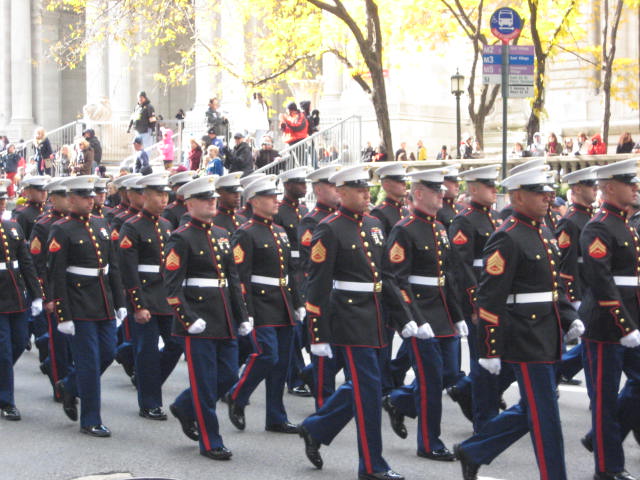
Marines on parade, Veterans Day, 2011, NYC.

Two Nights on the Town in NYC: War Lit Readings at The Center for Fiction and Pete’s Candy Store

Two readings in New York City last week—one by novelist Roxana Robinson and reporter David Finkel at the The Center for Fiction, a bookstore and library in midtown Manhattan, and another of new works by three young military veterans at Pete’s Candy Store, a Brooklyn bar—put the subjects, themes, and styles of the contemporary war lit scene on full and somewhat contrasting display.

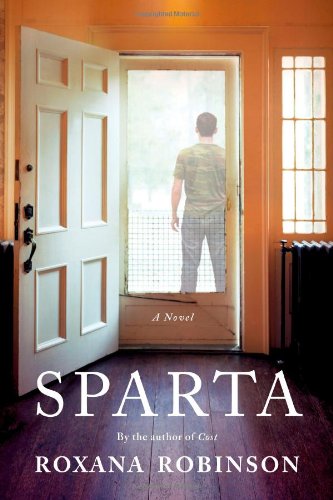
Sparta CoverThe Center for Fiction event, titled Fact and Fiction, featured Robinson and Finkel reading from their respective recent works Sparta and Thank You for Your Service.  Both Robinson and Finkel are established writers with a number of published works, prizes, and accolades to their names.  Neither are veterans, but their most recent works alike concern themselves with the aftermath of war.  Sparta tracks the downward spiral of a young Marine Corps officer, while Thank You for Your Service documents the tumultuous post-deployment lives of the Army infantry soldiers featured in Finkel’s acclaimed The Good Soldiers. Though Sparta is fiction and Thank You for Your Service non-fiction, they share a similar prose texture.  Robinson eschews flights of lyrical fancy for a plain style that mirrors reportage, and Finkel takes an almost anthropological interest in the daily details of the lives he describes.  The passages each read might well have been extracted from the other’s book, with characters and events of each portraying the war’s ability to inflect or even ruin the most mundane of day-to-day peacetime activities.

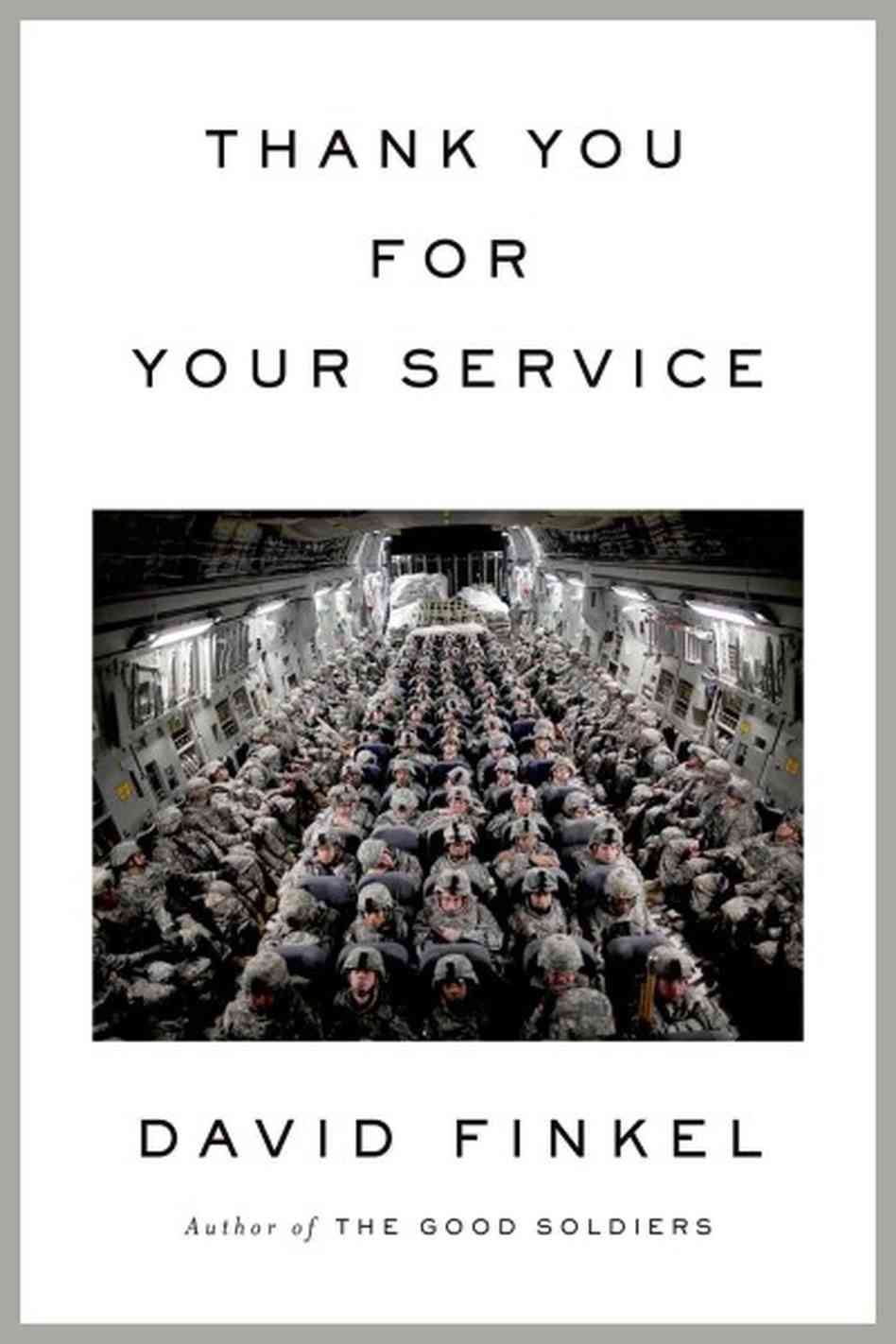
Thank You for Your ServiceBoth Robinson and Finkel have measured the psychological and social carnage wrought by the wars on those who fought them.  Not every combat veteran is a tortured soul, but a whole hell of a lot of them are, and Robinson and Finkel are appalled by the extremely uneven efforts of the nation to adequately help them.  The pairing of the two authors by The Center for Fiction makes sense, and would also work well in a college course or for anyone trying to understand post-traumatic stress.  “Stories matter,” said Finkel, and together Robinson’s and Finkel’s narratives carry their fair share of the load and then some (my favorite line from the Ranger Creed) in reminding, alerting, and inspiring an often oblivious nation to help struggling veterans.  Much is made of the “civil-military divide,” as if it’s the civilians who are out-of-touch with things.  But Robinson and Finkel have performed yeoman work trying to understand military culture and then reporting back sympathetically to the American reading public, while also helping the military understand itself.  Those in uniform should thank THEM for their service.

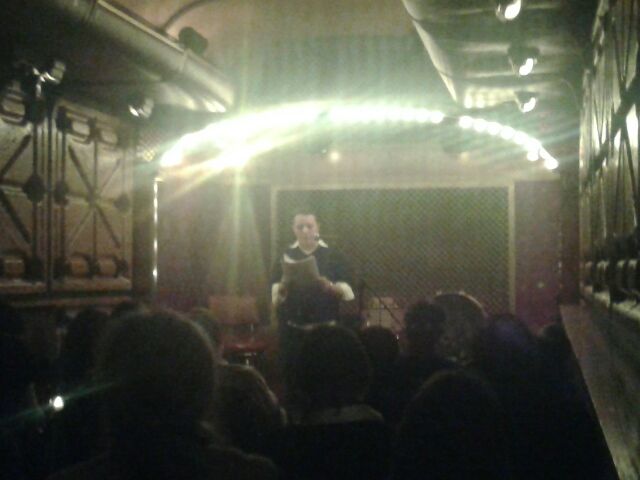
The Brooklyn event was part of Pete’s Candy Store’s Reading Series, which is dedicated to showcasing up-and-coming authors.  Titled Veterans of the Iraq/Afghanistan War, the reading was organized by Fire and Forget editor Roy Scranton, the ex-Army artilleryman and current Princeton graduate student who is fast becoming the Ezra Pound of the war lit world—a talented writer in his own right who also nourishes other writers’ geniuses (just go easy on any late-life hateful politics, please, Roy!).  I don’t think the three authors Scranton presented at Pete’s were full of the rage and confusion described by Robinson and Finkel, but stories definitely mattered to them, as they did to those of us in attendance.  In the tiny, dark performance space, on a night where temperatures outside hovered in the single digits, with most of the audience a pint or two down the hatch, the authors spun webs of words that enveloped their listeners in a dreamy snare of story-telling enchantment.  The picture below, bad as it is, renders something of the ambiance:

2014-01-23 19.53.39
Kristen L. Rouse reads at Pete’s Candy Store, Brooklyn, NY, 23 January 2014

Kristen L. Rouse, a three-time Afghanistan veteran, read a short story about military operations in Paktya province, the same area of operations in which I served.  Her story brought much of it back—the vehicle movements on IED-filled roads, the god-forsaken outposts, and the chai-drenched meetings with Afghans.  Clap your hands and say yea if you’ve ever been to COP Zormat, it ain’t easy to get to….   Johnson Wiley, a Marine Corps vet now studying at Rutgers, followed with poetry that I found compelling and evocative.  I have asked Wiley to send me a poem or two, and if he does I will post at least one.  Last up was Ravi Venkataramani, a West Point graduate who is now studying for his MFA at Columbia.  Venkataramani read a stunning story about a classmate’s death that portrayed the full measure of guilt and obligation inflicted on West Point grads by the relentless pressure of the military academy’s “duty, honor, country” ethos.

In conversation, Venkataramani reminisced fondly about a West Point English teacher named Major William Hecker.  I knew Hecker only from a few emails, but Venkataramani’s respect resonated with me.  While at West Point, Hecker wrote a well-received critical work in which he traced the origins of a famous essay by Edgar Allan Poe (who briefly attended West Point) called “The Philosophy of Composition” to Poe’s service in the Army as an artilleryman.  According to Hecker, Poe’s theory that all aspects of a work of fiction must contribute to a focused and climactic “literary effect” was garnered from artillery manuals that specified how to make bombs explode exactly on target.  The irony of all this is that a year after publishing this work, which marked him as an Army scholar of enormous potential, Hecker, also an artilleryman, was killed in Iraq by an IED—perhaps a mine and not a buried shell, but still a death freighted with an extra measure of cruelness, in a war already full of it.

RIP Major Bill Hecker, thank you for your service in Iraq and in the classroom.  As the West Point Alma Mater states, “Well done, be thou at peace.”  We’ll also dedicate this post to all the proud artillerymen out there: “Redlegs,” as they call themselves; their motto, “the King of Battle.”

Roxana Robinson’s Sparta, published by Sarah Crichton Books/Farrar, Straus and Gioux in 2013.

David Finkel’s The Good Soldiers, published by Macmillan in 2009.

David Finkel’s Thank You for Your Service, published by Sarah Crichton Books/Farrar, Straus and Gioux, in 2013

Fire and Forget:  Short Stories from the Long War, edited by Roy Scranton and Matt Gallagher, published by Da Capo Press in 2013.

Edgar Allan Poe.  Private Perry and Mr. Poe:  The West Point Poems, 1831, edited by William Hecker with an introduction by Daniel Hoffman and an afterword by Gerard McGowan, published by Louisiana State University Press in 2005.

Thank you everybody concerned at The Center for Fiction and Pete’s Candy Store for staging such great events.  Thanks also to Charlie Markley and Sean Case, who accompanied me to Pete’s Candy Store and helped make the night so enjoyable.

Little Magazines 3: Prairie Schooner and Michigan Quarterly Review

Prairie SchoonerTwo respected academic journals feature big time talents as guest editors of recent issues given over to war literature.  Prairie Schooner invited Brian Turner to assemble an all-star collection of writers on contemporary war for its winter 2013 issue, and Turner has delivered the goods.  Elyse Fenton, Siobhan Fallon, Roy Scranton, Benjamin Busch, and Colby Buzzell are familiar names who have contributed stories, poems, and essays to the issue.  Turner, always alert to non-American perspectives, also includes entries by foreign authors and writers on wars other than the Iraq and Afghanistan ones.  A complete version is not available on-line, and I don’t have a paper copy yet, but a roster of authors and titles can be found here.

I am honored to participate in a Prairie Schooner roundtable electronic discussion titled On War Writing.”  Other participants include Donald Anderson, Doug Anderson, Matt Gallagher, and Marilyn Nelson, whose work I have read, and Sam Hamill and Stacey Peebles, who are unknown to me but whose work I am looking forward to getting to know. 

Michigan Quarterly ReviewBenjamin Busch has selected and introduced a collection of Iraq and Afghanistan war poems for the winter 2013 issue of the Michigan Quarterly Review.  In “From the Desert Wars: Introduction,” Busch writes, “…these are words chipped out of the dirt by survivors exploring themselves and their war, all of them leading you to the monster.  It as though each poet carefully laid out his field notes, searched them for connections  to the immensity of human conflict, and found the least amount of language possible to send us messages.  This is what is left, just these words, each poet sifting the battlefield for evidence to compose a truth.”

I am not familiar with the poets, all veterans, Busch has chosen to publish but will honor their names—Bruce Lack, Hugh Martin, Clint Garner, Patrick Whalen—and look for ways to talk about their poems in more detail in later posts.  Busch contributes two poems of his own.  One, titled “Girls,” wonders what female Iraqi or Afghan children must make of the American soldiers in their midst.  Two lines:

We pass because we must, slow and reptilian,
unable to pretend we mean no harm.

I’ll quote another, titled “Subtext,” in its entirety:

“This is not about that”
It is too obvious
to write about, an occurrence
long with disappointment.
But it is over.
Uneven mud brick walls,
burnt plastic wind, diesel exhaust,
dust in the sky, children running,
the curiosity of goats
and men with sticks.
Body heavy with bullets, soil thick with bone and bleeding,
face rough with salt.
The war occurs
in everything now,
and this
is about that.

Busch is also in electronic print in The Daily Beast with this review of Lone Survivor.   I haven’t seen Lone Survivor yet, but will soon and look forward to writing about it, too.

More Notes Toward a Supreme War Fiction: Ryan Bubalo, Fire and Forget, Phil Klay, Frederick Busch, 0-Dark-Thirty, Nikolina Kuludžan

“Notes Toward a Supreme Fiction” is the title of a long Wallace Stevens poem that includes the lines:

Soldier, there is a war between the mind
And sky, between thought and day and night.

Later, Stevens writes:

How gladly with proper words the soldier dies,
If he must, or lives on the bread of faithful speech

With that, let’s catch up on developments in the contemporary war fiction scene.

A review essay in the LA Review of Books titled “Danger Close: The Iraq War in American Fiction” by Ryan Bubalo surveys major works by familiar war lit authors such as David Abrams, Kevin Powers, Siobhan Fallon, and Ben Fountain.   Writing of Billy Lynn, the protagonist of Fountain’s Billy Lynn’s Long Halftime Walk, Bubalo asks:  “To learn what you have to learn at the war, to do what you have to do, does this make you the enemy of all that sent you to the war?”  Kudos to the LA Review of Books, whose continuing coverage of war literature surpasses that of all the major literary reviews.

Brian Van Reet, one of the authors featured in the excellent Fire and Forget anthology (which is also mentioned in Bubalo’s piece), brings word on this blog post that Army Times has named Fire and Forget the #1 military book published in 2013.  Very cool of Army Times to place a work of fiction above the many memoirs, histories, and other non-fiction works about the Iraq and Afghanistan wars pouring out of the nation’s publishing houses.  And why not?  Fire and Forget features a who’s-who list of contemporary war authors, to include Abrams, Fallon, Matt Gallagher, and Brian Turner.

Speaking of which, a collection of short stories called Redeployment, by Phil Klay, yet another Fire and Forget author, will be published in March 2014 by Penguin, a big-time publisher.  Advance reviews are already lauding Redeployment, and having had the chance also to read it, I’ll praise it, too.  Klay, a former Marine, obviously kept his eyes open and a pen and pad handy on his Iraq deployment and afterwards, and now has crafted stories that open up interesting and important new vistas on the war experience.  An advance review from Kirkus is here.

Dust to Dust author and Generation Kill actor Benjamin Busch’s father Frederick Busch was a very accomplished author himself, having published many novels and short stories in the years before his death in 2006.   A new collection of short fiction, called The Stories of Frederick Busch, brings to the fore two tales from Busch senior’s 2006 collection Rescue Missions in which the Iraq War figures prominently.  In “Good to Go,” a couple whose marriage has cracked up reunites to help their war-tormented son.  In “Patrols,” a middle-aged writer back from a gig as an embedded reporter struggles with a case of writer’s block that is clearly related to the haplessly ineffectual role he played among the fighting men he covered.  Frederick Busch was known as a writer’s writer, a pro’s pro, and it is easy to see why.  Both stories move with a stately imperative not to be rushed, to not reveal all their secrets too quickly, that younger war writers might well emulate.

Ron Capps’ Veterans Writing Project has served invaluably as a place in which aspiring veteran and non-veteran writers interested in war subjects might find their voice and even publication in the VWP’s journal O-Dark-Thirty.  The latest issue contains perhaps the most sensational story I have yet read about the contemporary wars.  Called “The Final Cut,” it’s by a woman named Nikolina Kuludžan who is not a vet but has taught at the Defense Language Institute in Monterrey, California.  In “The Final Cut,” a young single female soldier begins an affair post-deployment with the man—married–who was her platoon sergeant in-theater.  The story starts in an almost breathless bodice-ripper fashion—the platoon sergeant’s name is “Rip,” and the narrator writes that “his body looks exactly how I always imagined it:  a flawless testament to fifteen years of pushups, pull-ups, sit-ups and running.  It’s a body that has fulfilled nature’s intent.” But it gets much darker and psychologically astute as the illicit sex the two share grows kinkier and the narrator’s understanding of the war-related dimensions of their relationship develops and deepens.  Clearly, the platoon sergeant requires more than a cold beer and a brand new flat-screen to simmer down after the intensity of combat; his darling wifey doesn’t come close to sating his need for intimacy, excitement, risk, and escape.  The narrator doesn’t say no for a second to the sergeant’s demands for sex, as if she knows his hunger is deeper seated than mere horniness and her ever-ready availability.  But she’s also aware that his wife lurks on the fringes of their passion, the odd one out in a post-deployment melodrama of jangled erotic circuitry.  The narrator states, “I just want all of us to admit that we’re in pain.   That we are not as normal as we make ourselves out to be.  That we need help.”  She suggests, and perhaps Kuludžan wants us to think, that she’s doing both the platoon sergeant and his wife a favor, that all this out-of-bounds coupling just has to happen before anything will ever be all right again.

Like Stevens writes, “Soldier, there is a war between the mind / And sky, between thought and day and night.”

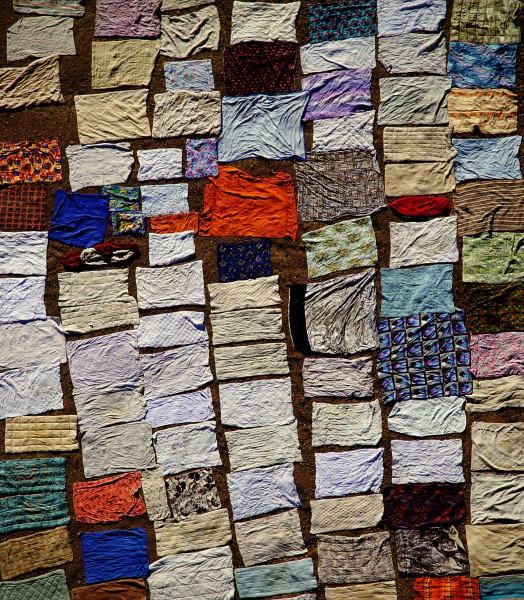
Laundry laid out to dry in Khowst, Afghanistan

Another blog post reference to Wallace Stevens’ “Notes Toward a Supreme Fiction” here.

Fire and Forget:  Short Stories from the Long War, edited by Matt Gallagher and Roy Scranton, published by De Capo, 2013.

Phil Klay’s Redeployment, to be published in March 2014 by Penguin.

The Stories of Frederick Busch, edited and with an introduction by Elizabeth Strout, published by Norton in 2014.

War Songs: Newsted’s Heavy Metal Tribute to Pat Tillman

Here’s ex-Metallica bassist Jason Newsted’s new band performing a song called “Soldierhead” from their 2013 album Heavy Metal Music:

Here is Newsted’s explanation of the lyrics from the Songfacts website:

And the lyrical content is based upon the Pat Tillman story, the NFL football player that went to be a hero and died of friendly fire in Afghanistan. So it was about standing up for yourself and being a hero. He was a gifted person; always could jump higher and run faster than everybody and wanted to use those abilities to protect what he believed in. The song is about standing up for what you believe in, and being willing to give your life for what you believe in. So even when you have it really good, you’ll still stand up for something you believe in, even though you wouldn’t have to. So that’s the subject matter in that one.

Here are the lyrics:

Bombs go off around me
Bullets chase my head
Demonscene hellscape
Try to not get dead

From the cradle I was in
Straight for the firing line
By the teeth of my skin
Dragon and the serpent versus swine

Never quite ready
It just becomes your turn
Evertight steady
No more light to burn

A lie has no feet
Cannot stand alone
A cry in the street
Who cast the first stone

With dirt between my teeth
I made the devil sell his soul
I know that he can bleed
Moon goes dark sun grows cold

Where my mind would take me
Never coming near
Scared my heart would break me
Why am I here 

Pat Tillman interests me, too, and I wrote about him on my old blog here.  My impression is that Tillman had a contemplative sereneness about him, while Newsted suggests he was full of anger and darkness.  Who knows? That’s what art allows us to do, explore possibilities.  I am very sure there will be more musical tributes and film and literary adaptations of Tillman’s life story in the years to come.

“Soldierhead” music and lyrics by Jason Newsted, lyrics © Imagem U.S. LLC.

A Night Out with Photographer Bill Putnam

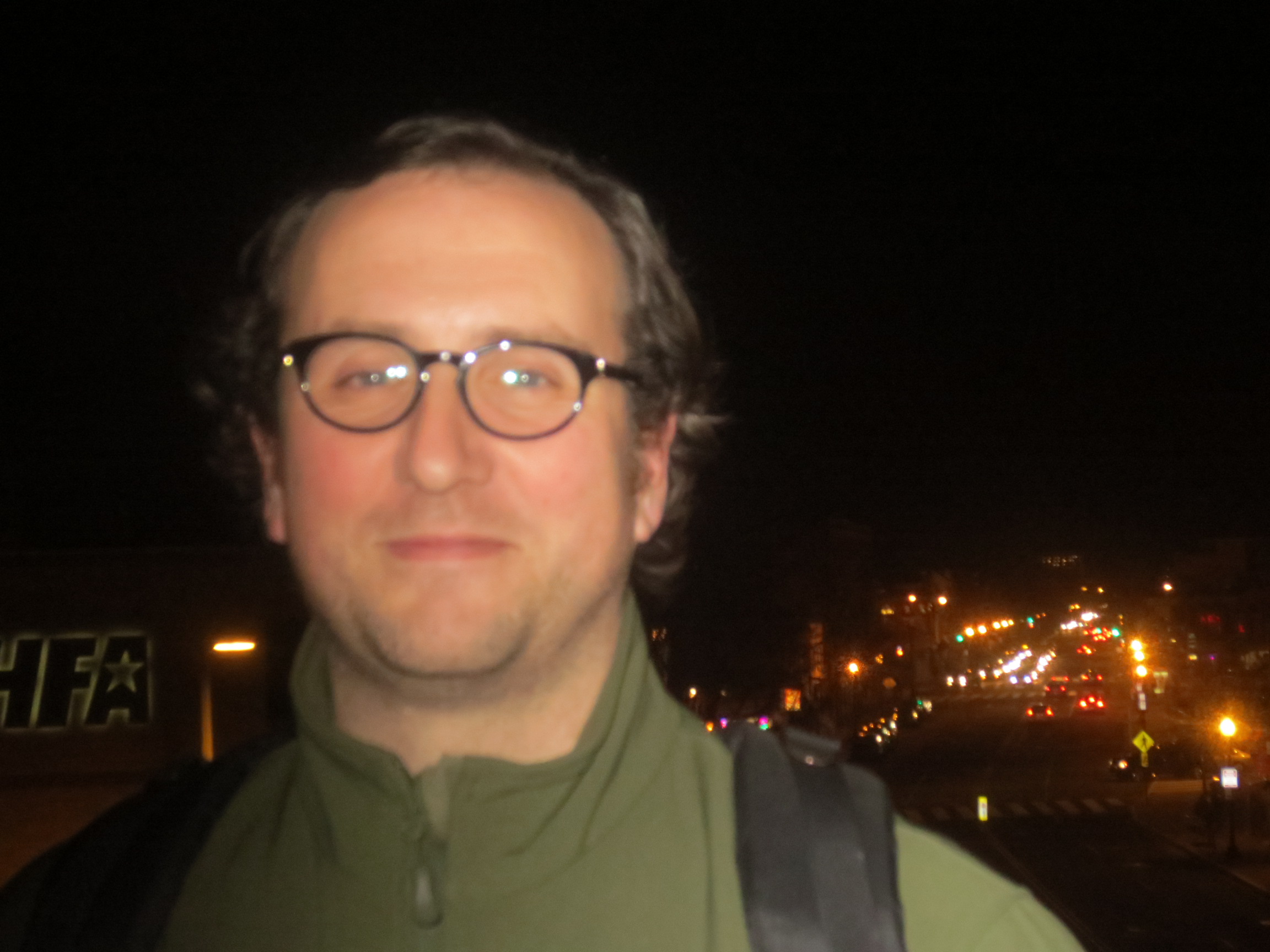
IMG_1244A trip to DC allowed to reconnect with Bill Putnam, the former US Army combat cameraman and embedded journalist whose work I have featured many times in this blog. Bill and I first met in Kosovo in 2002 where we were both part of Task Force 2-14, based in Camp Monteith in the northern part of the American sector. Later Bill served in Iraq as both a soldier and a civilian photojournalist and then twice in Afghanistan, first with the 101st Airborne Division in Paktika province and then in Helmand at Camp Leatherneck as the public affairs officer for a unit charged with training Afghan security forces. He currently lives in Washington and is going to school while looking for new photographic opportunities.

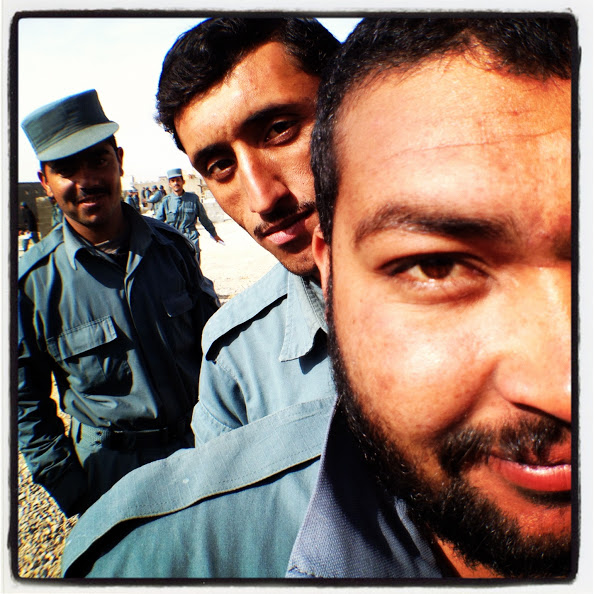
For me, Bill’s pictures are so alert to their subjects’ eyes that they read like uncanny straight shots into whatever it is the subjects think most important.  What they most want you to know, or what they most need to hide, or both.  Below, for example, is a shot Bill took of Afghan National Police recruits in training at Camp Leatherneck.

Afghan Natonal Police at Camp Leatherneck

In DC, we met at a dark, moody bar blasting classic and contemporary punk rock—hell yea–and traded our stories and plotted future projects. Bill told me the backstory of the pictures I’ve published here and brought me up-to-date on his current endeavors.  Here’s to you, Bill, and thanks for everything you’ve contributed to Time Now–you’re a true acolyte-of-war, now moving on to other things.

Bill Putnam website

Bill Putnam Twitter

Bill Putnam Facebook