“Terps”: Afghan and Iraqi Interpreters in War Memoir and Fiction

One aspect of the wars in Iraq and Afghanistan not generally understood is how dependent were American and other Western forces on the services of native interpreters to mediate virtually every interaction with host-nation military personnel and civilians.  Given the lack of Arabic, Dari, and Pashto speakers actually in the military and the paucity of bilingual speakers in Iraq and Afghanistan, you can assume that anything you might have read about in the papers that involved on-the-ground operations, and the millions of missions and engagements you didn’t, took place with a native speaker translator at the side of the officer or NCO charged with carrying them out.  Though some interpreters in Iraq outlaw-platoonand Afghanistan were American citizens or residents recruited in America and then deployed back to their homelands, most were natives. The fullest portrait of a host-nation interpreter and a US military member I know of appears in Sean Parnell’s Outlaw Platoon (2012), a memoir about Parnell’s service as an infantry platoon leader in Paktika province, Afghanistan.  Parnell uses anecdotes about his interpreters, one, named Abdul, faithful and competent, the other, Yusef, untrustworthy and treacherous, to frame his account.  “A good ‘terp,’” writes Parnell, “could make a huge difference in daily operations.”
“Terp” was the commonly used shorthand to describe military linguists.  I never really liked the term, but it was ubiquitous and even I would use it to describe “Terp Village,” the humble compounds affixed to US bases in which a unit’s interpreters lived.  The term appears again in a passage found in journalist-historian Bing West’s The Wrong War (2011).  West, describing operations in southern Afghanistan, writes, “The interpreters were the funnel for all coalition interactions with Afghans at all levels.”  Then, describing an interpreter named Siad, West continues: “Siad was typical of the local The Wrong Warinterpreters.  They all tried hard, and most worshipped the grunts they served locally.  Their thirst for absorbing American culture never ceased…  Their skills were marginal, no matter how hard they tried.  Their hearts were huge.  Anyone who doubted the magical image of America in the minds of millions of Afghans had only to spend a day under fire with a U.S. squad and the local terp.”

Before examining fictional representations of interpreters, I’ll post a passage from a private document written by a former interpreter of mine who is now applying for admission to the US.  It offers insight into the lived life of the men described abstractly so far:

I am engaged now and my fiancé is from Ghazni province.  All her relatives know that I am working with Coalition Forces as a linguist.  For that reason, I cannot go to Ghazni province now to see her or relatives or take part in a condolence or happiness party.  Since I know that everybody knows that I am working with Coalition Forces I do not feel free and I am sure my life is at risk.  Even in Kabul City where I live, I cannot go out at night and visit other people because I am very afraid my life is at risk.

War fiction writers have begun to make something of the possibilities offered by these complex figures and intense soldier-local national relationships.  Their portraits do what fiction does:  combine artistic creativity with realistic verisimilitude to provide social, psychological, and emotional nuance.  They might be said, however, to focus on dramatic aspects where the day to day record is more placid or positive.  The first depiction of which I am aware is in a Siobhan Fallon short story “Camp Liberty,” from her collection You Know When the Men are Gone (2011).  In this story, Fallon tells of a soldier deployed to Iraq, named  David, whose romantic relationship with SF-PictureMarissa, his stateside fiancé, fades as the working one with Raneen, a female interpreter, intensifies.  David grows enamored of Raneen, but she disappears and is probably killed before he is able to speak to her in anything but an on-the-job context.  Her disappearance leaves him more adrift than he imagined possible, and perhaps now too estranged from Marissa for that to ever be right again.  Fallon puts a romantic spin on what was usually a close working relationship between two men, while characterizing David and Raneen’s relationship as at least reasonably compatible and effective, but other stories depict much more fraught relationships.
In Kevin Powers’ The Yellow Birds (2012), an Iraqi named Malik appears as a minor character early in The Yellow Birds Coverthe book.  Powers’ narrator John Bartle tells us that Malik’s “English was exceptional… He’d been a student at the university before the war, studying literature.”  He wears a hood and a mask because, he says, “’They’ll kill me for helping you.  They’ll kill my whole family.’”  A few pages Malik is killed by a sniper, and Bartle and his friend debate whether to include him in their morbid count toward 1000 Coalition Force casualties:
“Doesn’t count, does it?” Murph asked.

“No.  I don’t think so.”

Bartle reports, “I was not surprised by the cruelty of my ambivalence then.  Nothing seemed more natural than someone getting killed.”

Redeployment“Money is a Weapons System,” by Phil Klay, in his recently released collection Redeployment (2014) portrays “a short and pudgy Sunni Muslim” interpreter known as “the Professor.”  Sullen and contemptuous, the Professor is “rumored to have blood on his hands from the Saddam days,” but Klay’s narrator, says, “Whether that was true or not, he was our best interpreter.”  A short exchange reflects their tense relationship:

“Istalquaal,” I finally said, trying to draw him out.  “Does it mean freedom, or liberation?”

[The Professor] opened his eyes a crack and looked at me sidelong.  “Istalquaal?  Istiqlal means independence.  Istalquaal means nothing.  It means Americans can’t speak Arabic.”

The most extensive portrait of an interpreter and the only one I know of published first in English that attempts to portray the interpreter’s thoughts and point of view is Joydeep Roy-Bhattacharya’s The Watch (2012).  In this novel, The Watchwhich is set in the southern, Pashtun-region of Afghanistan, a young ethnic Tajik interpreter named Masood, loyal to the Americans and eager to do well, is dropped off at a remote combat outpost in the middle of the night after the big battle.  He doesn’t know about the battle, but expecting better he confronts hostility and mysterious behavior at every turn from his new American hosts and allies.  Roy-Bhattacharya gets right the incredibly uneven regard of young American soldiers for those outside the fraternal ranks of their unit.  Masood is mystified and hurt by the Americans’ baffling rudeness, and yet it is more complex than that—just when he is ready to write off the Americans as barbarians, he meets a medic who knows more about Afghan literature and history than he does, then the warm and wise COP first sergeant, and finally the outpost commander, whose fanatical adherence to mission and security coincides with a more than passing fluency in Pashto and Dari.
The dramatic focus on interpreters and the soldier-interpreter relationship, to my mind, suggests several points:

  1. The interpreter, not the host nation populace, was the “other” most often encountered by American soldiers, and the only one with whom he or she might bond.  With emotional investment, however, comes gratitude, guilt, and feelings of loss after the relationship ends.
  2. In life, the relationship between soldier and interpreter was often characterized by respect and mutual affection.  In fiction, however, the relationship is mined for tension and drama.  The interpreter, from the fiction author’s viewpoint, is part of the problem, and dysfunctional interpreter relationships symbolize the divide between Western military forces and the populaces they intend to help.
  3. The interpreter himself, or herself, is a complex, in-between figure who must manage a thicket of complicated personal histories and commitments.  In some ways they become “people without a country,” or a contemporary “tragic mulatto,” neither white nor dark and doomed to unhappiness and premature death.
  4. Contemplation of the interpreter’s role help us understand the basic unreality and unknowability of the wars:  mediated, filtered, coming to us second-hand via seriously invested witness-participants.  The general situation short of combat was always linguistically, rhetorically, and even artistically arranged for us by translators about whom we knew little and did little to comprehend.
The Corpse ExhibitionThe only fiction I know of written by an Iraqi or Afghan that portrays interpreters is Iraqi expatriate author Hassan Blasim’s story “The Nightmares of Carlos Fuentes,” from his recently published collection of translated short stories The Corpse Exhibition (2014).  It is also the only tale that imagines a future existence for interpreters post-war and measures the long-term consequences of their involvement with Americans.  Carlos Fuentes is the pseudonym of an Iraqi named Salim Abdul Husain who has emigrated to Holland; he has taken the name because he reports that his own name makes him a marked man in the eyes of those who won’t forgive him for working as a translator for American forces.  Carlos Fuentes has seen nothing but violence and injustice in Iraq, and in Holland he becomes a model citizen, fully embracing European values and habits while scorning immigrants who don’t.   Blasim’s narrator states:

“Why are the trees so green and beautiful, as though they are washed by water every day?  Why can’t we be peaceful like them?  We live in houses like pigsties while their houses are warm, safe, and colorful.  Why do they respect dogs as humans?  ….  How can we get a decent government like theirs?”  Everything Carlos Fuentes saw amazed him and humiliated him at the same time, from the softness of the toilet paper in Holland to the parliament building protected only by security cameras.

All goes well for Carlos Fuentes until he begins having nightmares about his past life.  He takes extremely fantastic measures to avoid the nightmares—“One night he painted his face like an American Indian, slept wearing diaphanous orange pajamas, and put under his pillow three feathers taken from various birds”–and yet nothing works.  At tale’s end he is confronted in a dream by Salim Abdul Husain, his old self:

Salim was standing naked next to the window holding a broom stained with blood…. Salim began to smile and repeated in derision, “Salim the Dutchman, Salim the Mexican, Salim the Iraqi, Salim the Frenchman, Salim the Indian, Salim the Pakistani, Salim the Nigerian….”

The Carlos Fuentes character takes aim at Salim with a rifle, Salim jumps out the window, and the narrator tells us that Carlos Fuentes’s wife finds him dead on the pavement below in the morning.  In a final indignity, Carlos Fuentes’ death is reported in the papers as that of an “Iraqi man” rather than a “Dutch national,” and his brothers have his body taken back to Iraq for burial.  No one it seems has been much convinced by his effort to renounce his past.

Interpreting the interpreter, we can surmise that Carlos Fuentes’ divided self and attempted cultural makeover does not hold.  The war has traumatized him beyond his knowing and his idealization of the West a dream not meant for him to possess.  But it’s not just about what happens to him while working alongside American and European forces in country, or that his attempt to adopt and internalize Western values and beliefs have instead generated pathological self-hatred and destructiveness.  It’s about the lived life of immigrants after the personal relationship ends, the Americans go home, and the rest of the interpreter’s life begins.  Blasim’s story, and all stories about interpreters, remind us that real linguists exist by the 1000s in both Iraq and Afghanistan or elsewhere, and letting them fend for themselves now that we are gone is one more of the ways we fought the wars very callously and in ways that kept us from being as successful as possible.

****

Most of this post was first presented at the recent American Comparative Literature Conference in New York City.  Thanks to panel organizer Susan Derwin for inviting me to speak.  Thanks to fellow panelist Brian Williams, who reminded me of the presence of the interpreter Malik in The Yellow Birds.  The paper as delivered at ACLA did not reference The Yellow Birds.  I am invested in this subject because of my own positive experience with two interpreters in Afghanistan who are now in the United States, enlisted in the US Army, and who hope to become US citizens.  I am actively engaged in trying to help a third trusted interpreter emigrate to the US.  Paul Solotaroff describes the difficulty interpreters have in obtaining visas in “The Interpreters We Left Behind,” published this week in Men’s Journal.
A Place Belongs Forever to Whoever Claims It Hardest: Phil Klay’s Redeployment

Congratulations Phil Klay on winning the 2014 National Book Award for fiction for Redeployment!  Below is a repost of my review from earlier this year.

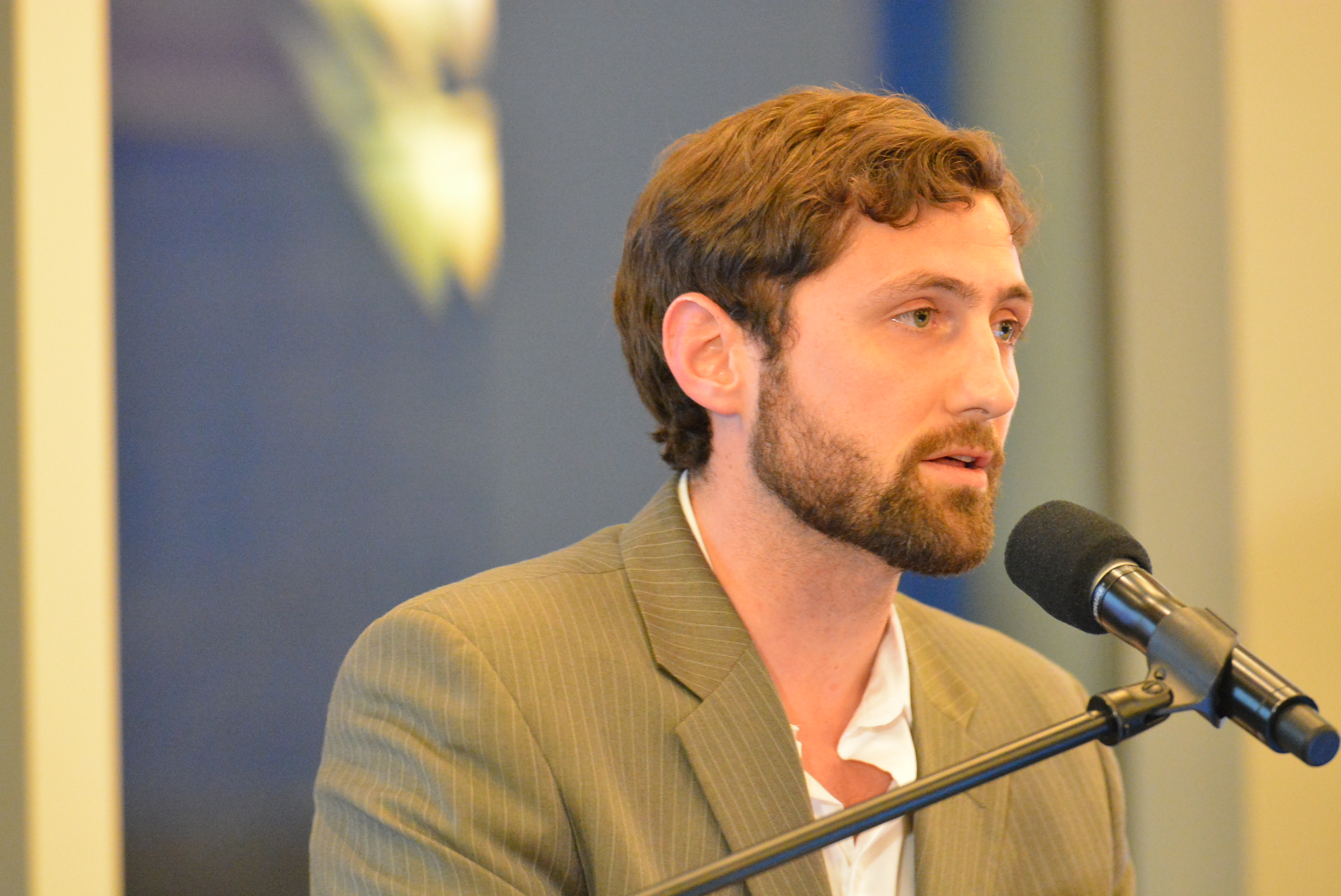
Phil Klay reading at West Point, April 2014.

Redeployment2012 was as good a year for contemporary war fiction as we’re probably going to get, what with the publication of The Yellow Birds, Billy Lynn’s Long Halftime Walk, The Watch, and Fobbit.  2013, by comparison, saw only Roxana Robinson’s Sparta make anything close to the splash of the previous year’s bumper crop of war novels. Now, early in 2014, comes Phil Klay (the last name rhymes with “sky”) and his collection of short stories Redeployment.  Riding a perfect wave of full-tilt advertising push from publishing giant Penguin, Redeployment has garnered glowing reviews from the New York Times, the Times Sunday Book Review, the Washington Post, the Daily Beast, the Wall Street Journal and the Internet media sphere.  While not a novel, Redeployment lights up the contemporary war fiction scene while readers wait for the next great novel to come along.

And why not?  A Dartmouth grad and former Marine who spent a year in Iraq as a personnel officer, Klay brings a lot to the table.  He has an impeccable ear for soldierly speech and while in was obviously on high alert for the nuances of military life.  He observed, for example, the differences in the deployment experiences and outlook of a wide variety of service members, ranging from infantrymen, artillerymen, and military police to chaplains and civil affairs officers.  One story in Redeployment, “Psychological Operations,” is narrated by an ex-enlisted Army soldier, an African-American Coptic Christian who studies at Amherst, a narrative persona that pretty much takes the cake for imagination.  But Klay’s characters are always believable and distinctive; as the reviewing cliché goes, they are “fully realized”:  round not flat, capable of change, growth, and surprise.  Even better, Redeployment‘s tales are, as another cliché has it, “fully imagined.”  Obviously not all autobiographical, they appear to be artistically rendered amalgams of overheard war stories that Klay twists, turns, and combines in unexpected ways.  Chuck Palahniuk writes in the forward to Fight Club that “To make the [original] short story into a book, I added every story my friends could tell.  Every party I attended gave me more material.”  Palahniuk’s tactic seems to have been Klay’s; my only wish, actually, is that Redeployment were also a novel–so many of its discrete chapters are ripe for expansion or linking with others to create a more comprehensive and blended long narrative.

And what are Klay’s well-crafted characters and storylines all about?  In public remarks, Klay discusses a question he’s asked often:  “Had I killed anyone in Iraq?”  Klay’s answer is no, but the question informs so many Redeployment stories that it clearly has become a preoccupation.  In “After Action Report,” for example, one Marine takes claim for his buddy’s kill, and then tries to figure out how to live with the aftermath.  In “Ten Kliks South,” an artilleryman ponders his responsibility for the deaths of civilians killed downrange by rounds he has helped launch. But in “Prayer in the Furnace,” an angry Marine infantryman cares not a whit about the deaths of Iraqis—he flat-out hates them.  Instead, his question is whether he had done anything that had gotten fellow Marines killed. The point is also made by the narrator of “Unless It’s a Sucking Chest Wound” who states, “I’d never had a personal relationship with any of the five fallen Marines, so I tended to think of their deaths with a solemn, patriotic pride rather than the self-loathing and self-doubt so clearly tearing [my friend] to shreds.”

Returning to “Prayer in the Furnace,” when the tale’s protagonist, a chaplain attempting to minister the angry infantryman, discusses the grunt’s gung-ho, bone-dumb Charlie Company commander with the battalion operations officer, the ops officer compares Charlie’s mission with Bravo Company’s:

“Bravo’s got good leaders and a calmer AO [Area of Operations],” he said. “They trained their Marines right.  Captain Seiris is good.  First Sergeant Nolan’s a rock star.  Their company gunny is retarded, but all of their lieutenants are good to go except maybe one, and he’s got a stellar platoon sergeant.  But not everybody can be competent.  It’s too late for Charlie to be anything other than what it is.  Our Kill Company. But this is a war. A Kill Company’s not the worst thing to have.”

A whole lot of knowingness goes into the composition of a paragraph like that.  As units, each with their own personality and level of competence, and compromised of individuals equally distinctive, pitched into their missions in Iraq and Afghanistan, what happened next was idiosyncratic, variable, and contingent.  “You go to war with the military you have,” Donald Rumsfeld was widely derided for saying, but he wasn’t wrong at the level of the individual–you go to war with who you are, constrained by the limits of the unit of which you are a part.  Every soldier up to his or her ears in the messiness of combat knows this in ways hard to fathom by those who might be tempted to think that decisions and choices were easier than they were. Redeployment doesn’t portray the military as screwed up beyond repair or chance of victory, but Klay does suggest that the Marines he was with were overmatched by the demands of the mission and loftiness of the Corps’ ideals and publicity. “Iraq,” the narrator of “Unless It’s a Sucking Chest Wound” asks, “What do you think?  Did we win?”  “Uhh… we did OK” is the response from a warrior said to have earned a Bronze Star with a V device for valor.

“Prayer in the Furnace” burns as hot as its title implies, but Klay works in registers other than the grim and deadly.  “Money as a Weapons System” is not exactly bloodless, but it humorously exposes the fraudulence and ineptitude of military nation-building endeavors. Having wondered at the failure of my own unit’s humanitarian assistance missions, Commander’s Emergency Response Program projects, Provincial Reconstruction Team efforts, and NGO programs in Afghanistan, where shot-up and abandoned clinics, schools, irrigation systems, and women’s centers littered the land, I was half-horrified, half-pleased to see something so similar vividly recreated in Redeployment.  The story soars on the strength of its skewering of absurd and hopeless “non-kinetic” civil affairs missions and the liveliness of the characters who try their best, or at least reasonably hard, to execute them.  Klay’s gift for character shines in his portrayal of Major Zima, an overweight civil affairs officer who is consistently underestimated by the leaner, meaner, and supposedly swifter narrator.  Part Falstaff, part Machiavelli, Major Zima is the only character in Redeployment who renders the slightest modicum of aid to the Iraqis outside the FOB while not being brutalized by the military bureaucracy within it.

My favorite review of Repeployment is by Sam Sacks for the Wall Street Journal.  Sacks places Klay in the context of big-time war fiction authors such as Tim O’Brien and Ernest Hemingway.  He also notes the basic “talkiness” of Redeployment:  many of its stories are about soldiers, Marines, and veterans explaining to interlocutors what they did and felt, rather than authorial descriptions of actions they performed.  That’s OK, most of what we talk about in our day-to-day lives is likewise about what other people have said.  Life exists in a blur of words about words, and our whole understanding of the Iraq war especially drifts in an inchoate haze of competing narratives.  How easy or hard is it to remember just how bad it was in 2004, 2005, 2006, and 2007?  So let’s give Mr. Klay his due–well done, sir–and close with words from essayist Joan Didion’s The White Album:

“Certain places seem to exist because someone has written about them….  A place belongs forever to whoever claims it hardest, remembers it most obsessively, wrenches it from itself, shapes it, renders it, loves it so radically that he remakes it in his image.”

Certain places.  Iraq.  Home again.

Time Now Live in Seattle: Association of Writers and Writing Programs Conference

AWPThis week I’ll be presenting at the Association of Writers and Writing Programs conference in Seattle.  Thanks to Roy Scranton for the invite; it’s an honor to be part of a panel with Roy, Joydeep Roy-Bhattacharya, and Phil Klay. If you’ll be at AWP, too, check us out at 10:30 on Friday morning.

Sterling review of Phil Klay’s short-story collection Redeployment here, just out today 26 February in the New York Times.  Congratulations, Phil!

Another 26 February update: Joydeep Roy-Bhattacharya will not be able to make it, but we will be joined by novelist and essayist Hilary Plum.  Check out this interview with Hilary on the Full Stop website.  It appeared shortly after the release of her 2013 novel They Dragged Them Through the Streets, which I haven’t read but am now eager to check out.

The AWP blurb for our panel:

F160. War Stories: Truth, Fiction, and Conflict. Roy Scranton, Phil Klay, Joydeep Roy-Bhattacharya, Peter Molin. Room 301, Western New England MFA Annex, Level 3. The truth of war is always multiple. Homer’s Iliad gives us both Achilles and Hector, just as Tolstoy’s War and Peace opens up a panorama of perspectives. Fiction offers an unparalleled medium to explore the conflicting truths of war, yet also offers dangers. How do we negotiate politics, witnessing, and voyeurism? How can we highlight war’s ugliness and still write a compelling story? How do we portray war’s beauty and still write an ethical one? Our panel explores these age-old problems.

The Corpse ExhibitionTo give you an idea of what’s on my mind, here’s an excerpt from Iraqi short-story writer Hassan Blasim’s “An Army Newspaper.”  Blasim’s narrator is the cultural editor of a military newspaper during the Iraq-Iran War. He writes of the submissions that he would receive from soldier-authors:

But I do admit that I would often interfere in the structure and composition of the stories and poems, and try as far as possible to add imaginative touches to the written images that would come to us from the front.  For God’s sake, what’s the point, as we are about to embark on war in poetry, of someone saying, “I felt that the artillery bombardment was as hard as rain, but we were not afraid”?  I would cross that out and rewrite it:  “I felt that the artillery fire was like a carnival of stars, as we staggered like lovers across the soil of the homeland.”  This is just a small example of my modest interventions.

Now why would Blasim write that?  What was his narrator thinking?

Hassan Blasim, The Corpse Exhibition and Other Stories of Iraq. Penguin, 2013.  Translated by Jonathan Wright.

War Poetry: Brian Turner’s “A Soldier’s Arabic”

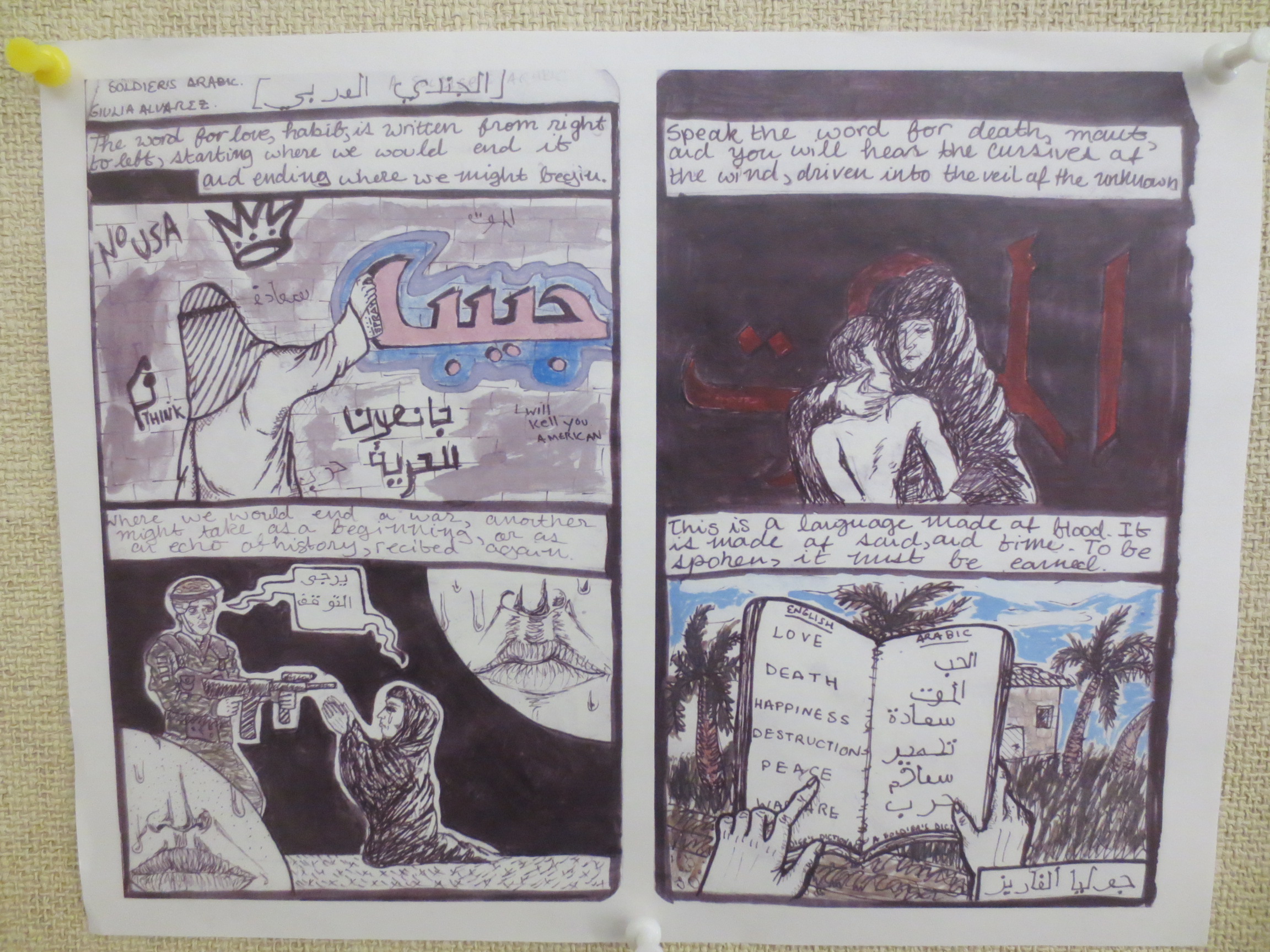
Brian Turner's "A Soldier's Arabic," as adapted by Giulia Alvarez
Brian Turner’s “A Soldier’s Arabic,” adapted by Giulia Alvarez. Click to enlarge!

“A Soldier’s Arabic”

This is a strange new kind of war where you learn just as much as you are able to believe.  –Ernest Hemingway

The word for love, habib, is written from right
to left, starting where we would end it
and ending where we might begin.

Where we would end a war
another might take as a beginning,
or as an echo of history, recited again.

Speak the word for death, maut,
and you will hear the cursives of the wind
driven into the veil of the unknown.

This is a language made of blood.
It is made of sand, and time.
To be spoken, it must be earned.

The great artwork by Giulia Alvarez at the top of the page illustrates the first poem in Brian Turner’s 2005 volume Here, Bullet.  Nine years after publication, not all might remember the force with which Here, Bullet shook the poetry world and inaugurated our contemporary war literature tradition.  No one in either the war or the lit business saw Turner coming–a poet with such skill, imagination, and empathy married with front-line experience, so devoid of amateurish stylistic flourishes or naïve or polemical thinking.  Even now, it’s hard to point to another war poet who comes close to the mark established by Turner in Here, Bullet and his subsequent 2010 volume Phantom Noise.  He practically defined the range of concerns and characteristic attitudes that almost all war lit writers would later echo, and in most cases he did so with more interesting imagery and emotional nuance than those that followed him.

Turner was also onto from the beginning subjects that others have overlooked or haven’t been prepared to deal with.  For example, the last line of “A Soldier’s Arabic”—“To be spoken, it must be earned”—seems to imply something about veteran-authors hoarding the right to speak with authority about war.  This sentiment remains strong today, but I don’t think it’s what Turner really feels, or what the poem is really about.  To me the line and the poem reach beyond the poet’s bond with fellow soldiers to embrace the Arab-Islamic world into which he and other Operation Iraqi Freedom participants were plunged.  Turner, more so than most American authors, has determinedly and persistently tried to measure the war in terms of the language, culture, and history of those on whose land it was fought.  Even a simple thing like learning the Arabic words for “love” and “death” is telling.  Not to underestimate anyone, but I’d be willing to bet less than 1% of Americans deployed to Iraq learned these most basic of words.  “Why would we?” they might ask, pragmatically enough from their perspectives, but short-sighted in its implications.

In this New York Times essay titled “After War, A Failure of the Imagination,” Marine vet Phil Klay asserts the power of fiction to make accessible foreign (in every sense of the word) experiences.  He pleads for readers who have not served or fought to sympathetically embrace the imagined worlds of war authors as acts that blend courage and curiosity.  Klay speaks mainly of efforts to bridge the divide between American civilian and military cultures, but pace Turner, I would extend Klay’s argument to the poetry and fiction written by Iraqis and Afghans. Turner as always leads the way.  In the current issue of Prairie Schooner, Turner as guest editor includes work by Iraqi, Afghan, Iranian, Pakistani, and Sudanese authors in near-equal numbers alongside American and European writers on war and conflict.  I look forward to opportunities to write about these authors and in the spirit of Turner offer notice of the following works of fiction authored by Iraqi writers:

Hassan Blasim’s The Corpse Exhibition and Other Stories of Iraq, recently published by Penguin.  I have written about Blasim here and will write more about him soon.

Abdel Khaliq al-Rikabi’s The Sad Night of Ali Baba.  Not yet translated into English, a short description is here and an interview with al-Rikabi is here.

Ahmed Saadwi’s Frankenstein in Baghdad.  Also not yet translated into English, but an intriguing review is here.

Thanks to Sean Case for alerting me to the Arabic Literature (in English) website.  Big thanks to Giulia Alvarez and all the other students in Rebecca Bahr’s War and Literature class at Horace Mann School in the Bronx, New York City.

Two Nights on the Town in NYC: War Lit Readings at The Center for Fiction and Pete’s Candy Store

Two readings in New York City last week—one by novelist Roxana Robinson and reporter David Finkel at the The Center for Fiction, a bookstore and library in midtown Manhattan, and another of new works by three young military veterans at Pete’s Candy Store, a Brooklyn bar—put the subjects, themes, and styles of the contemporary war lit scene on full and somewhat contrasting display.

Sparta CoverThe Center for Fiction event, titled Fact and Fiction, featured Robinson and Finkel reading from their respective recent works Sparta and Thank You for Your Service.  Both Robinson and Finkel are established writers with a number of published works, prizes, and accolades to their names.  Neither are veterans, but their most recent works alike concern themselves with the aftermath of war.  Sparta tracks the downward spiral of a young Marine Corps officer, while Thank You for Your Service documents the tumultuous post-deployment lives of the Army infantry soldiers featured in Finkel’s acclaimed The Good Soldiers. Though Sparta is fiction and Thank You for Your Service non-fiction, they share a similar prose texture.  Robinson eschews flights of lyrical fancy for a plain style that mirrors reportage, and Finkel takes an almost anthropological interest in the daily details of the lives he describes.  The passages each read might well have been extracted from the other’s book, with characters and events of each portraying the war’s ability to inflect or even ruin the most mundane of day-to-day peacetime activities.

Thank You for Your ServiceBoth Robinson and Finkel have measured the psychological and social carnage wrought by the wars on those who fought them.  Not every combat veteran is a tortured soul, but a whole hell of a lot of them are, and Robinson and Finkel are appalled by the extremely uneven efforts of the nation to adequately help them.  The pairing of the two authors by The Center for Fiction makes sense, and would also work well in a college course or for anyone trying to understand post-traumatic stress.  “Stories matter,” said Finkel, and together Robinson’s and Finkel’s narratives carry their fair share of the load and then some (my favorite line from the Ranger Creed) in reminding, alerting, and inspiring an often oblivious nation to help struggling veterans.  Much is made of the “civil-military divide,” as if it’s the civilians who are out-of-touch with things.  But Robinson and Finkel have performed yeoman work trying to understand military culture and then reporting back sympathetically to the American reading public, while also helping the military understand itself.  Those in uniform should thank THEM for their service.

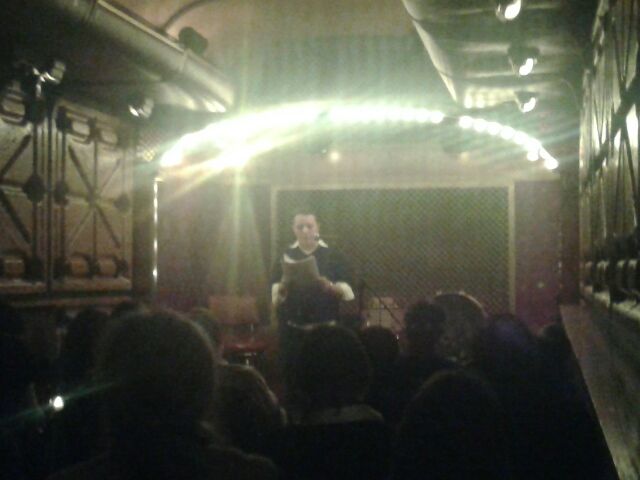
The Brooklyn event was part of Pete’s Candy Store’s Reading Series, which is dedicated to showcasing up-and-coming authors.  Titled Veterans of the Iraq/Afghanistan War, the reading was organized by Fire and Forget editor Roy Scranton, the ex-Army artilleryman and current Princeton graduate student who is fast becoming the Ezra Pound of the war lit world—a talented writer in his own right who also nourishes other writers’ geniuses (just go easy on any late-life hateful politics, please, Roy!).  I don’t think the three authors Scranton presented at Pete’s were full of the rage and confusion described by Robinson and Finkel, but stories definitely mattered to them, as they did to those of us in attendance.  In the tiny, dark performance space, on a night where temperatures outside hovered in the single digits, with most of the audience a pint or two down the hatch, the authors spun webs of words that enveloped their listeners in a dreamy snare of story-telling enchantment.  The picture below, bad as it is, renders something of the ambiance:

2014-01-23 19.53.39
Kristen L. Rouse reads at Pete’s Candy Store, Brooklyn, NY, 23 January 2014

Kristen L. Rouse, a three-time Afghanistan veteran, read a short story about military operations in Paktya province, the same area of operations in which I served.  Her story brought much of it back—the vehicle movements on IED-filled roads, the god-forsaken outposts, and the chai-drenched meetings with Afghans.  Clap your hands and say yea if you’ve ever been to COP Zormat, it ain’t easy to get to….   Johnson Wiley, a Marine Corps vet now studying at Rutgers, followed with poetry that I found compelling and evocative.  I have asked Wiley to send me a poem or two, and if he does I will post at least one.  Last up was Ravi Venkataramani, a West Point graduate who is now studying for his MFA at Columbia.  Venkataramani read a stunning story about a classmate’s death that portrayed the full measure of guilt and obligation inflicted on West Point grads by the relentless pressure of the military academy’s “duty, honor, country” ethos.

In conversation, Venkataramani reminisced fondly about a West Point English teacher named Major William Hecker.  I knew Hecker only from a few emails, but Venkataramani’s respect resonated with me.  While at West Point, Hecker wrote a well-received critical work in which he traced the origins of a famous essay by Edgar Allan Poe (who briefly attended West Point) called “The Philosophy of Composition” to Poe’s service in the Army as an artilleryman.  According to Hecker, Poe’s theory that all aspects of a work of fiction must contribute to a focused and climactic “literary effect” was garnered from artillery manuals that specified how to make bombs explode exactly on target.  The irony of all this is that a year after publishing this work, which marked him as an Army scholar of enormous potential, Hecker, also an artilleryman, was killed in Iraq by an IED—perhaps a mine and not a buried shell, but still a death freighted with an extra measure of cruelness, in a war already full of it.

RIP Major Bill Hecker, thank you for your service in Iraq and in the classroom.  As the West Point Alma Mater states, “Well done, be thou at peace.”  We’ll also dedicate this post to all the proud artillerymen out there: “Redlegs,” as they call themselves; their motto, “the King of Battle.”

Roxana Robinson’s Sparta, published by Sarah Crichton Books/Farrar, Straus and Gioux in 2013.

David Finkel’s The Good Soldiers, published by Macmillan in 2009.

David Finkel’s Thank You for Your Service, published by Sarah Crichton Books/Farrar, Straus and Gioux, in 2013

Fire and Forget:  Short Stories from the Long War, edited by Roy Scranton and Matt Gallagher, published by Da Capo Press in 2013.

Edgar Allan Poe.  Private Perry and Mr. Poe:  The West Point Poems, 1831, edited by William Hecker with an introduction by Daniel Hoffman and an afterword by Gerard McGowan, published by Louisiana State University Press in 2005.

Thank you everybody concerned at The Center for Fiction and Pete’s Candy Store for staging such great events.  Thanks also to Charlie Markley and Sean Case, who accompanied me to Pete’s Candy Store and helped make the night so enjoyable.

More Notes Toward a Supreme War Fiction: Ryan Bubalo, Fire and Forget, Phil Klay, Frederick Busch, 0-Dark-Thirty, Nikolina Kuludžan

“Notes Toward a Supreme Fiction” is the title of a long Wallace Stevens poem that includes the lines:

Soldier, there is a war between the mind
And sky, between thought and day and night.

Later, Stevens writes:

How gladly with proper words the soldier dies,
If he must, or lives on the bread of faithful speech

With that, let’s catch up on developments in the contemporary war fiction scene.

A review essay in the LA Review of Books titled “Danger Close: The Iraq War in American Fiction” by Ryan Bubalo surveys major works by familiar war lit authors such as David Abrams, Kevin Powers, Siobhan Fallon, and Ben Fountain.   Writing of Billy Lynn, the protagonist of Fountain’s Billy Lynn’s Long Halftime Walk, Bubalo asks:  “To learn what you have to learn at the war, to do what you have to do, does this make you the enemy of all that sent you to the war?”  Kudos to the LA Review of Books, whose continuing coverage of war literature surpasses that of all the major literary reviews.

Brian Van Reet, one of the authors featured in the excellent Fire and Forget anthology (which is also mentioned in Bubalo’s piece), brings word on this blog post that Army Times has named Fire and Forget the #1 military book published in 2013.  Very cool of Army Times to place a work of fiction above the many memoirs, histories, and other non-fiction works about the Iraq and Afghanistan wars pouring out of the nation’s publishing houses.  And why not?  Fire and Forget features a who’s-who list of contemporary war authors, to include Abrams, Fallon, Matt Gallagher, and Brian Turner.

Speaking of which, a collection of short stories called Redeployment, by Phil Klay, yet another Fire and Forget author, will be published in March 2014 by Penguin, a big-time publisher.  Advance reviews are already lauding Redeployment, and having had the chance also to read it, I’ll praise it, too.  Klay, a former Marine, obviously kept his eyes open and a pen and pad handy on his Iraq deployment and afterwards, and now has crafted stories that open up interesting and important new vistas on the war experience.  An advance review from Kirkus is here.

Dust to Dust author and Generation Kill actor Benjamin Busch’s father Frederick Busch was a very accomplished author himself, having published many novels and short stories in the years before his death in 2006.   A new collection of short fiction, called The Stories of Frederick Busch, brings to the fore two tales from Busch senior’s 2006 collection Rescue Missions in which the Iraq War figures prominently.  In “Good to Go,” a couple whose marriage has cracked up reunites to help their war-tormented son.  In “Patrols,” a middle-aged writer back from a gig as an embedded reporter struggles with a case of writer’s block that is clearly related to the haplessly ineffectual role he played among the fighting men he covered.  Frederick Busch was known as a writer’s writer, a pro’s pro, and it is easy to see why.  Both stories move with a stately imperative not to be rushed, to not reveal all their secrets too quickly, that younger war writers might well emulate.

Ron Capps’ Veterans Writing Project has served invaluably as a place in which aspiring veteran and non-veteran writers interested in war subjects might find their voice and even publication in the VWP’s journal O-Dark-Thirty.  The latest issue contains perhaps the most sensational story I have yet read about the contemporary wars.  Called “The Final Cut,” it’s by a woman named Nikolina Kuludžan who is not a vet but has taught at the Defense Language Institute in Monterrey, California.  In “The Final Cut,” a young single female soldier begins an affair post-deployment with the man—married–who was her platoon sergeant in-theater.  The story starts in an almost breathless bodice-ripper fashion—the platoon sergeant’s name is “Rip,” and the narrator writes that “his body looks exactly how I always imagined it:  a flawless testament to fifteen years of pushups, pull-ups, sit-ups and running.  It’s a body that has fulfilled nature’s intent.” But it gets much darker and psychologically astute as the illicit sex the two share grows kinkier and the narrator’s understanding of the war-related dimensions of their relationship develops and deepens.  Clearly, the platoon sergeant requires more than a cold beer and a brand new flat-screen to simmer down after the intensity of combat; his darling wifey doesn’t come close to sating his need for intimacy, excitement, risk, and escape.  The narrator doesn’t say no for a second to the sergeant’s demands for sex, as if she knows his hunger is deeper seated than mere horniness and her ever-ready availability.  But she’s also aware that his wife lurks on the fringes of their passion, the odd one out in a post-deployment melodrama of jangled erotic circuitry.  The narrator states, “I just want all of us to admit that we’re in pain.   That we are not as normal as we make ourselves out to be.  That we need help.”  She suggests, and perhaps Kuludžan wants us to think, that she’s doing both the platoon sergeant and his wife a favor, that all this out-of-bounds coupling just has to happen before anything will ever be all right again.

Like Stevens writes, “Soldier, there is a war between the mind / And sky, between thought and day and night.”

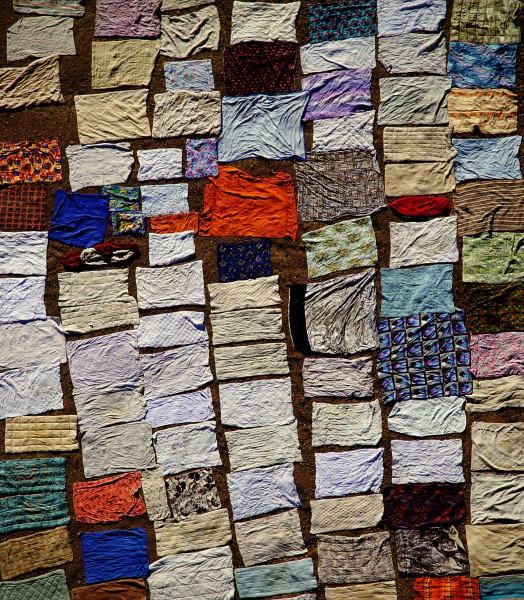
Laundry laid out to dry in Khowst, Afghanistan

Another blog post reference to Wallace Stevens’ “Notes Toward a Supreme Fiction” here.

Fire and Forget:  Short Stories from the Long War, edited by Matt Gallagher and Roy Scranton, published by De Capo, 2013.

Phil Klay’s Redeployment, to be published in March 2014 by Penguin.

The Stories of Frederick Busch, edited and with an introduction by Elizabeth Strout, published by Norton in 2014.

All Along the Afghan Watchtower: Joydeep Roy-Bhattacharya’s The Watch

The WatchJoydeep Roy-Bhattacharya’s 2012 novel The Watch registers many firsts in the burgeoning contemporary war lit genre.  It’s the first novel I know that’s set in Afghanistan.  The first set on a combat outpost, as opposed to a FOB.  The first to feature an extended battle scene—a terrific sequence that describes a Taliban effort to overrun the Americans in their small fortress.  The first to feature prominently the voices of host-nation civilians, in this case that of a young Pashtun woman—a double amputee at that—and a young Tajik male who works as an interpreter for American forces.  Not a first, in fact much like David Abrams’ Fobbit, The Watch narrates chapters through the perspective of several different American soldiers, from junior enlisted to first sergeant to lieutenant to captain, as well as the Afghan voices described above.  But unlike Fobbit’s satirical approach, The Watch is deadly serious—a tragedy.  At story’s end, the Americans and Afghans who have not been killed have absolutely no chance of living happily into the future.

The Watch’s plot adapts that of Antigone, Sophocles’ classic Greek play about a young Theban woman who defies the state by insisting that her brother, killed on the wrong side in a civil war, be accorded proper burial honors.  In The Watch, Nizam, the Pashtun double-amputee, is the Antigone figure.  Her brother, defiant of the American occupiers if not a Taliban by ideology, lies dead outside of COP Tarsândan after a midnight attack.  In the play, Antigone is thwarted by King Creon, the Theban ruler, who represents the power of the State, and her sister Ismene, who counsels moderation and fears Creon’s wrath.  In The Watch, the Creon role is occupied by Captain Connolly, the COP commander, while Ismene is Masood, a Tajik interpreter whose loyalties are split between the Americans who fight the treacherous Taliban and the Afghan cultural codes that emphasize respect for the dead.  Sophocles’ play clearly favors Antigone, a heroic young woman who fights authority, but dramatic space is left open to consider King Creon’s and Ismene’s perspectives.  Roy-Bhattacharya builds this same ambiguity into The Watch, especially in regard to Captain Connolly, on whom the fate of Nizam and her brother’s remains depend.  Portrayed unflatteringly in the novel’s early stages, by the end we see the staggering complexity of interests and consequences he must juggle to effectively “take care of troops and accomplish the mission”—that onerous mantra of military leadership whose twin dictates are usually in stark opposition.  It’s as if Roy-Bhattacharya realized in the course of writing The Watch that Connolly was too sympathetic to be a Creon.  The heavy-handed imposition of authority in the novel is by the greater US military and foreign policy apparatus that organized the war and now issues Connolly orders.  Connolly’s deliberations under the pressure of those orders, like Creon’s under the Greek gods’, are human, all too human.

The Watch’s abiding interest in Captain Connolly intrigues me.  Not to privilege the war experience of the officers, but I’m glad to see at least one portrayed favorably in the skeptical world of war fiction.  I also liked the character of Masood.  In The Watch, Masood is dropped at COP Tarsândan in the middle of the night after the big battle and confronts hostility at every turn from his new American hosts and allies.   Roy-Bhattacharya gets right the incredibly uneven regard of young American soldiers for those outside the fraternal ranks of their unit.  Frankly, the average 20-year-old American male doesn’t have it in him under the best of circumstances to welcome graciously strangers who do not share his cultural background, and the circumstances of the soldiers on Tarsândan are anything but the best.  Masood is mystified and hurt by the Americans’ baffling rudeness, and yet it is more complex than that—just when he is ready to write off the Americans as barbarians, he meets a medic who knows more about Afghan literature and history than he does, then the warm and wise COP first sergeant, and finally Captain Connolly, whose fanatical adherence to mission and security co-exist with a more than passing fluency in Pashto and Dari.  This extremely wide diversity in manners and education certainly exists within the American military and our larger society as well.

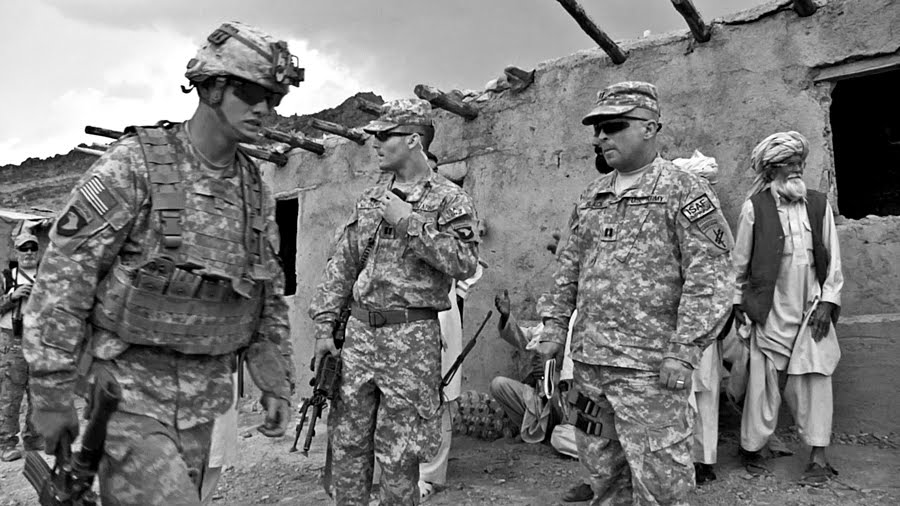
American soldiers in Afghanistan.  Picture by Bill Putnam, used by permission.
American soldiers in Afghanistan. Picture by Bill Putnam, used by permission.

Roy-Bhattacharya was born and raised in India and did not come to America to live until he began graduate school here as a young man.  In Masood, perhaps we see him replaying the highs and lows of his own first encounters with an America that bestows its hospitality and respect to outsiders in fitful and perplexing lurches.  This perspectival complexity is reflected in Roy-Bhattacharya’s acknowledgements:  one to “the people of Afghanistan” and another to an American he refers to as, “Officer, Gentleman.”  He also writes,

“To the U.S. Army officers in Afghanistan who befriended me and technically foolproofed the book—you know who you are—I have no words to adequately express my thanks.  I remain in awe of your objectivity, in gratitude for your unwavering enthusiasm, and in your permanent debt for your gift of friendship.”

Roy-Bhattacharya himself might be something of a Masood.  He helps us understand the war, hating what it has done and made us do and be, but not hating those of us who fought it.

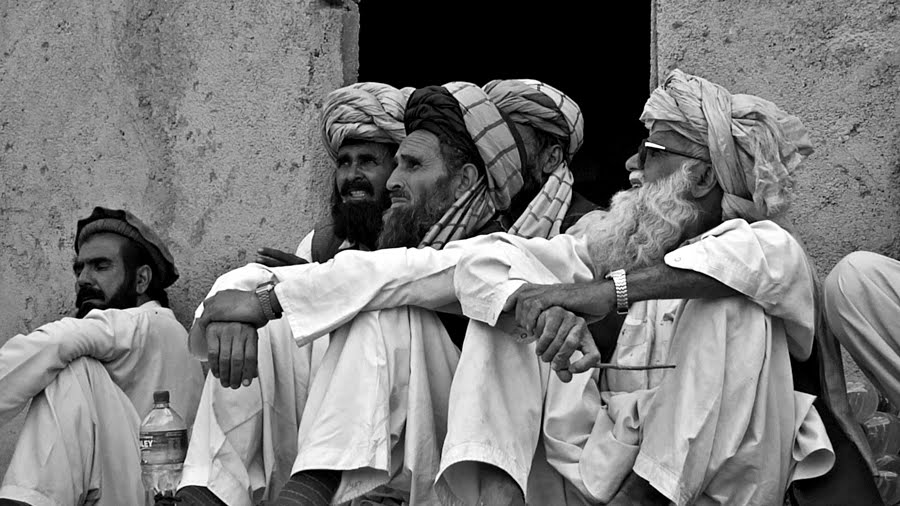
Afghan elders.  Picture by Bill Putnam, used by permission.
Afghan elders. Picture by Bill Putnam, used by permission.

A post on my blog 15-Month Adventure about Spera Combat Outpost:  All Hail the Defenders of Spera COP! 

Another post on 15-Month Adventure about Spera Combat Outpost: Spera COP Sector Sketch

A 15-Month Adventure post about interpreters:  Combined Action

A 15-Month Adventure post about a small Afghanistan FOB and its stout company commander: The KG

War Literati: Joydeep Roy-Bhattacharya, Phil Klay, and Roy Scranton

Joydeep Roy-Bhattacharya, Phil Klay, Roy Scranton

I spent the better part of Saturday with three talented authors of contemporary war fiction.  In the afternoon, I viewed the War/Photography: Images of Armed Conflict and Its Aftermath at the Brooklyn Museum in the company of Roy Scranton and Phil Klay. Scranton, a US Army Iraq vet, is the editor of Fire and Forget, the landmark anthology of Iraq and Afghanistan war short fiction that I’ve written about several times in this blog.  Scranton contributes a story to his own collection, and he’s working on a novel, but the drift of his thought goes well beyond war literature.  Below are links to two wildly creative and intellectually provocative essays he’s recently published in the New York Times and on an online site called The Appendix:

New York Times, Roy Scranton’s “Learning How to Die in the Anthropocene”

The Appendix, Roy Scranton’s “The Curse of Coherence”

Klay, a USMC Iraq vet, contributed a story to Fire and Forget and served as a guide (and perhaps an inspiration) to Roxana Robinson as she wrote Sparta.  Klay’s collection of short stories Redeployment will be released next year by Penguin.  I’ve read an advanced copy and greatly enjoyed it–if you are wondering what new subjects and perspectives are possible in war lit, you will, too.

Joining us later was Joydeep Roy-Bhattacharya, the author of The Watch, a novel about an Army unit on a small combat outpost in Afghanistan.  I somehow overlooked The Watch upon its release last year, and subsequently experienced an “OMG-what-have-I-missed” moment when I finally read it a couple of weeks ago. I’ll have plenty to say about The Watch in future posts, but here will only report that it combines military realism with literary skill and imagination to a high degree.

Together, we talked into the night and made plans for a panel presentation Scranton has organized for the Association of Writers and Writing Programs conference in Seattle next February.  Next spring, I’ll also be speaking on war literature at the American Comparative Literature Association conference in New York City in March and the Northeast Modern Language Association conference in Harrisburg, PA, in April. Join me at any of them if you can, and let all conversations continue.

Joydeep Roy Bhattacharya, Phil Klay, me, and Roy Scranton
Joydeep Roy-Bhattacharya, Phil Klay, me, Roy Scranton

New York Times Slideshow of the Brooklyn Museum War/Photography Exhibit

New York Times Review of the Brooklyn Museum War/Photography Exhibit


Class War: Roxana Robinson’s Sparta

Sparta CoverSeveral good books about the contemporary wars have been written by graduates of an ingenious program that opens up United States Marine Corps Officer Candidate School to rising college seniors, with no obligation for candidates to serve even after they graduate from college. Most do, though, and so the open-armed, non-binding invitation has reaped the Marines a bounty of smart, literary-minded young men from elite colleges who desire a healthy helping of “Semper-Fi Do-or-Die” before getting on with their lives. Among the books written by such men are the memoirs Dust to Dust by Vassar grad Benjamin Busch, Joker One by Princeton grad Donovan Campbell, and One Bullet Away by Dartmouth grad Nathaniel Fink. Coming soon is Redeployment, a collection of short stories by Phil Klay, another Dartmouth grad.

Speaking as a UC-Berkeley grad who went to Army OCS to become an infantry officer, I can kind of relate.

Also taking note of this phenomenon is Sparta, a novel by civilian author Roxana Robinson. Her protagonist is Conrad Farrell, a Williams College graduate from a comfy Westchester County, New York, far-suburban home, the kind whose dirt-road remoteness signals privilege, not poverty. Conrad’s decision to attend Marine OCS shocks and dismays his family and girlfriend. Now back from two savage tours in Iraq and out of the service, he begins a slow but steady deterioration from the ravages of post-traumatic stress.

It’s not a pretty tale, and it’s not told in a pretty, artful way. Sparta is sort of an anti-The Yellow Birds. It relates a similar tale of downward decline, but with none of The Yellow Birds’ lyrical flights (no pun intended) or near as much plot. Episodes unfold schematically: first, impulsive and reckless anger, then apathy and lack of focus, then withdrawal and denial, next headaches and insomnia. Flashbacks and erectile dysfunction. A futile stab at counseling. Alcohol abuse and self-medication. Suicidal thoughts, then suicidal gestures. When Conrad hears a loud bang, you know he’s going to duck. When a car veers too close while he’s driving, you know he’s going to panic. Conrad’s behavior is so out of kilter that it is hard to believe his girlfriend stays with him for a minute, let alone a year. It’s difficult to imagine him as an effective officer, or a cheerful, intelligent guy before he joined. The story is told almost entirely through Conrad’s eyes, but there’s so much we don’t understand. We’re left wondering, for example, why he got out of the Marines, since he has no plan for the future and misses his men so much. Why not get a job to keep busy? Date or chase girls? His depression socks in before he even knows he’s depressed, which might be the nature of such things, but his aimlessness makes him seem more like a goofy man-child than a focused adult. And because we aren’t allowed to eavesdrop on the other characters’ conversations and thoughts, we lose not just their perspectives on Conrad, but a fuller rendering of the angst those close to him must have suffered while hoping that he would once more be OK.

For all that Sparta’s darn near impossible to put down. Because Robinson doesn’t waste a word describing Conrad’s quick step toward self-destruction, Sparta reads very quickly. The  prose style is very direct—I can’t imagine a novel that begins as many sentences with “He,” as in the following passage describing Conrad in the process of bolo-ing the GMAT:

He was screwing it up. It was getting worse. He couldn’t pound the little things into any kind of sense.  It was getting worse, and the worse he felt, the worse he did. He was in a long panicked slide backward. He could feel himself his going and couldn’t stop himself.

Conrad’s upper-crust stiffness combined with the USMC suck-it-up ethos leaves him not strong but emotionally brittle, and Robinson describes this toxic psychic predicament shrewdly in short, sharp strokes. The most extended descriptions of anything are of the habits and habitats of Conrad’s liberal East Coast native milieu. The references to GMATs, Volvos, maids, and commuter trains remind us that Robinson is not telling a general story about all damaged veterans, but a particular one about a member of a class whose disdain for the war and the military seems based as much on taste and lifestyle as politics. Conrad’s parents care about him, but they take little pride for his service, understandable given his downward spiral, but they also seem to lack the warmth, curiosity, empathy, or other means, to include vocabulary and courage, to connect with him. They are good people in their way, but they are at a loss, and their scorn for soldiering contributes to Conrad’s funk and may even be the cause of it. It’s hard not to think that one thing that really eats at Conrad—in addition to everything else–is his inability to admit that his decision to join the Marines was an act of class betrayal, a big huge self-inflicted mistake, that his parents were right, and that he had every reason to know better.

Roxana Robinson, Sparta. Picador, 2014.

Where’s the War in Contemporary War Novels?

The past few weeks brought two significant additions to the contemporary war literature conversation. The first was a long review essay by Michael Lokesson in the Los Angeles Review of Books called “Passive Aggression: Recent War Novels.” Lokesson’s review covers much the same ground as this blog, with extended commentaries on Billy Lynn’s Long Halftime Walk, Fobbit, The Yellow Birds, and Sparta, among others. Lokesson also offers some historical musing about war and literature, going back to Homer, and finally a bit of meta-analysis on the possibilities for contemporary war lit to achieve greatness. “Reading this latest crop of accomplished soldier’s novels,” he writes, “I couldn’t shake the feeling that maybe modern war and its aftermath, as told through a soldier’s eyes, simply isn’t the stuff of great novels anymore.” Contemplating the fact that much “combat” in Iraq and Afghanistan consisted of waiting for IEDs to go off or a rocket to hit the FOB, Lokesson continues:

“In warfare [today], the soldier is passive to a startling degree, and even the war effort itself is built on passively securing the population rather than actively defeating the enemy. Molding passivity into great literature is never easy, as the current harvest of soldier’s novels attests, and the novelist who sets him or herself to the task is forced to climb a very steep mountain indeed. Can a truly classic novel arise under such conditions? I’d like to say yes, but I have my doubts.”

Regarding the wars that gave us Fallujah and COP Keating, I’m not so sure Lokesson’s characterization of them is entirely correct, though he might be onto something regarding their literature. He seems to have it in mind that a great war novel must portray heroic action or striking scenes of battle, and the current war lit record is scant on both counts. To help stir the pot of discussion, also out recently is Men in Black, a stunning video rendition of a terrific combat scene from Colby Buzzell’s memoir My War. I’ve praised Buzzell’s writing before; for my money, the scenes describing combat in My War render the material detail and visceral feel–half adrenaline, half fear–better than anything I’ve read elsewhere, fact or fiction. Hat’s off too to Buzzell’s collaborator Evan Parsons for bringing My War to video-digital life with his excellent graphic-novel like illustrations. Buzzell is certainly not passive, as either a fighter and writer, which is good, but he’s also not especially reflective. From his grunt’s eye perspective, war is about kill-or-be-killed, with factors that might require thought before, during, or after action of second import. Nor does he portray himself or anyone else heroically.

A great battle scene that unabashedly depicts a war hero can be found in another memoir, Lone Survivor, written by Navy SEAL Marcus Luttrell with the assistance of novelist Patrick Robinson. If you haven’t read the scene lately, or at all, describing the death of Lieutenant Michael Murphy, please check it out. The description of the battle leading up to Murphy’s death is also terrific, with Luttrell and Robinson vividly portraying the terror that comes from being shot at from all sides. While Buzzell’s as irreverent as they come, Luttrell’s 180 degrees the opposite—Lone Survivor is a glowing elegy to an officer whose last moments inspired Luttrell to write, “If they build a memorial to him as high as the Empire State Building, it won’t ever be high enough for me.” The passage gives me the shivers every time I read it, but it’s such an uncomplicated encomium I couldn’t imagine it in a “serious” novel, full of doubt and irony.

So, My War and Lone Survivor demarcate a range of possibilities, but they are memoirs, not fiction. In the major novels, there’s not much combat on display, let alone brave acts. Billy Lynn’s Long Halftime Walk contains about a page’s worth of fighting detail. The Yellow Birds and Fobbit both depict scenes in which friendly and enemy soldiers and civilians kill and get killed, but the climatic “battle” scene in each is an incoming mortar or rocket round that takes the life of key character while unawares on the FOB. A true enough possibility, I well know, but not exactly a heroic way to go out. Or one that allows an author to portray combat at any length.

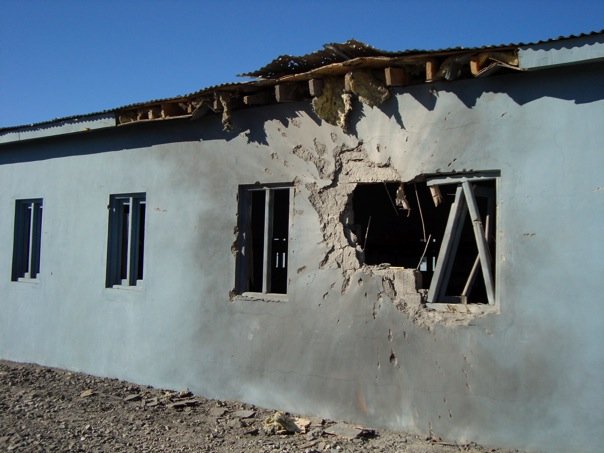
A Camp Clark, Afghanistan, barracks showing the results of a direct hit by a 107mm rocket.  Fortunately no one was inside at the time and no one was hurt.
A Camp Clark, Afghanistan, barracks after a direct hit by a 107mm rocket. Ouch.

But Fobbit–contra to its title–actually does quite well depicting two episodes set outside the wire. In these, author David Abrams portrays dispute and potential violence between Americans and Iraqis that place American soldiers in the crucible of real-time, on-the ground decision-making, with many eyes watching, about whether to take a life or not. In the two scenes, a hapless officer underreacts in one tense stand-off involving a suicide bomber and overreacts in the other. In the first scenario, Abrams writes, “If someone had taken immediate action forty minutes ago, none of this would be an issue, but the commander on the scene–a pinch-faced captain named Shrinkle, known for his hems and haws–had waited too long.” A bold sergeant named Lumley takes charge, which needs to happen, but Abrams hints at the after-effects: “It would be a long time, years and years of therapy, before he could wipe from his mind the sight of that head erupting in a bloody geyser. He’d pulled the trigger without thinking through the consequences. He was not sorry he hadn’t hesitated but there was always that nagging, niggling doubt: maybe haji wasn’t going for the grenade….”

Abrams is on to something here; he seems to be saying that successful performance in combat isn’t so much a matter of bravery but of incisive decision-making under pressure. Here may be the gold waiting for extraction by future war novelists: not scenes of valor, but scenes of the mind as it decides what to do next, continuously, again and again, in difficult circumstances with important consequences.