Veterans Writing

Matt Gallagher’s latest post on the New York Times At War webpage explains the structural fault lines that divide the veterans writing community. Gallagher notes that veterans writing workshops are a growth industry, key components of the veterans programs now established in many colleges and cities. He notes that within the veteran writing community motivations differ. Some see writing as a matter of self-expression or healing. Others see it as a means by which they might turn themselves into big-time, well-regarded artists. Some think their stories need ultra-precise realistic rendering of their personal experiences and are unable to see the need for artistic re-imagining at all. Some veteran writers overvalue the degree to which their war experience makes them uniquely qualified to write about war. They scoff at the pretensions of someone who hasn’t “been there and done that” to write meaningfully and movingly about war.

These are all subjects that interest me. I’m familiar with veterans programs sponsored by colleges as diverse as Farmingdale State and Vassar, to say nothing of my occasional interaction with the veteran population at West Point. It occurs to me that the New GI Bill, which basically funds four years of college for anyone who has recently served overseas, is as worthy a program as the storied GI Bill of the post-World War II days, and that if we as a nation (or at least our government) are serious about our commitment to veterans, generous allotments for education are second only to effective medical care as a material, no-BS way of saying thanks. College is just the right place for many vets—they can simmer down after their service while preparing for their future–and it makes sense that classes that allow them to explore their war experience are part of the curriculum.

The question of whether a writer who hasn’t been to war can write well about war also intrigues me. Gallagher cites Ben Fountain as the example par excellence of an author who never served in the military, let alone saw combat, but who can still convey what it is like to be a soldier. I love Billy Lynn’s Long Halftime Walk, too, but have noted that Fountain evades extended description of battle. Is that a place he just didn’t feel comfortable going? Brian Van Reet, a decorated vet, portrays two horribly mangled veterans in comic-grotesque terms in “Big Two-Hearted Hunting Creek.” Would a civilian feel as comfortable doing so? Is there something wrong with someone who isn’t disabled portraying characters who are? Both these cases reflect the issues of credibility and authority that permeate discussions of war writing.

We actually already have lots of fiction and non-fiction that describes what it is like to fight, and what it is like to live after fighting. Most of them are rendered largely through the perspective of one protagonist. I’m eager for a story that expresses the totality of an Iraq or Afghanistan deployment. A cast of characters, not just one main one. A vivid depiction of social milieu, from the squad up to the brigade, as they progress from home station to theater, spend a year on a FOB doing missions while interacting with local nationals, and then redeploy and get on with their post-war lives. A plot that takes a novel to properly set up and unfold. Where is that book? Fobbit, by David Abrams, comes close, but I want more.  I’m now starting Sparta, by Roxana Robinson. Robinson’s not a vet, but maybe her book will take me there.

In the meantime, we might consider how a scene might be portrayed through poetry, through fiction, through personal experience. Here is how Brian Turner conveys his thoughts on the plane ride back from Iraq:

“Night in Blue”

At seven thousand feet and looking back, running lights
blacked out under the wings and America waiting,
a year of my life disappears at midnight,
the sky a deep viridian, the houselights below
small as match heads burned down to embers.

Has this year made me a better lover?
Will I understand something of hardship,
of loss, will a lover sense this
in my kiss or touch? What do I know
of redemption or sacrifice, what will I have
to say of the dead — that it was worth it,
that any of it made sense?
I have no words to speak of war.
I never dug the graves of Talafar.
I never held the mother crying in Ramadi.
I never lifted my friend’s body
when they carried him home.

I have only the shadows under the leaves
to take with me, the quiet of the desert,
the low fog of Balad,
orange groves with ice forming on the rinds of fruit.
I have a woman crying in my ear
late at night when the stars go dim,
moonlight and sand as a resonance
of the dust of bones, and nothing more.

And from early in Sparta, here is how Robinson depicts a similar scene:

The plane was full of sprawling, loose-lipped Marines, lost, gone, dead to the world.

Conrad liked seeing them like this: sleep was like salary, his men were owed. They were infantry grunts, and they’d been seven months on duty without a single day off. They deserved to sleep for months, years, decades. They deserved this long, roaring limbo, this deep absence from the world, from themselves. This plane ride was the floating bridge between where they’d been and where they were going—deployment and the rest of their lives. They deserved these hours of unconsciousness, this gorgeous black free fall.

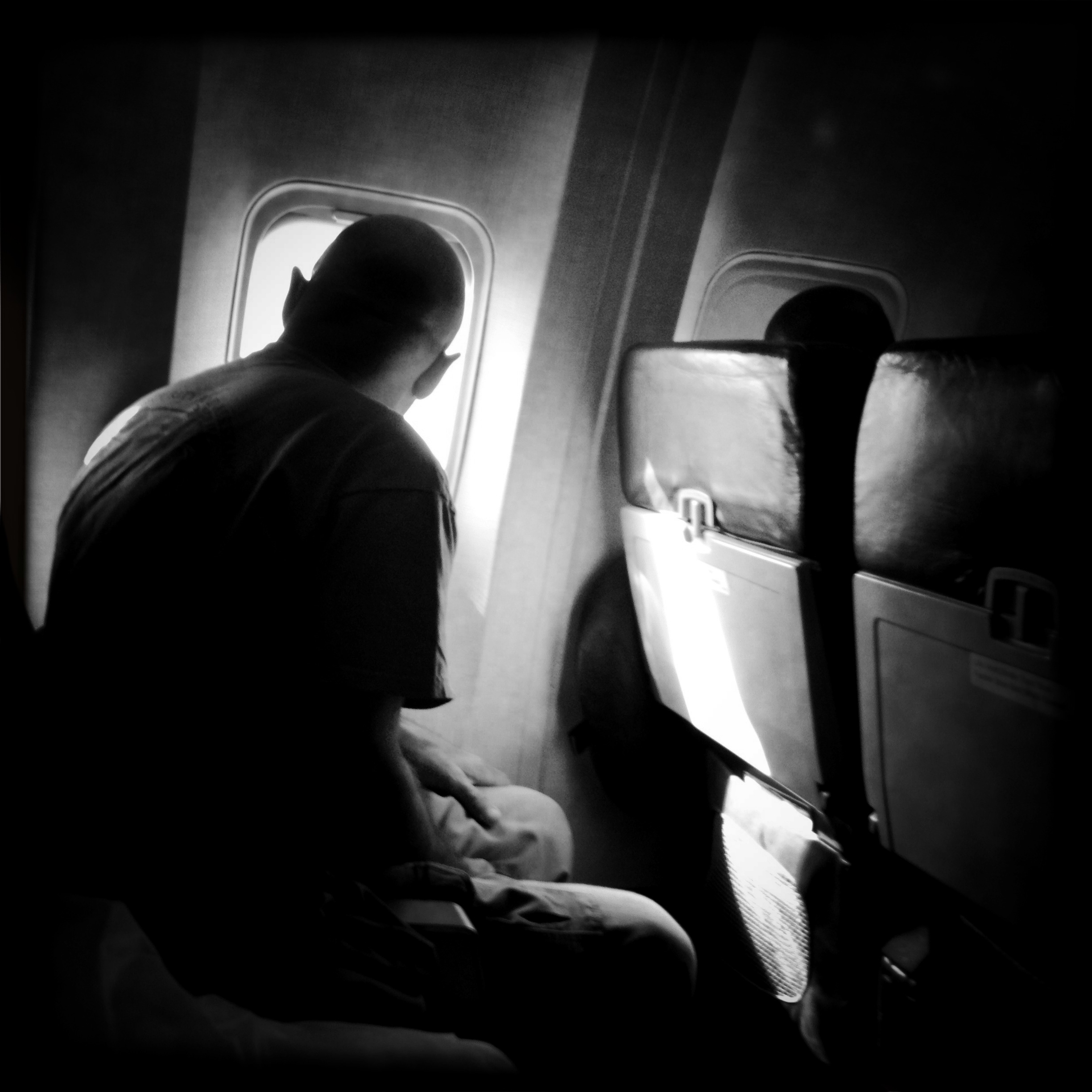
My rendition of the same experience stems from a flight back from Afghanistan on mid-tour leave. I was the senior officer on a charter plane from Kuwait to Ireland. As such I sat up front and conversed with the senior flight attendant. She was maybe 30, with that half-pasty, half-refined look that comes from trying to maintain professional polish while living on hotel room service. She was very nice, and we traded stories while the rest of the plane dozed. Our flight was peaceful, and yet she told me of horrible flights out of Iraq in the bad days of 2006 and 2007, when soldiers would wake screaming out of nightmares born of bad memories and ravaged psyches. Seven hour flights would be filled with noise and bustle as fellow soldiers subdued distraught friends wacked out–or not wacked out enough–on Ambien. As we talked on she told me that she had gone to college at Indiana, as did I. That was cool, so I asked her where she hung out in Bloomington. To my surprise she mentioned the local punk rock club. Judging from her looks and job, I never would have guessed it, but she really knew her stuff. She had run a ‘zine, and still went to shows and knew all the bands. Since I had come-of-age near DC listening to classic hardcore groups such as Minor Threat and the Bad Brains, we had a lot to discuss. So, on through the flight we traded stories about our favorite records and shows. While 90% of the other passengers slept 90% of the time, my interlocutor lured me out of my deployment anxieties and uncertainty about the future with magical tales of a musical history that if we didn’t quite share, we both could appreciate.

My story isn’t as good as Turner’s or Robinson’s, or related as well, but it’s mine, which counts for something. All stories need telling, whether they find many listeners or not. It’s a social catharsis, enacted individually but resonating collectively.
Courtesy of Bill Putnam.  Used by permission.
Courtesy of Bill Putnam. Used by permission.

New York Times review of Roxana Robinson’s Sparta

Veteran David Carrell writes about his return to college at Vassar

My War author Colby Buzzell writes about his own love of punk rock
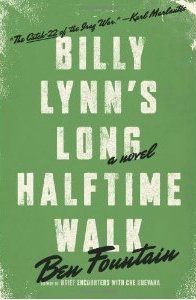
“Thank You for Your Service”: Ben Fountain’s Billy Lynn’s Long Halftime Walk

BLLHW Cover2Most vets know that queasy ambivalence that comes when a well-meaning American tells them, “Thank you for your service.” The sentiment is sincere, but also a little bit feeble, maybe even something of a back-handed compliment. Nowhere near as bad as, say, being spit upon, but being told “Thank you for your service” still registers flatly—the words are inadequate to or ignorant of what the service actually entailed, what the recipient might actually feel about the matter, or the responsibility and consequences that might actually come with bestowing thanks.

That’s a lot of “actually” separating the words, the ideas, the deeds, and the people involved.

This conundrum gets writ large in Ben Fountain’s Billy Lynn’s Long Halftime Walk. About an infantry squad being feted on a two-weeks-long “Victory Tour” for their heroism in Iraq, the novel culminates with “the Bravos’” participation in a garish halftime ceremony at a Dallas Cowboys football game. For the most part observing the dramatic unities of game-day, Texas Stadium time and place, BLLHW  takes place on Thanksgiving, fittingly enough, and in a down-at-the-heels football Coliseum Fountain describes as looking like “a half-assed backyard job” and suggestive of “soft paunches and mushy prostates.” The novel is focalized through the eyes of Billy Lynn, the most heroic of the Bravos and the one most sensitive to the Texas-sized admixture of adulation and condescension the squad encounters. The mostly white, mostly rich, mostly male, and very gregarious Cowboy fans are eager to honor real-live war heroes, but they don’t really know how to behave in the presence of actual—that word again–ragamuffin grunts. The soldiers’ valor in combat obviously gives lie to their own pretensions of manliness, and slights, misunderstandings, and awkwardness accumulate throughout the course of the novel. After outright hostility and confrontation ensue, the Bravos are hastened back (and hasten back) to war, and the tiny fissures of attitude and values that divide the serving soldiers and the homefront populace have widened into a Texas-sized chasm of mutual incomprehension and incompatibility.

Fountain never served in the military, but neatly sidesteps issues of authenticity and authority by minimizing the amount of page-space given to the Bravos’ time overseas and in combat. The battle scenes that made them famous are described as they were captured by the news film crew that recorded their exploits and as they now exist in the swirl and haze of Billy’s memory. Fountain is on much surer ground describing events at home, where his impressive powers of observation, imagination, representation, and speculation get right not only the rough-love camaraderie of the Bravos, but skewer again and again the comfy and sheltered pretensions of an upper-class America too distracted by material, commercial, and celebrity excess to think well, or really even care deeply, about the nation’s wars. Fountain writes in the hopped-up razzmatazz style of Tom Wolfe, with lots of over-the-top figures of speech and nonstandard ways of arranging text on the printed page to represent speech and sound. Crazed metaphors and similes appear by the dozens, such as the following one oft-quoted in reviews and too good to pass up here. In a flashback scene, Fountain describes Billy lying in the sun with his smoking-hot bikini-clad sister and noticing her crucifix, a “small gold cross [that] lay on the swell of her breasts, a tiny mountaineer going for the top.”

Indeed, though an issue here is one of the book at large: Billy is far too inarticulate in speech and inchoate in thought to be the vessel for the piercing social critique and linguistic pyrotechnics Fountain favors. Billy can barely remember what happened in combat, is confused by the notion that he is a hero, dreads going back to war, is helpless in the face of calamities that have overtaken his family, is unhappy at the game, and is preoccupied by his virginity, which he very much wants to shed. Getting laid is the only token of gratitude from a grateful nation that Billy really wants, and his failure to entice even one member of America’s collective womanhood to indulge him—on his own Victory Tour, for crying out loud—exacerbates his self-loathing and plunges him into periodic funks. “Billy, you’re flaking out on me again,” his squad leader cautions him repeatedly. Billy seems to be the kind of guy who always knows a little more or a little less than everyone else, but Fountain describes him as also possessing a sweet charisma that is respected by savvier male characters and which actually—that word once more–makes him adorable to women. Along with everything else, BLLHW is a love story, and though Billy doesn’t (quite) lose his virginity before heading back to Iraq, he connects, at least for a moment, physically and emotionally with an equally sweet and endearing Dallas Cowboy cheerleader. This plot line strains credulity, but is enjoyable nonetheless. A fleeting romance among the ruins seems to be the least Billy, for whom the reader has come to feel strongly, deserves–our tiny mountaineer makes it for a moment to the top.

An audio clip of Billy Lynn’s Long Halftime Walk is available here.

Ben Fountain’s Billy Lynn’s Long Halftime Walk: A Novel.  HarperCollins (2012)

In the Rear with the Gear: David Abrams’ Fobbit

Fobbit CoverOften compared in reviews to Catch-22 and M*A*S*H, David Abrams’ Fobbit portrays the Forward Operating Base, or FOB, as the material manifestation of the conceptual perversity and corruptness of the US military mission in Iraq (and by extension Afghanistan). Fobbit’s exposé of rear-echelon life and culture supports the sneaking suspicion of many deployed soldiers that victory was doomed as long as the FOB, with all its bloat and isolation, served as the locus from which the fighting forces might generate the will, the might, the ingenuity, and the resources necessary to defeat the wily foe on the other side of the base barrier walls. We’re lucky that Abrams, a writer with a laser-like eye for character, social context, and telling detail, has chosen black humor as his mode of expression. Though the novel ends horribly for its characters (as does Catch-22), most of it is played for laughs. I’ll speculate that Abrams has taken it easy on the Army out of an affection borne of 20 years of service as an award-winning Army journalist. Were the tone serious, the bloodletting would be merciless and unbearable.

Joseph Heller supposedly said that to write Catch-22 “all he had to do was take notes” while serving in the World War II Army Air Force. Abrams obviously kept his pen-and-pad nearby, too, while the Army around him unveiled the laughable reality behind the pretence of organization, efficiency, and idealism. Fobbit’s plot tracks the parallel lives of a variety of soldier types easily recognizable by veterans:  the Army captain hopelessly over his head as a leader of warriors, other much more decisive officers and NCOs who just seem at home in combat, and a variety of rear-echelon staff officers, sergeants, and troops (the “fobbits” of the novel’s title) preoccupied with rationalizing their feeble contributions to the war effort. Many of these types get their say, but most of the novel is focalized through the perspective of Staff Sergeant Chance Gooding, Jr., a Public Affairs non-commissioned officer whose job and views seem to reflect Abrams’ own. The coin of the social capital realm on Gooding’s FOB is competence and courage in action—an even question the novel proposes is whether it is worse to fight and find oneself lacking or to never have fought at all. Fobbit’s answer is that the two are equally bad: from a fobbit’s point-of-view, a war that doesn’t allow all its participants to excel in battle is mean and unfair, besides being deadly and horrible.

Big picture considerations aside, Abrams doesn’t miss many of the foibles of FOB life and its minor characters:  the smoke shack heroes whose braggadocio matches their nicotine consumption while standing in inverse proportion to the time they’ve spent outside the wire; the hot chick who is not going to sleep with everyone, but might do so with at least somebody; the hard infantrymen who give the lie to the soft comfort of the fobbits and make them ashamed of themselves. “They also serve who stand and wait,” wrote John Milton, but if all your standing and waiting is in line at the Dining Facility, it’s tough to feel especially good about your deployment. Or how your nation has organized itself to fight the war. In my experience, though, many fobbits seemed to enjoy their year overseas. Squeaky clean from daily showers and weekly laundry, plump from three hot meals a day, padding from bunk to workplace to chow hall to PX to gym to MWR center, oversized M16s slung awkwardly across their backs, mindful of the virtual military requirement to be perpetually chin-up and cheerful, lots and lots of fobbits appeared to be having a good time. Honestly, they just seemed high on the shared experience of danger, distance from home, and life shorn of decisions and distractions.

Of course there were exceptions, such as the male soldier whose marriage was floundering, or the single-mom female soldier whose child care plan had fallen apart. And Abrams-slash-Gooding’s perch inside a division “G1 Personnel” Public Affairs Office rendered him full access to the most misery-producing structure of life on a FOB:  duty on a battalion, brigade, division, corps, or task force headquarters staff. Having experienced it myself, it’s hard to imagine jobs better designed to enrage and enfeeble a middle-aged officer, nominally at the height of his or her adult powers, but now reduced to bone-grinding servitude and routine, interspersed by always terrifying and usually humiliating interactions with full-bird colonels and general officers. As a career non-com, Abrams must have often wondered at the unholy conglomerations of bureaucratic rigmarole in which he was snared, concocted by superior officers and said to be responsible for the operational, logistical, and administrative support of the fighting force. That these self-constructed torture chambers made their inhabitants deeply unhappy must have seemed clear. That they were necessary for the effective conduct of the war much less so.

An excerpt from Fobbit, from David Abrams’ webpage.

David Abrams’ Fobbit:  A Novel.  Grove Press-Black Cat (2012).

Bob on the FOB

BOBontheFOB Comics Facebook page.

James River Blues: Kevin Powers’ The Yellow Birds

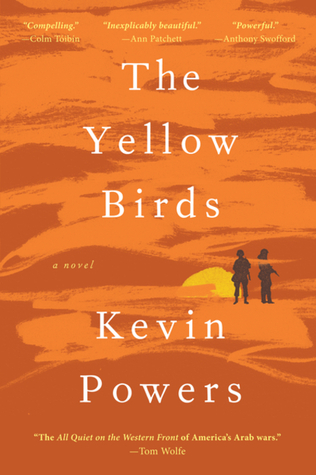
The Yellow Birds CoverKevin Powers’ acclaimed The Yellow Birds features many scenes set in Iraq, Germany, and Fort Dix, New Jersey. The latter locale intrigues me, for I served two years at that backwater post and it pleases me to see it made central in an important contemporary war novel. But being from Virginia myself I’m most attracted by the great portions of The Yellow Birds that take place in the Old Dominion. John Bartle, Powers’ distressed narrator, resides across the James River from Richmond before enlisting and just after completing his service, and he ends the novel living in a remote cabin tucked under a western Virginia mountain. The novel’s geography resonates with my own biography. For eight years, I lived with the James River a straight half-mile shot through the woods behind my house and all-in-all I spent the first 22 years of my life in Virginia. In Afghanistan I served alongside members of the Virginia National Guard, which gave me further understanding of the descendants of Virginian plantation gentry and small farm yeomen. All this would be irrelevant if I didn’t in fact detect a certain Virginia-ness permeating The Yellow Birds, a quality that makes it what it is and as effective as it is, a quality rooted in Virginia geography, history, and culture. Let me see if I can explain.

Frank Hobbs,
Frank Hobbs, “Condominium Construction on the James Riverfront, Richmond, VA”

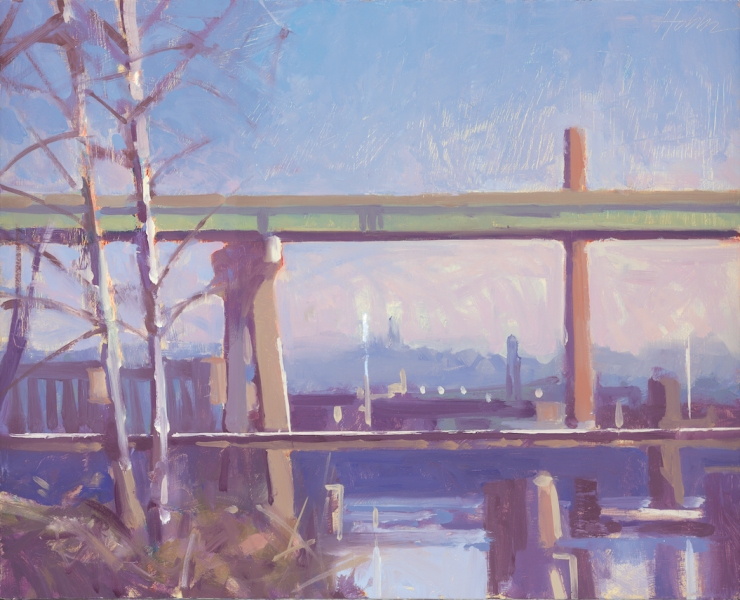
To be a Virginian is first to be a product of the soft and beautiful landscape and climate of the Tidewater, Piedmont, Blue Ridge Mountains, Shenandoah Valley, and the Appalachians, all of it connected by the state’s languid rivers, the most significant of which is the James. Virginia’s gentle terrain and weather seem to conspire to make it physically and psychically hard to get or stay angry. Such natural tonic is corroborated by the impossibly high standards for gentlemanly comportment and achievement set by icons such as Washington, Jefferson, and Lee. To this day, I have trouble imagining a Virginian perpetrating a truly vicious or hurtful act. Even as they are confused by or ignorant of their proud aristocratic tradition, most find it absolutely painful to say no to anyone or not lend a helping hand where needed. To say that such deference makes them wildly vulnerable in the face of a world that is a lot more conniving and harsh than they are is an understatement, which is part of John Bartle’s problem in The Yellow Birds. In all this I speak mostly of white Virginians, for consideration of the state’s tortured history of race relations and its African-American demographic seriously undercut idealization of its white patrician elders while infusing the calm landscape with blood and fire. We can think first of Sally Hemings–desire and denial–and Nat Turner–rebellion and suppression–and then wonder about the contemporary athletic prowess of ferociously competitive African-American Virginia sportsmen such as basketballers Moses Malone and Allen Iverson and football players Lawrence Taylor, Bruce Smith and Michael Vick.  Do they represent a modern instantiation of Virginia’s genteel white and gritty black social bifurcation and commingling?

These factors seep into the works of Virginia artists as diverse as Edgar Allan Poe and Patsy Cline and help make them thoroughly unique and rich. Poe and Cline, the sweetest of souls, seemingly doomed to die young, their art works melancholy to the core, tinged everywhere by loss and yearning, haunted by fear and desperation, and deeply wise about pain that comes from within and without. That’s heady company in which to place Powers, and time will tell if the comparison holds up, but it represents a way to begin to understand the lyric morbidity of The Yellow Birds. To my mind, John Bartle’s effort to make sense of his tangled life and deployment is a particularly Virginian response, knowingly sketched by its author, who was raised and went to college in Richmond.

Frank Hobbs,
Frank Hobbs, “South Richmond (Richmond, VA)”

The novel’s subject is the loss of innocence completely and irredeemably; its title is taken from a military cadence that tells of a “yellow bird with a yellow bill” whose head is smashed “upon my windowsill.” Like Poe’s raven, the doomed canaries represent an idea that torments narrator John Bartle as he recounts the story of his criminal complicity in a war crime and his subsequent deterioration during and after his deployment to Iraq as an infantryman. Bartle’s story is not as much about his encounter with military culture and combat as it is about the intense relationship with two fellow soldiers who imbue his service with color and significance. Murph is a younger enlisted soldier, also from Virginia, whom Bartle vows, foolishly as it turns out, to protect. Sterling is Bartle and Murph’s platoon sergeant, a stone-cold veteran of several deployments whose rough love envelops his subordinates even as it hastens them toward their destruction. Bartle’s name is an obvious nod to Herman Melville’s famous Bartleby, the scrivener who “prefers not to” do what his boss asks of him. Bartleby’s passive-aggressive non-compliance is a result of spirit-draining stint working in the US Mail’s dead letter office, and letters figure prominently in The Yellow Birds, but Powers’ Bartle is brought to a state of numbed withdrawal from life after a series of events vastly more horrific and consequential than those experienced by Melville’s scrivener. Compared to Bartle, Bartleby’s choice to opt out is a far greater act of agency and free will than anything manifested by Bartle, who seems dragged through life by circumstance, chance, the will of others, and the mishaps that ensue anytime he tries to act purposefully. Actually interested in trying to please others, he learns, if anything, that doing so negates his own individuality and resourcefulness, while mostly screwing things up for his intended beneficiaries.

Many reviews of The Yellow Birds point to its opening lines as evidence of Power’s stylistic pitch:

The war tried to kill us in the spring. As grass greened the plains of Nineveh and the weather warmed, we patrolled the low-slung hills beyond the cities and towns. We moved over them and through the tall grass on faith, kneading paths into the windswept growth like pioneers. While we slept, the war rubbed its thousand ribs against the ground in prayer.

Such prose is not sedate, but in comparison to the jazzed-up language of Ben Fountain’s Billy Lynn’s Long Halftime Walk and David Abrams’ Fobbit—both full of laugh-out-loud figures of speech and one-line zingers—The Yellow Birds is slower, more contemplative, more lyrical. No character is ridiculed, and military and political ethics and purposes are not scorned. Even descriptions of combat and the characters’ rough military speech are rendered in a heightened literary register that conveys brooding seriousness and intense artistic imagining. The cumulative effect is to suggest that the catastrophic events that lead to the death of many of the novel’s characters and Bartle’s deterioration are akin to a slow-moving car wreck. Murph in fact uses that analogy to explain combat:

“It’s like a car accident. You know? The instant between knowing that it’s gonna happen and actually slamming into the other car Feels pretty helpless actually, like you’ve been riding along same as always, then it’s there staring you in the face and you don’t have the power to do shit about it And know it. Death, or whatever, it’s either coming or it’s not …. Like that split second in the car wreck, except for here it can last for goddamn days.”

These sentiments make a mockery of heroism, or any kind of human free will. They recast soldiers as inert entities to whom things happen. By the end of The Yellow Birds, Murph dies, Sergeant Sterling dies, and so do several minor characters. Bartle lives on and tries to feel ordinary again, but does so only by severely reducing the scope of his world: “I don’t want to look out over the earth as it unfurls itself toward the horizon. I don’t want desert and I don’t want plains. I don’t want anything unbroken. I’d rather look out at mountains. Or to have my view obstructed by a group of trees.” “James River Blues,” a terrific song by Old Crow Medicine Show, a band with deep Virginia roots, helps explain Bartle’s state-of-mind:

On the cool flow
Floatin’ down, down below
The bridge to the water’s edge
From the ridge to the ledge
From the hills to the sea
I’ll become a memory

Ensconced back within the Virginian landscape Bartle waits his own vanquishing. His journey beyond the state borders has been a disaster; his personal saga mirrors the downward historical trajectory of the Commonwealth; his character flaws those of his people. Bartle’s catastrophe could be any soldier’s, or that of the nation’s, but that it is a Virginian’s makes it that much more distinctive and poignant.

Frank Hobbs,
Frank Hobbs, “Sycamores and Green Bridge, Richmond, VA”

Kevin Powers, The Yellow Birds. Little, Brown, and Company (2012).

Frank Hobbs’ art by permission of the painter.

This post is dedicated to Sergeant First Class Kevin Dupont, a member of the Massachusetts National Guard who died of wounds suffered in 2009 while attached to a Virginia National Guard advisor team assigned to Camp Clark, Khowst Province, Afghanistan.

UPDATE September 13, 2015:  RIP today Moses Malone, mentioned here-in, a Virginia high school basketball prodigy and later an NBA MVP–one of the heroes of my youth.

War Fact or Fiction: Brian Van Reet on the “Kill Memoir”

Aftermath of a suicide bombing, Khowst Province, Afghanistan, 12 May 2009.
Aftermath of a suicide bombing, Khowst Province, Afghanistan.

Iraq vet and author Brian Van Reet’s recent essay in the New York Times, called A Problematic Genre, the ‘Kill Memoir,'” lambastes memoirs written by veterans who take pride in the number of enemy they killed in combat. He mentions as an extreme example Carnivore, written by an Army vet whose publicist claimed the author had killed in combat 2,746 Iraqis. Van Reet likens the Carnivore author to a sergeant in his own unit who embarrassed everyone by bragging about the number of Iraqi casualties he tallied. That this sergeant intended to get a tattoo commemorating each of them amplified and clarified his foolishness. That his credibility was suspect made matters worse. Clearly, the guy was fighting the war according to a script of his own devising, one that had him not playing a dutiful soldier or conventional hero or leader, but a hardened bad-ass killer.

Truth to tell, though, such dreams lurked close to the surface in many of the infantrymen and special forces types I saw in Afghanistan, me included. A rational approach to war is expressed by an 82nd Airborne Division platoon leader speaking of his feelings prior to going into action in the Persian Gulf War: “You’re feeling really excited about going to play in the big game, and horrified and scared out of your mind that you have to play the big game at the same time.” Horrified of what? “That you could get killed. And you get asked to do things tha you really don’t want to do. I don’t know many serial killers in the Army. Most people just really prefer not to have to kill anyone if they don’t have to” (Quoted in Nancy Sherman’s Stoic Warriors).

But lots of new personnel and units arrive in theater infected by desire to see combat.  An infantry captain is quoted in the current issue of Army magazine: “Every blue-blooded infantryman who deploys wants to get into a fight.  We want to plan and execute offensive operations.  We want to close with and destroy the enemy.  We want to take charge and be in charge.” It was barely use talking to such soldiers of counterinsurgency and nation-building and key leader meetings and training and advising when they were out of their minds to see what it was like to shoot at someone and be shot at in return. Once they had seen combat (and survived) they might settle down and be good for more commonplace things. But often their initial survival, if not success, whetted their appetites, and now that they had “got some,” they desired even more. Like the author of Carnivore, they turned war into a competitive game of testosterone-fueled one-upsmanship, clothing their blood-lust and thrill-seeking in the justifications of duty and necessity. Such attitudes were unseemly and most did their best to keep them dampened down.  But not all felt this way. Some guys just seemed so determined to, as the saying goes, “get their war on.” And not all were ridiculed or scorned. In the hierarchy of soldiering, hardened killers could accrue enormous social capital. Where fear and confusion reigned, they offered toughness and purpose, of a kind. Operating insidiously within and sometimes overtly against the chain-of-command, they used their rank and stature to make the war all about kill-or-be-killed.

It’s no wonder such soldiers’ memoirs sell, as Van Reet realizes, but still he castigates a publishing industry that cravenly vends sensational war memoirs to a fawning reading public. Such fare glorifies the killing it describes, and thus perpetuates war rather than doing anything to end it. But even if kill memoir authors position themselves as self-effacing and introspective, their books are still shaky vehicles for the delivery of truth. The problem lies in the form as much as the sentiments. Memoir, Van Reet reminds us, is such a self-aggrandizing, unreliable, and stereotyped genre that it might be the last place, not the first, we would go to for factual detail or insight about what it means to kill in combat.

Van Reet instead touts the supremacy of fiction over “fact” and in particular literary novels such as David Abrams’ Fobbit and Kevin Powers’ The Yellow Birds. “Though they are fictional,” he writes, “they read in my mind, like more accurate depictions of the totality of what happened in Iraq than any of the supposedly factual accounts I have mentioned.” I’ll second that, and throw in, as does Van Reet later in the essay, Ben Fountain’s Billy Lynn’s Long Halftime Walk as a third novel that, taken with the other two, make 2012 the annus mirabilis of Iraq war fiction. Indeed, each of the novels, in its way, examine the relationship of a softer, more sensitive soldier who comes under the sway of a much more decisive, hardened, experienced soldier at home with the business and psychology of killing. Among the novels’ other achievements, they use the tools of fiction—perspective, irony, empathy, style, tone—to interrogate the attitudes toward combat and killing described above and presented naively and self-servingly in memoirs and histories. Usually, they find such pronouncements swaddled in layers of self-deception and self-justification, and they convey sympathy for characters who at least struggle toward awareness and growth.

But as impressive as Abrams’, Powers’, and Fountain’s novels may be, they are, as we speak, still a feeble countervailing force in a publishing environment characterized by what Van Reet calls “the triumph of the kill memoir.” Van Reet closes by issuing a challenge to veteran writers, other authors interested in war, the publishing industry, and by implication, reading audiences:  we can all do better. I’ll second that, too.

Iraqi Iraq War Fiction: Hassan Blasim’s “The Green Zone Rabbit”

At last, contemporary war fiction from the other side–a chance to see how the Iraqis think about us.  Only it’s not that simple, because the Iraqis portrayed in Iraqi author Hassan Blasim’s great “The Green Zone Rabbit” are so caught up in their internal Iraqi-only machinations and subterfuges that the American presence barely registers, save for a number of references to Facebook.  Apparently, even sectarian infighters in the Baghdad warzone lived from status update to status update.  And who needs Americans, anyway, when the Iraqis in “The Green Zone Rabbit” kill each other just fine in the most brutal ways?

The first person narrator describes the death of two of his brothers:  “The Allahu Akbar militias took them away to an undisclosed location. They drilled lots of holes in their bodies with an electric drill and then cut off their heads. We found their bodies in a rubbish dump on the edge of the city.” And that’s not the worst of it in, in story that manages to be graphic without being sensational.  According to critic Yasmeen Hanoosh, Blasim’s fiction consists of “at once peremptory and incredulous accounts of human violence.”  That seems about right.

What is the context for such laconic treachery and death?  According to Hanoosh, Iraq’s war with Iran and Saddam Hussein’s dictatorship set the conditions for latent Shia-Sunni tensions to catalyze, not the Americans’ overthrow of Saddam and their subsequent occupation. In other words, post-2003 civic degeneration is only the latest manifestation of the contemporary historical nightmare from which Iraq is still struggling to awake. Within the literary realm, Hanoosh tells us that the emergence of authors such as Blasim represents an intellectual revolt against state-and-church sanctioned official speech. The import is a distrust of triteness and cant, formula and convention.

This historical-cultural stew generates a fictional texture unlike anything I’ve seen in American war fiction.  One thing immediately noticeable in “The Green Zone Rabbit” is that the protagonists are grown adults, with richer personal histories and more complex worldviews than the boyish and girlish heroes of American fiction.  There seems to be a lack of sentimentality and emotional gush, too; Hajjar, the narrator of “The Green Zone Rabbit,”  is hyper-aware of the dangerous world he inhabits, but the story isn’t all about his feelings toward killing and dying in the way that, say, it is for the protagonists of Billy Lynn’s Long Halftime Walk or The Yellow Birds. Nor is it moralistic.  For Hajjar, the problem of the war is as much intellectual than it is emotional or political or ethical or even religious.  “The Green Zone Rabbit” emphasizes how quick of mind one must be merely to survive in an environment where motives are always obscure and loyalty in jeopardy.

“The Green Zone Rabbit” can be found at the Words Without Borders website, whose April 2013 issue is dedicated to Iraq, Ten Years Later.  The biography of Blasim therein tells us that a collection of his stories called The Corpse Exhibition will come out next year, translated from Arabic by Jonathan Wright.  Yasmeen Hanoosh’s overview of Iraqi literature is also worth reading:  “Beyond the Trauma of War: Iraqi Literature Today”.  So too is Polish journalist Mariusz Zawadzki’s “A Vacation in Basra”, which is excerpted from his book Brave New Iraq.  Zawadzki, among other things, is remarkably generous about the American occupation.  He writes:

You can accuse the Americans of a lot of things, but one thing you have to give them: they have never been economical in Iraq. They have sacrificed masses of energy, billions of dollars and thousands of dead to carrying out the impossible and absurd task that they have set for themselves. I have gotten to know many of them; some I have considered stupid or arrogant, but all of them—from the privates to the generals—have performed their Sisyphean labor with real commitment.

That’s why you could even love the Americans, in a way.

Not sure if that’s what Hassan Blasim would say about the matter, but it’s a perspective worth thinking about, or even better, given fictional representation and made available for critique.

Thanks to Sean Case for alerting me to the Words Without Borders website.

Review of Hassan Blasim at the Shortly Speaking webpage

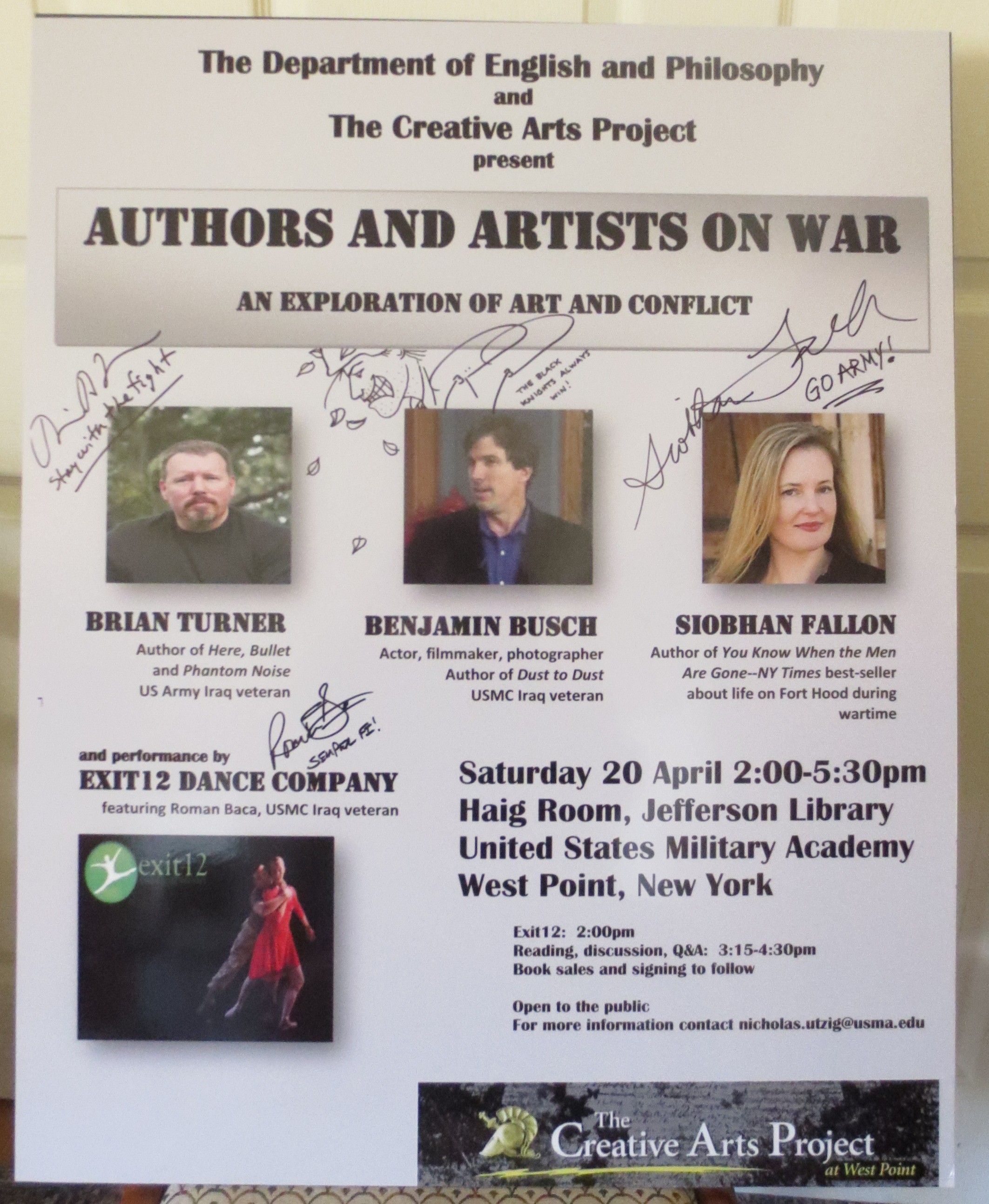
Brian Turner, Benjamin Busch, Siobhan Fallon, and Exit12 @ West Point

IMG_0818

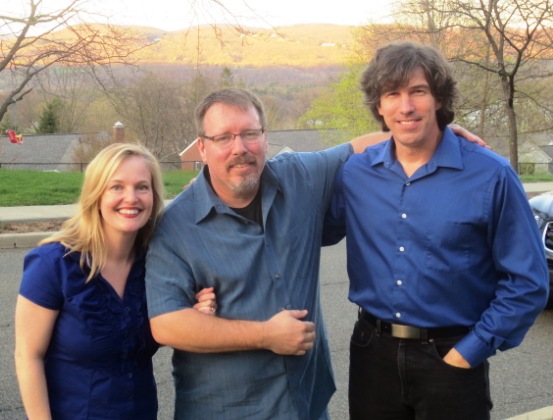
This event brought together three great authors–Brian Turner,  Siobhan Fallon, and Benjamin Busch–to speak about their efforts to portray the turmoil of war.  As each of them had been profoundly affected by the war in Iraq, it seemed fitting a decade and a month after the invasion to ask about their whereabouts in March 2003 and then have them describe when the war became manifest in their art. The remarks subsequently ranged over many subjects, but focused most specifically on the damage enacted on individuals and relationships by deployment and exposure to death and killing.

Asked to read selections from their works that generated strong audience reactions, Turner read “At Lowe’s Home Improvement Center” from Phantom Noise, Fallon read from her story “Leave” from You Know When the Men Are Gone, and Busch read passages from Dust to Dust that described his decision to join the Marines and his first few days of training at Quantico.

Later, each of the authors read passages or poems that had been written pre-2001 that had influenced them then or seemed important now.  Siobhan Fallon read from Tim O’Brien’s “The Things They Carried.”  Benjamin Busch read Joe Haldeman’s Vietnam War poem “DX,” which he had copied into a green military-issue notebook and carried with him in Iraq.  Finally, Brian Turner recited from memory Israeli poet’s Yehuda Amachai’s “The Diameter of the Bomb”—an especially appropriate poem in light of last week’s Boston Marathon bombing:

      The diameter of the bomb was thirty centimeters
      and the diameter of its effective range about seven meters,
      with four dead and eleven wounded.
      And around these, in a larger circle
      of pain and time, two hospitals are scattered
      and one graveyard. But the young woman
      who was buried in the city she came from,
      at a distance of more than a hundred kilometers,
      enlarges the circle considerably,
      and the solitary man mourning her death
      at the distant shores of a country far across the sea
      includes the entire world in the circle.
      And I won’t even mention the crying of orphans
      that reaches up to the throne of God and
      beyond, making a circle with no end and no God..

Amazing.

Exit12 performed two dances:  “Aggressed/This is War” consisted of two solo pieces that together depicted the story of a returned vet struggling to reintegrate into peacetime life.  “Yarjuun,” which means “We hope” in Arabic, was a piece written by Exit12 director Roman Baca in Iraq in collaboration with an Iraqi dance troupe.  Both dances were in turn playful, sad, sexy, and politically-charged, with inspired music, props, and choreography that dramatized the effects of war without being either too obvious or too elusive.

I had a hand in organizing this affair so I definitely want to thank the artists, all those in the audience, and all those helped make it happen.  Wish everyone reading could have been there, too!

Below left to right:  Siobhan Fallon, Brian Turner, Benjamin Busch:

???????????????????????????????

Exit12 below–Adrienne de la Fuente, Joanna Priwieziencew, Roman Baca, Chloe Slade, and Paige Grimard:

???????????????????????????????

The Imagined Wars of the Heart

In an earlier post, I wrote of the similarity of Brian Van Reet’s “Big Two-Hearted Hunting Creek” and Siobhan Fallon’s “The Last Stand.”  In each story a badly wounded Iraq war vet confronts the fact that his wife has chosen to leave him.  In Fallon’s story, the vet and his wife are so tenderly portrayed that the reader is left gasping with sympathy for both of them.  We want them each to somehow be happy again, if not together then in their now separate lives.  In Van Reet’s story, the soldier and his wife are monsters, albeit colorful ones.  They have not been just buffeted and damaged by the war, but ruined by it.

Both stories are great, just in case that needs saying.

As up-to-the-minute as they are, “Big Two-Hearted Hunting Creek” and “The Last Stand” also belong to a tradition of stories about wounded male vets being jilted by wives and girlfriends.  Alice Fahs remind us of that in The Imagined Civil Wars when she describes a Civil War tale called “A Leaf From a Summer” published in Harper’s Weekly in November 1862.  Fahs writes:

“In that story a soldier faced an amputation hopefully because he had a letter from his beloved ‘next to his heart’; afterward, contrary to the surgeon’s expectations, he indeed ‘began to rally.’ But after receiving a letter telling him that his shallow lover had changed her mind and would not ‘marry a cripple,’ the hour quickly came ‘when they lowered him into the earth, and fired their volleys over him.’  As the narrator commented, ‘his enemy had struck him unarmed and unaware.’  As such the popular fiction revealed, the war only intensified a long-standing literary connection between love and war:  numerous stories claimed not only that women’s love was vital to a successful war but that love itself equaled war in its power to kill men.”

Below is a link to a web reprint of the story as it appeared in the 8 November 1862 Harper’s Weekly, for those who can’t get enough of that breathless, clichéd, one-sided 19th-century narration.

A Leaf From A Summer

“A Leaf From A Summer” is laughable, while the strength of Fallon’s and Van Reet’s stories is their ability to convey marital breakup with a sense of perspective, balance, nuance, and realism.  Examined in isolation, however, the pain of a soldier’s heartbreak is real and consequential.  A chapter called “Dear John” from Matt Gallagher’s excellent war memoir Kaboom:  Embracing the Suck in a Savage Little War describes the carnage wrought on the soldiers in his cavalry scout platoon when they were jilted while deployed.

“Dear Johns crushed men of otherwise unquestionable strength and total resoluteness.   In the time they most needed something right and theirs, it was taken away from them.  It wasn’t like getting dumped—it had a far more resounding impact on the soldier.  He became rougher, harsher, crueler…. Truthfully, it usually made him a better soldier, but he lost some vital slivers of his humanity in the process.”

Gallagher also explains that Dear Johns “didn’t just impact the recipient.  They affected the psyches of teams, sections, platoons, and troops, bringing home to everyone the recognition that the same thing could happen to them and forcing them to wonder if it was going to.  Or if it already had and they just didn’t know about it yet.  This mind fuck was the worst part for many.”

Gallagher points out that a soldier’s romantic interest represents his (or her) hope that an ideal or at least better world awaits his return and thus makes the misery of the war endurable and grounds his conduct while deployed.  But he also reminds us that many soldiers are shitty boyfriends or husbands.  Neglectful and needy by turns, they might be outraged and hurt by unfaithfulness even while being unfaithful themselves.  Gallagher doesn’t do much more to explain Dear Johns from a woman’s point of view, but Kit, the protagonist of “The Last Stand” and Sleed, the protagonist of “Big Two-Hearted Hunting Creek,” also present their spouses with many issues even without the problem of their dismemberment and disfigurement.  The implication seems to be that women are attracted by the idea of loving a soldier, but find the reality very difficult to deal with.  Perhaps they also suspect that male soldiers love war and the military more than they do their wives and girlfriends, and thus determine to make their men pay.

Brian Van Reet’s “Big Two-Hearted Hunting Creek” can be found in Fire and Forget:  Short Stories, published by De Capo Press in 2012.

Siobhan Fallon’s “The Last Stand” can be found in You Know When the Men are Gone, published by Amy Einhorn Books-Putnam in 2011.

Matt Gallagher’s Kaboom:  Embracing the Suck in a Savage Little War was published by De Capo Press in 2010.

Alice Fahs’ The Imagined Civil War:  Popular Literature of the North and South 1861-1865 was published in 2001 by the University of North Carolina Press.

Toni Morrison: “Words and War at West Point”

Toni Morrison Speaks at West Point

The link takes you to a New York Times article on Nobel Prize-winning author Toni Morrison’s visit to West Point, where she discussed her latest novel Home with cadets and faculty.  The article makes a great case both for the relevance of Home as a text concerned with the Iraq and Afghanistan wars and for the value of literature in helping future officers understand war.

The Imagined Wars

Alice Fahs’ The Imagined Civil War: Popular Literature of the North and South 1861-1865 (2001) offers many ways to put current Iraq and Afghanistan war literature in focus. Just taking her nine chapters in order, I’ll quote two sentences from each that make claims about Civil War literature that may still ring true today.  I’ve also added comments of my own that I hope begin to help us sort out the truth and relevance of Fahs’ ideas.

Popular Literary Culture in Wartime: “From the start of the war many readers, writers, and publishers in both the North and South assumed that the war was a literary as well as military event, one that would inspire a new linking of individual and nation within poem, song, and story. Few would have admitted that market considerations played an important role in both encouraging and limiting expressions of patriotism in poetry and prose.”

Comment:  There really hasn’t been a “popular” Iraq and Afghanistan war literature in the way Fahs describes poems, songs, and stories saturating the Civil War print marketplace.  Entertainment/artworks about the current wars have appeared only intermittently, and their artist-creators from what I can tell have expressed themselves sincerely in ways that have seemed most suitable to the ideas they’ve been trying to convey.  The high regard of veterans, their fellow artists, and most intelligent, loyal readers seems to drive them more than the dollar.  Now if there was actually any kind of money to be made by telling contemporary war stories, things might change.

The Early Spirit of the War: “Increasingly, the lived, personal experience of war became the subject of war literature. Although ‘war-songs’ and ‘battle-calls’ were published throughout the conflict, they were supplemented with an extensive literature that insisted on the primacy of the individual experience of war.”

Comment:  I think this is true.  It’s a long way from Toby Keith’s “Courtesy of the Red, White, and Blue (the Angry American)” in 2002 to Kevin Powers’ The Yellow Birds and Ben Fountain’s Billy Lynn’s Long Halftime Walk in 2012.

The Sentimental Soldier: “Yet by 1862, and then in increasing numbers as battle deaths mounted during 1863 and 1864, popular poems that asserted the importance and individuality of the ordinary soldier began to act as a counterpoint to poetry that stressed the subordination of individual interests to the needs of country. Sentimental stories and songs also focused intently on the individual experiences of the ordinary soldier on the battlefield and in the hospital, especially imagining that soldier’s thoughts at the moment of death.”

Comment:  This one’s hard to figure out.  Certainly death, killing, injury, pain, and loss are front-and-center subjects of contemporary war literature, but what is Fahs driving at by calling such business “sentimental”?  That has the ring of a sneer to it, and yet for most of us (I would say), exploring the human experience of mortality and suffering are exactly what literature should be doing.

The Feminized War: “In both the North and South throughout the conflict, a feminized war literature put white women center stage in the war, demanding recognition not only of women’s contributions to the war effort but also, as the war wore on, of their intense suffering. In doing so, such literature did not displace the importance of men in the conflict, but it did sometimes ask for equal recognition of women’s sacrifices, thus contributing to the diversity of claims to the war’s meanings to be found in the pages of popular literature.”

Comment:  Women are starting to appear in contemporary war literature, too, both as fighters and as spouses, friends, lovers, and family members affected by war.  But one of Fahs’ points is that Civil War literature was intensively market-driven, and that authors shaped stories to appeal to a huge female readership.  Is this still true today?

Kingdom Coming: “As in so many other Northern stories and novels of the war, the achievement of black heroism was, ironically, most easily imagined through sacrificial death. Nevertheless, the imagination of black heroism within popular literature marked a new phase in representations of African Americans.”

Comment:  Seemingly not an issue in contemporary war literature, but the absence or token inclusion of minorities in current war art and literature is curious, as I discussed in my post on Toni Morrison’s Home.

The Humor of War: “Instead of merely reaffirming the values of patriotism, discipline, obedience, and endurance, war humor acknowledged that sloth, laziness, cupidity, disobedience, and negligence were also among the values associated with the war. Most of all—and most transgressive of the heroic norms of patriotic literature—war humor made the simple but profoundly subversive point that war was ridiculous.”

Comment:  Bring it on!  More Colby Buzzell, more Ben Fountain, more David Abrams, please!

The Sensational War: “Although it has often been suggested that the war acted as an impetus for the development of realism in American letters, popular wartime literature reveals that the experience of war acted just as much—if not more—as the impetus for the development and wide dissemination of adventurous romance, the domain of ‘cheap’ novels…. Strongly linked to melodrama in language, plot, and characterization, sensational literature emphasized a world of moral certainty composed of dastardly villains and spotless heroes, and of pure good and evil.”

Comment:  Not such a problem today, but that’s because there really isn’t even a low-brow, pulp, popular, or “cheap” war literature market anymore. Everything that I’m aware of aims high; no one’s writing stories that gleefully depict the warzone as a realm for the uncomplicated killing of bad guys and other adventures.

A Boys’ and Girls’ War: “Yet war-related novels written for and marketed to children were subversive of antebellum familial ideals in several respects. They were attuned to patriotism and entertainment, nationalism and individualism, obedience and adventure.”

Comment:  How have the Iraq and Afghanistan wars been explained, represented, and marketed to youths?  Now that would be an interesting subject for study.

The Market Value of Memory: “As these shifts in popular literary culture remind us, memories of wars are far from static or permanent…. Whereas during the war Northern women’s experiences on the home front or African American soldiers’ exploits had been imagined as a form of participation in the war, increasingly only men’s experiences in battle counted as the ‘real’ war.”

Comment:  Too early to tell, but Hollywood’s interest in SEAL Team 6 and other special forces might be an indication that this dynamic hasn’t changed.

I hope these snatches of Fahs’ book intrigue you like they do me. Her “provocative-but-plausible” idea per page index is off the chart, in my opinion.  I have a little bit more to say about Fahs in a future post, and also plan to look at some of the scholarly work on the literature from other wars to see what they have to offer.

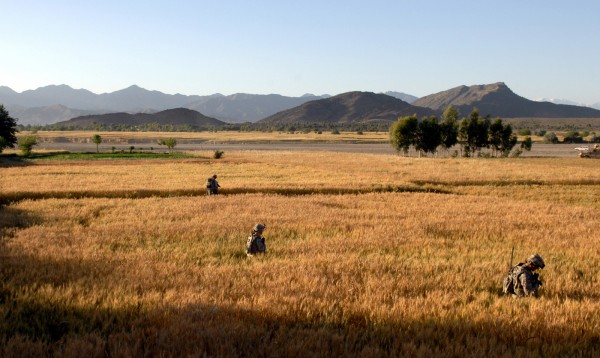
Wheat fields, Khowst Province, Afghanistan.