A Contemporary War Short Fiction Listicle

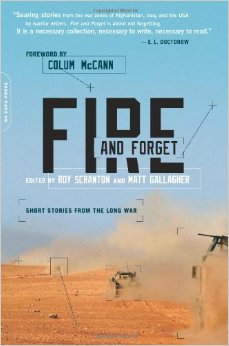
The 2013 Fire and Forget anthology of short war fiction featured a who's-who of established and soon-to-be-prominent war writing authors.
The 2013 Fire and Forget anthology of short war fiction features a who’s-who of established and soon-to-be-prominent war-writing authors.

Ten excellent short stories about war in Iraq and Afghanistan, listed in alphabetical order below by author, with no writer represented more than once. Very subjective, and not definitive, but I wouldn’t walk into a room of war writers without knowing them all. It’s interesting that of the stories featuring American service men-and-women, only one, Will Mackin’s “Kattekoppen,” is set entirely in-theater. Another, Annie Proulx’s “Tits-Up in a Ditch” features scenes set before, during, and after deployment. The others portray soldiers and Marines upon return to the States and feature flashbacks to or reminiscences about Iraq or Afghanistan–the signature narrative moves of contemporary war short fiction so far.

Hassan Blasim, “The Green Zone Rabbit.” The best of any number of diabolically perverse stories in The Corpse Exhibition, a collection of tales set mostly in Baghdad by Iraqi expatriate Blasim, the Edgar Allan Poe of the 21st-century.

Frederick Busch,“Good to Go.” Busch’s son Benjamin served two tours in Iraq and writes like a dream himself, but his father gets the nod here with this early-on (2006) story of a war-damaged Marine.

Siobhan Fallon, “The Last Stand.” Any story in Fallon’s remarkably even You Know When the Men Are Gone could have made the list, but this portrait of the collapse of a wounded veteran’s marriage stands out for its heart-rendering tenderness toward the two protagonists, Kit and Helena.

Mariette Kalinowski, “The Train.” One of three entries on the list from the Fire and Forget anthology (edited by Roy Scranton and Matt Gallagher), Kalinowski’s story of an alienated female veteran remains, as far as I know, the only fiction written by a woman veteran with significant outside-the-wire experience in Iraq or Afghanistan.

Phil Klay, “Redeployment.” There are other great stories in Klay’s collection Redeployment, but the title tale, with its already famous first line, “We shot dogs,” has captured both the public and critical imagination as the saga par excellence of the traumatized vet. “Redeployment” first appeared in the Fire and Forget anthology.

Nikolina Kulidzan, “The Final Cut.” This sizzling story, which appeared in the Veterans Writing Project journal O-Dark-Thirty, portrays directly what other war fiction has tip-toed around or treated demurely: the jangled-up erotic circuitry of redeployed veterans, both men and women.

Will Mackin, “Kattekoppen.”  Surreal sci-fi influenced fiction about an artillery battery in Afghanistan; it appeared in the surprisingly war-lit-friendly New Yorker. For more sci-fi inflected short war fiction, see Brian Turner’s “The Last Wave” and Andrew Slater’s “New Me,” both in Fire and Forget.

Annie Proulx, “Tits-Up in a Ditch.” Proulx, like Frederick Busch, is a literary old master in relation to war writing’s young Turks, but her 2008 story anticipates many themes that would become later become commonplace in the works of other authors: women-in-uniform, IEDs, disability, post-deployment disaffection. “Tits-Up in a Ditch” first appeared in the New Yorker.

Katie Schultz, “Into Pure Bronze.” Sharp portraits of American fighting men and women abound in Schultz’s flash fiction collection Flashes of War, but this story of young Afghans playing soccer in Kabul Stadium arguably best showcases Schultz’s impressive powers of imagination and empathy.

Brian Van Reet, “Big Two-Hearted Hunting Creek.” The third story from Fire and Forget to make the list, Van Reet’s bleak and acerbic tale features two of the most-instantly-memorable protagonists of the war writing canon:  the badly disabled Sleed and Rooster, two veterans whose physical carnage is more than matched by their damaged psyches.

Honorable mention stories and authors are too many to list, but I hope to give them their due in time.

War Writers and War Readers: More on John Renehan’s The Valley

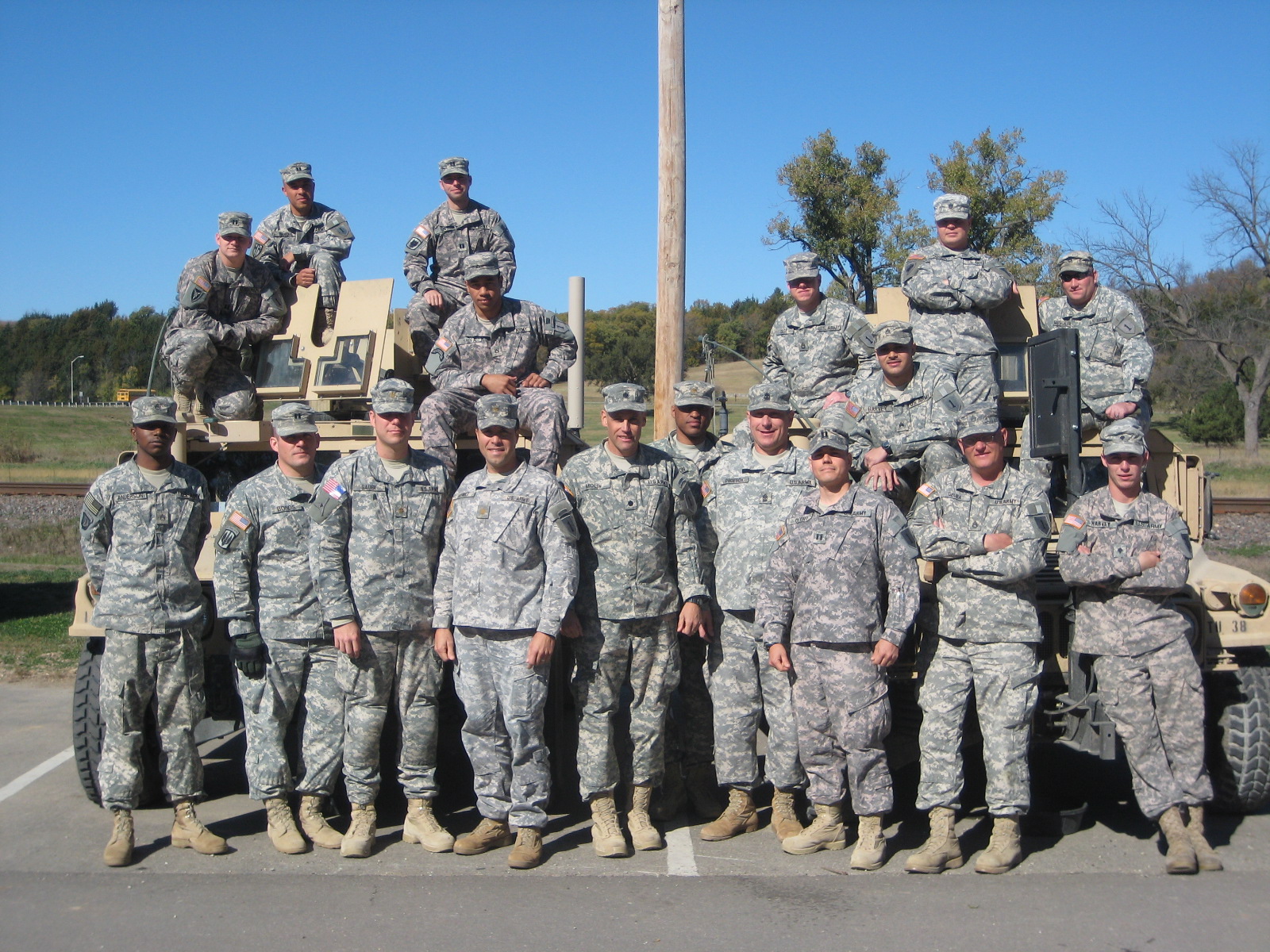
My advisor team, prior to deployment to Afghanistan. Fort Riley, KS, 2008

Asking whether writers who are not veterans can write credibly about war and the military is dumb, for writing about any subject succeeds to the extent it is well imagined and written, not because it emanates from the lived life of its author. Asking if readers who haven’t served in the military or seen war can accurately assess war writing is actually a more intriguing question. The answer’s “yes,” but there are also interpretive possibilities. Veterans lean into writing about war with an extra-level of attentiveness, while also being determined not to be impressed too easily. They are eager to see their own experiences reflected and critical of failed efforts to get the details right, so their enthusiastic sympathy for a book rises in proportion with which they can identify with characters, settings, and events portrayed on the page.

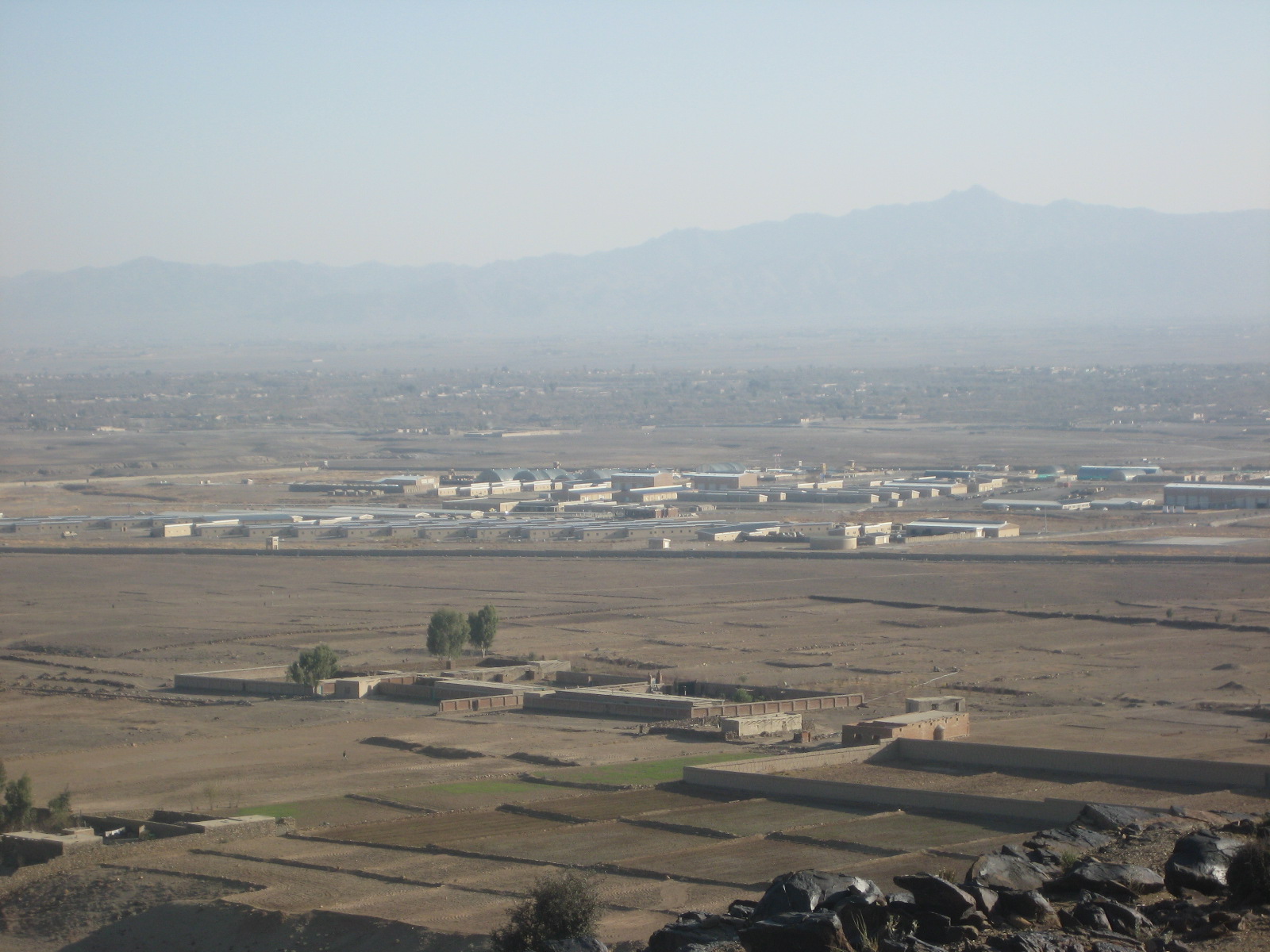
So it was for me on reading John Renehan’s novel The Valley. No fiction written so far about Iraq and Afghanistan has resonated so personally with my own experience and impressions. The physical geography of Army bases depicted in The Valley might well have been mine during my time in Khost, Afghanistan, with FOB Salerno, Spera Combat Outpost, and a tiny OP on the hill above Spera COP very nearly matching Renehan’s fictional equivalents. Scenes portraying long convoys to a remote outpost and a battle-as-it-was-fought-over-the-radio from an outpost Tactical Operations Center are also experiences I have lived through many times. Flashbacks in The Valley to episodes set at “land navigation” training sites at Fort Benning, Georgia, triggered recollections about my own formative experiences on the legendary Yankee Road North and South map-and-compass courses during Officer Candidate School, Infantry Officer Basic Course, and Ranger School. Even the novel’s central conceit—that of an officer assigned to conduct a meaningless Article 15-6 investigation in the midst of a warzone—reflected my own tour-of-duty. During my deployment, I spent three weeks conducting a senseless 15-6 investigation to determine the whereabouts of a unit’s lost property at a time–the 2009 national elections–in which the concentrated devotion of every American officer was required to make sure the mission went well. Finally, Renehan even uses the phrase “time now” multiple times–how could I not like that?

Novels are places where the nuances of social life are explored, and The Valley corroborates my experiences in this regard, too. Contemporary war fiction hasn’t spent much time portraying officers, but The Valley features a gamut of brass-wearing major and minor characters who conform to type while also displaying individuality. Most of the novel is focalized through the eyes of its protagonist, Lieutenant Black, and it seems clear enough that his views are also those of the author, who himself was a field artillery officer. Black reminds me of many disgruntled lieutenants I have known over the years, their Army hopes dashed and now seething with resentment and salivating to get out. Stuck behind a desk in the unit personnel office, Black burns with envy of a platoon leader still in command of his unit:

Derr spent most of his time outside the dreary midsize base where Black spent all of his time, stomping through the Afghan backhills with his platoon and shooting at people. It was precisely what Derr had imagined he would be doing when he set out to become an Army officer, and the universe had graciously given him no reason to question his assumptions…. When he had paper-type business he needed help with, he made his way to Black, to be found reliably behind his desk doing precisely the opposite of what he had imagined when he became an Army officer.

After travelling to COP Vega, Black observes a picture of Lieutenant Pistone, the COP’s officer-in-charge. It would take stones the size of the super-blood-moon for a fobbit such as Black to critique the leader of the most dangerous outpost in the battalion area of operations, but Black quickly sizes up Pistone as a lightweight:

Black was a quick study of the various sorts of people who are attracted to the military. There was a lot of different ones, but he felt he could peg Pistone pretty quickly. Geek made good.

He had known the type before. The brainy guy who was never good with the girls, never got picked for the team, spent an ineffectual childhood probably getting picked on a little bit, developed a nice put-upon complex. Then he discovered the military somehow and learned that even if you are all those things you can still get to do this. That your military life can stand as a triumphant ongoing Fuck You to all the guys who’d always been cooler.

He became your squared-away supersoldier, in his own way. Fastidiously organized, diligent about physical training. Not necessarily a good leader.

He walked around with the sound track of his freshly awesome life playing in his head. He tended to forget that succeeding in the military was not so much about his own cosmic journey to heroism as it was about how good he was at dealing with people, handling people, taking care of people. Sooner or later, the Army turned on him, left him friendless there as in life.

The Valley also features a nice portrait of Black’s battalion commander Lieutenant Colonel Gayley:

True, the beating bureaucratic heart of the Army had a slobbering crush on officers like Gayley. Somewhere in a lab at West Point his instructors had mixed him in a bowl, whipping into him the precise proportions of accountability, flawless attention to detail, chipper optimism, and bold cooperativeness, folding in a hardy tolerance for paperwork and a relentless professional ambition, with a dash of tanned physical perfection for flavor….

He was a little of everything and a little of nothing. He yelled at the right people, didn’t yell at the wrong people, didn’t fail in his duties, didn’t cause surprises or embarrassments. He was just so.

Black doesn’t hate Lieutenant Colonel Gayley exactly, or even think he’s incompetent, but the chin-up façade of perfection irritates him. It’s the kind of manicured remoteness that gets many officers branded “not real people.” Black, on the other hand, isn’t consumed with maintaining appearances at all costs and is shown bonding quickly with enlisted soldiers and standing up to NCOs used to steamrolling wishy-washy officers. It’s a fantasy image of being the lieutenant every young officer dreams of being, but few are consistently. In the context of The Valley, it’s proof that the overall Army mission is screwed because it doesn’t recognize the true leaders of combat soldiers in its midst. That’s not exactly my impression of how the Army recognized or didn’t recognize excellence, but it’s not entirely wrong either.

War Crime: John Renehan’s The Valley

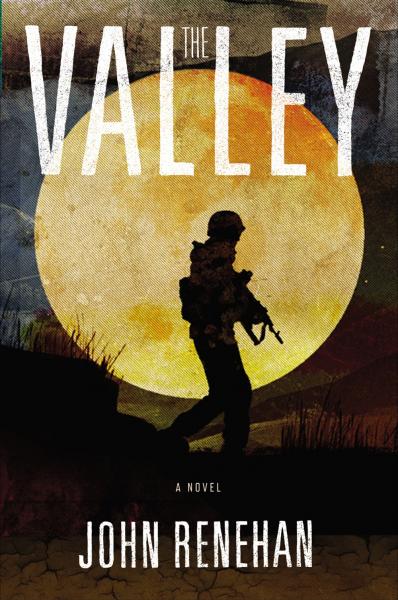
ValleyEx-US Army officer John Renehan’s novel The Valley surprises and pleases at many turns. The story of an Army infantry lieutenant assigned to conduct an official Article 15-6 investigation of a seemingly minor incident at a remote outpost in Nuristan province, Afghanistan, The Valley maps the highly structured form of a crime novel onto the equally structured form of a war novel. Rather than forced, the mash-up of genres in Renehan’s hands feels harmonious and productive. 15-6 investigations are a fact-of-life for Army officers—I did about ten of them while I was in—and so in The Valley the conceit serves plausibly to expose how awry might go a small, isolated unit, and the LT-as-private-dick motif breathes new life into the many-times-told tale of a junior officer’s disillusionment.

The Valley’s protagonist is Black, no first name given, who at novel’s opening is pushing paper at battalion headquarters after losing his position as a platoon leader. Black’s appointment to investigate a wayward weapons discharge by an American soldier outside Combat Outpost (COP) Vega, the most remote and dangerous outpost in the battalion’s area of operations, is just another indignity he must endure before he can quit the Army. After a long convoy up the rugged valley of the novel’s title, Black is met at COP Vega with hostility from the outpost’s soldiers. They clearly hold out on him, they clearly are wracked by internal strife, and they clearly are beholden to the charismatic sway of the outpost’s two senior sergeants, Sergeant First Class Merrick and Staff Sergeant Caine. COP Vega’s nominal officer-in-charge, Lieutenant Pistone, departs the outpost on the same convoy that brings Black to it, and in the week before the convoy returns to exfil him, Black learns that Lieutenant Pistone has been an ineffective, cowardly leader and yet also somehow connected to wrongdoing far more consequential than the weapons discharge that prompted official investigation.

Sensing the basic rottenness of COP Vega, Black begins kicking over rocks to discover what creepy-crawly things lie beneath. The unit’s manning roster doesn’t match up with the personnel actually on COP Vega, and its relationship with the town nearest the outpost is abysmal, even by Afghanistan standards. A second, smaller outpost, unknown to higher headquarters, exists on the heights above COP Vega, its raison-d’etre both tactical and things more nefarious. Most significantly, Black learns that Sergeant First Class Merrick and Staff Sergeant Caine hate each other, and one or the other or both has gone rogue and taken factions of the platoon with him. A mysterious “Other Governmental Agency” American comes and goes, leaving behind enigmatic hints about COP Vega’s dark mysteries. At stake, Black further discovers, are the valley’s poppy growing and heroin distribution networks, into which at least some of the Americans have enmeshed themselves both for personal profit and narcotic bliss. As Black strings together clues that threaten the prevailing balance-of-power, he places his own life and everyone else’s life on COP Vega, precarious to begin with, in even greater jeopardy.

Renehan narrates the story mostly through Black’s perspective, but withholds description of the key cognitive leaps made by the sleuthful lieutenant as he uncovers the extent of COP Vega illegality—we see him acting on his intuitions, but we are never sure what exactly he has perceived that propels the successive steps of his inquiry. The result is a thrilling speed-read to The Valley’s end as the reader, or this one anyway, goes near-crazy to learn precisely what evil has befallen COP Vega and who is responsible. There are red herrings galore, as well as some seemingly gratuitous and even goofy plot turns, but rather than quibble, I would love to meet someone else who has read The Valley so we can argue about its many what-the-hell-was-that-all-about moments.

Comparisons are said to be odious, but perhaps also apt in consideration of The Valley’s achievement. The novel reads as if Renehan had grafted JK Rowling’s (aka Robert Galbraith) The Cuckoo’s Calling onto Joydeep Roy-Bhattacharya’s The Watch, and then mixed in elements of Aaron Gwyn’s Wynne’s War. The fiercely independent Black bears much resemblance to Cormoran Strike, the gruff, no-nonsense veteran turned private eye driven by spite and ethics to uncover wrong-doing in The Cuckoo’s Calling. Like The Watch, The Valley plumbs the rank-based social dynamics of life on a middle-of-nowhere American outpost in Afghanistan, but where The Watch enfolds its storyline in the reassuring purview of its stalwart outpost commander and first sergeant, The Valley suggests power and authority invested in the chain-of-command corrupts rather than ennobles. Like Wynne’s War, The Valley contains brisk moments of action-adventure that begin on a remote Afghan outpost and then grow ever more exotic as its heroes journey outside the wire. But more so than Wynne’s War and The Watch, The Valley finds a compelling story through which to showcase its thematic interests. In Renehan’s view, poor leadership and poorly-defined missions unleash moral chaos and then evil among soldiers in small units left alone to fight the war as they can. Where Wynne’s War seems fanciful and The Watch pulls its punches, The Valley’s noir and police procedural elements convey a moral seriousness—a bigger message—that manages to implicate the entire US military mission in Afghanistan.

John Renehan’s The Valley. Dutton, 2015. This review by no means exhausts my interest in The Valley, so I hope to return to it in a future post.

2011: The Year Contemporary War Fiction Became a Thing

In a 2011 Atlantic magazine article titled “Where’s the Great Novel About the War on Terror?” Matt Gallagher, the author of the Iraq War memoir Kaboom, explores reasons why, as of the time he writes, so little fiction had appeared that addressed America’s wars in Iraq and Afghanistan. “Almost a decade after the first bombs were dropped in Afghanistan,” Gallagher writes, “even the most avid bookworm would be hard-pressed to identify a war novel that could be considered definitive of this new generation’s battles.” The title of Gallagher’s article bears an eery similarity to a question posed by German critic Walter Benjamin in a 1936 piece called “The Storyteller.” Looking back at World War I, Benjamin wrote, “Was it not noticeable at the end of the war that men returned from the battlefield grown silent–not richer, but poorer in communicable experience?”

Benjamin continues by suggesting that “the flood of war books”–particularly novels–that began appearing in Germany ten years after World War I’s end shortchanged “experience,” or wisdom, for what he derisively called “information.” Be that as it may, let’s keep our eye on Gallagher here, for he wasn’t wrong surveying America’s recent publishing past. In my search for war fiction published prior to 2011 I can find only a few short stories scattered here-and-there. Frederick Busch (Benjamin Busch’s father) published two short tales, “Good to Go” and “Patrols,” for examples, in small literary magazines before including them in his 2006 collection titled Rescue Missions. Annie Proulx’s “Tits-Up in a Ditch” about a woman who loses an arm to an IED in Iraq, appeared in the New Yorker in 2008, as well as in Proulx’s collection of short stories titled Fine Just the Way It Is: Wyoming Stories 3. Busch and Proulx were both established authors—each over 60 years old at the time they wrote their stories–with many published titles and critical laurels to their credit. I’m glad they turned their attention to the nation’s millennial wars, but not sure why a younger cohort of writers, to include veteran-authors, didn’t make Iraq and Afghanistan their subjects sooner than they did.

Gallagher notes the publication of Siobhan Fallon’s collection of tales about life at Fort Hood, Texas, You Know When The Men Are Gone, which appeared in January 2011. But he’s skeptical that more fiction might be forthcoming in the years to come. Iraq and Afghanistan, he suggests, just might go undocumented by authors of fiction, much like, say, the Filipino-American War (his example, not mine). Gallagher, bless him, wasn’t right in this case. 2011 would see the publication not only of You Know When The Men Are Gone, but Helen Benedict’s Sand Queen, and the years after 2011 would see much more fiction about the Iraq and Afghanistan wars, authored by veterans and civilians alike. Let’s give credit to Fallon and Benedict for initiating the contemporary war lit surge, and by no means should we succumb to Benjamin-like skepticism about their achievement. Benedict, an academic and activist writing as a critic-from-outside unimpressed by the military effort, and Fallon, an Army spouse writing as a military insider full of knowing sympathy, established twin poles of literary possibility that virtually every writer since has followed one-way-or-the-other. That You Know When the Men Are Gone and Sand Queen were authored by women and featured women protagonists is also important. The great wave of war novels that arrived in 2012–The Yellow Birds, Billy Lynn’s Long Halftime Walk, The Watch, and Fobbit–was “all dudes,” as the saying goes, but 2013 and onwards featured many war fiction titles by and about women.

Let’s note also that Gallagher’s novel about Iraq, Youngblood, and Roy Scranton’s War Porn, which Gallagher mentions as an example of a war novel having trouble finding a publisher, will be out in 2016. Finally, Time Now, which I began in 2012, owes much to a comment by Gallagher I heard while in the audience for his presentation at the War, Literature, and the Arts conference at the United States Air Force Academy in 2010. Gallagher remarked that any war writer seeking to establish him or herself in our modern era had better have an online presence. I already kept a blog going about my Afghanistan deployment, so I wasn’t thunderstruck by Gallagher’s claim, but it occurred to me then that the art, film, and literature of the current wars might benefit from dedicated digital coverage and critique. Hence this blog, and hence, Matt Gallagher, thanks.

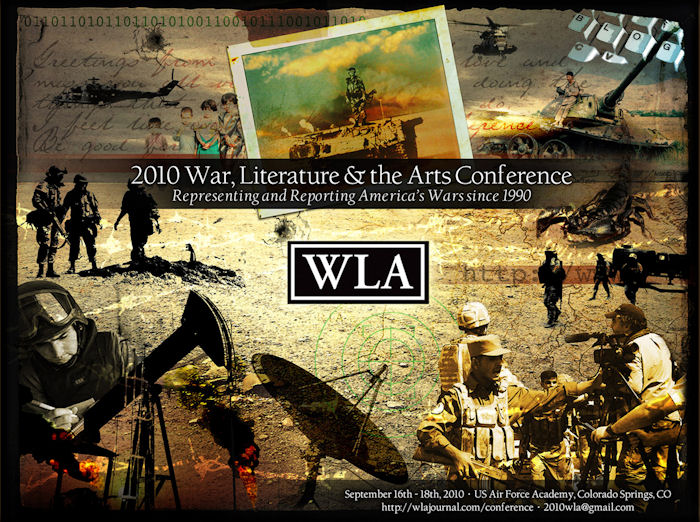
While we’re rendering thanks, let’s also commend the organizers of that 2010 War, Literature, and the Arts conference, which was so seminal in its recognition of contemporary war writing as a genre and so inspiring not just to me but to many others.  At the time, I was already aware of Brian Turner’s work, but the WLA conference was my initial exposure to writing by Fallon, Gallagher, Benjamin Busch, Jehanne Dubrow, Elyse Fenton, and quite a few others (though note Fallon as the only author of fiction). So here’s to WLA editor Donald Anderson and conference organizers Jesse Goolsby and Brandon Lingle. Excellent writers themselves, they nourish excellence in others, storytellers interested not in purveying information but communicating experience.

WLA-Poster

In Our Time

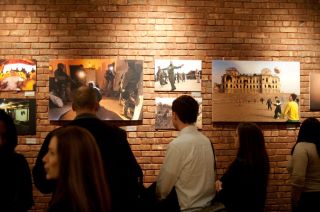
On the 116th anniversary of Ernest Hemingway’s birth, I’m republishing my tribute to him that I first posted on my old blog 15-Month Adventure. It recounts, in the style of Hemingway, a visit to the Conflict Zone war photography exhibit in New York City in 2012. The photo described in the story, taken by Jed Conklin, can be found in the gallery (#5 of 20, to be specific) at this New York Times story on the exhibition. Read my story, please, read the link, and then read today at least one story from In Our Time, Hemingway’s great collection of home-from-war fiction.

****

The veteran made his way across the first floor and took the elevator up to the third floor. There were so many people in the gallery that he could not see the photos on the walls. He had to squeeze people aside just to look at them.

The pictures were really good. Some were of soldiers in action, like one of a Marine pulling another Marine to safety. Another showed a soldier staring through the window of a Humvee that had just been attacked. The windshield was splattered with blood and gore, and an M4 rifle lies on the hood of the Humvee.

The picture was intense, but it was the rifle on the Humvee hood that got him. He remembered using that same space for quick meetings, and how soldiers would spread their weapons and gear across the flat surface to free their hands to take notes or look at their maps.

Now, in the picture, the M4 looked forlorn as it lay separated from the soldier inside the vehicle. But also sinister, the jet black weapon and its equally black sling sprawled on the yellow-brown Humvee hood like a nest of vipers on the desert floor.

Other pictures showed soldiers in calmer moments. Many were of Iraqis and Afghans. Some were taken during moments of fear, pain, and loss, others in the midst of daily life. These pictures were good, too.

The veteran looked at every picture twice. Then he stood outside on the sidewalk and thought about going back in to see them one more time. He watched the crowd come and go and decided to head home. The cab driver seemed willing to talk, but the veteran let the cab roll on quietly, up the Avenue of Americas and then Park Avenue to Grand Central.

Four Hispanic men were clowning around in the line at McDonald’s. One of the men began singing a song in English, “Open Arms” by Journey. The guy could really sing. He sounded just like Steve Perry. He was really good. But then he stopped, and he and his friends started cracking up again in Spanish.

On the train, the veteran read Hemingway’s In Our Time. The stories were good. The best was “The Battler,” but the one that made him wonder most was “Soldier Home.” The protagonist, a WWI vet back from the war, goes to see his sister play “indoor baseball.” What the hell was indoor baseball?

He was thinking about that when he noticed the woman across the aisle. She had been fiddling with her phone and computer and drinking a 24-oz. can of beer. Now, though, she was upset. At first he tried to ignore her, but it was impossible. She had a bloody nose that would not stop bleeding.

“Can you watch my stuff for a minute?” she asked.

She hurried to the bathroom. The veteran moved across the aisle to stake a better claim on her things. After a while, she returned, and he went back to his side of the train.

When the veteran’s train arrived at his station, he got off and he went home.

Conflict Zone

Contemporary War Fiction: Is The Best Yet to Come?

Camps Parsa and Clark, Khost Province, Afghanistan

In an essay published online in Harper’s this week titled “First-Person Shooters: What’s Missing in Contemporary War Fiction,” Sam Sacks takes millennial war authors to task for writing solipsistic stories that focus on the plight of woebegone individual soldiers traumatized by their deployments. Childlike innocents more than hardened warriors, the protagonists of war fiction bumble through their tours without doing any real fighting and then wallow in self-pity upon return. Their constant complaints that they don’t understand what they have experienced are matched only by their assertions that even if they could explain what happened on deployment, readers who hadn’t been there wouldn’t get it. The whole thing, Sacks asserts, is “pitiable,” coming from soldiers who were supposed to have fought competently and bravely, and made worse by MFA programs that have transformed veteran would-be writers into morose belly-button gazers too dull and chicken to address the moral and political implications of their service.

Thus Sacks seems not very impressed by the war lit he’s read so far, giving it what feels like a grade of C- or even D-  for its failure to achieve all that it might have. “One of the jobs of literature is to wake us from stupor,” he concludes, “and the best attempts of today’s veterans have done little to disturb it.” Though Sacks doesn’t mention American Sniper, the logic of his critique explains why the memoir and film were so popular. While fiction protagonists fret about buddies killed by random mortar rounds, Chris Kyle shot bad guys left and right, didn’t feel a lick of remorse, wrote about it candidly, and was subsequently rewarded with adoration and riches. Kyle’s claim that “For myself and the SEALs I was with, patriotism and getting into the heat of the battle were deeply connected” doesn’t reflect Sacks’ politics, but Sacks would probably find it a more profound and honorable statement about the larger dimensions of Iraq and Afghanistan than anything in name-your-favorite-novel by name-your-favorite-author-of-war-fiction.

Sacks is a lively writer, and he knows how to insert a knife and twist it so it really hurts. I don’t disagree with most of his observations, though, just the final assessment. The trends and patterns Sacks identifies are writ large in the pages of the stories he examines. But rather than taking the measure of contemporary war fiction in order to damn its authors, I value what the corpus of war fiction has accomplished so far and for what it promises in the future. Most soldiers were not heroes, the wars were damn confusing, and that confusion is clearly and smartly reflected in the writing about it so far. “Write-what-you-know,” an MFA precept that irritates Sacks to no end, seems prudent for vet novelists the first time out, even if it leads to the “the abyss of subjectivity,” as Sacks claims. Holding veteran authors responsible for exacerbating the civil-military divide also seems a little harsh, given what so far has been a better effort than anyone else has attempted to bridge that divide. Sacks thinks it is a problem that no veteran has yet written a work that combines the imaginative sweep of War and Peace with the cultural punch of Uncle Tom’s Cabin. But the issues he identifies as structural and endemic are better seen as challenges for the next round of war fiction writers to figure out and transcend—which I’m pretty sure they are already in the process of doing.

Special Operations Old and New: Lea Carpenter’s Eleven Days

Eleven DaysLea Carpenter’s novel Eleven Days presents a different portrait of United States special operations capability than does Masha Hamilton’s What Changes Everything, which I reviewed two posts ago. In What Changes Everything, the wife of an American civilian kidnapped in Afghanistan refuses entreaties by US officials to deploy military forces—we can presume unconventional operators—to rescue him. She doesn’t trust the military; their track record of success is poor and they’re as likely to get her husband killed as save him. In Eleven Days, the mother of a Navy SEAL who has disappeared in Afghanistan places her hopes in his recovery in the hands of high-level Washington insiders deeply instantiated in the world of clandestine operations. Where What Changes Everything is skeptical of American military might, Eleven Days is admiring, especially of elite formations of those termed “special,” “unconventional,” “black ops,” or “members of the intelligence community.”

The polarized perspectives of the two novels reflect a deep military debate about the role of special operations in the wars in Iraq and Afghanistan that now is also playing itself out in the homefront cultural domains of art, entertainment, and the courting of public opinion.

In military terms, the question is to what extent did special operations save American lives in Iraq and Afghanistan, vanquish our enemies, and help achieve our nation’s greater war aims, primarily that of forestalling further 9/11-style attacks on American soil, but also those related to nation-building overseas. In the art, entertainment, and public opinion domains, the question is whether the glamor of special operations will make any sort of reasoned consideration of the military issue possible.

The military question is explored at some length in this recent New York Times article titled SEAL Team 6: A Secret History of Quiet Killers and Blurred Lines” and in even greater detail in Dirty Wars, Jeremy Scahill’s account of the rise of the military’s umbrella organization for unconventional and elite forces, Joint Special Operations Command. The Times report is ambivalent, while Scahill is scathingly critical about the now unquestionable prominence of special operations as a strategic and tactical capability within our military-defense apparatus.

The cultural question is reflected in the public’s fascination with films such as American Sniper and Captain Phillips, as well as the dozen or so books written by ex-operators, many of them Navy SEALs who seemingly have little regard for the dark-side credo of “silent professionalism.” That clear thinking about the military question has been complicated by the Hollywood glitz machine and the self-promotion of those involved is unfortunate.

It is unfair to hold Eleven Days’ feet to the fire regarding these ginormous questions, though. Carpenter’s admiration for SEALs is writ large on every page of Eleven Days, but the novel’s unique and valuable aspects are other than descriptions of SEAL training, equipment, culture, and history, of which there are many. Its most obvious interest is the mother-son bond that joins Sara, and Jason, the Navy SEAL lieutenant who goes missing while on an operation in Afghanistan. Actions in-country are barely described; the emphasis is on Sara’s turbulent emotions as she is subjected to prying media inquiry and intense deliberations with highly-placed government officials trying to secure Jason’s release. As Sara endures these extremely unwelcome intrusions on her privacy, her mind and the book’s narration ruminate on things past, especially Jason’s childhood love for all things military that led him as a young adult first to Annapolis, then the SEALs, and finally to combat in Afghanistan. As it happens, Jason’s father David was a decorated operator himself in Vietnam and remains deeply connected to the SpecOps and DC intelligence worlds. Though long out of Sara’s and Jason’s life after the brief affair that brought Jason into the world, he now returns to help facilitate Jason’s return.  In conjunction with another DC insider known as “the godfather,” Dave arranges for a private jet to bring Sara and him to Afghanistan in hopes of reuniting with their son. The plot seems to stretch a bit thin in these parts, but who am I to say whether things like that happen or not? In any case, Carpenter’s imagining of Sara and Jason’s lived lives, their thoughts about things, their love for each other, and especially Sara’s distress when Jason goes missing, is moving and rich.

Eleven Days’ greatest interest for me, however, lies in its portrait of how our millennial wars are perceived and engaged in by upper-tier inside-the-Beltway older men such as David and the godfather. David especially has spent his long life matching his militaristic inclinations with the militaristic opportunities of the moment in ways that accord with his wealth, his educational pedigree, his social standing, his breeding and culture, his notion of public service, and most of all, his sense of belonging to a fraternity of manly men of adventure and accomplishment. Sara no longer lives in proximity to such men, but her dalliance with David as a young woman gives her permanent re-entry rights into their milieu of richy-rich-rich swashbucklers, men whose early CIA, SEAL, and Green Beret years are only the beginning of many decades spent doing clandestine things in exotic locales. This elite faction of the war machine is more James Bond than John Rambo, as reflected in a passage about David narrated through the perspective of Sara:

He is in his mid-seventies now, he has a beard, and he is thinner, but it is him. He is wearing a beautiful suit, his blue collar (always a blue collar) open at the neck just enough that she sees a glint of gold. A necklace. He always liked nice things, an air of disrepair shattered by the presence of a Rolex submariner or a double-stitched Charvat tie.

If one matches this description against any of number of passages from American Sniper, such as one in which Chris Kyle reports spending off-duty time in Iraq “watching porn, playing video games, and lifting weights,” we have the beginnings of a pretty good social analysis of an older and newer style of special operations culture. Jason, twixt the two eras, affects the tattooed, bearded, and iron-pumping mode of the modern-man-of-special-operations-war, while retaining a few traits of the gentleman-warrior, such as packing Seven Pillars of Wisdom in his rucksack when he heads off to fight, that are characteristic of David’s generation. We might usefully also compare David and Jason to men such as Blackwater founder and war profiteer Erik Prince—an ex-Navy SEAL who seems very much a man of our modern times, though one whose ties to the first wave of sea-air-land operatives who came-of-age in the Kennedy administration seem more superficial than profound.

I suppose there must be somewhere between 500 and 5,000 men like David in real life. Too old to be on the front lines, but still in the game at some rarified level of governance, industry, and social connection. As eager to get their war on as anybody else, how do they remain relevant? At what level do they still influence the things that matter? Are they vestiges of an aristocratic older style, unaccounted for contemporary power-brokers, or models for what may come as the dark-side operators of Iraq and Afghanistan themselves grow too old for ground combat and find new modes of serving the nation militaristically and fresh outlets for their thrill-seeking spirits? Eleven Days has piqued my interest in warrior greybeards such as David as much as it has in young operator-bucks like Jason and proud-but-worried moms such as Sara. That’s probably a reflection on my own long-in-the-tooth, white male, now-firmly-on-the-outside-looking-in subject position, but so it is. I invite you to read Eleven Days and consider for yourself.

Lea Carpenter, Eleven Days. Vintage, 2013.
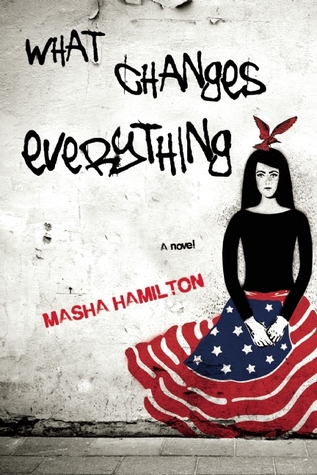
Masha Hamilton’s What Changes Everything

HamiltonThe plot of Masha Hamilton’s novel What Changes Everything contains many threads, the most important being the kidnapping of Todd Barbery, the head of a refugee relief organization in Afghanistan, by Afghan opportunists seeking to barter his life with whoever might pay the most for it. Todd’s wife Clarissa, a New York City college professor, refuses requests by the US government intermediaries to use force to rescue Todd and instead relies on Todd’s Afghan assistant Amin to obtain her husband’s relief. As Clarissa waits, she meets Danil, a Brooklyn graffiti artist whose brother has been killed in a friendly-fire incident while serving as a soldier in Afghanistan that the military tries to efface. Danil commiserates with Clarissa and advises her to retain faith in Amin, who eventually succeeds in effecting Todd’s release through his cultural and negotiating savvy.

In telling this story What Changes Everything begins to complicate understanding of what war in Afghanistan and novels about war in Afghanistan entail. Hamilton, who has served in Afghanistan as a cultural advisor to the US high command, eschews portraits of troops and battle and instead offers a compelling story about how war ensnares a wide range of characters other than those in uniform. These include Afghan noncombatants, American aid officials, and American family members touched by the war’s destruction. Besides Todd, Clarissa, Amin, and Danil, major characters include Danil’s mother Stela, who writes grief-stricken letters to politicians and celebrities seeking understanding of her son’s death and others to Danil that Danil refuses to even open, and Mandy, the mother of a young soldier injured in Afghanistan, who flies to Kabul in a Quixotic effort to lend her training as a nurse to war-stricken Afghans. Though the novel is short, several minor characters also figure so prominently that they might well be considered major: Todd’s daughter Ruby disagrees with her stepmother Clarissa’s decision to trust Amin, and Mandy encounters first a mercenary operator who knew her son well and then Zashfelt, a mysterious Afghan woman implicated first in Todd’s capture and then his release.

As if that all weren’t enough, Hamilton also includes imaginary letters written by Afghanistan’s last pre-Taliban president, Mohammad Najibullah, to his daughters in the days just prior to his murder at the hands of the Taliban in 1996. The imagined letters serve the plot in that they tell us that Amin as a young man had missed a chance to save Najibullah’s life, which now makes him determined to save Todd’s. But they also remind us of Afghanistan’s history, good and bad, pre-2001. Najibullah was not a saint—he was head of Afghanistan’s secret police under the Russians—but he comes across beautifully in the letters. In contrast to the spasmodic pleas for help written by Stela and the cluttered and confused thoughts of the other American characters, Najibullah’s letters portray a man who is absolutely composed, intelligent, cultured, full of affection for his daughters, gifted with words, and proud of his achievements as head of a country he loves.

Hamilton keeps all of this together very well. Clarissa’s skeptical resistance to military action pays off and in so doing dramatizes What Changes Everything’s most trenchant theme: the US military, addicted to violence and incapable of subtlety, would do well to pay more attention to what vastly more experienced and wiser Afghans try to tell them. I didn’t like the novel’s early scenes that show Mandy arriving on her solo mission to Kabul without sponsorship or much preparation at all, but subsequent events confirm that Hamilton intends to portray her as a bit of a self-important fool. Todd Barbery is even more of a self-important fool, and he has only himself to blame for the trouble he gets into. Hamilton’s point seems to be that Americans, even or especially those eager to help Afghanistan, tend to be both oblivious and arrogant. Among many other problems, they are bad listeners and poor communicators, qualities at which Afghans such as Amin excel, their skills honed by endless struggle for survival. But Amin is not perfect, either, and the novel’s story of trial and growth is his, too, as we see him desperately trying to reap the lessons wrought by past failure to successfully negotiate Todd’s release.

Early in the book a scene in which Stela’s friend Yvette admonishes her, “You’ll do what you want in the end. But don’t do anything before tomorrow, Stela, promise me that much. We need to talk more, after you’ve found your tongue again.” Stela’s not ready to listen to Yvette, to Stela’s detriment, but later she will recognize the truth of her friend’s advice that communication is essential. Her plight is that of all What Changes Everything’s characters, and tips Hamilton’s hand. Obtaining freedom from murderous kidnappers is one thing, but learning to listen and trust, while slowing down enough to nourish family-and-friendship is what really matters, to answer the question implied by the novel’s title, when it comes to escaping the prison-house of self-absorption. And in contrast to stories about Afghanistan that portray American special operations daring-do or castigate a seemingly incorrigibly corrupt and backward Afghan society, What Changes Everything asks us to think that it is not like that at all.

Masha Hamilton, What Changes Everything. Unbridled Books, 2013.

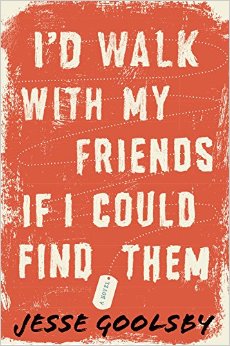
The Long War Forever: Jesse Goolsby’s I’d Walk With My Friends If I Could Find Them

JG I'd WalkI’d Walk With My Friends If I Could Find Them, Jesse Goolsby’s soon-to-be-released novel about three US Army male soldiers bound by shared horrific experience in Afghanistan, offers plenty of reasons to be excited about the expanding possibilities of contemporary war fiction. Both in subject matter and manner of narration, it does things no Iraq or Afghanistan war novel has yet done, which makes it fresh and delightful–though also harrowing–while its determination to tell a different story in a different way serves as a subtle critique of war fiction heretofore published. I’d Walk With My Friends’ greatest achievement is the rich imagining of its protagonists’ lives before they joined the military and long—generations long—after they returned from Afghanistan. Chapters set in Afghanistan ring true in terms of details and emotional exactitude, but Goolsby’s bigger point is that war experience exists in a continuum of life events that precede any soldier’s deployment and play-out directly and indirectly in the days, weeks, years, and decades following, with war’s insidious ruination affecting not just the returning veteran but his or her family and friends, too, incrementally mostly but often cataclysmically. It is this capacious ability to envision the “human cost of war” that distinguishes I’d Walk With My Friends from other war novels, whose tighter focus in comparison seems more a failure of imagination than a literary virtue.

Goolsby’s an active-duty Air Force officer, and I often wondered what the many Air Force personnel I met in Afghanistan thought about the Army folks who by-and-large did most of the fighting. I’d Walk With My Friends suggests that Goolsby,  though not an Afghanistan veteran, has indeed been given to speculation about the men and women who volunteered to serve on the ground in the nation’s recent wars. A tour working in a DoD office charged with managing the military’s human resource programs seems to have made him especially sympathetic towards soldiers whose time overseas, let us say, did not go so well and left him curious about the long-term consequences. The novel’s protagonists are enlisted US Army soldiers who bring their distinctive regional backgrounds, personalities, and family histories to the shared experience of the warzone. Wintric Ellis is a chill rural California kid, a small-town hot shot who dreams of escape and grandeur. Armando Torres hails from an assimilated Colorado Hispanic family presided over by a charismatic con-man of a father whom Armando worships. Big Dax is a 6’6” New Jersey-ite, physically imposing and impressive at first glance, but actually timidly deferential to anyone more self-assured than he is and given to impulsive fits of bravado to try to prove himself. In Afghanistan, the three squad-mates endure a vexing humanitarian mission, survive a suicide bomber attack in Kabul, and together are complicit in the death of an Afghan girl who approaches them on checkpoint duty in the middle of nowhere. One of them is also victimized–let’s not be coy, the incident is a man-on-man rape–on-base in a way that is far more consequential than anything that happens outside the wire—a scenario that suggests the horrible possibility that it is American military culture itself, rather than war, that wreaks the most damage on its members.

But a mark of Goolsby’s skill is that he refuses to blame military service or war single-mindedly on the troubles that befall Wintric, Torres, and Big Dax. They are catalysts, certainly, but it’s more than that. The men’s personalities, as made clear in the scenes depicting life before service, shape—indeed, almost bring them inevitably to—the events they encounter in Afghanistan, as if the nostrum “fate is character” were all too true, and their personalities are also complicit in their unraveling afterwards. Goolsby excels at portraying the complex relationship between character and circumstance. Debilitated by inadequate personal resources, Wintric’s, Torres’, and Big Dax’s inability to deal with their Afghanistan experience is exacerbated by their crumb-bum high school educations and the impoverishment of the junk-food-and-pop-culture American milieu, both feeble preparations for life’s storms. And yet we feel for I’d Walk With My Friends’ tragic heroes, as quotidian as their downward spirals are, much as we do for the befuddled, overmatched heroes of Thomas Hardy novels such as Jude the Obscure and The Mayor of Casterbridge. We can’t hate them, because we recognize ourselves in them, and because Goolsby makes us love them by making their dissolution so vivid.

The vitality stems from Goolsby’s ingenious ability to devise scenes that portray characters in the full clutches of their unique defects and also from the manner of the novel’s narration. I’d Walk With My Friends is related entirely in present tense, which renders a real-time, documentary feel to the episodic events the characters endure. The protagonists’ sagas are not related in first-person, but the third-person descriptions are heavily focalized through the eyes of the main characters, so that descriptions of physical environment are limited to what Wintric, Torres, and Big Dax would actually be observing. There is almost no effort to render interior thinking, so the characters’ thoughts must be dramatized through spoken speech, though Goolsby’s ability to portray realistic and entertaining conversation is, again, excellent. What Goolsby doesn’t offer at all, though, is authorial commentary on the events he portrays, so readers are left to their own wits to make sense of the characters and events described. Nor does Goolsby employ much figurative language; if there is a metaphor or simile in the book that is not offered by one of the characters, I missed it.

So what to make of the lean-and-mean stylistic texture of the book? The parts that Goolsby leaves out by design are the parts his characters repress to their detriment. United by their horrible war experience, Wintric, Torres, and Big Dax lack the power of comprehension and articulation to resolve its complications. Instead, they lie, misrepresent, and refuse to confront what needs confronting most. Life metastasized by war for them is best lived by reducing things to simplicities, trivialities, escapes, half-measures, and evasions, which is basically what they did before before war, too. But now, following war, the consequences–self-destruction unto death and familial wreckage into perpetuity–are far more dire. The beauty of I’d Walk With My Friends lies in the fine-grained particularity with which Goolsby imagines how it is so.

Jesse Goolsby, I’d Walk With My Friends If I Could Find Them. Houghton Mifflin Harcourt, 2015.

The Ever-Changing War Lit Scene

petescandystoreTwo weeks ago I was invited to read fiction on stage in a Williamsburg, Brooklyn, bar called Pete’s Candy Store. Pete’s often hosts readings, but only once a year dedicates a night to veteran writing. This year’s event was hosted by Kaboom author and Words After War mainstay Matt Gallagher, who had many nice things to say about me and my fellow readers Paul Wolfe, Teresa Fazio, and Brandon Willitts. Wolfe, a former Army officer now at Columbia, read fiction set in Iraq. Fazio, a former Marine officer, read from a memoir-in-progress. Willitts, a Navy enlisted veteran, read fiction set in the American west. I read an adaptation of a myth I first encountered in Ovid’s The Metamorphoses called “Cyex and Alceone.” My adaptation, called “Cy and Ali,” holds true to the outlines of Ovid’s myth, but I placed my updated story in the modern era, with action set in Afghanistan and back home. The story wasn’t new—I first published it on my old blog 15-Month Adventure then later republished it in Time Now, but no one seemed to notice or mind. Two listeners liked the way I included a woman’s point-of-view, which was cool. Another told me that the story made her choke up a bit. That’s what you get I guess with stories based on myth: big emotions. “If you want to make your readers feel loss, make them love something and then take it away,” the writing workshop maxim goes.

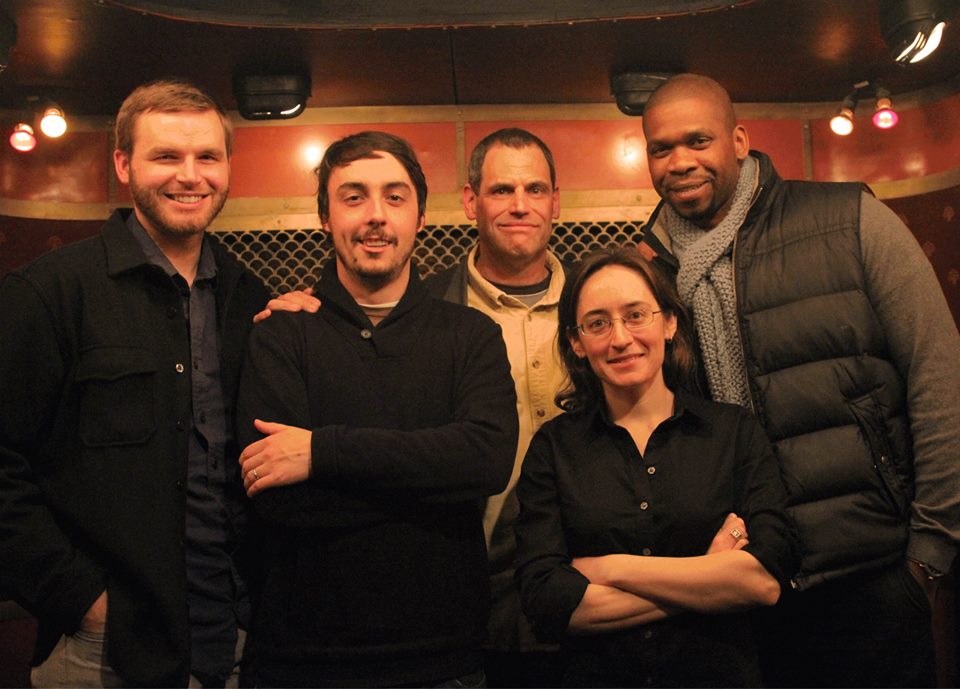
Brandon Willitts, Matt Gallagher, me, Teresa Fazio,  Paul Wolfe
Brandon Willitts, Matt Gallagher, me, Teresa Fazio, Paul Wolfe

I’m working on a series of stories based on Ovid. The war lit scene has done ancient Greece to death—Sparta, Odysseus, Penelope, Antigone, etc.—so my schtick is to do classical Rome. The physical transformations of Ovid’s The Metamorphoses, when updated in the vernacular of fiction, give your stories a magical realist bent, with people changing into trees and birds and such things, which really wrenches your stories out of the mode of journalistic rendering of realistic detail in a hurry, if that’s what you want. I’ll let you know how it works out.

The expanding and permeable borders of the veterans writing scene continue to admit new members and permute in interesting ways. In the audience at Pete’s were two Army friends, Sean Case and Erin Hadlock. Both veterans, each has contributed significantly to veterans writing. Sean, who keeps an eye on the latest-and-greatest in Arabic literature, was the first to alert me to Hassan Blasim—until someone tells me otherwise, Case was the man who “broke” Blasim in America, no small achievement. Hadlock recently published an essay co-written with Sue Doe in Generation Vet: Composition, Student-Veterans, and the Post-9/11 University (2014) called “Not Just ‘Yes Sir,’ ‘No Sir’: How Genre and Agency Interact in Student-Veteran Writing” that was referred to left-and-right in panels at the recent Conference on College Composition and Communication. Apparently, “military literacy genres”—think awards, evaluations, mission orders, field manuals, storyboards, etc.—are red-hot subjects of study in academia. But Hadlock’s bigger claim to fame is that she was Matt Gallagher’s first squad leader in ROTC way back when at Wake Forest. Now that’s saying something….

Me, Erin Hadlock, Sean Case, Matt Gallagher.

Thanks to Jillian Capewell and Lindsay Hood, the organizers of Pete’s Candy Store Reading Series.