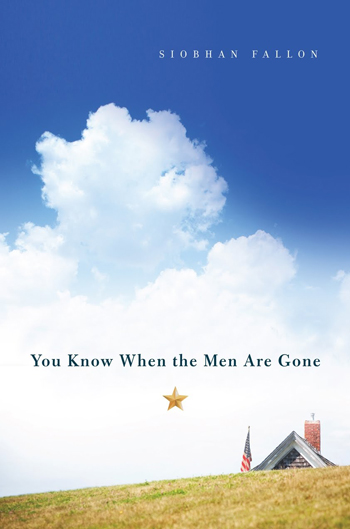
On Stage-Siobhan Fallon’s You Know When the Men Are Gone

From San Francisco comes news that the Word for Word Performing Arts Company will stage an adaptation of Siobhan Fallon’s You Know When the Men Are Gone that features two of the collection’s short stories, “The Last Stand” and “Gold Star.”  “The Last Stand” is about a badly wounded Fort Hood soldier who, among other things, clambers upon a mechanical bull in a last ditch effort to save his pride, his marriage, and everything else worth living for.  He stays atop the bull for only a few moments and alas the marriage doesn’t last much longer.  It’s my favorite story in YKWTMAG; by the end of it your heart goes out to both the soldier and the woman who doesn’t love him enough anymore to stay married to him.  “Gold Star” is about a young war widow named Josie Schaeffer who still resides at Fort Hood in the weeks after the death of her husband overseas.  Kit Murphy, the wounded soldier whose wife ditches him in “The Last Stand,” reappears in “Gold Star.”  A soldier in Sergeant Schaeffer’s squad, he wants to pay his respects to his former sergeant’s wife–by far, it appears, the most heartfelt thing anyone in the Army has done for her after her husband’s death.  Both stories are about loss, big loss, with the slight sliver of connection between Kit and Josie at the end of “Gold Star” hardly recompense for the pain.

No doubt the shows will render well Fallon’s knack for emotional nuance and ear for dialogue.  I’m curious how they will recreate her superb eye for the physical details of military base life and sensitivity to the ambiance of Army culture.

The shows will run from 31 January to 24 February at the Z Space theater in San Francisco.

Word for Word specializes in stage adaptations of  classical and contemporary fiction.

SF-Picture

Update 23 February 2013:

Two reviews of the Word for Word/Z Space production in San Francisco of Siobhan Fallon’s You Know When the Men Are Gone are available online.  Both lavish praise on the performance.

From the San Francisco Chronicle.

From an online review called Edge.

Fire and Forget II: Brian Van Reet’s “Big Two-Hearted Hunting Creek”

Brian Van Reet’s “Big Two-Hearted Hunting Creek” had me with its opening lines:

A few weeks ago, Sleed and I loaded onto a sleek tour bus.  We filed behind a gaggle of other “wounded warriors” –the term the Army used to refer to us in official memoranda.  I guess it’s what we were, but the phrase was too cute to do our ugliness justice.

The second contemporary story I know of to take the plight of wounded, disabled, and disfigured veterans as its subject—Siobhan Fallon’s “The Last Stand” is the first—“Big Two-Hearted Hunting Creek” recounts its narrator Rooster and his best friend Sleed’s participation in an Army-sponsored fishing trip for long-term Walter Reed patients.  The tale obviously tips its hat to “Big Two-Hearted River” and other stories published in 1925 in Ernest Hemingway’s great return-from-war collection In Our Time.  In “Big Two-Hearted Hunting Creek,” Rooster’s face has been horribly scarred and a hand mangled by a bomb in Iraq.   Now, seething with anger and regret, he contemplates a life “transformed in a flash I could not remember.”  He lashes out against his parents and is prone to fits of rage-induced impulsive behavior, such as biting the head off a rainbow trout he cannot properly fillet.

And Rooster’s the healthy one compared to his friend Sleed, who lost a leg and his private parts in the same blast that injured Rooster.  A charismatic and energetic soldier when whole, Sleed is now “Jake Barnes and Ahab rolled into one,” his self-hatred and grouse against the world amplified by the fact that his wife has left him and is now, according to a detective Sleed has hired, having public sex with her new boyfriend:  “‘Restrooms, parked cars–my man said he got footage of them in the car outside my baby’s daycare.’”

Ouch.

Spoiling for vengeance, Sleed stalks two teenage girls playing hooky from….  Well, I don’t want to give away the plot details more than I have already.  It’s a brutal, ugly tale, but great for all that.  Fully imagined and instantly memorable, Rooster and Sleed owe more to Flannery O’Connor’s grotesque purveyors of evil  in stories such as “A Good Man is Hard to Find” and “Good Country People” than Hemingway’s stoic Jake Barnes, the emasculated hero of The Sun Also Rises.  But lord let’s hope Van Reet really is trying to work the same black comic vein for which O’Connor is famous.  If  his rendering of the despair and self-loathing of badly-wounded soldiers is meant to be literally true and representative, then we’ve all got a lot to answer for.

According to the Contributors notes in Fire and Forget, Van Reet is a University of Virginia (Wahoo-wah!) drop-out who earned a Bronze Star with “V” Device for action in Baghdad.  More power to him in all things.

Brian Van Reet’s Webpage

Fire and Forget: Short Stories

Fire and Forget is a new collection of war-themed short stories written mostly by veterans of the Iraq and Afghanistan wars.  The collection features well-known authors such as Brian Turner, Colby Buzzell, David Abrams, and Siobhan Fallon, as well as group of lesser known veteran authors associated with the New York University Veteran Writers Workshop.  Editors Matt Gallagher (author of the war memoir Kaboom and an Iraq and Afghanistan Veterans of America mainstay) and Roy Scranton (a former artilleryman and now a grad student at Princeton) are both members of the Workshop and have also contributed stories to the collection.

The forward to Fire and Forget is provided by Colum McCann—not a vet, but a prominent Irish-American author who has served as mentor for many of the Fire and Forget authors.  McCann’s interest in the project is much the same as mine in this blog:  the protracted but inevitable emergence of a body of literature by which the wars will accrue their definitive representation and legacy.  He writes:  “The stories of the wars that defined the first decade of the twenty-first century are just beginning to be told.  Television programs, newspaper columns, Internet blogs.  We’ve even had a couple of average Hollywood movies, but we don’t yet have all the stories, the kind of re-interpretive truth-telling that fiction and poetry can offer.”

The phrase “fire and forget” is a militaryism that describes missiles that once launched do not require further guidance from their operators to be accurate.  Such smart missiles hone in on their targets through the use of laser and infrared optic systems or internal radars.  As such, fire and forget missiles have not been weapons especially associated with the IED and dumb bomb-wracked wars in Iraq and Afghanistan, so editors Gallagher and Scranton take time to explain how the phrase serves their purpose in other ways. On one hand, Fire and Forget stories, once launched into the world, might catalyze within public consciousness with the unerring aim of a smart missile, alerting readers to what they have not paid enough attention to in regard to the wars.  On the other hand, the stories represent catharsis for their authors.  Haunted by memories of their war experience, they write, and as they write, they cease to be haunted.

Hopefully.

All of Fire and Forget’s stories deserve focused attention, and I’ll give that to them in future posts if my energy permits.  Here, though, I’ll attempt just a brief survey.  The stories divide into two camps:  those that are set in-theater, and those which situate themselves in the States upon the return home.  An example of the first is Brian Turner’s “The Wave That Takes them Under,” the war poet’s first published fiction as far as I know.  The story of a patrol lost in an Iraq desert sandstorm, the tale dramatizes notions of temporal instability Turner also explores in one of my favorite poems from Here, Bullet, “To Sand.”  Another, Roy Scranton’s “Red Steel India” places its characters in a much more mundane deployment experience, that of fighting off hours of endless boredom on duty at a FOB Entry Control Point, where the only excitement consists of seriously strained interactions with Iraqi soldiers, interpreters, and camp workers.  Whether portraying the fantastical or the banal, the in-theater tales feature grunts’ eye perspectives on deployment, far from the sterile perspectives recounted in more official histories, memoirs, journalism, and government pronouncements.  By such narratives, we begin to feel how the war was experienced by those who in most cases were most vulnerable, without the armor of degrees, age, or rank.

The stories set on the homefront reflect the difficulty so many vets have reestablishing relations with family and loved ones and reintegrating into society.  Several feature plots that reunite soldiers who served together overseas; the nostalgia for the camaraderie of deployment is palpable.  Quite a few feature violent incidents in the lives of their vet protagonists, ranging from a rage-induced killing of a chicken in Matt Gallagher’s “And Bugs Don’t Bleed” to a drunken smash-up of a fast-food franchise in Colby Buzzell’s “Play the Game” to a grotesque act of public indecency in Brian Van Reet’s “Big Two-Hearted Hunting Creek.”  The stories suggest that vets’ most basic problem, stated in the most basic way, is calming the heck down.  Siobhan Fallon—not a vet, but the spouse of one—works in a somewhat quieter, more domestic key.  Her tale “Tips for a Smooth Transition” updates the ages-old saga of Odysseus’s return to Penelope after the Trojan Wars, complete with the misrecognitions, tests of trustworthiness, and bedroom dramatics of Homer’s original.  It portrays an Army officer, home for the third time, whose multiple deployments have turned him into a joke or poor imitation of a husband, not malicious or unfaithful, but Will Ferrell-like in his obliviousness and self-absorption.  And yet, his wife, through whose eyes the story is told, is riven by doubts in her own right to judge, since, as we learn, she herself has been less than circumspect while her husband’s been gone.   Smart in its observed detail, astute in its psychological insight, and even funny at moments in a way the other stories in Fire and Forget generally are not, “Tips for a Smooth Transition” seems to have the fullest sense of the subtle, as opposed to sensational, ways the wars have wreaked havoc on their participants’ happiness and emotional health.

In closing, for now, hat’s off to all the Fire and Forget authors and editors.  I’m sure I’ll be writing more about their stories as I turn them over in my mind in the weeks and months ahead, and I look forward to reading anything the authors publish in the future.

Fire and Forget

Walter E. Piatt, Paktika

Very few serving US military field-grade officers have written books about their war experience.  Only one that I know—Walter E. Piatt–has published poetry.  As fate would have it, then-Lieutenant Piatt and I were roommates and fellow platoon leaders in B Company, 5-20 Infantry many years ago. Back then, Piatt was the crown prince of the “Regulars”—the most competent, poised, and physically tough lieutenant in the battalion.  He just seemed to have it all together, and was rightfully loved by the brass, admired by peers, and respected by troops.  Neither arrogant nor a stick in the mud, he was at the center of whatever fun was to be had and ever ready to turn the most harrowing event into laughter.  I don’t know if he was writing poetry when we were roommates, but I knew he had a thoughtful side in addition to everything else.

Obviously destined for Army greatness, Piatt moved quickly up through the ranks.  By March 2004 he was the battalion commander of the 2-27 Infantry “Wolfhounds” and had deployed with his battalion to Paktika province, Afghanistan.  He since has commanded a brigade and now is an assistant division commander of the 10th Mountain Division.  But it wasn’t until the last month or so that I learned that Piatt had published a book called Paktika:  The Story of the 2nd Battalion 27th Infantry “Wolfhounds” in Paktika, Afghanistan (2006) that recounts–mostly in poetry–the story of the Wolfhounds’ year in that dangerous province pushed up against the Pakistan border.

Paktika combines short prose passages describing deployment-related events with verse ruminations on the events’ human aspects.  The prose passages are worthy of attention in their own right.  I particularly enjoyed an account of the Wolfhounds’ first battalion-sized operation against the Taliban, a mission marked by mishaps and unexpected occurrences.  Another passage interestingly recounts the Wolfhounds’ participation in the 2004 Afghan election—an event that next to the killing of Osama Bin Laden marks the high water mark in the long war.

But it is the verse that intrigues most.  Piatt’s typical poem consists of 2-4 syllable lines arranged without punctuation over the length of a page.  Not very interested in subtleties of thought and language, Piatt uses poetry to convey in clear, concentrated terms emotions associated with the responsibilities of command and deployment.  One I appreciated (and could relate to, based on my own deployment experience) recounts his anxiety in the wake of the first round of rocket attacks the Wolfhounds were to endure:

     They came
     On a day
     When all felt safe
     The first were off
     Then seven more
     Came crashing in
     Destroying all
     They contacted
     All ran
     And for most
     This was their first
     As they ran
     They clung to life
     Thinking only
     Of surviving
     The next few minutes
     This war
     Became real
     And the soldier
     Realized he was mortal
     As the rockets fell
     On Orgun-E
     (“Rocket Attack”)

The most surprising and endearing poems in Paktika are those written from the point-of-view of others than Piatt himself.  Poems told through the eyes of his wife, his sister, and his Afghan Army counterpart, for examples, demonstrate Piatt’s ability to empathize, to see the mission in terms other than the win/loss calculation of victory.  Sometimes this empathetic ability leads Piatt into bouts of self-exploration.  “Sergeant on Duty” articulates Piatt’s misgiving that his sympathy for Afghans might be a weakness that disqualifies him from being hard enough to be successful:

     The soldier spoke
     And I listened
     He said
     He hated them
     These men
     He cannot understand
     His belief be damned
     God could not help
     His hatred pours
     Each day
     He is here
     These are not men
     They are not humans
     Incapable of feeling
     Not worthy
     Of our compassion
     The only emotion
     He could feel
     Was hate
     Then he looked at me
     And said
     You like them
     Don’t you
     I struggled to respond
     My duty
     Will not allow
     My emotion to speak
     For I see
     A spark
     In all of the them
     I see the man
     Not the differences
     Yet the soldier
     Struck a nerve
     Closer to the truth
     Than I wanted it to be
     Perhaps inside
     There is not enough hatred
     To do
     What I came here to do
     And in the end
     I won’t be strong enough
     To kill
     My fellow man

Such a poem, to me, packs an extraordinarily complex array of emotions and ideas into an extremely compressed space.  The Lieutenant Piatt I knew was never afraid to admit he was wrong or that he did not know an answer.  Such ability is rare among officers; typically most are anxiety-ridden about revealing doubt or hesitation.  But in “Sergeant on Duty” I think Piatt might be worrying a bit too much.  In Shakespeare’s great play Henry V, King Henry walks among his troops at night taking measure of their fears and his own.  It is a quiet, somber scene, but not a foreboding one.  The next day in the battle of Agincourt, Henry leads the English to victory against the French in the face of overwhelming odds.

Could it be similar for Piatt?  I think his ability to take others’ views seriously–reflected in the penchant for turning his encounters with them into verse–is a source of his strength. That the strength is there should be no question.  The testimony of one of his men, recounted in an Amazon review of Paktika, provides the evidence:

“I had the pleasure to serve under Col. Piatt as a Wolfhound in the Paktika province of Afghanistan. It is an experience I will always treasure. I learned more about myself and the nobility of soldiering in that year than any other. I can say that Col. Piatt is an officer who lives his beliefs and leads by example. He was the soldier with the most “wheel time” and the longest time “outside the wire” in the Battalion. In essence that meant he spent more of our deployment in a vehicle, on the frontiers, in the face of danger than any of the soldiers in his command. This behavior goes a long way to inspire an Infantryman who is tired, scared and homesick. Thanks again Sir, No Fear!”

So, strength, courage, and wisdom through poetry.

Piatt Paktika