James River Blues: Kevin Powers’ The Yellow Birds

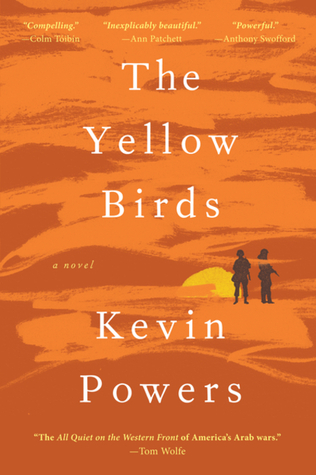
The Yellow Birds CoverKevin Powers’ acclaimed The Yellow Birds features many scenes set in Iraq, Germany, and Fort Dix, New Jersey. The latter locale intrigues me, for I served two years at that backwater post and it pleases me to see it made central in an important contemporary war novel. But being from Virginia myself I’m most attracted by the great portions of The Yellow Birds that take place in the Old Dominion. John Bartle, Powers’ distressed narrator, resides across the James River from Richmond before enlisting and just after completing his service, and he ends the novel living in a remote cabin tucked under a western Virginia mountain. The novel’s geography resonates with my own biography. For eight years, I lived with the James River a straight half-mile shot through the woods behind my house and all-in-all I spent the first 22 years of my life in Virginia. In Afghanistan I served alongside members of the Virginia National Guard, which gave me further understanding of the descendants of Virginian plantation gentry and small farm yeomen. All this would be irrelevant if I didn’t in fact detect a certain Virginia-ness permeating The Yellow Birds, a quality that makes it what it is and as effective as it is, a quality rooted in Virginia geography, history, and culture. Let me see if I can explain.

Frank Hobbs,
Frank Hobbs, “Condominium Construction on the James Riverfront, Richmond, VA”

To be a Virginian is first to be a product of the soft and beautiful landscape and climate of the Tidewater, Piedmont, Blue Ridge Mountains, Shenandoah Valley, and the Appalachians, all of it connected by the state’s languid rivers, the most significant of which is the James. Virginia’s gentle terrain and weather seem to conspire to make it physically and psychically hard to get or stay angry. Such natural tonic is corroborated by the impossibly high standards for gentlemanly comportment and achievement set by icons such as Washington, Jefferson, and Lee. To this day, I have trouble imagining a Virginian perpetrating a truly vicious or hurtful act. Even as they are confused by or ignorant of their proud aristocratic tradition, most find it absolutely painful to say no to anyone or not lend a helping hand where needed. To say that such deference makes them wildly vulnerable in the face of a world that is a lot more conniving and harsh than they are is an understatement, which is part of John Bartle’s problem in The Yellow Birds. In all this I speak mostly of white Virginians, for consideration of the state’s tortured history of race relations and its African-American demographic seriously undercut idealization of its white patrician elders while infusing the calm landscape with blood and fire. We can think first of Sally Hemings–desire and denial–and Nat Turner–rebellion and suppression–and then wonder about the contemporary athletic prowess of ferociously competitive African-American Virginia sportsmen such as basketballers Moses Malone and Allen Iverson and football players Lawrence Taylor, Bruce Smith and Michael Vick.  Do they represent a modern instantiation of Virginia’s genteel white and gritty black social bifurcation and commingling?

These factors seep into the works of Virginia artists as diverse as Edgar Allan Poe and Patsy Cline and help make them thoroughly unique and rich. Poe and Cline, the sweetest of souls, seemingly doomed to die young, their art works melancholy to the core, tinged everywhere by loss and yearning, haunted by fear and desperation, and deeply wise about pain that comes from within and without. That’s heady company in which to place Powers, and time will tell if the comparison holds up, but it represents a way to begin to understand the lyric morbidity of The Yellow Birds. To my mind, John Bartle’s effort to make sense of his tangled life and deployment is a particularly Virginian response, knowingly sketched by its author, who was raised and went to college in Richmond.

Frank Hobbs,
Frank Hobbs, “South Richmond (Richmond, VA)”

The novel’s subject is the loss of innocence completely and irredeemably; its title is taken from a military cadence that tells of a “yellow bird with a yellow bill” whose head is smashed “upon my windowsill.” Like Poe’s raven, the doomed canaries represent an idea that torments narrator John Bartle as he recounts the story of his criminal complicity in a war crime and his subsequent deterioration during and after his deployment to Iraq as an infantryman. Bartle’s story is not as much about his encounter with military culture and combat as it is about the intense relationship with two fellow soldiers who imbue his service with color and significance. Murph is a younger enlisted soldier, also from Virginia, whom Bartle vows, foolishly as it turns out, to protect. Sterling is Bartle and Murph’s platoon sergeant, a stone-cold veteran of several deployments whose rough love envelops his subordinates even as it hastens them toward their destruction. Bartle’s name is an obvious nod to Herman Melville’s famous Bartleby, the scrivener who “prefers not to” do what his boss asks of him. Bartleby’s passive-aggressive non-compliance is a result of spirit-draining stint working in the US Mail’s dead letter office, and letters figure prominently in The Yellow Birds, but Powers’ Bartle is brought to a state of numbed withdrawal from life after a series of events vastly more horrific and consequential than those experienced by Melville’s scrivener. Compared to Bartle, Bartleby’s choice to opt out is a far greater act of agency and free will than anything manifested by Bartle, who seems dragged through life by circumstance, chance, the will of others, and the mishaps that ensue anytime he tries to act purposefully. Actually interested in trying to please others, he learns, if anything, that doing so negates his own individuality and resourcefulness, while mostly screwing things up for his intended beneficiaries.

Many reviews of The Yellow Birds point to its opening lines as evidence of Power’s stylistic pitch:

The war tried to kill us in the spring. As grass greened the plains of Nineveh and the weather warmed, we patrolled the low-slung hills beyond the cities and towns. We moved over them and through the tall grass on faith, kneading paths into the windswept growth like pioneers. While we slept, the war rubbed its thousand ribs against the ground in prayer.

Such prose is not sedate, but in comparison to the jazzed-up language of Ben Fountain’s Billy Lynn’s Long Halftime Walk and David Abrams’ Fobbit—both full of laugh-out-loud figures of speech and one-line zingers—The Yellow Birds is slower, more contemplative, more lyrical. No character is ridiculed, and military and political ethics and purposes are not scorned. Even descriptions of combat and the characters’ rough military speech are rendered in a heightened literary register that conveys brooding seriousness and intense artistic imagining. The cumulative effect is to suggest that the catastrophic events that lead to the death of many of the novel’s characters and Bartle’s deterioration are akin to a slow-moving car wreck. Murph in fact uses that analogy to explain combat:

“It’s like a car accident. You know? The instant between knowing that it’s gonna happen and actually slamming into the other car Feels pretty helpless actually, like you’ve been riding along same as always, then it’s there staring you in the face and you don’t have the power to do shit about it And know it. Death, or whatever, it’s either coming or it’s not …. Like that split second in the car wreck, except for here it can last for goddamn days.”

These sentiments make a mockery of heroism, or any kind of human free will. They recast soldiers as inert entities to whom things happen. By the end of The Yellow Birds, Murph dies, Sergeant Sterling dies, and so do several minor characters. Bartle lives on and tries to feel ordinary again, but does so only by severely reducing the scope of his world: “I don’t want to look out over the earth as it unfurls itself toward the horizon. I don’t want desert and I don’t want plains. I don’t want anything unbroken. I’d rather look out at mountains. Or to have my view obstructed by a group of trees.” “James River Blues,” a terrific song by Old Crow Medicine Show, a band with deep Virginia roots, helps explain Bartle’s state-of-mind:

On the cool flow
Floatin’ down, down below
The bridge to the water’s edge
From the ridge to the ledge
From the hills to the sea
I’ll become a memory

Ensconced back within the Virginian landscape Bartle waits his own vanquishing. His journey beyond the state borders has been a disaster; his personal saga mirrors the downward historical trajectory of the Commonwealth; his character flaws those of his people. Bartle’s catastrophe could be any soldier’s, or that of the nation’s, but that it is a Virginian’s makes it that much more distinctive and poignant.
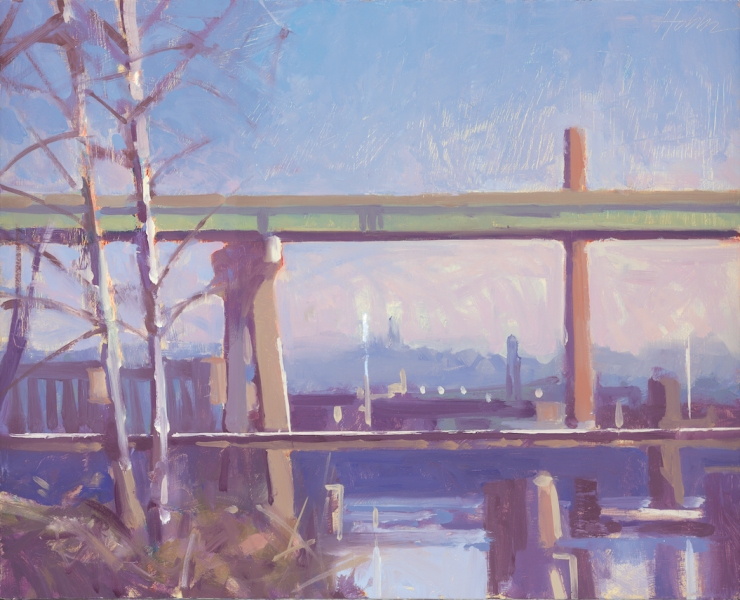
Frank Hobbs,
Frank Hobbs, “Sycamores and Green Bridge, Richmond, VA”

Kevin Powers, The Yellow Birds. Little, Brown, and Company (2012).

Frank Hobbs’ art by permission of the painter.

This post is dedicated to Sergeant First Class Kevin Dupont, a member of the Massachusetts National Guard who died of wounds suffered in 2009 while attached to a Virginia National Guard advisor team assigned to Camp Clark, Khowst Province, Afghanistan.

UPDATE September 13, 2015:  RIP today Moses Malone, mentioned here-in, a Virginia high school basketball prodigy and later an NBA MVP–one of the heroes of my youth.

War Fact or Fiction: Brian Van Reet on the “Kill Memoir”

Aftermath of a suicide bombing, Khowst Province, Afghanistan, 12 May 2009.
Aftermath of a suicide bombing, Khowst Province, Afghanistan.

Iraq vet and author Brian Van Reet’s recent essay in the New York Times, called A Problematic Genre, the ‘Kill Memoir,'” lambastes memoirs written by veterans who take pride in the number of enemy they killed in combat. He mentions as an extreme example Carnivore, written by an Army vet whose publicist claimed the author had killed in combat 2,746 Iraqis. Van Reet likens the Carnivore author to a sergeant in his own unit who embarrassed everyone by bragging about the number of Iraqi casualties he tallied. That this sergeant intended to get a tattoo commemorating each of them amplified and clarified his foolishness. That his credibility was suspect made matters worse. Clearly, the guy was fighting the war according to a script of his own devising, one that had him not playing a dutiful soldier or conventional hero or leader, but a hardened bad-ass killer.

Truth to tell, though, such dreams lurked close to the surface in many of the infantrymen and special forces types I saw in Afghanistan, me included. A rational approach to war is expressed by an 82nd Airborne Division platoon leader speaking of his feelings prior to going into action in the Persian Gulf War: “You’re feeling really excited about going to play in the big game, and horrified and scared out of your mind that you have to play the big game at the same time.” Horrified of what? “That you could get killed. And you get asked to do things tha you really don’t want to do. I don’t know many serial killers in the Army. Most people just really prefer not to have to kill anyone if they don’t have to” (Quoted in Nancy Sherman’s Stoic Warriors).

But lots of new personnel and units arrive in theater infected by desire to see combat.  An infantry captain is quoted in the current issue of Army magazine: “Every blue-blooded infantryman who deploys wants to get into a fight.  We want to plan and execute offensive operations.  We want to close with and destroy the enemy.  We want to take charge and be in charge.” It was barely use talking to such soldiers of counterinsurgency and nation-building and key leader meetings and training and advising when they were out of their minds to see what it was like to shoot at someone and be shot at in return. Once they had seen combat (and survived) they might settle down and be good for more commonplace things. But often their initial survival, if not success, whetted their appetites, and now that they had “got some,” they desired even more. Like the author of Carnivore, they turned war into a competitive game of testosterone-fueled one-upsmanship, clothing their blood-lust and thrill-seeking in the justifications of duty and necessity. Such attitudes were unseemly and most did their best to keep them dampened down.  But not all felt this way. Some guys just seemed so determined to, as the saying goes, “get their war on.” And not all were ridiculed or scorned. In the hierarchy of soldiering, hardened killers could accrue enormous social capital. Where fear and confusion reigned, they offered toughness and purpose, of a kind. Operating insidiously within and sometimes overtly against the chain-of-command, they used their rank and stature to make the war all about kill-or-be-killed.

It’s no wonder such soldiers’ memoirs sell, as Van Reet realizes, but still he castigates a publishing industry that cravenly vends sensational war memoirs to a fawning reading public. Such fare glorifies the killing it describes, and thus perpetuates war rather than doing anything to end it. But even if kill memoir authors position themselves as self-effacing and introspective, their books are still shaky vehicles for the delivery of truth. The problem lies in the form as much as the sentiments. Memoir, Van Reet reminds us, is such a self-aggrandizing, unreliable, and stereotyped genre that it might be the last place, not the first, we would go to for factual detail or insight about what it means to kill in combat.

Van Reet instead touts the supremacy of fiction over “fact” and in particular literary novels such as David Abrams’ Fobbit and Kevin Powers’ The Yellow Birds. “Though they are fictional,” he writes, “they read in my mind, like more accurate depictions of the totality of what happened in Iraq than any of the supposedly factual accounts I have mentioned.” I’ll second that, and throw in, as does Van Reet later in the essay, Ben Fountain’s Billy Lynn’s Long Halftime Walk as a third novel that, taken with the other two, make 2012 the annus mirabilis of Iraq war fiction. Indeed, each of the novels, in its way, examine the relationship of a softer, more sensitive soldier who comes under the sway of a much more decisive, hardened, experienced soldier at home with the business and psychology of killing. Among the novels’ other achievements, they use the tools of fiction—perspective, irony, empathy, style, tone—to interrogate the attitudes toward combat and killing described above and presented naively and self-servingly in memoirs and histories. Usually, they find such pronouncements swaddled in layers of self-deception and self-justification, and they convey sympathy for characters who at least struggle toward awareness and growth.

But as impressive as Abrams’, Powers’, and Fountain’s novels may be, they are, as we speak, still a feeble countervailing force in a publishing environment characterized by what Van Reet calls “the triumph of the kill memoir.” Van Reet closes by issuing a challenge to veteran writers, other authors interested in war, the publishing industry, and by implication, reading audiences:  we can all do better. I’ll second that, too.

War Art: Michael Figueroa

"No Slack"
“No Slack”

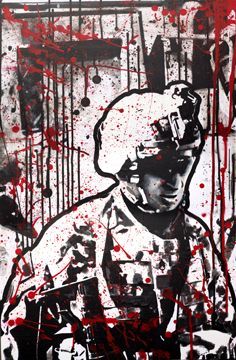
Michael Figueroa is a great example of a contemporary war artist who follows the aesthetic impulse to “make it new.” A US Army vet now living in the greater Chicago area, Figueroa never deployed while in the service, but nonetheless his paint-and-image collages have an of-the-moment quality about war and soldiering I find very appealing.  In fact, his ability to turn the material matter of military life into vision-inspired art is quite incredible. Traditional and typical war art seems interested in realistic representation of combat scenes and emphasizes either heroism or war’s horror.  Often the values and politics are pretty obvious. Figueroa takes familiar military images and iconography and spins them and mixes them and makes them bleed and sweat.  Neither heroic nor horrific, neither ironic nor naive, his artworks exude an in-between spirit that is half-troubling, half-exhilarating.  I love them.

Figueroa studied at the American Academy of Art in Chicago.  His website can be found here and his art can be purchased here.  He has sometimes exhibited in conjunction with Graffiti of War, an organization dedicated to showcasing soldier art for the benefit of veterans.  Below are more samples of Figueroa’s work.

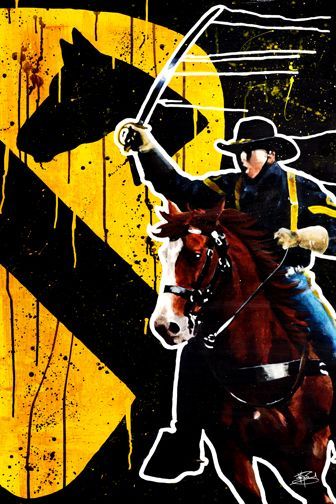
"The First Team"
“The First Team”

If I had ever served in the 1st  Cavalry Division, I definitely would purchase this print.

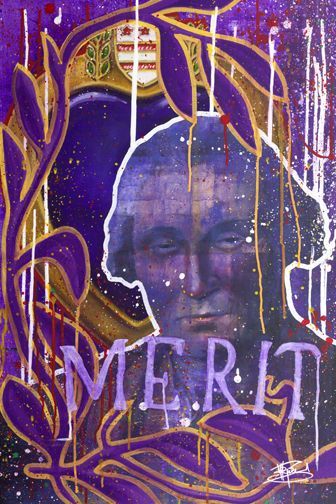
"MERIT for heart"
“MERIT for heart”

Figueroa’s inspiration for this picture is the inscription on the backside of the Purple Heart:   “For Military Merit.”

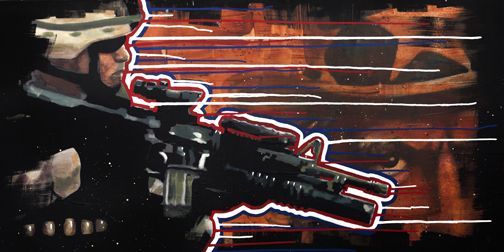
"Son of Sam"
“Son of Sam”

The title refers to famous pictures of Uncle Sam, but also brings to mind the 1970s mass-murderer David Berkowitz, who, as it happens, was in my Army unit in South Korea a decade or so before I arrived.

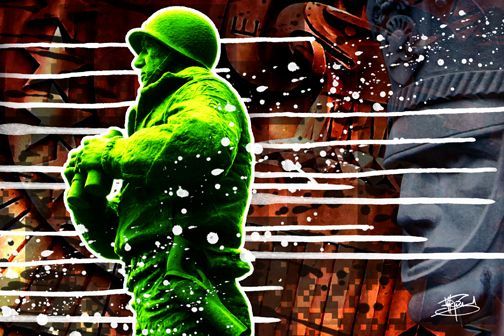
"Duty Honor Country"
“Duty Honor Country”

The inspiration here was a visit to West Point.

All photos used with permission of the artist.

A War Music Sampler: Country, Folk, Hip-Hop

Marine Corps Iraq vet Jimmie Rose tore it up on America’s Got Talent the other night.  Pure country from the coalfields of Kentucky–“Four days after high school graduation, I went underground” he puts it–Rose sang a song that didn’t mention the war, but in the accompanying interview he related that he joined the Marines because it couldn’t possibly be more dangerous than work in the mines.  Here’s to him, for he’s got a charming “aw shucks” demeanor and a voice to die for.  His song, “Coal Keeps the Lights On,” won’t win any kudos from eco-warriors, but amply illustrates the perspective of a demographic that doesn’t have the luxury of picking-and-choosing its means of making a living.


Country is the music of choice for huge swaths of the American military and acoustic guitars by the thousands manage to survive the rigors of travel to help country-loving soldiers while away their deployments.  A good example is the following video by Zac Charles, filmed live from a FOB in Paktika Province, Afghanistan.  It’s called “Until I Get Home.”

Neither Rose’s nor Charles’ politics are confrontational, but other vets use their music to channel their misgivings about the war, express the pain of their service, and plea for the cause of wounded and damaged fellow soldiers.  A good example is Jason Moon’s “Trying to Find My Way Home”:

Some ex-soldiers put their military experience as far in the rear-view mirror as they possibly can.  The music they make betrays few traces of their past lives in the military and overseas.  Emily Yates, for example, after six years in the Army and two tours in Iraq, moved to San Francisco, hippy-fied herself, and now has filled up YouTube with music videos extolling the greatness of marijuana.  We’ll pass on those and post one that actually does have her looking back:  her rendition of the 3rd Infantry Division’s great fight song “Dogface Soldier,” done here in an anti-war mode:

After a lifetime of music listening, I can probably name five songs combined by Tupac, Biggie, Jay-Z, and Kanye.  That’s nothing to be proud of, but I don’t feel like I’m actually all that unknowing about hip-hop music and culture.  That’s because on all my deployments, I’ve been witness to many amazing freestyle spoken-word battles among young (mostly) black soldiers and played plenty of basketball in makeshift gyms with the throbbing beats and ominous lyrical flow of the inner city musical idiom blasting over the sound system.  An example of how hip-hop permeates the everyday life of deployed soldiers can be found in the video below.  Hip-hop artist Chamillionaire on a tour of Iraq invites Specialist “Rap” Myers to join him in an impromptu performance in a FOB gym or morale, welfare, and recreation center:

The ex-soldier I know of making the most determined effort to turn his deployment experience into a hip-hop career is Soldier Hard.  Here’s his most watched video on YouTube, “Combat Veteran.”

To all the soldiers who are also music-makers:  Don’t stop.

War Songs: Jason Everman

In the midst of my series on Iraq and Afghanistan war-related music comes this great New York Times article about Jason Everman, who had short stints in Nirvana and Soundgarden before joining the Army as an infantryman. Both Ranger and Special Forces-qualified, Everman got out in 2006 after combat in both Afghanistan and Iraq. He then enrolled at Columbia and recently graduated with a BA in philosophy.

So, while I was looking for music performed in theater or upon a veteran’s return, I learn of a veteran-musician who did his serious music-making before he joined and deployed. Everman wasn’t with Nirvana and Soundgarden at their peak, but he certainly contributed to those magnificent bands’ on-stage crunch in their early years and more than brushed shoulders with the creative talents who were his bandmates. Like millions, I was tremendously impressed by the great Seattle grunge groups. They shaped the taste and consciousness of many of us who later went to war, for better or worse, and of many of those who didn’t go to war but now wonder about what it all meant. And so it’s cool that one of them bridged the gap between the music-makers and we who took the music forward with us in life.

The part of the Times story that got me most recounted Everman’s mounting resolution to join the Army while living in San Francisco in 1994. As his bandmates slept, Everman was rising early to work out and get ready. Boy, did that trigger memories of living in the East Bay town of Albany after finishing grad school. I used to knock out pushups and pull-ups by myself in a local park while preparing for my own infantry odyssey. I was 26 when I first started thinking about joining, and actually signed up a year or two later. Everman was 26 when he joined, as was Colby Buzzell, whom I wrote about a couple of weeks ago, and who was also from the Bay Area and who also dreamed of being a grunt.

So what is it about the infantry that entices not-so-young-anymore men into giving it all up in the name of adventure and service to the nation?

And what is it about Northern California? Brian Turner’s from Fresno, not so far away from San Francisco, and he too joined the infantry at a late age. Thinking about it further, Matt Gallagher, not an infantryman but a cav scout, which is close enough, is from Sacramento, just up I-80 from the Bay. Something in the air there just must easily get in the bones of dreamy young men craving challenge and purpose. Maybe it’s as Ishmael in Moby-Dick says: “Here goes for a cool, collected dive at death and destruction, and the devil fetch the hindmost.”

And then these dreamy young men who go off to war want to write about their experiences. Or, in the case of Jason Everman, hopefully, will write about them. But if he doesn’t, no problem, because he has already had a chance to say his say and he used it well. Something tells me that soldier-authors such as Turner, Buzzell, and Gallagher probably know just about every song Nirvana and Soundgarden ever recorded. That includes those from the early years when Everman was helping them become, as the Army slogan puts it, “all that they could be.” We are, to a large degree, the music that is important to us, so thanks, Jason Everman, just thanks.

Happy 4th of July everybody.