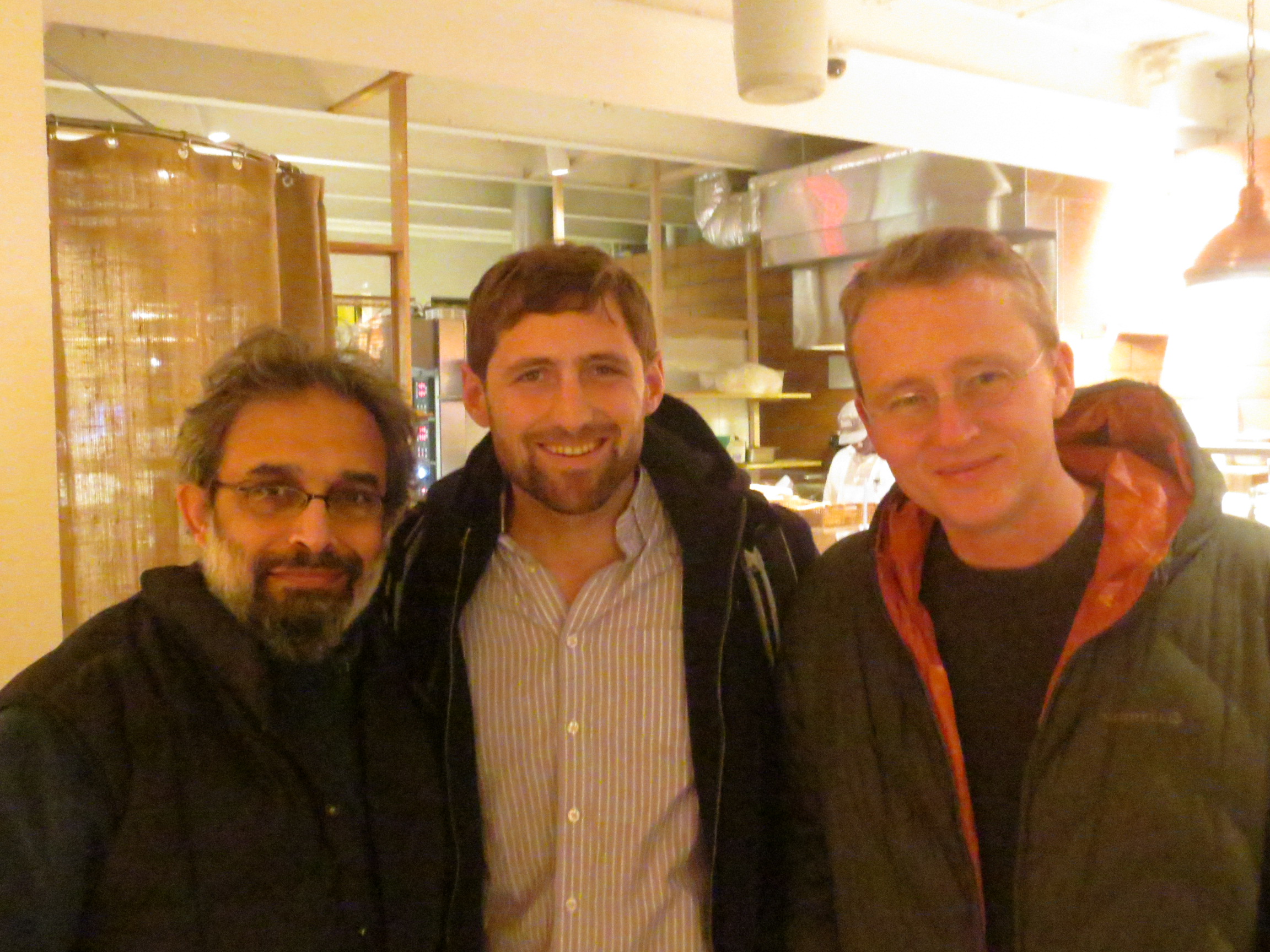
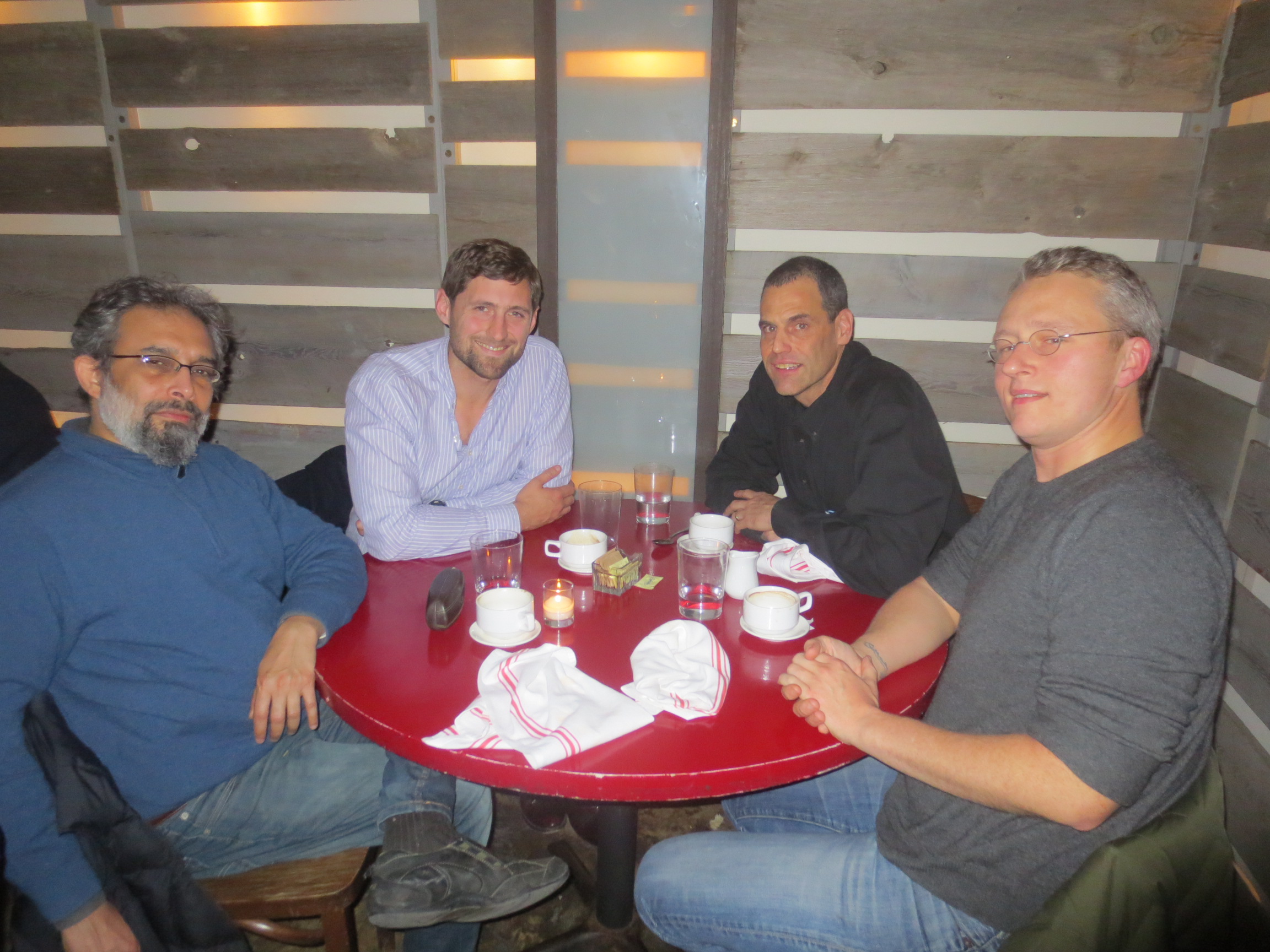
A Night Out with Photographer Bill Putnam

IMG_1244A trip to DC allowed to reconnect with Bill Putnam, the former US Army combat cameraman and embedded journalist whose work I have featured many times in this blog. Bill and I first met in Kosovo in 2002 where we were both part of Task Force 2-14, based in Camp Monteith in the northern part of the American sector. Later Bill served in Iraq as both a soldier and a civilian photojournalist and then twice in Afghanistan, first with the 101st Airborne Division in Paktika province and then in Helmand at Camp Leatherneck as the public affairs officer for a unit charged with training Afghan security forces. He currently lives in Washington and is going to school while looking for new photographic opportunities.

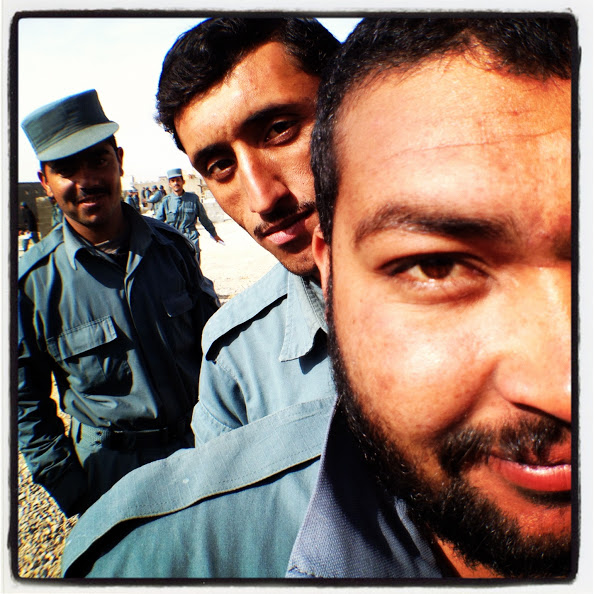
For me, Bill’s pictures are so alert to their subjects’ eyes that they read like uncanny straight shots into whatever it is the subjects think most important.  What they most want you to know, or what they most need to hide, or both.  Below, for example, is a shot Bill took of Afghan National Police recruits in training at Camp Leatherneck.

Afghan Natonal Police at Camp Leatherneck

In DC, we met at a dark, moody bar blasting classic and contemporary punk rock—hell yea–and traded our stories and plotted future projects. Bill told me the backstory of the pictures I’ve published here and brought me up-to-date on his current endeavors.  Here’s to you, Bill, and thanks for everything you’ve contributed to Time Now–you’re a true acolyte-of-war, now moving on to other things.

Bill Putnam website

Bill Putnam Twitter

Bill Putnam Facebook

Soldier Art, Just After the Heat of the Moment

Rough Day

The picture above is called “Rough Day at Rushdi Mullah.”  The artist is Army Specialist ________.  It was sent to me by a friend who served alongside Specialist ______.  Here is the story behind the picture:

“Here is that drawing that I meant to send you.  Sorry for the delay, but I lost your e-mail address.  Backstory:  It was drawn by one of our Public Affairs Office soldiers, Specialist _______.  On February 6, 2007  I was on battlefield circulation with her and we stopped at the Combat Outpost in the village of Rushdi Mullah, a very volatile village south of Baghdad in the heart of the Triangle of Death.  As we approached the outpost we monitored the call that they had come under sniper fire and had a casualty.  We entered the COP as B Company/4-31 Infantry was responding to the incident.  The casualty was Private First Class ________, KIA by a sniper bullet as he was maintaining security in his rooftop guardpost.  He was 20 years old and from ________.

“COP Rushdi Mullah was the tip of the spear.  It lay on a key Line of Communication that basically bisected the Triangle of Death and controlling that village enabled us to make the final push to the Euphrates and gain freedom of movement throughout our Area of Operations.  It was not only key terrain, but it was mere feet away from some of the baddest Al Qaeda insurgents that ever needed a high lead diet.  We put B Company out there and they withstood furious resistance and delivered devastating effects on the enemy.  They had nothing, no sanitation, hot chow, no down time, and 24 hour security to withstand the relentless attacks of the enemy.  They took pride in being the hardest of the hard and hammering at the strength of AQ.

“The unit dealt with the situation, increased their security posture and took positive measures to ensure the village felt their resolve.  The sniper was ultimately hunted down and killed.  But the moment that this picture was captured was that moment, when all the smoke had cleared, that you realized that these noble, hardened warriors were young boys from farms in Kansas and slums in Detroit, but they were brothers in arms, committed to each other and they lived and died with each other.  We lost a great American on February 6, 2007, and those boys in B Company/4-31 paid a price as well.  As Daniel Patrick Moynihan said at Kennedy’s funeral, ‘We may laugh again, but we will never be young again.’

“Thanks for letting me share this with you, and thanks for what you are doing.

____”

Thank you ___, thank you Specialist ________, thank you Private First Class________, thank you B Company/4-31 Infantry.  Specialist ______ and Private First Class ________, I’ll publish your names if you or your family give me permission.  Thank you to all who have served and who are serving now.  Thank you to the people of Iraq and Afghanistan who want a decent, fair, peaceful life, as we all do.

All Along the Afghan Watchtower: Joydeep Roy-Bhattacharya’s The Watch

The WatchJoydeep Roy-Bhattacharya’s 2012 novel The Watch registers many firsts in the burgeoning contemporary war lit genre.  It’s the first novel I know that’s set in Afghanistan.  The first set on a combat outpost, as opposed to a FOB.  The first to feature an extended battle scene—a terrific sequence that describes a Taliban effort to overrun the Americans in their small fortress.  The first to feature prominently the voices of host-nation civilians, in this case that of a young Pashtun woman—a double amputee at that—and a young Tajik male who works as an interpreter for American forces.  Not a first, in fact much like David Abrams’ Fobbit, The Watch narrates chapters through the perspective of several different American soldiers, from junior enlisted to first sergeant to lieutenant to captain, as well as the Afghan voices described above.  But unlike Fobbit’s satirical approach, The Watch is deadly serious—a tragedy.  At story’s end, the Americans and Afghans who have not been killed have absolutely no chance of living happily into the future.

The Watch’s plot adapts that of Antigone, Sophocles’ classic Greek play about a young Theban woman who defies the state by insisting that her brother, killed on the wrong side in a civil war, be accorded proper burial honors.  In The Watch, Nizam, the Pashtun double-amputee, is the Antigone figure.  Her brother, defiant of the American occupiers if not a Taliban by ideology, lies dead outside of COP Tarsândan after a midnight attack.  In the play, Antigone is thwarted by King Creon, the Theban ruler, who represents the power of the State, and her sister Ismene, who counsels moderation and fears Creon’s wrath.  In The Watch, the Creon role is occupied by Captain Connolly, the COP commander, while Ismene is Masood, a Tajik interpreter whose loyalties are split between the Americans who fight the treacherous Taliban and the Afghan cultural codes that emphasize respect for the dead.  Sophocles’ play clearly favors Antigone, a heroic young woman who fights authority, but dramatic space is left open to consider King Creon’s and Ismene’s perspectives.  Roy-Bhattacharya builds this same ambiguity into The Watch, especially in regard to Captain Connolly, on whom the fate of Nizam and her brother’s remains depend.  Portrayed unflatteringly in the novel’s early stages, by the end we see the staggering complexity of interests and consequences he must juggle to effectively “take care of troops and accomplish the mission”—that onerous mantra of military leadership whose twin dictates are usually in stark opposition.  It’s as if Roy-Bhattacharya realized in the course of writing The Watch that Connolly was too sympathetic to be a Creon.  The heavy-handed imposition of authority in the novel is by the greater US military and foreign policy apparatus that organized the war and now issues Connolly orders.  Connolly’s deliberations under the pressure of those orders, like Creon’s under the Greek gods’, are human, all too human.

The Watch’s abiding interest in Captain Connolly intrigues me.  Not to privilege the war experience of the officers, but I’m glad to see at least one portrayed favorably in the skeptical world of war fiction.  I also liked the character of Masood.  In The Watch, Masood is dropped at COP Tarsândan in the middle of the night after the big battle and confronts hostility at every turn from his new American hosts and allies.   Roy-Bhattacharya gets right the incredibly uneven regard of young American soldiers for those outside the fraternal ranks of their unit.  Frankly, the average 20-year-old American male doesn’t have it in him under the best of circumstances to welcome graciously strangers who do not share his cultural background, and the circumstances of the soldiers on Tarsândan are anything but the best.  Masood is mystified and hurt by the Americans’ baffling rudeness, and yet it is more complex than that—just when he is ready to write off the Americans as barbarians, he meets a medic who knows more about Afghan literature and history than he does, then the warm and wise COP first sergeant, and finally Captain Connolly, whose fanatical adherence to mission and security co-exist with a more than passing fluency in Pashto and Dari.  This extremely wide diversity in manners and education certainly exists within the American military and our larger society as well.

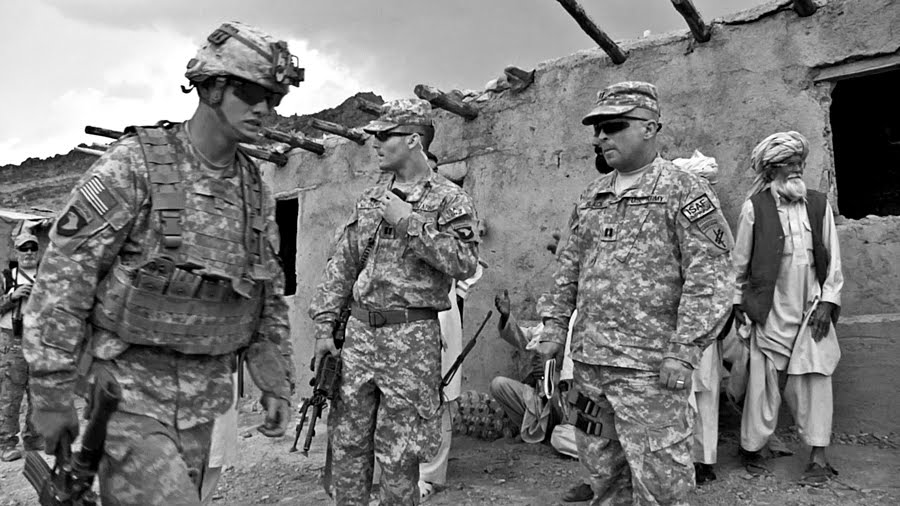
American soldiers in Afghanistan.  Picture by Bill Putnam, used by permission.
American soldiers in Afghanistan. Picture by Bill Putnam, used by permission.

Roy-Bhattacharya was born and raised in India and did not come to America to live until he began graduate school here as a young man.  In Masood, perhaps we see him replaying the highs and lows of his own first encounters with an America that bestows its hospitality and respect to outsiders in fitful and perplexing lurches.  This perspectival complexity is reflected in Roy-Bhattacharya’s acknowledgements:  one to “the people of Afghanistan” and another to an American he refers to as, “Officer, Gentleman.”  He also writes,

“To the U.S. Army officers in Afghanistan who befriended me and technically foolproofed the book—you know who you are—I have no words to adequately express my thanks.  I remain in awe of your objectivity, in gratitude for your unwavering enthusiasm, and in your permanent debt for your gift of friendship.”

Roy-Bhattacharya himself might be something of a Masood.  He helps us understand the war, hating what it has done and made us do and be, but not hating those of us who fought it.

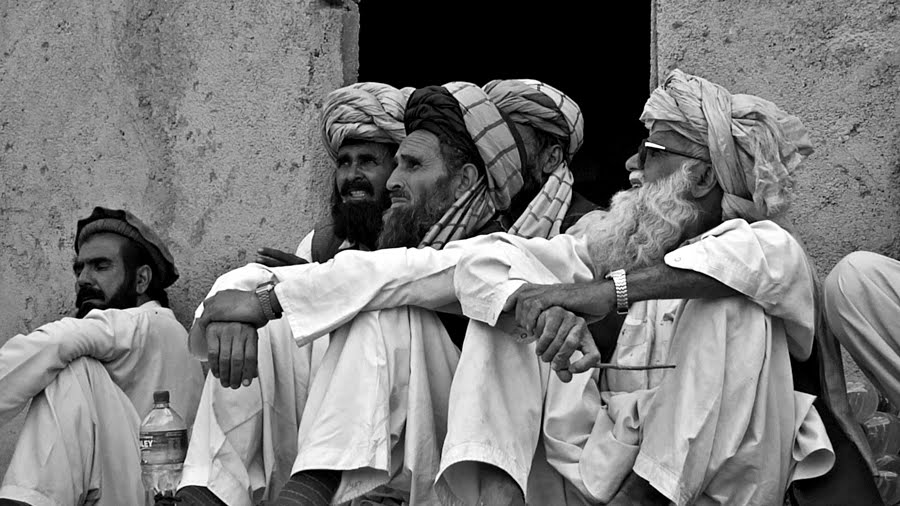
Afghan elders.  Picture by Bill Putnam, used by permission.
Afghan elders. Picture by Bill Putnam, used by permission.

A post on my blog 15-Month Adventure about Spera Combat Outpost:  All Hail the Defenders of Spera COP! 

Another post on 15-Month Adventure about Spera Combat Outpost: Spera COP Sector Sketch

A 15-Month Adventure post about interpreters:  Combined Action

A 15-Month Adventure post about a small Afghanistan FOB and its stout company commander: The KG

Her Own Private Ithaca: Jehanne Dubrow’s Stateside

Stateside3Jehanne Dubrow’s volume of poems Stateside portrays a stressful period in the marriage of the poems’ speaker before, during, and after the deployment of her husband, a Navy enlisted sailor or officer.  In so doing, it brings impressive skill and sensitivity to bear on the theme that war is also hell on the home front. Dubrow, who lives on Maryland’s Eastern Shore, sets Stateside‘s poems in nearby locales such as Washington DC, Virginia Beach, and Assateague Island.  I know the Chesapeake Bay/mid-Atlantic region well and love it like crazy, but here it serves as the backdrop for pain and confusion.  Home is where the hurt is, indeed.

Dubrow’s artistry shows in her ingenious adaptation of traditional verse forms and meters.  Many of the poems in Stateside are sonnets, for instance, but Dubrow makes this stuffy form amenable to contemporary thought and speech by mixing up conventional rhyme and stanza schemes and relaxing the stately iambic pentameter rumble.  Check the following, for an example:

     "The Rooted Bed"     

     I’m stateside now, my husband six months gone.
       I think of another soldier and his wife
     they built their bedpost from an olive tree,
       roots spreading underfoot, gray branches splayed
     like fingers, floorboards grassy as a lawn.
       The tree grew through the center of their life.
     They slept beneath its living canopy.
       And once the wife was alone, its shade
     stroked darkened hands across her brow.
       I like to imagine that she often thought
     of chopping down the trunk, fed up with boughs
       which dropped their leaves, black fruit turning to rot.
     I can’t help asking if, when he came home,
       did they lie together there or sleep alone?

Reading Stateside the first time through, I did not notice how structured by meter and rhyme the poems were, but the clever stylistics fill the verse with an allure and power that kept drawing me back.  I can also easily imagine them being very pleasant to hear read aloud, with the music of rhyme, half-rhyme, alliteration, and assonance swirling through the air enroute to the ear.

The passage in “The Rooted Bed” about boughs and leaves recalls Shakespeare’s great Sonnet 73, in which “yellow leaves, or none, or few” hang on the boughs of trees which are said to be “bare ruined choirs where late the sweet birds sang.” But the real precursor poem here is Homer’s The Odyssey, in which Odysseus and his wife Penelope have built a massive bed attached to a tree, alone in which Penelope sleeps for twenty years while Odysseus goes to war.  A head note to “The Rooted Bed,” taken from The Odyssey, offers a direct clue to Dubrow’s thematic concerns:  “One moment he seemed … Odysseus to the life– / the next, no, he was not the man she knew.”  So too do the titles of the poems that follow “The Rooted Bed”:  “Argos,” “Ithaca,” “Penelope, Stateside,” and so on.  In Penelope, Dubrow finds an historical-literary ancestor who lends gravitas and imagination to her saga of contemporary marital angst.

“The Rooted Bed” and other poems titled “In Penelope’s Bedroom” and “On the Erotics of Deployment” suggest that Dubrow is not shy about exploring the carnal dimensions of modern military marriage.  A great scene from Tennessee Williams’ Cat on a Hot Tin Roof where Big Mama berates Maggie the Cat by saying, “When a marriage goes on the rocks, the rocks are there, right there” while emphatically slapping Maggie’s bed seems to be the spirit of Stateside, too.  Unhappiness in the bedroom begets unhappiness in life, or vice-versa, but in either case it’s not very fun to live through. Poem after poem in Stateside records a husband-wife relationship beset by chill—desire unrequited, communication balked, and passion a memory.

In Cat on a Hot Tin Roof, Maggie suspects her husband Brick desires his friend Skipper more than he does her, and she attempts to seduce Skipper to test her theory and spite her husband.  Adultery and homosexuality don’t figure in Stateside, but the psycho-sexual circuitry of Cat crackles throughout the volume.  Dubrow’s poetic speaker can’t help but feel disappointed by her husband, who is preoccupied by career, mission, and unit.  She’s also stung by his obliviousness to her desire, and frankly, a little mystified herself at its persistent strong presence.  The dream of a shared life—public, domestic, and intimate–trashed by the war, she now wonders about Penelope’s sterling rectitude in the face of her many suitors.  Surely her thoughts and emotions must have been more complicated than Homer tells us.  Suggesting how that might be so, she uses the tools of history and poetry to make what is nominally her husband’s war even more her own than it already is.

My favorite poem from Stateside:      

     "Surface Warfare"

     Our arguments move
     across the surfaces
     of things, smooth

     flat areas where silence
     floats for weeks.
     The rule:  whoever speaks

     first loses.  If he patrols
     the living room,
     then I control

     our bed, an Atlantic
     filled with my insomnia,
     the quilts too thick

     to wade through.
     Some nights I think
     drowning would be easier

     and drink mouthfuls of salt.
     No shallows here,
     only the fathoms of marriage,

     and we are anchored side
     by side, the darkness wide,
     percussive as a mine.

Stateside was published in 2010 by Triquarterly Books, an imprint of Northwestern University Press.  It might be read usefully and pleasurably alongside Elyse Fenton’s Clamor, also published in 2010 and Juliana Spahr’s This Connection of Everyone with Lungs, published in 2005.  All three use poetry to explore the war’s devastating impact on trust and intimacy from a woman’s point-of-view.    

More on Stateside from Jehanne Dubrow’s website

A review of Stateside by David Abrams from his blog The Quivering Pen
War Literati: Joydeep Roy-Bhattacharya, Phil Klay, and Roy Scranton

Joydeep Roy-Bhattacharya, Phil Klay, Roy Scranton

I spent the better part of Saturday with three talented authors of contemporary war fiction.  In the afternoon, I viewed the War/Photography: Images of Armed Conflict and Its Aftermath at the Brooklyn Museum in the company of Roy Scranton and Phil Klay. Scranton, a US Army Iraq vet, is the editor of Fire and Forget, the landmark anthology of Iraq and Afghanistan war short fiction that I’ve written about several times in this blog.  Scranton contributes a story to his own collection, and he’s working on a novel, but the drift of his thought goes well beyond war literature.  Below are links to two wildly creative and intellectually provocative essays he’s recently published in the New York Times and on an online site called The Appendix:

New York Times, Roy Scranton’s “Learning How to Die in the Anthropocene”

The Appendix, Roy Scranton’s “The Curse of Coherence”

Klay, a USMC Iraq vet, contributed a story to Fire and Forget and served as a guide (and perhaps an inspiration) to Roxana Robinson as she wrote Sparta.  Klay’s collection of short stories Redeployment will be released next year by Penguin.  I’ve read an advanced copy and greatly enjoyed it–if you are wondering what new subjects and perspectives are possible in war lit, you will, too.

Joining us later was Joydeep Roy-Bhattacharya, the author of The Watch, a novel about an Army unit on a small combat outpost in Afghanistan.  I somehow overlooked The Watch upon its release last year, and subsequently experienced an “OMG-what-have-I-missed” moment when I finally read it a couple of weeks ago. I’ll have plenty to say about The Watch in future posts, but here will only report that it combines military realism with literary skill and imagination to a high degree.

Together, we talked into the night and made plans for a panel presentation Scranton has organized for the Association of Writers and Writing Programs conference in Seattle next February.  Next spring, I’ll also be speaking on war literature at the American Comparative Literature Association conference in New York City in March and the Northeast Modern Language Association conference in Harrisburg, PA, in April. Join me at any of them if you can, and let all conversations continue.

Joydeep Roy Bhattacharya, Phil Klay, me, and Roy Scranton
Joydeep Roy-Bhattacharya, Phil Klay, me, Roy Scranton

New York Times Slideshow of the Brooklyn Museum War/Photography Exhibit

New York Times Review of the Brooklyn Museum War/Photography Exhibit