Dodge (War) Poetry Festival 2014

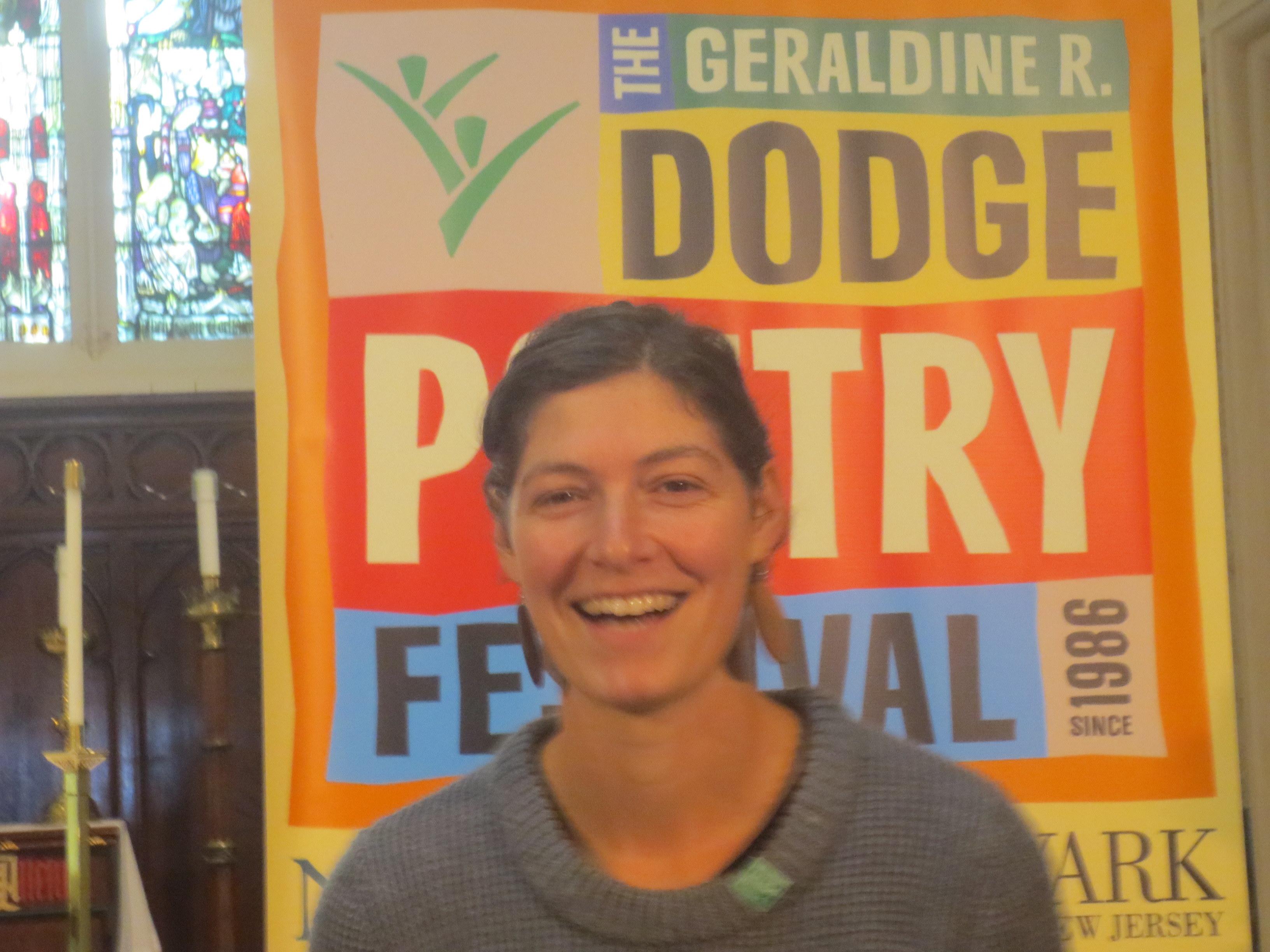
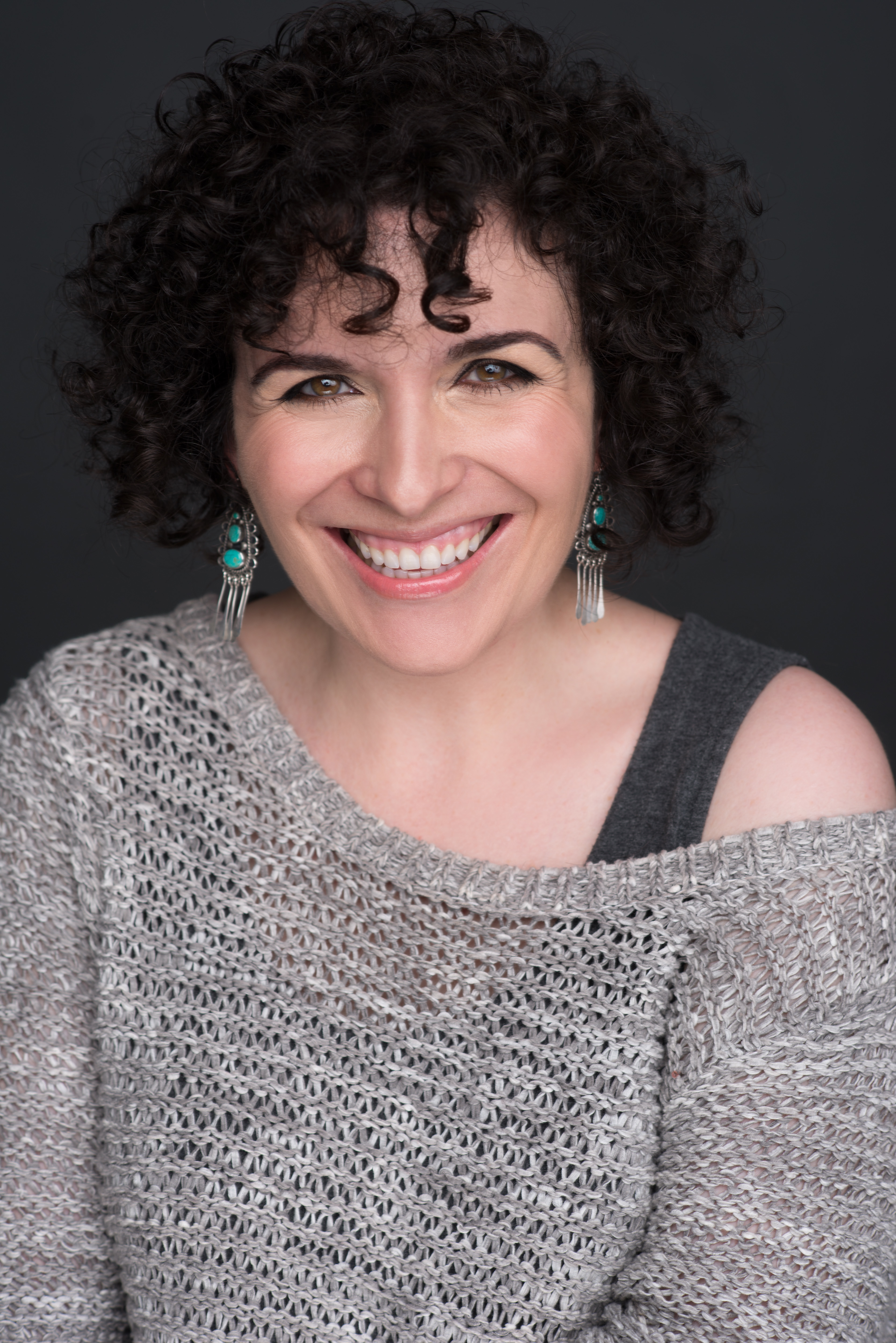
Elyse Fenton at Dodge Poetry Festival 14.
Elyse Fenton, Dodge Poetry Festival 2014.

War subjects and themes were the focus of this year’s Dodge Poetry Festival, the nation’s largest celebration of poetry, held annually in Newark, New Jersey. The marquee event was a contemporary war poem extravaganza called Another Kind of Courage, about which more later. But sprinkled throughout the readings and panel discussions featuring big-time civilian names such as Gary Snyder and Robert Pinsky were poets familiar to readers of this blog such as Brian Turner, Elyse Fenton, and Jehanne Dubrow. The commingling of war-themed poems within the greater flow of versification rendered ample opportunity to think about how war has inflected poetry generally in the 21st century. It also allowed one to take stock of how a first-generation of contemporary war poets might be moving on to subjects and approaches more centered within the poetry mainstream.
Jehanne Dubrow
Jehanne Dubrow

Fenton, for example, appeared on a panel that featured among others Richard Blanco, a gay Hispanic-American poet who read at President Obama’s second inauguration, but America’s recent wars were barely mentioned by the participants. Fenton, the wife of a veteran, read only “After the Blast” from her acclaimed first work Clamor. Her other poems, from a current work-in-progress called “Sweet Insurgency,” had little to do with deployment, combat, or life on the homefront, though the title alone attests to the lingering persistence of things, words, and ideas military in Fenton’s apprehension of the world. Dubrow, for her part, read just three poems from her impressive work Stateside, to include one I love called “Nonessential Equipment,” on a panel that featured no other war poets. Her husband continues to serve in the Navy, but Dubrow has turned her attention to subjects other than the vexations of martial marital relations. Still, the interest in violence and trauma inherent in Stateside continues, or is even intensified, in the poems Dubrow read from a soon-to-be published work about her mother’s harrowing life growing up in El Salvador.

As for Turner, readings at Dodge and another one a week earlier in New York gave ample evidence that he has plenty of poetry to draw on that doesn’t explicitly touch on his service as an infantryman in Iraq. Many examples can be found in Phantom Noise, but others, some that predate his military service and others written after, look at family history, regional influence, and the complexities of modern life. In New York, at an event called Stage Meets Page, Turner traded turns reading with a performance poet named Rives, a winner of freestyle contests and a giver of TED talks. Rives is probably used to blowing poetic competition off the stage, but Turner more than held his own, riffing off Rives’ cues and dipping deep into a black notebook full of funny, startling, brilliant verse that had far more to do with life out of uniform than in. For an example of the same from Dodge, on a panel on masculinity and poetry that also featured the aforementioned Pinsky and Blanco, Turner read “Zippo” from Phantom Noise.
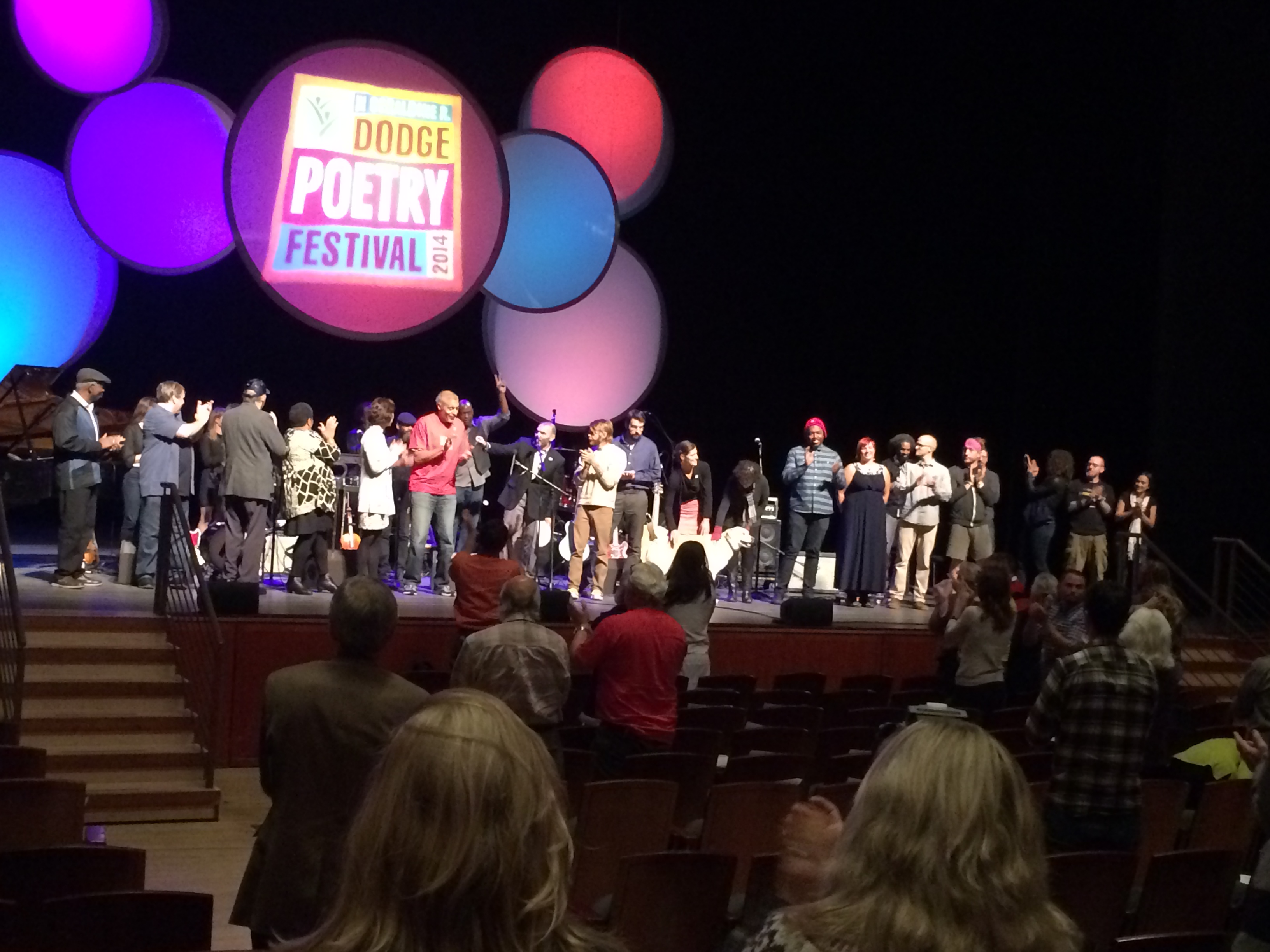
Another Kind of Courage poets and musicians take their bows, Dodge Poetry Festival 2014.

The Another Kind of Courage event brought Turner, Dubrow, and Fenton together with wise war-poet old hands Yusef Komunyakaa and Marilyn Nelson and a group of younger vet poets associated with a collective called Warrior Writers. Together, as organized by festival program director Martin Farawell, they recounted a narrative-in-verse about deployment through the multiple voices of a large and diverse body of poems read by their authors. The general arc of the story focused on psychological trauma and political outrage, which is understandable and dramatic, but by no means the be-all and end-all of what war poetry is and can be. Still, Another Kind of Courage inspired wonder about the possibilities of staging war poetry and showcased many fantastic individual performances. Warrior Writers’ Jeremy Stainthorp Berggren galvanized the audience with the Eminem-like “PTSD (P.lease T.ry S.omething D.ifferent)” and Jennifer Pacanowski’s “Parade,” read to the accompaniment of a simple guitar strum, did much the same in a softer key.
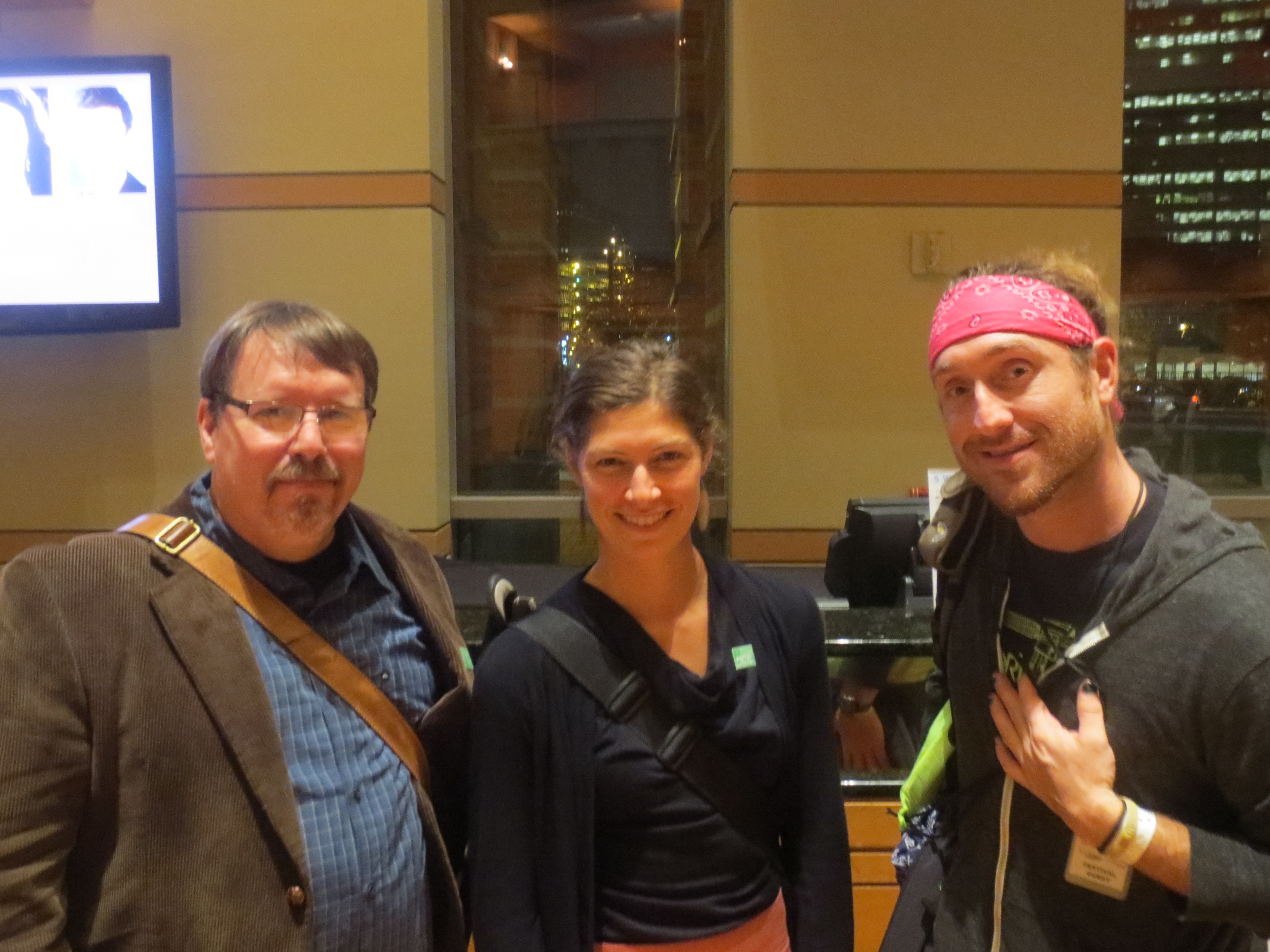
Brian Turner, Elyse Fenton, and Jeremy Stainthorp Berggren at Dodge Poetry Festival 14
Brian Turner, Elyse Fenton, and Jeremy Stainthorp Berggren, after the Another Kind of Courage performance. Dodge Poetry Festival 2014

For all of the above, a highlight of Dodge for me was meeting Robert Pinsky for the first time since I took a class from him almost 30 years ago, when, fed up with graduate school, I asked him to write a letter of recommendation for my application to Officer Candidate School. Pinsky, a former national poet laureate, published a volume of poetry called Gulf Music in 2007. Interested in knowing if it addressed the wars in Iraq and Afghanistan, I purchased a copy and read it between acts at Dodge. I didn’t have to look long, for the very first poem, “Poem of Disconnected Parts,” ruminates on torture in the name of politics as perpetrated by oppressive regimes around the world, the United States unfortunately not excepted. But Pinsky, it turns out, is ambivalent or confused about conflict and violence more than he is stridently opposed; many of the poems in Gulf Music document him trying to work out the exact relationship between the propensity to inflict harm and the inclination to create art. In “Poem of Disconnected Parts,” for example, he writes:

The [torturers] created nicknames for torture devices:
The Airplane. The Frog. Burping the Baby.

Not that those who behead the helpless in the name
Of God or tradition don’t also write poetry.

In “Inman Square Incantation,” he writes:

Forgive us, we don’t exactly believe or disbelieve
What the President tells us regarding the great issues
Of peace, justice, and war—skeptical, but distracted

By the swarm of things.

That seems about right, but in a poem (perhaps aptly) titled “Stupid Meditation on Peace,” the drift of Pinsky’s thought turns more sinister and daring. He begins by describing himself as an “Insomniac monkey-mind,” an image that sets up a series of stanzas that consider the proposition that art depends on the dark energy of conflict:

We choose one of two tributaries: the River
Of Peace, or the River of Productivity.
The current of Art he says runs not between

Banks with birdsong in the fragrant shadows—
No, an artist must follow the stinks and rapids
Of the branch that drives millstones and dynamos.

Is peace merely a vacuum, the negative
Of creation, or the absence of war?
The teaching says Peace is a positive energy:

Still something in me resists that sweet milk,
My mind resembles my restless, inferior cousin
Who fires his shit in handfuls from his cage.

Pinsky’s not wrong, I feel, and he’s way too hard on himself. But these are hard things to say or prove, and must be couched in terms of irony, possibility, and humor, if not self-deprecation and laceration. For certain though, Pinsky the poet is tied up with the life course that took me to the battlefields of eastern Afghanistan: the letter of recommendation I still have is the material proof.
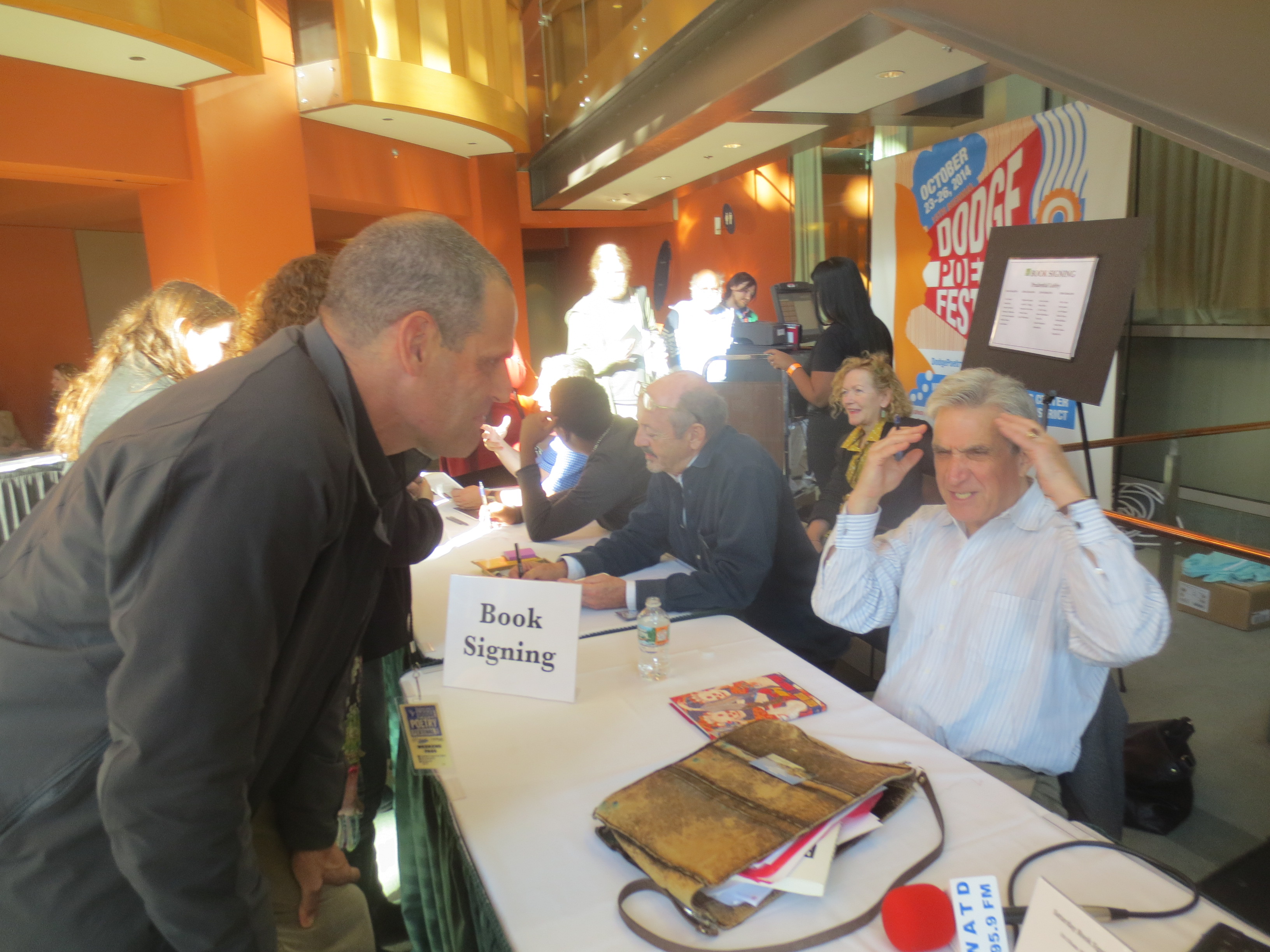
Robert Pinsky seems a little dismayed by my reappearance in his life.

Robert Pinsky, Gulf Music. Farrar, Strauss, and Giroux, 2007.

“Tomorrow the War Will Have a Picnic”: Global Perspectives on the Global War on Terrorism

arts_books2-1_49“Tomorrow the War Will Have a Picnic” is a poem written by an Iraqi author named Abdul Razaq Al-Rubaiee on the eve of the American invasion in 2003.  It and other poems written by Iraqi poets are collected in the anthology Flowers of Flame: Unheard Voices of Iraq (2008). Flowers of Flame came to my attention when a scholar proposed to speak about it for a panel titled Global Perspectives on the Wars in Iraq and Afghanistan that I am trying to set up for the American Comparative Literature Association conference next March in Seattle. Alas, as I write I don’t have enough papers to meet the ACLA’s requirement of six to make the panel a go. But the entries I have received have already done much of what I hoped to accomplish by alerting me to the work of non-American authors who have written stories, poetry, and plays about Iraq and Afghanistan.  Flowers of Flame is one example, and below are a few more:

The Blind Man's GardenPakistani-British novelist Nadeem Aslam’s The Blind Man’s Garden (2013), tells the story of two brothers who enter Afghanistan from Pakistan not to fight Americans, but to help wounded Afghans. Aslam’s earlier novel The Wasted Vigil (2008) is also set in Afghanistan.  An interview with Aslam at Bookslut is especially not to be missed for many reasons–I’ll quote my favorite part, in which Aslam describes how he taught himself to be a writer:

So over the course of the next 10 or 11 years I read everything. I would go to person A and say, “Tell me, who’s a great writer?” William Faulkner. So I read everything by William Faulkner. I would begin with the first novel and end up with the last novel. I would go to person B and say, ‘Who’s a great writer?’ Thomas Hardy. I read everything by Thomas Hardy, sequentially. Who’s a great writer? D.H. Lawrence, James Joyce, Vladimir Nabokov, Dostoevsky.

And then I wanted to know, how much thought is allowed in one paragraph? How many images are allowed per page? What is a comma? And so I copied out the whole of Moby-Dick by hand. I copied out the whole of As I Lay Dying by Faulkner by hand. I copied out Lolita. I copied out Beloved. I copied out The Street of Crocodiles by Bruno Schulz, Gabriel García Márquez’s The Autumn of the Patriarch….

Christine Evans is an Australian-born playwright who now lives in America. Her multi-media play You Are Dead. You Are Here (2013, with more productions coming in 2015) portrays a relationship between a male American soldier and a young female Iraqi blogger.  An earlier play called Slow Falling Bird (2003) features an Afghan girl living in limbo in an Australian immigrant detention center.  Evans’ other plays–Trojan Barbie (2009) and Weightless (2007)–don’t invoke Iraq and Afghanistan directly, but instead comment obliquely on modern life as it has been shaped by a decade of war.  Trojan Barbie, by-the-by, draws inspiration from Euripides’ The Trojan Women to portray the plight of women in the midst of a war, conflict, and violence-saturated historical epoch.  In the latest PMLA, a seriously scholarly journal published by the Modern Language Association, Ellen McLaughlin describes her own stage adaptation of Sophocles’ Ajax called Ajax in Iraq (2009).  Evans’ and McLaughlin’s works add two more data points to the now indisputable pile of evidence proving that classic Greek literature has been the go-to sourcepool for contemporary war writers.

you-are-dead

I’ve appealed to ACLA for an exception-to-policy and will soon find out if my panel will occur or not.  I hope so, but even if it doesn’t, many thanks to the scholars who brought Flowers of Flame, The Blind Man’s Garden, and You Are Dead. You Are Here to our attention.  I look forward to reading both the original works and the critical commentary.

Flowers of Flame: Unheard Voices of Iraq.  Edited by Sadek Mohammed, Soheil Najm, Haier Al-Kabi, and Don Veach. Michigan State University Press, 2008.

Nadeen Aslam.  The Blind Man’s Garden.  Knopf, 2013.

Christine Evans.  You Are Dead.  You Are Here.  Indie Theater Now, 2013.

Congratulations, Phil Klay!

Phil Klay outside Siobhan Fallon's father's bar, the South Gate Tavern, Highland Falls, New York.
Phil Klay outside Siobhan Fallon’s father’s bar, the South Gate Tavern, Highland Falls, New York, spring 2014.

The National Book Foundation announced its prestigious National Book Awards today, and Phil Klay’s collection of Iraq war short stories Redeployment was one of five finalists in the fiction category. Redeployment joins Kevin Powers’ The Yellow Birds and Ben Fountain’s Billy Lynn’s Long Halftime Walk, both finalists in 2012, as recent war lit short-list fiction nominees.

October in the Railroad War Lit Earth

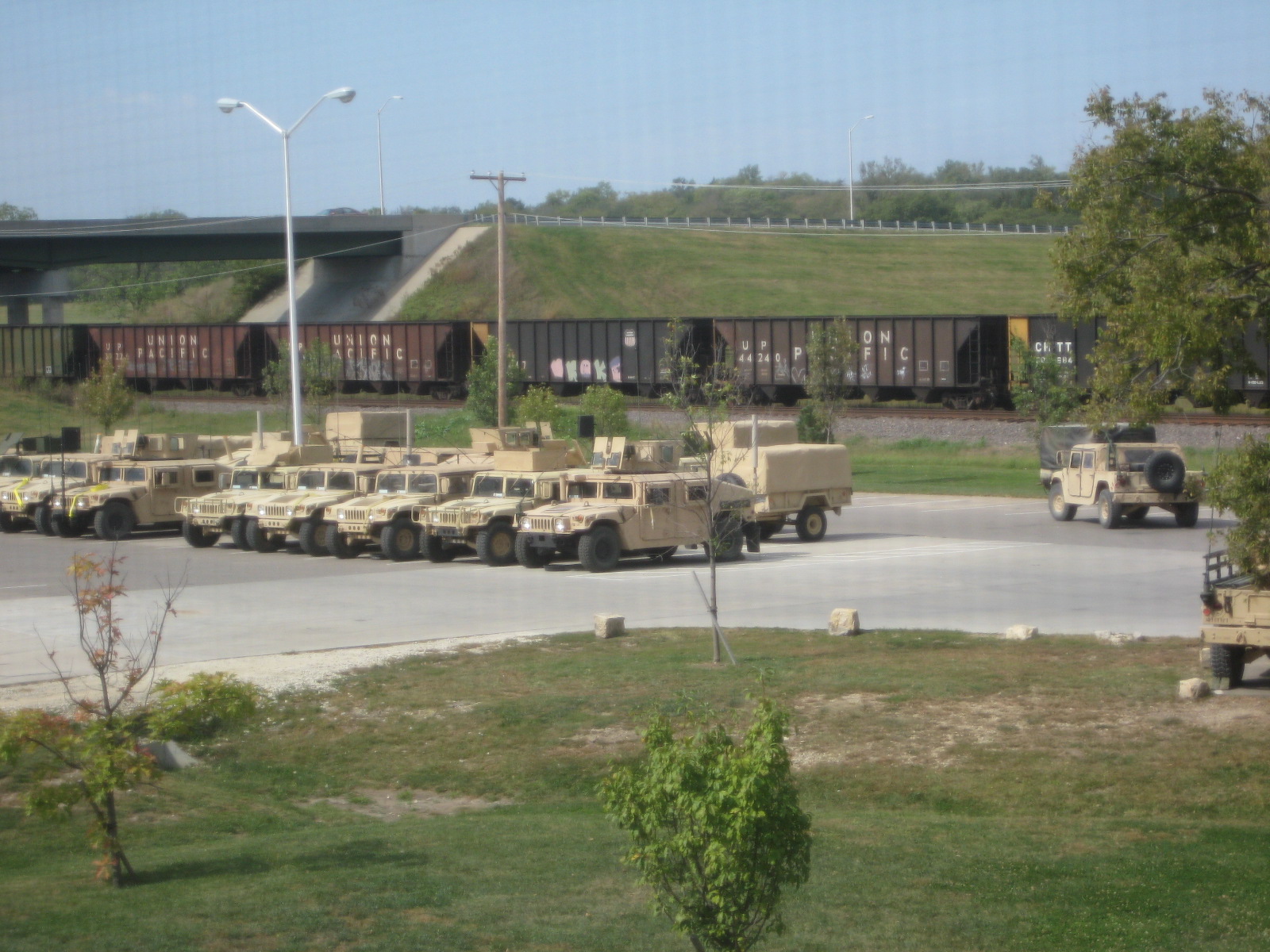
Fort Riley, Kansas, October 2008

“October in the Railroad Earth” is the title of a beautiful prose-poem by Jack Kerouac, who served for about a week in the Navy during World War II and somewhat longer in the Merchant Marine. I have already used the title of Kerouac’s fantastic ode to autumn for the title of a post on my old blog. There it actually made a lot of sense as I wrote about long, glorious days of training in the warm Kansas sunshine while we prepared to deploy to Afghanistan. But I can’t resist repurposing the title, so here we go. A potpourri of miscellaneous war-lit notes is not my usual modus, but ideas, events, and publications have been accumulating so fast that I can’t possibly give each the extended consideration it deserves, so please bear with me.

Late in August, I attended a Sunday afternoon writing workshop co-sponsored by New Jersey branches of the Combat Paper Project and WarriorWriters. With veterans of Somalia and Vietnam I traded writing prompts relevant to military experience and we read each other our responses. Here’s one I wrote on “environment”:

I find very few soldiers wax poetical about Iraq.  Nothing about the flat desert, the hot sun, and the squalid chaos of the cities seems to have impressed them.  Afghanistan, on the other hand, exerted an enchanting allure on many of the soldiers who served there.  The high mountains, often snow-capped and surprisingly forested, the clean air (at least outside of Kabul), the ancient villages built into the sides of wadi and mountain walls, and the roads that snake through the treacherous mountain passes all possess intoxicating powers. Quickening everyone’s step and filling them with wonder, the landscape makes soldiers fall halfway in love with a country that might kill them.

Speaking of falling in love with soldiering in Afghanistan, check out Brian Castner’s impressive essay in the LA Review of Books called “Afghanistan, A Stage Without a Play” on why so little fiction has been written about Afghanistan compared to Iraq. It’s curious, Castner wonders, why Afghanistan seems to have inspired triumphalist memoirs by Navy SEAL team members and infantry lieutenants, while the literary output of Iraq has been fiction and poetry written by disillusioned enlisted soldiers. I’m honored to have been quoted by Castner alongside several other veteran-writers. Along the same lines, I was fortunate to view the movie Korengal and hear Sebastian Junger speak about his love for the soldiers he filmed in action on COP Restrepo in Afghanistan. The next night, in contrast, at Penumbra, a hip photography exhibition space in New York City, I heard Benjamin Busch speak more grimly about the photographs he took in Iraq first as a deployed Marine and earlier this year when he returned to write a story for Harper’s called “Today is Better than Yesterday.” The twinned events inspired many reflections about the linkage of war, words, and images about which I hope to write soon. On a more personal level, Junger and Busch are men-after-my-own-heart, for sure: older, deeply cerebral and artistic gentlemen driven to delve deep into the mysteries of the manly realm of war. Speaking of which, I spent a fun, rewarding afternoon in New York with Maurice Decaul, ex-USMC Iraq vet, ex-Columbia, and now in NYU’s graduate fiction writing program. Decaul writes like the second coming of John Keats, as illustrated by a New York Times essay titled “Memory Lapse” and the poem “Shush,” featured below. But more importantly, Decaul is a genial warm soul who instinctively gravitates towards helping people and getting them organized for effective action and life. As he regaled with me stories about the Columbia and NYU veterans’ programs, I realized exactly how curmudgeonly have been my own efforts in this regard.

Another gentleman, Brian Turner, is reading several times in the NY-NJ-Conn area in the coming months following the release of his memoir My Life as a Foreign Country. I hope to make a couple of the readings, in particular the Dodge Poetry festival “Another Kind of Courage war poetry event on Saturday October 25 in Newark, NJ. The bill also includes Yusef Komunyakaa, Marilyn Nelson, Jehanne Dubrow, and Elyse Fenton, all poets whose work I know and admire. On Veterans Day, I’ll join several other vet-writers to read selections from our favorite World War I authors at an event organized by Words After War and Brooklyn Reading Works at The Old Stone House in Brooklyn.

I also have two conference presentations lined up for next spring. In March, in Seattle, I am moderating a panel at the American Comparative Literature Association conference on literature inspired by the wars in Iraq and Afghanistan written by non-Americans. As I write, nobody has submitted a paper proposal, which honestly I kind of anticipated. But if you are an academic and know of a work about the post-9/11 wars written by someone who wasn’t born in the US of A, please consider joining me. In April, I will participate on a panel on war memoir at the Association of Writers and Writing Programs conference in Minneapolis. Also on the panel are Ron Capps, Colin Halloran, and Kayla Williams, so I’m very excited to take part. AWP is a huge party, for those who have never been, in addition to being an intellectual feast for the literary-inclined, so please join us if you can.

And so it goes, on and on. To Jack-y Kerouac-y, maybe not a patron saint of war writing, but certainly a kindred spirit and fellow traveller of all who burned to live intensely and then express themselves through their art.

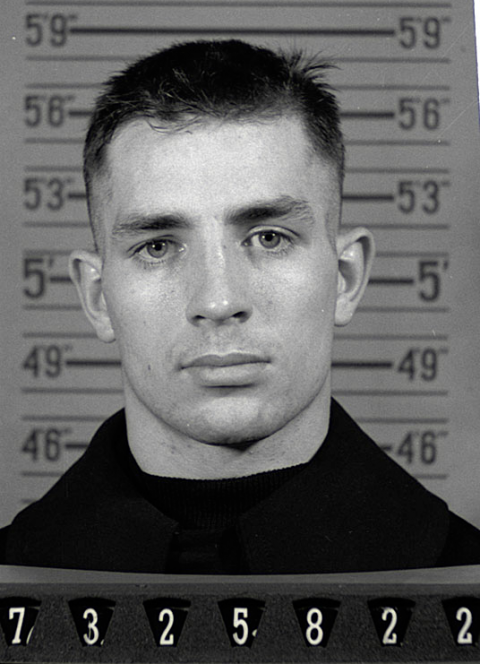
Jack Kerouac's Navy enlistment photo, 1942.
Jack Kerouac’s Navy enlistment photo, 1942.