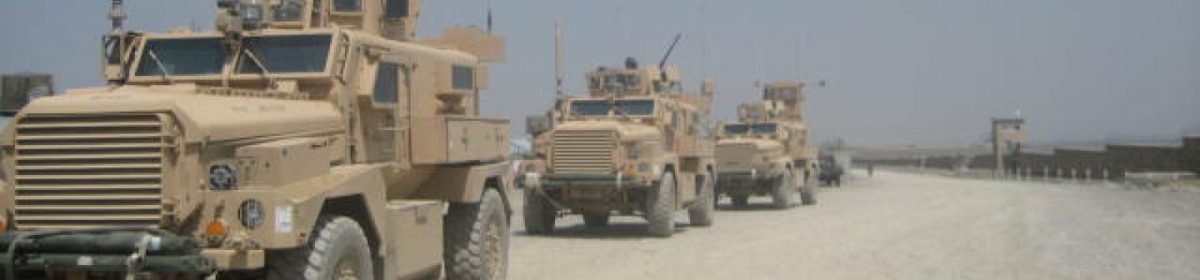
Who built these things? An abandoned fortress near Spera Combat Outpost, Khost province, Afghanistan.
Last week I presented twice at the Conference on College Composition and Communication in Tampa, Florida. One presentation was part of a panel called Community Writing Programs for Veterans; my contribution was a discussion of the New York City writers’ collective Words After War. Two days later, I read a paper titled, “When the Veteran in the Class is the Teacher” as part of a panel on student-veterans.
This week, I read original fiction at Pete’s Candy Store, Brooklyn, NY, as part of their annual veterans reading night event. Also reading will be Teresa Fazio, Chris Wolfe, and Brandon Willitts, hosting will be Matt Gallagher.
My next stop is the American Comparative Literature Association conference in Seattle, where I will join a seminar titled, “What Does War Look Like? Visual Trauma and Representation.” My paper is called “Ariella Azoulay and the Photographic Situation of War in Iraq.”
Then on to the Association of Writers and Writing Programs conference, or “AWP” for short, in Minneapolis. I’m moderating a panel titled “Who Can’t Handle the Truth? Memoirs by Iraq and Afghanistan Veterans” that features Ron Capps, Kayla Williams, and Colin D. Halloran. Capps is the author of Seriously Not All Right and the maestro of the Veterans Writing Project. Williams’ two memoirs are Love My Rifle More Than You and Plenty of Time When We Get Home. Halloran is the author of the poetry collection Shortly Thereafter and has a memoir and another volume of verse in the works.
Last stop is the American Literature Association conference in Boston. I’ll be on a panel called “The Politics of Contemporary War”; my paper will be on canon (not “cannon”!) formation within the contemporary war body of fiction and poetry. The panel will be moderated by Aaron DeRosa, and also presenting will be Stacey Peebles and Laura Clapper. DeRosa and Peebles are currently co-editing an upcoming issue of Contemporary Fiction Studies dedicated to 21st-century war fiction; Peebles is also the author of Welcome to the Suck: Narrating the American Soldier’s Experience in Iraq, the praises of which I’ve sung many times in Time Now.
Spera Combat Outpost, a combined US-Afghanistan outpost on the Pakistan border.
Appreciation Yak: Only thing I like about Fayetteville is all the eye candy. Military men are the best men. I’m in heaven every time I come home from school.
Subsequent Yaks:
I’m the opposite. They’re not really my type, but so many of them message me on dating sites (sad I know, but it’s convenient) since so many live around here.
Really… I feel like most military guys are super sweet, plus they stay in shape… Which is greattt.
My type is more like, k-pop boy band kinda guy lol.
Haha, they’re cool too.
I dunno, I guess something just kinda scares me about masculinity. At least you have plenty to be happy about in this city lol.
That’s about the only thing.…
Yep nothing else pretty much. Like I’m trying my hardest to think of something to do here other than shopping.
I’ve been watching Netflix like it’s my job.
Except when their PTSD does something bad to you.
That’s not always the case…. Can’t be afraid of people because of possibilities.
I can be afraid of anything I want, thank you very much. And PTSD scares me. I know from first hand.
First replier here, I agree the PTSD can be potentially very harmful for both in a relationship, but another reason for me is, I wouldn’t be able to handle the times he has to go off and fight.
That is such a good point! My friend’s boyfriend just got deployed for nine months.
Yeahh… loneliness, lots of worrying., and trust issues on my part (or his part, too). It wouldn’t really work out for me I think.
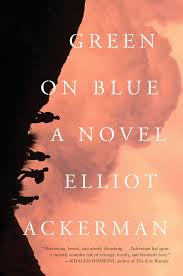
USMC veteran Elliot Ackerman’s novel Green on Blue describes events that ring true to my own deployment experience in east Afghanistan. As an advisor who daily spent hours in the company of Afghans with loaded weapons, a “green on blue” incident—the murder of an American by an Afghan army member–was always a possibility. Ackerman’s descriptions of torturous truck journeys down narrow wadis and on the edge of cliffs brought back memories, too. As I’ve written elsewhere, for every story of combat in Afghanistan, I have five involving crazy vehicle escapades. The portraits of village shuras and life behind kalat walls in Green on Blue mirrored dozens of my own engagements with Afghans, often with me being the only American in a room full of turbaned and bearded Pashtun men.
For all that, as I began to read Green and Blue I was prepared to be disappointed, for I knew it might be hard not to quibble with Ackerman’s rendering of combat on Afghanistan’s eastern border with Pakistan. Happily, though, Ackerman gets all the above right and whole lot more, too. Through the audacity of its imaginative reach, as well as the acuity of its insight into what war in Afghanistan is about, Green on Blue significantly expands the borders of contemporary war literature.
The story’s protagonist is Aziz, a young Paktika province Pashtun who signs on as a member of a militia to revenge the death of his parents and the loss of a leg by a beloved older brother. The militia he joins is led by a ruthless, mysterious, and charismatic leader named Commander Sabir. Sabir, aided and funded by an American advisor named “Mr. Jack,” battle with a clan led by a wizened tribal warrior named Gazan for control of a middle-of-nowhere village called Gomal. Gomal has no tactical, political, or economic significance, but Aziz, Sabir, Gazan, and other Afghans in the story fight over it in an endless cycle of violence rooted in personal vendettas and dreams of war profiteering. As the novel unfolds, Ackerman drives home the point that war in Afghanistan, as it is experienced by actual Afghans, is only circumstantially concerned with the American intervention. Even the green on blue murder that gives the book its title is more a matter of circumstance than an act motivated by hatred and global politics.
Ackerman, who served as I did as an advisor, suggests that pashtunwali codes of nang and badal—honor and revenge, respectively—motivate Pashtuns to ceaselessly seek retribution against each other for wrongs inflicted on family members. And as if nang and badal weren’t fuel enough to keep the fighting going for another thousand years, Sabir and Gazan are well aware that their place in the bigger conflict keeps the local economy going. Not only do they stand to profit personally by siphoning off war-related lucre, their followers and their families’ livelihood depend on it, too. Commander Sabir explains:
All are caught up in this, he said. The question is whether you’ll be a victim or prosper in it. What justice is there for you if Gazan, who crippled your brother, prospers in peace with the Americans? What justice is there if we lose control of him and never build our outpost [in Gomal]? Yes, there will be peace for Gomal and Gazan, but us, what of us? The Americans will no longer need us. How do we survive then?
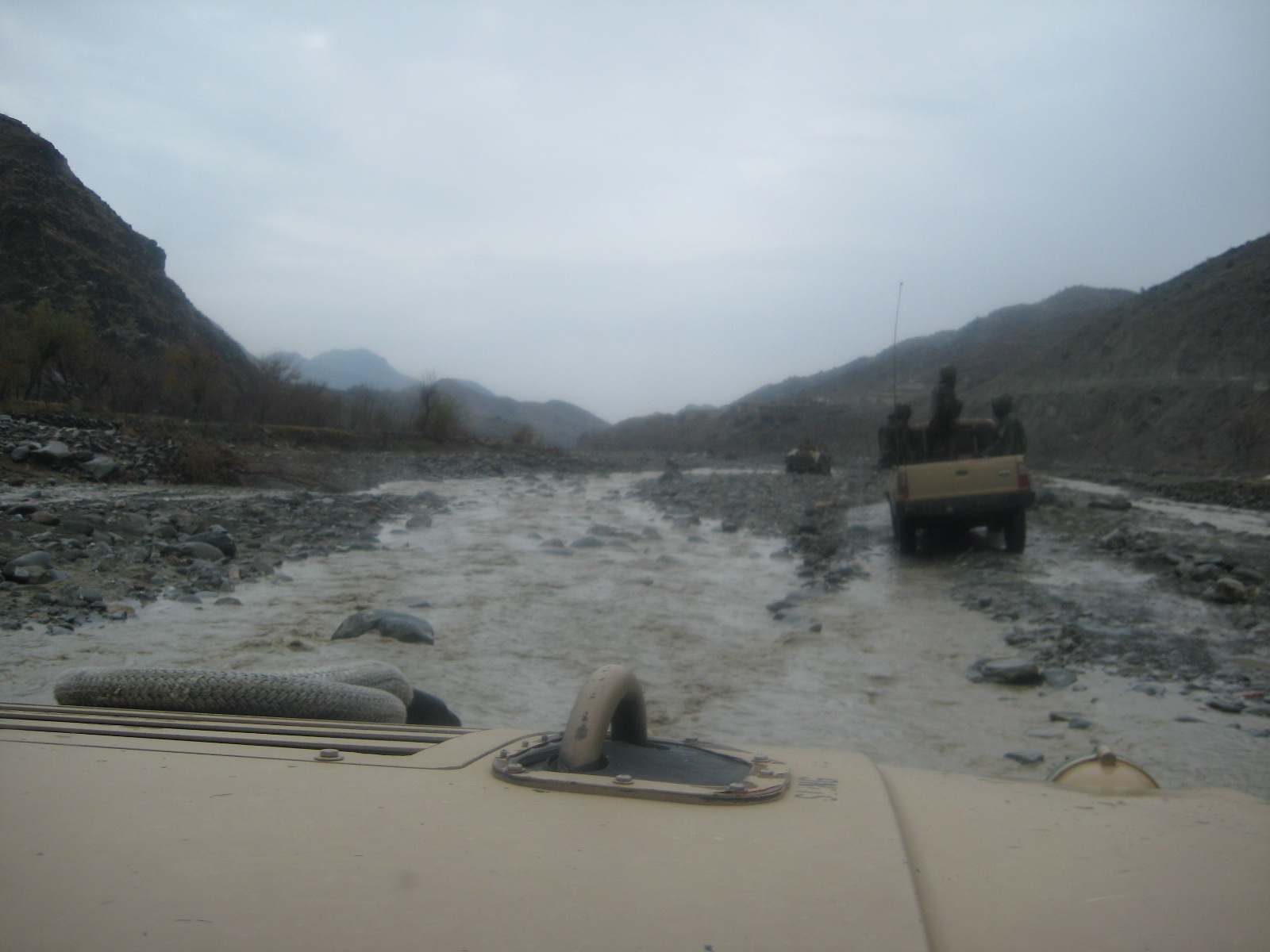
Every warzone has its characteristic look, feel, and pace, or at least our mental pictures of them do. I saw American Sniper this weekend and the many scenes portraying Marines and SEALs clearing houses in urban areas resonated in my mind as sui generis Iraq combat. I enjoyed Sebastian Junger’s movies Restrepo and Korengal very much, but their endless scenes of soldiers on outposts blasting away at remote hillsides with their machine guns didn’t do much for me in terms of characteristically representing war in Afghanistan (and I was responsible for a very similar outpost, Spera COP, in my own sector). For me, most vividly, Afghanistan entailed vehicle movements deep into remote districts and enclaves. Combat action was always possible and sometimes occurred, but the long drives there and back felt like something epic even when there was no battle. Ackerman’s descriptions of treacherous truck movements through Afghanistan wadis and mountains are frequent and rich:
We rushed past Shkin village, where cooking fires glowed inside the few mud-walled homes. We drove on towards the darkness of the southern mountains. At the base of the range, our convoy slowed to a crawl. Here the north road continued south, but we turned off and traversed the uneven ground to a wet ravine tha rolled out like a sloppy tongue. I watched Commander Sabir’s HiLux ease itself into the ravine’s mouth. It took the first bend and was swallowed by the mountain. Issaq’s HiLux followed and then, quickly, the rest of us. And our convoy disappeared.
The mountains closed around us. We drove through them like children playing in a window’s long curtains, chasing each other, all of us near, hidden in the fold….
But Green on Blue‘s most interesting feature is its first-person narration in Aziz’s voice. War novels such as Joydeep Roy-Bhattacharya’s The Watch and Michael Pitre’s Fives-and-Twenty-Fives admirably feature Afghan and Iraqi characters, but Ackerman’s feat surpasses those with its plausible and engaging rendering of a life experience as foreign as an American might imagine. Such acts of ventriloquism are not without risk; an easy criticism would be that rather than a feat of empathetic representation, it bespeaks an act of literary imperialism bankrupt in principle and doomed to fail practically. Ackerman could well have told the story from Mr. Jack’s point-of-view or presented the story as memoir, for surely many of its events are close to those he experienced or heard about on deployment. But we have already have portraits of American army captains in Afghanistan in The Watch and Aaron Gwyn’s Wynne’s War, so kudos to Ackerman for approaching his story from a different direction. Green on Blue sympathetically makes us privy to Aziz’s dawning awareness of just how complicated and bleak is the world he inhabits.
Ackerman renders Aziz’s voice simply and directly; rarely, for instance, does Aziz envelop his thoughts in Islamic platitudes or verses from the Koran. Instead, nang and badal and various Pashtun proverbs are the constants in his mental flow:
Once, in Sperkai, an older child had split my lip in a fight. When my father saw this, he took me to the boy’s home. Standing at their front gate, he demanded that the father take a lash to his son. The man refuse and father didn’t ask twice. He struct the man in the fact, splitting his lip just as his son had split mine. Before the man could get back to his feet my father left, the matter settled. On the walk home, my father spoke to me of badal, revenge. He told me that a man, a Pashtun man, had an obligation to take badal when his nang, his honor, was challenged. In Orgun, every stranger’s glance made me ache for a time when my father might return and take badal against those who’d pitied his sons.
Once in while, the register shifts into ‘murican-Injun’ picture-speech, as when Aziz says, “We turned wrenches until our shadows were made long by the late-afternoon sun.” And in a couple of places, Aziz sounds suspiciously like a young American MFA-trained author, as in a passage where he considers the feel of a pistol in his hand:
Its heft sunk into my palm, and I felt the permanence of its metal. A pistol’s purpose was the same as a rifle’s, but achieved it so casually. A rifle requires the whole body to fire it. Laying the buttstock into the shoulder, leaning against the recoil, concentrating on the sights, all of this draws from every part of the shooter. But with a pistol, just a flick of the wrist and a light twitch with an index finger delivers a hard bullet.
Overall, though, Aziz’s voice is fine. Ackerman lets the events of the story pull the narrative forward by having Aziz relate them without much stylistic overlay. His thoughts and actions seem motivated by what anyone would conceive of as plausible human nature, leavened by pashtunwali. When I arrived in Afghanistan, an American told me that working with Afghans was much like working with Americans, except that Afghans possessed two great fears that Americans didn’t worry as much about: one, they might die at any moment, and two, their families would be left destitute as a result. The statement served me well as I watched the Afghans I knew make choices and express their beliefs. Now, reading Green on Blue, the claims seems true also for Aziz, whose ability to choose is constrained everywhere by the proximity of death and poverty, and animated only by dreams of nang and badal. His war, like my war, was not just flying bullets and exploding mines, but complex local social dynamics characterized by grudge, worry, feud, and angling for advantage.
On the wadi road to Spera, Khost province, Afghanistan, January 2009.
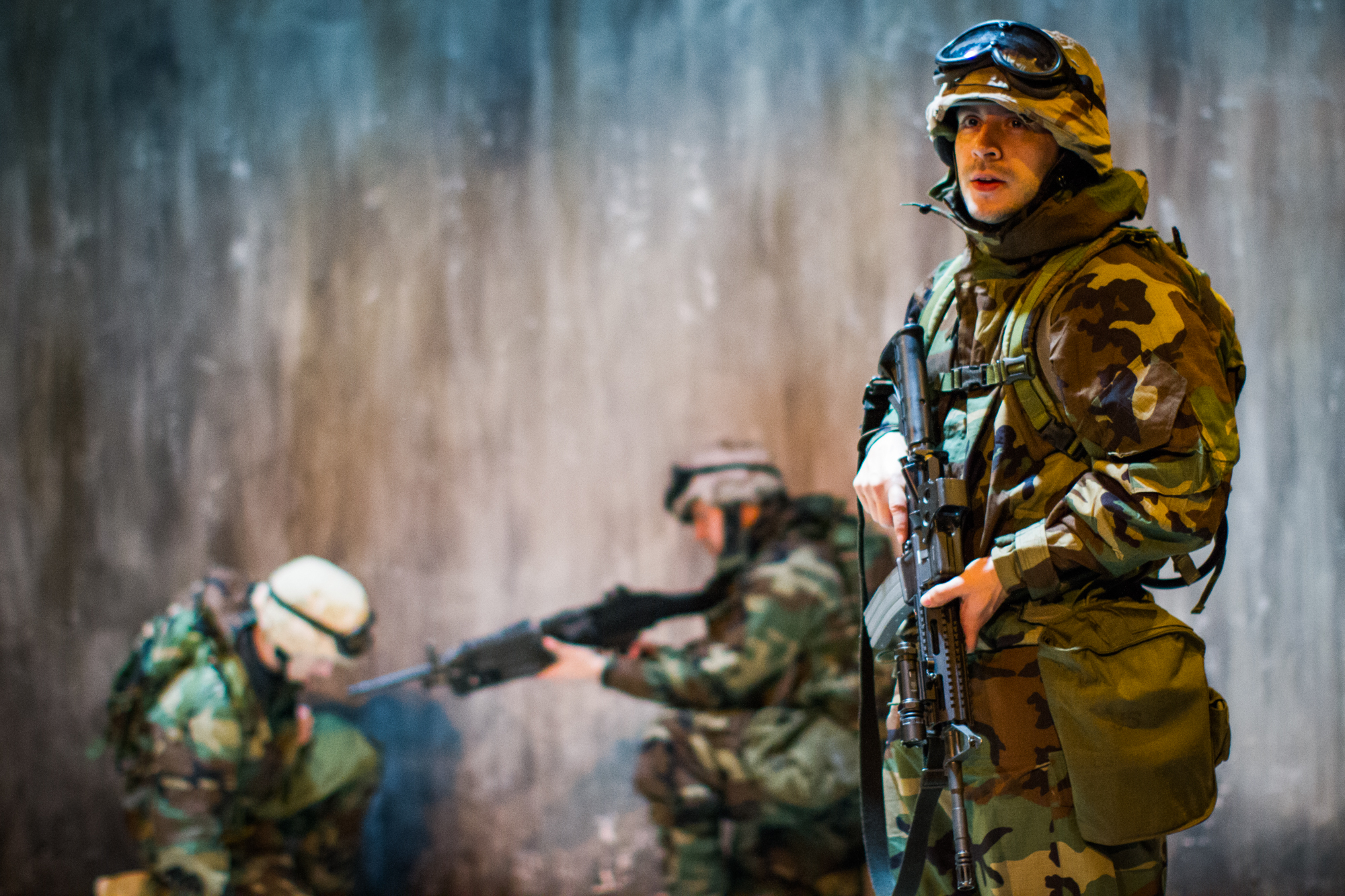
Dijla Wal Furat: Between the Tigris and the Euphrates photo by Bjorn Bolinder.
Sitting in the audience before Poetic Theater’s production of playwright Maurice Decaul’s Dijla Wal Furat: Between the Tigris and the Euphrates, I mused that the last year or so has not brought many stage representations of contemporary war and war-related issues. The last one that came to mind was another Poetic Theater production, Goliath, that I attended one winter ago. I once proposed that theater might be the artistic medium that best portrays war subjects in ways that compellingly binds together veterans and non-veterans in shared contemplation, but this seems not to have happened. So I guess I was wrong, if in no other way than that I overestimated that a large audience might be found for any stage performance not on Broadway.
Be that as it may, as the lights dimmed and Dijla Wal Furat: Between the Tigris and the Euphrates opened, I leaned forward in anticipation of the shared-in-darkness vitality of theater. Decaul, a USMC vet who participated in the invasion of Iraq in 2003, takes us back there to portray Marines in action in those early days of war. 2003 seems so long ago—the first moments of a decade-plus of war whose full horrible dimensions no one saw coming. The remoteness of Decaul’s story was exemplified by the chemical protective suits his characters wore and the gas masks they carried. Boy does that gear ever date them…. Remember when Weapons of Mass Destruction were what we though the war was about? Of course no WMDs were ever found by anyone, but Decaul’s retrospective portrait brings to the fore salient aspects that eventually would characterize war in Iraq and Afghanistan. The infliction of unintended casualties on innocent civilians. The difficulty of determining friend from foe. The presence of the press in the combat zone as omniscient judges. The spasms of guilt that would afflict individual soldiers and Marines as they killed and saw buddies killed. In the years after 2003 these issues would metastasize and become defining, overwhelming aspects of our war experience.
I enjoyed everything about Dijla Wal Furat, but within the context of the greater story, two individual scenes dazzled as examples of theatrical possibility. The opening scene, in which a Marine mortar squad “hangs” (or, launches) rounds—one of which goes off-course and kills innocent Iraqis—marvelously blended the real-world choreography of a crack mortar crew with the artistry of stage dance, music, light, and sound. Another scene, in which an Iraqi man is followed about on stage by the ghost of his dead friend, poignantly drove home the lingering presence of the past as it affects those still alive in the present. The mortar and ghost scenes showed Decaul the master of two trains of stagecraft—representational fidelity to real life heightened aesthetically and the magical permutation of real life in the pursuit of greater artistic truth. Decaul, I’ve learned, has been accepted into a prestigious Brown University program for talented young playwrights and Dijla Wal Furat provided plenty of evidence why. Kudos also to director Alex Mallory, who also brought Goliath to the Poetic Theater stage last year, and all the actors.
Since watching Dijla Wal Furat I’ve been exploring other books and artworks to make better sense of 2003. My general impression is that the entire nation was driven mad by the 9/11 attacks to the point it couldn’t think well about anything. Watching the HBO series Generation Kill again and reading Love My Rifle More Than You, Kayla Williams’ excellent memoir about service in Iraq in 2003, reminded me of how simultaneously naïve and arrogant we were as a military, how many mistakes we made, and how consequential it would all become. Increasing my despair has been Jeremy Scahill’s Dirty Wars: The World is a Battlefield (2013), in which Scahill describes the growth of Joint Special Operations Command and special operations in general in the years after 9/11. Decaul and Williams vividly portray the difficulty and inefficiency that typified ground force operations in the early Iraq days; Dirty Wars describes an administration that at the highest levels expected as much and didn’t really care. In Scahill’s telling, Secretary Rumsfeld, Vice-President Cheney, and President Bush were too transfixed with turning the CIA and military special forces into worldwide kill/capture teams in search of high value terrorist targets to focus on the mess that was fast becoming Iraq from 2004-2008. Contemptuous of conventional ground forces—too stodgy, not aggressive or responsive enough, led by dullards and manned by drop-out post-adolescents, as Scahill describes their attitude—our national leaders abdicated responsibility for establishing anything like the appropriate conditions by which men and women like Decaul and Williams might succeed on the ground and feel especially proud of their service afterwards.
Whether any of that is the truth, the whole truth, and nothing but the truth, I don’t know, but it’s all got me thinking.
Dijla Wal Furat: Between the Tigris and the Euphrates writer Maurice Decaul and director Alex Mallory on opening night.
TalkinBroadway review of Dijla Wal Furat: Between the Tigris and the Euphrateshere.


 Time Now: The Wars in Iraq and Afghanistan in Art, Film, and Literature