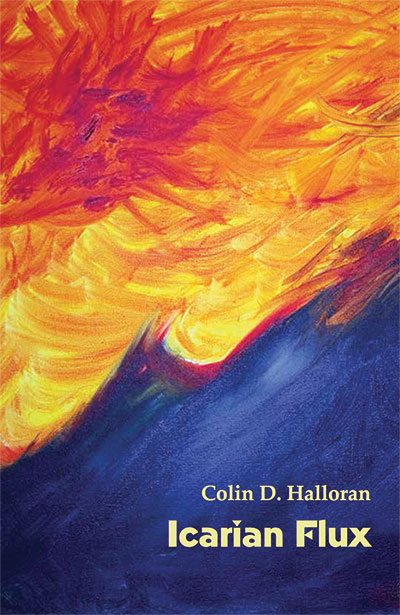
Colin D. Halloran’s Icarian Flux

CvrIcarianFlux_bookstore2015 brought two volumes of verse by authors whose previous works are central to the contemporary war poetry corpus. Interestingly, neither of the new works address Iraq or Afghanistan directly or at length. In The Arranged Marriage, Jehanne Dubrow, the author of Stateside, a collection exploring a military spouse’s anxiety about deployment, now gives us a collection of poems based on the life of her mother, who was forced into an abusive marriage in her native Central America. In Icarian Flux, Colin D. Halloran, the author of the verse-memoir Shortly Thereafter, about his Army tour in Afghanistan, imaginatively considers the myth of Icarus. Both volumes offer strong models of artists engaged with and even formed by military experience, but who refuse to let their art or their identities be defined by war and service. We might remain alert, however, for overlaps, lingering traces, and subtler forms of connection to the military even as we consider Dubrow’s and Halloran’s new interests in their own lights. Leaving The Arranged Marriage for another day’s discussion, here I’ll briefly explore Icarian Flux’s very interesting post-war and post-war-lit dimensions.

Halloran’s specific point-of-identification with Icarus, the boy who flew too close to the sun, is hard to determine, even in a poem—the first in the volume—titled “Self-Portrait as Icarus.” Icarus typically represents overreaching ambition and failure to follow directions. Seen somewhat more positively, he stands for incautious but inspired youth, reckless and headstrong for sure, but still one who seems to be made to pay a little too dearly for his mistakes. Halloran may have in mind his tour in Afghanistan, which ended abruptly as a result of a non-combat injury, but the Army and deployment are mentioned only in the author’s bio and not, as far as I can tell, in the poetry. Halloran’s Icarian fall could also be years of troubled drift post-service, collapsed relationships, or even his initial literary forays, inflected with high hopes and subsequent disappointments. Icarus’s wax-and-wings, undone by the sun, may figure specifically in Halloran’s imagination then as his soldier’s weapons and gear, his pen and his books, or more generally as his confident sense-of-self—none of which equipped him to survive the challenges to which he put himself. The opening lines of “Self-Portrait as Icarus” in fact suggest that Halloran thinks he may be doomed to repeated falls, with failure ingrained by fate in his character:

If you can’t achieve greatness elsewhere,
find it in the fall

my next will be at night
not because of lessons learned
but because I want to see

the stars from the other side….

Halloran presents himself here as a connoisseur of disappointment, an expert of loss, and a student of life after failure. The poems following “Self-Portrait as Icarus” reflect that self-image as almost every poem portrays the act of falling from a variety of intriguing perspectives. “Rain Fall,” for example:

The thing about falling
in rain
is that you’re not alone.

Your solitary descent
becomes bigger than yourself:
communal
alone among the many,
also alone.

Something about driving at night inspires Halloran; just as one of the best poems in Shortly Thereafter, “The Moon’s Still Up,” describes a night convoy in Afghanistan, several of my favorites in Icarian Flux also find Halloran at the wheel in the dark. A good example is “Interstate Icarus”:

As I follow the pavement eastward
up mountains
I’m driving on the tops of trees.

I challenge the glow on the other side
to rise
and meet me.

And as I find the hint of its intentions
captured in cirrus and nearly eye-level,

I ease off the gas
and slow

my inevitable

descent.

Not every poem in Icarian Flux so aggressively pursues the imagery and symbolism of Icarus. Three great ones (too long-lined to be reprinted here), “Lakeridge Drive,” “We Were Kings,” and “On Potholes and Exes,” ruminate on loss, memory, and disappointment while expanding the range of images and tones typical of the rest of the volume. “Troy,” a sestina composed of one-word lines, dazzles with its manipulation of form. Many poems rely on carefully controlled repetition of key words and images; knowing what I know of Halloran as a public speaker, these incantatory poems would be a joy to hear him read out loud. Finally, a series of poems remind us that though the connotations of falling are mostly negative, the word and image also apply to one of life’s most positive experiences, falling in love. But, of course, it’s complicated: “Falling: In Love,” for example, advances the notion that failure can be redeemed by love, even as it also suggests how impossible or implausible is the task:

I find it wholly foreign,
falling with someone there
to catch me

or at least

collect feathers
ripped out by wind
or thrown up on impact

gather shards of wax,
forged, melted,
fallen, reformed

and wear a feather
around her neck,
not on her wings,

reform the wax,
add wick, not quill
and light it

in my memory.

Poetry’s generalized and abstract symbolic register, reliant not on accessible biography and obvious narration, but figurative setting and privately-observed detail, is not for everyone, or even anyone all the time. But those of us who love it, especially as we consider specific poems in the context of what we do know about their authors and their total body of work, will greatly appreciate Icarian Flux. We all fall, Halloran reminds us, and the getting-back-up-again is never as simple and easy as conventional homilies and platitudes would have it. From one angle, stripping his poetry of the freighted terminology of deployment and trauma might be seen as Halloran’s effort to broaden his appeal to readers resistant to the rhetoric of veteran woe. A better read is that Halloran has drawn on the wider range of cultural resources to speak of loss and low periods in ways that encompass the entirety of human life and are not dependent merely on one aspect of it.

Colin D. Halloran, Icarian Flux. Main Street Rag Publishing Company, 2015. The quoted passages have been slightly modified due to the limitations of WordPress.
War Writing Anxiety of Influence: Bobbie Ann Mason and Tim O’Brien

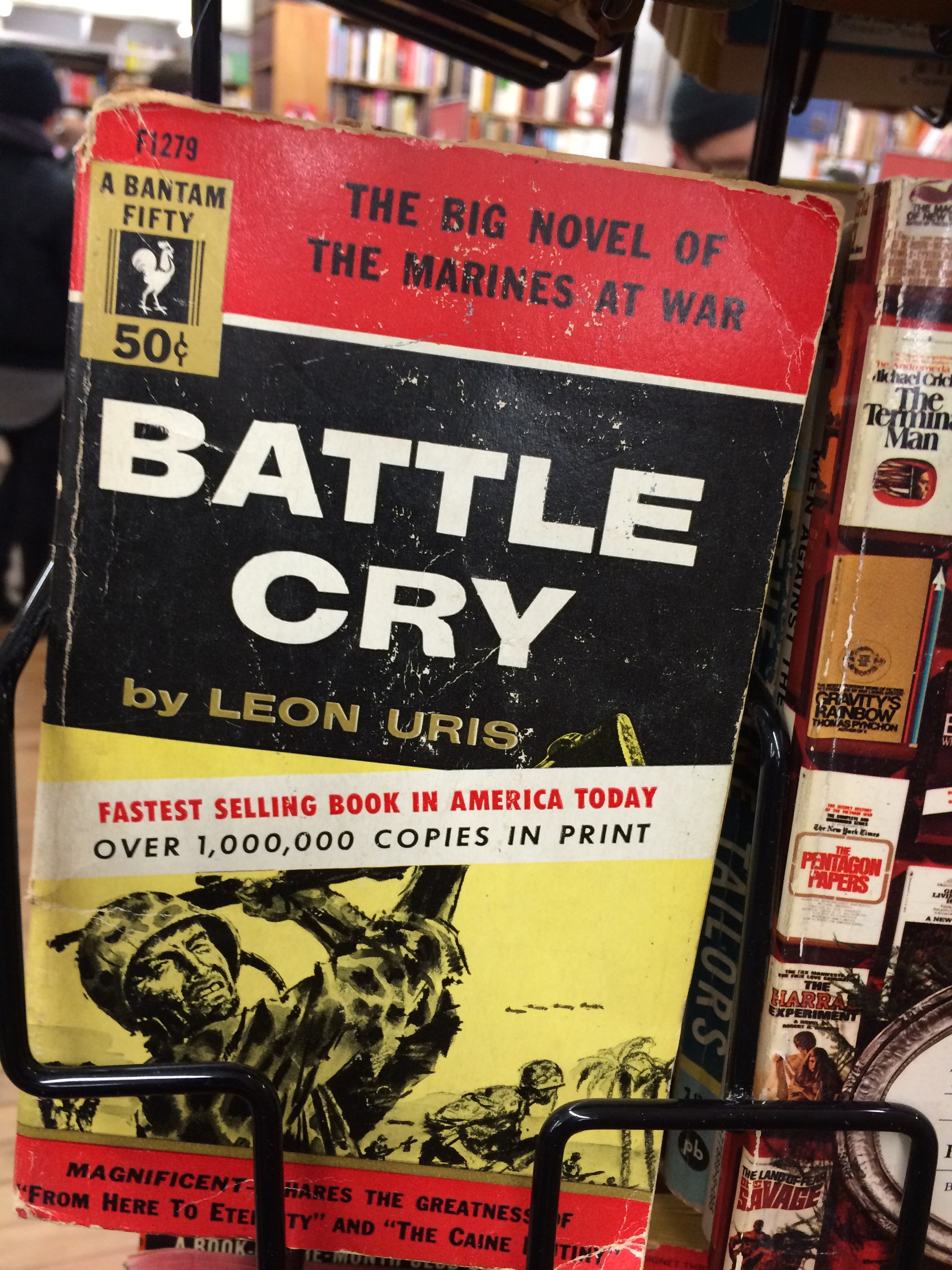
Leon Uris's Battle Cry was a best-seller in 1953. In 1955, it was made into a movie that I loved as a kid.
Leon Uris’s Battle Cry was a best-seller in 1953.
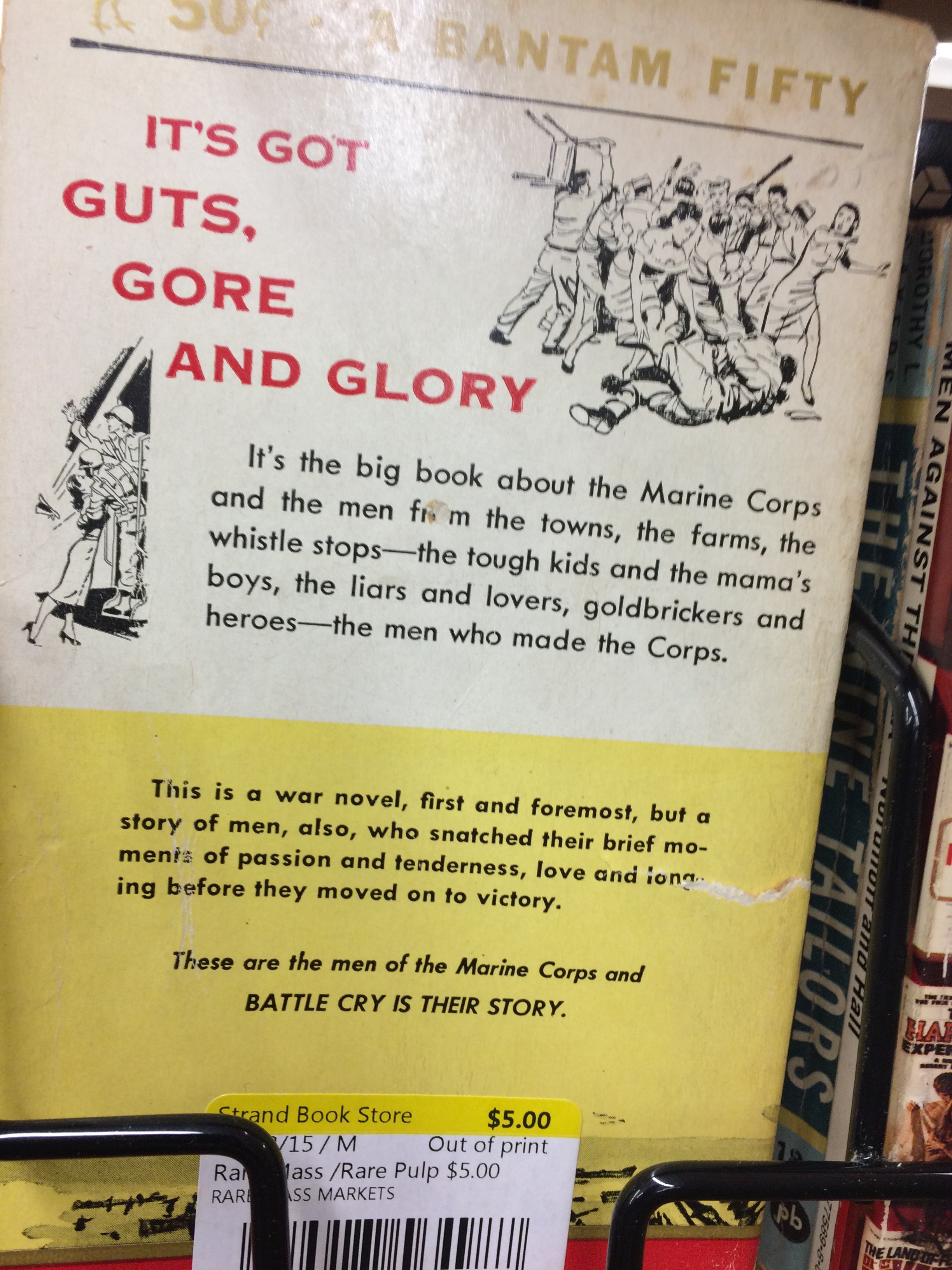
The back cover verbiage offers a fair assessment of what war writers and war writing marketeers thought was important in 1953: men and manliness.
The back cover verbiage offers a fair assessment of what war writing marketeers thought was important in 1953: men and manliness.

“Anxiety of influence” is a phrase associated with literary critic Harold Bloom. It refers to the response of authors to important and beloved precursor authors by writing works that either imitate cherished models or attempt to surpass them. The phrase was on my mind as I composed my spoken comments at our MLA 16 roundtable discussion “Contemporary Literary of the Forever Wars,” which I have excerpted below. Please read them in conjunction with my published remarks about war-writing authored by women at our panel website.

***

“…almost nobody, it seems, remembers Bobbie Ann Mason’s 1985 novel In Country or has seen the 1989 movie based on it. This is curious, because Mason’s novel was critically praised upon publication and reasonably popular (the movie a little bit less so). This is curious because In Country dramatizes issues still very current in today’s body of war fiction: the troubled vet, the problem of homecoming, the difficulty of finding words to convey the experience of war, the vexed dispute over authority and right-to-speak about war, and an already yawning civil-military divide. This is curious, because In Country was authored by a woman and is narrated through the perspective of a young woman named Samantha Hughes, the niece of its troubled Vietnam vet protagonist.

“I don’t know if women or male authors of contemporary war fiction feel the force of Mason’s influence—I haven’t read or heard any of them say so—and I haven’t (yet) done the legwork of tracing the exact lines of connection between Mason and contemporary war writing. I won’t even say much more about Mason here, but rather speculate about the Vietnam War author everybody HAS read and praised: Tim O’Brien, and specifically O’Brien’s short-story ‘How to Tell a True War Story.’ One reason ‘How to Tell a True War Story’ is so popular is because it addresses and dramatizes what have emerged as the driving aesthetic and ethical imperatives of contemporary war writing: its relationship to ‘truth,’ its effort to define what is really important about the experience of war, and its attempt to adjudicate who has the right to decide what is really important about the experience of war.

“Upon rereading ‘How to Tell a True War Story’ recently, however, I came to the conclusion not that the story pronounces definitively on the business of writing about war, but that O’Brien’s narrator—who is quite distinct from O’Brien himself, in my reading–is quite possibly insane, or at least driven to sputtering frustration by his inability to explain exactly how to tell a true war story, or to demonstrate what a true war story really looks like. If I were to read ‘How to Tell a True War Story’ out-loud, I would do so as if it were a nineteenth-century dramatic monologue along the lines of Robert Browning’s ‘My Last Duchess’ or Edgar Allan Poe’s ‘The Cask of Amontillado’—the last thing the narrator is at the end of the story is calm, reasonable, and satisfactorily arrived at an explanation of what a true war story is all about. Its famous last lines, ‘It’s about love and memory. It’s about sorrow. It’s about sisters who never write back and people who never listen’ deserve to be shouted, not patiently explained, with the narrator becoming ever more agitated and inchoate. The surety with which he has begun his tale has evaporated in the face of the difficulty of extrapolating meaning from the anecdotes he relates and the inadequacy of his epigrammatic stabs at profundity.  Statements such as ‘A true war story is never moral’ and ‘True war stories do not generalize’ are not home-truths then, but desperate last-ditch hand-holds on the way to radical incoherence.

“And what about the ‘sisters who never write back’—specifically the ‘dumb cooze’ sister of Curt Lemon—and ‘those people who never listen’? By ‘those people,’ the narrator seems to have in mind the woman of ‘kindly temperament and humane politics’ who approaches him after a reading to express her dismay about the poor water buffalo shot by Rat Kiley. The narrator’s over-the-top anger that the woman has missed the point of his story is decidedly part of his problem getting at the truth of war-story-telling. The narrator’s sense of what that project entails clearly includes women, or more properly put, implicates them: ‘It’s always a woman,’ as he states. Specifically, women are representatives and objects of love, desire, beauty, and sex, though never soldiers or people the narrator respects. They inform war writing’s aesthetic, ethical, rhetorical, ontological, epistemological, and every other kind of -ological structure, but the images of women who don’t write back or listen well suggest that the narrator has trouble figuring how they do so meaningfully. In other words, the problem is his, not Curt Lemon’s sister’s or the well-intentioned woman in the audience. The narrator’s frustratingly incomplete conceptualization of war and war writing, bereft of understanding how women have important roles to play or things to say, stands as a signifying dramatization of the male-dominated and male-centric state of war-writing prior to Iraq and Afghanistan. Today’s cohort of women veterans and women war authors, we can thus understand, are in the process of addressing and rectifying that failure of communication….”

****

In future posts, I’ll sketch a few ways I think the presence of women in significant numbers both in uniform and in the ranks of war writers has changed war-writing. I’m also thinking about ways that masculinity has reconfigured itself in modern war fiction, perhaps beneficially and admirably so, but probably more likely in an effort to re-instantiate its privileges on new contemporary terms. I’m glad to hear from anyone else who also has thoughts on the matter.

Contemporary Literature of the Forever Wars: MLA 2016

Austin-MLA-2016At the recent Modern Language Association (MLA)  conference in Austin, Texas, six of us convened a panel titled “Contemporary Literature of the Forever Wars” to discuss the memoirs, fiction, and poetry of war in Iraq and Afghanistan. Ikram Masmoudi, whose War and Occupation in Iraqi Fiction I recently reviewed, wasn’t able to join us, unfortunately, but Stacey Peebles, Patrick Deer, Roy Scranton, AB Huber, and I reiterated and expanded upon remarks we have posted on our panel website. Our moderator, Aaron DeRosa, offered brief introductory remarks that set the tone for the panel, and, it should be noted that he and Peebles are coediting an upcoming issue of Modern Fiction Studies devoted to Iraq and Afghanistan war literature—the call for papers of which can be found here.

DeRosa had us speak in order of increasingly speculative and conceptual slant, so while Peebles, Deer, and I began by taking mostly backward looks at works already written, Scranton’s and Huber’s concluding comments made provocative challenges to future war writers. Scranton reminded us that war writing, whatever its virtues, owes its existence to war’s victims, a fact depressing enough to contemplate when we’re talking about Americans and even worse when war lit’s triumphs are predicated on the dead bodies of Iraqis and Afghans who neither asked for war nor benefited from it. To make his point, Scranton suggested that Hassan Blasim’s “The Corpse Exhibition,” about an Iraqi virtuoso of artistic war-death, is arguably the most apt war story written to date for how it dramatizes the moral reprehensibility of producing art about killing. In its wake, Scranton warned, less self-conscious war fiction risks naivety and ethical undernourishment.

Huber took the discussion to even more intriguing places. Riffing on the latent implications of “unmanned” in the phrase “unmanned aerial devices,” Huber inquired what it meant for war fiction when its heroes are displaced from the battlefield to drone command centers 1000s of miles away. Speculating that new ways of war, such as drone-fighting, that don’t have men staring death in the face are rendering conventional war fiction, poetry, and memoir obsolete, Huber suggested that modern war has generated new textual forms such as “the leak”: depersonalized, de-narrativized documents stripped of authorial experience and authority and creative origin and which fuzz the borders between official and unofficial. Sporting with one of my own lines, “When the great work about war in Iraq and Afghanistan is written, it will be written by a woman,” Huber suggested that battlefield records placed into public view by Chelsea Manning’s Wikileaks already constituted the exemplary literary artifact of 21st-century war.

Huber’s comments might be considered fanciful by non-academic audiences, but they got the roomful of scholars thinking—exactly the kind of visionary re-imagining of the possibilities of war literature we all hoped the panel would inspire. The body of modern war literature so far produced, centered on the experience of author-combatants, earnestly tries to set the conditions for its understanding. Discerning readers, however, accept neither war writing’s ideas nor its premises as either self-evident or given, and have begun to work it over hard. Once more, I encourage you to read the statements posted on our MLA panel website–they are important first words in the process.

***

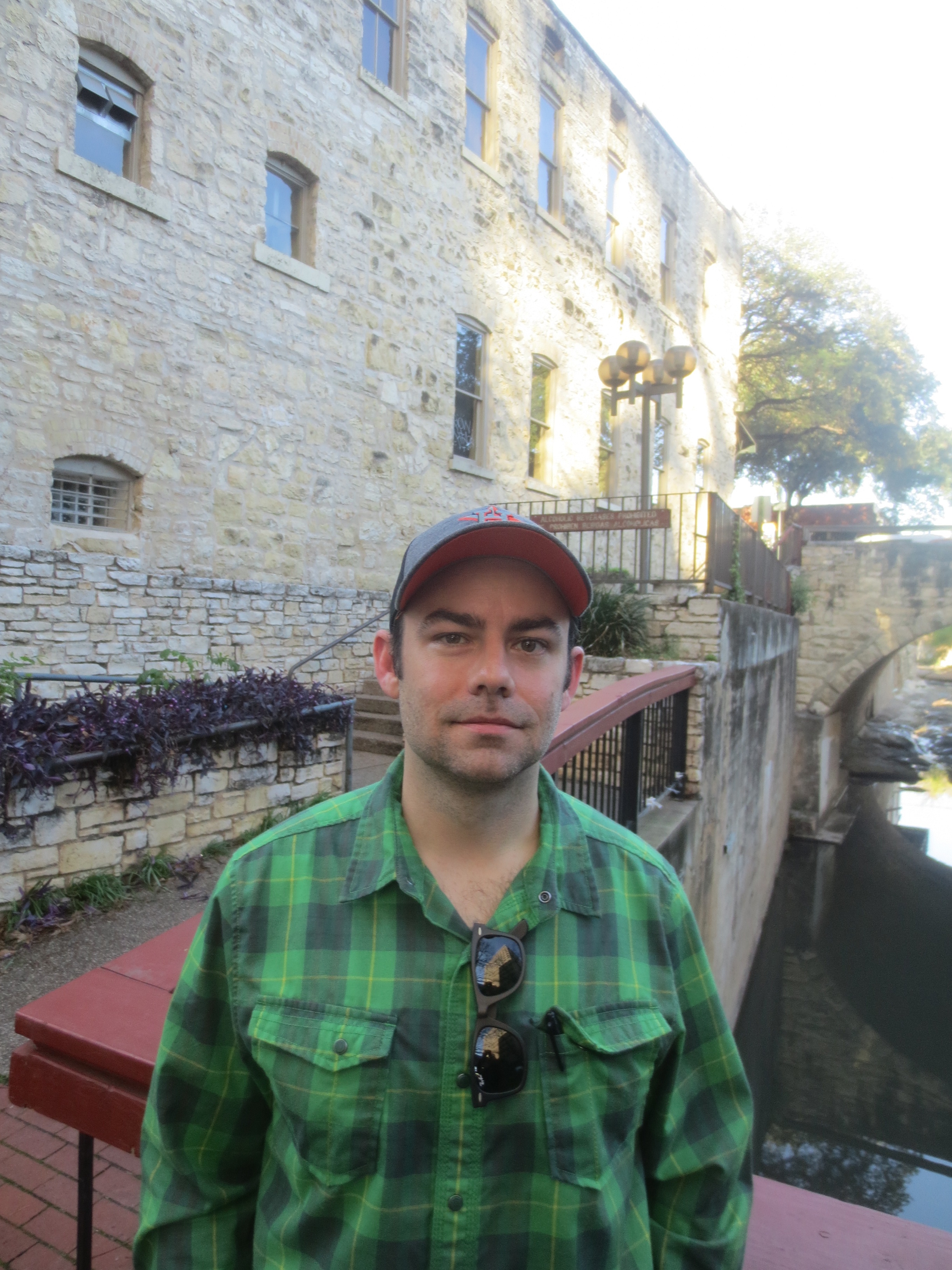
Austin was full of pleasures other than MLA, and a real highlight for me was meeting and having lunch with Brian Van Reet, the author of two of my favorite short stories about war in Iraq, “Big Two-Hearted Hunting Creek” and “Eat the Spoil.” Van Reet’s novel Spoils, he is happy to report, will be out in 2017.

Brian Van Reet, Austin, Texas, January 2016.

The Military Spouse’s Book Reviewed: Andria Williams’ The Longest Night

The Longest NightCongratulations to Andria Williams on the release of her novel The Longest Night this week. A domestic drama cum technological thriller about a military family during the Cold War, The Longest Night displays the same lively, curious, and generous spirit of Williams’ The Military Spouse Book Review, Time Now’s compadre in martial-themed literary blogging. Williams is an alert and appreciative reader of Time Now, thankfully, so my fear upon reading The Longest Night was not that I would dislike it, but that I wouldn’t be able to find ways to write about it in the context of my interest in Iraq and Afghanistan. Broadly considered, however, every novel published after 9/11 reflects and refracts the tension of contemporary war. Those recent novels that make their subjects past conflicts—Toni Morrison’s Home, Karl Marlantes’ Matterhorn, Denis Johnson’s Tree of Smoke, Sara Novic’s Girl at War, for examples—even more directly proffer ways to better understand what it means to be at war now by reminding us of antecedents. Without pushing the point too far or too hard, in The Longest Night, historical displacement—Idaho, 1961—might be said to allow Williams to obliquely address aspects of 21st-century military service, deployment, and war she has observed as a close reader of contemporary war literature and the wife of a several times deployed Navy officer.

The protagonists of The Longest Night are Paul and Natalie Collier, an Army couple with kids who are assigned to an Idaho Falls, Idaho, base dedicated to testing portable military nuclear reactors. Paul is part of a small team of enlisted soldiers responsible for the military’s smallest reactor, a temperamental prototype known as the CR-1. Paul is by-the-book and devoted to duty, which causes him to quickly run afoul of his boss, Master Sergeant Richards, a bitter, semi-functional alcoholic who resents Paul because he is young, hopeful, and dedicated. Paul is all that, but unfortunately, he’s also a bit rigid and unimaginative, which makes things hard for his wife Natalie, a freer-spirit who can accept the strictures of military life and marriage to Paul as long as she’s not reminded, that is to say tempted, by more exciting possibilities. But just as Paul fails to get along with his boss, Natalie’s relationship with Master Sergeant Richards’ wife Jeannie flounders. The social strain grows even more complicated when Master Sergeant Richards connives to have Paul re-assigned temporarily to another nuke site in far-away Greenland; in his absence, Natalie befriends and then loses her heart to Esrom, a dreamy Idaho cowboy-mechanic much more her type in spirit and outlook. To this saga of marital drama, Williams adds the danger of techno-catastrophe: upon Paul’s return to Idaho, the CR-1 undergoes a meltdown, which may or may not be a result of human error. Based on a true event in 1961 in which three men died, Williams’ dramatized version of the incident forces Paul and Master Sergeant Richards, as well as Natalie and Jeanne, to confront their animosity, and Natalie to come to terms with her feelings for Esrom, in the midst of calamity.

The Longest Night reminds us that at the tail-end of the Eisenhower era and the dawn of Kennedy’s New Frontier a small sliver of the populace actively faced the international threat-of-the-day while the vast majority of Americans got on with their lives as obliviously as possible. Even in a nation far more militarized than it is now, Paul and Natalie’s status as an Army family isolates them from native small-town Idaho residents resistant to outsiders and change. Paul’s nuclear silo, located 50 miles from town, resembles the combat outposts oft-portrayed in contemporary war-writing, and Williams better-than-most describes fraught soldierly human interaction in dangerous, isolated conditions. Startling descriptions of enlisted soldiers left responsible for highly-complex nuclear reactors—true historically—reminded me of contemporary military scenarios that have the officer corps preoccupied with strategy and careers while neglecting the worker-bees—to include the Chelsea Mannings, Edward Snowdens, and drone-operators—who actually have their hands on the cyber weaponry and killing machines of our day (though neither treason nor combat are issues in The Longest Night, I should say). Paul’s return home from work every day is certainly not reflective of Iraq and Afghanistan, though the close intertwining of warzone and homefront experiences made possible by today’s modern media makes an analogy conceivable. More saliently, Paul’s short-term deployment to Greenland allows The Longest Night to portray the experience of family separation entirely characteristic of contemporary war. Williams is everywhere all-the-time alert to the difficulty military service places on marriage: Paul does not plan to be a distant, neglectful husband and Natalie has no intention of being tempted by another man, but so it happens in the novel and so it still happens to military couples.

1961 was a time of social conformity, while 2016 prizes individuality, so it’s tricky business retroactively creating characters who inhabit that distant age without being either stereotypes or looking like aliens imported from the future. For me, Paul and Natalie are true to their period: intelligent processors of their perceptions and experiences, but still beholden to the cultural possibilities available to them. They are far more conventional and purposeful than the often reckless and hedonistic enlisted couples I knew while in, but I’ll buy that their propriety–as well as their own form of recklessness–was characteristic of the era. Williams notices what her characters notice, but also much that they don’t understand or only half-intuit; this close attention to their interiority as much as the period detail makes The Longest Night come alive. In many ways, though, the strictures of military service and culture portrayed in The Longest Night might be said to be timeless, for Williams casts a net around military families and military duty and pulls in many fine fish in the way of still relevant insights about life in uniform. Readers who never served or veterans who served only a tour or two can make of Williams’ portrait of military domesticity what they will, but readers who have tried to keep a marriage together over the long haul of a military career will marvel at her acuity at describing the rewards and pleasures, such as they are, while also conveying a more pervasive feeling of disappointment and perhaps even of life wasted. That’s almost too tough a sentiment to contemplate in the present, frankly, so it helps that Williams has framed the possibility in a long ago, far-away place.

Some readers, I suppose, will have trouble with Williams’ kluging of domestic drama and techno-action storylines, but The Longest Night’s suspense-and-surprise-laden plot elevates it above the faux-biography and mundane reportage of much war fiction. Keeping together the complicated mix of ingredients—family drama, military dysfunction, nuclear meltdown, Cold War America, the civil-military divide—is Williams’ power of language. The Longest Night sentences bounce with unexpected word choices, turns-of-phrase, figures-of-speech, and images. Exciting use of free indirect discourse generates finely-shaded judgments in those novelistic spaces between the characters’ thoughts and Williams’ own. Descriptions of nuclear reactor technology never bog down the narrative, and dialogue meant to be charming or funny actually is—tonally, The Longest Night is winsome, but it’s easy to imagine Williams writing comedy. Imagination, insight, and craft are all in fine order, so the saddest thing to report here is that we won’t have the pleasure of reading a review of The Longest Night on The Military Spouse Book Review.

Andria Williams, The Longest Night. Random House, 2016.

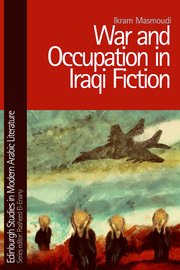
Ikram Masmoudi’s War and Occupation in Iraqi Fiction

Ikram MasmoudiIkram Masmoudi’s most welcome War and Occupation in Iraqi Fiction surveys a remarkable body of fiction that portrays from the inside Iraq’s 30+ year history of war, oppression, invasion, occupation, and sectarian violence beginning with the Iran-Iraq War in 1980. According to Masmoudi, novels authored prior to Saddam Hussein’s overthrow by US forces in 2003 were marked by the Ba’athist regime’s censoring practices, but immediately following 2003 Iraqi authors in numbers uninhibitedly began writing novels that portrayed with critical urgency and imagination both the Iran-Iraq War and the 1991 Gulf War. Very soon, they also began to write novels that depicted the horrendous social turmoil unleashed by American occupation and subsequent sectarian violence. American readers might be somewhat aware of fiction by Hassan Blasim and Sinan Antoon, two expatriate Iraqi authors in the tradition of which Masmoudi writes. Masmoudi touches on both Blasim and Antoon, but the primary focus of her study is a series of mostly-untranslated novels written by authors unable to flee tyrannical power, foreign occupation, and sectarian conflict. Based on Masmoudi’s accounts of these works, one can only hope they are quickly brought into English, for they appear to combine compelling storylines, perceptive insights, and literary craft to a high degree.

War and Occupation in Iraqi Fiction chapters on the novels of the Iran-Iraq War and the Gulf War are full of interest, but of most concern here are two chapters devoted to works set in post-2003 Iraq. In Chapter Three, titled, “Bare Life in ‘New Iraq,’” Masmoudi examines three novels whose protagonists are interpreters working for Americans. The protagonist of each novel begins as a hopeful idealist, mostly secular and not ideologically motivated, and each is brought to ruin by the experience of trying to assist Americans. The protagonist of Shakir Nuri’s The Green Zone (2009) translates for a high-ranking officer in the Coalition Provincial Authority. Appalled by the ignorance and brutality of his American bosses and driven to seek vengeance against them for the death of his wife, Nuri’s protagonist detonates a suicide vest at a Green Zone gathering of CPA and Iraqi leaders. Inaam Kachachi’s The American Granddaughter (2008, with an English translation in 2012) features an Iraqi-American heroine who returns to Iraq to serve as a translator for American forces. Naïve and unassuming at first, she soon realizes that rather than aiding Iraq’s transition to democracy, she is participating in its subjugation to the extent of accompanying US soldiers on raids on the homes of innocent non-combatants. In Baghdad Marlboro (2012), by Najm Wali, an American Gulf War veteran returns to Iraq to seek forgiveness and reconciliation with the families of soldiers he helped kill in 1991. The goodwill quest immediately goes awry; the American is quickly kidnapped and killed and the translator he has retained to help him must flee for his own life from the perpetrators of the murder.

The novels described in Chapter Three of War and Occupation in Iraqi Fiction describe the occupation and individual Americans unflatteringly enough, but do so in the context of a more general Iraqi social deterioration plagued by problems more of Iraq’s own making (though of course connected to the occupation). Fundamentalist, sectarian, and Iraqi criminal violence arguably equal the horrors of American imposition of force for the protagonists of The Green Zone, The American Granddaughter, and Baghdad Marlboro. The novel Masmoudi explores in Chapter Four, however, is much more uncompromising in its indictment of Americans. The chapter, titled “Bare Life in the Camp,” examines at length Shakir Nuri’s The Madmen of Camp Bucca (2012). Nuri here is unsparing in his portrait of the atrocious carceral conditions of the American prison camp named in its title, which housed upwards of 20,000 prisoners in makeshift conditions in a remote desert corner of Iraq. The horrors of Camp Bucca have been amply described in Helen Benedict’s novel Sand Queen (2011), but based on the quotations from The Madmen of Camp Bucca provided by Masmoudi, Benedict didn’t know the half of it. Masmoudi doesn’t offer biographies of the authors she studies, so it’s not clear if Nuri was incarcerated at Camp Bucca (or if he and the other Chapter Three authors worked as interpreters themselves) and thus speaks from first-hand experience. In any case, though, the quoted passages from The Madmen of Camp Bucca are full of damning detail and overlaid with a sense of dismay that the American occupiers are not just brutal, but inept and thoughtless. One passage from Nuri’s novel, for example, takes aim at the ignominy of Camp Bucca being named after a New York City firefighter who gave his life trying to save others at the fall of the Twin Towers:

Oh you, the firefighter whom America committed a crime against, you sacrificed your life to save innocent Americans; America did nothing more than humiliate you by naming after you the worst prison ever in the history of humanity…. Oh my God, does this man deserve to be insulted every day while his soul still hovers above the place of the crime? And to make matters worse, America invited the daughter of this man to visit the camp to bless this quagmire that bears the name of her father.

Camp Bucca has its defenders and apologists–its Wikipedia entry, for example, appears to have been written by a US military public relations team–but those trying to put a shiny face on whatever happened there will be arguing uphill in wake of Nuri’s (and Benedict’s) depiction. But Nuri suggests that a shiny face was never the point of Camp Bucca anyway, as its whole purpose was to inflict humiliation on Muslims equal to the anger felt by Americans about 9/11.  The narrator of The Madmen of Camp Bucca reports:

Every time the guards look at the banner with the name “Bucca” on it, they show their teeth and become even more violent towards us, as if we had exploded the World Trade Center. Cursed is New York who is sending us such people.

Masmoudi resurfaces an interesting statement in this regard by Henry Kissinger found in Bob Woodward’s State of Denial (2006). Woodward writes, “Asked why he had supported the Iraq War, Kissinger replied”:

“Because Afghanistan wasn’t enough” … In the conflict with radical Islam, [Kissinger] said they want to humiliate us. “And we need to humiliate them.” The American response to 9/11 had essentially to be more than proportionate–on a larger scale than simply invading Afghanistan and overthrowing the Taliban. Something else was essential. The Iraq War was essential to send a larger message, “in order to make the point that we are not going to live in the world that they want for us.”

The fiction Masmoudi studies seems perplexed that Iraq’s and America’s national histories have had to have been so intertwined in the first place; from Kissinger’s statement it appears that it was Iraq’s bad luck to be in the way of an angry nation eager to take a swing at it-didn’t-care-who-or-what. Iraqi war fiction takes the measure of individual American soldiers often–many novelists describe their first encounter with actual Americans, as in a passage from The Green Zone: “I did not expect to see them except on a TV screen, and here they were, flesh and blood before my eyes; they never tired of searching us.” Clearly enough the American occupiers are found wanting in most cases, though exceptions occur. Five enlisted Marines in The Green Zone, for example, are portrayed as individuals roughly no worse and no better than one might expect. The dominant response, however, is disappointment: narrators and characters repeatedly report their shock on learning that the military forces that deposed Saddam were not just ignorant of Iraq’s rich history and treacherous social dynamics, not just disdainful of its Islamic religion and culture, and not just arrogant in their belief in their own superiority.

Their biggest problem, one gleans, is that Americans were just lousy at doing what they thought needed doing: untrained, unresourced, without a plan, their on-ground performance wildly out of whack with their vaunted goals, ideals, and standards of competence. To Iraqis, then, the humiliation of being subjugated by boobs adds stinging insult to real injury and abuse. Generous amounts of self-loathing on this count permeate Iraqi war fiction, along with many other forms of guilt and internalized hatred brought about by a sense of ineptitude and helplessness. Iraqi authors use fiction to portray injustice wrought by foreign occupiers, but also to come to terms with their own complicity—both personal and collective—in allowing a proud nation to precipitate its own destruction over the course of thirty torturous years. This complex attitude, sad as it is, enriches and elevates the fiction that documents it and might even be said to account for the body of work. Deprived of all other forms of productive, legitimate, and non-violent citizenship, the authors and characters of Iraqi war fiction resort out of necessity to story-telling to bear witness, call for change, and assert their agency.

Iraq’s post-2003 war fiction, in Masmoudi’s reading of it, privileges the point-of-view of dissidents, deserters, prisoners, suicide bombers, and other marginal figures, to include lowly soldiers given little choice but to obey orders and kill or be killed. Masmoudi sees the Iraqi war fiction corpus as exemplifying the ideas of influential Italian political theorist Giorgio Agamben’s Homo Sacer: Sovereign Power and Bare Life (1998); Agamben terminology such as “homo sacer,” “bare life,” “state of exception,” and “the camp” organizes and deepens Masmoudi’s analysis at many points. Agamben is generally thought to critique Western modes of thought and political organization, so Masmoudi cinches his relevance to the Islamic Middle East milieu of Iraq by linking Agambian notions to post-colonial scholar Achille Mbembe’s concept of “necropolitics”—a social order predicated on technological means of killing—and Frantz Fanon’s analysis of the devastating psychological effects of colonialism on both colonizer and colonized. Lurking behind Agamben, Mdbeme, and Fanon is Michel Foucault’s “biopower”: the exertion of political power through control of the body politic.

These heavy-hitter theorists are handled accessibly and sensibly by Masmoudi; Iraq war fiction titles such as Freedom of the Bagged Heads (Jasim al-Rasif, 2007), The Dead of Baghdad (Jamal Husaya Ali, 2008), Killers (Diya Ali-Khalidi, 2012), The Morgue of Baghdad (Burhan Shawi, 2012), The Corpse Washer (Sinan Antoon, 2010, translated into English in 2013), The Corpse Exhibition (Hassan Blasim, 2013), and Frankenstein in Baghdad (Ahmad Al-Sadawi, 2013) suggest how Mbembe for one is on to something. In any case, Masmoudi’s approach is more thematic than theoretical. We might hope for even more historical and biographical context than she offers. Who are the authors she studies, and are they representative of a large segment of Iraq citizenry or a particularized class of intellectual-artistic dissidents? Were ideologically-motivated Shias and Sunnis publishing fiction? What were the conditions of publication in Iraq during the American years—who was reading, who was publishing, how popular were the works, and what was their influence? What control over media, print, and culture did Americans try to exert (probably none, through either benign or sloppy neglect, but still worth exploring)? Inaam Kachachi, the author of The American Granddaughter, is a woman, but the other authors under examination are men; what else might we learn from fiction written by Iraqi women? Everything Masmoudi offers for consideration is excellent, but leaves me, and hopefully others, wanting more. A logical first step will be the translation into English of all the novels of which she writes.

Ikram Masmoudi is an assistant professor of Arabic Studies at the University of Delaware. War and Occupation in Iraqi Fiction was published in 2015 by Edinburgh University Press as part of its Studies in Modern Arabic Literature series. The translations provided in the passages quoted above are Masmoudi’s.