The First Fast Draw: David Zimmerman’s The Sandbox

The Sandbox, David Zimmerman’s 2010 novel about American soldiers at war in Iraq, didn’t go unnoticed upon publication. It was reviewed in both the New York Times and the Los Angeles Times, for example, and both papers found good things to say about it. The Sandbox has had a quiet afterlife, however: never to my knowledge has it been name-checked approvingly by other war-writers, mentioned alongside other works by fans, critics, and scholars of the war-writing genre, nor considered for Hollywood movie-making. Even after Zimmerman, who teaches in the MFA program at Iowa State, released a second novel featuring an Army soldier, 2012’s Caring is Creepy, his name seems to have barely registered in the contemporary war writing collective awareness, part of which includes Time Now. Ignorant of Zimmerman and his work, I have several times erroneously proclaimed Helen Benedict’s 2011 Sand Queen as “the first Iraq War novel.” But hearing-tell of The Sandbox a year-or-so ago, I kept an eye out for it and recently spotted a copy in my local library. After checking out and reading The Sandbox, I’m happy to make amends for past slights and place Zimmerman’s novel at the forefront of the contemporary war novel tradition, while also rendering praise where praise is due.

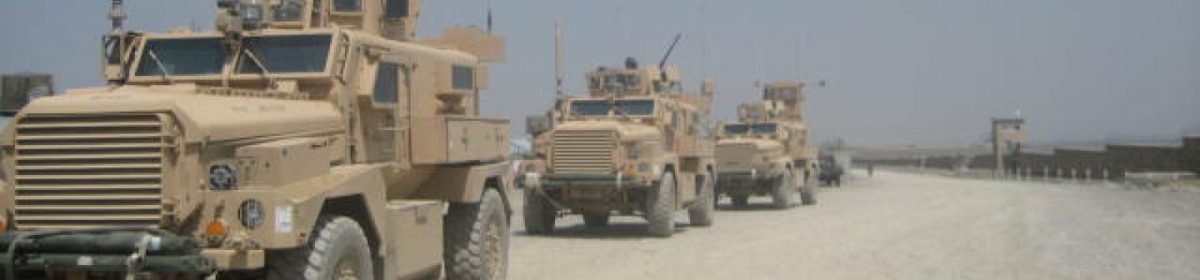
The Sandbox is narrated by a junior enlisted soldier named Toby Durrant, an infantryman assigned to a platoon manning a middle-of-nowhere outpost in Iraq named FOB Cornucopia, or Corn Cob, as the soldiers call it for short. Corn Cob is built upon the ruins of an ancient Iraq fortress and located near an abandoned toy factory, both of which figure heavily in the plot. Though Durrant’s platoon suffers indirect fire attacks within Corn Cob and IED attacks while on patrol, they seem to have no real mission other than maintaining US “presence” in the area. Durrant is popular among his fellow soldiers, save one, Lopez, a by-the-book goody-goody E4-promotable. Lopez suspects that Durrant, who has befriended an Iraqi orphan living alone in the abandoned toy factory, is offering information about US capabilities to local insurgents, and he relays his suspicion to the unit’s lieutenant and platoon sergeant. The platoon leadership, already enormously uptight and remote from the men they lead, are glad to make Durrant a scapegoat for the unit’s tactical setbacks, because, as Durrant begins to sniff out, the lieutenant and sergeant are party to a criminal endeavor, along with a high-ranking general, to abscond with millions of dollars of US reconstruction money they have hidden near the outpost—the real reason for Corn Cob’s continued existence. Also smelling the money is a Military Intelligence captain, assigned by someone somewhere to investigate suspected wrong-doing on Corn Cob, who seems more interested in enriching himself through blackmail or other shady means than recovering stolen money or building a case against corrupt members of the chain-of-command. Somehow also involved is a shifty Iraqi named Ahmed, who works on the base as a mechanic and as Durrant’s companion on frequent shit-burning details, which also figure significantly in the plot. Ahmed seems to know a lot about things above his pay-grade and to have ingratiated himself with the FOB leadership, and he accesses Corn Cob through a secret door in the perimeter wall that only he knows about, but exactly who he is and what his motivation is goes unexplained.

Durrant must make sense of all this—really, try to survive it–from his disadvantageous position in the lower ranks, while trying to save the Iraqi child he has befriended, and at the same time dealing with being dumped by his fiancé, who also informs him that she is aborting the child of Durrant’s she is carrying. Durrant is likeable in a snarly, snarky way that seems true to the way many junior soldiers are in life and almost all of them are in war fiction—his combination of smarts and attitude is very much the voice of “Joe,” the “E4 Mafia,” and the “Terminal Lance” found in Matthew Hefti’s A Hard and Heavy Thing, Brandon Caro’s Old Silk Road, and Maximillian Uriarte’s The White Donkey, as well as Lieutenant Black’s in John Renehan’s The Valley: young white male soldiers turned contemptuously anti-authoritarian by the incompetence and hypocrisy of their chains-of-command. Durrant’s thoughts about things are not complex—I would have liked to have seen more psychological exposition of how it feels to be a soldier who learns that his own unit leadership not only thinks he is a traitor but wants him dead—but Zimmerman excels at depicting Durrant in conversation with other characters, in terms of crafting naturalistic dialogue that both drives forward the plot and allows the minor characters’ personalities to emerge. In particular, Durrant’s friendship with his best friend, a black guy named Rankin, his cagey discussions with the MI captain, and, most of all the Dear John letter he receives from his fiancé, along with a subsequent phone conversation, are all very well done. Zimmerman also does well with physical depictions of soldier life and combat and, MFA instructor that he is, prolifically generates intriguing metaphors and similes:

“The sky is the color of a nicotine-stained finger.”

“…he’s already about as popular as a wet fart.”

“The wind smells like unwashed hair.”

“His shadow looms on the wall behind him like a dark, unhappy doppelganger.”

Pretty good, that last one, but to return to the plot–a secret door in the perimeter wall, really? Also not helping things are screwed-up military details, such as references to soldiers shining boots—I don’t think that ever happened in Iraq, where from the beginning soldiers were issued suede desert boots that didn’t require polish—and to “Kiowa” helicopters that are said to transport passengers and which feature door gunners—uh, no. Even more exasperating is the novel’s end, which resolves nothing: the last few pages describe an enormous battle, but ends in medias res, as if Zimmerman ran out of time or ideas to bring it to a more satisfactory close. We don’t learn, for example, how or if Durrant survives to write the novel, for example, or if the MI captain, the lieutenant, the platoon sergeant, Ahmed, or the Iraqi orphan live or die, let alone if one of them gets away with the loot. Many critics of Iraq and Afghanistan war fiction have hypothesized that never-ending nature of the wars have made narrative closure in books and films about them difficult; the coitus interruptus conclusion of The Sandbox might serve as Example 1 of the problem. If The Sandbox had an artier, edgier feel, such an ambiguous, indeterminate finale might have worked, or if it were a little more integrated with the storytelling ethos—in the manner of the famous last shot of the movie Butch Cassidy and the Sundance Kid where the Paul Newman and Robert Redford characters are frozen in place as they charge into a hail of lawmen’s bullets—it also might have succeeded, but that’s not the case here.

Assessing the strengths and weakness of The Sandbox, the sub-headline for the LA Times review states, “The dialogue and description of the troops’ plight are realistic. But the conspiracy they get caught up in is absurd.” That’s spot-on, but to end on a positive note, Zimmerman gets a lot of things right while being the first to confront the major obstacle with which war writers afterwards would continually struggle, namely, devising a realistic and compelling plot commensurate with their belief that the lives of soldiers deployed to Iraq and Afghanistan are worthy of novel-length portraiture. Recasting the story of a soldier at war as a search for riches recalls movies such as Three Kings and Kelly’s Heroes, while previewing Aaron Gwyn’s later novel Wynne’s War, while the idea that a war story might also be a police procedural foreshadows novels-to-come such as The Valley and Matt Gallagher’s Youngblood. Centering the action on a remote FOB brings to mind Joydeep Roy-Bhattacharya’s The Watch, and Zimmerman’s many excellent depictions of vehicle operations anticipate Michael Pitre’s Fives-and-Twenty-Fives. In addition, many scenes described in The Sandbox—IED explosions, shit-burning details, sandstorms, memorial services, and scorpion fights, for just a few examples—would pepper the pages of future war fiction.

In a 2010 interview, Zimmerman offered an intriguing glimpse of the war-writing business as he tried to find a publisher for The Sandbox. After finishing his novel in 2007, he faced a series of rejections and requests to radically revise it before Soho finally accepted it for publication. “…at that point,’’ he states, “Iraq movies were doing terribly and almost all of the [rejection] letters mentioned that. They said, ‘Nobody’s going to buy any books about Iraq right now from the fiction standpoint.'” Zimmerman did what he had to do to break the impasse, and if the results were not perfect, he established patterns and first depicted scenes that the writers after him cannot claim to have devised, but only tried to better.

David Zimmerman, The Sandbox.  Soho, 2010.

War Films: Billy Lynn’s Long Halftime Walk and War Machine

I wish the movies Billy Lynn’s Long Halftime Walk and War Machine were better than they are, but after watching both  several times, it’s hard to argue with the mixed reviews and lukewarm popular reception each earned upon release. Defeating hope that Hollywood might compellingly portray the wars in Iraq and Afghanistan in ways that bite hard politically and psychologically, both squander the potential of their print sources and the talent of their proven actors and filmmakers.

In the case of Billy Lynn’s Long Halftime Walk, the Ang Lee-directed movie version of Ben Fountain’s National Book Award-winning novel just plays flat. The beauty of Fountain’s novel about a misbegotten effort to honor the members of an infantry squad at a Dallas Cowboys game lay in its ingenious imagining of the multiple ways the infantrymen, known as the Bravos, exposed a modern America desperately looking for heroes at the same time it has divorced itself from real investment in the wars that might generate them. The allures of big money, big time sports, military idolatry, Hollywood fame, evangelical salvation, and conservative talk radio that consume the citizenry gathered to watch the Cowboys and fete the Bravos quickly reveal their shallowness when bumped up against the Bravos’, and particularly Billy’s, skepticism toward everything that lies beyond the realm of their shared warfighting experience. Holding things together in the novel are Fountain’s stylistic pyrotechnics, which supercharged even the most mundane physical descriptions while giving crazed articulation to Billy’s muddled misgivings. Driving everything forward was a very basic set of questions that generated suspense as the game clock ticked: Would the Bravos make fools of themselves in the halftime ceremony? Would Billy and his cheerleader crush Faison find a way to be together? Would Billy succumb to the pleas of his peacenik sister and a hippie preacher and refuse to return to Iraq? Would the film deal that a big shot Hollywood producer named Albert is trying to put together come to fruition?

Unfortunately, little of this works in the movie, the slackness of which renders the trenchant social critique and human drama of the novel pointless, disconnected, and tedious. The first couple of scenes, which introduce Billy and the Bravos, their military escort Major Mac, Albert, and Dallas Cowboys PR factotum “Pussy Boy Josh” while setting up the basic premises of the Bravos’ battlefield heroics and their arrival at Cowboys Stadium for a Thanksgiving Day orgy of congratulations and celebration, are OK, but just OK. Within minutes of the somewhat-promising start, however, scenes begin to fizzle, storylines start to slog, and soon the actors, and Lee, too, seem to have lost interest in the movie they are making, and the viewing experience becomes a slow grind to the end. Why exactly this is so, and whether it need be so, is a good question. To my mind, many scenes, such as those featuring Billy’s sister (played by Kristen Stewart), and especially the final showdown involving Billy, his squad leader Staff Sergeant Dime (Garrett Hedlund), Albert (Chris Tucker), and Cowboys owner Norm (Steve Martin) over the proposed movie deal, could have been better staged and more vibrantly acted. A.O. Scott, in an otherwise favorable New York Times review, writes that Billy Lynn feels “more like a filmed play than an adapted novel” and that “the acting has a studied, stagy quality.” I agree, but am not as forgiving as Scott; honestly, some of the scenes have the turgid, blocky quality of 70s and 80s TV dramas such as Mannix and Vega$, shows featuring lunky and ponderous men taking turns delivering very serious lines.

Perhaps, though, something deeper, maybe even structural, drains the movie’s energy. The hole at the center of it all might be Billy himself: sweet and something of an idiot savant, he is also passive and inarticulate—though the formula worked for Forrest Gump, it’s not exactly what you want as the star of a movie that strives to be a blockbuster. Joe Alwyn looks great as Billy Lynn, and God Bless Billy I hope he gets to sleep with Faison as soon as possible and then lives happily ever after with her, but still…. The book strives to make us think that Billy’s battlefield heroics have some connection to his integrity and sound sensibility, as does the movie, but the movie struggles more than the book to make us feel his nobility to the same degree that the other characters do. It’s not hard to imagine Billy ten years on living a low-key life much like that of the protagonist of another recent film: the Adam Driver character in the indie movie Paterson—a former Marine now loved by a woman better-looking than he seemingly deserves, a good man basically, but otherwise so cowed by the complexity of life—in particular his own past life–that he determines to keep everything as simple, as routine, and as repetitive as possible. This is all by the way of suggesting that Fountain’s novel, despite the stylistic razzmatazz and the glitzy trappings of the NFL and Destiny’s Child, is at heart another quiet, minor-key portrait of a brooding combat veteran—a hard act to pull off in Hollywood and an even harder sell in American cineplexes.

In the failure of Billy to establish himself as the dynamic center of the film, Staff Sergeant Dime and Billy’s squadmates takes precedence, with multiple scenes showing them baiting well-meaning Cowboys fans, and the film’s climax consists of several long-winded speeches by Dime defending the Bravos against the manipulation and exploitation of Norm and Albert. But something goes awry with Lee’s effort to consolidate virtue and honor on behalf of Billy and the Bravos. Without Fountain’s wise contextualizing of the Bravos’ hard-earned integrity, their aggressive irritability comes off as more problematic than justifiable or admirable, and eventually one’s sympathy starts shifting toward the subjects of their taunts and accusations, and one begins to wonder why the Bravos don’t just take the damn film deal, no matter the terms—like, who wouldn’t? In so doing, the film inadvertently flips the novel’s perspective on the civil-military divide: rather than demonstrating an American populace out of touch with its warrior class, Ang’s movie suggests that military men such as the Bravos have withdrawn into a self-protective sense of their own superiority they defend by lashing out at civilians they consider lame, which is almost all of them.

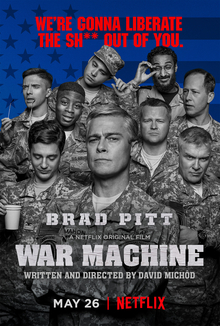
War Machine, directed by David Michod and starring Brad Pitt as Glen McMahon, a four-star general based on General Stanley McChrystal, has its own interesting relationship to its source material, its own troubled effort to organize a compelling movie around its central character, and its own interesting take on the civil-military divide. Where Joe Alwyn and the rest of the Bravo junior enlisted soldiers in Billy Lynn’s Long Halftime Walk are well-cast as 19-year-old infantrymen, Brad Pitt—far from his Tyler Durden fighting trim–is too doughy to play a convincing McChrystal, a lean, mean running machine if ever there was one. As any YouTube video of McChrystal illustrates, McChrystal epitomizes the Civil-War-reenactor gauntness of the highly-driven modern infantry officer; Michael Hastings in The Operators, the book War Machine fancifully adapts, describes McChrystal as resembling Christian Bale, and based on what I know of very gaunt Bale, I’d say hell yea, that would work.

Pitt and Michod, however, seem torn between realistic and parodic portrayal of McChrystal—McMahon comes off as a cross between George C. Scott’s portrait of General George Patton in Patton (loud, profane, complex, and admirable) and George C. Scott’s General Buck Turgidson character in Dr. Strangelove (loud, profane, stupid, and reprehensible), leaving the audience to figure out whether McMahon is a larger-than-life, charismatic warrior-leader-intellectual or a buffoon, a fool who doesn’t know that he is a fool. A voiceover (which we learn halfway through the movie is the Hastings character’s) alludes to McChrystal’s cerebral approach toward modern war and his ability to organize “systems” to defeat enemies, but in scene-after-scene, as portrayed by Pitt, General McMahon comes off as neither a Patton or a genius, but a dunce who over-explains things to people who know better as if they were 5th-graders. Similarly, McChrystal was notorious for gleaning information from seized cell phones and laptops, and the intel-and-targeting processes he pioneered in Iraq were highly digitized, but a running joke in War Machine is that General McMahon is an old school low-tech throwback who gets flustered by the challenge of hooking up his computer.

Which would be OK, if Michod and Pitt were playing everything for laughs, as the attached advertising poster implies, but it’s clear that they are not, or not always. Pitt’s over-the-top performance is so bizarre as to short-circuit War Machine’s thematic interest in documenting the failure of military “COIN,” or Counterinsurgency, strategy in Afghanistan, of which McChrystal is portrayed as a primary proponent. The way Pitt’s characterization makes the most sense is that Michod and Pitt make McChrystal ridiculous to reinforce the point that COIN was a foolish and doomed strategy. One of the interesting aspects about The Operators is Hastings’ own working out of his feelings toward McChrystal. Initially charmed, then intrigued, and finally appalled by McChrystal and his inner circle’s insouciant trash-talking, he comes to see them as evil, disloyal, and reprehensible in light of what he perceives as the failure of McChrystal’s leadership in Afghanistan as commander-in-chief there. In Hastings’ telling, it’s not smearing the President and the French while on a three-day binge in Europe that is McChrystal’s worst crime (to say nothing of his cover-ups of the Abu Ghraib and Pat Tillman fiascos), it’s his promotion of COIN, a strategy that was hated by both Afghans and the US troops who had to implement it. In Hasting’s view, McChrystal is neither a hero nor a joke, but something worse: tangible evidence that one of America’s leading general lives in a bubble comprised of arrogant sycophants deeply hostile to civilian leadership and out of touch with the troops they lead and the people of the country they are nominally helping, men who purvey dubious strategies that might prolong war forever, but never win it.

Michod and Pitt appear to get all that, but torn between parody and biopic, War Machine reduces Hasting’s argumentative edge and subtler portraiture to Saturday Night Live-levels of characterization, and for some reason—given its basic contempt for McChrystal–spins the story to be one of McChrystal’s redemption through an epiphany that the troops in the field hate his COIN strategy and his subsequent avowal at movie’s end to reshape war goals to brutal extermination of the enemy: “Give ‘em hell, boys. Kill those motherfuckers. Eat them alive,” General McMahon tells a group of special operators preparing for a mission. McChrystal, according to Hastings, never publicly renounced COIN strategy, for what it’s worth, but OK, the movie’s allowed to take some liberties to hammer home the point that COIN sucks. Still, more interesting and important aspects of Hastings’ book and the larger saga of McChrystal’s rise-and-fall are left unexamined. The ethics of the McChrystal staff’s shit-talking their civilian leadership, for example, are barely raised, nor are the ethics of Hastings reporting of what might be defended as late night beer-talk among fighting men used to bluntly speaking their minds. Though War Machine portrays at length General McMahon’s staff, it does so for comic and cinematic effect, as if to fill the screen with the type of jazzed-up fast-talkers who populate movies such as The Wolf of Wall Street, The Big Short, and War Dogs. Michod makes little effort to link McMahon’s staff to corresponding members of McChrystal’s real staff, which might have been a useful way to comment artistically on real historical figures, and he seems to validate the staff’s self-perceptions that they are colorful, tell-it-like-it-is swashbucklers—like grown men still acting like the Bravos in Billy Lynn–not drunken yes-men who naively sabotage their boss’s career, as Hastings ultimately concludes them to be.

So, we’re left with a movie about a foolish man who tries to implement a foolish strategy, but which hints that it might have been about a talented man who tries to implement a flawed strategy under difficult circumstances, and is done in by hubris and the men he trusted most. For the record, I don’t think either The Operators or War Machine has it quite right. Hastings glosses over McChrystal’s effort to bring Joint Special Operations Command operations in Afghanistan to their Iraq-like levels of targeted-killing refinement, and so too does War Machine, save for General McMahon’s final exhortation to the special operations team. McChrystal’s investment in COIN was always inch-deep lip-service, and his real interest in Afghanistan, as it was in Iraq, was organizing special operators—SEALS, Delta Force, SAS, Green Berets, and Ranger Task Forces—for dark-side raids to kill or capture high-value targets. From that perspective, anything that involved mollifying Afghans or establishing a framework that made the war understandable to line troops (such as the Bravos) was a cover for missions launched by special operations bubbas after the sun went down—pain-in-the-ass elements of the job that McChrystal took upon himself so others wouldn’t have to. The movie about McChrystal I would like to see, then, would be a much tauter tracing, sans satire, of his transformation (with the help of Admiral William McRaven) of Joint Special Operations Command into the real 21st century “war machine.” Sort of what Zero-Dark-Thirty might have been, if Katherine Bigelow had not made her subject a Global War on Terror side-show organization such as the Central Intelligence Agency and her protagonist a low-ranks bit player like the Jessica Chastain character.

Oh well, the issue is not what films I would have made, but that two recent big-time productions fail on their own terms to be the best movies they might be. With seven years of service in infantry battalions, two years on general officer staffs, and a year in Afghanistan while McChrystal was in charge there, I was eager to see how Hollywood portrayed life in the ranks and at the top of the command pyramid. Perhaps, though, all that has made me too picky: Why in one scene in Billy Lynn’s Long Halftime Walk is Staff Sergeant Dime wearing an Expert Infantryman’s Badge and in another a Combat Infantryman’s Badge? Why in the battle scene are the Bravos firing their M4s on full automatic, a capability most issue M4s don’t have? Watching War Machine, I noted that the representation of overstuffed, high-tech command posts stuffed with computer terminals and big screens seemed a little thin compared to the upper-echelon headquarters I had peeps of.

But ultra-realistic verisimilitude is not the ground on which the two movies struggle most, or something I really care much about. I’m beginning to think that it is beyond Hollywood to make movies contemptuous of war in Iraq or Afghanistan that are both critical and popular successes—with the lack of popularity easier to understand than the failure of so many talented people to successfully stitch together story, character, cinematography, and point-of-view in entertaining, insightful, and aesthetically pleasing ways. Legendary French filmmaker Jean Renoir purportedly said that all war-writing is inherently anti-war, while all war movies inevitably glamorize war. Whether Renoir’s statement is true factually or logically, the most captivating and best-made movies about Iraq and Afghanistan, such as American Sniper and Lone Survivor, are ones that portray soldiers unambiguously proud of their identities and devoted to their missions and that represent battlefield courage and skill without irony or ridicule.

Ben Fountain’s take on Ang Lee’s adaptation of his novel can be found here.

A positive review of War Machine that focuses on Brad Pitt’s performance, from the Village Voice here.

Another positive review of War Machine, from Task and Purpose, that focuses on its portrayal of COIN here.

A negative review of War Machine, from The Atlantic here.

Thanks to Andria Williams for pointing out that the Adam Driver character in Paterson, named Paterson, is a former Marine–a fact revealed only by a quick shot of a bedside portrait. Driver himself, as has been well-documented, is a former Marine who besides achieving acting success has promoted the cause of veterans arts in many forms and venues.

Time Now Fiction: Captains Dietz and Avis

Apollo and Daphne, by Francesco Albini, circa 1615-1620.

This story, titled “Captains Dietz and Avis,” is based on Ovid’s retelling of the Daphne and Apollo myth.  It is the third or maybe fourth and last myth I’ve written and posted that adapt Ovid’s The Metamorphosis in ways relevant to America’s 21st-century wars.  It can also be read as a companion piece to my last blog post, about 2017’s flurry of women-authored and women-centric war-writing.

****

Captain Avis, male, married, had been at the FOB for three months when Captain Dietz, female, also married, but not to Captain Avis, arrived. One of the other new arrivals reported that Captain Dietz had been in tears on the helicopter ride in. She never expected to end up so far downrange, and now she faced a year apart from her husband, who was stationed on another FOB elsewhere in Afghanistan. Captain Avis had helped calm Captain Dietz down, speaking to her kindly, helping get her stuff to her quarters, and taking her to the dining facility for her first meal there. All seemed good, but not really, because everyone could tell Captain Dietz was already being a little too solicitous. “Be wary of the guy who just wants to be your friend,” was the by-word for the women on the camp, because it always turned out such men wanted more than friendship. Truth-be-told, within the admonishment was the hint that the women themselves might not trust their own desires and defenses as their year downrange unfolded. Better to hang with the other women, the wisdom was, or the cohort of men and women with whom you arrived, or the men and women who worked in your immediate vicinity.

In this case, though, it didn’t help that Captain Avis and Captain Dietz were both signal officers assigned to the commo shop, which meant they were together roughly 18 hours a day. At first it didn’t look so bad, as Captain Avis showed her the ropes and Captain Dietz loosened up. Soon, she was volunteering for missions outside the wire and had made many friends among the other soldiers across the camp. But then things got worse. It began when insurgents targeted the camp with accurate mortar and rocket fire, which put everyone on edge and made restful sleep difficult. Then one of the most popular soldiers on camp was killed by an IED. As the war’s dangers overtook the camp, everyone’s mood tightened and Captain Dietz especially began to go downhill. First her good cheer vanished and then she began dropping weight. She didn’t say anything to anyone about Captain Avis, but she asked the commander about reassignment to her husband’s FOB, or to be allowed to go visit him. That couldn’t happen, though, and Captain Avis continued to hover about her, only now it clearly didn’t seem healthy, or even appropriate. He was always with her and in a way, such as when they ate alone together in the dining facility, that made it seem that others weren’t welcome to join them. Everyone could see that he was always talking to her and that she wasn’t enjoying it.

After three steadily deteriorating weeks, Captain Dietz collapsed from exhaustion and strain. It wasn’t just the combat. Captain Avis had told her that he was divorcing his wife and that he now considered Captain Dietz his confidante, or even his soulmate, possibly his destiny. He wanted her to leave her spouse, too, so they could be together. He explained how he felt they had bonded under the stress of combat and that their shared experience in Afghanistan would serve as the basis for their future together. Captain Dietz tried unsuccessfully to hold Captain Avis at arm’s length, but it didn’t work and no one interceded to help. She never let Captain Avis touch her, but instead of getting the message that she wasn’t interested, Captain Avis took her rejection as a sign that Captain Dietz was really meant for him. Captain Dietz missed her husband terribly and blamed Captain Avis, not the war, for ruining her deployment. After passing out on the way from her hootch to the laundry facility, Captain Dietz spent three days in the Troop Medical Clinic. Then she was transferred to another FOB, where she served out her tour without any real work to do. She killed time listlessly in her hootch, marking off days on the calendar nailed to the plywood partition in the women’s bay and emailing and chatting with her husband. When her husband sent Captain Avis’s commander photocopies of the love-struck laments Captain Avis had posted on his Facebook page that were clearly directed at Captain Dietz, the commander used them as the basis for a letter of reprimand to be placed in Captain Avis’s file. Captain Avis protested that it was all a misunderstanding and that he and Captain Dietz were just friends, but the commander ordered Captain Avis to never contact Captain Dietz again and to cut out the crazy Facebook postings.

Summer of 17: Women Fighting and Writing

A scene from Bullet Catchers, currently running in New York.

“All wars are boyish and fought by boys,” wrote Herman Melville a long time ago, but it’s hard not to notice all the women-authored and women-centric war-writing that has appeared in the summer of 2017. Much of the new work has taken the shape of memoir and journalism, but new fiction and theater also contribute to the feel that something different and exciting is happening. Some of the new work is by “First Wave” women war writers such as Siobhan Fallon and Helen Benedict–familiar names in the war-writing scene–but appearing also are many new writers–a “Second Wave”–describing subjects and representing perspectives previously unheard or overlooked. The new work is appearing in print or being performed on stage, but online venues seem to be the medium of choice for publication and discussion of this up-to-the-moment phenomenon. Much credit goes to a highly motivated-and-resourced new organization called The War Horse, of which a profile of founder Thomas Brennan can be found here. The War Horse in particular has taken upon itself to promote writing by women-veterans, and even more specifically a War Horse writing workshop that took place in New York City in April, led by David Chrisinger, though not limited to women, has been enormously generative of first-person narratives detailing aspects of life in uniform for women in all its variety and implication. Some examples include:

“Learning to Breathe Through the Journey of Addiction and PTSD,” by Army veteran Jenny Pacanowski.

“Drown Proofing, Khaki Shorts. Some Things About Dive School Don’t Change,” by Coast Guard veteran Tenley Lozano.

“Circumstances, Fortunes, or Misfortunes, by USMC veteran Teresa Fazio.

The titles of Pacanowski’s and Lozano’s pieces preview their intriguing storylines; Fazio’s title doesn’t give her story away so readily, but the article describes the author’s post-service trip to India to find meaning in the Sikh tradition of Prasad. Fazio’s not the only female vet with a spiritual bent, either; another War Horse seminar participant (and my former central New Jersey neighbor), Army veteran Supriya Venkatesan, describes her own search for tranquility through Transcendental Meditation in an article titled “I Lived in a Town Where Everyone Meditated Together. Every Day.” Venkatesan already has a list of non-war-related publishing credits as long as your arm on exotic subjects such as bio-hacking, eco-sex, and home-birth, fyi for all aspiring vet-writers searching to break out of rigid identification as a mil-and-war writer. 

In the articles I’ve posted, Pacanowski, Lozano, Fazio, and Venkatesan don’t directly address military sexism and toxic military masculinity, but awareness of the difficulty of being a woman in uniform underwrites the ethos and worldview of their writing. Not coincidentally, The War Horse broke the story of the Marine Corps photo-sharing scandal early in 2017—Thomas Brennan’s post-Marine career began as an investigative journalist. Fellow ex-Marine Elliot Ackerman, the author of the novels Green on Blue and Dark at the Crossing, profiled Brennan this summer in a telling piece for Esquire titled “Inside the Nude Photo Scandal That Rocked the Marine Corps”—the despair of two proud Marines as they confront the easily-held misogyny of fellow male Marines is palpable. Appearing at almost the same time as Ackerman’s piece was Andria Williams’ story “The List,” a fictional dramatization of a photo-sharing scandal involving two Air Force officers, published on Afghan Post author Adrian Bonenberger’s The Wrath-Bearing Tree web journal. Williams, whose blog The Military Spouse Book Review has long tracked women’s war writing and military family issues, notes that she presciently first drafted her story in 2013, but filed it away thinking it too far-fetched. Little did she know…. the one-two punch of Ackerman’s article and Williams’ story reinforces the impression that the military’s ability to satisfactorily resolve its gender and sexual harassment/sexual abuse issues anytime soon and without outside help is slim, but if identifying the problem is the first step to a solution, then the authors have done their part.

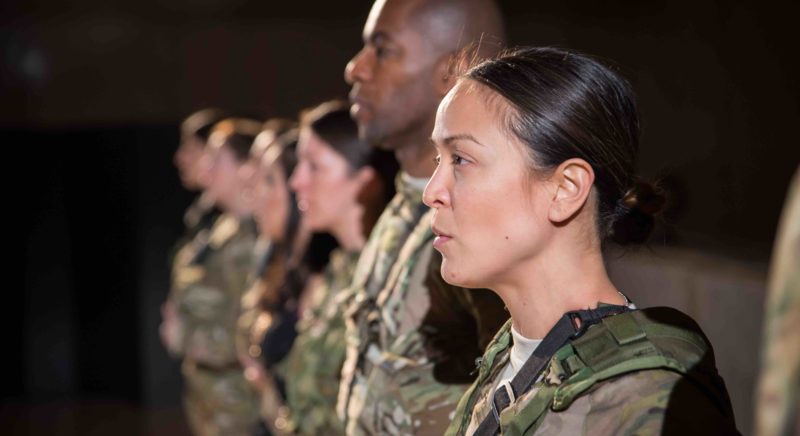
The battle goes on on other fronts, too. On stage, a new play called Bullet Catchers, currently running in New York City, portrays life in an Army unit through the perspective of the women who occupy leadership positions, as well those who serve in the ranks. Bullet Catchers has already elicited at least two shrewd reviews from wise observers of the passing scene: Bullet Catchers: Women’s Modern Warfare” by Rachel Kambury posted on the New York City Veterans Alliance website and “A Plausible Reality by Teresa Fazio, written for Consequence magazine.

Finally (though I’m bound to be forgetting something significant), are the appearance of four books in 2017 by First Wave contemporary war-writing women authors. Already out are Elyse Fenton’s volume of verse Sweet Insurgent and Siobhan Fallon’s novel The Confusion of Languages and soon to come are poet Jehanne Dubrow’s Dots & Dashes and novelist Helen Benedict’s Wolf Season. And finally finally, just published is long-time editor of the Veterans Writing Project journal 0-Dark-Thirty editor Jerri Bell’s and Tracy Crow’s anthology It’s My Country Too: Women’s Military Stories from the American Revolution to AfghanistanIt’s My Country Too’s historical perspective reminds us that the current perfect storm of First and Second Wave women’s war-writing didn’t appear brand new spun out of whole cloth. Not to push things back to 1776, as Bell and Crow do, but to a more-recent 2016, important precedents began appearing last year when anthologies such as Retire the Colors, edited by Dario DiBattista, and The Road Ahead, edited by Adrian Bonenberger and Brian Castner, offered robust mixtures of powerful stories by both men and women veterans.

So what to make of it all? The first step, it seems to me, is recognizing, respecting, and encouraging the development. The second step is assessing what women’s war-writing has to tell us, both about life-in-uniform for women and masculine traditions and conventions of war-writing. Third, preparing for the backlash, which will inevitably come in the form of sneers about “the feminization of war-writing” and efforts to reestablish its manly basis. Fourth, ever-more precisely disentangling current notions about military culture, war-winning, and fighting ability from their unproductive entwinement with accepted cultural ideas about manhood and patriarchy, so that the military becomes a better place for all Americans to serve, rather than being a big boy’s club, and applies itself more effectively to winning wars, rather than being an endless employment and get-rich opportunity for flag-wavers, war addicts, mercenaries, and profiteers.