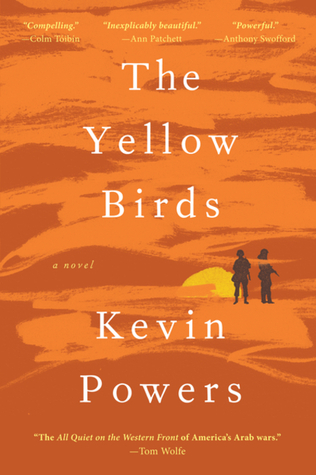
James River Blues: Kevin Powers’ The Yellow Birds

The Yellow Birds CoverKevin Powers’ acclaimed The Yellow Birds features many scenes set in Iraq, Germany, and Fort Dix, New Jersey. The latter locale intrigues me, for I served two years at that backwater post and it pleases me to see it made central in an important contemporary war novel. But being from Virginia myself I’m most attracted by the great portions of The Yellow Birds that take place in the Old Dominion. John Bartle, Powers’ distressed narrator, resides across the James River from Richmond before enlisting and just after completing his service, and he ends the novel living in a remote cabin tucked under a western Virginia mountain. The novel’s geography resonates with my own biography. For eight years, I lived with the James River a straight half-mile shot through the woods behind my house and all-in-all I spent the first 22 years of my life in Virginia. In Afghanistan I served alongside members of the Virginia National Guard, which gave me further understanding of the descendants of Virginian plantation gentry and small farm yeomen. All this would be irrelevant if I didn’t in fact detect a certain Virginia-ness permeating The Yellow Birds, a quality that makes it what it is and as effective as it is, a quality rooted in Virginia geography, history, and culture. Let me see if I can explain.

Frank Hobbs,
Frank Hobbs, “Condominium Construction on the James Riverfront, Richmond, VA”

To be a Virginian is first to be a product of the soft and beautiful landscape and climate of the Tidewater, Piedmont, Blue Ridge Mountains, Shenandoah Valley, and the Appalachians, all of it connected by the state’s languid rivers, the most significant of which is the James. Virginia’s gentle terrain and weather seem to conspire to make it physically and psychically hard to get or stay angry. Such natural tonic is corroborated by the impossibly high standards for gentlemanly comportment and achievement set by icons such as Washington, Jefferson, and Lee. To this day, I have trouble imagining a Virginian perpetrating a truly vicious or hurtful act. Even as they are confused by or ignorant of their proud aristocratic tradition, most find it absolutely painful to say no to anyone or not lend a helping hand where needed. To say that such deference makes them wildly vulnerable in the face of a world that is a lot more conniving and harsh than they are is an understatement, which is part of John Bartle’s problem in The Yellow Birds. In all this I speak mostly of white Virginians, for consideration of the state’s tortured history of race relations and its African-American demographic seriously undercut idealization of its white patrician elders while infusing the calm landscape with blood and fire. We can think first of Sally Hemings–desire and denial–and Nat Turner–rebellion and suppression–and then wonder about the contemporary athletic prowess of ferociously competitive African-American Virginia sportsmen such as basketballers Moses Malone and Allen Iverson and football players Lawrence Taylor, Bruce Smith and Michael Vick.  Do they represent a modern instantiation of Virginia’s genteel white and gritty black social bifurcation and commingling?

These factors seep into the works of Virginia artists as diverse as Edgar Allan Poe and Patsy Cline and help make them thoroughly unique and rich. Poe and Cline, the sweetest of souls, seemingly doomed to die young, their art works melancholy to the core, tinged everywhere by loss and yearning, haunted by fear and desperation, and deeply wise about pain that comes from within and without. That’s heady company in which to place Powers, and time will tell if the comparison holds up, but it represents a way to begin to understand the lyric morbidity of The Yellow Birds. To my mind, John Bartle’s effort to make sense of his tangled life and deployment is a particularly Virginian response, knowingly sketched by its author, who was raised and went to college in Richmond.

Frank Hobbs,
Frank Hobbs, “South Richmond (Richmond, VA)”

The novel’s subject is the loss of innocence completely and irredeemably; its title is taken from a military cadence that tells of a “yellow bird with a yellow bill” whose head is smashed “upon my windowsill.” Like Poe’s raven, the doomed canaries represent an idea that torments narrator John Bartle as he recounts the story of his criminal complicity in a war crime and his subsequent deterioration during and after his deployment to Iraq as an infantryman. Bartle’s story is not as much about his encounter with military culture and combat as it is about the intense relationship with two fellow soldiers who imbue his service with color and significance. Murph is a younger enlisted soldier, also from Virginia, whom Bartle vows, foolishly as it turns out, to protect. Sterling is Bartle and Murph’s platoon sergeant, a stone-cold veteran of several deployments whose rough love envelops his subordinates even as it hastens them toward their destruction. Bartle’s name is an obvious nod to Herman Melville’s famous Bartleby, the scrivener who “prefers not to” do what his boss asks of him. Bartleby’s passive-aggressive non-compliance is a result of spirit-draining stint working in the US Mail’s dead letter office, and letters figure prominently in The Yellow Birds, but Powers’ Bartle is brought to a state of numbed withdrawal from life after a series of events vastly more horrific and consequential than those experienced by Melville’s scrivener. Compared to Bartle, Bartleby’s choice to opt out is a far greater act of agency and free will than anything manifested by Bartle, who seems dragged through life by circumstance, chance, the will of others, and the mishaps that ensue anytime he tries to act purposefully. Actually interested in trying to please others, he learns, if anything, that doing so negates his own individuality and resourcefulness, while mostly screwing things up for his intended beneficiaries.

Many reviews of The Yellow Birds point to its opening lines as evidence of Power’s stylistic pitch:

The war tried to kill us in the spring. As grass greened the plains of Nineveh and the weather warmed, we patrolled the low-slung hills beyond the cities and towns. We moved over them and through the tall grass on faith, kneading paths into the windswept growth like pioneers. While we slept, the war rubbed its thousand ribs against the ground in prayer.

Such prose is not sedate, but in comparison to the jazzed-up language of Ben Fountain’s Billy Lynn’s Long Halftime Walk and David Abrams’ Fobbit—both full of laugh-out-loud figures of speech and one-line zingers—The Yellow Birds is slower, more contemplative, more lyrical. No character is ridiculed, and military and political ethics and purposes are not scorned. Even descriptions of combat and the characters’ rough military speech are rendered in a heightened literary register that conveys brooding seriousness and intense artistic imagining. The cumulative effect is to suggest that the catastrophic events that lead to the death of many of the novel’s characters and Bartle’s deterioration are akin to a slow-moving car wreck. Murph in fact uses that analogy to explain combat:

“It’s like a car accident. You know? The instant between knowing that it’s gonna happen and actually slamming into the other car Feels pretty helpless actually, like you’ve been riding along same as always, then it’s there staring you in the face and you don’t have the power to do shit about it And know it. Death, or whatever, it’s either coming or it’s not …. Like that split second in the car wreck, except for here it can last for goddamn days.”

These sentiments make a mockery of heroism, or any kind of human free will. They recast soldiers as inert entities to whom things happen. By the end of The Yellow Birds, Murph dies, Sergeant Sterling dies, and so do several minor characters. Bartle lives on and tries to feel ordinary again, but does so only by severely reducing the scope of his world: “I don’t want to look out over the earth as it unfurls itself toward the horizon. I don’t want desert and I don’t want plains. I don’t want anything unbroken. I’d rather look out at mountains. Or to have my view obstructed by a group of trees.” “James River Blues,” a terrific song by Old Crow Medicine Show, a band with deep Virginia roots, helps explain Bartle’s state-of-mind:

On the cool flow
Floatin’ down, down below
The bridge to the water’s edge
From the ridge to the ledge
From the hills to the sea
I’ll become a memory

Ensconced back within the Virginian landscape Bartle waits his own vanquishing. His journey beyond the state borders has been a disaster; his personal saga mirrors the downward historical trajectory of the Commonwealth; his character flaws those of his people. Bartle’s catastrophe could be any soldier’s, or that of the nation’s, but that it is a Virginian’s makes it that much more distinctive and poignant.

Frank Hobbs,
Frank Hobbs, “Sycamores and Green Bridge, Richmond, VA”

Kevin Powers, The Yellow Birds. Little, Brown, and Company (2012).

Frank Hobbs’ art by permission of the painter.

This post is dedicated to Sergeant First Class Kevin Dupont, a member of the Massachusetts National Guard who died of wounds suffered in 2009 while attached to a Virginia National Guard advisor team assigned to Camp Clark, Khowst Province, Afghanistan.

UPDATE September 13, 2015:  RIP today Moses Malone, mentioned here-in, a Virginia high school basketball prodigy and later an NBA MVP–one of the heroes of my youth.

War Fact or Fiction: Brian Van Reet on the “Kill Memoir”

Aftermath of a suicide bombing, Khowst Province, Afghanistan, 12 May 2009.
Aftermath of a suicide bombing, Khowst Province, Afghanistan.

Iraq vet and author Brian Van Reet’s recent essay in the New York Times, called A Problematic Genre, the ‘Kill Memoir,'” lambastes memoirs written by veterans who take pride in the number of enemy they killed in combat. He mentions as an extreme example Carnivore, written by an Army vet whose publicist claimed the author had killed in combat 2,746 Iraqis. Van Reet likens the Carnivore author to a sergeant in his own unit who embarrassed everyone by bragging about the number of Iraqi casualties he tallied. That this sergeant intended to get a tattoo commemorating each of them amplified and clarified his foolishness. That his credibility was suspect made matters worse. Clearly, the guy was fighting the war according to a script of his own devising, one that had him not playing a dutiful soldier or conventional hero or leader, but a hardened bad-ass killer.

Truth to tell, though, such dreams lurked close to the surface in many of the infantrymen and special forces types I saw in Afghanistan, me included. A rational approach to war is expressed by an 82nd Airborne Division platoon leader speaking of his feelings prior to going into action in the Persian Gulf War: “You’re feeling really excited about going to play in the big game, and horrified and scared out of your mind that you have to play the big game at the same time.” Horrified of what? “That you could get killed. And you get asked to do things tha you really don’t want to do. I don’t know many serial killers in the Army. Most people just really prefer not to have to kill anyone if they don’t have to” (Quoted in Nancy Sherman’s Stoic Warriors).

But lots of new personnel and units arrive in theater infected by desire to see combat.  An infantry captain is quoted in the current issue of Army magazine: “Every blue-blooded infantryman who deploys wants to get into a fight.  We want to plan and execute offensive operations.  We want to close with and destroy the enemy.  We want to take charge and be in charge.” It was barely use talking to such soldiers of counterinsurgency and nation-building and key leader meetings and training and advising when they were out of their minds to see what it was like to shoot at someone and be shot at in return. Once they had seen combat (and survived) they might settle down and be good for more commonplace things. But often their initial survival, if not success, whetted their appetites, and now that they had “got some,” they desired even more. Like the author of Carnivore, they turned war into a competitive game of testosterone-fueled one-upsmanship, clothing their blood-lust and thrill-seeking in the justifications of duty and necessity. Such attitudes were unseemly and most did their best to keep them dampened down.  But not all felt this way. Some guys just seemed so determined to, as the saying goes, “get their war on.” And not all were ridiculed or scorned. In the hierarchy of soldiering, hardened killers could accrue enormous social capital. Where fear and confusion reigned, they offered toughness and purpose, of a kind. Operating insidiously within and sometimes overtly against the chain-of-command, they used their rank and stature to make the war all about kill-or-be-killed.

It’s no wonder such soldiers’ memoirs sell, as Van Reet realizes, but still he castigates a publishing industry that cravenly vends sensational war memoirs to a fawning reading public. Such fare glorifies the killing it describes, and thus perpetuates war rather than doing anything to end it. But even if kill memoir authors position themselves as self-effacing and introspective, their books are still shaky vehicles for the delivery of truth. The problem lies in the form as much as the sentiments. Memoir, Van Reet reminds us, is such a self-aggrandizing, unreliable, and stereotyped genre that it might be the last place, not the first, we would go to for factual detail or insight about what it means to kill in combat.

Van Reet instead touts the supremacy of fiction over “fact” and in particular literary novels such as David Abrams’ Fobbit and Kevin Powers’ The Yellow Birds. “Though they are fictional,” he writes, “they read in my mind, like more accurate depictions of the totality of what happened in Iraq than any of the supposedly factual accounts I have mentioned.” I’ll second that, and throw in, as does Van Reet later in the essay, Ben Fountain’s Billy Lynn’s Long Halftime Walk as a third novel that, taken with the other two, make 2012 the annus mirabilis of Iraq war fiction. Indeed, each of the novels, in its way, examine the relationship of a softer, more sensitive soldier who comes under the sway of a much more decisive, hardened, experienced soldier at home with the business and psychology of killing. Among the novels’ other achievements, they use the tools of fiction—perspective, irony, empathy, style, tone—to interrogate the attitudes toward combat and killing described above and presented naively and self-servingly in memoirs and histories. Usually, they find such pronouncements swaddled in layers of self-deception and self-justification, and they convey sympathy for characters who at least struggle toward awareness and growth.

But as impressive as Abrams’, Powers’, and Fountain’s novels may be, they are, as we speak, still a feeble countervailing force in a publishing environment characterized by what Van Reet calls “the triumph of the kill memoir.” Van Reet closes by issuing a challenge to veteran writers, other authors interested in war, the publishing industry, and by implication, reading audiences:  we can all do better. I’ll second that, too.

War Art: Michael Figueroa

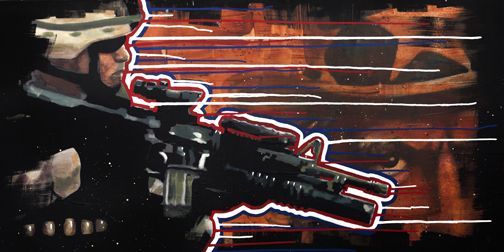
"No Slack"
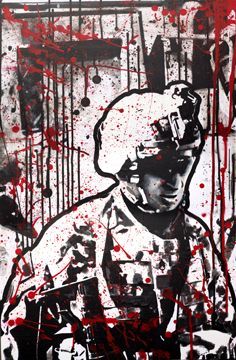
“No Slack”

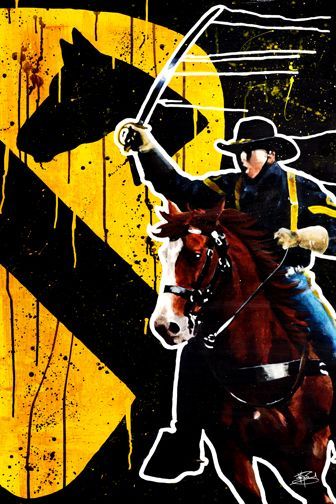
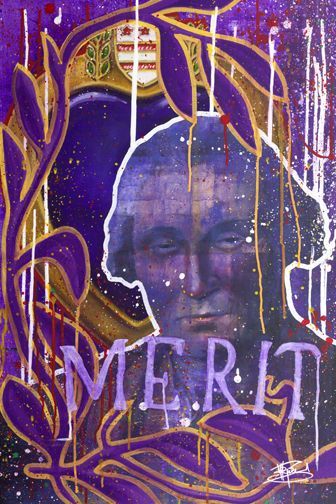
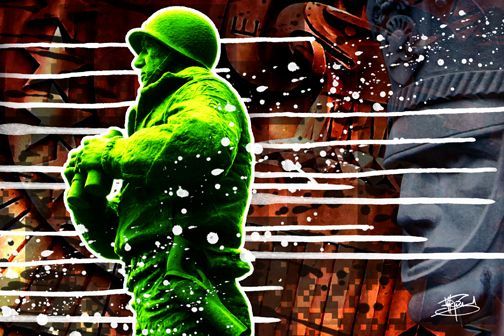
Michael Figueroa is a great example of a contemporary war artist who follows the aesthetic impulse to “make it new.” A US Army vet now living in the greater Chicago area, Figueroa never deployed while in the service, but nonetheless his paint-and-image collages have an of-the-moment quality about war and soldiering I find very appealing.  In fact, his ability to turn the material matter of military life into vision-inspired art is quite incredible. Traditional and typical war art seems interested in realistic representation of combat scenes and emphasizes either heroism or war’s horror.  Often the values and politics are pretty obvious. Figueroa takes familiar military images and iconography and spins them and mixes them and makes them bleed and sweat.  Neither heroic nor horrific, neither ironic nor naive, his artworks exude an in-between spirit that is half-troubling, half-exhilarating.  I love them.

Figueroa studied at the American Academy of Art in Chicago.  His website can be found here and his art can be purchased here.  He has sometimes exhibited in conjunction with Graffiti of War, an organization dedicated to showcasing soldier art for the benefit of veterans.  Below are more samples of Figueroa’s work.

"The First Team"
“The First Team”

If I had ever served in the 1st  Cavalry Division, I definitely would purchase this print.

"MERIT for heart"
“MERIT for heart”

Figueroa’s inspiration for this picture is the inscription on the backside of the Purple Heart:   “For Military Merit.”

"Son of Sam"
“Son of Sam”

The title refers to famous pictures of Uncle Sam, but also brings to mind the 1970s mass-murderer David Berkowitz, who, as it happens, was in my Army unit in South Korea a decade or so before I arrived.

"Duty Honor Country"
“Duty Honor Country”

The inspiration here was a visit to West Point.

All photos used with permission of the artist.

A War Music Sampler: Country, Folk, Hip-Hop

Marine Corps Iraq vet Jimmie Rose tore it up on America’s Got Talent the other night.  Pure country from the coalfields of Kentucky–“Four days after high school graduation, I went underground” he puts it–Rose sang a song that didn’t mention the war, but in the accompanying interview he related that he joined the Marines because it couldn’t possibly be more dangerous than work in the mines.  Here’s to him, for he’s got a charming “aw shucks” demeanor and a voice to die for.  His song, “Coal Keeps the Lights On,” won’t win any kudos from eco-warriors, but amply illustrates the perspective of a demographic that doesn’t have the luxury of picking-and-choosing its means of making a living.


Country is the music of choice for huge swaths of the American military and acoustic guitars by the thousands manage to survive the rigors of travel to help country-loving soldiers while away their deployments.  A good example is the following video by Zac Charles, filmed live from a FOB in Paktika Province, Afghanistan.  It’s called “Until I Get Home.”

Neither Rose’s nor Charles’ politics are confrontational, but other vets use their music to channel their misgivings about the war, express the pain of their service, and plea for the cause of wounded and damaged fellow soldiers.  A good example is Jason Moon’s “Trying to Find My Way Home”:

Some ex-soldiers put their military experience as far in the rear-view mirror as they possibly can.  The music they make betrays few traces of their past lives in the military and overseas.  Emily Yates, for example, after six years in the Army and two tours in Iraq, moved to San Francisco, hippy-fied herself, and now has filled up YouTube with music videos extolling the greatness of marijuana.  We’ll pass on those and post one that actually does have her looking back:  her rendition of the 3rd Infantry Division’s great fight song “Dogface Soldier,” done here in an anti-war mode:

After a lifetime of music listening, I can probably name five songs combined by Tupac, Biggie, Jay-Z, and Kanye.  That’s nothing to be proud of, but I don’t feel like I’m actually all that unknowing about hip-hop music and culture.  That’s because on all my deployments, I’ve been witness to many amazing freestyle spoken-word battles among young (mostly) black soldiers and played plenty of basketball in makeshift gyms with the throbbing beats and ominous lyrical flow of the inner city musical idiom blasting over the sound system.  An example of how hip-hop permeates the everyday life of deployed soldiers can be found in the video below.  Hip-hop artist Chamillionaire on a tour of Iraq invites Specialist “Rap” Myers to join him in an impromptu performance in a FOB gym or morale, welfare, and recreation center:

The ex-soldier I know of making the most determined effort to turn his deployment experience into a hip-hop career is Soldier Hard.  Here’s his most watched video on YouTube, “Combat Veteran.”

To all the soldiers who are also music-makers:  Don’t stop.

War Songs: Jason Everman

In the midst of my series on Iraq and Afghanistan war-related music comes this great New York Times article about Jason Everman, who had short stints in Nirvana and Soundgarden before joining the Army as an infantryman. Both Ranger and Special Forces-qualified, Everman got out in 2006 after combat in both Afghanistan and Iraq. He then enrolled at Columbia and recently graduated with a BA in philosophy.

So, while I was looking for music performed in theater or upon a veteran’s return, I learn of a veteran-musician who did his serious music-making before he joined and deployed. Everman wasn’t with Nirvana and Soundgarden at their peak, but he certainly contributed to those magnificent bands’ on-stage crunch in their early years and more than brushed shoulders with the creative talents who were his bandmates. Like millions, I was tremendously impressed by the great Seattle grunge groups. They shaped the taste and consciousness of many of us who later went to war, for better or worse, and of many of those who didn’t go to war but now wonder about what it all meant. And so it’s cool that one of them bridged the gap between the music-makers and we who took the music forward with us in life.

The part of the Times story that got me most recounted Everman’s mounting resolution to join the Army while living in San Francisco in 1994. As his bandmates slept, Everman was rising early to work out and get ready. Boy, did that trigger memories of living in the East Bay town of Albany after finishing grad school. I used to knock out pushups and pull-ups by myself in a local park while preparing for my own infantry odyssey. I was 26 when I first started thinking about joining, and actually signed up a year or two later. Everman was 26 when he joined, as was Colby Buzzell, whom I wrote about a couple of weeks ago, and who was also from the Bay Area and who also dreamed of being a grunt.

So what is it about the infantry that entices not-so-young-anymore men into giving it all up in the name of adventure and service to the nation?

And what is it about Northern California? Brian Turner’s from Fresno, not so far away from San Francisco, and he too joined the infantry at a late age. Thinking about it further, Matt Gallagher, not an infantryman but a cav scout, which is close enough, is from Sacramento, just up I-80 from the Bay. Something in the air there just must easily get in the bones of dreamy young men craving challenge and purpose. Maybe it’s as Ishmael in Moby-Dick says: “Here goes for a cool, collected dive at death and destruction, and the devil fetch the hindmost.”

And then these dreamy young men who go off to war want to write about their experiences. Or, in the case of Jason Everman, hopefully, will write about them. But if he doesn’t, no problem, because he has already had a chance to say his say and he used it well. Something tells me that soldier-authors such as Turner, Buzzell, and Gallagher probably know just about every song Nirvana and Soundgarden ever recorded. That includes those from the early years when Everman was helping them become, as the Army slogan puts it, “all that they could be.” We are, to a large degree, the music that is important to us, so thanks, Jason Everman, just thanks.

Happy 4th of July everybody.

War Songs: Daniel Somers

While researching music made by service members in Iraq and Afghanistan and veterans upon their return, I learned of the death by suicide two weeks ago of Daniel Somers. Somers was an Army intelligence analyst who after two tours in Iraq settled in Phoenix and began making music as part of an arty post-rock outfit named Lisa Savidge. On the band’s Facebook page, Somers is given credit for “vocals, rhythm guitar, studio mastermind.” Lisa Savidge never broke out of the Arizona indie music scene, but exploring their music on YouTube and elsewhere on the web reveals a band with a distinctive vision and sound. Think, maybe, The National overlaid with Explosions in the Sky-like guitars. So, pretty esoteric stuff, not for the masses, but I like it, and the band is tight and the recording immaculate. Two examples will illustrate:

Appalachachas lyrics are obscure, but some band literature reports they are about the drudgery of touring. The video, which makes use of the Cold War documentary “The Challenge of Ideas,” suggests that the song’s interest is nationalist ideology and militarism. Either way, it is gorgeous.

Fire Exiting, according to Lisa Savidge’s Facebook page, is about the “aftermath of war.”

Which brings us to the long suicide note left by Somers, large portions of which can be found in this Phoenix New Times obituary written by Melissa Fossum. The note castigates the military for first taking him to war and then abandoning him afterwards as he slid into abject physical and mental pain. Fossum writes sympathetically, in part based on her understanding of Lisa Savidge’s interest and importance. In another Phoenix New Times article published two years ago, Fossum and Somers together advanced a claim for how contemporary indie rock informed and defined the Iraq conflict:

Musically, the Vietnam War era is remembered through “All Along the Watch Tower,” “American Woman,” “War Pigs,” and Hot Rocks-era Rolling Stones — the sort of heavily bluesified rock songs you’ll hear in Platoon and Full Metal Jacket. Odd as it may seem, future generations may think Operation Iraqi Freedom sounds like Franz Ferdinand, The White Stripes, and Modest Mouse.

 At least to Dan Somers, lead singer and guitarist for Phoenix indie band Lisa Savidge, who did two tours of duty in Iraq.

“We were literally rolling around lacing people up with a machine gun blasting The Killers’ Hot Fuss,” he says.

Yes, “Mr. Brightside” and all. The irony of fighting a war while indie rock songs like “All These Things That I’ve Done” (“I’ve gooot soul but I’m nooot a sooooldier”) play in the background is not lost on Somers.

“I admit that that’s a little bizarre, but that’s what it was. I hadn’t really gotten introduced to indie rock before that, so suddenly it became this part of my life in the most bizarre circumstances imaginable.”

Indie rock, to include a healthy helping of The Killers, was the soundtrack to my deployment, too, and I’m interested in how and why such music and the war connect.  But Somers’ taste and mine weren’t everyone’s, and in future posts, I’ll describe an Iraq and Afghanistan war musical landscape that also includes country, hip-hop, metal, and whatever else I can find. I also won’t miss a chance to explore the music about the war made by Iraqis and Afghans. But for now let’s pay tribute to a soldier-musician for whom the propulsive beats, edgy vocals, and chiming guitars of modern rock were the best way to make sense of what he had seen, who he had become, and where he wanted to go.

RIP Daniel Somers, survived by his wife Angeline. I wish things had been better for you and thank you for your service and music.

UPDATE: A 23 August 2013 Washington Post article on Daniel Somers

Daniel Somers
Daniel Somers

War Songs: Mike Doughty

Happy 5th Anniversary of my redeployment from Afghanistan. I’m pinning this post back to the top because it’s the one I associate most with the day of my return, 8 November 2009.  Read on, and you’ll see why.

All soldiers go to war with an Ipod or smartphone full of music with which they while away the long hours of the movement into theater and into which they retreat to block out the boredom and misery of deployment.  Vulnerable to the shameless emotionalism of pop songs in a way they may not be in the States, deployed soldiers are seared by poignant expressions of longing and loss, and made exuberant by celebrations of love and life.  Pink Floyd’s “Wish You Were Here,” overplayed to the point of banality on classic rock stations, brought me to my knees when played at a fallen soldier’s memorial service in Afghanistan.  But even the most trite song, experienced under the conditions of deployment, accrues intensity.  A good example is in the following video, which features Linkin Park’s “Waiting for the End,” a song by a rap-rock band I normally wouldn’t pay much attention to other than in conjunction with this video.  But the video features the cheerleaders of my beloved Washington Redskins visiting FOBs in Kuwait and Afghanistan, some of which I recognize.  The combination of those familiar landscapes, homely scenes of FOB life, and—what?—all that out-of-place feminine beauty?–jacks up my appreciation of the song, while the song makes my memories of deployment more vivid.

Washington Redskins Cheerleaders in Afghanistan/”Waiting for the End” by Linkin Park

The following video of Air Force personnel performing a stunning version of Adele’s “Rolling in the Deep” does not make me nostalgic, however. Instead it recreates the power of music within the deployment experience.  The brown t-shirts, reflective safety belts, and plywood backdrop add the realistic touches that cinch within the heart the song’s expression of irrecoverable loss, which is a huge emotional component of deployment. The power of the performance is clearly related to the intensity of being so far from home.

Cover of Adele’s “Rolling in the Deep”

Turning to music that specifically addresses the war, the record is uneven and not very clear.  On opposite poles of the political spectrum are Toby Keith’s “Courtesy of the Red, White, and Blue” and John Fogerty’s “I Can’t Take It No More.”  Both Keith and Fogerty are fine singers, and all props to Keith for his support of the troops and to Fogerty for being a US Army veteran and also for writing and singing the great Vietnam anti-war song “Fortunate Son.” But here, Fogerty’s lefty screed and Keith’s uber-patriotism are both unsubtle to the max and their sentiments are enveloped in formulaic song structures and sounds.  Much more interesting to me is Mike Doughty’s “Fort Hood,” named after an Army base that is not mentioned in a song that only obliquely refers to the war:

Mike Doughty’s “Fort Hood”

The lyrics go:

I’d rather watch movie stars get fat
I’d rather hang up the flag and be done with it
I’d rather keep the frenzy and the fire out of my mind

I’d rather take sides in an argument
I’d rather crank up the bass in a dark basement
I’d rather leave the mobs and the murder in a distant land

Let the sunshine in

My vote’s a bed and a football pool
Five on the red and six on the blue
Wake up, fool, this is no time for a shouting match

I smell blood and there’s no blood around
Blanked out eyes and the blanked out sound
See them coming back motionless in an airport lounge

Let the sunshine in

You should be getting stoned with a prom dress girl
You should still believe in an endless world
You should be blasting Young Jeezy in a parking lot

Let the sunshine in

In a blog post titled “So What’s Fort Hood About? Doughty explains:

I want to be really clear about this. I’ve gotten emails from soldiers who dig it, but I want to make it totally explicit what the song means.

The first verse is about guilt. That I can go about my daily life without thinking of the violence and the fear in Iraq, and the sacrifice people are making over there.

The first part of the second verse is about frustration with political pissing matches, instead of unity among our elected representatives to serve these guys. The second half is about how the war haunts me; how I see dudes in uniform in airports and wonder what’s going on in their heads, what they’ve witnessed.

The bridge is about lost innocence. Young guys that go over there and come back scarred–bodily, often, but also psychologically, that so many of them will have the burden of post-traumatic stress disorder, nightmares, haunting images.

I wrote the song basically out of two experiences; I went to Walter Reed last year, met some guys who had lost limbs, and came out scared and grateful. And I grew up an Army brat in the 70s, when many of the adult males around me were in Vietnam, and there was lots of strange behavior that I now recognize as PTSD.

Fort Hood is the base in Texas that’s lost the most people in Iraq and Afghanistan.

OK, cool.  In November 2009, two or so years after the song came out, a U.S. Army medical service corps officer named Nidal Malik Hasan shot up the Soldier Readiness Center, or SRC, on Fort Hood and in so doing killed 13 soldiers.  SRCs are places where soldiers go through a series of medical and administrative checks just prior to and just after deployment.  At the time Hasan was rampaging through the Fort Hood SRC, I was snaking my way through the Fort Riley, Kansas, SRC, just a day after returning from Afghanistan.  I watched the news reports of the massacre filter in on TVs meant to amuse us while we were waiting in the SRC’s long lines. My first thought was that a soldier standing in line at Fort Hood had snapped under the tedium of the bureaucratic processing. Only later did I learn that Hasan was a disgruntled Muslim. That’s significant, but actually more interesting to me was that he was from Arlington, Virginia, as am I, and as is General Stanley McChrystal, who was then commander-in-chief in Afghanistan.  That confluence made me think about the Vietnamese-American singer Thao Nguyen, whom I saw in concert two days before flying to Afghanistan and whose music I listened to throughout my deployment. Nguyen is from Falls Church, Virginia, right next to Arlington, and in one of my favorite publicity shots she sports an Arlington Cubs soccer jersey. Man did I ever play on a lot of Arlington Cubs sports teams growing up. Maybe Hasan and McChrystal did, too, but I know for sure that McChrystal played, as did I, on a Mario’s Pizza baseball team, because he says so in his memoir.

Sometime later I discovered that Mike Doughty had grown up on West Point, home of the United States Military Academy, where I currently live and teach.  I don’t know exactly how, but the music that we listen to that is associated with the war knits together the personal with the national and international by imbuing them with meaning and making them felt deeply in the heart.  “Know Better, Learn Faster” sings Thao Nguyen in my favorite song by her, but only if it were that easy.

“Fort Hood,” written by Gerome Ragni, Galt MacDermot, James Rado, and Michael Doughty. Lyrics ©EMI Music Publishing, 2008.

War Memoir: Benjamin Busch’s Dust to Dust

Benjamin Busch, Vassar fine arts major and two-time USMC Iraq vet, reminds me of an amalgam of my best friend and myself when we were eight years old.  Frank Hobbs lived two doors down in Lynchburg, Virginia.  Every day we would play army in the neighborhood and woods behind our houses.  When we weren’t outside we were drawing pictures of battleships, fighter plane dogfights, and football games.

Almost 50 years later, I’m in the Army and Frank is an artist and art teacher at Ohio Wesleyan University.  Not only does he paint like a dream, he writes like one, too.  I highly recommend checking out his blog and website, which feature plenty of his works and smart, interesting talk about art.  His paintings are landscapes, but they are as much about painting as they are of the objects and terrain they portray.  As naturalistic and realistic as the pictures appear, you never ever lose awareness of the artist’s mind at work and the evocative array of color, line, and texture created by the painted brushstrokes on canvas.

In Dust to Dust, Busch brings that same artist’s sensibility to his portrait of his service in Iraq. If Colby Buzzell’s My War is arranged episodically and chronologically, and features a haphazard pastiche of war-related documents, Dust to Dust is highly artificed, everywhere and all the time organized in unconventional ways by Busch’s controlling eye and hand.  In truth, only about a quarter of the book describes Busch’s life in uniform, as he places his desire to join the Marines and deployment experience in the context of his life and ruminations about the natural order of things.  The book is not organized chronologically; chapters are named after elemental entities—water, metal, soil, etc.—and within each chapter unfold biographical episodes that directly or tangentially exemplify how natural elements have structured Busch’s life. Think back, for example, in your own life, about ten episodes in which, say, water figured, and now write about them in sequence while probing their connected meaning.  As lived, the connections might have gone unnoticed, but in Dust to Dust they become manifest for Busch, thanks to his biographical-archaeological excavation work.   In James Joyce’s phrase, it’s a “retrospective rearrangement” of events that, to an artist and like-minded reader, makes more sense than a boring chronological recounting or focus on obvious “highlights.”

This is difficult to explain and perhaps confusing (or, if you are like me, delightful) to read. Fortunately, Busch is a fine writer and many of the events he describes are interesting in and of themselves.  In another post, I’ve mentioned the two most moving scenes in the book:  one where he describes telling his parents he has joined the Marine Corps and another in which he writes of his mother’s decline and death.  But Busch can be funny as well.  A great episode describes Busch trying to salvage an abandoned car that has been occupied by a hive of wasps:

“I went into my trailer and put on three layers of sweatshirts, jeans, two layers of sweatpants, two pairs of socks, boots, a scarf, an extreme sports bike helmet that I had found in a Salvation Army store, ski goggles, and winter gloves.  It was July and I boiled in the density of inappropriate clothing.  It was difficult to bend my arms and legs.  There were no brakes anyway, and I figured there to be an unlikely requirement for dramatic steering so my immobility was of little concern.  We looped the chain to the front, and I opened the door to an explosion of wasps.

“I sat on the seat and I could feel the hive crush and stir through my clothes.  The wasps hovered and dove at me, and the compartment filled with them.  It was like seeing molecules of gas heated.  I almost felt that I had changed scale, become smaller, the wasps larger at this distance than they should be.  I recall nothing of the short trip to the top of the hill except that I went there with every wasp on earth.”

Not to read too much into it, especially because the scene gets funnier, but it plays like an eerie comic foreshadowing of Iraq, where Busch would pile on body armor prior to driving down IED-strewn roads in military vehicles.

An IED strike indeed is the climax of Dust to Dust, where Busch describes the death of a fellow Marine officer and friend with whom he had patrolled side-by-side throughout a long day brightened only by their exchange of jokes.  “We had a similar sense of humor and were also like-minded about how to approach the embattled city,” Busch writes.  Unable to evacuate his now dead friend before the sun goes down, Busch must pull security around his friend’s burning truck through the night—life imitating the art of Walt Whitman’s great Civil War poem “Vigil Strange I Kept on the Field One Night.” Then, within a few years, first Busch’s father and next his mother died.  This nexus of death focalizes Dust to Dust; as the book nears its close we see that the point of Busch’s long meditations and idiosyncratic selection of anecdotes has been to plum his own preoccupation with mortality and sense that mortality was even more preoccupied with him.  Busch hints that his life-long desire to serve in the Marines and see combat, if not tantamount to a death wish, was a compulsive ride on a very unsafe roller coaster, sure to end badly for someone, if not him.  It can’t quite be nature’s plan, because war is a social act and the decision to join the military a personal one.  But the intricate organizational texture of Dust to Dust replicates the densely intertwined yarn of life’s discreet threads.

In the book’s closing pages, Busch describes finding a copy of John Milton’s epic poem Paradise Lost on the desk of his father—the novelist Frederick Busch—some years after his father had passed.  He reprints Milton’s famous final lines, which describe Adam and Eve making their way out of Eden “hand in hand, with wand’ring steps, and slow.”  Paradise Lost represents a heroic effort, perhaps man’s best, to impose artistic order on the revolt of Satan and man’s fall and eventual salvation through religious faith.  Milton aimed to “justify the ways of God to man.” But that formulation doesn’t work for Busch; in the philosophy of Dust to Dust art is the only stay against eternal oblivion:  “It is the living task of every artist to suffer the constant premonition of death while drawing plans for immortality.”  In my signed copy of Dust to Dust, Busch wrote, “We are stars and oceans and earth.  It will be language that survives.  Live forever.”

I’ll buy that.  I wonder if Frank Hobbs does?

Frank Hobbs, Frank Hobbs, “Winter–Athens, Ohio.” Athens, Ohio is my birthplace.

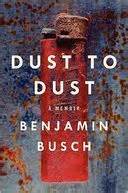
Benjamin Busch, Dust to Dust:  A Memoir.  Ecco, 2012.

War Memoir: Colby Buzzell’s My War

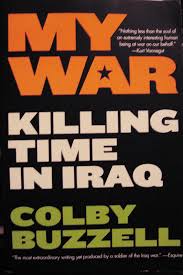
One reason I like Colby Buzzell’s My War:  Killing Time in Iraq is that I can relate to it.

Buzzell was 26 years old when he entered the Army.  In My War he writes, “my heart was dead set on being a trigger puller, and so I told [the recruiter], there’s nothing else that interests me in the Army besides the infantry.”  That was me, too, at age 26 fifteen years earlier.  Buzzell’s life up until he joined was scruffier than mine; he reports that his rap sheet consisted of “a couple of assault-and-battery charges, drunk in public, shoplifting, open containers, that kinda crap.”  When I joined I had two college degrees, a wife, and a kid on the way.  Buzzell’s aspiration in the Army was to work his way up from machine gun ammo bearer to assistant gunner to gunner while assigned to a unit deployed to Iraq.  I wanted to go to Officer Candidate School, Infantry Officer Basic Course, jump school, and Ranger school en route to becoming a platoon leader in Korea.

My past and ambitions were more respectable than Buzzell’s, but we had the same musical and literary heroes:  Black Flag, Social Distortion, Hunter Thompson, and Charles Bukowski. We both got what we wanted from the Army, too, which is cool.  I’m thinking that Buzzell, like me, appreciates that the Army never lied to him in the biggest way, a fact that made other indignities and hardships easier to bear.

In November 2003 Buzzell deployed to Iraq with a Stryker fighting vehicle-equipped brigade from the 2nd Infantry Division.  By December the unit had been blooded, and over the next 10 months, they experienced the highs and lows of infantry life in Baghdad and Mosul—heavy fighting, dull patrolling/observation post/traffic control checkpoint operations, and the mindless routine of FOB life.  In June 2004, Buzzell began a blog about his deployment, which he called My War in tribute to a ripping Black Flag song from the early 1980s.  Buzzell writes:

“I’d been in Iraq for a while now, and we were doing multiple combat missions per day, countless raids, countless missions, and being in an infantry platoon, we were spending most of our time outside the wire, thus I probably had a different perspective than someone who never left the base.

“Fuck it.

“Without even thinking twice about it, I decided right there and then to start up a blog.  Why not? If these soldiers and even officers were doing them and saying all sorts of moronic shit, and military was allowing it to go on, I might as well do one, too.”

In another place, Buzzell quotes Charles Bukowski:  “’These words I write keep me from total madness.’”

Buzzell’s memoir My War, published in 2005, records both his experience in combat and back on the FOB as his blog gained first popularity, then notoriety, and finally scrutiny from his chain-of-command.  Eventually he shut it down, but My War the memoir recoups many of the posts in addition to journal entries, commentary, autobiographical sketches, and a variety of other documents such as news reports and Army public affairs releases pertinent to Buzzell’s story.

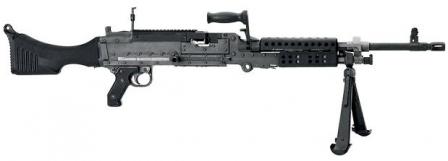
My War is excellent on many levels, but I’ll focus on a few that are most relevant to a blog on war and art.  Buzzell brings a sensitivity to art to his writing—not only are his blog and book named after a song, he nicknamed his machine gun “Rosebud” after the sled that plays so prominently in Citizen Kane, and his blog featured a picture of Picasso’s “Guernica.”  It also helps that Buzzell is a good writer, with his indebtedness to Hunter Thompson, Charles Bukowski, and (I’ll also throw in) Tom Wolfe energizing My War’s prose and elevating it above the plodding styles of other war memoirs. Buzzell’s projection of self—his voice—is also likable.  He comes off as open, honest, curious, funny, eager to explain, and fearless—the last thing anyone would accuse him of being is a stick-in-the-mud.  Despite an anti-authoritarian streak a mile wide, he finds plenty to like and respect about the Army.  One of the tidbits that endeared Buzzell to me was his account of reading cover-to-cover the Field Manuals and Technical Manuals governing the Army’s M240 Bravo machine gun.  That tells me right there that he wanted to be a good troop and probably was.  Even his saga of military transgressiveness keeps getting subverted by members of his chain-of-command who are remarkably understanding about his blog.  Not only are they in Buzzell’s eyes inspirational and competent combat leaders, their words and actions are stitched together by intelligence and fairness.

Looking back at the fuss raised by Buzzell’s blog, I’m actually kind of surprised the military didn’t outright ban blogging by deployed service members.  But I guess the 13,000 soldiers, Marines, sailors, and airmen (including me) who started blogs were too much to deal with.  It would have been like trying to ban tattoos or smoking.

Buzzell doesn’t miss much, and description of Army life turns into criticism when he confronts stupidity, hypocrisy, small-mindedness, and other forms of abject disconnect between the ideal and the actual.  The characteristic move in My War is for Buzzell to play off words spoken or written by others:  Someone said this, and it turned out to be true.  Another said this, but it was false.  The Army orders said we were going to do this, and instead we did that.  Hyper-alert to the way the war narrative is constructed by words, Buzzell’s most telling shots aim at disingenuousness propagated by military spokesmen.  His account of his participation in the assault of the Mohammed Al Noory mosque in Mosul, titled “Fuck You, Mosque,” will be studied forever by historians seeking to reconcile an infantryman’s view of battle with “official” versions disseminated in doctrine and press releases:

“…I then directed my M240 Bravo machine gun toward the tower and pulled the trigger completely back and didn’t let go until I was completely out of rounds.  Links and brass shells spitting out of the right side of my weapon, making a huge mess all over.  It was fucking beautiful. (Almost burned the barrel.) I sprayed all up and down the tower, which had four or five slim windows, until I expended my ammunition.  As I reloaded the 240 with another belt of 7.62, I was thinking to myself, “Jesus Christ, I can’t believe I’m actually shooting at a holy place of worship.’  I thought we weren’t allowed to do this kind of thing.”

He then quotes a member of his squad:  “’Man, this is collateral damage like a muthafucka’” and summarizes, “We both laughed, because one of the key mission tasks was to keep collateral damage to a bare minimum, but I guess that all goes out the window once you take fire from a mosque.”

Buzzell’s one for colorful detail, not piercing analysis.  My War paints a lively picture of life within an infantry squad, and it isn’t for the dainty.  Seemingly without a filter, Buzzell writes at length of the masturbation habits of deployed soldiers and of misogyny and homophobia run amuck—critics interested in exploring “homosociality” will find My War a happy hunting ground for evidence that masculinity is constructed upon ridicule of sexual difference.  Buzzell’s smart enough to know better than his crude squadmates, but his attitude seems to be that of Moby-Dick‘s Ishmael, who determines to be on the best of terms with whatever group of cannibals he finds himself among.  Buzzell is more in synch with his fellow soldiers in his attitude toward soldiering, where he toggles between two poles:  1. Desire to do as little as possible combined with scorn for the chain-of-command.  2.  Desire not to fuck-up mixed with eagerness to bask in the glow of higher-up approval.  In regard to violence, politics, and ethics, Buzzell feigns glee in regard to the first and indifference about the latter two, but over the course of My War piles up evidence that the war is badly fought and mostly pointless.

Vivid is a good word for My War. One of the first memoirs on the scene, it sets a high standard for memorable detail, episode, character, and language.  Mocking and euphoric rather than mopy, My War challenges readers to question whether mockery and euphoria are justifiable and sustainable responses to combat.  No book or movie interested in portraying the soldier’s perspective on the contemporary wars can safely ignore the question.

M240 Machine Gun
M240B Machine Gun

Colby Buzzell, My War:  Killing Time in Iraq.  Berkley-Penguin, 2005.

War Memoir: The Good, The Better, The Best

I read just about any war memoir that comes along, both for what it says and how it says it.  Books such as General Stanley McChrystal’s My Share of the Task (2013) and Colonel Peter R. Mansoor’s Baghdad at Sunrise (2008) provide high-level factual detail about command culture and decision-making that so far has eluded journalists and historians.  McChrystal’s memoir, for example, offers more insight into dark-side special operations and Ranger task force missions than anything I’ve read elsewhere.

Other memoirs—many of them, actually—document young officers’ journeys from battle-curious to battle-hardened.  I’m interested in this saga, too, and can relate to it, though the bullets didn’t start whizzing around my head until I was past 50.  Nathaniel Fink’s One Bullet Away (2006), Donovan Campbell’s Joker One (2010), and Craig Mullaney’s The Unforgiving Minute (2010) are of this type.  Reading them together, one is struck by how super-serious and self-absorbed their authors are, how burdened they have become by their West Point- and Marine Corps-honed codes of honor and responsibility.  Nothing wrong with that in the performance of duty, but it takes reading a more irreverent, wider-angled memoir such as Matt Gallagher’s Kaboom to realize how  Fink, Campbell, and Mullaney have internalized a military value system that seems as limiting as it does ennobling, at least when it comes to writing about war.  Where Gallagher brings analytical perspective and a sense of humor to his depiction of the soldiers he leads, the people in whose midst he fights, and the bigger national and cultural machinery he serves, the Fink, Campbell, and Mullaney memoirs offer a single-minded strategy for processing their experience:  how does what I saw live up to how I thought it would be?  The heroes of their own stories, the authors are eager to report they held up pretty well, if only now they are just a little sadder and wiser.  Though all contain episodes describing war’s awfulness and military absurdity, they say little that the big official Army and Marine Corps or a generous, uncritical reading public could not understand and forgive them for.

The memoirs that interest me most are those that move beyond experience and self to a keener rendering of a war made malleable through language and art.  Not surprisingly, such memoirs are decidedly unofficial, and the authors skeptical of anything that smells like cant or hypocrisy.  For me, so far, the two that do these things best are Army infantryman’s Colby Buzzell’s My War (2006) and Marine Corps officer Benjamin Busch’s Dust to Dust (2012).  I gather that in uniform both Buzzell and Busch served honorably and to the best of their abilities; they fought and fought hard when they had to and weren’t interested in making too much trouble for any leader who earned their respect.  But their anti-authoritarian and artistic streaks emerge in their literary endeavors.  The words and ideas given to them through military training and command channels to understand their service just don’t seem to have gone far enough for them.  Nor did the extant tradition of war literature, and so they were compelled to craft new, original, more creative and arguably more honest ways of writing about the war.  My War and Dust to Dust thus reflect an intensely aesthetic rendering of battle, in allegiance to a code of artistic values put first to the performance of military duty in combat and then to the writing about it.

In future posts, I’ll try to explain better and further.

My War   Dust to Dust