Here here to war lit 2014, a year that brought us Phil Klay’s Redeployment, Hassan Blasim’s The Corpse Exhibition, and Brian Turner’s My Life as a Foreign Country, among many excellent others. The Iraq and Afghanistan wars, ferocious as they were at times, never captured the nation’s undivided attention. Now nine years after Fallujah, five full years after my own redeployment, fighting in Iraq flickers back to life while conflict in Afghanistan drizzles on. Time will tell what recent events mean in terms of American soldier boots on the ground, but the wars now seem to burn more hotly in the nation’s literary imagination than they ever did in its political awareness. War lit has established itself as a steady persistent presence in the minds of authors, publishers, critics, and readers. Not the biggest deal going, by any means, but book people seem far more willing now to give the wars their due than when 20 American soldiers a week were dying.
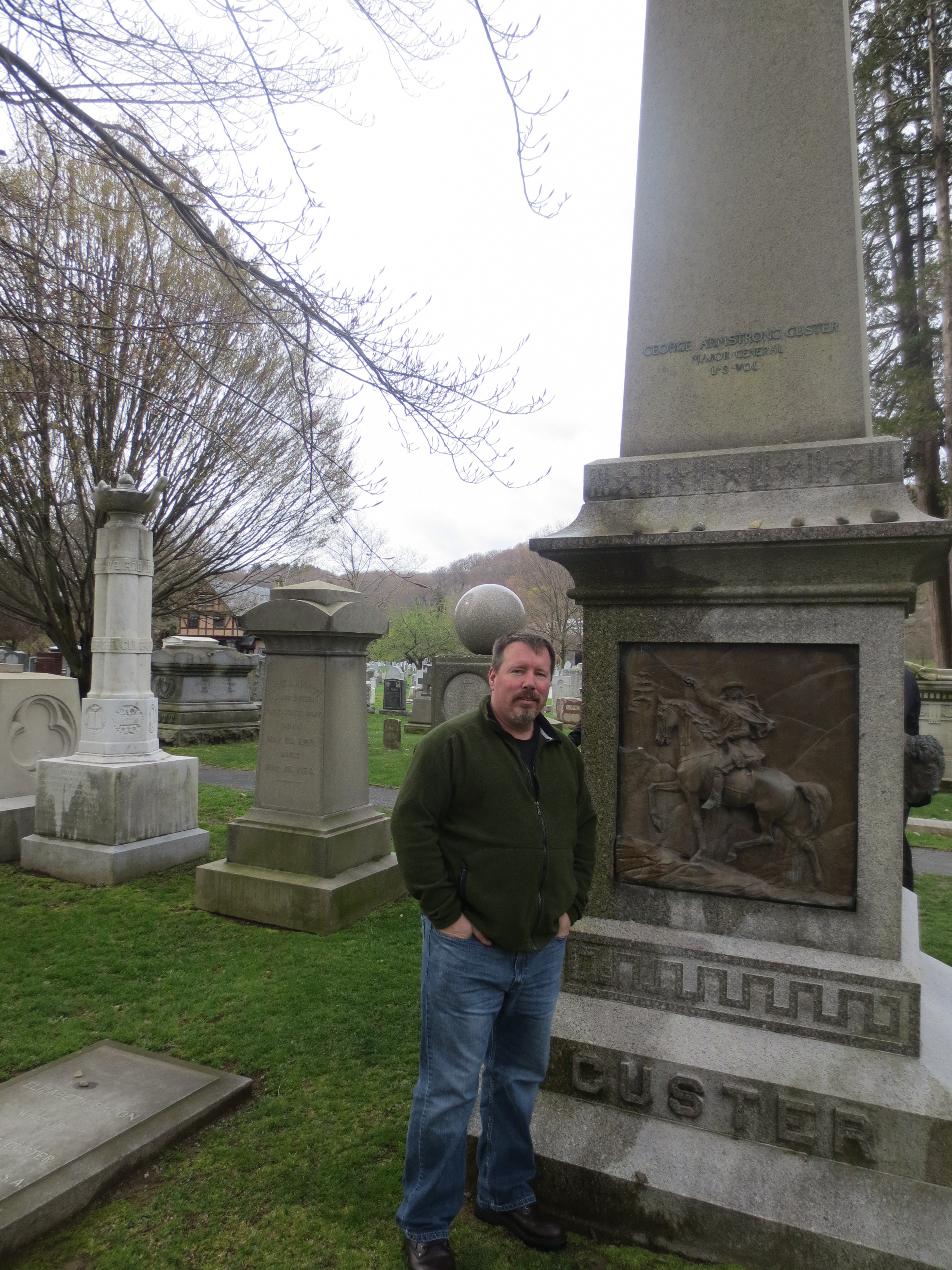
Phil Klay and Hassan BlasimBrian Turner at Custer’s grave, West Point, New York.
What is the right relationship of high-minded war literature and the nation at large? In World War II and even more so Vietnam, war literature, or at least a lot of it, acted subversively to question and undermine official pronouncements and stabs at controlling speech and thought. But in the 2000s and current decade, there seems to be no “there there” in terms of a dominant narrative or popular consensus against which our most sensitive and imaginative authors might set themselves, no greater truth on whose behalf they wield their words and stories. Leaving Blasim, an Iraqi expatriate, out of it, Klay and Turner, good as they are, rarely mock the wielders of power, so it’s hard to say how dangerous they are to the status quo. What government policy, cultural understanding, or body of literature, art, and film do they resist or subvert? Official sanctioning of torture and cross-border drone strikes? The “support the troops” ethos and the caricature of the troubled vet? The Navy SEAL and sniper memoir and Hollywood war sagas such as Zero Dark Thirty, Lone Survivor, and Fury? Yes to all, but the best might be to come. War lit doesn’t need to more polemical, just more expansive. Its focus on the lived life of individual soldiers and the plight of veterans, noble as it is, also feels somewhat preparatory, as if the genre in toto might be waiting for even more acute and impassioned observers to capture in the most accurate proportions the vexed connectivity of soldier experience, the wars at large, and the national mood.
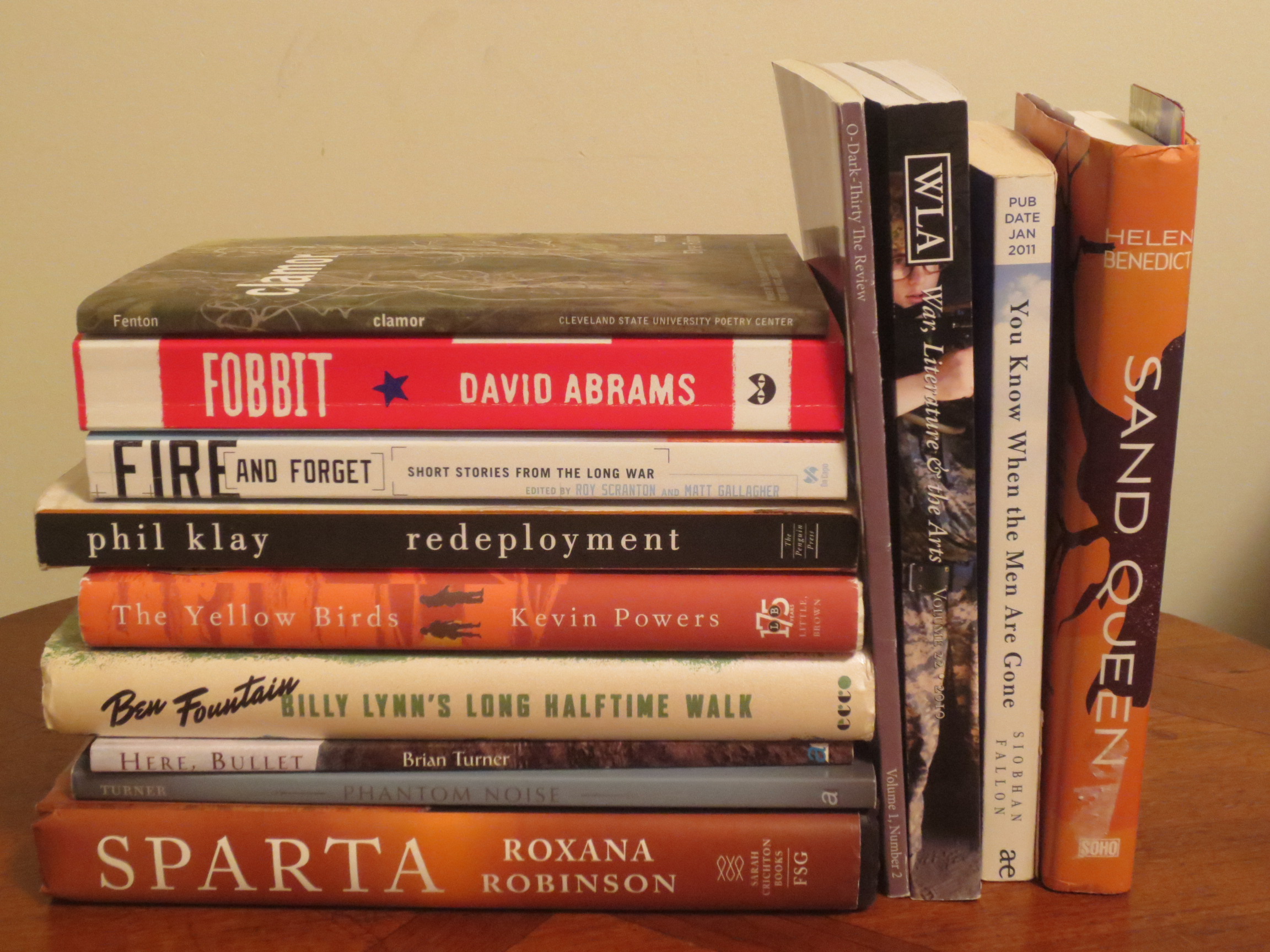
The novel would seem to be the medium for just such a project, and we might remember the excitement of 2012 when The Yellow Birds, The Watch, Billy Lynn’s Long Halftime Walk, and Fobbit lit up the war lit scene. 2013 and 2014 seem not to have delivered the same wallop, but I’ve probably missed a thing or two. In the coming weeks I’ll turn my attention to a slew of 2014 (and older) releases. Waiting on my shelf are Lea Carpenter’s Eleven Days, Masha Hamilton’s What Changes Everything, Aaron Gwyn’s Wynne’s War, Atticus Lish’s Preparation for the Next Life, and Nadeem Aslam’s The Blind Man’s Garden. And 2015 will bring Elliot Ackerman’s Green on Blue, Jesse Goolsby’s I’d Walk with My Friends If I Could Find Them, and Matt Gallagher’s Young Blood. Ackerman, Goolsby, and Gallagher combine significant war experience and impressive writing talent, so as I pitch into my New Year’s reading, my hopes are high, very high. I hope yours are, too.
At the bottom of this post is a video of the group reading at the Old Stone House in Brooklyn I moderated on Veterans Day. Below I’ve named my fellow readers, all veterans of Iraq or Afghanistan who are now active authors in print or on-line. I’ve listed the units with whom they deployed, along with their reading selections and the time their appearance can be found on the video. Each of us chose a passage from a work by a writer who fought in World War I or was profoundly affected by the war:
Introductions by Louis Crawford, Brooklyn Reading Works, and Brandon Willitts, Words After War.
Me, US Army officer, Embedded Transition Team advisor in Afghanistan: Introduction of readers.
Eric Nelson, US Army officer, 173rd Airborne Brigade, Afghanistan: Wilfred Owen, “Dulce et Decorum Est”; Siegfried Sassoon, Memoirs of an Infantry Officer (13:00).
Lisbeth Prifogle, USMC officer, aviation, Iraq: Frederic Manning, Her Privates We (19:20)
Jacob Sotak, US Army sergeant, Provincial Reconstruction Team, Afghanistan: Albert-Paul Granier, Cockerels and Vultures (27:00)
Me: Wallace Stevens, “Lettres d’un Soldat” (33:00).
Mariette Kalinowski, sergeant USMC, logistics and convoy ops, Iraq: Vera Brittain, Testament of Youth (35:00).
Adrian Bonenburger US Army officer, 173rd Airborne Brigade, Afghanistan: Louis Ferdinand Céline, Journey to the End of the Night (43:00).
Nate Bethea, US Army officer, 25th Infantry Division, Afghanistan: Robert Graves, Goodbye to All That (47:00).
Vic Zlatanovic, US Army enlisted, 173rd Airborne Brigade, Afghanistan: Rebecca West, The Return of the Soldier (57:20).
Me: Joyce Kilmer, “Rouge Bouquet” (1:06).
An obvious first link between Great War authors and contemporary war authors is the essential literariness of the effort to understand military experience. World War I authors such as Wilfred Owen, Robert Graves, and Siegfried Sassoon were highly educated and extremely aware of the British literary tradition they hoped to join and further with their works. Likewise, today, so many war authors are the products of first-class undergraduate educations and graduate MFA and journalism programs. Consciousness of what’s come before—not just of World War I authors, but also the great writers who came out of World War II and Vietnam—is also a feature distinguishable everywhere in contemporary war writing. There are other affinities, too. While listening to my fellow readers at the Old Stone House, I noted their attraction to passages that exposed the horror of World War I combat, reflected enormous disillusionment with stated national aims and ideals, and articulated the profound difficulty of getting on with life after the fighting was over. These are all real points of connection that suggest World War I literature remains relevant to our modern way of thinking about war and its consequences.
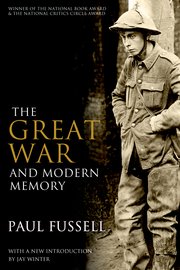
The scholarly work that explains best the influence of World War I and World War I writing is Paul Fussell’s The Great War and Modern Memory. First published in 1975, Fussell’s study was groundbreaking in its time and seems not to have aged a bit. Its greatness lies not just in Fussell’s attention to the ideas and language of authors of memoirs, poetry, and fiction about World War I, which is fantastic, but in the way he documents wholesale, pervasive shifts in habits of expression and thought throughout British and American culture as a result of the war. That World War I helped usher in our modern era is not news, but no one has as precisely or substantially documented exactly how as well as Fussell, who served as an infantry lieutenant in World War II before commencing a long, distinguished career as a professor at Rutgers and Penn.
Astonishing insights and claims jump off of almost every page of The Great War and Modern Memory. For example, Fussell writes, “Every war is ironic because every war is worse than expected…. But the Great War was more ironic than any before or since. It was a hideous embarrassment to the prevailing … myth which had dominated the public consciousness for a century. It reversed the Idea of Progress.” Expanding on this grand claim, Fussell continues:
Furthermore, the Great War was perhaps the last to be conceived as taking place within a seamless, purposeful “history” involving a coherent stream of time running from past through present to future. The shrewd recruiting poster depicting a worried father of the future being asked by his children, “Daddy, what did you do in the Great War?” assumes a future whose moral and social pressures are identical with those of the past. Today, when each day’s experience seems notably ad hoc, no such appeal would shame the most stupid to the recruiting office. But the Great War took place in what was, compared with ours, a static world, where the values appeared stable and where the meanings of abstractions seemed permanent and reliable.
Irony, Fussell claims, was the dominant mode of the great World War I writing tradition—the revealed horror of war giving the lie to innocence and idealism—and remains the tradition’s gift to war writers afterward. But there were many more ways that the war changed the way not just war writers, but everyone, thought about not just war, but everything. Fussell hits the jackpot of literary scholarship by plausibly connecting epochal shifts in the ways that people think, act, and use language with the cultural conditions that engendered such change. World War I, for example, was when governments and the popular press developed a quasi-official language of euphemistic high-diction to gloss over the senselessness of war slaughter: “warriors” instead of “soldiers,” “the fallen” instead of “the dead,” for examples. In the same vein, World War I was when official pronouncements, the popular press, and soldier-authors began to describe war using the language of sportwriting and the stage. It would take about two seconds to find in today’s war writing passages that channel the sporting spirit of plucky comradeship in the face of adversity or the sense that becoming a soldier and going to war is akin to an actor playing a role; Fussell says these trends first emerged in World War I popular and literary writing. Fussell’s boldest claim, perhaps, is that the great divide between opposing forces in France—dug-in trenches separated by a desolate “no man’s land”—instituted a cultural habit of binary thinking that simultaneously divided all life into antagonistic domains and drove caring people into endlessly fretting about making connections and overcoming difference.
That’s something to consider, for sure, but it gives a hint of Fussell’s stretch. It would take a lot longer piece of writing than a blog post to fully canvass Fussell’s claims, let alone connect them systematically to today’s war writing. That needs to happen, but what really needs happening is for a scholar as shrewd as Fussell to take stock of the growing body of Iraq and Afghanistan war literature and tell us what it has to tell us with the same acuity and detail as Fussell does for World War I writing in The Great War and Modern Memory. Scholarship on 21st-century war literature and popular writing about war awaits its coming-of-age.
Paul Fussell, The Great War and Modern Memory (Oxford, 1975, 2000).
Two scholarly works that do address contemporary war literature are Stacey Peebles’ Welcome to the Suck: Narrating the American Soldier’s Experience in Iraq (Cornell, 2011) and Ty Hawkins’ Reading Vietnam Amid the War on Terror (Palgrave-MacMillan, 2012). For more on World War I and World War II literature, see Patrick Deer’s Culture in Camouflage: War, Empire, and Modern British Literature (Oxford, 2009), among others. While there’s a shortage of scholarly work on Iraq and Afghanistan war literature, there’s a vibrant, growing body of critical work on war and conflict photography that may help us understand war writing as well. I’ll cover those works in a future post.
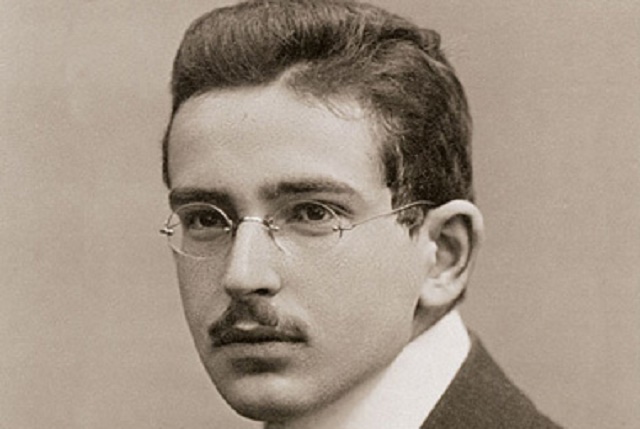
My title alludes to an essay titled “Paris, the Capital of the 19th Century” by Walter Benjamin, a German-Jewish writer well-known to those who have studied literature, history, or the arts in grad school, if not so famous among the masses. Benjamin’s thesis was that Paris, through its up-to-the-minute confluence of architecture, city design, affinity for new modes of artistic reproduction, and rampant indulgence of consumer capitalism, was the “it” city of the nineteenth century. The most modern, the most happening, the most vital, the first home of all things new and exciting.
Walter Benjamin, war author? Benjamin, a Jew, committed suicide in 1940 when his effort to flee Nazi Germany was stymied.
Today, my local paper ran a story about how even Paris, along with many other cities, strives to capture the spirit of Brooklyn, the New York City borough that currently crackles with artistic and entrepreneurial creative energy. From my perch 50 miles north, I’ve been fortunate enough the last couple of years to make many forays into Brooklyn-land and drink deep of its magical mystical mojo. It’s hard not to get excited about what one discovers or become eager to seek the approval of its brave, bold, tough, and talented residents. Along with almost everything else in every other domain of life that seems worth paying attention to, Brooklyn sets the tone and pace of the contemporary war writing scene, too, with veteran and interested non-veteran authors by the dozens tapping into Brooklyn’s vitality in hopes of infusing their writing with urgency and relevance. Phil Klay, Matt Gallagher, and Roy Scranton, for examples, come immediately to mind as Brooklyn-based war authors who preside over not just the local, but national war lit scene by modeling excellence with their own work and exuding a generous spirit of encouragement to other war writers and readers.
On Veterans Day, I was invited by the war writers collective Words After War to moderate a group reading by up-and-coming war authors at the Old Stone House in Brooklyn. The Old Stone House, an historical site associated with the Revolutionary War Battle of Brooklyn, has for several years co-sponsored a Vets Day reading with an organization called Brooklyn Reading Works. The concept this year was for contemporary war writers to read selections from World War I authors in homage to the 100th anniversary of the beginning of the Great War. I liked the idea immediately—I’ve got plenty to say about the links between contemporary war writing and the WWI war writing tradition of Owen, Sassoon, and Hemingway, and I was eager to see which authors attracted the attention of other contemporary vets.
I’ll save the analysis for another column, however, and will, regrettably, for now shortchange attention to my fellow readers in this post. Below are my remarks and selections, for what they are worth. Thank you Words After War, the Old Stone House, Brooklyn Reading Works, and vet-authors Eric Nelson, Mariette Kalinowski, Lisbeth Prifogle, Jacob Sotak, Vic Zlatanovic, Nate Bethea, and Adrian Bonenberger. Most of the authors named are already in print and online, and all are working on projects that will make us pay even closer attention in the future.
XXX
“I’m honored to be here today to moderate Veterans Day: Writing War Fiction and Memoir as a guest of The Old Stone House, Brooklyn Reading Works, and Words after War. Tonight marks at least the third, or maybe even more, year in a row that Veterans Day has been commemorated with a literary event in this historic location. The format for this year’s event was conceived by Words After War executive director Brandon Willitts, who noted that 2014 was the 100th anniversary of the beginning of World War I, a war notable for the quality of the literature produced by those who fought it. Brandon’s idea was to have veterans of our contemporary post-9/11 wars who are active authors of fiction, poetry, memoir, essay, and nonfiction pay homage to the warrior-authors of the Great War, and in so doing render tribute to all those who have served our nation in its armed forces.
“I want to consider the particularly Brooklyn aspects of our endeavor here tonight. Brooklyn today is known for its hospitality to creative individuals—authors, artists, and musicians. But we might also remember its even stronger tradition of sending its sons and now its daughters to defend the nation and fight its wars. I couldn’t find exact numbers of Brooklynites who fought in World War I, but surely they were substantial, as New York state provided by far the greatest number of soldiers to the overseas army that fought in Europe. You can search online the names of those New York residents who died in World War I, and it shouldn’t surprise anyone that the first name, Boatswain Mate First Class Aksel Aanensen, and darn near the last, Private First Class Samuel Zuckerman, were from Brooklyn. We can also learn that a woman from Brooklyn, Daisy Kirkterp, a nurse, is memorialized for giving her life during World War I.
“Veterans Day is not Memorial Day, but those who gave their life in combat are a special subset of those whom we honor on Veterans Day, so let’s render tribute to Brooklyn residents who have died in Iraq and Afghanistan, such as Captain John McKenna, USMC (Iraq, 2007), and Army Specialist Deon Taylor (Afghanistan, 2008). We want above all to be sure that those who die in combat do not die in vain, and the families of Captain McKenna and Specialist Taylor should take great comfort in, among other things, their beloved lost ones are remembered in the proud, tough, caring community from which they came.”
XXX
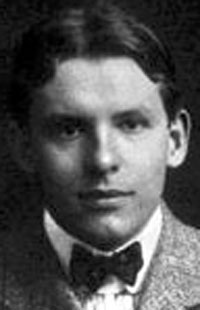
Wallace Stevens
“Wallace Stevens is not usually thought of as a World War I poet, but the great American modernist appeared in print as early as 1914 with a poem, called “Phases,” that directly engaged the war. Shortly after the war ended, he wrote “Lettres d’un Soldat,” a passage from which I will now read. It is like no other Wallace Stevens poem or no other war poem that I’ve ever read, which makes it very cool indeed.”
John Smith and his son John Smith,
And his son’s son John, and-a-one
And-a-two and-a-three
And-a-rum-tum-tum, and-a
Lean John, and son, lean John,
And his lean son’s John, and-a-one
And-a-two and-a-three
And-a-drum-rum-rum, and-a
Rich John, and son, rich John,
And his rich son’s John, and-a-one
And-a-two and-a-three
And-a-pom-pom-pom, and-a
Wise John, and son, wise John,
And his wise son’s John, and-a-one
And-a-two and-a-three
And-a-fee and-a-fee and-a-fee
And-a-fee-fo-fum—
Voila la vie, la vie, la vie
And-a-rummy-tummy-tum
And-a-rummy-tummy-tum.
XXX
Joyce Kilmer
“I will close by reading a poem by a poet who was not a Brooklynite, but who fought and died in the Fighting 69th Infantry, a legendary New York City unit. Sergeant Joyce Kilmer, the author of the famous poem “Trees,” and the namesake for Brooklyn’s Joyce Kilmer Square, wrote “Rouge Bouquet” just before his death in France in 1918. The poem, which is about the deaths of his fellow soldiers by artillery barrage in a French forest named Rouge Bouquet, is very much of its time not just in regard to its depictions of the horror of war, but in regard to its notions of duty, courage, and honor. We have more complicated notions about these values than did those who fought World War I, in part because of the test-by-fire the values were subjected to in the Great War. But let’s end with a poem that unabashedly renders the old virtues in the old ways, because the sentiments, despite how many times the world has turned since, can still stir us today.”
In a wood they call the Rouge Bouquet
There is a new-made grave to-day,
Built by never a spade nor picK
Yet covered with earth ten meters thick.
There lie many fighting men,
Dead in their youthful prime,
Never to laugh nor love again
Nor taste the Summertime.
For Death came flying through the air
And stopped his flight at the dugout stair,
Touched his prey and left them there,
Clay to clay.
He hid their bodies stealthily
In the soil of the land they fought to free
And fled away.
Now over the grave abrupt and clear
Three volleys ring;
And perhaps their brave young spirits hear
The bugle sing:
‘Go to sleep!
Go to sleep!’
Slumber well where the shell screamed and fell.
Let your rifles rest on the muddy floor,
You will not need them any more.
Danger’s past;
Now at last,
‘Go to sleep!’
There is on earth no worthier grave
To hold the bodies of the brave
Than this place of pain and pride
Where they nobly fought and nobly died.
Never fear but in the skies
Saints and angels stand
Smiling with their holy eyes
On this new-come band….
And up to Heaven’s doorway floats,
From the wood called Rouge Bouquet
A delicate cloud of bugle notes
That softly say:
‘Farewell!
Farewell!’
Comrades true, born anew, peace to you!
Your souls shall be where the heroes are
And your memory shine like the morning-star.
Brave and dear,
Shield us here.
‘Farewell!’
Nate Bethea, Eric Nelson, Adrian Bonenberger, Brandon Willitts, Mariette Kalinowski, Vic Zlatanovic, Lisbeth Prifogle, me, Jacob Sotak
Thanks to Melissa Parrish, Iraq US Army vet, for turning me on to Wallace Stevens’ “Lettres d’un Soldat,” and in particular the great “John Smith and son John Smith” passage.
“Tomorrow the War Will Have a Picnic” is a poem written by an Iraqi author named Abdul Razaq Al-Rubaiee on the eve of the American invasion in 2003. It and other poems written by Iraqi poets are collected in the anthology Flowers of Flame: Unheard Voices of Iraq (2008). Flowers of Flame came to my attention when a scholar proposed to speak about it for a panel titled Global Perspectives on the Wars in Iraq and Afghanistan that I am trying to set up for the American Comparative Literature Association conference next March in Seattle. Alas, as I write I don’t have enough papers to meet the ACLA’s requirement of six to make the panel a go. But the entries I have received have already done much of what I hoped to accomplish by alerting me to the work of non-American authors who have written stories, poetry, and plays about Iraq and Afghanistan. Flowers of Flame is one example, and below are a few more:
Pakistani-British novelist Nadeem Aslam’s The Blind Man’s Garden (2013), tells the story of two brothers who enter Afghanistan from Pakistan not to fight Americans, but to help wounded Afghans. Aslam’s earlier novel The Wasted Vigil (2008) is also set in Afghanistan. An interview with Aslam at Bookslut is especially not to be missed for many reasons–I’ll quote my favorite part, in which Aslam describes how he taught himself to be a writer:
So over the course of the next 10 or 11 years I read everything. I would go to person A and say, “Tell me, who’s a great writer?” William Faulkner. So I read everything by William Faulkner. I would begin with the first novel and end up with the last novel. I would go to person B and say, ‘Who’s a great writer?’ Thomas Hardy. I read everything by Thomas Hardy, sequentially. Who’s a great writer? D.H. Lawrence, James Joyce, Vladimir Nabokov, Dostoevsky.
And then I wanted to know, how much thought is allowed in one paragraph? How many images are allowed per page? What is a comma? And so I copied out the whole of Moby-Dick by hand. I copied out the whole of As I Lay Dying by Faulkner by hand. I copied out Lolita. I copied out Beloved. I copied out The Street of Crocodiles by Bruno Schulz, Gabriel García Márquez’s The Autumn of the Patriarch….
Christine Evans is an Australian-born playwright who now lives in America. Her multi-media play You Are Dead. You Are Here (2013, with more productions coming in 2015) portrays a relationship between a male American soldier and a young female Iraqi blogger. An earlier play called Slow Falling Bird (2003) features an Afghan girl living in limbo in an Australian immigrant detention center. Evans’ other plays–Trojan Barbie (2009) and Weightless (2007)–don’t invoke Iraq and Afghanistan directly, but instead comment obliquely on modern life as it has been shaped by a decade of war. Trojan Barbie, by-the-by, draws inspiration from Euripides’ The Trojan Women to portray the plight of women in the midst of a war, conflict, and violence-saturated historical epoch. In the latest PMLA, a seriously scholarly journal published by the Modern Language Association, Ellen McLaughlin describes her own stage adaptation of Sophocles’ Ajax called Ajax in Iraq (2009). Evans’ and McLaughlin’s works add two more data points to the now indisputable pile of evidence proving that classic Greek literature has been the go-to sourcepool for contemporary war writers.
I’ve appealed to ACLA for an exception-to-policy and will soon find out if my panel will occur or not. I hope so, but even if it doesn’t, many thanks to the scholars who brought Flowers of Flame, The Blind Man’s Garden, and You Are Dead. You Are Here to our attention. I look forward to reading both the original works and the critical commentary.
Flowers of Flame: Unheard Voices of Iraq. Edited by Sadek Mohammed, Soheil Najm, Haier Al-Kabi, and Don Veach. Michigan State University Press, 2008.
Nadeen Aslam. The Blind Man’s Garden. Knopf, 2013.
Christine Evans. You Are Dead. You Are Here. Indie Theater Now, 2013.
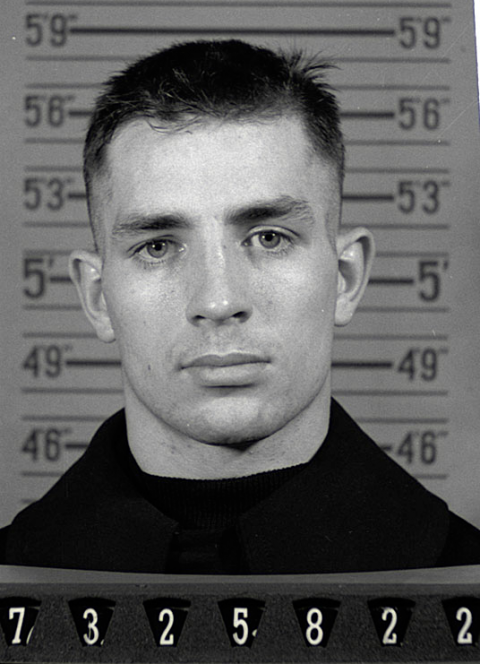
“October in the Railroad Earth”is the title of a beautiful prose-poem by Jack Kerouac, who served for about a week in the Navy during World War II and somewhat longer in the Merchant Marine. I have already used the title of Kerouac’s fantastic ode to autumn for the title of a post on my old blog. There it actually made a lot of sense as I wrote about long, glorious days of training in the warm Kansas sunshine while we prepared to deploy to Afghanistan. But I can’t resist repurposing the title, so here we go. A potpourri of miscellaneous war-lit notes is not my usual modus, but ideas, events, and publications have been accumulating so fast that I can’t possibly give each the extended consideration it deserves, so please bear with me.
Late in August, I attended a Sunday afternoon writing workshop co-sponsored by New Jersey branches of the Combat Paper Project and WarriorWriters. With veterans of Somalia and Vietnam I traded writing prompts relevant to military experience and we read each other our responses. Here’s one I wrote on “environment”:
I find very few soldiers wax poetical about Iraq. Nothing about the flat desert, the hot sun, and the squalid chaos of the cities seems to have impressed them. Afghanistan, on the other hand, exerted an enchanting allure on many of the soldiers who served there. The high mountains, often snow-capped and surprisingly forested, the clean air (at least outside of Kabul), the ancient villages built into the sides of wadi and mountain walls, and the roads that snake through the treacherous mountain passes all possess intoxicating powers. Quickening everyone’s step and filling them with wonder, the landscape makes soldiers fall halfway in love with a country that might kill them.
Speaking of falling in love with soldiering in Afghanistan, check out Brian Castner’s impressive essay in the LA Review of Books called “Afghanistan, A Stage Without a Play” on why so little fiction has been written about Afghanistan compared to Iraq. It’s curious, Castner wonders, why Afghanistan seems to have inspired triumphalist memoirs by Navy SEAL team members and infantry lieutenants, while the literary output of Iraq has been fiction and poetry written by disillusioned enlisted soldiers. I’m honored to have been quoted by Castner alongside several other veteran-writers. Along the same lines, I was fortunate to view the movie Korengal and hear Sebastian Junger speak about his love for the soldiers he filmed in action on COP Restrepo in Afghanistan. The next night, in contrast, at Penumbra, a hip photography exhibition space in New York City, I heard Benjamin Busch speak more grimly about the photographs he took in Iraq first as a deployed Marine and earlier this year when he returned to write a story for Harper’s called “Today is Better than Yesterday.”The twinned events inspired many reflections about the linkage of war, words, and images about which I hope to write soon. On a more personal level, Junger and Busch are men-after-my-own-heart, for sure: older, deeply cerebral and artistic gentlemen driven to delve deep into the mysteries of the manly realm of war. Speaking of which, I spent a fun, rewarding afternoon in New York with Maurice Decaul, ex-USMC Iraq vet, ex-Columbia, and now in NYU’s graduate fiction writing program. Decaul writes like the second coming of John Keats, as illustrated by a New York Times essay titled “Memory Lapse”and the poem “Shush,” featured below. But more importantly, Decaul is a genial warm soul who instinctively gravitates towards helping people and getting them organized for effective action and life. As he regaled with me stories about the Columbia and NYU veterans’ programs, I realized exactly how curmudgeonly have been my own efforts in this regard.
Another gentleman, Brian Turner, is reading several times in the NY-NJ-Conn area in the coming months following the release of his memoir My Life as a Foreign Country. I hope to make a couple of the readings, in particular the Dodge Poetry festival “Another Kind of Courage“ war poetry event on Saturday October 25 in Newark, NJ. The bill also includes Yusef Komunyakaa, Marilyn Nelson, Jehanne Dubrow, and Elyse Fenton, all poets whose work I know and admire. On Veterans Day, I’ll join several other vet-writers to read selections from our favorite World War I authors at an event organized by Words After War and Brooklyn Reading Works at The Old Stone House in Brooklyn.
I also have two conference presentations lined up for next spring. In March, in Seattle, I am moderating a panel at the American Comparative Literature Association conference on literature inspired by the wars in Iraq and Afghanistan written by non-Americans. As I write, nobody has submitted a paper proposal, which honestly I kind of anticipated. But if you are an academic and know of a work about the post-9/11 wars written by someone who wasn’t born in the US of A, please consider joining me. In April, I will participate on a panel on war memoir at the Association of Writers and Writing Programs conference in Minneapolis. Also on the panel are Ron Capps, Colin Halloran, and Kayla Williams, so I’m very excited to take part. AWP is a huge party, for those who have never been, in addition to being an intellectual feast for the literary-inclined, so please join us if you can.
And so it goes, on and on. To Jack-y Kerouac-y, maybe not a patron saint of war writing, but certainly a kindred spirit and fellow traveller of all who burned to live intensely and then express themselves through their art.
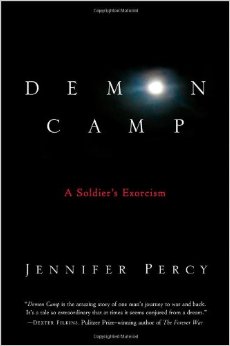
I was thirty pages into Jennifer Percy’s Demon Camp before I learned, thanks to a quick check of Amazon reviews, that I was not reading a novel. I felt stupid, which is kind of normal, but also disappointed, because I thought the story’s conceit was outstanding: an investigative journalist covering the story of an Afghanistan veteran possessed by demons starts seeing demons herself. I was also enjoying Percy’s style, which reminded me of the lurid tones of Cormac McCarthy. Bring on the strange, at long last something really weird. The opening paragraph set the trap:
Sergeant Caleb Daniels wanted to save all the veterans from killing themselves. A machine gunner three years out of the 160th Special Operations Regiment, 3rd Battalion, he’d tried to kill himself, four or five times, but he was interrupted each time—once by his dead buddy Kip Jacoby; once by his girlfriend Krissy, whom he met at a strip club; once on a lake by his house in his canoe when the rain stopped and he saw the moon; and once when the demon called the Black Thing came into his bedroom in Savannah and said, ‘I will kill you if you proceed,’ and Caleb said, ‘No you won’t, asshole, because I’m going to do it myself.
So Caleb Daniels, it turns out, is a real person, and on Demon Camp‘s terms, so too is the Black Thing. Percy writes, “Caleb said these things could transfer, and because these things are not limited to war, I started to wonder if it was following me.” Demon Camp is not then a story of descent into madness, but of seeming madness taken very literally.
If Demon Camp isn’t a novel, what is it? Investigative journalism, perhaps, but the haunted prose and Percy’s insertion of herself into the story are just the beginning of its breaches of the tenets of objective reportage. Creative nonfiction, a genre beloved by MFA programs, though not one that has garnered much traction among the reading public, is another possibility. Creative nonfiction authors such as Annie Dillard combine reportage and reflection in highly wrought soufflés that say as much about them as the objects of their investigation. But the knock on creative nonfiction is that it is more of a literary experience than anything having to do with real life. Percy, as I make sense of Demon Camp, has something urgent to say about the wars in Iraq and Afghanistan, the people who fought them, and the nation that sent them off and to which they return.
The highlight of Caleb Daniel’s service was deployment to Afghanistan with the famed 160th Special Operations Regiment “Night Stalkers” aviation unit. Left behind at the FOB on the helicopter mission to save the Navy SEALS on the Operation Red Wings mission that served as the basis for the book and movie Lone Survivor, Caleb avoids the death that came to sixteen others when the Taliban shot down their CH-47 Chinook. Too wracked by guilt and PTSD to continue serving, Caleb commences a post-Army life that, as documented by Percy, is a tornado of destructive behavior: employment false-starts, financial difficulties, broken relationships, drinking, run-ins with authority, violence, the whole nine yards. And all this before we consider his membership in a fringe religious sect that believes wholesale in good and bad demons and exorcisms, played out in Georgia backwoods churches “down four dirt roads,” as Percy writes. The immediate object of Caleb’s faith is exorcising the demons that, for him, represent PTSD. Barely interested in morality and good behavior, Caleb is drawn to evangelical religion because it offers a convincing explanation for the presence of evil in the world.
Caleb’s chicken-fried version of the battle between heaven and hell makes William Blake’s cosmology look simple and logical, for those familiar with the visionary English poet. But Percy’s approach eschews the irony Flannery O’Connor might bring to the same subject for the straight-faced respect Walker Evans and James Agee displayed when they portrayed with stark dignity Alabama sharecroppers in Let Us Now Praise Famous Men. I’m straining here to find analogies for Demon Camp’s strange brew, so let me close with a few simpler statements that will help you decide whether to read it for yourself. It’s not Caleb’s standard issue dysfunctional behaviors Percy’s most interested in describing, it’s his strange belief system and means of processing experience. Emerging into adulthood, shaken by the war but seemingly untouched by the normative institutional values he was supposed to have obtained from family, school, and church, to say nothing of the Army’s “official” values of loyalty, duty, respect, selfless service, honor, integrity, and personal courage, Caleb possesses a hot mess of an interior life that I think Percy actually admires. Patriotism, discipline, and other soldierly virtues be damned, Caleb’s stew of ideas, motivations, and fears stand as huge reproaches to authority and convention, and authority and convention should take heed. Caleb is more disorderly–or disordered–than they imagine and not cowed in the least by their supposed power, and he’s probably not the only one who thinks and feels as he does. Entranced by her mixed-up but charismatic subject, Percy offers him to us an antidote to the idealized, simply motivated “good soldier,” and she challenges us to take him as seriously as she does.
But Percy’s even bigger grouse, I think, is with the conventions of war literature. My theory is that Demon Camp is as generically and stylistically unstable as it is because Percy believes much writing about the war is far too settled. Why write another same-old, same-old story? Too comfortable with itself, falling predictably into standardized themes and scenes, and making few demands on the reader, the whole war lit biz, I’ll bet Percy would say, instantiates what it purports to critique. Willing to break rules and take risks, to include ridicule, misunderstanding, and lack of sales (though I think Demon Camp would make a great movie), Percy plays for the bigger stakes of being a game-changer.
Sergeant Caleb Daniels, if you read this, thank you for your service, trite at that phrase is. To make it through Survival, Evasion, Resistance, and Escape school and to soldier successfully with the Night Stalkers speaks volumes. I hope you are healthy, happy, and productive.
Jennifer Percy, Demon Camp: A Soldier’s Exorcism. Scribner, 2014.
Enlisted grunt Colby Buzzell’s and armored cavalry officer Matt Gallagher’s blogs-from-the-front in their time seemed as new and different about the Iraq War as IEDs and FOBs. But in the years since Buzzell’s My War and Gallagher’s Kaboom galvanized Internet reading audiences the blog format’s luster has fizzled a bit and the Internet has changed structurally. In the face of competition from faster-moving, quicker-hitting social media forms such as Twitter and Facebook, it’s hard not for blogs to smell a little musty. As big money has upped the standards for web-based mass media and created plenty of outlets for the most distinctive voices, personal websites can seem quaint or a little bland. Still, they persist, reflecting and shaping popular opinion in a quieter, but still insistent vein. Most don’t speak to the masses, but all can aspire for influence within circles of like-minded cognoscenti. Below are the post-9/11 wars art and literature sites I check regularly:
War, Literature, and the Arts (WLA). The flagship of war lit and art websites, full of quality reviews, essays, and creative work. Not single-mindedly focused on the contemporary wars, but it doesn’t ignore them, either; currently featured is an essay by Ben Fountain and reviews of Katey Schultz’s Flashes of War, David Abrams’ Fobbit, and the Fire and Forget anthology. The site is affiliated with the United States Air Force Academy and operates under the wise, caring supervision of Donald Anderson. If you haven’t read Anderson’s Gathering Noise from My Life: A Camouflaged Memoir (2012), you should, but don’t take my word for it, read Brian Turner’s and Siobhan Fallon’s blurbs at the link.
Red Bull Rising. A powerhouse compendium of war lit announcements and commentary. Blog maestro Randy Brown–aka “Charlie Sherpa”–’s passion for sharing news, rendering credit, and building a community of contemporary war lit lovers via the Internet puts Time Now’s similar efforts to shame. Brown’s a former NCO in the Iowa National Guard, and he writes with the same curmudgeonly practicality and helpfulness I associate with the many members of the Iowa Guard I served with in Afghanistan.
Military Experience & the Arts (MEA). I don’t know MEA maven Travis Martin, a US Army vet of two tours in Iraq, but he clearly not only has his heart in the right place but possesses a ton of organizational and entrepreneurial clout. The MEA site is big-time beyond compare, with so many links, pages, and announcements it’s hard to keep track of everything. If I am reading their “Publications” tab correctly, they sponsor no less than four online journals dedicated to veteran and military-themed literature.
The Veterans Writing Project (VWP) and O-Dark-Thirtywebsites provide writing opportunities for veterans of all wars. The VWP site contains information about writing workshops and seminars, while O-Dark-Thirty features poetry, stories, and interviews featuring established and up-and-coming veteran authors from World War II onward. I also highly recommend VWP and O-Dark-Thirty founder Ron Capps’ memoir Seriously Not All Right (2014). Not only has Capps’ service as both a military officer and State Department official taken him to Kosovo, Africa, Iraq, and Afghanistan, like Donald Anderson he writes from the vantage point of having more than just a couple of decades of life experience under his belt.
While The Military Spouse Book Review is not singly-minded focused on war lit and The War Movie Buffon post-9/11 war film, they overlap enjoyably enough with Time Now’s concerns that I always keep an eye on them. And finally, a number of published war authors–probably most–also maintain a website or blog, and if I don’t visit them as much as the sites listed above, I get to all of them sooner or later. Thanks everyone for writing and posting; the Golden Age of the blog may have passed, but to paraphrase a character in a Flannery O’Connor short story, “No one’s not doing it anymore if we’re still doing it.”
Stacey Peebles’ 2011 Welcome to the Suck: Narrating the American Soldier’s Experience in Iraq only discusses one book of poetry—Brian Turner’s Here, Bullet (and treats it as if it were memoir rather than verse)—and one dramatic film—In the Valley of Elah–but it should engage anyone interested in the art, film, and literature about our contemporary wars. A study of the first wave of writing and film by and about contemporary veterans, Welcome to the Suck has much to say about the Iraq War, the men and women who fought it, the nation who sent them off to fight, and the way the war is represented in text and film.
Peebles’ thesis is that that memoirs, poetry, and movies by and about Iraq veterans document veteran struggles to reconcile military and civilian identities. The authors and artists she studies join the military willingly, but subsequently find themselves at odds with martial culture and ideals. Formed by their contemporary cultural context–rapidly changing gender norms, pop cultural saturation, and digital media possibility—they enlist confident they can handle the worst they might see. But military life, and more specifically the experience of war, overwhelms them. Still proud of their service and eager to remember positive aspects of it, their nostalgic fondness rests uneasily alongside messed-up minds and damaged bodies. The texts they write and the movies made about them record this confused and fragmented sense of self.
In chapter one, “Lines of Sight: Watching War in Jarhead and My War: Killing Time in Iraq,” Peebles discusses two early war memoirs, Anthony Swofford’s 2003 Jarhead and Colby Buzzell’s 2005 My War: Killing Time in Iraq. Each describes how their authors’ fascination with pop culture, especially movies about Vietnam, influences both their time in service and how they write about it later. The chapter also dissects how Iraq differed from Vietnam, how the perspective of contemporary soldiers was shaped by their times and sense of history, and how new technologies—such as the DVD and the blog–impacted the fighting of the war tactically and personally.
In chapter two, “Making a Military Man: Iraq, Gender, and the Failure of the Masculine Collective,” Peebles explores three memoirs that illustrate how modern soldier identities clash with traditional military stereotypes and the concept of the military as a “masculine collective.” Peebles first analyzes Joel Turnipseed’s 2003 memoir Baghdad Express, in which Turnipseed presents himself as a philosopher-aesthete among the Marines with whom he deploys. Next, Peebles examines Nathaniel Fink’s 2005 memoir One Bullet Away: The Making of a Marine Officer, in which Fink describes his ultimately failed attempt to project “hardness” to the soldiers under him. Finally, Peebles looks at Kayla Williams’ 2005 memoir Love My Rifle More Than You, in which Williams recounts her efforts to gain acceptance in the male-dominated units with whom she serves in Iraq.
In chapter three, “Consuming the Other: Blinding Absence in The Last True Story I’ll Ever Tell and Here, Bullet,” Peebles compares the attitudes taken toward Iraqis in two works, John Crawford’s memoir The Last True Story I’ll Ever Tell (2005) and Brian Turner’s volume of poetry Here, Bullet (2005). Where Crawford is “consumed” by hatred and disgust, Turner is filled with empathy and curiosity about Iraqis as people and for their history and culture. While the problems with Crawford’s point-of-view are obvious, Peebles also suggests that Turner’s surfeit of empathy also presents difficulty: it complicates his role as a soldier and as a literary tactic risks aestheticizing the enemy “Other.”
Chapter four, “On U.S.: Combat Trauma on Film in Alive Day Memories and In the Valley of Elah,” examines two 2007 films: the HBO documentary Alive Day Memories: Home from Iraq and Paul Haggis’s feature film In the Valley of Elah. Peebles suggests that both films—each about the physical and mental wounds endured by veterans—represent movie-making and storytelling as “sophisticated [narrative] prostheses” that complement therapeutic, medical, and mechanical recovery aids. While promising much, filmmaking also suffers the same limits as, say, a prosthetic leg or trauma medication—while trying to generate a return to “wholeness” that is probably not really attainable, they also exacerbate and extenuate the sense of loss and disjunction felt by the war’s casualties.
At the end of each chapter, Peebles renders a brief look at an Iraqi blog, text, or film that supplements the discussion of the American cultural artifacts under examination, and in her conclusion she compares The Hurt Locker to Vietnam movies such as Full Metal Jacket, The Deer Hunter, and Apocalypse Now. Welcome to the Suck is published by a university press and features references to literary criticism heavyweights such as Judith Butler and Jurgen Habermas. But Peebles writes lucidly and economically, and the book is as organized as a five-paragraph mission order. Without describing specific battles and barely mentioning politics, Peebles delights the eager reader with the acuity and freshness of her insights. An academic text that is accessible to the interested general audience, Welcome to the Suck sets a high bar for the critical studies that are sure to follow.
Stacey Peebles’ Welcome to the Suck: Narrating the American Soldier’s Experience in Iraq. Cornell University Press, 2011.
At AWP14, I had lunch with a hail-fellow-well-met merry band of war writers. At the far end of the table were Roy Scranton, Benjamin Busch, Phil Klay, and Christine Leche. At our end were Brian Castner, Mariette Kalinowski, Colin Halloran, and Lauren Kay Johnson. Katey Schultz was supposed to be with us, but peeled off enroute to our Seattle waterfront restaurant destination. About two beers in, I announced that I was reading James Joyce’s Ulysses as part of a nationally-dispersed, Internet-connected reading group. I was about 99% prepared for that conversational gambit to fall flat.
Boy was I wrong.
Our end of the table erupted in an explosion of comments, questions, and exclamations. Mariette Kalinowski had read Joyce’s modernist masterpiece in the not so distant past. So had Colin Halloran. Not sure about Lauren Johnson, but because we were happy she let us rave on. Brian Castner, it turned out, was auditing a class on Joyce at Niagara University in Buffalo. He didn’t like Ulysses as much as the rest of us, but that made for good conversation. He told us that his prof at Niagara had studied under an Irishman named Declan Kiberd. I liked that, because I think the world of Kiberd’s Ulysses and Us: The Art of Everyday Life in Joyce’s Masterpiece. Here’s what Kiberd writes about Ulysses as a World War I novel:
“The world war raging as Joyce wrote had been made possible by a narrow-mindedness among nations, whose leaders often failed to see the larger context of their actions. The openness of form and the multiplicity of viewpoints in a book like Ulysses implicitly challenges the sort of zealotry which led to the carnage.
“After the war, many soldiers were so traumatized by their suffering in the trenches they could no longer tell stories which carried the pressure of felt experiences. Many also simply fell silent, lapsing into neurasthenia. Even among those who remained eloquent on the topic, there was a sense of the ‘unreality’ of civilian life, of everyday living. Ulysses, though begun around the same time as war itself, tried to restore the possibility that ‘good counsel’ might come from a story. Young men who had gone to war in search of stimuli were now in search of a consciousness which would teach them how to protect themselves from over-stimulation….
“…..While Joyce wrote Ulysses, sovereigns fell, empires toppled, a world system collapsed: but he knew he was writing a book for the future community which might take their place. In that book he would explore modes of teaching and learning which answer the emotional and intellectual needs of ordinary people in search of a wiser way of life.”
Kiberd thinks Ulysses protagonist Leopold Bloom is a calm, wise, curious, warm soul who should be admired for his lack of militarism and nationalism. The point is well-taken by my late-middle-age sensibility, though maybe not so accessible to those whose spirit burns younger and hotter. Still, here’s to Joyce, to Ireland and the Irish, and to the “future community” of which Kiberd writes. Tomorrow I’m entered for better or worse in a local St. Patrick’s Day 5K, so let’s see how that goes. Below is a picture of the St. Patrick’s Day race we ran at Camp Clark, Khowst Province, Afghanistan, in 2009:
Roy Scranton is the editor of Fire and Forget, an anthology of war fiction. Benjamin Busch’s memoir of USMC service in Iraq is titled Dust to Dust. Phil Klay’s collection of Iraq stories Redeployment is just out. Christine Leche edited Outside the Wire, a collection of stories written by soldiers in classes she taught on bases in Afghanistan. Katey Schultz’s short story collection Flashes of War appeared in 2013. Brian Castner is the author of The Long Walk, a memoir of service as an Explosive Ordnance Disposal officer in Iraq. Mariette Kalinowski, a USMC Iraq veteran, contributed to Fire and Forget. Colin Halloran served in the Army in Afghanistan and has written a book of poetry titled Shortly Thereafter. Lauren Kay Johnson also served in Afghanistan as member of the Air Force. An essay by her titled “Home from War, But Not at Peace” can be found here.
… and writers do so by drinking coffee and beer and eating meals and trading stories into the night. Thanks to all who attended or presented at the war lit and veteran writers panels at the Association of Writers and Writing Programs conference in Seattle this past weekend. On the war lit side, I enjoyed meeting and chatting with Brian Turner, Benjamin Busch, Elyse Fenton, Brian Castner, Mariette Kalinowski, Katey Schultz, and Colin and Lauren Halloran. On the academic side, kudos to Ron Capps and Alexis Hart’s presentation “Lead from the Front: Best Practices for Working with Veterans in the Writing Classroom” and everyone on Kathryn Trueblood’s panel “The Soldier’s Perspective: How Creative Writing Serves Vets and They Serve Each Other”: Shawn Wong, Christine Leche, Will Borego, and Clayton Swanson.
I presented with Phil Klay and Hilary Plum on a panel organized by Roy Scranton. Judging by the size of the crowd and the number and quality of questions we received, we did a pretty good job, but if you need more proof, read about Klay’s presentation in this NewYorker.com/online blog posting about “AWP14.”
Or, consult Boston-area author Julian Zabalbeascoa, who flagged me down the day after we presented to tell me how much he enjoyed our panel. AWP being what it is–a writers’ convention–Zabalbeascoa let slip that he was near completion of a novel about the Spanish Civil War, a portion of which appears in the latest Ploughshares. I read his story “498” on the flight home and was so blown away I immediately read it a second time. It’s available online here, so please check it out. In my mind “498” is an excellent example of war fiction that comments on our contemporary wars and war literature obliquely by nominally addressing other wars. Other examples of the form include Karl Marlantes’ Matterhorn, about Vietnam, and Toni Morrison’s Home, about the Korean War, and I’ll have more to say about them in posts to come.
Finally, the talk of the conference was a recent N+1 essay titled “MFA vs NYC“ by Chad Harbach. The jist of Harbach’s argument is that the creative writing scene is divided. One camp, so to speak, is spread across the country and aligns itself with the burgeoning and welcoming MFA program and literary magazine market. The other is centered in New York City, Brooklyn specifically, and fights for upward mobility in the ferociously competitive publishing industry there. Ye war writers out there, does this formulation make sense to you???
“Wolves Keep in Touch by Howling” is a poem by Martha Silano that appears in the winter 2013-2014 Ploughshares. Not a war poem, but I like it and the title’s too good to pass up.
A transcript of my presentation, titled “War, Stories: Fact or Fiction”: Molin Seattle AWP. Overlook all typos, please, but comments welcome. Yea, that should be Donovan Campbell, not Donovan Fink, who wrote Joker One, as opposed to Nathaniel Fink, who wrote One Bullet Away.
Business cards were mission essential equipment at AWP14
UPDATE: This essay on AWP14 by Aaron Gilbreath, titled “My Fictional Fantasy: Finally a World Where Writers Matter,” appeared recently on Salon. I think it nicely captures the spirit of the conference from the perspective of one who was skeptical going in, as was I, but found a lot to like about it, as did I.





 Time Now: The Wars in Iraq and Afghanistan in Art, Film, and Literature