Benjamin Busch

Busch-Crossing, 2005

Benjamin Busch is a Vassar graduate and two-time veteran of USMC tours in Iraq.  Now out of the service, he has proven a dynamo of artistic production, most if it directly and I suspect all of it implicitly related to his war experience.   He’s acted in TV series such as Generation Kill and The Wire, directed several short films, and written a memoir titled Dust to Dust.  He’s the son of novelist Frederick Busch, whose influence weighs heavy on his mind in Dust to Dust.  Father-son relationships get played out in lots of war literature, which I plan to document in upcoming posts.  For now, I’ll just say that perhaps Busch gets his amazing productivity from his father, who published at least 16 novels.  Or maybe it’s a Marine thing.

I haven’t read any of Frederick Busch’s novels, but Benjamin Busch might get his whimsical yet cerebral style from his father, too.  That quality certainly characterizes the photographs in The Art in War, a book of snaps taken during his Iraq tours.  In the book, Busch writes short explanations for each photograph.   In public performance, as he projects his pictures Busch reads the written commentary in a way that I find mesmerizing.  An example of Busch’s one-two image-word punch:

“Disneyland”

I went into a building near the entrance of an abandoned amusement park to take a picture of Mickey Mouse that was painted on a window from the inside. As I focused the lens on the series of American cartoon characters, a Marine appeared in the missing window that I had come through. There is an innocent wonder in his expression and despite his weapons and combat equipment he seems to be what he is, young and misplaced. An American child grown into armed maturity who still looks into the room, empty aside from me, for something that he expects to recognize. To see an Iraqi interpretation of an American icon next to the reality of American occupation made this photograph important to me. In the window beside Mickey is a cartoon image of an Indian, our Native American. This makes the triptych even more powerful as our own nation, America, began as an occupation of theirs.

Another, not so whimsical, but also reflective of Busch’s sensitivity to the material artifacts that structure and define our lives:
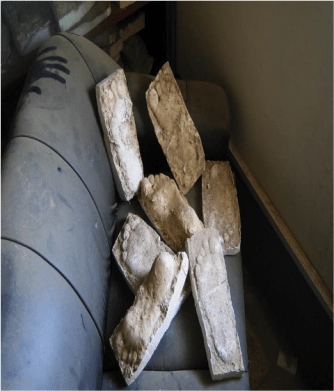
“Hand and Feet”

I caught this image in an evidence examination room in the Al Anbar Criminal Investigations Building. It had been abandoned for over a year and these plaster casts of feet from crime scenes had been moved onto a couch as former Iraqi police had sifted the room for valuable items. It is one of the most important photographs that I have ever taken in that, in the absence of a single person, it is completely human. I seek imagery that proves human presence without relying on the presence of people. The recent hand print in the dust on the back of the couch made this image speak to past, present and evidence of what is uniquely human.

The notion of imagery that “proves human presence without relying on the presence of people” returns me to an idea I introduced earlier:  that Busch’s art, even when it doesn’t explicitly reflect martial images and themes, is about war.  I like toying with this idea in relation to lots of artistic production of the 2000s.  For here, I’ll suggest that Busch’s wonderful short film Bright (2011) is one such work that can be interpreted in the context of our nation’s wars in Iraq and Afghanistan, even though it doesn’t mention them.  In Bright, actor Eric Nenninger plays a young white man so traumatized by an unspecified event that he is not just afraid of the dark but darn near paralyzed in life, too.  He lives in a brightly lit house with an older black blind man—played by Robert Wisdom—who seems to do better coping with his disability than his housemate.  Their post-trauma issues play out in a plot that evokes a national storyline set in motion by 9/11, and perhaps Busch’s personal journey, too.

Short Bright clip:  http://www.youtube.com/watch?v=N97HA1hCczs

The Bright IMDb page:  http://www.imdb.com/title/tt1798611/

All quoted text from War, Literature, and the Artshttp://www.wlajournal.com/19_1-2/busch.pdf

Tim Hetherington

Tim Hetherington was the British photojournalist who collaborated with Sebastian Junger on the making of  Restrepo, the documentary of life on a combat outpost in eastern Afghanistan.  Later, in 2011, Hetherington was killed in Libya during the civil wars there.  His pictures that interest me most are those taken “inside the wire”—soldiers lounging about, roughhousing, or sleeping in their forlorn combat outposts.  The times in-between the patrols and other missions that take them “outside the wire” into the much more dangerous open spaces.

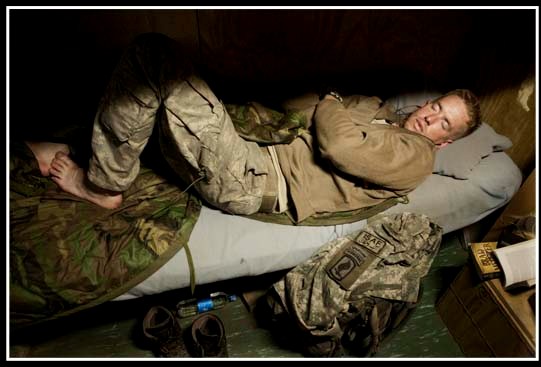
The two pictures below generate impressions and bring back memories.  The first presents a study in shades and textures of brown:

Considered as a slice of deployed life, the photo strikes a nerve that those who haven’t served might not understand completely.  In the Army, “uniform discipline” is a big deal.  The idea is that it is important for soldiers to adhere to uniform standards—everyone at all times in the prescribed uniform.  To uniformity zealots, that soldiers are allowed to idle about shirtless in the daytime is probably the reason things aren’t going so well in Afghanistan on the grand scale.  The breakdown of uniform standards, the thinking goes, is a clear indication of a sloppy, badly-led unit.  More than half believing this sentiment myself, I never let my soldiers in Afghanistan be “out of uniform” in my presence or when they were outside the wire, conducting missions, and otherwise representing the unit.  Be that as it may, the photo speaks more directly to another aspect of the war experience.  The happy soldiers suggest that, death and petty uniform policies aside, life on a combat outpost was a man’s man’s idyll of guns, muscles, and tattoos.  Smoking and joking, they wait for the next battle to begin.

This second picture reflects a more homely moment in outpost life:

Everything about it is characteristic:  the low light, the wood bunk, the “poncho liner” blanket, the gear and water bottles stewn about, the blue bedding and green white-flecked tiles—apparently standard issue across Afghanistan.  The bare feet adding poignancy to it all.  In the first picture, the soldiers laugh by day, stripped nearly naked.  In the second, the soldier, contorted and not looking very comfortable at all, sleeps at night with his uniform on.

Bill Putnam 2

This picture by Bill Putnam shows a US Army patrol taking a brief halt on top of an Afghanistan hill.

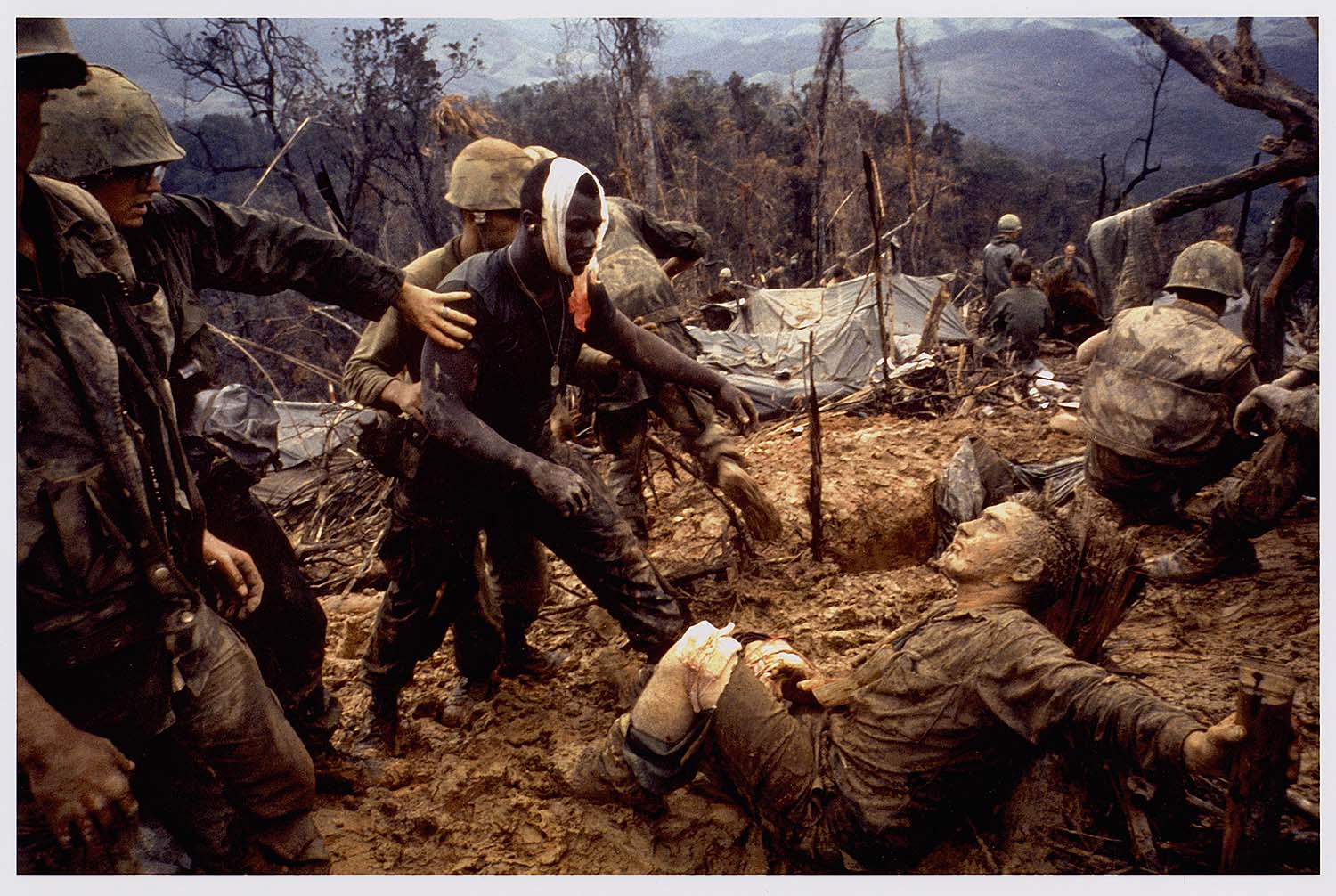
I like it for its muted color palette–grey, green, brown, some black–and the array of emotions reflected in the faces and bodies of the soldiers.  Some are relaxed, others display tension.  Their equipment hangs upon them not obtrusively, but organically, even the weird mounts for night vision goggles that protrude from their helmets like antennas and the M4 in the foreground that seemingly sits far too high on its bearer’s torso.  The way their gazes go off in different directions and the bulb like prominence of the helmets reminds me of Larry Burrows’ great picture of a hilltop scene taken during the Vietnam War:

Burrows’ picture is far more dramatic, of course, and rightfully famous.  But who’s to say the soldiers in Bill Putnam’s picture aren’t themselves minutes away from a similar scene of devastation and carnage?

Bill Putnam 1

I’ll begin populating this blog by featuring some of my favorite Iraq and Afghanistan war photographers.  First up, Bill Putnam.  Bill and I served together on a deployment to Kosovo when he was an active-duty soldier.  Now out of the Army, he has embedded with the 101st Airborne Division on tours in Iraq and Afghanistan.

If you visit Bill’s website you’ll notice his skill at portraiture.

That skill is also featured in this article from the Pittsburgh City Paper.

Here, though, I’ll highlight Bill’s work at greater range, in part because he gave me permission to use these pictures (a while back, and for a different project, true) and in part because they were taken in eastern Afghanistan, where I served.  Most of all, I like the tilt of the rockscrabble terrain, the blue skies and billowing clouds, and the soldiers that stitch the earth and sky together.

The Arts of War

In the spring of 2013 I will teach a class titled “The Arts of War.”  The course will focus on war literature from Iraq and Afghanistan, and the course theme will be the homecoming and aftermath.  Selections from Homer’s Odyssey will get the class started, as will Sophocles’ Philoctetes.  We’ll also look at Hemingway’s In Our Time, particularly “Soldier’s Home,” as well as some other poems, stories, and memoirs from the great tradition of war literature.  Turning to contemporary texts, we will read the following:

Brian Turner:  Here, Bullet and Phantom Noise.

Siobhan Fallon:  You Know When the Men Are Gone.

Benjamin Busch:  Dust to Dust.

Pat Fountain:  Billy Lynn’s Long Halftime Walk.

Kevin Powers:  The Yellow Birds.

Toni Morrison: Home.