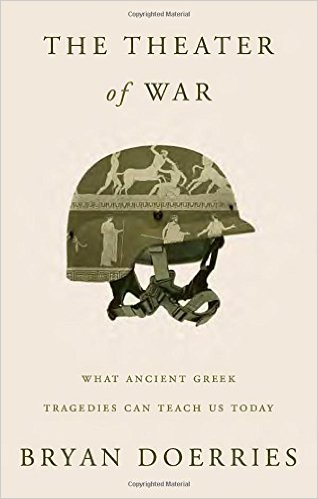
So this is interesting. A classics scholar named Sarah Ruden published on a website called Books and Culture: A Christian Review a scathing review of a book called The Theater of War: What Ancient Greek Tragedies Can Teach Us Today. On another website, Vice, Iraq veteran Colby Buzzell published a glowing review of the same book and included a flattering interview with its author Bryan Doerries. Vice is decidedly not a “Christian Review,” but, war, not religion, is the issue here.
The Theater of War is an off-shoot of a theatrical project of nearly the same name. Formed by Doerries to address battle-related trauma, Theater of War the dramatic project stages readings of classic Greek plays such as Ajax and Philoctetes whose plots feature military heroes in exile and anguish in the years after war. Theater of War productions feature veterans and, sometimes, famous actors, in the lead parts. After the readings are over, Doerries moderates a question-and-answer session that allows cast and audience members to discuss the plays’ relevance to veterans of Iraq and Afghanistan and their difficulty reintegrating into civilian society. The idea is that the plays concern themselves with the psychological damage of war in ways that can be helpful to veterans suffering from PTSD, as well as bringing military and civilian audience members together in dialogue. Theater of War has proven popular, and performances have been staged on several military bases, as well as on many college campuses. Upcoming performances on October 27 and 28 are set for the Guggenheim Museum in New York City.
Ruden, however, is not impressed by The Theater of War. In her review, titled “Art for All of Us: Greek Tragedy and War Veterans,” she offers a few token compliments that praise Doerries’ translating and directing ability, and then switches her critical selector switch from “safe” to “full automatic” and begins engaging targets left-and-right. Ancient Greek tragedy, properly understood, according to Ruden, has little to do with war-related trauma. The Greeks themselves didn’t understand the concept, nor did they ever single out veterans as objects of special social concern who needed public coddling. Jonathan Shay, the psychiatrist who popularized the idea that Greek classics could teach us how to heal veterans with psychological and moral injury, had it all wrong. So does Doerries. The whole belief that “storytelling” can be therapeutic is preposterous. The misuse of art for utilitarian, didactic purposes is a disgrace. Doerries would be better off staging Greek plays for general audiences, to include veterans, and drop the canard that the plays speak meaningfully specifically on behalf of veterans or help bridge the civil-military divide:
“But not only does [Doerries’] set-up keep really glorious adaptations away from the mainstream; it seems apt to deprive the tragedies of the most plausible benefit they could have for the traumatized, which is the benefit of universally shared beauty and meaning. We already ghettoize veterans, not to mention the dehumanizing of and profiteering from prisoners and the terminally ill. ‘Here’s a piece of art designed just for you in your pitiable state’ seems at best a pretty condescending prescription….”
In his review titled “How Ancient Greek Tragedies Can Help Veterans Deal With PTSD,” Buzzell describes approaching the assignment to examine The Theater of War with a skepticism much like Ruden’s, which he expresses equally forcefully, though in the infantryman’s idiom for which he is known:
“To be honest, when I first received this book, I was like, Are you fucking kidding me? As someone who’s witnessed the theater of war up close and personal as an infantryman in the United States Army (Iraq 2003–4) and has lived to tell about it, I found the whole concept to be a bit absurd. I know there’s all sorts of crazy shit out there beyond the conventional VA-prescribed prescription medication and/or therapy sessions to help those returning home after war “adjust”: yoga, nature hiking, scuba diving, filmmaking, horseback riding, tai chi, herbal and dietary supplements, group drum circles, art projects, meditation, ballet dancing, getaway vacations, bright-light therapy, music therapy, companion dogs, medical marijuana, acupuncture, and other such things. But now there’s this bright idea of exposing soldiers to Greek tragedies that were written 2,500 years ago as a way to help those struggling with readjustment issues and PTSD? Get the fuck outta here.”
But Buzzell is also open-minded and curious, in addition to being penetrating and eloquent, and he tells us that after completing The Theater of War he saw a lot in it to like. Buzzell relates especially to Doerries’ descriptions of Ajax, who as Buzzell puts it, “returns home from war and feels as if he’s been betrayed, gets depressed, snaps, goes on a blind killing spree, then kills himself with his own sword.” Yikes! Presumably Buzzell appreciates something Doerries explains about how Ajax might have been saved from himself and restored to health and happiness, but beyond recommending that Theater of War be read by a “larger audience,” Buzzell doesn’t go into much detail about exactly what excites him. The interview with Doerries, however, generously allows the author-director to explain for himself his goals, and more importantly, what he has observed after staging dozens or hundreds of performances of Theater of War. Buzzell’s questions are more interesting, in fact, than Doerries’ answers, but Doerries acquits himself well—modest about making great claims for Theater of War’s scholarly or medical legitimacy, he defends his project on the empirical grounds that audiences have been moved by it and many veterans in addition to Buzzell claim to have been helped by it.
A curiosity of this critical duel, such as it is, is that it seems neither Ruden nor Buzzell have seen an actual performance of Theater of War. I have, and came away from the experience in ways that make me sympathetic to both reviewers (I have not yet read Doerries’ book). On this blog, I have been skeptical of contemporary war lit’s propensity to identify too readily with classic Greek literature, but I certainly welcome chances to view modern adaptations of ancient myths and plays as they come along. Aloof and analytical as I am, though, I was determined to resist notions that the town-hall-cum-Dr.-Phil atmosphere of the performance Q&A meaningfully connected Greek warriors and modern soldiers, or being seduced by the idea that I was participating in an event that channeled the spirit of Athenian dramatic festivals. But the large audience with whom I sat had few such qualms. They responded to the reading with vigorous applause and energetic participation in the post-reading discussion. Even more telling, the specific group with whom I watched Theater of War—a group of military academy cadets who included several deployment veterans—were also enthralled. On the drive home from the theater, we stopped at a McDonalds in the middle-of-nowhere and after eating our meals (a bus-driver’s discount for me for bringing in the group!), we talked late into the night about the performance and how it related to modern war, soldiering, and military leadership. It was as spontaneous and free-flowing a conversation with officers-to-be as I’ve ever been part of, and much of the credit goes to Doerries, Theater of War, and the power of Greek tragedy.
Anybody else think it would be a great idea to invite both Ruden and Buzzell to the upcoming productions of Theater of War at the Guggenheim?
I made my first visit to a VA hospital this week. All initial impressions are positive, I’m happy to report.
Bryan Doerries, The Theater of War: What Ancient Greek Tragedies Can Teach Us Today. Knopf, 2015.
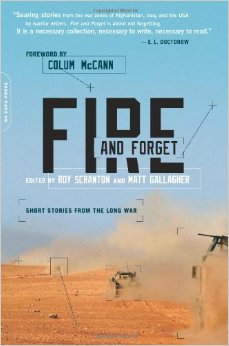
The 2013 Fire and Forget anthology of short war fiction features a who’s-who of established and soon-to-be-prominent war-writing authors.
Ten excellent short stories about war in Iraq and Afghanistan, listed in alphabetical order below by author, with no writer represented more than once. Very subjective, and not definitive, but I wouldn’t walk into a room of war writers without knowing them all. It’s interesting that of the stories featuring American service men-and-women, only one, Will Mackin’s “Kattekoppen,” is set entirely in-theater. Another, Annie Proulx’s “Tits-Up in a Ditch” features scenes set before, during, and after deployment. The others portray soldiers and Marines upon return to the States and feature flashbacks to or reminiscences about Iraq or Afghanistan–the signature narrative moves of contemporary war short fiction so far.
Hassan Blasim, “The Green Zone Rabbit.” The best of any number of diabolically perverse stories in The Corpse Exhibition, a collection of tales set mostly in Baghdad by Iraqi expatriate Blasim, the Edgar Allan Poe of the 21st-century.
Frederick Busch,“Good to Go.” Busch’s son Benjamin served two tours in Iraq and writes like a dream himself, but his father gets the nod here with this early-on (2006) story of a war-damaged Marine.
Siobhan Fallon, “The Last Stand.” Any story in Fallon’s remarkably even You Know When the Men Are Gone could have made the list, but this portrait of the collapse of a wounded veteran’s marriage stands out for its heart-rendering tenderness toward the two protagonists, Kit and Helena.
Mariette Kalinowski, “The Train.” One of three entries on the list from the Fire and Forget anthology (edited by Roy Scranton and Matt Gallagher), Kalinowski’s story of an alienated female veteran remains, as far as I know, the only fiction written by a woman veteran with significant outside-the-wire experience in Iraq or Afghanistan.
Phil Klay, “Redeployment.” There are other great stories in Klay’s collection Redeployment, but the title tale, with its already famous first line, “We shot dogs,” has captured both the public and critical imagination as the saga par excellence of the traumatized vet. “Redeployment” first appeared in the Fire and Forget anthology.
Nikolina Kulidzan, “The Final Cut.” This sizzling story, which appeared in the Veterans Writing Project journal O-Dark-Thirty, portrays directly what other war fiction has tip-toed around or treated demurely: the jangled-up erotic circuitry of redeployed veterans, both men and women.
Will Mackin, “Kattekoppen.” Surreal sci-fi influenced fiction about an artillery battery in Afghanistan; it appeared in the surprisingly war-lit-friendly New Yorker. For more sci-fi inflected short war fiction, see Brian Turner’s “The Last Wave” and Andrew Slater’s “New Me,” both in Fire and Forget.
Annie Proulx, “Tits-Up in a Ditch.” Proulx, like Frederick Busch, is a literary old master in relation to war writing’s young Turks, but her 2008 story anticipates many themes that would become later become commonplace in the works of other authors: women-in-uniform, IEDs, disability, post-deployment disaffection. “Tits-Up in a Ditch” first appeared in the New Yorker.
Katie Schultz, “Into Pure Bronze.” Sharp portraits of American fighting men and women abound in Schultz’s flash fiction collection Flashes of War, but this story of young Afghans playing soccer in Kabul Stadium arguably best showcases Schultz’s impressive powers of imagination and empathy.
Brian Van Reet, “Big Two-Hearted Hunting Creek.” The third story from Fire and Forget to make the list, Van Reet’s bleak and acerbic tale features two of the most-instantly-memorable protagonists of the war writing canon: the badly disabled Sleed and Rooster, two veterans whose physical carnage is more than matched by their damaged psyches.
Honorable mention stories and authors are too many to list, but I hope to give them their due in time.
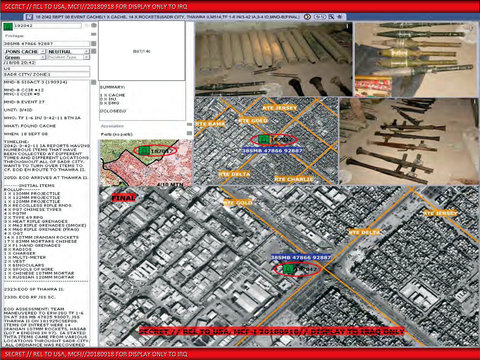
Declassified US Army storyboard published in “The Most Lethal Weapons Americans Found in Iraq,” by John Ismay, October 18, 2013, New York Times.
In the military, there are the things that happen, and there are the ways that the things that happen are accounted for and publicized. The coin-of-the-realm of contemporary military communication is the storyboard, about which little has been written save for a post at my old blog here. The recent catastrophe in Kunduz, Afghanistan, in which a functioning hospital operated by Doctors Without Borders was destroyed by friendly airstrikes has sent the US high command Afghanistan into paroxysms of “trying to get the story right” while doing the utmost in “damage control,” damage defined primarily as harm to the reputation of the command. No doubt dozens of storyboards about the event have already been created and are circulating and competing “at the highest levels” of the military to establish the official response and lasting historical record of whatever-the-hell-happened on the ground (and in the air). They’re all classified, so the general public will never see them, but behind-the-scenes storyboards are serving as the basis for whatever statements about the mess are being released to the media. Here’s to hoping they help current US commander in Afghanistan commander General John Campbell get it right, for I have a high opinion of General Campbell–I knew him slightly as the very competent and sensible brigade operations officer when I was a company commander and fifteen years later he greeted me warmly by name when we ran into each other on a remote Afghanistan FOB.
The following is a story about storyboards I wrote this summer in which I adapted Ovid’s myth of Arachne and Athena to a modern context involving the creation of storyboards in a brigade headquarters in Afghanistan in response to a tactical screw-up. It’s not based on any event in particular, and may or may not have some resemblance to processes currently at work concerning Kunduz.
****
The Brigade Storyboard Artist
Captain Alex Athens had been the undisputed master of PowerPoint storyboards within the brigade headquarters since the unit’s arrival in Afghanistan. No order was disseminated until he had compressed it into a carefully orchestrated one-slide tapestry of photos, maps, graphic symbols, and textual data that prescribed every detail of an upcoming mission from intelligence to logistics to actions-on-the-objective. No mission was complete until he had compiled a perfectly manicured one-page/one-screen garden of text and images representing information, data, assessment, and analysis that thereafter would comprise the enduring record of whatever had happened, no matter what anyone said later on, and each storyboard he created was eminently ready to be submitted up the chain-of-command, if the event or mission recorded was important enough, to “the highest levels” and consequently shape understanding of what was happening on the battlefields and drive policy and strategy decisions. Nominally objective, his storyboards were in reality a representational reality meticulously constructed by Captain Athens’ highly organized, supremely artistic processing of what really realer-than-real soldiers had encountered outside the wire, reported in terse radio reports, scribbled about on notepads, photographed on pocket cameras, and committed to memory as best they possibly could under confusing, stressful circumstances. Though far from the senior officer on the brigade staff, Captain Athens had made himself its most valuable member in the brigade commander’s eyes. No one could tell the story of what was supposed to happen as well as Captain Athens, and no one could better tell the story of what supposedly had happened.
Captain Athens’ success had imbued him with an autocratic, aloof air that made him respected, though more feared than well-liked, among his peers on the brigade staff. In that claustrophobic and deeply unhappy cauldron of furious military endeavor, lots of people grumbled, could be prickly to deal with, and periodically descend into funks, but a spirit of shared servitude, black humor, and forced good cheer generally prevailed, so it was notable that Captain Athens had few friends among the many other staff officers, nor did he seem to bond with the other officers scattered throughout the base. But whether he was liked or not was really beside the point. Since no one worked for him directly, he couldn’t really make anyone miserable personally, so as long as he kept creating storyboards that were better than anyone else’s and were loved by the brigade commander, then that was enough, more than enough, really.
But when Captain Athens went on mid-tour leave, the problem arose of who would replace him as the brigade’s designated storyboard creator. Captain Jones tried, but his storyboards were full of errors and oddly unsynchronized typefaces and needed dozens of revisions before they were ready to be disseminated. Captain Smith’s were OK, but just OK, and he couldn’t complete them in a timely manner, let alone work on two or three simultaneously as could Captain Athens. With Captain Athens gone, both morale and effectiveness within the brigade headquarters plummeted. Without his storyboards suturing gaps between concept and plan and plan and action, uniting the headquarters across all staff sections and up-and-down the chain-of-command, it felt like the brigade was fighting the enemy one-handed. Orders were understood incoherently and execution turned to mush. Storyboards sent higher generated questions and skepticism, or even derision. The brigade commander’s mood turned more horrible than usual and he pilloried his deputy and senior staff members, accusing them of sabotaging the success of his command.
Desperate for help, the brigade ransacked their subordinate units for an officer or staff NCO who might replace Captain Athens. Of course none of the subordinate units wanted to give up their own best storyboard artist, so now they engaged in subterfuges to avoid complying with brigade’s tasking. That’s how Technical Sergeant Arrack’s name got sent up to brigade. In his battalion, he’d been a night shift Tactical Operations Center NCO whose potential as a storyboard artist was unrecognized. An Air Force augmentee to an infantry unit, he had never been outside the wire, much less in combat. Nothing much was expected of him by the infantry bubbas with whom he worked, thus the night shift TOC duty answering routine radio transmissions and compiling the morning weather report. The battalion submitted his name to brigade confident that it would be summarily rejected and they wouldn’t have to replace Sergeant Arrack on the night shift. But Sergeant Arrack’s trial storyboard for brigade had been magnificent. Created to support the brigade’s new plan to engage the local populace on every level of the political-economic-cultural-military spectrum over the next six months, it was a masterful blend of bullet points, text boxes, maps, charts, images, graphics, borders, highlights, and different type faces and fonts, totally first-class in every way and obviously presentable without correction even at “the highest levels.” The brigade operations officer’s heart leaped when he saw it, because he recognized how good it was and was confident that it, and Sergeant Arrack, too, would make the brigade commander very happy.
And so he was, and so for the remaining three weeks of Captain Athens’ leave Sergeant Arrack was the brigade go-to storyboard creator. In twenty-five days he generated thirty-seven unique storyboards in addition to the routine ones that accompanied daily briefings and needed only to be adjusted for recent developments. The entire life of the brigade during that period passed through Sergeant Arrack’s fingertips and into his computer’s keyboard and then to reappear in magically animated form on his workstation screen: raids, key leader meetings, unit rotation plans, IED and suicide bomber attacks, VIP visits, regional assessments, intelligence analyses, and every other operation and event that took place in the brigade’s area of operations was nothing until it was transformed by Sergeant Arrack’s storyboard artistry.
Captain Athens heard-tell of some of this while on leave and didn’t like it. Though overworked as the primary brigade storyboard artist, he liked the status and the attention it brought to him. Truth to tell, he was glad when his leave ended and he made his way back to the brigade headquarters. But his first meeting with Sergeant Arrack did not go well. Sergeant Arrack was seated at his workstation, busy on an important project. Engrossed in what he was doing, he had barely looked up. “Hmmm, good to meet you, sir, I’ve heard a lot about you,” he murmured, and turned his eyes back to his computer screen and began tapping away again at the keyboard. Captain Athens hated him immediately, and he could tell his place within the brigade HQ had now changed. Among other things, people just seemed to like Sergeant Arrack more than they liked Captain Athens, and were eager to work with him, eat with him, and hang out with him, while they approached Captain Athens gingerly. And when the brigade operations officer assigned Captain Athens a new storyboard project, it was obvious that it wasn’t a priority mission, what with the operations officer making a lame excuse about easing Captain Athens back in slowly.
Over the next five weeks, the tension between Captain Athens and Sergeant Arrack bubbled. Captain Athens was now Sergeant Arrack’s superior, and though Captain Athens didn’t do anything totally unprofessional, he didn’t make things easy for his subordinate, either. He assigned him menial tasks such as inspecting guard posts around the FOB walls in the middle of the night and inventorying the headquarters supply vans, all ploys designed to get Sergeant Arrack out of the brigade headquarters while reminding him of his place in things. Rarely did Captain Athens let Sergeant Arrack near a computer and he never complimented him or made small talk of any kind with him. Everyone on the staff saw what was going on, and gossiped about it endlessly, but no one said anything officially, and the atmosphere within the brigade headquarters roiled as a result of the unconfronted animosity. For his part, Sergeant Arrack spoke about the matter only in guarded terms with some of the other staff NCOs. He didn’t want to make trouble, but it wasn’t long before he hated Captain Athens just as much Captain Athens hated him. The brigade commander pretended not to notice anything was wrong, but neither did he tell anyone that he had come to like Sergeant Arrack’s storyboards more than Captain Athens’. The captain’s were good, but Sergeant Arrack’s were better.
The tension between Captain Athens and Sergeant Arrack boiled over when Captain Athens told Sergeant Arrack he was detailing him to the dining facility to conduct headcounts. Sergeant Arrack determined not to take the sleights any longer and complained to the senior Air Force NCO on post who spoke to the brigade command sergeant major who then spoke to the brigade commander. The conversation between the commander and the command sergeant major took place at an auspicious moment, however. The night previously a raid to capture a high value target had gone very wrong. The intended target had not been at the objective and the military age male who had responded to the noise outside the family kalat walls with an AK-47 in his hand and subsequently shot by the Americans had been a nephew of the provincial governor. That’s not to say he couldn’t have been Taliban, too, but there was no proof that he was, and his death would certainly demand explanation. Next, a woman in the kalat, distraught and angry, had charged the American soldiers, and she too had been shot. As the unit had waited for extraction from the already botched mission, the helicopters coming to get them had identified a group of gunmen a klick away from the landing zone. Not taking any chances, the helicopter pilots had opened fire on the shadowy shapes in their night vision goggles, but the gunmen turned out to be a platoon of Afghan army infantrymen on patrol with their American advisor team. Even worse than worse, the advisors had done most things right—they had had their mission plan approved, called in all their checkpoints, and marked themselves and the Afghans appropriately with glint tape and infrared chem lights that should have made them recognizable to the helicopter pilots–but once buried deep in the mountain valleys their comms had gone tits-up and they couldn’t talk to anyone quickly enough to forestall the attack from above. So now the airstrike was a cock-up of the highest order and six Afghan soldiers, along with the two civilians, plus one American soldier, were dead, and higher headquarters was screaming for information and the Afghan provincial governor was outside the door demanding to know what the brigade commander was going to do about it.
If any event was going to be briefed at “the highest levels,” it was this one for sure, and the brigade would need the best damn storyboard anyone had ever created to make sure the right narrative and message were conveyed or the mess would even grow bigger. It wasn’t just that the facts had to be right, the tone had to be perfect, or even more than perfect, if that was possible. The storyboard had to signify that the mishap in the dark night was just an unfortunate blip in a continuum of fantastically positive things that were happening and that everything was under control, that the brigade had this, would get to the bottom of things, learn the appropriate lessons, take the right actions, punish appropriately who needed to be punished, and just generally get on with it without any help from higher and especially without the basic competence of the unit, which meant the reputation of the brigade commander, being put up for discussion.
The brigade command sergeant major, oblivious to the events of the night before, walked into the brigade commander’s office at 0730 to discuss the Sergeant Arrack situation. Normally the brigade commander would have cut him off, but the mention of Sergeant Arrack’s name gave him an idea. He would have both Captain Athens and Sergeant Arrack build storyboards describing the events of the previous night. It would be the ultimate test, he thought, to build the best storyboard possible under the most trying conditions imaginable, and whichever storyboard was best would go a long way to forestalling tidal waves of scrutiny from above. The brigade commander issued directions to the operations officer and the operations officer passed the word to Captain Athens and Sergeant Arrack. Each commandeered a workstation with an array of secure and non-secure laptops spread out in front of them and multiple oversized screens on which to project their designs. They gathered records of radio message traffic and patrol debriefs, both hard-copy and digital, pertinent to the botched mission and opened up all the necessary applications on their computers. Each was told they had full access to anyone they needed to gather information and reconcile conflicting reports, but they had only two hours to complete their work and send their storyboards to the brigade commander, who of course would pick the one to be sent to higher. Captain Athens and Sergeant Arrack fueled themselves with energy drinks, snacks, and dip, and got to work. After two hours of furious endeavor, each pushed save one last time and sent their storyboards forward.
Captain Athens’ storyboard was good, real good. The brigade commander gazed at it on his computer screen and admired its very organized and aesthetically pleasing appearance. In the upper left corner was the required administrative information—unit name, date-time group, security classification, etc. Down the left border was a timeline, in great detail, of all the events that had taken place on the mission. In the upper-half-center was a map that showed the locations of the night’s major events. Each was marked with a succinct, well-turned description of what had occurred in each location. Below the map were four pictures, each dedicated to showing a different aspect of the night’s events. On the right were a series of summarizing statements that prudently listed complicating factors, actions already completed in response to the disaster, and actions planned to be taken in the name of damage control. Everything was done extremely competently, perfectly positioned, not a thing out of place. Borders, background, font and font-size were all to standard. It exuded the professionalism of a unit that had its shit together in every way and as such would undoubtedly forestall questions and offers of unwanted help. The brigade commander was pleasantly surprised; Captain Athens had come through in spades.
Then the brigade commander opened the email attachment sent by Sergeant Arrack. The PowerPoint slide clicked into focus and the brigade commander gasped, for what appeared was not what he expected and could hardly even be said to be a storyboard. Unbeknownst to the brigade commander, Sergeant Arrack had been up all night trying to resolve a problem with his daughter’s childcare plan back home in New Mexico. The situation still wasn’t right when he had gone to chow in the morning. At the dining facility, he sat with a group of soldiers from his old infantry battalion who filled him with stories of how shitty things had gone down on last night’s raid. When Sergeant Arrack arrived at brigade, a scorching email from his ex-wife greeted him accusing him of not fulfilling the requirements of their divorce decree. Then the operations officer gave him the mission to make a storyboard that would cover the brigade’s ass about the fucked-up raid, and do it in so-called “friendly” competition with an officer whose guts he hated, and vice-versa. “Fuckin’ fuck this fuckin’ horseshit,” he had muttered as he settled into his workstation.
Sergeant Arrack’s creation was immediately arresting, no doubt, but it had little obviously to do with the mission the night before. Instead, Sergeant Arrack had created a gruesome montage of horrific war-related images, snippets of military operations orders and Persian script, along with smears of colors, mostly red and black. The most striking image was that of an Afghan man with a knife sunk to the hilt in the side of his head. Somehow the man’s countenance teetered between that of an extremely gaunt but handsome young Afghan and a skullish death-head whose vacant eye-holes bore into the viewer like the gaze of doom. It was as if Sergeant Arrack, an extremely talented artist, had perceived the assignment as a chance to portray the hellishness of war as effectively as possible, without a touch of romantic idealization of its dark side, and had done so in way that manifested both supreme imaginative power and technical skill. The whole thing, beautiful and terrifying at the same time, constituted a huge FU to the Army mission in Afghanistan generally and to a brigade he no longer cared about personally.
The brigade commander expressed mild concern about Sergeant Arrack’s state-of-mind—“Holy shit, Sergeant Arrack has lost it!”—but he was too busy to either take offense or worry much about Sergeant Arrack now. He of course selected Captain Athens’ storyboard as the competition winner and with no changes immediately forwarded it to his boss accompanied by a note explaining that he was in full control of the response to the calamities of the previous night. He then told Captain Athens to look out for Sergeant Arrack but under no circumstances did he want to see him in the brigade headquarters again. Captain Athens didn’t have any problems with the order and even gloated a little that his competitor had cracked up under the pressure of the tough assignment. Sergeant Arrack’s perverted storyboard might be museum quality but that’s not what mattered now. Working with the command sergeant major and the Air Force liaison NCO, Captain Athens placed Sergeant Arrack on 24/7 suicide watch for a week and then reassigned him to the FOB fuel point in the motor pool. Now, instead of building slides in the air-conditioned brigade operations center for review at “the highest levels,” Sergeant Arrack pulls twelve-hour shifts in a plywood shack annotating fuel delivery and distribution on a crumpled, coffee-stained spreadsheet secured to a dusty clipboard. To kill time during the hours when absolutely nothing is happening, he sweeps spider webs from the corners of the office.
 So this is interesting. A classics scholar named Sarah Ruden published on a website called Books and Culture: A Christian Review a scathing review of a book called The Theater of War: What Ancient Greek Tragedies Can Teach Us Today. On another website, Vice, Iraq veteran Colby Buzzell published a glowing review of the same book and included a flattering interview with its author Bryan Doerries. Vice is decidedly not a “Christian Review,” but, war, not religion, is the issue here.
 Time Now: The Wars in Iraq and Afghanistan in Art, Film, and Literature