On Stage in New York and New Jersey

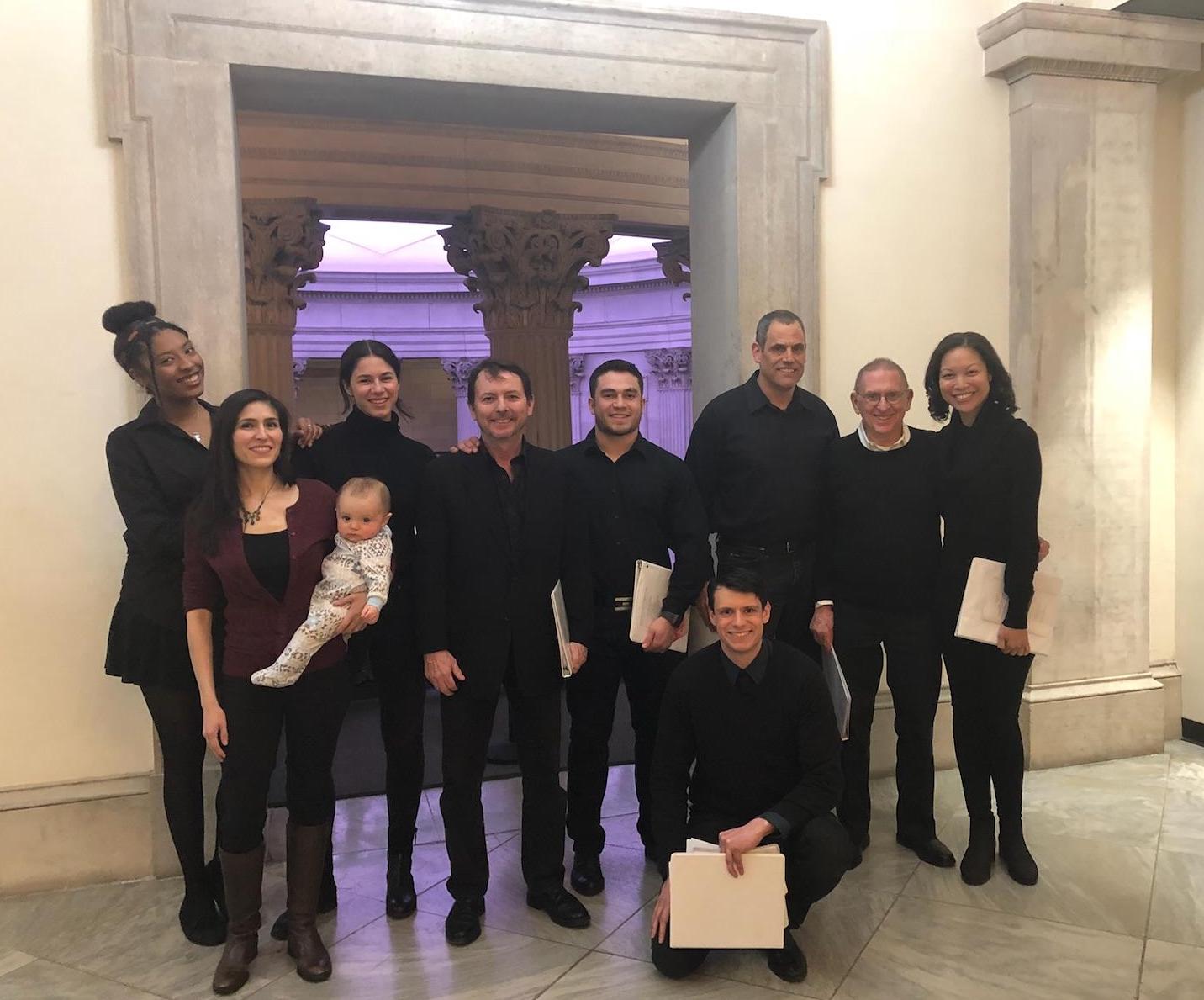
The cast of Autumn Ever After, with John Meyer kneeling in front and Karen Alvarado holding baby Mateo.

John M. Meyer, an airborne-Ranger Army veteran of Iraq and Afghanistan, has turned himself into a playwright-actor-director-producer of great talent and productivity. While a student at Texas, Meyer wrote and acted in a play titled American Volunteers and had another play he authored, Cryptomnesia, performed by Lawrence University in Wisconsin. Since moving to New Jersey with his wife Karen Alvarado, who just graduated from the Rutgers MFA acting program, Meyer has remained busy in theater while working on a PhD dissertation on British World War II legend Orde Wingate. I go to many Rutgers theatrical productions, and Meyer and Alvarado live across town from me, but I first met Meyer when he emailed me out of the blue to discuss a play he was writing. Called Westhusing in the House of Atreus, it was based on the life and mysterious death in Iraq of Colonel Ted Westhusing, an infantry officer and philosophy professor at West Point whom I knew well. The play—as yet unproduced—combines Meyer’s interest in contemporary war with Greek and Shakespearean theater, as the play riffs on themes from classic mythology and large swaths of it are written in blank verse. Later I watched Meyer act in two plays in New York City, Philoctetes and Our Trojan War, and Alvarado perform leading roles in two Rutgers plays, one an all-female production of Julius Caesar (she played Marc Antony) and the other Federico Garcia Lorca’s Blood Wedding. Last summer, my wife and I hosted a parlor play in our apartment titled The Priceless Slave, written by Meyer and starring Alvarado.

I was recently drawn even further into the Meyer-Alvarado orbit when they asked me to join a writing group they had organized under the auspices of Aquila Theater’s Warrior Chorus. For several years now, Aquila Theater has robustly sponsored plays that combine interest in contemporary war and Greek classics (including the aforementioned Philoctetes and Our Trojan War). This cross-pollination speaks to the background of Aquila Theater executive director Peter Meineck, a Brit who served in his own nation’s army before obtaining a PhD in the Classics and a teaching position at NYU. Meyer’s bent is much the same as Meineck’s, and under his leadership nine of us gathered on Friday nights for two months to brainstorm ideas for a crazy-quilt adaption of Midsummer Night’s Dream and two Greek classics, Aristophanes’ Frogs and Euripides’ Hippolytus we called Autumn Ever After. The end-result, which we performed in two staged readings, did not feature a particularly martial theme, but all the participants were either veterans or family members of veterans. Our Warrior Chorus writing group was one of four, each led by a vet-theater veteran (Jenny Pacanowski, Neath Williams, and Dan Murphy, by name) and featuring vets in writing and performing roles, so many thanks to Aquila Theater for its generous support of the cause and for facilitating my stage debut, late in my late-late-late middle-age.
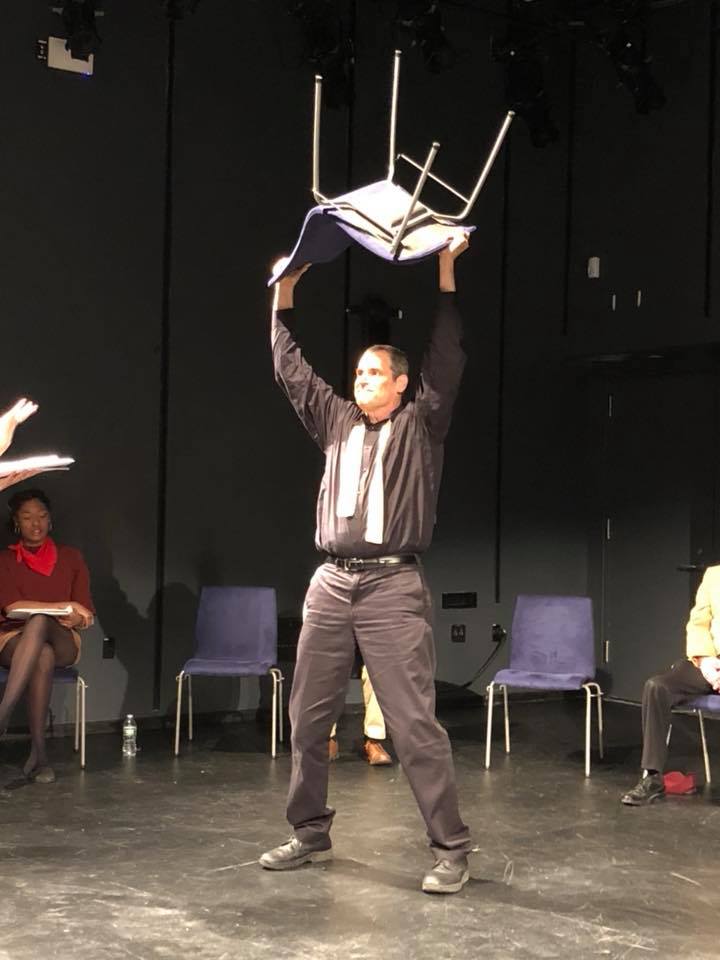
My theatrical debut, as Herakles, no less–a role I was born to play?

A second recent Meyer-Alvarado production, even more central to the subject of contemporary war theater, is Bride of the Gulf, a play about Iraqi civilian and British soldier interaction over ten years in Basra, Iraq. Written by Meyer and directed by and starring Alvarado, Bride of the Gulf recently completed short runs in New York City and New Brunswick, NJ, in preparation for a run at the prestigious Edinburgh Festival Fringe in Scotland later this summer. A publicity blurb describes the plot economically: “Amid the violence that engulfed southern Iraq in 2007, a sharp-witted Iraqi woman searches for her missing husband at the behest of her mother-in-law.” The blurb doesn’t do justice to the complexity of the characterization, which includes British soldiers and news crews and sectarian militiamen, in addition to Iraqi non-combatants whose lives are ruined by war. The acting, featuring Alvarado as the bereaved bride (“Bride of the Gulf” is also a nickname for Basra) and a cast of American and American-Iraqi actors, was intelligent and vibrant. Even better was the staging:  a mesmerizing swirl of movement, speech, sound, music, light, and image. Overall, it was intriguing to watch a play about the Iraq war written and performed by (mostly) Americans that doesn’t make the physical suffering and moral anguish of American soldiers its subject and isn’t beholden to strict straightforward linear narration and representations of reality. From my short acquaintance with Meyer and Alvarado, I’ve learned that their sense of what a play can do and be is expansive. Never staid, too-talky, or one-dimensional, a Meyer-Alvarado production makes use of a wide range of stagecraft possibilities to generate immediate effect and lasting resonance.
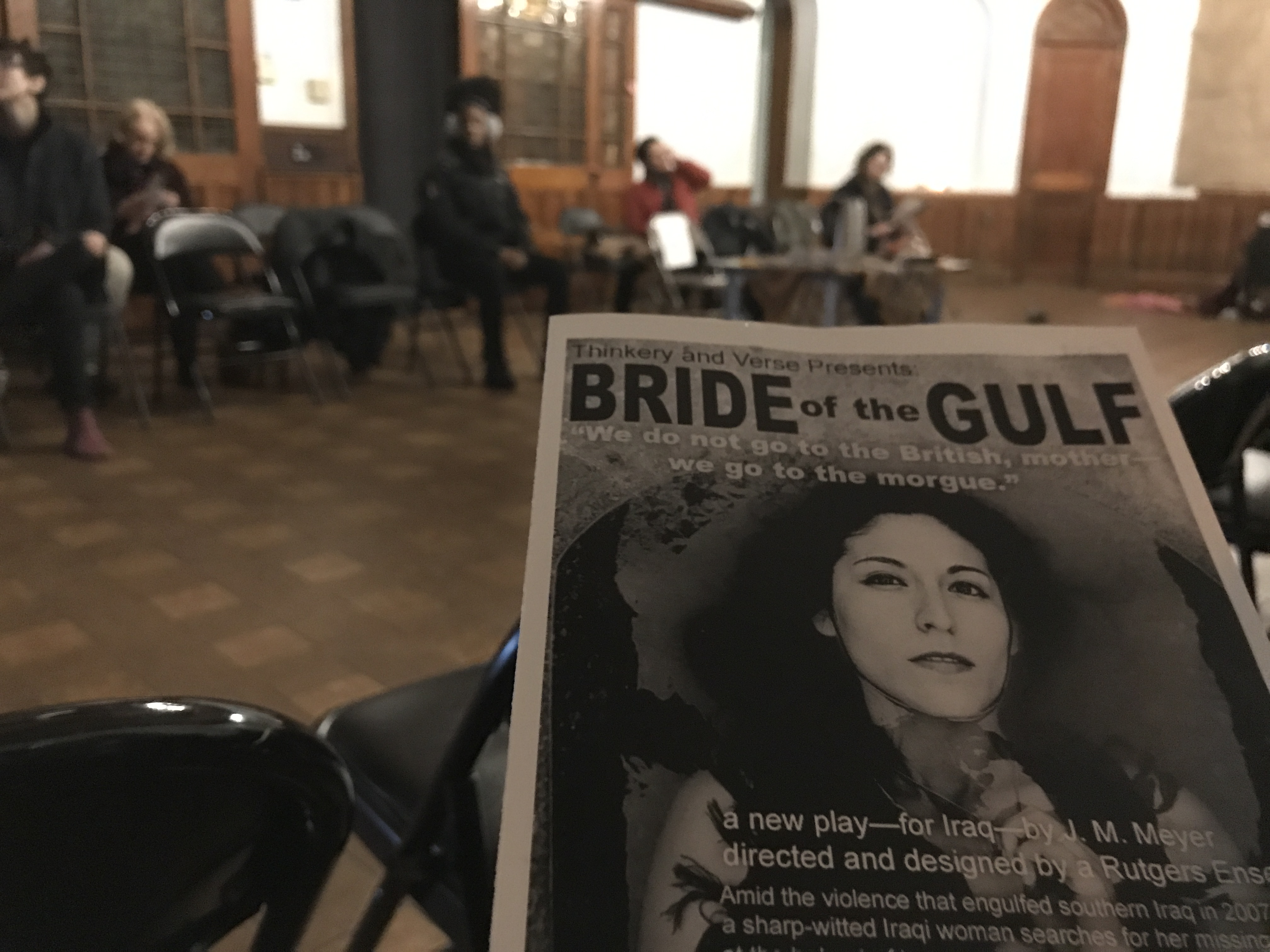
Bride of the Gulf, before the lights go down.

Many thanks to my Autumn Ever After castmates, from left to right in the picture above:  Andrea Bellamore, Melina Schmidt, James P. Stanton, Frank Dolce, Lou Bullock, and Nelly Savinon.
AWP18-Tampa, FL

The annual AWP writers’ conference is a feel-good affair more suited for socializing and networking than serious literary pondering. So it was this year, too, in Tampa in March, even as the writing, reading, and publishing throngs arrived stunned by the preceding year’s political tumult. In sunny warm Tampa, however, they–we–took not just solace in each other’s company, but positive good cheer and mutual uplift. This split response—a public hail-fellow-well-met spirit belying the dismay expressed privately at home and at the keyboard—extended even to the war-writing crowd. Serious issues lay on the table, such as the increasingly problematic position of veterans in the overheated contemporary public sphere and the could-be-much-better gender and race demographics of modern war-writing. But those heavy-duty matters took a backseat to catching up with old friends and meeting new ones.

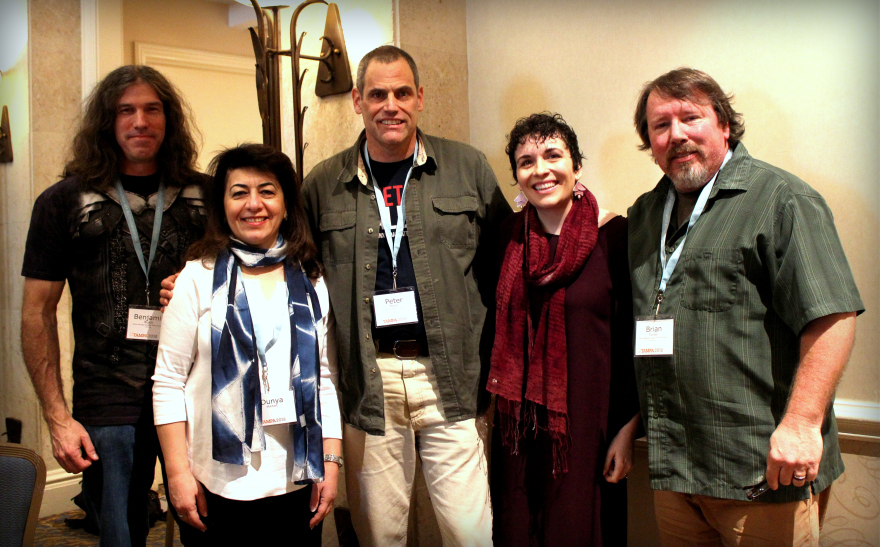
The pattern was evident at the panel I moderated, titled “Crisis, Conflict, and Verse” and featuring an all-star quartet of poet-authors: Brian Turner, Benjamin Busch, Jehanne Dubrow, and Dunya Mikhail. We drew the dreaded 9:00am Saturday morning time-slot, which, along with our forbidding title, conspired to drive attendance downward, as if our topic was just too depressing to contemplate with memories of Friday night festivity still swirling in the brain, along with the fumes of five or ten beers. And truthfully, we kind of frightened ourselves, as first Busch, then Dubrow, and finally Mikhail paradoxically found powerful words to express how their belief in the power of the word has been shaken by recent political and cultural turns. Turner, even as he reported reeling not just from the national state-of-affairs but the agony of his wife Ilyse Kusnetz’s death in 2016, sensed gloom settling in and took it upon himself to infuse our proceedings with levity and hope. Levity, by performing with the always-up-for-anything Busch an impromptu dramatic enactment of the Kay Ryan poem “The Elephant in the Room”  and hope by speaking movingly about the importance of friendship and art in the dark days of loss and despair.

The rest of AWP was, for me, a blur of hits-and-misses. I arrived too late to catch a panel organized by veterans studies scholar Mariana Grohowski titled Women, War, and the Military: How to Tell the Story featuring Helen Benedict, Jerri Bell, Tracy Crow, and Mary Doyle, so I’ll leave it to others to report on its proceedings. It’s a great subject, though, one on many people’s minds these days, as both the military and mil-writing-and-publishing scene confront a variety of gender-related problems. MIA at this year’s AWP unfortunately were the authors of several notable 2017 war novels, such as David Abrams, Brian Van Reet, Elliot Ackerman, and Siobhan Fallon, so we weren’t able to hear their thoughts about their recent books and their reception. The online war-writing community was heavily represented, however, with principals from The War Horse; War, Literature, and the Arts; Wrath-Bearing Tree; the Veterans Writing Project/O-Dark-Thirty; and Consequence on-hand, their strength-in-numbers perhaps suggestive of a movement of the war-writing center-of-gravity from the page and the book to the wide-open, fast-moving digital realm.

Mostly though, AWP was about more personal pleasures, such as meeting for the first time authors I admire such as Seth Brady Tucker, Brooke King, Phil Metres, and Steve Kiernan. A dinner with Ron Capps and a small group of Veterans Writing Program mainstays was a joy. A panel on James Salter, whom I consider one of the patron saints of Time Now, held during the last time slot of the conference and attended by me and three others in one of the largest presentation halls at the convention, was as full of inspiring things as I hoped it would be.

Finally, though it’s become a cliché to write about interesting conversations with Uber drivers (like, “OOOO, I’m SO in touch with toilers in the gig-economy boiler room”), the four I had to-and-from my faraway motel offered fascinating glimpses into the lives of south Floridians. One driver was a Coptic Christian immigrant from Egypt, another worked days rehabilitating sex offenders, a third reported that he was getting married in a week, starting a business, and buying a house two years after finding himself broke and homeless, and the fourth had funny tales to tell about late-nights transporting Tampa Bay Buccaneers home from the clubs. I found the drivers’ stories intriguing and encouraging, on the whole. Somewhere in them I caught glimpses of the levity and hopefulness Brian Turner would have us remember, glimpses of people who had not been defeated.

Photo of Benjamin Busch, Dunya Mikhail, me, Jehanne Dubrow, and Brian Turner by Andria Williams. More photos by Williams here.

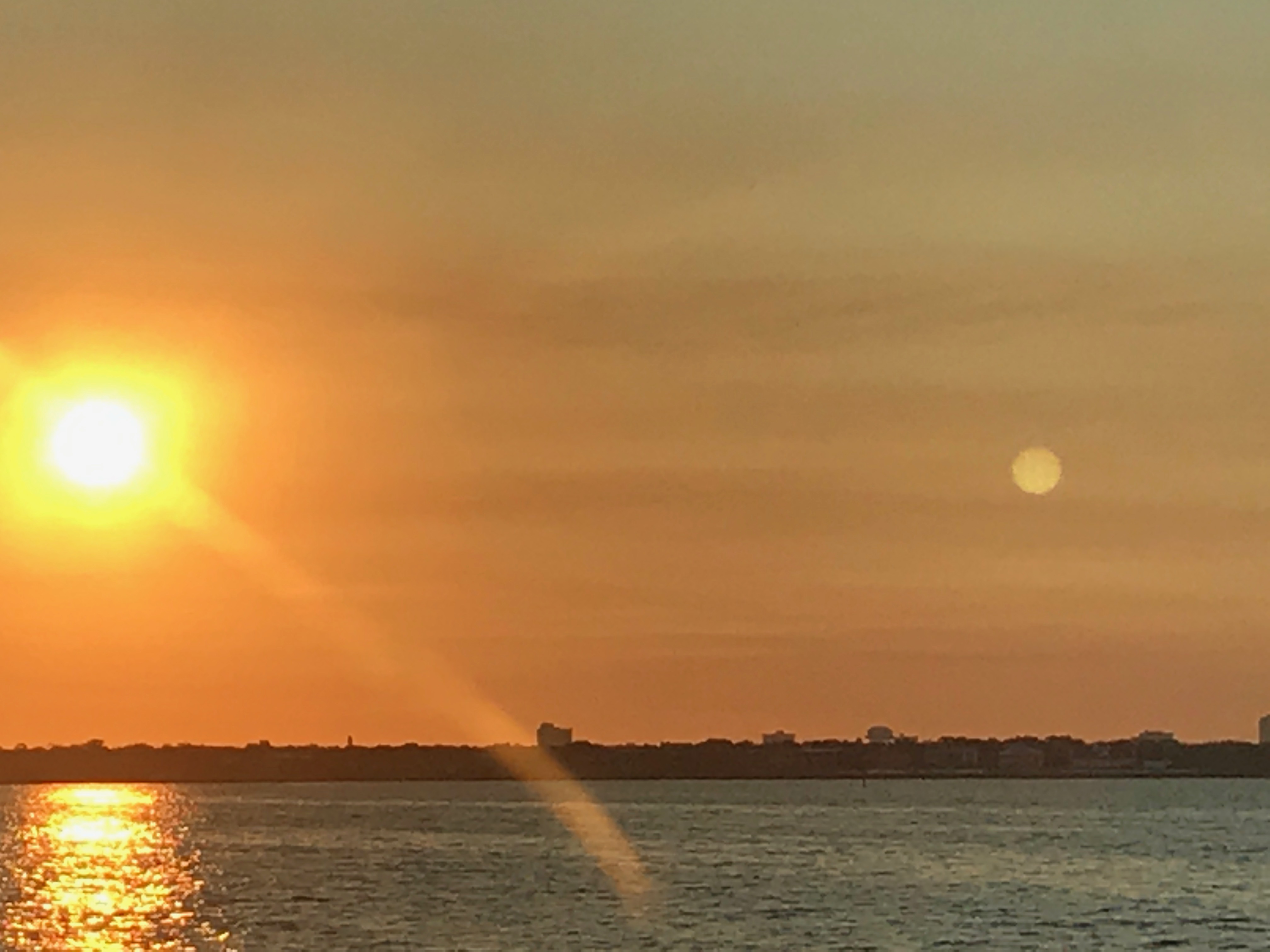
Approaching Tampa across the causeway in the AM. That would be so cool if the round orb on the right were the moon, but alas it was just a spot on the car window.

To the Veterans Writing Project!

For the last two years I’ve served as the online Mentoring Program Coordinator for the Veterans Writing Project. In the role, I arranged approximately 80 partnerships between aspiring veteran (and some active-duty) writers and seasoned authors, teachers, and writing coaches. It’s been rewarding, and not just because I think I’ve played a part in helping veterans find their writing voices. Equally gratifying has been meeting the talented, generous volunteers who have offered substantial, generous feedback and inspiration to veterans near the beginning of their writing journeys. The focus of Time Now is literary fiction and poetry (and some memoir), most of it authored by veterans with advanced degrees and published by big-time publishers and periodicals. My work with the VWP, on the other hand, has been at the grassroots level. Trying to understand the hopes of VWP aspiring writers has been a marked counterpoint to discerning the more sophisticated concerns of, say, MFA-trained veterans competing for National Book Awards. I won’t say that being the Mentoring Program Coordinator has necessarily kept me in touch with veteran-writing street (I’m a retired 05 with a PhD pushing 60, after all), but to the extent that I have helped anyone at all, I like to think that my work has aided fellow veterans who have not had the advantages I’ve had.

The veteran writers cover a wide range demographically. Many have been Vietnam veterans, still trying to sort out their war experiences fifty years later. Most though are younger—Iraq and Afghanistan veterans—and about half have been women. The majority of aspirants are writing memoir, with fiction and poetry the next largest genres, but authors of articles, essays, screenplays, drama, song, and mixed-media genres have all been well-represented. Many are dealing with traumatic experiences, have not had happy tours in uniform, or seem not to be prospering now—I’ve had many veterans without computers of their own send me drafts tapped out on phones or public library terminals. While some vet-writers have dreamed openly of commercial success, many more have couched their desire to write in terms of therapy, search for understanding, and desire to record and document. I’ve long since lost track of the number of Mentor Program vet-writers who have placed pieces in print, which is great, but the real reward has come in heartfelt testimonials vet writers have sent me thanking me for putting them in touch with their mentors.

To the mentors—thank you. Several mentors are friends and a few are familiar names to readers of Time Now, but most I will never meet, though I’ve enjoyed getting to know you and your own work electronically. It’s inspiring to know that there are people like you out there—interested in writing and ready to invest in the lives of strangers.

It’s time now (no pun intended) to give up the duty, but, fortunately, a worthy successor has already volunteered to take over as Mentoring Program Coordinator: Jacob Agatucci, an Army vet now a professor at Central Oregon Community College. If you are an aspiring vet-writer with a draft of work in hand for which you would like a sympathetic reader, contact Jake at jake@veteranswriting.org. If you are a published writer or writing teacher or coach who would like to mentor aspiring vet-writers, write Jake at the same address. To both groups, your work is important and will be appreciated, and you will not be alone going forward.

Finally, thanks to Veterans Writing Project founder and director Ron Capps and other VWP principals such as Jerri Bell, Jim Mathews, Dario DiBattista, and Carole Florman for letting me be part of the team. Don’t ever stop what you are doing!

Veterans Writing Project Mentor Program webpage here.