Matthew Komatsu, an Air Force pararescue jumper, has twice now published articles reflecting his love for Joseph Heller’s satirical World War II novel Catch-22. Both pieces argue that Catch-22, great in-and-of-itself, especially resonates for Iraq and Afghanistan vets by accurately reflecting the inanity of military bureaucracy and the self-serving incompetence of senior military officers they themselves observed on deployments. In other words, Komatsu believes that as much as looking back at World War II, Catch-22, published in 1961, anticipates the devolution of America’s military from a world-beating titan to a force expert at perpetuating wars ad infinitum, but never winning them. The proverbial self-licking ice-cream cone….
It’s an argument hard-to-argue with, at least the part that pertains to actual US Army military endeavor in Vietnam, Iraq, and Afghanistan. I encourage you to read both of Komatsu’s articles; if you have served, you will certainly find many parts to which you can relate.
Why ‘Catch-22’ Is The Closest Thing To The Truth About The War
Somewhere in The Great Beyond, Joseph Heller is Having a Bitter Laugh About ‘The Afghanistan Papers’
Not as easily available is an essay on Catch-22 I contributed to a student study-guide anthology published in 2021 by Salem Press. The guide, titled Critical Insights: Catch-22, is part of a series aimed at undergraduates and advanced high-school students. My piece, co-authored with Iraq and Afghanistan vet J. M. Meyer, is titled “Yossarian bleated faintly: Catch-22 and Military Experience in the New Millennium.” In the volume Introduction, editors Laura and James F. Nicosia write, “This essay is an eye-opening contribution by scholars who have first-hand experience in and knowledge of the military.”
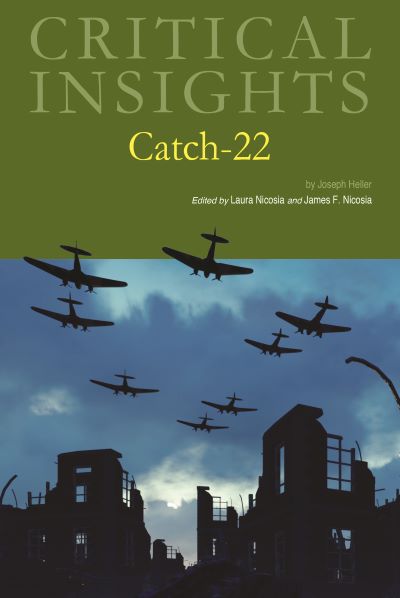
My contribution to “Yossarian bleated faintly” is a run-down of reasons Iraq and Afghanistan veterans continue to reference Catch-22 to describe their own wars. I reference Komatsu’s “Somewhere in the Great Beyond” Catch-22 article, and I also explore some of the war-lit authored by vets that clearly pays homage to Catch-22. From there, Meyer mounts a more ambitious, trenchant argument about how Catch-22 relates to larger matters of contemporary culture and political discourse.
There’s no digital version of the chapter available (yet), and it’s still too soon post-publication to just reproduce it for free here, so I’ll summarize my contribution and offer a couple of passages.
On rereading Catch-22 last year, I was struck by how dark and grim much of it is. In my memory were all the funny bits lampooning military absurdity and dysfunction. Also in mind was a notion of the protagonist/anti-hero Yossarian riding above the fray, his anti-authoritarian cleverness keeping him one-step ahead of the madness. That’s there, but there’s a lot I didn’t remember as well, such as how genuinely shaken is Yossarian by what befalls him, to the point, by the end of the novel, of mental instability (an instability that is reflected in increasingly hallucinogenic scenes and episodes, as well as in the prose style). In the essay, I invoke two au courant words, trauma and PTSD, and consider their relevance to Catch-22:
The unpleasant consequence of Yossarian’s psychological turmoil, grounded in moments of real terror in the sky, is trauma, which adds emotional resonance experienced personally to the larger critique of military dysfunction in ‘Catch-22.’
Toward the end of my section, I try to reconcile Yossarian the traumatized war-victim with Yossarian the insubordinate provocateur, and then link those traits to the jaded-and-wounded outlook of many Iraq and Afghanistan junior enlisted and junior officer vets:
His colorful contempt for military bureaucracy and the chain of command, as well as his acuity in knowing how to push the buttons of stuffed shirts and uptight frauds, are generally humorous to behold and arguable safe to indulge in even by soldiers who volunteered for service.
Reconciling the insubordinate mischief-maker with the death-shaken traumatized victim of war is central to understanding Yossarian’s enduring influence, especially among twenty-first century soldiers and veterans of Iraq and Afghanistan. In response to nonsensical wars, a modern soldier sensibility has emerged that blends elements of Yossarian’s dominant characteristics and and given them contemporary expression, primarily by using humor to convey a righteous moral and intellectual superiority that has brought soldiers to war on ludicrous premises and then ineptly organized itself to fight. The sentiment accounts for the emergence of two distinct cohorts of disgruntled soldiers and junior officers prominent within the modern soldier-and-veteran community. Known respectively as the “E4-Mafia” and the “jaded junior officer,” these unofficial cohorts constitute most evidently the spirit of ‘Catch-22’ in the modern military. The E4-Mafia (or, as they are know in the Marines, “Terminal Lances”; thus the title of Maximilian Uriarte’s satirical comic strip) consists of soldiers in the rank just below that of sergeant who, in the manner of ‘Catch-22”s ex-PFC Wintergreen, claim to be the true agents of military daily duty, adept at pulling strings and making things happen in the name of making the bureaucracy run, while all-the-while possessing jaundiced contempt for the military that makes them defer [obsequiously] to superior officers. The jaded junior officer motif refers to lieutenants and captains exasperated by military rigamarole and incompetent senior officers. Feeling marginalized and unappreciated, veterans of this stripe have turned to memoir, fiction, and the Internet to exact their vengeance….
In other words, ridicule, satire, and laughter serve as dominant modes of expression for soldiers who don’t like what they see, and in fact may be really hurting, but also understand they damn well volunteered for it. I have much more to say on the issue, to include a breakdown of contemporary war lit works that most directly reflect the spirit of Catch-22, but this is all I’m going to give away here. If you really want to read more, and I know you and like you, write me an email, and I’ll share a PDF of the entire piece. Otherwise, Critical Insights: Catch-22 is available for sale online and might be available in your local school or college library.
Critical Insights: ‘Catch-22.’ Edited by Laura Nicosia and James F. Nicosia. Salem Press, 2021.



 Time Now: The Wars in Iraq and Afghanistan in Art, Film, and Literature