The contemporary war lit corpus of poetry, fiction, and memoir has covered a lot of ground, but has had little to say so far about the presence of gay men and women in uniform. Jesse Goolsby’s I’d Walk With My Friends If I Could Find Them contains a gruesome male-on-male rape scene, and Matt Gallagher’s Youngblood features a cameo appearance by a closeted company commander, but that’s about it in terms of fiction published by big-name publishing houses. Poetry, nothing comes to mind, either, though an exhaustive search of vet writing anthologies and web publishing sites would surely turn up something. Jeffrey McGowan’s memoir One Gay Man’s Life in the Don’t-Ask-Don’t-Tell Military, published in 2005, is interesting, but McGowan left the Army in 1998. Playing by the Rules, by gay former Marine Justin Elzie, was published in 2010, but Elzie was out of the Marines long before 9/11. Amazingly, as far as I can tell, no book-length memoir by a gay or lesbian Iraq or Afghanistan veteran has yet appeared. Please, somebody, tell me that I’m wrong.
Maybe what I’m describing is a good thing. Everyone’s more accepting now, right, and Don’t Ask Don’t Tell has been repealed and gay Americans can finally serve openly. There’s nothing about a service member’s sexual orientation that would by itself make it an interesting subject for fiction, verse, or memoir, correct? No war writer I know is a homophobe (or misogynist or racist), so I’ll bet if you asked them about the absence of gay characters in their works they would say it just didn’t occur to them, given the story they were trying to write. Heck, hetero-normative soldier sexuality has barely been touched in published fiction, save for, on the crude side, passing references in a number of works to FOB port-a-pottie coitus, and on the deft side, the short fiction of Siobhan Fallon and the under-the-grandstand quickie flamboyantly described by Ben Fountain in Billy Lynn’s Long Halftime Walk. Maybe that’s fair—too much relationship and erotic stuff and a war novel becomes something other than a war novel, the way these things are probably understood by those most interested in writing and reading war stories. Romance, maybe, or erotica, or least interesting of all, women’s fiction, whatever that phrase means in the minds of book buyers and readers.
Whether all the above is a result of publisher decision-making or authorial disinclination to address Don’t Ask Don’t Tell-related issues, I don’t know. But these musings bring us to Scott D. Pomfret’s You Are the One, which came out earlier this year. Pomfret is a many-times-published author in the thriving gay literature underground; You Are the One is one of six books he’s written for gay-oriented publishers. You Are the One contains thirteen stores published in gay literary journals between 2005 and 2015, four of them directly portray gay military members before, during, and after deployment to Iraq or Afghanistan and all interestingly open up heretofore unexamined vistas on the lives and worldviews of soldiers that both help describe modern sexual behavior and transcend the merely prurient sexual. In “You Are the One,” a super-femme civilian narrator finds himself in strange cahoots with his lover’s company commander to guard the sexual orientation of the narrator’s lover. In “Transport,” a battle-hardened sergeant preys on one of his junior enlisted soldiers while on mission in Iraq. “Swagger” describes a bar hook-up between a special operator and the son of a Vietnam veteran. In “The Casualty Assistant,” a gay casualty assistance officer consoles the widow of a soldier killed overseas.
All are interestingly conceived and plausible enough, given what I’ve seen and read over the years. Though Pomfret is not a veteran, he gets the details right and his stories engage on many levels beyond the erotic; he is a fine writer in terms of his eye for nuance and ability to craft a quality sentence. All the stories, save “The Casualty Assistant,” contain graphic sexual scenes, which though cool in terms of frankness and cheap voyeurism, distract somewhat from the larger tales being told. In “The Casualty Assistant,” on the other hand, we learn that the narrator is gay, and it matters in terms of his perspective on things, and because the story is not about seduction and getting off, it speaks more clear-mindedly to what gay soldiers must have always already been noticing about the hetero-dominant culture in which they furtively served during the days of Don’t Ask, Don’t Tell. As such, it hints at what insights we might garner from other LBGT-authored stories, should they ever make it into print.
Scott D. Pomfret, You Are the One. Ninestar Press, 2016.
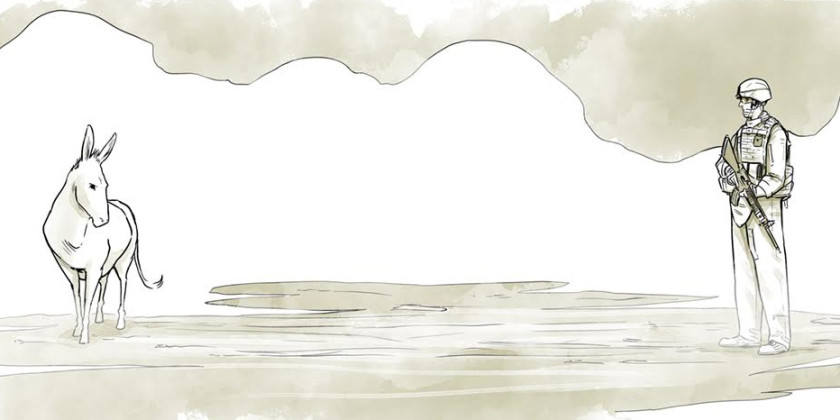
I’ve haven’t read a bad word yet about Maximilian Uriarte’s graphic novel The White Donkey, and you won’t find one here, either. It would be hard to top Charlie Sherpa’s review of The White Donkey on Red Bull Rising, so I’ll keep things short. The story of a young Marine, morose and purposeless to begin with, disillusioned by the military in general and traumatized specifically by combat in Iraq, The White Donkey plot recoups many scenes and characters now commonplace in contemporary war writing. The protagonist, Lance Corporal Abe Belatzeko, is a listless and adrift young man who had hoped that the Marines might provide the purpose and motivation he couldn’t muster as a civilian. That doesn’t happen, however, as Abe finds life in the Marines mostly dull and senseless, frequently miserable, and rarely inspiring or rewarding. His lack of gung-ho spirit is quickly perceived by his peers and sergeants, who either are “all in” or better able to “fake it until they make it.” As The Valley author John Renehen (an Army veteran) described the Semper Fi Do or Die ethos to me in an email, “I remember realizing in Ramadi that the typical Marine is not some jarhead muscle man but a clean-scrubbed eager-beaver kid who looks like he’s 15 and just wants you to tell him to do something, anything, so he can do it 110% and have you tell him he did a good job.”
Abe can’t muster that level of commitment, and foolishly he thinks that his constant complaining and emotional distance constitutes a worthy critique of USMC dysfunction. When his best friend Garcia rips him a new one for his slacker attitude, however, Abe realizes how off-putting his belly-aching and ass-dragging have become. He resolves to get his act together, but unfortunately, things completely unravel when his truck hits an IED while on mission and Garcia is killed. The IED strike occurs as the men are singing along to The Killers’ “All These Things That I Have Done”—“I got soul, but I’m not a soldier”—the chant, known by all who deployed to Iraq and Afghanistan, getting very near to the heart of contemporary civ-mil split identity: willing to wear the uniform, willing to go to war, but refusing to accept total indoctrination into the warrior way asked for by service, and in fact commenting ironically on the incongruity of hapless boy-men, raised on Call of Duty and South Park, now armed to the teeth and on behalf of their nation heading into battle with ruthless Islamic radicals. The disaster that befalls Abe precipitates further decline and provides proof positive of Stacey Peebles’ articulation of the defining story line of Iraq and Afghan War memoirs and narratives: a young man who trusts that his upbringing and his branch-of-service will protect him from the worst of war, only to learn the hard way how badly he has miscalculated.
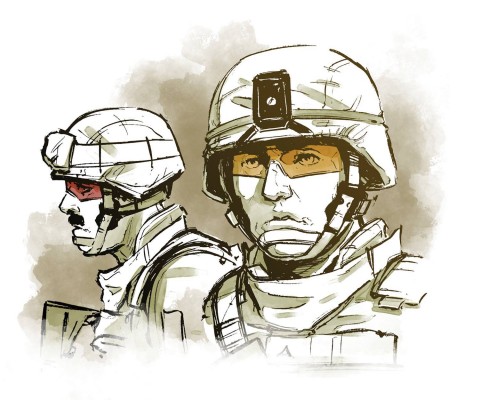
Uriarte’s majestically simple narrative and drawings distill stock war story elements and artistically re-invigorate them. Above all, he makes Abe worthy of sympathy, in contrast to some other portraits of alienated veterans who come off as unlikeable louts. Frankly, many similar narratives, of which there are by now dozens, seem crude and tedious in comparison, though they try much harder, while The White Donkey storyline effortlessly pulls readers forward, even as they may be tempted to linger on each page to marvel at Uriarte’s ability to portray story, scene, and character through image. Perhaps the graphic novel–unable to render complex adult interiority and extended authorial commentary–is a form ideally suited to portray a young man’s experience of war and redeployment. But that notion shortchanges Uriarte’s achievement, to say nothing of the interior life of young men. A veteran of tours in Iraq as both an infantryman and a combat artist, Uriarte also possesses a degree from the California College of Arts, a potent blend of experience and education. For years Uriarte has authored the cartoon strip Terminal Lance, which features sardonic looks at military life from the viewpoint of fictional junior enlisted Marines, including Abe and Garcia. Terminal Lance is excellent, but only hints at the imaginative enhancements Uriarte has wrought on the cartoon’s characters, subjects, themes, and sensibility in The White Donkey, as if its larger canvas sought to expose the limits of junior enlisted sarcastic wise-assery. What The White Donkey forgoes in terms of the Terminal Lance cartoon’s humor, it more than makes up for on the strength of its strong storyline, poignant perspective, and evocative artwork.
Maximilian Uriarte, The White Donkey/Terminal Lance. Little, Brown, and Company, 2016.
Elizabeth Samet’s Washington Post review of J. Kael Weston’s The Mirror Test intrigued me. Samet, in my reading, simultaneously approves of Weston’s fiery indictment of the United States’ poor execution of the wars in Iraq and Afghanistan and is irritated by it. Weston, a veteran of many tours in both countries as a US State Department political advisor, castigates US policy makers in Washington and generals in the big command headquarters while celebrating the bravery and grunt’s-eye view of reality of the Marines and soldiers with whom he often confronted Iraqis and Afghans “outside the wire” and “on the ground.” Those are fair positions, Samet posits, based on Weston’s extensive experience and the reports of many others. The problem, Samet seems to be saying, is that Weston’s arguments aren’t exactly novel, especially coming this late in the game from someone with all the advantages of education and position Weston possesses and now expresses so righteously as if no one had ever said them before. Declaring one’s hatred for Beltway insiders and rear-echelon fobbits, while pronouncing one’s affiliation with common soldiers, are ideas that the nation might still benefit from by heeding, but in June 2016, they’re hardly the basis of an original critique of government and military policy and operations. Anyone who cares has heard the song many times, and no one who has not already memorized the words will begin singing it now.
What’s needed, if I read Samet correctly, or maybe it’s just me, are new ideas about what the wars entailed and what they mean. Fresher thinking about the experience of soldiers. Deeper exploration of American militarism in national and global affairs. Intriguing new terms and more complex arguments and counter-arguments, more ingenious processing of the data about what happened, and surprising discoveries of heretofore unobserved connections. It’s all well-and-good that someone’s been outside the wire to face danger and complexity, but how can one’s writing and thinking also venture outside the wire?
In other domains—medicine, technology, education, science, for examples,—”longform” journalism is typically a place, maybe the place, where new ideas by authors of skill and gravitas are seriously proposed and tried out. I was recently asked to compile a list of articles, web postings, and book excerpts, publicly available on the Internet, that did some of that work in regard to America’s twenty-first century wars, and the results are below. Most of the articles I read when they appeared, while others are new finds discovered just the last couple of weeks. A few are buried behind pay-and-registration walls, for which I apologize, but all are well worth seeking out. Many corroborate my own impressions and war experiences and serve as the intellectual basis for my understanding of how the wars unfolded and what have been their consequences. Others, however, contradict my own thoughts, or report on facets of the war of which I have little other knowledge. The best don’t just report events, but make bold judgments about assumptions and values underwriting the things they describe.
“Crimes in Iraqi’s Triangle of Death.” Jim Frederick, Time. Excerpt from Black Hearts: One Platoon’s Descent into Madness in Iraqi’s Triangle of Death (2010).
Many apologies for the great writers and articles I’ve left out. I could compile a second list, and probably will someday, composed of dozens of worthy articles on less prominent sites than the Harpers/Atlantic/New Yorker -type web places I’ve privileged here. Another list could also feature more diverse voices, by gender, race, religion, and country of origin. Many articles address PTSD and technology, but there’s a few subjects, such as the repeal of DADT, the rise of special operations, the expanded role of women in the military, and the revaluation of the laws of war occasioned by Islamic terrorism that are underrepresented in my list. I looked, maybe not hard enough, entirely possible, but my initial search found few on those subjects that rose above the level of reportage and advocacy to the realm of idea and concept.
Call me greedy, but I want even more. The articles above, good as they are, might now serve most usefully as a seedbed for better things to come, as if everything they propose had to be said first in order now that more creative and perceptive writers can build on them. Here’s an example of what I have in mind, taken from the literary domain I know best. Say what you will about Roy Scranton’s concept of the “trauma hero,” describing a veteran who seems to relish a little too much his or her post-war distress, it got everyone’s attention when it first appeared in a Los Angeles Review of Books essay early in 2015. The memorable phrase defines both a common way that Iraq and Afghanistan veterans are being represented in fiction, poetry, and film, and suggests some of the motif’s moral implications and cultural significance, little of which Scranton approved. Many didn’t like Scranton’s essay; they said it wasn’t fair, it wasn’t subtle, and even if it were true, the tone was off, as if Scranton were guilty of not being supportive either of veterans or veteran-authors—the sum total of the responses reinforcing the notion that Scranton’s darts had struck close to the bone.
Phil Klay, for one, might not have liked the not-so-implicit sneer inherit in the phrase “trauma hero,” since his striking short-story “Redeployment” was singled out by Scranton as definitively portraying a veteran confused and reeling from his tour-of-duty. Recently, in a Brookings non-fiction think-piece, Klay refined his sense of the ethical landscape inhabited by those who volunteered to fight in Iraq and Afghanistan and who continue to weigh the consequences of their decision. Klay advances the notion that the war service of “citizen-soldiers” (he thankfully refrains from using “warriors,” though he might have interrogated how that term has come to serve as a popular descriptor for men and women in uniform) has put them in a position of “moral risk”: a heightened capacity for understanding the complexity of human experience, based on their personal engagement with war folly and darkness, their own and the nation’s, naively volunteered for when young, true, but still an experience they must own and be responsible toward going forward. But knowing how military service might lead to ethical compromise, Klay’s argument goes, is not necessarily debilitating. It can also, Klay argues hopefully and with examples, generate purposeful commitment to being as good as one can be in the aftermath.
The essay is learned and eloquent; Klay fights like the devil to keep from celebrating veterans as forged-by-fire explorers of morally ambiguous wastelands who now know better than the rest of Americans, even as his essay conjures this possible understanding of them into being. But it’s not really so important whether Klay wins the war of ideas by more fully and accurately sketching the moral psychology of veterans better than Scranton. What counts first is that engaged readers consider for themselves the logic and evidence for his claims. What counts second is consideration of the tension now in play, with the self-indulgent distressed veteran constituting one pole of an interpretive force-field and the veteran as ethical avatar the other. And what counts even more is not what either Scranton or Klay has already said, but the response to come by an equally formidable commentator.
Whether that writer splits the difference between Scranton and Klay or takes the argument in a new direction remains to be seen, but the result will certainly be exciting and helpful. It’s not just an intellectual exercise, either; consequential decisions affecting the lives of real people are on the line. The debate’s importance isn’t best measured looking backward at events that have already occurred, but in how its implications will influence difficult choices to come and how they are absorbed internally by those whom they affect most. And to bring things back to fiction, which I love most, we’ll all be able to see how Scranton himself riffs on the trauma hero theme in his soon-to-be-published novel War Porn. I don’t know if Klay’s next fictional work will portray war and veterans, but I’m betting it features characters dealing with intensely problematic experiences they lived through when young.
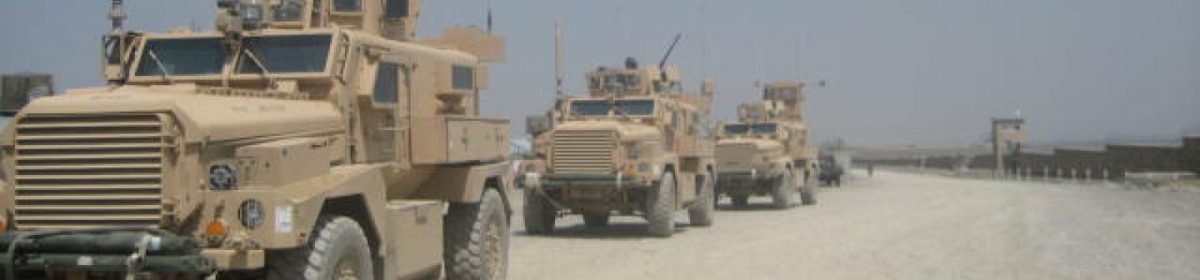
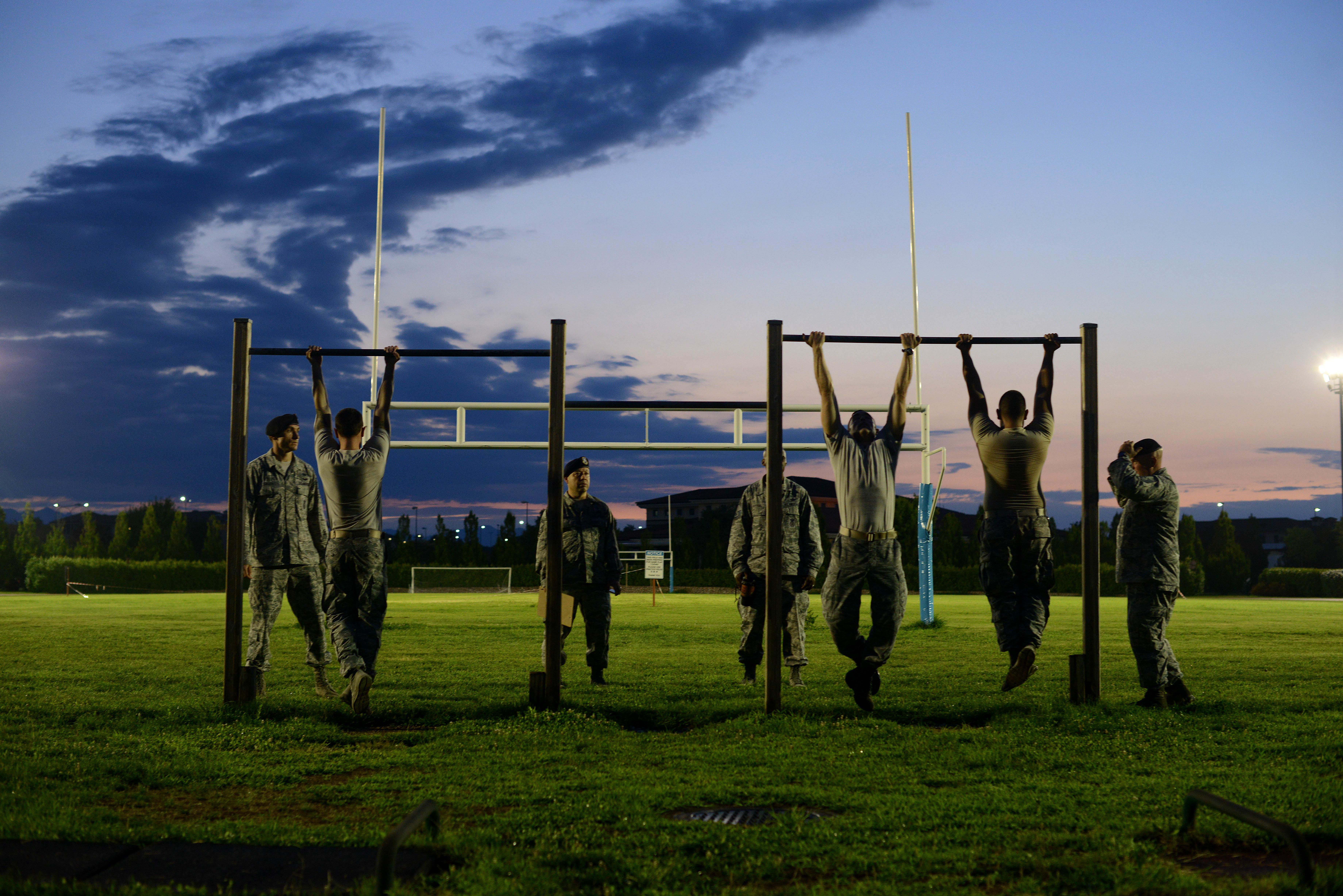
USAF photo by TSgt Evelyn Chavez. In 2009, TSgt Chavez and I served together on FOB Lightning, Paktya Province, Afghanistan.
1. For the past year, I’ve been the Mentor Programcoordinator for Ron Capps’ Washington, DC-based Veterans Writing Project. As such as I’ve connected many aspiring veteran-writers with experienced authors, teachers, and editors. The duty has brought me in pleasant and productive contact with many literary-minded folks, while also providing numerous looks at the range of interests, subjects, and attitudes characteristic of veterans using words to explore their military and war experiences. The veterans generally fall in two camps: Vietnam vets working on memoirs and unit histories and Iraq and Afghanistan vets writing memoir, fiction, and poetry. The mentors are all published authors and experienced teachers, some with military experience, but many who have never served. If you are either interested in serving as a mentor or working with a mentor, see the VWP Mentor Program webpage and write me at pete@veteranswriting.org. Right now, we have several vet-writers waiting for mentors, so I’m hoping some of the authors and teachers who read Time Now will volunteer to help out.
2. I had the pleasure recently of reading a short story on stage at New York City’s The Wild Project theater as part of an event titled Kicking Down Doors: Veterans in America and Their Families in America. The event, sponsored by a group called Poetic License, was organized by veterans Everett Cox and Jenny Pacanowski, two mainstays in the New York and New Jersey veteran writing and arts communities. Many thanks to Cox and Pacanowski for including me on the bill and coaching me through my pre-performance jitters, and many thanks also to my fellow readers and performers Katelyn Sheehan, Nancy Elkin Nybard, Camilo Mac Bica, John D. Manley, and John M. Meyer, as well as Cox and Pacanowski, and even more thanks to everyone who came. I’m very interested in the movement of war writing from the page to the stage, which is happening in many interesting ways across the nation, and was happy to participate in a small way in the phenomenon.
My name and me in lights.Jenny Pacanowski and Everett Case.
3. One place that has already staged a number of veterans-oriented dramatic productions is Wisconsin, the state whose vibrant veterans writing community I profiled a couple of weeks ago in a post on Matthew J. Hefti’s A Hard and Heavy Thing. Since the appearance of that post, I’ve heard from Martin McClendon, the Theater Department Chair at Carthage College in Wisconsin, who offers the following report detailing a number of veterans-oriented dramatic productions in Wisconsin and elsewhere in the Midwest:
My colleague Alvaro Rios at UW-Milwaukee is working on a new play, he is himself a vet and it will deal with vet issues. Several years ago at UW-Stevens Point there was a play called Soldier’s Circle based on blogs of soldiers who fought in Afghanistan. At Augustana [College] in Illinois, they commissioned a play called A Green River, dealing with veteran suicide. I saw it 2 years ago at the American College Theater Festival festival in Milwaukee. Lastly, I am starting a conversation with Edwin Olvera, Milwuakee-based choreographer and dancer, who has created numerous works based on his experiences and impressions of service. I’m hoping we can somehow work with him here at Carthage in the near future, as part of our dance program.
4. Another place already actively staging exciting, well-attended dramatic readings of veterans’ stories is San Diego (the locale, as it happens, for another novel I also recently reviewed, Elizabeth Marro’s Casualties). The driving force in San Diego is Justin Hudnall, the executive director of a literary and performing arts non-profit organization called So Say We All. Hudnall, a school-trained actor who has worked around the world as an emergency relief coordinator, is an artistic-entrepreneur of the first order. Besides organizing readings that attract audiences upwards of 300, So Say We All produces podcasts and radio shows featuring the stories of veterans. Hudnall has also published an anthology titled Incoming: Veteran Writers on Returning Home, which features essays on life post-deployment and post-service by Benjamin Busch, Brandon Lingle, Brooke King, Nathan Webster, and Natalie Lovejoy, among others.
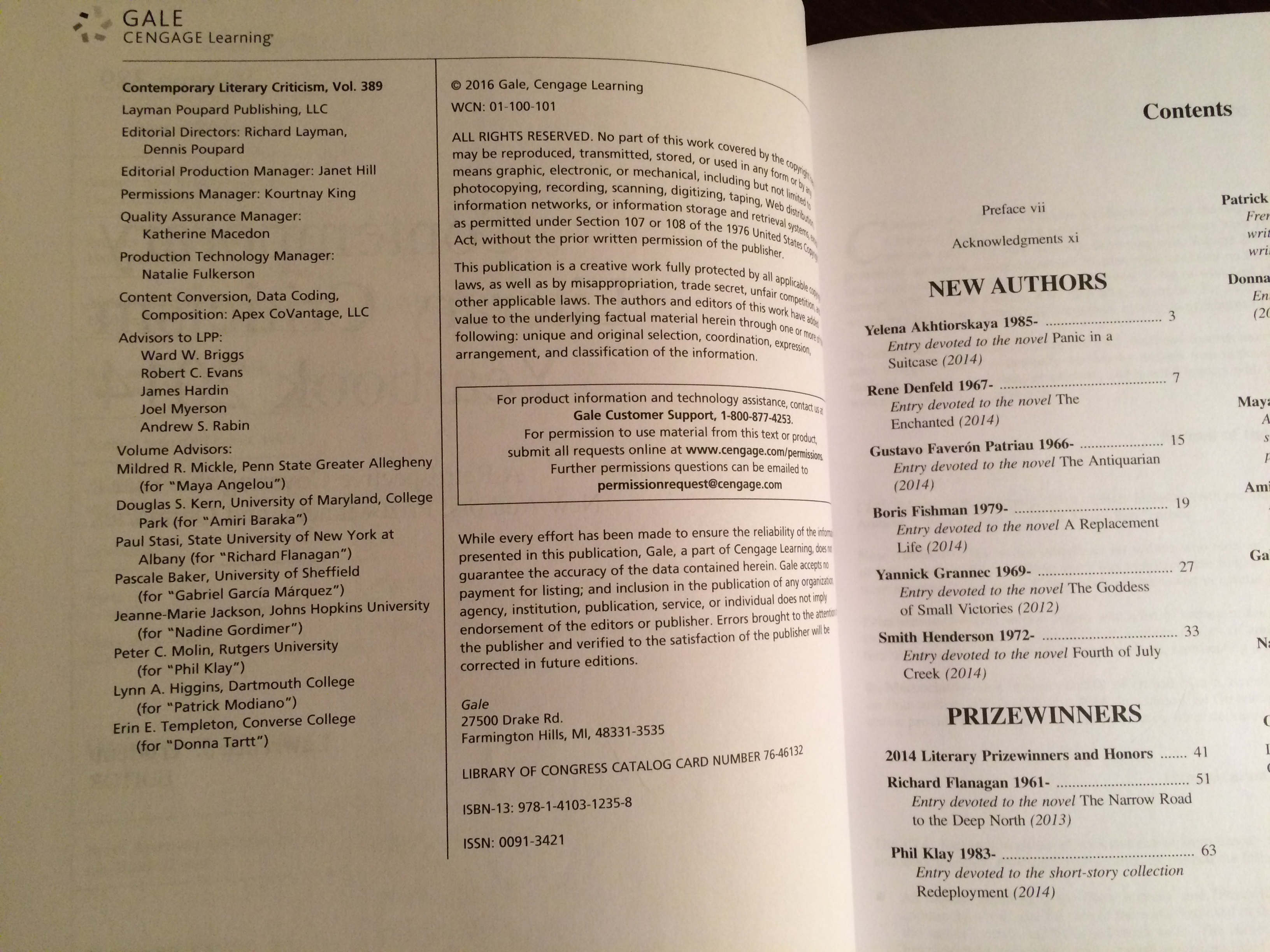
5. No war fiction made the final cut of stories reprinted in The Best American Short Stories2015, but at least four war writers made the list of “Other Distinguished Stories of 2014.” Congratulations to Elliot Ackerman for “A Hunting Trip” (originally published in Salamander), Phil Klay for “War Stories” (Consequence), Luke Mogelson for “To the Lake” (Paris Review), and Brian Van Reet for “Eat the Spoil” (Missouri Review). This year’s Best American Short Stories was edited by T.C. Boyle, an author I’ve long read and admired, and, for what it’s worth, a review of The Best American Short Stories 1984, edited by John Updike, that I wrote for the Daily Californian, the UC-Berkeley student newspaper, was one of the first articles I ever published. Speaking of Phil Klay, I was asked to compile the “Additional Reading” list for the entry on Klay for his entry in in Gale-Cenage Learning’s scholarly compilation Contemporary Literary Criticism, vol. 389. It’s a measure of Klay’s achievement that he was included in CLC, a serious academic resource, and it was enjoyable to read or re-read the many reviews Redeployment inspired on its release in 2014.
6. A final note about AWP 16, a good one. The real MVP, if I can be forgiven a lapse into idiotic modern parlance, of the war writers contingent in Los Angeles was Kayla Williams, the author of the memoirs Love My Rifle More Than You and Plenty of Time When We Get Home. Whether speaking from the platform at two panels, in attendance at other war writing panels, or in informal discussions between events, Williams was everywhere impressive. Now comes news that she has been named the director of the Department of Veterans Affairs Center for Women Veterans, a senior executive position with real authority and clout. One of the tenets of Time Now is that contemporary war writers and artists are not just doing remarkable things now, but are on the cusp of long productive careers as authors, artists, and public figures, so it is very cool to see Williams move into a position of such great significance in national affairs. And since, as I understand it, she will have a story appearing in the upcoming second volume of the Fire and Forget anthology of short contemporary war fiction, we have more of Williams’ writing to look forward to, as well.
7. Finally, I’ve been a member now for a couple of years of a group called the Military Writers Guild, a consortium of writers, mostly veterans, but not all so, interested in military subjects and dedicated to mutually supporting members’ writing efforts. MWG authors primarily address strategy and policy, but open their arms to creative writers as well—Jesse Goolsby and Charlie Sherpa, for example, are also members of MWG. I recently attended an MWG BBQ in Arlington, VA, and was happy to meet in person many fellow members whom I previously knew only through email or by reading their articles, to include Ty Mayfield, David A. Mattingly, and Adin Dobkin, and enjoyed hearing their stories and learning about their current writing projects. Enthusiasm for joining the analytical and artistic sides of the MWG house is strong, and I look forward to helping the cause in the coming year. The presence of AWP in Washington, DC, for example, in 2017 might serve as a focal point for boosting awareness of MWG within the literary writing community, and vice-versa.
As a famous rabbit used to say, “That’s all folks.” I hope everyone’s summer is off to a good start.
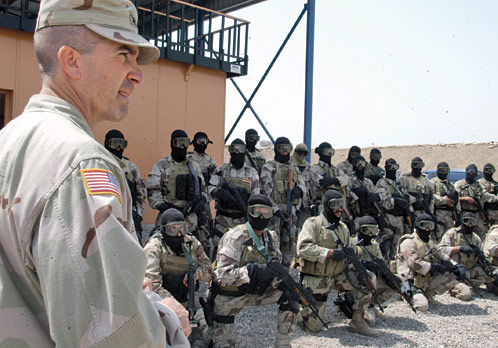
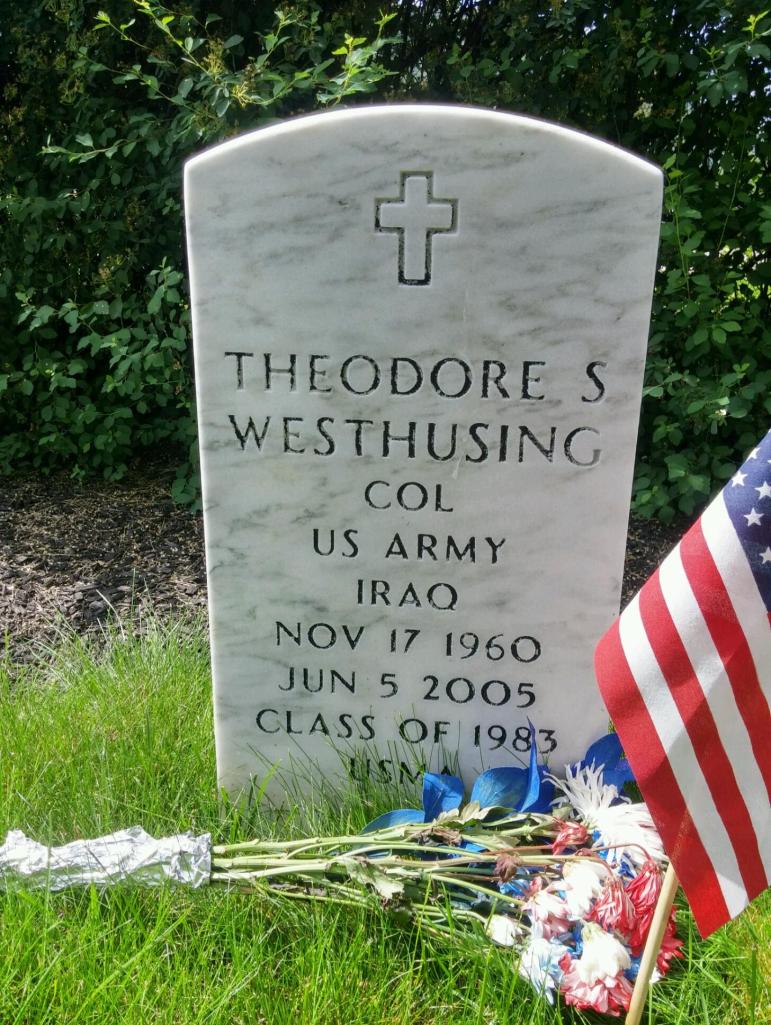
When Colonel Theodore S. “Ted” Westhusing died in Iraq in 2005, he was the highest-ranking US military officer to have lost his life in either Operation Iraqi Freedom or Operation Enduring Freedom. Most signs point to suicide, just a few weeks before he was due to rotate home, but some evidence suggests, and some believe fervently in this evidence, that he was killed by the American contracted security operatives he supervised. Either way, it was clear that he was distressed by the unethical behavior of his American subordinates and the elite Iraqi police his unit was in charge of training and the failure of his commanders, notably then-Lieutenant General David Petraeus, to heed his warnings about the fraud, waste, and abuse he observed. That Westhusing had written a PhD dissertation on military honor, based on his study of classical Greek philosophy, and that he was on-track to become the head of West Point’s Department of English and Philosophy and thus in charge of the ethical education of military academy cadets adds to the tragedy, the irony, or the poignancy of his story. One read of Westhusing’s life is that his rigid principles made him too brittle to deal with the vagrancies of war. Another is that his death was an important early sign of just how badly the Army was struggling to accomplish its many-sizes-too-big mission to modernize and Westernize Iraqi security forces. A third casts Westhusing’s example as a cautionary tale that the war was destined to chew up, in one form or another, any good man or woman sent to fight it. Personally, I think Westhusing was a victim of a collision between two war-fighting ideologies: an ethical approach predicated on the laws of war that Westhusing believed the 1990s United States military exemplified, and the new brutal, results-oriented way of war, based on targeted assassinations and enhanced interrogation tactics, that the American security contractors and Iraqi secret police were bringing into being.
Westhusing’s death was the story of a moment, but even in its time it did not really grip the American public, who wanted to hear about heroes, not senior officers who cracked up and couldn’t take it any more. They probably wondered if Westhusing didn’t reveal the basic incongruity of academic scholarship and tough-minded warfighting—any major fool might say the two disciplines are incompatible. Perplexed or ambivalent or maybe embarrassed about this ambitious military officer who campaigned for the position that eventually overwhelmed him, many might have also have wondered why he couldn’t have just gutted out a few more weeks, returned to his wife and three children, settled into his comfy and distinguished West Point position, and put the whole mess behind him. That’s what any sane man would do, right, and who’s to say that’s not what any good man might do, too? Westhusing himself described his life’s journey in terms of goodness—his wife Michelle reports that her husband told her she didn’t need to study philosophy because she was, according to him, “already good.” For Westhusing, then, the military built and tested character in defense of what was right and honorable, and not a dismal human endeavor organized around obedience and violence. Duty in Iraq was for Westhusing a chance to meld personal philosophy with on-the-ground experience. He didn’t dream of being a hero, in other words, he was entranced by the idea that being a soldier offered the greatest possible opportunity to be good.
That’s a lot to contemplate, notions as simultaneously naïve, arrogant, and idealistic as those that drove Chris McCandless into the Alaska backcountry (Westhusing took his PhD at Emory in Atlanta, where McCandless studied as an undergraduate, for what it’s worth). Predictably, not many have lingered over them, but a few observers over the years have viewed Westhusing’s life and death in terms of their metaphorical or even dramatic possibility. Los Angeles Times writer T. Christian Miller in Blood Money: Wasted Billions, Lost Lives, Corporate Greed in Iraq (2006) uses Westhusing to frame his exposé of Bush administration fraud and negligence. A West Point classmate of Westhusing named D. Richard Tucker wrote and staged a one-act play titled Duty, Honor, Profit in Seattle in 2008. I haven’t seen Duty, Honor, Profit, but parts of it can be read online. A description on Tucker’s website suggests that his play is not so much an exploration of character under duress, but a criminal procedural: “The Army’s investigation attributed his death to suicide, but a large amount of evidence pointed towards conspiracy and murder. As Ted’s friends attempt to uncover the mystery, they come to even more disturbing conclusions. This is a true story.”
Recently, I’ve learned that US Army veteran John Michael Meyer is bringing towards production a new play called Westhusing in the House of Atreus. The title refers to a cursed royal family in the Greek mythos from which sprung the warriors Agamemnon and Menelaus; Meyer here repurposes the myth to suggest that the American officer corps, or greater military family, in Iraq, led by General Petraeus, was rife with similar treachery and conflict. Meyer’s credentials are interesting: a Ranger-qualified enlisted infantryman who has served in both Afghanistan and Iraq, he is completing a PhD in social sciences at the University of Texas. While an undergraduate at Texas (at roughly the same time Kevin Powers and Brian Van Reet were in the UT MFA program—wow!), Meyer’s play American Volunteers (2010)—about US soldiers at war on the Afghanistan-Pakistan border—won a distinguished prize. Meyer has staged other plays as well, and he also acts: just a couple of weeks ago I saw him play the part of Neoptolemus in a production of Sophocles’ Philoctetes that revisioned Sophocles’ play as a parable of the plight of contemporary veterans. Meyer tells me he was first alerted to Westhusing’s story by one of Westhusing’s old professors; perhaps Meyer saw something of his own effort to combine serious scholarship and hardcore soldiering writ large in Westhusing’s story.
I’ve read a draft of Westhusing in the House of Atreus and loved it. Not only is much of the dialogue in remarkable blank verse, but Westhusing’s last days are plausibly imagined by Meyer and so too is his effort to place Westhusing’s thoughts and acts in the context of the Greek traditions of philosophy, tragedy, and military service that meant so much to him. Meyer also skillfully envisions rich stage roles not just for Westhusing but for secondary characters: General Petraeus, Michelle Westhusing, two contractors who work for Westhusing, his department head at West Point, a female interpreter, and a female military lawyer. The result is not a fawning portrait or vindication of Westhusing, but something even better: an assessment in full of his complex and often contradictory impulses, ideas, beliefs, and actions.
Here’s to hoping that Westhusing in the House of Atreus makes it to the stage and succeeds in bringing the problems presented by Westhusing into sharp public focus while also telling us much about the man and those closest to him at the end of his life. One issue is that of how we remember military suicides as we honor the nation’s war dead on Memorial Day and throughout the year. I’m magnanimous on the point, for reasons personal as much as abstract. I didn’t know Westhusing in his last days, but I served a tour with him at West Point in the 1990s, where, among other things, he and Michelle were my family’s sponsors when we arrived, helping us choose quarters and making us feel welcome. Later, we played countless hours of basketball and touch football together as members of our department teams. On the “fields of friendly strife,” Westhusing was our fearless captain, and off the field, he was the funny organizer of much merriment, so it’s hard for me to imagine why later in life he would either kill himself or inspire another American to kill him. He could sometimes be aloof, lost in the realm of philosophical thought and his exalted dream of what being an officer meant, but there were many more moments of generosity, good cheer, and wit, and his love for Michelle and their children was clear and strong. I had the chance to meet his high school basketball coach and his family, and it was obvious they adored Westhusing and viewed him as something of a crown prince, which pretty much all of us did, too. Without doubt, Westhusing felt that not just his philosophy but his identity were stained during his short unhappy overseas tour; I’m with Michelle, who, when asked why her husband died, tersely replied, “Iraq,” but feel the story’s reach is also longer and more complicated. What I can state safely, and I’m sensing Meyer agrees, is that Westhusing did not have to die and the world would be a better place if he hadn’t, which, speaking of stories writ large, is basically true of every soldier, sailor, airman, and Marine whose life ended in Iraq and Afghanistan.
The greatest tribute paid by a nation to its war dead on Memorial Day is recognition that they, when called upon, fought and gave all, which inspires determination to fight for what’s right in the rest of us. The greatest hope expressed is that those who lost their lives in war did not do so in vain; unfortunately, the deplorable circumstances of the wars in Iraq and Afghanistan make it hard to cherish that hope in regard to the roughly 7,000 Americans who died in them. But Memorial Days also give the living a chance to remember and honor fighting men and women lost in war as individuals, almost all whom died while young and by their lights trying to be good and do good, and now their lives over long before they fulfilled their potential to become even better people and improve the lives of others. RIP Memorial Day 2016 those with whom I once served and who later died either in Iraq or Afghanistan: Ted Westhusing, Joe Fenty, David Taylor, and Bill Hecker. Also, members of Camp Clark, Afghanistan, units with whom I served in 2008-2009: John Blair, Kevin Dupont, Alex French, Peter Courcy, and Jason Watson. Finally, former students Dennis Pintor, Todd Lambka, Brian Freeman, and Taylor Force.
West Point, NY. Picture taken May 30, 2016, by John Nelson.
Mothers figure prominently in Kevin Powers’ The Yellow Birds and Ben Fountain’s Billy Lynn’s Long Halftime Walk, though the portraits are focalized through the eyes of their soldier sons and the view is not especially appealing—the moms are withered, negligible figures battered by life and exercising little influence over their children. Roxana Robinson’s Sparta fulsomely portrays the thoughts of a much more vital mother as she observes the deterioration of her beloved son, a Marine Corps officer home from Iraq. Unfortunately, however, her efforts to understand and help her son are ultimately as futile as those of the mothers in Powers’ and Fountain’s novels. Masha Hamilton’s What Changes Everything and Lea Carpenter’s Eleven Days depict “proactive” (military-speak, apologies) mothers who travel to Afghanistan to investigate the circumstances of their sons’ injury and death, respectively. Their Tiger/Helicopter Mom impulse is understandable in concept if far-fetched in probability, but even these Herculean or Amazonian efforts to remain important in the lives of their military-minded sons are useless practically, though important emotionally in terms of closure.
Outside of fictional portraits, a passage from Benjamin Busch’s memoir Dust to Dust describes his mother’s response to the news that he has joined the Marines:
My mother took a deep breath, her hands clamped to the edge of the table as if she were watching an accident happen in the street. Her father had been a Marine, had gone to war and almost not come back.
A New York Timesessay by Matt Gallagher’s mother, Deborah Scott Gallagher, captures her anguish at seeing her son go off to war:
“I will be stalwart,” I had said to myself on the drive home from the airport the morning I said goodbye to him. “I will be steadfast. I will read and listen to the reputable war reporters, and I will write my senators and congressmen, but I will not lose faith in my country. I will concentrate on sustaining my son rather than myself, and I will not confuse self-pity with legitimate worry and concern over him and his men. I will be proud, justifiably proud, but I will not be vainglorious! And I will never, never, never let him know how frightened I am for him.”
But, within moments of returning home, I had broken all but one of these promises to myself. I was doing laundry and, as I measured detergent into the washer, the Christmas carol CD I was playing turned to Kate Smith’s magnificent contralto, singing, “I Heard the Bells on Christmas Day.”
“And in despair, I bowed my head,” she sang. “There is no peace on earth, I said. For hate is strong and mocks the song of peace on earth, good will to men.”
And, at that moment, for only the third time in my adult life, I began to sob — not cry, not weep — but sob uncontrollably, sitting on the floor of my laundry room, surrounded by sorted piles of bed linens and dirty clothes.
Siobhan Fallondescribes a trip to Walter Reed to meet soldiers recovering from wounds and their families:
And there were mothers. Unlike the military members and their spouses, who somehow all seemed in great and hopeful spirits, the mothers looked stunned. They seemed to be trying to grip their emotions tightly, but their faces hid nothing. Their faces said: “Why did this happen to my beautiful boy?”
Taken together, the portraits suggest that one of the deepest fissures in the civil-military divide is the one separating mothers from their soldier, sailor, Marine, and airman male children.
This brief survey of mothers in contemporary war literature brings us to Elizabeth Marro’s 2016 novel Casualties, about a woman named Ruth Nolan whose son Robbie commits suicide after returning from a tour in Iraq with the Marines. As it happens, Ruth, divorced from her son’s father, is a senior executive for a large defense contractor, so she’s part of the money-making apparatus more-or-less complicit in her son’s death. As Robbie sinks downward following redeployment, so too does Ruth’s career, as she is out-maneuvered by a wily colleague gunning for her job. After losing both her son and her position, the benumbed Ruth begins driving cross-country from her home in San Diego, but gets only as far as Nevada before further calamity ensues. Following a parking lot accident, Ruth is fleeced by a one-legged Gulf War veteran. Next she drinks herself blind and is subsequently relieved of her credit and bank cards, and then is saved from sexual assault by the same peg-legged con man who just connived her out of a couple of thousand dollars. Ruth and her rescuer, Casey MacInerney by name, then strike an unlikely partnership to travel cross-country together in search of…. what? For Ruth, reunion with her brother and parents in rustic, grounded New Hampshire, and for Casey, reconnection with an abandoned daughter in New Jersey. Ruth and Casey’s relationship, at first frosty, go figure, warms as they travel. Getting to know each other’s stories, solving a few financial and logistical problems together (the money he’s scammed from her is quickly gone), a common interest in Melville, a little booze, a little weed, and soon they aren’t just surly fellow-travelers, but lovers, at least for a night or two.
Sketched so schematically, the lost-soul characters and road-trip plot seem a little contrived, but Marro’s deft telling redeems the creaks. I found a lot to like about Ruth—I sympathized with a woman within shouting distance of my own age who is both life-tested and life-scarred, and who now must endure an extremely rough patch. Not to be prurient, but the portrait of a powerful middle-aged woman who gets blotto drunk by herself in public and later sleeps with a man from a far different station in life made me wonder. I don’t know how these things might happen in real life, but in Casualties’ novelistic world, Marro’s weaving of character and circumstance generates a sequence of events that seem not just plausible but inevitable, in the way that fate and character organically intertwine in good fiction. Ruth has had for years misgivings about her performance as a mother and for months ignored threats to her job. Like many might, she foregoes dealing with these festering issues until they blossom like twin flowers of evil, at the worst possible time and with the most consequential damage.
Casey’s portrait is more uneven; in the early scenes he appears as a dangerous lout without potentially redeeming qualities, so his transformation into an American version of JK Rowling/Robert Galbraith’s Cormorant Strike—a grizzled, one-legged veteran whose gruff integrity appeals like catnip to women searching for something real—is a stretch. But once past the unpromising start, Casey too comes alive as a character and his shared journey with Ruth in search of emotional connection believable. Even better, I found Marro’s portrait of Robbie very compelling and even moving. Robbie reminded me of many young white California men I’ve known or observed, guys who lose interest in school and home by age 15 and subsequently drift into the alternative worlds of surfing, skateboarding, punk rock, or, as in Robbie’s case, off-road racing, accompanied by nascent alcohol and drug abuse. Distressed veterans populate virtually every novel about war in Iraq and Afghanistan, but Marro is among the few authors who dare bring their heroes to actual suicide. Though Robbie’s death comes one-half of the novel in and occurs off-page, before he dies Marro offers many astute, empathetic glimpses of a confused man-child already lost before joining the Marines and whose time in service speeds his unraveling.
He didn’t know who or what he was when he enlisted. He just knew what he wasn’t. He wasn’t the college kid like Ruth wanted. He wasn’t headed for any corner office like she had with a secretary and a bunch of people running around while she cracked the whip. He was no surfer, no skinny golden boy like her boss’s kid. It used to scare the shit out of him when he tried to imagine what he wanted or who he was supposed to be and nothing came to him. Nothing that mattered.
The Marines didn’t care, though. They were going to make him part of something bigger than whatever the hell he thought he was.
Even more commendable than the portrait of Robbie is Casualties’ rendering of the basic lack of humanity undergirding corporate war profiteering. Like suicide, defense industry maleficence and hypocrisy has been left largely untouched by war novelists, perhaps because they struggle to find ways to dramatize big money shenanigans as they impact the lives of common soldiers. Perhaps also, they, confused by their own moral authority, are ambivalent about war sins of which they too are guilty when they are writ large in the American money-making landscape. Ben Fountain’s portrait of Norman Oglesby, the richy-rich Dallas Cowboys owner featured in Billy Lynn’s Long Halftime Walk is a notable exception to the rule. Marro’s depiction of Don Ryland, the wolfish impresario of RyCom, the defense contractor for whom Ruth works, lacks Fountain’s satirical and stylistic élan, but is more direct and damning. While Ruth tries to welcome Robbie home, at work she is dealing with charges that RyCom has not adequately insured the contracted workers it has sent into the Iraq war zone:
Ruth looked from the names on the single page in front of her to the eleven-inch stack of files Sylvia had dumped on her desk. The “pending” files. Some of the claims had been “pending” for eleven months. Some longer. Ruth had opened the files before she stopped, rattled by the juxtaposition of ordinary job descriptions and extraordinary injuries: interpreter, double amputee; truck driver, quadriplegic; medical technician, brain trauma. She tried not to read the names but they were right there, on the first page, their stories crammed into small boxes below: Ahmed Hazazi, born in Detroit, fluent in Arabic, IED blast. Marissa Albertson, age twenty-seven, caught when a newly built clinic she was working in collapsed after a nearby explosion; the truck driver, Clayton Massey, spinal cord severed after his caravan was ambushed.
Each name clawed at her in a way she’d never expected.
Ruth soon learns that RyCom has no intention of admitting guilt or compensating the wounded contractors, and her efforts on their behalf are perceived as soft and disloyal by Ryland and the hard-hearted, self-serving lacky who uses Ruth’s vulnerability following the death of her son to instigate her dismissal. What can a mother do when the military-industrial beast that has comfortably supported her professional ambition bares its blood-and-lucre stained teeth? Not much apparently, except run like hell.
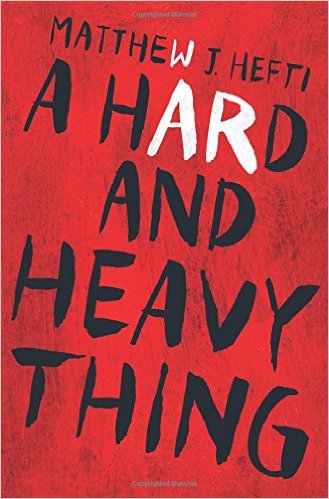
It’s been hard not to notice the recent flury of writing and art by Wisconsin veterans. Matthew J. Hefti’s novel A Hard and Heavy Thing, about two childhood friends from Wisconsin tested by battle in Iraq, arrived in January of this year. Kyle Larkin’s short stories “Minarets,”originally published on the Military Experience and the Artswebsite, and “The Night Before Christmas,” which I have read in manuscript, are two of the best war stories set in-country and focused on the experience of infantrymen I’ve read lately. Just last week, Larkin published a provocative essay on Military Experience and the Arts titled “Post Traumatic Narrative Disorder,” in which he argues that frustration, confusion, and ambivalence, not trauma, might better serve as the defining characteristic of veteran-redeployment stories. David Chrisinger, a veterans program administrator at the University of Wisconsin-Stevens Point, has published an eloquent collection of veteran-student narratives titled See Me For Who I Am: Stories of War and Coming Home and Chrisinger also keeps an affiliated website, also remarkable, called Stronger at the Broken Places: Student Veterans and the Long Walk Home from War. Singer-songwriter Jason Moon has been around longer—I first posted his excellent return-from-war lament “Trying to Find My Way Home” a couple of years ago—but I’ve only recently become acquainted with his organization Warrior Songs, which promotes music by and about veterans, and a recent radio interview sparkled with insights about his own struggle with PTSD and his efforts to help others so afflicted.
Chrisinger is not a veteran, but the works of the other Wisconsin residents I’ve named are born of extensive military experience. Hefti deployed twice to Iraq and twice to Afghanistan as an Explosives Ordnance Disposal technician, while Larkin and Moon deployed to Iraq as an infantryman and combat engineer, respectively, in the Wisconsin National Guard. Taken together, the Wisconsin warrior artists are mostly interested in the earthy world of fighting men and the crucible of combat, though the narratives collected by Chrisinger represent a broader range of service and viewpoints. Further judging from their work and comments, it appears, sadly, that war and deployment mostly stunned them and then sent them stumbling for years afterwards. A feeling of pride persists, though, an attitude that may be roughly summarized as, “Whatever else you might say, we answered the call, and now it’s our right or obligation to bear witness.” The perceptive Brian Castner, in his forward to See Me For Who I Am, writes that the veteran students anthologized there-in sometimes seem to wear “a sense of superiority on their sleeve,” and then immediately recalibrates the impression to note the authors’ honesty: “’Here are my warts, they say, where are yours?’” All the writing that I’ve seen, both fiction and memoir, also emits a strong sense of Wisconsin place: a tight-knit homogenous culture organized around loyalty to family and community and other sturdy, sensible values, but one in which residents cope with oppressive expectations by drinking heavily and lashing out at ones they love most. “Trying to find my way home,” indeed….
All these sentiments are on display in Hefti’s A Hard and Heavy Thing. The novel’s two protagonists, Levi and Nick, come-of-age in a small town near LaCrosse, where they are the singer and guitar player, respectively, in a popular punk band. Levi is coarse and Nick is sensitive, but both are well on their way to alienation, misanthropy, and alcoholism even before joining the Army in the wake of 9/11. Service in the active Army and then the Guard brings them a few years later to Iraq, where Nick’s truck is blasted by an IED that kills the other occupants and leaves Nick badly injured and pinned inside the wreckage. Levi rescues his friend and then fights off an insurgent counterattack, for which he is awarded a Silver Star. Levi holds himself responsible for the events leading to the IED strike, however, and thus the award he receives feels more like an albatross around his neck than a decoration. Several years later, Levi returns to Wisconsin, and now out of the Army, moves in with Nick and his wife Eris, a cool hometown beauty with trauma issues of her own. Nick, dealing with his wounds, and Eris, trying to stay sober, have crafted lives of rigid conformity and routine to keep themselves straight, at the cost of any youthful promise and happiness. The arrival of Levi, hell-bent on self-destruction and pining for Eris, who has repressed feelings for him, too, quickly undoes the fragile stability.
Much is of interest in A Hard and Heavy Thing. I found the battle scene, for example, exciting, especially since it reflected aspects of my own experience of being trapped in a truck rocked by explosion with casualties onboard. There’s not much of LaCrosse as a social milieu or the Army as a culture, but what Hefti portrays of LaCrosse’s townie bars and family folkways and Regular Army and National Guard distinctiveness intrigues. The novel is narrated in third-person, primarily through Levi’s point-of-view, and a series of bracketed asides reveal that the narrative’s author is Levi himself and the third-person story is an amalgamated love song to Nick/suicide note-mea culpa (adding to the literary razzle-dazzle is a minor character named Matthew Hefti). In neither the main narrative nor the bracketed asides, however, is Levi particularly subtle about what ails him nor observant about the world around him, in part because, by his own telling, he drinks heavily and continuously in the years after his discharge.
In two key aspects of his story, Levi doesn’t just recount his life’s struggle through the fog of alcohol, but is evasive and even disingenuous. Specifically, he is coy about revealing whether he really tried to commit suicide while in the Army (the perception that he did being the cause of his discharge) and whether, at novel’s end, he attempts to seduce or actually does seduce Eris. The ambiguous bedroom scene comes at the end of a long day in which Levi gets drunk with his father and berates him for being a stupid jerk (he’s already grievously insulted his mom and sister), gets even more drunk with Nick and brawls with him in a park, and then arrives at Nick’s house and gets Eris drunk, too. Though everyone he meets tells him he needs help, Levi doesn’t hold himself very accountable for his malaise or the turmoil he causes, even as his narrative constitutes a plea for understanding and forgiveness. Why should he? Lead singer of a popular band, the recipient of a Silver Star, the object of desire of the prettiest woman in town, he’s got what every guy wishes he had.
We’re meant to understand that these accomplishments don’t mean much to Levi, but an equally dominant impression is that they fuel his self-image as an iconoclastic rogue whose boorish behavior serves as a catalyst for making less honest people own up to truths they’d rather not face. Not especially curious or sympathetic about others, or even very forthright himself, Levi wields his disdain for people, places, and events like a badge of honor. In other words, his “sense of superiority” is in full-on collision with openness about his “warts,” and it’s not just for his family and friends that he’s a handful. Somewhere beyond a hot mess and trouble-with-a-capital-T, Levi’s tough to deal with for readers, too, who are going to have to decide whether they love him or hate him. The same is true of the very aptly titled A Hard and Heavy Thing as a whole. Does it reinstantiate the rapidly coalescing “trauma hero” motif in contemporary war literature, or is it a compelling, realistic, and self-aware narrative about young men who go to war and the damage that ensues? That’s a go-to question important, ethically and aesthetically, not just in Wisconsin, but everywhere, though more sharply defined by Badger State veteran writers and artists than elsewhere.
Matthew J. Hefti, A Hard and Heavy Thing. Tyrus Books, 2016.
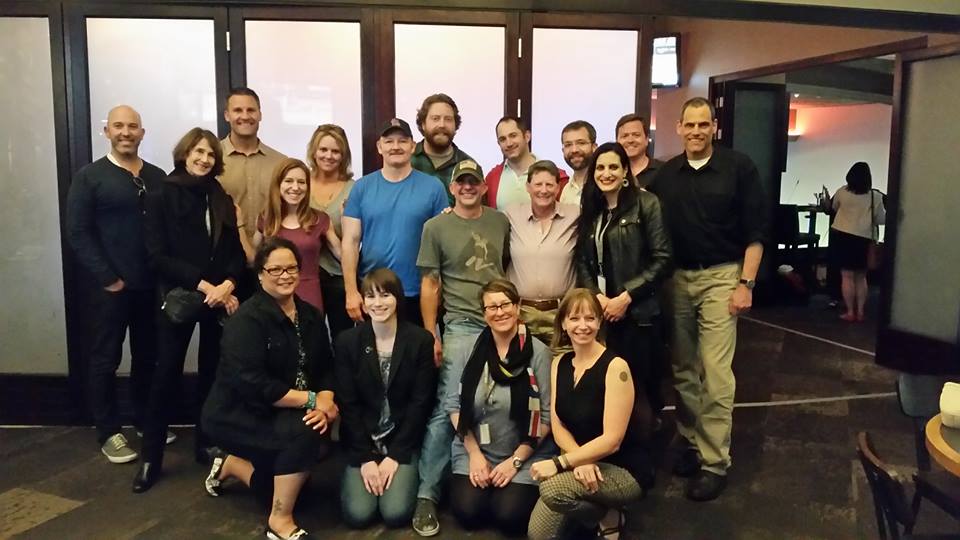
Front row: Mary Doyle, Lauren Halloran, Mariette Kalinowski, Kayla Williams. Second row: Roxana Robinson, Andria Williams, Jay Moad, Adam Stone, Vicki Hudson, Olivia Kate Cerrone. Back row: Julian Zabalbeascoa, Jesse Goolsby, Angie Ricketts, David Chrisinger, Adrian Bonenberger, Brian Castner, John Ismay, me. If we had taken the picture just a few minutes earlier, Colin Halloran, Brian Turner, Benjamin Busch, Ron Capps, Matt Gallagher, Justin Hudnall, Sylvia Ankenman Bowersox, and a few other war-writing stalwarts would have been in it, too.
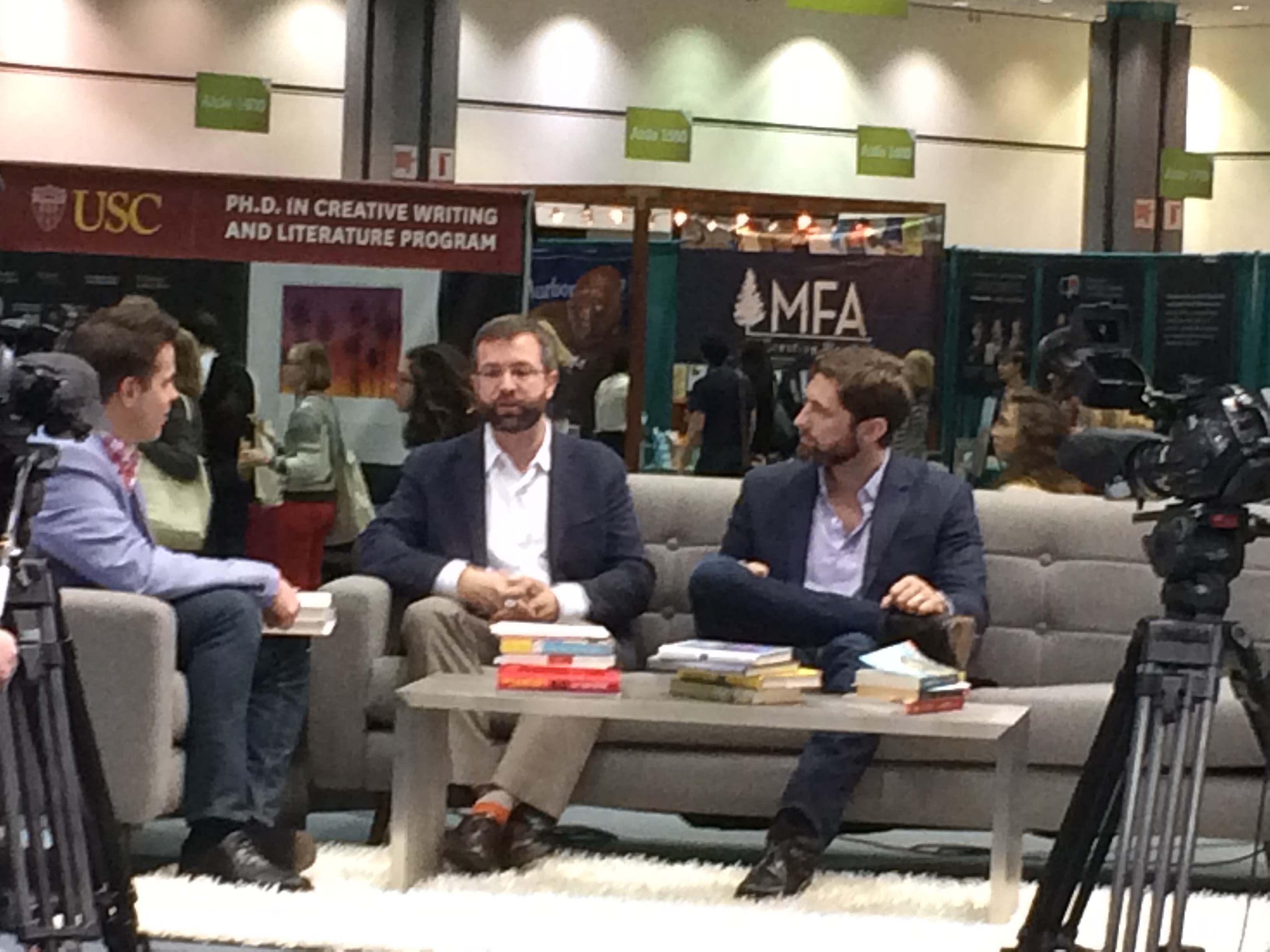
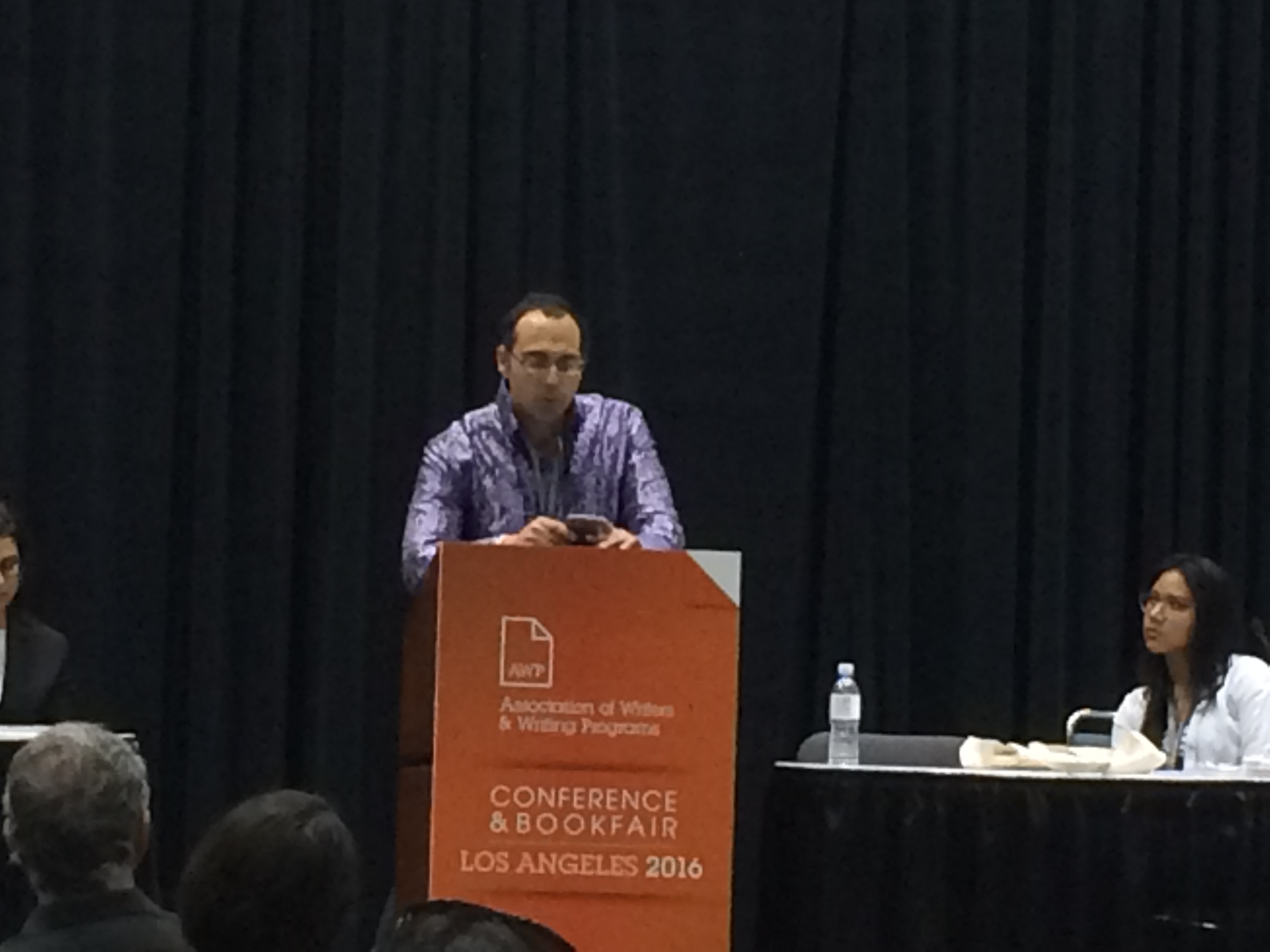
Above and below’s a collection of photographs from this year’s Association of Writers and Writing Programs conference. Apologies for my mug being in so many of them; all credit goes to the writers of fiction, poetry, and memoir whose work is the reason AWP exists.
Ron Capps, me, Kayla Williams, Maurice Decaul, Colby BuzzellJesse Goolsby, Andria Williams, me, Matt GallagherLauren Halloran, Mary Doyle, Jerri Bell, Vicki Hudson, Mariette KalinowskiAdrian Bonenberger, Angie Ricketts, Kayla Williams, Brian CastnerBrian Castner and Phil KlayPhil Metres
We’re all mostly smiley-face here, which is great; nothing wrong with enjoying a little company. Just the meals alone were special: lunch at a taco truck with Colby Buzzell; dinner at a chic French place with Veterans Writing Project honcho Ron Capps, his wife Carole, and VWP fellow-travellers Kayla Williams and Jerri Bell; a quickie cafeteria meal with Matt Gallagher, Benjamin Busch, and Adrian Bonenberger in which Gallagher, Busch, and Bonenberger said at least twelve funny things each; an after-panel snack-and-beer with a group of writers where we were joined by Lauren Halloran’s mom and dad–her mom a veteran of the Gulf War with great stories to tell; and a dinner at the Sherman Oaks home of Susan Derwin, a friend from the academic world, where I met Tom Helscher, who went to the same junior high at the same time as me in Virginia and who now runs a veterans writing program at UC-Santa Barbara.
One of the most salient comments about contemporary war-writing I heard at AWP struck a soberer note, however. I asked Roxana Robinson, an AWP featured speaker, the president of The Authors Guild and author of the excellent war novel Sparta, to what she attributed her interest in contemporary war writing and what she thought its merits. Her response was that war writers who are veterans have a more extensive and authentic relationship with violence–violence in which they may have participated, witnessed, been touched by, or dwelt on. Writers who haven’t fought, deployed, or lived within a profession devoted to war, she continued, have at best a second-hand relationship with wartime violence, and this distance means that they struggle in their attempts to portray it, imagine its possibilities, not just for how it might happen, but for how it reverberates afterwards. I don’t think Robinson was trying to stir the pot about whether civilians can write about war; after all she’s the author of an essay titled “The Right to Write,” in which she persuasively argues that non-veterans can do so. It’s the subjects, war and the military, I heard her saying, that infuse war writing with an urgency centered on contemplation of what it means to harm others while facing injury and death oneself.
I shared the paragraph above with Robinson to make sure I paraphrased her correctly and had permission to do so. In her reply, she graciously wrote:
I very much like your last sentence, which is beautifully phrased, and which reminds me all over again of how much this subject interests me. These are some of the great questions, aren’t they – contemplating your living self as an agent of death. Contemplating the imminence of death to your living self. Not just contemplating but understanding these things in your body.
With at least twelve events featuring authors who have written about deployment to Iraq and Afghanistan, the recent Association of Writers and Writing Program conference offered plenty of opportunity to assess the public face of war writing while also catching up with fellow members of the war writing community. Within an hour of arrival, for example, I was trading stories with Colby Buzzell, whom I had never met before, at a taco food truck near the Los Angeles Convention Center, the site of the conference this year. AWP, as the conference is called, was full of such moments for me, and, I suspect, many others. The panel presentations and readings were excellent, and just as rewarding were the off-stage conversations with old and new friends.
Notions of inclusion and expansion characterized the war-writing panels, as many were specifically designed to showcase authors who were not white male combat veterans writing lugubrious sagas of self. All to the good, and I’m eager now to read authors such as Qais Akbar Omar, a former Afghan interpreter who has written a memoir titled A Fort of Nine Towers; Vicki Hudson, a former MP officer whose creative and non-fiction writing begins to redress the glaring omission of LBGT voices in the war-writing field; and Mary Doyle, a former Army NCO who’s now a prolific author of military-and-deployment accented detective fiction. A panel on memoir featured Kayla Williams, maybe the first female Iraq veteran to write a memoir (she’s now written two), and Angie Ricketts, who has written about the cloistered world of infantry officer wives suffering through their husbands’ multiple deployments. Elsewhere, I was delighted to hear Mariette Kalinowski read fiction that originated in her service as a gunner on Marine convoys in Iraq; Philip Metres read poetry about Abu Ghraib from his volume Sand Opera; and ex-Marine playwright Maurice Decaul speak of his efforts to produce plays written, performed, and staged by veterans.
Phil Metres reads from Sand Opera
The war writing interest in diversity coincided somewhat uneasily with a larger AWP concern this year with matters of race. Touchstones included the furor over the removal of Vanessa Place from the AWP selection committee because of her alleged insensitivity (in the name of fighting racism) about issues important to black Americans, Claudia Rankine’skeynote speech, which targeted the literary world for its implicit racism, and a Ruth Ellen Kocher blog post documenting two demeaning incidents at AWP that reinforced her impression that even among progressive-minded white writers, her black skin signifies second-class citizenship. Everyone who serves in the heavily-integrated military is race-conscious, though most of us like to think that the armed forces are free of, or at least freer of, the racial polarization that currently characterizes much of America. Evidence exists that corroborates this somewhat smug perception, but it is hardly appropriate for white veterans to pronounce definitively that all is well. The same issues surface in the war writing scene, too, with interesting permutations. Neither Mary Doyle nor Maurice Decaul, both black, make race a central concern in their writing about service and war. At her panel, Doyle actively resisted such categorization and explained that if anyone wants to know what really drives her literary bent, they should ask about her lifelong love for Dick Francis, the English author of detective novels set in the upper-crust world of horse-racing. A sweet AWP moment for me was eavesdropping while Doyle and Brian Turner reminisced about a shared deployment to Bosnia, proof that at least sometimes the peculiarly intense experience of service in the Army green machine overwhelms preoccupation with skin color. But it’s not as easy as that, nowhere near the last words on the matter, and I would love to hear Doyle’s and Decaul’s (or anyone’s) most developed thoughts about race and the military, and race and writing about war, should they be inclined to offer them. For what it’s worth, I have written a little more about the subject on this blog in a post titled Toni Morrison’s Home: The Africanist Presence in War Literature.
A second theme emerging out of the alchemy of public and private remarks was a sense that war-writing has matured as a publishing genre, which is to say that it is a much more commercial affair now than previously. Where once war writers were just happy to make it into print, many now are savvy practitioners of the business side of writing, where book deals are made and real money is on the line in the way of advances, foreign sales, next-book contracts, movie options, and ancillary speaking-and-writing gigs. As Jesse Goolsby noted, “The ‘off-page’ stuff can be as important as what’s on the page.” In separate events, Goolsby, Brian Castner, and Kayla Williams each spoke candidly and at-length about publishing—together the three might make a great panel at next year’s AWP titled “The Business of War Writing” (hint, hint). The two themes of diversification and professionalization intersected in frequent discussions about publishers’ receptivity to nontraditional war narratives. From my vantage point, publishing houses seem reasonably open to diverse perspectives, especially when rendered with a smidgeon of literary talent and verve. Things could always be better, of course, but the evidence so far suggests that it is readers, general readers, not the literary-minded ones, who perpetuate the popularity of books by and about young men who have performed bravely in combat, with best-selling titles such as American Sniper and Outlaw Platoon being the proof.
My contribution to AWP this year was to help organize two panels for which I also served as moderator. The first, Iraq Veteran-Writers Ten Years Later: Words After Words After War, featured four writers who all served in Iraq prior to 2005 and subsequently commenced lives largely organized around writing. Two authors, the aforementioned Colby Buzzell and Kayla Williams, were among the first veterans into print after 2003, while two others, Ron Capps and Maurice Decaul, have taken longer to find their writing voices and appreciative audiences. My intent here was to allow these interesting authors to take us back to their deployment days and then help us follow them forward as their thoughts about their service in Iraq coalesced and matured and their lives as writers evolved. Each had insightful ideas and anecdotes to speak of–why aren’t all AWP panels taped and archived? It’s impossible to reduce their common concerns to a sentence, but I sensed that Decaul and Williams are now exploring writing and life possibilities still deeply informed by early experience in Iraq, while Capps and Buzzell are more ready to move on, as if their deployment memories have now (perhaps thankfully) reached a half-life state of dissolve. Whatever these four authors do next, we’ll all be watching—it’s not just that they are “leaders” per se within the war-writing community, though they are, but that they now bring so much hard-earned gravitas to bear on any subject they choose to examine. More simply put, they’ve lived through more of life and life’s writing experiences than most of the rest of us.
Speaking of which–life–participants on the memoir panels spoke often about the problems of “life-writing,” which involves carefully modulating impulses toward self-promotion, self-disclosure, self-deception, self-deprecation, and even self-laceration. It took the panels featuring fiction to illustrate the insidiousness of this dynamic by portraying scenes too touchy to confess to in memoir. The aim of my second panel, New Directions in Contemporary War Literature, was to bring forth authors of novels about the military and war written within the last two years and see what reverberations their readings generated. I couldn’t have been happier with the result, the exact shape of which I didn’t see coming and which truth to tell was somewhat scary, though all the better for that.
Jesse Goolsby, the author of I’d Walk With My Friends If I Could Find Them, went first, choosing a passage from near the end of the novel in which one of the characters, Wintric Ellis, long after the war, sits in his car trying to work up the courage to kill the soldier who sexually assaulted him in Afghanistan. Early in the novel, Wintric participates in a shoot-or-don’t-shoot scenario in Afghanistan when he and his buddies are faced by a suicide bomber; now at the end of the novel it emerges that what has wrecked Wintric’s life was not enemy on the battlefield, but one nominally on his own side, and he must once more decide whether to kill someone or not. It’s a wrenching scene, similar in its way to Siobhan Fallon’s great short story “Leave,” and was beautifully read by Goolsby.
While Wintric deliberates, he fields a call from his wife, who wonders what he is up to. Wintric lies to her about his intentions, and it turns out that he has lied to her about other aspects of his deployment, too, more out of shame than meanness. Such deceit and cowardliness is hard to own up to in memoir, but the very stuff that fiction is good at portraying. Mendacity (to reference Cat on a Hot Tin Roof) also figures in Andria Williams’ The Longest Night, which dramatizes a real-life nuclear catastrophe that took place on an Army base in Idaho during the Cold War, while also offering startling astute portraits of the men who worked on the base and their families. Williams read an early scene foreshadowing the reactor meltdown and another longer one describing the mediocre career and desultory marriage of Master Sergeant Richards, a pompous senior NCO in charge of the reactor. The passage, told from the NCO’s wife’s point-of-view, is simultaneously devastating and funny-as-hell, and Williams’ reading, as did Goolsby’s, captivated the audience. The bigger import, alas, also had much in common with Goolsby’s: a military whose self-image is very badly out of sorts with its reality. Where there should be heroism, there’s folly; where leadership, selfishness; competency, dysfunction; loyalty, deceit; trust, contempt; camaraderie, betrayal; and faithfulness, infidelity.
If anything, the discrepancy between reality and appearance was heightened in the passage that Gallagher read from his novel Youngblood, one line of which went, “We were what we pretended to be.” The scene portrayed Youngblood hero Lieutenant Jack Porter as he makes a “blood money” reparations payment to the family of an Iraqi noncombatant they have killed. Porter finds himself adrift in a moral wasteland that puts him at odds not just with Iraqi values and customs, but also with the expectations of his men and his chain-of-command. Not trusting himself or anyone else, but performing, so to speak, on stage with all eyes on him, Lieutenant Porter must depend upon his wits to decode the swirl of ambiguous clues to determine what he should do and how he should feel. Many literary roads lead back to Melville, and as Gallagher read of Porter’s confusion I was reminded of Benito Cereno’s Amasa Delano, the Yankee ship captain who boards a slave ship on which the slaves have rebelled and taken control. As the slaves force the slave ship captain to pretend he is still in charge, Delano struggles to understand that the appearance of normality that the slaves have constructed for him is a fraud, as his powers of discernment, undermined by arrogance and false assumptions, prove far too weak to help him figure out the complicated situation he finds himself in. Critics have noted many references to the pretend world of theater in Benito Cereno, and much the same occurs in Youngblood, where really-real reality is continuously destabilized by Gallagher’s references to the stories, lies, myths, delusions, pretense, and other means of distortion and manipulation that purport to describe it.
The three readings, taken together, portrayed the complicated and often perverse flux of identity and play of truth inherent to life in uniform, with the authors in superb control of their material. If the message and tone were ominous, perhaps I’m making too much of it. Novels are imagined projections about how things might be, after all, not official pronouncements about the way things are. In any case, though, the story-writing talent on display set a high bar for the next round of novels about military and war. Two audience members, neither veterans, but the authors of many novels between them, told me the reading was the best event they attended at AWP. I was glad to hear that, but not too surprised, because I was pretty sure beforehand that it, like AWP itself, was going to be good.
Many thanks to all who made AWP so enjoyable this year. In addition to everyone named above I’ll mention Lauren and Colin Halloran, Jerri Bell, Benjamin Busch, Adrian Bonenberger, Jay Moad, Brandon Lingle, Carole Florman, Susan Derwin and Steven Venz, Tom Helscher, Justin Hudnall, Sylvia Ankenman Bowersox, Olivia Kate Cerrone, Julian Zabalbeascoa and his wife Kate, Lisa Sanchez, David Chrisinger, Christopher Robinson, Danuta Hinc, Christopher Meeks, all friends, family members, and fellow travelers, everyone I’ve forgotten, and last but not least Roxana Robinson for hanging out with us for a while and then saying such nice things on social media.
The Association of Writers and Writing Program conference—AWP for short–is the year’s largest gathering of literary fiction, non-fiction, memoir, and poetry authors; small and big publishing house managers and editors; MFA program directors and students; and writing acolytes of unaffiliated stripe. This year’s AWP is in Los Angeles this coming Thursday through Saturday, March 31-April 2. Among the several hundred offerings are at least 11 events focused on writing about war or featuring authors of prominent war literature works. I’m fortunate to be part of two of them, and I’m excited about attending as many of the others as I can. Below I’ve listed the events featuring war writing of which I am aware and include links to as many authors’ (war-writers and those on panels with war-writers) webpages as I could find. Let me know if you spot any mistakes, omissions, or changes from the official program.
1. Iraq Veteran-Writers 10 Years Later: Words After Words After War. Peter Molin, Colby Buzzell, Kayla Williams, Maurice DeCaul, Ron Capps. Thursday 1:30pm. Room 408 A, LA Convention Center, Meeting Room Level.
2. The National Book Critics Circle Celebrates Award-Winning AuthorsPhil Klay, Héctor Tobar, and Amy Wilentz. Thursday 3:00pm. Petree Hall, LA Convention Center, Exhibit Hall Level One.
3. Blood and Water: Poets Pouring into Nonfiction. Laura McCullough, Benjamin Busch, Kelle Groom, Michael Klein. Thursday 4:30pm. Room 407, LA Convention Center, Meeting Room Level.
6. Veteran Poetry Reading. Jeb Herrin, Karen Skolfield, Vicki Hudson, Soul Vang. Saturday 9:30am. Room 513, LA Convention Center, Meeting Room Level.
7. Equal Voices: Evolution of the Modern War Memoir. Adrian Bonenberger, Kayla Williams, Brian Castner, Angela Ricketts. Saturday 10:30am. Diamond Salon 6&7, JW Marriott LA, Third Floor.
8. Women Soldiers and Veterans Writing Their Lives. Sonya Lea, Warren Etheredge, Suzanne Morrison, Maggie Shartel, Kelly Dickinson. Saturday 12:00pm. Room 512, LA Convention Center, Meeting Room Level.
9. Helping: A Tribute to Robert Stone. Marlon James, Roxana Robinson, David Ulin. Saturday 12:00pm. Diamond Salon 6 &7, JW Marriott LA.
10. New Directions in Contemporary War Fiction. Peter Molin, Matt Gallagher, Andria Williams, Jesse Goolsby. Saturday 1:30pm. Room 510, LA Convention Center, Meeting Room Level.
11. Inheriting the War Anthology Reading: Poetry and Prose by Descendants of Vietnam Veterans and Refugees.Cathy Linh Che, Philip Metres, Laren McClung, Monica Sok. Saturday 3:00pm. AWP Bookfair Stage, LA Convention Center, Exhibit Hall Level One.
12. Peter Ho Davies, Joyce Carol Oates, and Roxana Robinson: A Reading and Conversation. Sponsored by the Author’s Guild, Ecco, and Kundiman. Saturday 8:30pm. Concourse Hall, LA Convention Center, Exhibit Hall Level One.
 The contemporary war lit corpus of poetry, fiction, and memoir has covered a lot of ground, but has had little to say so far about the presence of gay men and women in uniform. Jesse Goolsby’s I’d Walk With My Friends If I Could Find Them contains a gruesome male-on-male rape scene, and Matt Gallagher’s Youngblood features a cameo appearance by a closeted company commander, but that’s about it in terms of fiction published by big-name publishing houses. Poetry, nothing comes to mind, either, though an exhaustive search of vet writing anthologies and web publishing sites would surely turn up something. Jeffrey McGowan’s memoir One Gay Man’s Life in the Don’t-Ask-Don’t-Tell Military, published in 2005, is interesting, but McGowan left the Army in 1998. Playing by the Rules, by gay former Marine Justin Elzie, was published in 2010, but Elzie was out of the Marines long before 9/11. Amazingly, as far as I can tell, no book-length memoir by a gay or lesbian Iraq or Afghanistan veteran has yet appeared. Please, somebody, tell me that I’m wrong.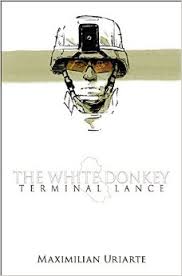






 Time Now: The Wars in Iraq and Afghanistan in Art, Film, and Literature