Nadeem Aslam’s The Wasted Vigil

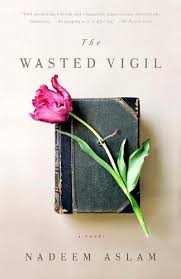
The Wasted VigilThe Wasted Vigil, Anglo-Pakistani author Nadeem Aslam’s ambitious novel about war in Afghanistan, did not arrive unheralded in 2008. Widely reviewed in major media outlets, it was pronounced the first important novel depicting contemporary war in Afghanistan, or, for that matter, Iraq. The Wasted Vigil‘s publication afterlife, however, has been curiously quiet—I’ve seen it referred to only here-and-there in writing about 21st century war fiction and it seems not to have been a significant influence on the rush of American-authored war novels that began appearing in 2011. Reviewing The Wasted Vigil in 2016, then, is a matter of restoring its pride-of-place in the annals of contemporary war literature, exploring the reasons for its semi-obscurity, and taking the measure of its interesting aspects.

The Wasted Vigil is both panoramic in scope and intensively focused in terms of time and place. Major characters include Marcus, a British expatriate entomologist who has lost a wife, a daughter, and a hand to the Taliban; David, an American ex-spy who has lost a brother to war; Lara, a Russian woman whose brother died in Afghanistan; and Casa, a young Taliban jihadist. The secondary cast numbers a variety of Afghan villagers and militia men, US special forces and contracted security operatives, and family members and friends of the American, British, and Russian major characters. The action takes place in and around Marcus’s house near Jalalabad, where Marcus has lived through decades of invasion, civil war, efforts to expel infidels, and the first years of Operation Enduring Freedom. The house, like the highly symbolic edifices found in the works of magical realists such as Gabriel Garcia-Marquez or Salmon Rushdie, to say nothing of Poe’s gothic House of Usher, features a number of fanciful embellishments. In the basement lies a giant Buddha-head and the remnants of a perfume factory—the Buddha-head, though not the perfume factory, has somehow survived the reign of the Taliban. Upstairs, Marcus’s Afghan wife in a fit of insanity has nailed the books in the library to the ceiling, while Marcus himself has lathered with mud the friezes painted on the interior walls to hide them from Taliban scrutiny. Outside, a nearby lake serves David’s Quixotic-Thoreauvian ambition to build by hand a birch-bark canoe, in the midst of the war, with, as it comes to pass, the help of Casa, who has disguised his identity as a Taliban. Aslam stirs this stew of schematic ingredients and serves them up in ways meant to be clearly representative of the failed aspirations of each character’s national and demographic origin. Over the course of a few days, described with frequent flashbacks and explanatory digressions, the hopes of each of the major characters, and in some cases their lives, are destroyed and the fragile polyglot, multinational dream of coexistence comes undone.

The Wasted Vigil reveals all its main characters to be unwitting or witting perpetrators of the fall of the house of Marcus, as well as its victims, but Aslam clearly designates Casa as the primary destroyer of the tenuous social harmony Marcus’s house represents. While other Afghans make decisions and act according to understandable mixtures of personalized desires and search for advantage, influenced by Islam and history but not predetermined by them, Casa is possessed of a diseased worldview that makes him impervious to reason, tolerance, gratitude, or kindness, while sharpening every impulse to wage war on infidels and generating heinous ideas about women. Aslam subtly portrays the thoughts of a young man infected by Talibanism as Casa is exposed to the sacrilegious ways of Marcus’s house and its residents. The end result, though, the default setting so to speak, is always a robotic return to form that drives him to destroy non-believers in the name of Allah. The depiction could not be bleaker; in comparison, Afghan insurgents portrayed in novels such as The Watch, Green on Blue, and The Valley are models of cosmopolitanism. To hope that it might be otherwise, The Wasted Vigil suggests, is foolishness—the unrewarded effort referred to in the novel’s title.

A critic blurbed on the paperback edition of the The Wasted Vigil praises the “sheer, astonishing loveliness” of Aslam’s prose, but a 2008 New York Times review takes Aslam to task for what it perceives as unnecessarily “florid” language in sentences such as, “The pomegranate was on a table close to the fireplace. She slit it open now. The outer layer of scarlet seeds had been warmed by the flames. The temperature of menstrual blood, of semen just emerged from a man’s body.” The reviewer comments: “Perhaps Afghanistan, a place of extremes, invites this overblown style. It certainly seduced Aslam, a writer of considerable talent, into thinking he could render its titanic tragedies by pushing his language into operatic effusion.” Hanging an author by the poor quality of his worst sentences might be churlish, but the critique invites consideration whether Aslam just tried too hard, too early on, to say too much about events unfolding in the “Graveyard of Empires,” as if the literary razzle-dazzle interfered with a more accessible story more simply told. The wave of contemporary war novels that began arriving in 2011—Sand Queen, Billy Lynn’s Long Halftime Walk, The Yellow Birds, The Watch, and Fobbit, for examples—revealed the inclination of American authors and readers for tales tightly focused on the experiences of young American fighting men and women. In other words, their characters, and by extension, their authors (Sand Queen author Helen Benedict and The Watch author Joydeep Roy-Bhattacharya are partial exceptions here) were not very interested in the historical and cultural dimensions of the wars in which the protagonists fought. It would take a few more years before authors of contemporary war fiction began to attempt the longer, wider, deeper, more comprehensive views that Aslam pioneered in 2008. Similarly, war lit readers initially put off by The Wasted Vigil’s grandiloquent style, overpopulated and exotic cast, somewhat preposterous setting, highly programmatic plot, and bleak theme might now reconsider whether it all really is too extravagant or not.

My review of Aslam’s 2013 novel The Blind Man’s Garden.

Nadeem Aslam, The Wasted Vigil. Vintage-Random House, 2008/2009.

Sinan Antoon’s The Corpse Washer

The Corpse Washer 2The subject of Iraqi-American author Sinan Antoon’s 2013 novel The Corpse Washer is the devastation wrought on an Iraqi family by the American occupation and subsequent sectarian violence. Antoon has lived in America since 1991, but The Corpse Washer reads as if it were a novel written from the Iraqi side, from the inside, with all the authority and righteousness of witness and victim that perspective entails. As such, it makes novels about the Iraq War depicted from American vantage points seem ethically unstable, as if spinning tales for publishing profit and reading pleasure about the petty dramas of American fighting men and women in a war that we started and in which everyone who fought volunteered was a problem. Was the waste of Iraq worth it if for no other reason than that it provided grist for the ambitions of a few dozen American literary aspirants? Does every page of contemporary war lit come at the expense of a dead Iraqi? Every dollar made?

Those are tough questions, even as they are willfully oblivious to the conscience and politics reflected in much contemporary war fiction, and in any case Antoon is not immune from their reach. But if we accept that The Corpse Washer reflects an authentic Iraqi sensibility, how does it differ from American war fiction? Originally published in Arabic in 2010 as The Pomegranate Alone and translated into English by Antoon himself, The Corpse Washer’s protagonist is Jawad Kazim, the scion of a Baghdad family whose livelihood for generations has been the preparation of the dead for Muslim burial. Secular, educated, and artistic, Kazim eschews the family profession, but the press of war drives business up while destroying the multifarious civil society that might nourish dreams of escape. As options disappear and his own family is touched by violence, Kazim, to his despair, inherits his father’s profession. At the level of message, then, The Corpse Washer is simple and clear: Kazim may not be interested in war, but war is interested in him, and if war hasn’t yet killed Kazim, at novel’s end he is fully imbricated in its harvest of dead bodies, as, the novel suggests, are all Iraqis.

Stylistically, The Corpse Washer’s prose texture is lyrical and figurative compared to the no-frills verisimilitude of most American war fiction. A passage such as the following is almost unimaginable coming from an American war author and would inspire suspicion in many readers:

Death is not content with what it takes from me in my waking hours, it insists on haunting me even in my sleep. Isn’t it enough that I toil all day tending to its eternal guests, preparing them to sleep in its lap? Is death punishing me because I thought I could escape its clutches? If my father were still alive he would mock my silly thoughts. He would dismiss all this as infantile, unbecoming to a man. Didn’t he spend a lifetime doing his job day after day, never complaining of death? But death back then was timid and more measured than today.

I can almost hear death saying: “I am what I am and haven’t changed at all. I am but a postman.”

If death is a postman, then I receive his letters every day. I am the one who opens carefully the bloodied and torn envelopes. I am the one who washes them, who removes the stamps of death and dries and perfumes them, mumbling what I don’t entirely believe in. Then I wrap them carefully in white so they may reach their final reader–the grave.

Judging by the worldviews described in The Corpse Washer and the Afghanistan war novels (The Wasted Vigil and The Blind Man’s Garden) by Pakistani-English author Nadeem Aslam, both authors and their characters view life much more grandiosely than do Americans. Nature, family, history, art, religion, and philosophical meditation on the cosmic swirl of good and evil appear to play bigger parts in the minds of Muslim citizens of the middle East and southwest Asia than they do in the minds of Americans soldiers and the authors who write about them. In the works of Antoon and Aslam, the events of the day are saturated with connections to larger frames-of-reference, in particular the crushing burden of Islamic faith, which the characters find simultaneously enriching and loathsome. Jesse Goolsby’s excellent novel I’d Walk With My Friends If I Could Find Them provides evidence for the comparison. The deepest conversation its three American soldier protagonists have while in Afghanistan concerns which Division I football teams don’t have the word “university” in their names. Goolsby damningly (though with love, too) portrays how obsession with trivia and nonsense betrays the protagonists’ lack of vocabulary and even inclination to think in larger terms before and after service, too. The banal quality of their talk and vacuous quality of their minds are the results of poor educations and weak American cultural- and family-based traditions of passing on wisdom. Ill-equipped to think well about the events of their lives, they eventually pay the cost in moral and mental distress they don’t understand and can’t describe.

Perhaps, though, little ultimately and practically differentiates banter about football and couching every utterance in high-flown language and baroque references to religion, art, and history, for all the good either does anybody. Perhaps Americans are blissfully lucky not to be haunted by larger structures of awareness, and our virtues, such as they are, may only be possible because of our defects. No one expects 20-year-olds to be as sensitive as older men trained to be artists and clerics and women informed by 2500-year-old traditions of family, anyway, and for all the cultural richness of Iraqi Islamic society the social-political pay-off seems to be slight, what with its horrible oppression of women and propensity to mutilate opponents, either before or after killing them, neither of which Antoon is shy about portraying. But whether writerly affectation or cultural truth, the literary consequences of the high-flown style are two: a far less inspired prose texture in works written by Americans about Americans, one, and, two, the rendering of the impression that a nation populated by deeply perceptive people was first liberated, if that’s the right word, and then ruined by another whose soldiers were astonishingly crude.

Sinan Antoon, The Corpse Washer. Yale University Press, 2013.

War Dance: Costa Compagnie’s After Afghanistan

Costa Compagnie
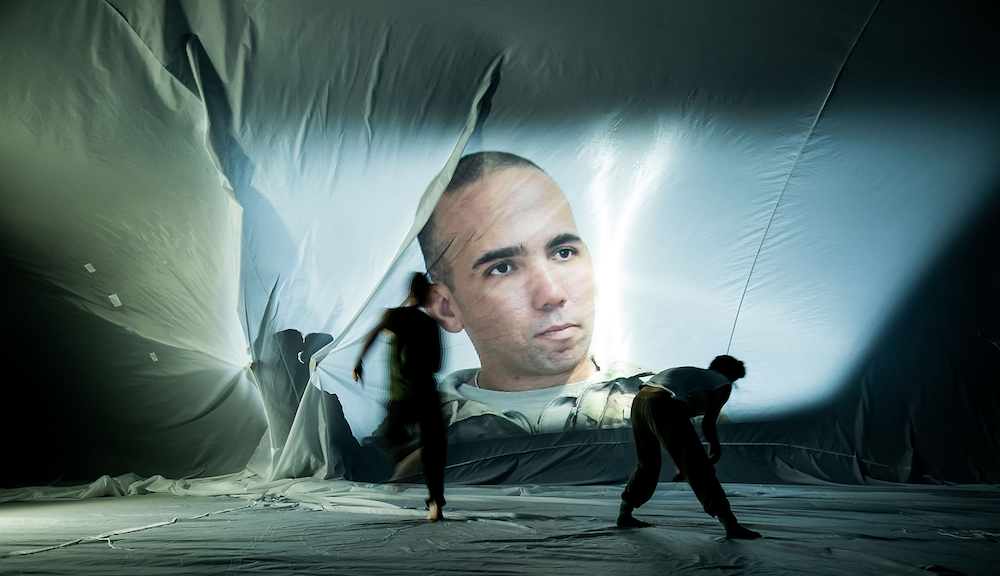
A scene from Costa Compagnie’s Conversion_2: After Afghanistan.

Two years ago I had the pleasure of meeting Felix Meyer-Christian, the artistic director for Costa Compagnie, a German performance art collective. Costa Compagnie productions combine images, video, music, dance, spoken word, and audience interactivity in what their website calls an “Archeology of the Present” that investigates “global transformative processes.” The highly conceptual self-descriptions belied a much easier-to-describe task that brought Meyer-Christian and me together: I helped him interview US Army service members who had served at the American military base in Heidelberg for a project exploring the base’s 50+ year history as a locus of German-American relations organized around joint military endeavor. The kaserne closed in 2013, but in its time its presence focalized intense social and political processes and personal emotional responses, especially for Germans, whose shared military history with the USA since the end of World War II has not been unproblematic. Costa Compagnie sought to capture this intensity and complexity through mixed-media art–an audacious project. Just one complicated aspect, for instance, was reconciling the fondness with which most American soldiers remember their time in Heidelberg, as well as the fondness, as I understand it, held by many Heidelberg residents who perhaps worked at the kaserne or did not view its existence with any particular animosity, with the militaristic and global-political considerations that underwrote its existence.

The project, titled Conversion_1: A German-American Choreography, was staged in the Heidelberg kaserne gymnasium in 2014. A trailer for Conversion_1 illustrates how Costa Compagnie generates artistic analogies for not just representing but recreating the experience of living within such a highly complicated admixture of historical and social currents:

Even as Meyer-Christian was conducting interviews for Conversion_1, he was also preparing for a second production, titled Conversion_2: After Afghanistan. Conversion_2’s intent was to extend Conversion_1’s interest in militarized shared histories as reflected at the level of community to German and American FOBs in Afghanistan as the NATO and ISAF involvement there wound down. From the Costa Compagnie website comes this description:

The Costa Compagnie does not try to explain the world to the audience. Instead they very effectively and powerfully document the kaleidoscope of an heterogeneous Afghan present on the way to an uncertain future by artistic means.

In the trailer for Conversion_2, the opening shots of a pneumatic drill-equipped crane breaking down a US Army FOB are particularly stunning. Some of the music is ambient military base noise—generators, aircraft engines, and other machinery—turned into pulsing electronica, which is also very cool. Costa Compagnie premiered Conversion_2 in Germany in 2015 and will stage a reduced-scale all-English version  at Vassar College in the fall of 2016. They are also negotiating to perform in New York City as well. I’ll be there if they do, and I hope you will be, too.

Matt Gallagher’s Youngblood

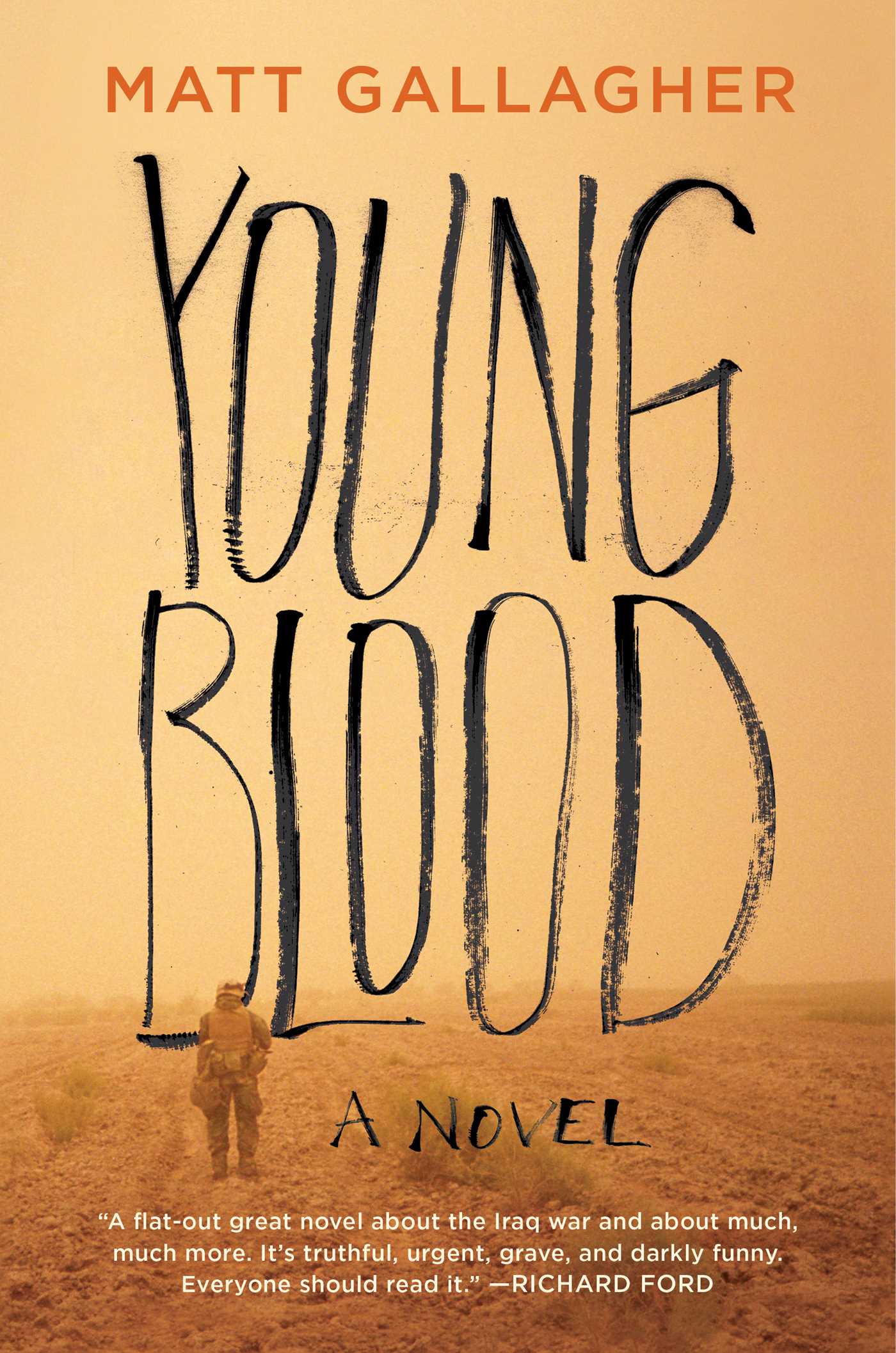
youngblood-9781501105746_hrMatt Gallagher’s novel Youngblood arrives this month to high praise. Michiko Kakutani in the New York Times writes, “With Youngblood, [Gallagher] has written an urgent and deeply moving novel.” Roxana Robinson, the author of Sparta, reports in the Washington Post that “…Matt Gallagher shows again how war works in the human heart — something we’ll need to know, as long as there is war.” Kakutani avoids grand pronouncements about the state of war writing today and Youngblood’s place in it, but Robinson notes that “War lit is now part of who we are, holding up a mirror, bearing witness to our culture” and that “Gallagher raises all these issues in smart, fierce, and important writing that plays a big part in our new genre.” Robinson implies that with Youngblood Gallagher has moved the needle, so to speak, in regard to war-writing and in so doing perhaps has moved to the head of the field in terms of achievement. Youngblood, in this view, capitalizes on possibilities hinted at by other contemporary war fiction, avoids pitfalls common to the genre, and pioneers new subjects, themes, styles, and manners of treatment.

I’m not quite prepared to say that all of this is true, though I’m leaning that way, or to explain how it all might be true, though I’m beginning to form ideas. In a dust-jacket blurb Kakutani writes of Gallagher’s “ability to move effortlessly between the earnest and the irreverent, the thoughtful and the comic.” In other words, Gallagher has a few more gears than most war-writers, especially veteran writers, and it shows in Youngblood’s deft rendering of scene, character, and context and the quality of individual sentences. In her Washington Post piece, Robinson states, “Everyone who reads war lit knows Matt Gallagher,” which speaks to Gallagher’s early prominence as the keeper of a war blog and author of a memoir both titled Kaboom, his editorship (with Roy Scranton) of the Fire and Forget anthology of short war fiction, his service as lead writing instructor with Words After War, and his many occasional pieces in print and around the web. Youngblood itself has existed in a state of revision metamorphosis for at least five years since Gallagher first hinted at its existence in 2011, and in an interview on the Bomb website Gallagher speaks about the hard work of transitioning from memoir to fiction. The years in the wood-shed now pay off triumphantly. In terms of thematic insight and narrative-stylistic texture, Youngblood is on another level completely from Kaboom and Gallagher’s Fire and Forget entry “And Bugs Don’t Bleed.”

Youngblood begins with a prologue by its first-person narrator Lieutenant Jack Porter that riffs on the difficulty of war-tale-telling in ways familiar from Tim O’Brien’s “How to Tell a True War Story”:

It’s strange, trying to remember it now. Not the war, that’s all tangled up, too. I mean the other parts….

A lot of people ask, “What was it like?” and once, I even tried to answer. I was home, with old friends. They meant well, and while they didn’t want a perfect story, they wanted a clean one. It’s what everyone wants, and I knew that. But it came out wrong….

What was it like? Hell if I know. But next time someone asks, I won’t answer straight and clean. I’ll answer crooked, and I’ll answer long. And when they get confused or angry, I’ll smile. Finally, I’ll think. Someone who understands.

The tone here is portentous, but Porter’s voice soon relaxes into a winning blend of snark, self-deprecation, sensibleness, and perception. On Youngblood’s first page, Porter reports that upon waking up one morning after several months in Iraq, “I shook out my boots to make sure a scorpion hadn’t crept into them during the night. It hadn’t happened to anyone yet, but still, there were stories.” The prologue and opening scene reflect the vexed nature of military wisdom, with stories—anecdotes, lore, and narratives—providing the best access to knowledge but also frustrating with their inadequacy, manipulativeness, and possible fraudulence. In novels, stories become plots—interwoven narratives that seem as dependent on character and context as they do on events—and Youngblood raises the war-writing bar in regard to complex, imaginative, and suspenseful story-lines. One thread has Porter struggling to solidify his command of his platoon as his leadership authority is challenged by the arrival of a much harder, more experienced NCO named Daniel Chambers. A second has Porter trying to solve a possible series of murders that took place several years earlier in Ashuriyah, the fictionalized neighborhood near Baghdad his men patrol daily, killings in which Chambers, on an earlier tour, may have been complicit. As these story-lines unfold a third develops: Porter’s growing affection for Rana, an Iraqi woman whose marriage to an American soldier early in the war appears to be connected with the unsolved deaths.

That the first years of Operation Iraqi Freedom were freewheeling enough to permit a soldier to venture solo outside the wire to court an Iraqi woman intrigues Porter, and me as well–I’m not sure I’ve ever heard of a soldier marrying an Iraqi who did not work as linguist, cultural analyst, or some other position on a FOB. Similarly, a second Iraqi woman character who supplements her duties as an outpost wash-woman by serving its soldiers sexually seems a stretch, but Gallagher’s certainly heard stories or seen things I haven’t been privy to. Youngblood uses the imaginative space of a novel to speculate that such things might have happened and how they might have happened, which probably means they did happen, in my reckoning, in some form or another, on the down-low. In the same vein, Porter’s company commander is a closeted homosexual, and Chambers is sleeping with the hot chick at battalion headquarters. A well-informed non-fiction account of the romantic and erotic lives of deployed soldiers remains to be written, but Youngblood uses fiction to plausibly frame many of the possibilities. And while no one would argue that a slew of GI marriages and an organized sex-for-pay system were just what OIF and OEF needed, the heated-up private lives of Youngblood characters reminds us that the official sexual sterility of our operations in Iraq and Afghanistan is connected, at some level, with the barren unfruitfulness of our political and military partnerships.

In any case, romance and marriage with an Iraqi national could only happen under conditions of extensive civ-mil engagement, and Youngblood tells a tale of American occupation and counterinsurgency, not combat. As Porter states early on, “We’d been in country five months, and hadn’t even been shot at yet.” The setting allows Gallagher to show American soldiers engaging Iraqis on terms other than at the point-of-a-gun and over a longer duration than a raid. To the soldiers in Youngblood, Ashuriyah residents are anything but a faceless blur of military-aged-males who need killing. Porter’s platoon is first slowly, then quickly drawn into a complicated swirl of sectarian feuding and side-taking, accompanied by careful withholding and dissemination of important information. The soldiers learn that the people of Ashuriyah have names and distinctive personalities, thoughts, and goals, along with complicated personal histories, family ties, and memories; they are met daily by the Americans and each inspires varying levels of trust, respect, and regard. Much contemporary war fiction—Sand Queen, The Watch, The Valley, and The Knife, for examples—portrays Iraqi and Afghan characters, and Green on Blue is wholly devoted to the view of an Afghan tribal militia-member—but among novels written by Americans, Youngblood by far particularizes the wide-ranging and diverse social world encountered by American soldiers.

Youngblood also possesses a sense of history that many other war novels lack, a deficiency shared by most soldiers deployed to Iraq and Afghanistan. Not history as in “Cradle of Civilization” or “Graveyard of Empires,” blah blah blah, but recent real history as towns, neighborhoods, and communities experienced successive waves of American occupation. American military planners pay lip service to what they call “situational awareness” and “institutional memory,” but most American soldiers on deployment were as oblivious about what happened in the preceding five years of the battle spaces they occupied as they were of the people who lived there. All who deployed know the saw about Iraq and Afghanistan wars being “fought one year at a time” and references to the daily grind of non-descript, unfocused missions as “Groundhog Day” were also common—a damning indictment of the sloppy and thoughtless new American way of war. In Youngblood, however, it matters that it is circa 2010 in Ashuriyah, not 2007, 2005, or 2003: because things change, truth and knowledge become moving targets. Consciousness of their late-stage participation in their generation’s war preoccupies Porter’s men. Though eager to test themselves under fire, none want to be killed in a war no one cares about anymore. But riding out their deployment doing nothing but vapid presence patrols and checkpoint operations proves impossible. Events that occurred early in the occupation have consequences that take time to develop, as memories linger and sometimes fester and opportunities for action arise. The lives of Porter and his men are jeopardized by things thought to be long past mattering, but which reverberate anew under the pressure of fresh circumstances. The longer view doesn’t win the war for Porter’s platoon, but it certainly gives Youngblood more moral heft than war fiction that renders Iraq and Afghanistan as generic post-2003 spaces or portray time rigidly from a purely American perspective—a year away from home, a few hours’ mission, a night spent waiting out rocket attacks.

Gallagher speaks openly in interviews of his love for David Simon’s television crime series The Wire, and it’s easy to see The Wire‘s Detective Jimmy McNulty in Porter’s raffish approach to duty. We might also see the rivalry between Porter and Chambers as a reworking of Stringer Bell and Avon Barksdale’s legendary brains-vs-brawn contestation for control of west Baltimore’s drug-dealing ring, and Youngblood definitely features a Bubbles-type informant. But the excellence of The Wire and Youngblood lies not in their ability to create memorable characters, as great as they are at that. Gallagher views Iraq as Simon did Baltimore: a never-ending saga of colliding social forces in which the actors might possess very distinctive personalities, but little real agency. Instead, their opportunities for action are defined by the cohorts in which they group themselves—police, drug-dealers, politicians, dock-workers, etc. in the case of The Wire—and they are destined to play parts scripted by circumstances beyond any one individual’s ability to control. Soldiers more than most people understand they are cogs in bigger systems and processes, but soldiers are also tantalized by dreams of heroic individualism and tend to think of their deployments as highly-personalized war dramas starring themselves. Novelists should know better, though, as should veterans five years removed from deployment. Youngblood’s The Wire-like alertness to social, cultural, and historical context demonstrates how it might be so.

Matt Gallagher, Youngblood. Atria, 2016.

Christopher Robinson and Gavin Kovite’s War of the Encyclopaedists

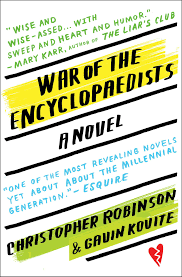
War of theA lieutenant’s story should always be interesting. Whether expressed in memoir, fiction, or poetry, tales of promising youth crashing against the chaos of battle and the colossus of military culture and tradition provide ample grounds for dramatic conflict and inward soul-searching. But when I got around to reading the first wave of lieutenant memoirs written by veterans of Iraq and Afghanistan, they struck me as off-key and dated. Not to name names, but the memoirs published in the 2000s seemed rooted in pre-9/11, pre-digital-age notions of how young officers might respond to their ordeals. The tone’s a little stiff, as if the authors were overly indebted to leadership homilies learned in officer training programs, from Hollywood movies such as Platoon, and from a heroic tradition of war literature rooted in ancient Greece and culminating in Tim O’Brien’s “The Things They Carried.” The authors seemed preoccupied with testing themselves as leaders of men in battle, and oblivious to other dimensions of the wars they were fighting, such as actual Iraqis and Afghans and the complicated mission of occupation. The authors, too full of respect for a military that was seriously struggling, didn’t much resemble the young officers I met during deployment to Afghanistan in 2008-2009 or knew generally.

By 2010, a generational divide between junior officers—lieutenants and captains—and field grade officers—majors and up—divided the officer corps in ways unforeseen in 2005. According to the field grades, junior officers were undisciplined and disrespectful, even as senior officers acknowledged that lieutenants and captains were combat-experienced and deployment-tested like they themselves never had been. The view from below was even more antagonistic: to the juniors, anyone commissioned before 2001 was apt to be a dinosaur, or a blustering paper-maché tiger, oddly-motivated by concern for career and appearances and devoid of practical wisdom. Army captain Matt Gallagher’s 2010 Kaboom was first officer’s memoir in which something resembling this modern voice and mentality—way less self-serious and very ambivalent about the bigger military being served—appeared. Elizabeth Samet’s 2014 No Man’s Land, based on her friendship with dozens of West Point-educated young officers, also sympathetically catalogued this perspectival divide between young and old. Contemporary war fiction was slower to channel such up-to-the-moment sentiments, but recently has begun to catch up. Novels such as Michael Pitre’s Fives and Twenty-Fives, John Renehen’s The Valley, Christopher Robinson and Gavin Kovite’s War of the Encyclopaedists, and now Gallagher’s own Youngblood portray lieutenants at war in ways that seem very aware of how 25-year-olds actually are these days, especially those in uniform and wearing brass.

By some rights, I’m the ideal reader for Robinson and Kovite’s War of the Encyclopaedists. The novel’s two subjects—friends Halifax Corderoy, a neurotic English grad student, and Mickey Montauk, a second lieutenant in charge of an infantry platoon in Iraq—reflect components of my own young adulthood as an MA English student who left grad school to join the infantry,–and indeed I related to much that each respectively undergoes in grad school and the Army. A central conceit of the novel—that Corderoy and Montauk are co-authors of a clandestine Wikipedia page called “The Encylopaedists” in which they imaginatively refract the major events of their friendship—reminds me of my own experiments in Wiki-writing in its early days. My grad school and lieutenant days were some thirty years ago, however, and War of the Encyclopeadists’ jacket cover resolutely announces itself as “one of the most revealing novels yet about the millennial generation.” The “m-word,” dare I speak its name? Writers under 30, I’ve noticed, are suspicious that boomers and Gen Xers have anything meaningful to say to them or about them, and they aggressively patrol the boundaries of who can speak for their generation. The “m-word” is related to the equally fraught “h-word”—hipster—and Corderoy and Montauk, who at novel’s opening are throwing art-themed parties in Seattle’s groovy Capital Hill district, are clearly members of the intellectual and military wings of the cool crowd. These factors made my retired-lieutenant-colonel-self a little hesitant about testing Robinson and Kovite’s waters.

But fools rush in, as they say, as they also say no fool like an old fool, so here goes. I quite enjoyed the worlds and worldviews of Corderoy and Montauk, as well as those of the women in their lives, Mani Saheli and Tricia Burnham, and am glad Robinson and Kovite have generously allowed me, and all of us, to peep, eavesdrop, and lurk in their presence. I found their life stories interesting, laughed at their observations, sympathized with their mishaps and lows, and celebrated their triumphs, such as they were. Which is good, because if I didn’t have such a fine time reading War of the Encylopeadists, prolonged exposure to Corderoy’s, Montauk’s, Mani’s, and Tricia’s 20-something effervescence would have been depressing and their antagonism to age painful. Young as I no longer am, they reminded me at every turn what a blessing youth is, even when defined by anxiety, doubt, setbacks, and missed opportunities. The characters themselves wouldn’t see it this way, but from the vantage point of age they are clearly in the middle of the most exciting time of their lives, which the authors make palpable on the page.

So if Corderoy and Montauk are millennials, what’s so millenial about them? The most prominent trait I noticed is their ruthless tendency to “judge the living shit” (to use a phrase offered by Robinson and Kovite) out of people who strike them as douchebags, bores, or representative of authority, which is almost everyone. To the extreme, they prefer their own company, and the company of like-minded women such as Mina and Tricia, and though in-your-face-rudeness is not their style, they are miserable when forced to spend time with people who don’t please them. The second thing I noticed is their emotional armor, suspicious of sentimentalism and lacking vocabulary, know-how, and courage to express feelings. Their reserve and ironic attitudes makes them, well, cool, especially Mina and Tricia, who are so emotionally tough as to be practically bullet-proof, but it also causes problems: their friendships grow distorted, their romantic relationships contorted, drugging and drinking (“partying”!) consume them, they have definite purpose and commitment issues, and the fanciful Wikipedia page Corderoy and Montauk devise soon becomes the sincerest means by which the two friends communicate with each other. Perhaps youth was ever so, but the tendencies seem decidedly pronounced in this “millennial” novel. The good news is that none of this precludes Montauk from being a pretty fair lieutenant once he swings into action. While Corderoy drifts and wilts in graduate school, the demands of Army missions and the needs of his soldiers draw Montauk out of himself and show him to be both a reasonably competent leader and damn decent person, too. It’s pretty clear, though, that he would not be happy in the slow-moving, tradition-bound Army should he survive combat and try to make it a career.

Montauk reminds me of many lieutenants I knew who weren’t hung up on proving themselves hard at every opportunity. Free of ridiculous self-identification as a “warrior,” he executes missions, takes care of soldiers, and confronts problems sensibly and independently. His platoon’s mission to man a Green Zone checkpoint is not a high-speed one, but it’s intriguing and dangerous enough to keep Montauk and his platoon on their toes. Robinson and Kovite to their credit never once have Montauk complain about boredom or the heat—two duller-than-dirt sentiments that should be banished from future writing about Iraq. Montauk makes a few mistakes, chief among them a crack-pot idea to offer a bounty for information about the murder of one of his interpreter, but that’s the nature of being a second lieutenant. A very interesting scene portrays Montauk being rebuked by his company commander, Captain Byrd. Field grade officers in War of the Encyclopaedists offer Montauk nothing, but Byrd sympathetically details Montauk’s good qualities and his limitations:

“Montauk, let me tell you what your mission is. Your mission is to secure the southern entrance into the Green Zone. It’s to ensure that the Green Zone doesn’t get blown up by anything coming through your checkpoint. It’s also to accomplish that while taking care of the troops in your platoon and following my orders. Which, by the way, means informing when you intend to something novel like post personal rewards for information leading to the death or capture of a terrorist.”

“Yes, sir.”

“I don’t want to stifle your initiative. You’re all about finding ways to accomplish the mission, and that’s good. You’ll be a good company commander someday. But this reward shit is dumb. It’s just going to lead to a bunch of Iraqis coming up to try to your cash.” He spat in the bottle again. “But maybe the real issue is that it makes you look like a weirdo in front of your platoon. You know what most guys read around here? Maxim.”

“Uh, hooah?”

“You’ve got a bunch of highbrow shit coming in, like your book review newspapers. And a big old copy of The Canterbury Tales. It’s good that your troops think you’re a smart guy. That’s going to give them confidence. But you need to understand how you come off to your platoon. They need to know that you’re not making decisions affecting their personal health and safety based on some criteria from some cuckoo-cloud Montauk-land. And what I this is that your reward scheme comes across to your guys as a weirdo obsession. That you’re thinking about revenge rather than your mission, or that you’re somehow more attached to your translator than your men. Understand what I’m saying?

“Roger, sir.”

“So, with that in mind, shit-can the reward. Any questions?”

“No, sir.”

“All right. Dismissed.”

Montauk slung Molly [his weapon] over his shoulder and headed out the door.

“And go read a copy of Men’s Health or Low Rider or something,” Byrd said.

Montauk resents authority figures and hates speechifying, as I suspect do Robinson and Kovite, but Byrd isn’t wrong and Montauk needs to hear what he has to say. The talk is not meant by the authors to be a beat-down, and Montauk doesn’t take it that way. His relationship with his platoon is actually fine, but not all his ideas are good ones. Being a second lieutenant is a constant, very intense, often painful process of matching one’s own thoughts about matters against real possibility, and good company commanders such as Byrd serve as reality-principle agents aiding the learning process. That’s the kind of stuff that makes lieutenants’ stories memorable, and War of the Encylopaedists commendably gives this ages-old tale modern expression.

Christopher Robinson and Gavin Kovite, War of the Encyclopaedists. Scribner, 2015.

Colin D. Halloran’s Icarian Flux

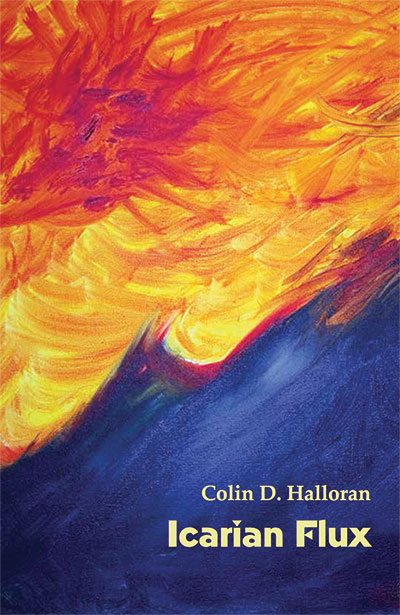
CvrIcarianFlux_bookstore2015 brought two volumes of verse by authors whose previous works are central to the contemporary war poetry corpus. Interestingly, neither of the new works address Iraq or Afghanistan directly or at length. In The Arranged Marriage, Jehanne Dubrow, the author of Stateside, a collection exploring a military spouse’s anxiety about deployment, now gives us a collection of poems based on the life of her mother, who was forced into an abusive marriage in her native Central America. In Icarian Flux, Colin D. Halloran, the author of the verse-memoir Shortly Thereafter, about his Army tour in Afghanistan, imaginatively considers the myth of Icarus. Both volumes offer strong models of artists engaged with and even formed by military experience, but who refuse to let their art or their identities be defined by war and service. We might remain alert, however, for overlaps, lingering traces, and subtler forms of connection to the military even as we consider Dubrow’s and Halloran’s new interests in their own lights. Leaving The Arranged Marriage for another day’s discussion, here I’ll briefly explore Icarian Flux’s very interesting post-war and post-war-lit dimensions.

Halloran’s specific point-of-identification with Icarus, the boy who flew too close to the sun, is hard to determine, even in a poem—the first in the volume—titled “Self-Portrait as Icarus.” Icarus typically represents overreaching ambition and failure to follow directions. Seen somewhat more positively, he stands for incautious but inspired youth, reckless and headstrong for sure, but still one who seems to be made to pay a little too dearly for his mistakes. Halloran may have in mind his tour in Afghanistan, which ended abruptly as a result of a non-combat injury, but the Army and deployment are mentioned only in the author’s bio and not, as far as I can tell, in the poetry. Halloran’s Icarian fall could also be years of troubled drift post-service, collapsed relationships, or even his initial literary forays, inflected with high hopes and subsequent disappointments. Icarus’s wax-and-wings, undone by the sun, may figure specifically in Halloran’s imagination then as his soldier’s weapons and gear, his pen and his books, or more generally as his confident sense-of-self—none of which equipped him to survive the challenges to which he put himself. The opening lines of “Self-Portrait as Icarus” in fact suggest that Halloran thinks he may be doomed to repeated falls, with failure ingrained by fate in his character:

If you can’t achieve greatness elsewhere,
find it in the fall

my next will be at night
not because of lessons learned
but because I want to see

the stars from the other side….

Halloran presents himself here as a connoisseur of disappointment, an expert of loss, and a student of life after failure. The poems following “Self-Portrait as Icarus” reflect that self-image as almost every poem portrays the act of falling from a variety of intriguing perspectives. “Rain Fall,” for example:

The thing about falling
in rain
is that you’re not alone.

Your solitary descent
becomes bigger than yourself:
communal
alone among the many,
also alone.

Something about driving at night inspires Halloran; just as one of the best poems in Shortly Thereafter, “The Moon’s Still Up,” describes a night convoy in Afghanistan, several of my favorites in Icarian Flux also find Halloran at the wheel in the dark. A good example is “Interstate Icarus”:

As I follow the pavement eastward
up mountains
I’m driving on the tops of trees.

I challenge the glow on the other side
to rise
and meet me.

And as I find the hint of its intentions
captured in cirrus and nearly eye-level,

I ease off the gas
and slow

my inevitable

descent.

Not every poem in Icarian Flux so aggressively pursues the imagery and symbolism of Icarus. Three great ones (too long-lined to be reprinted here), “Lakeridge Drive,” “We Were Kings,” and “On Potholes and Exes,” ruminate on loss, memory, and disappointment while expanding the range of images and tones typical of the rest of the volume. “Troy,” a sestina composed of one-word lines, dazzles with its manipulation of form. Many poems rely on carefully controlled repetition of key words and images; knowing what I know of Halloran as a public speaker, these incantatory poems would be a joy to hear him read out loud. Finally, a series of poems remind us that though the connotations of falling are mostly negative, the word and image also apply to one of life’s most positive experiences, falling in love. But, of course, it’s complicated: “Falling: In Love,” for example, advances the notion that failure can be redeemed by love, even as it also suggests how impossible or implausible is the task:

I find it wholly foreign,
falling with someone there
to catch me

or at least

collect feathers
ripped out by wind
or thrown up on impact

gather shards of wax,
forged, melted,
fallen, reformed

and wear a feather
around her neck,
not on her wings,

reform the wax,
add wick, not quill
and light it

in my memory.

Poetry’s generalized and abstract symbolic register, reliant not on accessible biography and obvious narration, but figurative setting and privately-observed detail, is not for everyone, or even anyone all the time. But those of us who love it, especially as we consider specific poems in the context of what we do know about their authors and their total body of work, will greatly appreciate Icarian Flux. We all fall, Halloran reminds us, and the getting-back-up-again is never as simple and easy as conventional homilies and platitudes would have it. From one angle, stripping his poetry of the freighted terminology of deployment and trauma might be seen as Halloran’s effort to broaden his appeal to readers resistant to the rhetoric of veteran woe. A better read is that Halloran has drawn on the wider range of cultural resources to speak of loss and low periods in ways that encompass the entirety of human life and are not dependent merely on one aspect of it.

Colin D. Halloran, Icarian Flux. Main Street Rag Publishing Company, 2015. The quoted passages have been slightly modified due to the limitations of WordPress.

War Writing Anxiety of Influence: Bobbie Ann Mason and Tim O’Brien

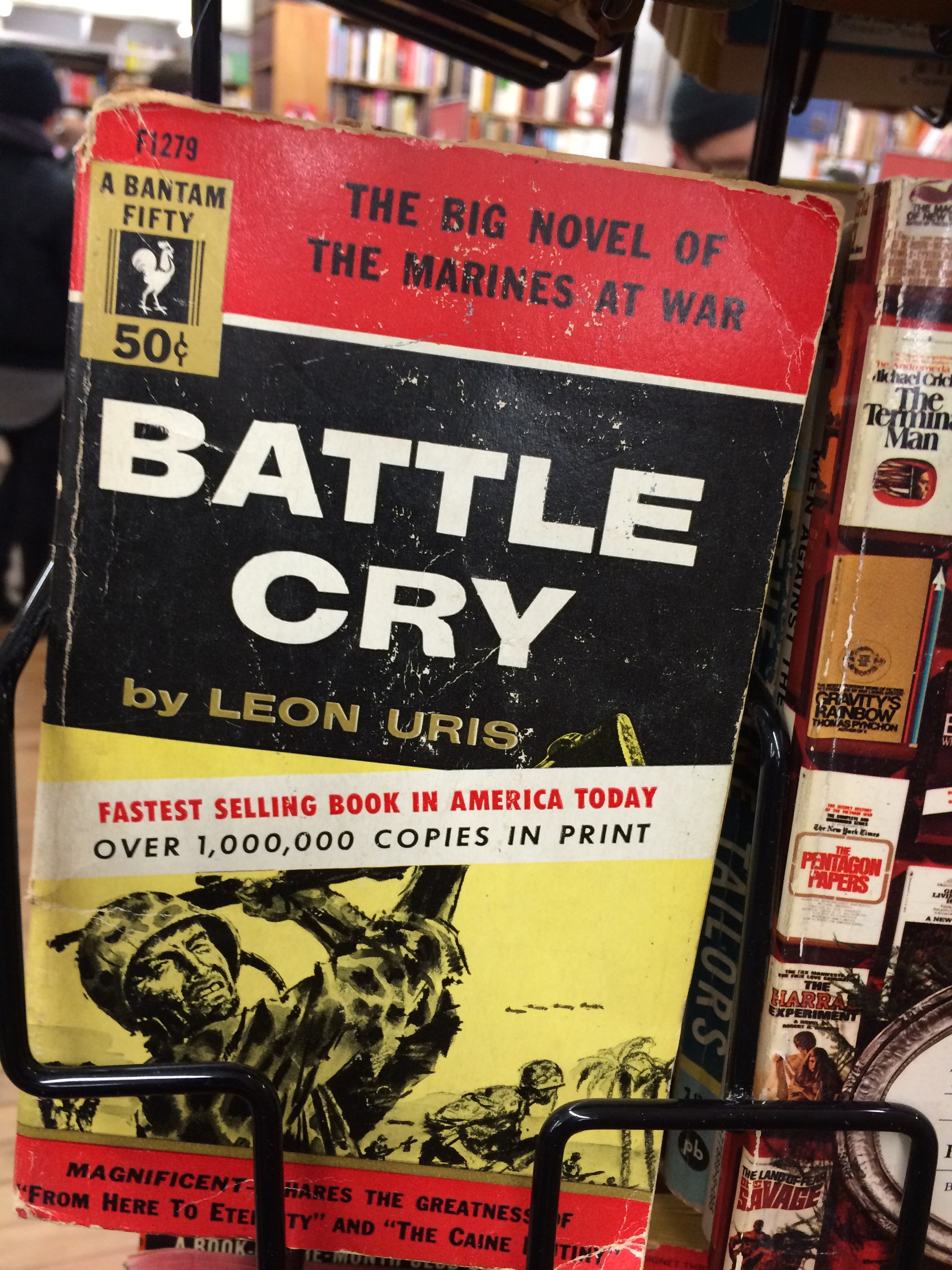
Leon Uris's Battle Cry was a best-seller in 1953. In 1955, it was made into a movie that I loved as a kid.
Leon Uris’s Battle Cry was a best-seller in 1953.
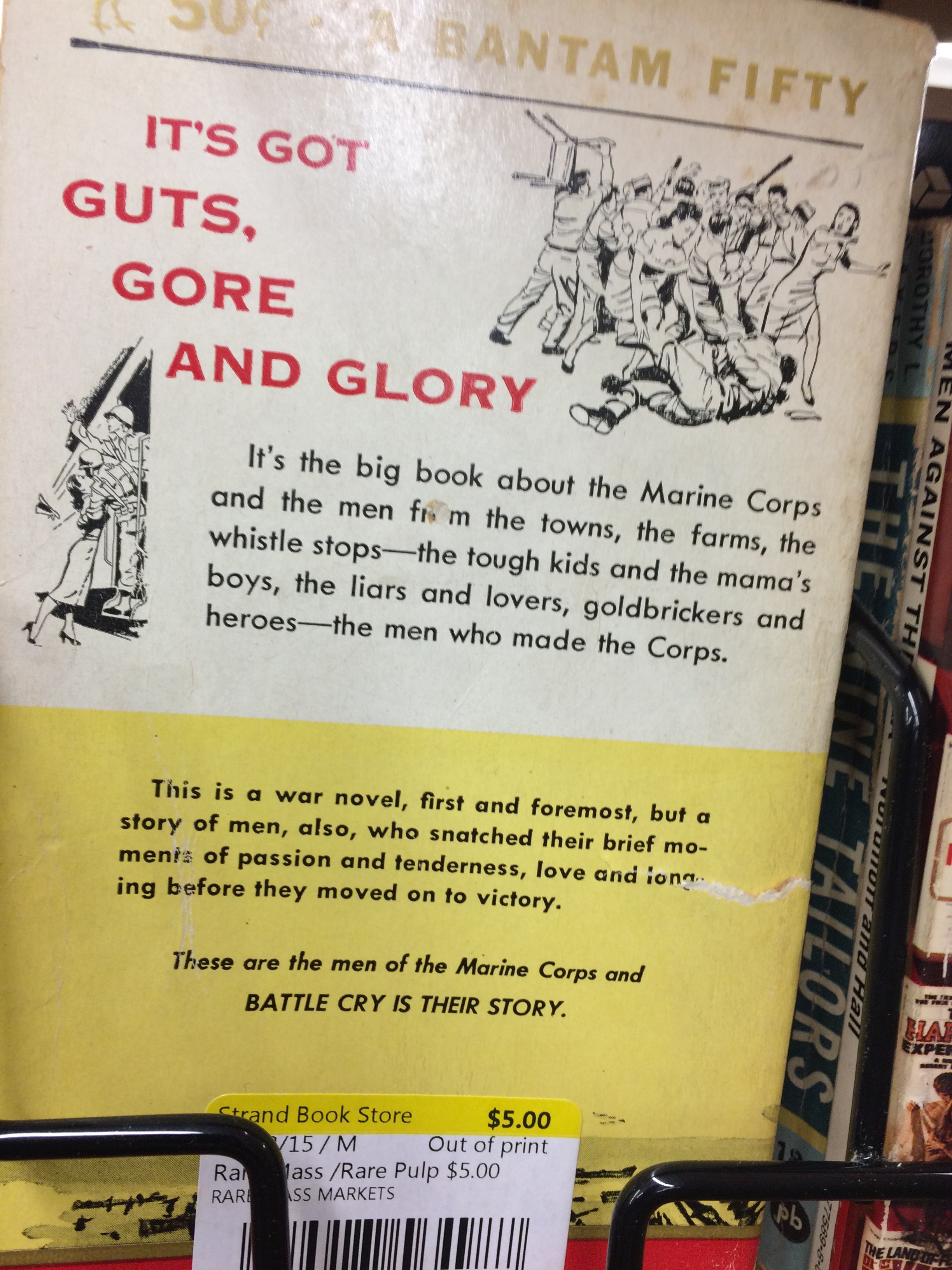
The back cover verbiage offers a fair assessment of what war writers and war writing marketeers thought was important in 1953: men and manliness.
The back cover verbiage offers a fair assessment of what war writing marketeers thought was important in 1953: men and manliness.

“Anxiety of influence” is a phrase associated with literary critic Harold Bloom. It refers to the response of authors to important and beloved precursor authors by writing works that either imitate cherished models or attempt to surpass them. The phrase was on my mind as I composed my spoken comments at our MLA 16 roundtable discussion “Contemporary Literary of the Forever Wars,” which I have excerpted below. Please read them in conjunction with my published remarks about war-writing authored by women at our panel website.

***

“…almost nobody, it seems, remembers Bobbie Ann Mason’s 1985 novel In Country or has seen the 1989 movie based on it. This is curious, because Mason’s novel was critically praised upon publication and reasonably popular (the movie a little bit less so). This is curious because In Country dramatizes issues still very current in today’s body of war fiction: the troubled vet, the problem of homecoming, the difficulty of finding words to convey the experience of war, the vexed dispute over authority and right-to-speak about war, and an already yawning civil-military divide. This is curious, because In Country was authored by a woman and is narrated through the perspective of a young woman named Samantha Hughes, the niece of its troubled Vietnam vet protagonist.

“I don’t know if women or male authors of contemporary war fiction feel the force of Mason’s influence—I haven’t read or heard any of them say so—and I haven’t (yet) done the legwork of tracing the exact lines of connection between Mason and contemporary war writing. I won’t even say much more about Mason here, but rather speculate about the Vietnam War author everybody HAS read and praised: Tim O’Brien, and specifically O’Brien’s short-story ‘How to Tell a True War Story.’ One reason ‘How to Tell a True War Story’ is so popular is because it addresses and dramatizes what have emerged as the driving aesthetic and ethical imperatives of contemporary war writing: its relationship to ‘truth,’ its effort to define what is really important about the experience of war, and its attempt to adjudicate who has the right to decide what is really important about the experience of war.

“Upon rereading ‘How to Tell a True War Story’ recently, however, I came to the conclusion not that the story pronounces definitively on the business of writing about war, but that O’Brien’s narrator—who is quite distinct from O’Brien himself, in my reading–is quite possibly insane, or at least driven to sputtering frustration by his inability to explain exactly how to tell a true war story, or to demonstrate what a true war story really looks like. If I were to read ‘How to Tell a True War Story’ out-loud, I would do so as if it were a nineteenth-century dramatic monologue along the lines of Robert Browning’s ‘My Last Duchess’ or Edgar Allan Poe’s ‘The Cask of Amontillado’—the last thing the narrator is at the end of the story is calm, reasonable, and satisfactorily arrived at an explanation of what a true war story is all about. Its famous last lines, ‘It’s about love and memory. It’s about sorrow. It’s about sisters who never write back and people who never listen’ deserve to be shouted, not patiently explained, with the narrator becoming ever more agitated and inchoate. The surety with which he has begun his tale has evaporated in the face of the difficulty of extrapolating meaning from the anecdotes he relates and the inadequacy of his epigrammatic stabs at profundity.  Statements such as ‘A true war story is never moral’ and ‘True war stories do not generalize’ are not home-truths then, but desperate last-ditch hand-holds on the way to radical incoherence.

“And what about the ‘sisters who never write back’—specifically the ‘dumb cooze’ sister of Curt Lemon—and ‘those people who never listen’? By ‘those people,’ the narrator seems to have in mind the woman of ‘kindly temperament and humane politics’ who approaches him after a reading to express her dismay about the poor water buffalo shot by Rat Kiley. The narrator’s over-the-top anger that the woman has missed the point of his story is decidedly part of his problem getting at the truth of war-story-telling. The narrator’s sense of what that project entails clearly includes women, or more properly put, implicates them: ‘It’s always a woman,’ as he states. Specifically, women are representatives and objects of love, desire, beauty, and sex, though never soldiers or people the narrator respects. They inform war writing’s aesthetic, ethical, rhetorical, ontological, epistemological, and every other kind of -ological structure, but the images of women who don’t write back or listen well suggest that the narrator has trouble figuring how they do so meaningfully. In other words, the problem is his, not Curt Lemon’s sister’s or the well-intentioned woman in the audience. The narrator’s frustratingly incomplete conceptualization of war and war writing, bereft of understanding how women have important roles to play or things to say, stands as a signifying dramatization of the male-dominated and male-centric state of war-writing prior to Iraq and Afghanistan. Today’s cohort of women veterans and women war authors, we can thus understand, are in the process of addressing and rectifying that failure of communication….”

****

In future posts, I’ll sketch a few ways I think the presence of women in significant numbers both in uniform and in the ranks of war writers has changed war-writing. I’m also thinking about ways that masculinity has reconfigured itself in modern war fiction, perhaps beneficially and admirably so, but probably more likely in an effort to re-instantiate its privileges on new contemporary terms. I’m glad to hear from anyone else who also has thoughts on the matter.

Contemporary Literature of the Forever Wars: MLA 2016

Austin-MLA-2016At the recent Modern Language Association (MLA)  conference in Austin, Texas, six of us convened a panel titled “Contemporary Literature of the Forever Wars” to discuss the memoirs, fiction, and poetry of war in Iraq and Afghanistan. Ikram Masmoudi, whose War and Occupation in Iraqi Fiction I recently reviewed, wasn’t able to join us, unfortunately, but Stacey Peebles, Patrick Deer, Roy Scranton, AB Huber, and I reiterated and expanded upon remarks we have posted on our panel website. Our moderator, Aaron DeRosa, offered brief introductory remarks that set the tone for the panel, and, it should be noted that he and Peebles are coediting an upcoming issue of Modern Fiction Studies devoted to Iraq and Afghanistan war literature—the call for papers of which can be found here.

DeRosa had us speak in order of increasingly speculative and conceptual slant, so while Peebles, Deer, and I began by taking mostly backward looks at works already written, Scranton’s and Huber’s concluding comments made provocative challenges to future war writers. Scranton reminded us that war writing, whatever its virtues, owes its existence to war’s victims, a fact depressing enough to contemplate when we’re talking about Americans and even worse when war lit’s triumphs are predicated on the dead bodies of Iraqis and Afghans who neither asked for war nor benefited from it. To make his point, Scranton suggested that Hassan Blasim’s “The Corpse Exhibition,” about an Iraqi virtuoso of artistic war-death, is arguably the most apt war story written to date for how it dramatizes the moral reprehensibility of producing art about killing. In its wake, Scranton warned, less self-conscious war fiction risks naivety and ethical undernourishment.

Huber took the discussion to even more intriguing places. Riffing on the latent implications of “unmanned” in the phrase “unmanned aerial devices,” Huber inquired what it meant for war fiction when its heroes are displaced from the battlefield to drone command centers 1000s of miles away. Speculating that new ways of war, such as drone-fighting, that don’t have men staring death in the face are rendering conventional war fiction, poetry, and memoir obsolete, Huber suggested that modern war has generated new textual forms such as “the leak”: depersonalized, de-narrativized documents stripped of authorial experience and authority and creative origin and which fuzz the borders between official and unofficial. Sporting with one of my own lines, “When the great work about war in Iraq and Afghanistan is written, it will be written by a woman,” Huber suggested that battlefield records placed into public view by Chelsea Manning’s Wikileaks already constituted the exemplary literary artifact of 21st-century war.

Huber’s comments might be considered fanciful by non-academic audiences, but they got the roomful of scholars thinking—exactly the kind of visionary re-imagining of the possibilities of war literature we all hoped the panel would inspire. The body of modern war literature so far produced, centered on the experience of author-combatants, earnestly tries to set the conditions for its understanding. Discerning readers, however, accept neither war writing’s ideas nor its premises as either self-evident or given, and have begun to work it over hard. Once more, I encourage you to read the statements posted on our MLA panel website–they are important first words in the process.

***

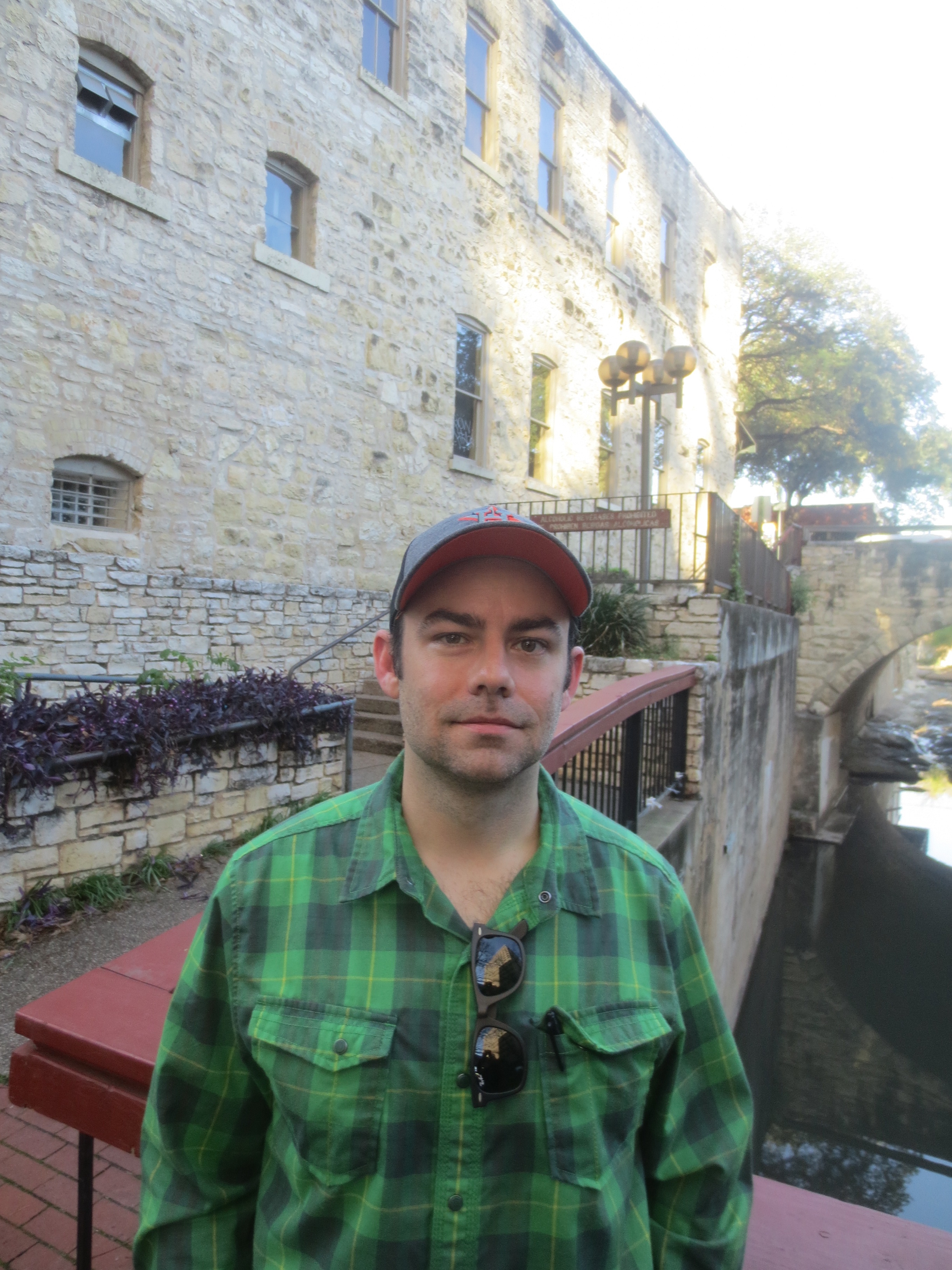
Austin was full of pleasures other than MLA, and a real highlight for me was meeting and having lunch with Brian Van Reet, the author of two of my favorite short stories about war in Iraq, “Big Two-Hearted Hunting Creek” and “Eat the Spoil.” Van Reet’s novel Spoils, he is happy to report, will be out in 2017.

Brian Van Reet, Austin, Texas, January 2016.

The Military Spouse’s Book Reviewed: Andria Williams’ The Longest Night

The Longest NightCongratulations to Andria Williams on the release of her novel The Longest Night this week. A domestic drama cum technological thriller about a military family during the Cold War, The Longest Night displays the same lively, curious, and generous spirit of Williams’ The Military Spouse Book Review, Time Now’s compadre in martial-themed literary blogging. Williams is an alert and appreciative reader of Time Now, thankfully, so my fear upon reading The Longest Night was not that I would dislike it, but that I wouldn’t be able to find ways to write about it in the context of my interest in Iraq and Afghanistan. Broadly considered, however, every novel published after 9/11 reflects and refracts the tension of contemporary war. Those recent novels that make their subjects past conflicts—Toni Morrison’s Home, Karl Marlantes’ Matterhorn, Denis Johnson’s Tree of Smoke, Sara Novic’s Girl at War, for examples—even more directly proffer ways to better understand what it means to be at war now by reminding us of antecedents. Without pushing the point too far or too hard, in The Longest Night, historical displacement—Idaho, 1961—might be said to allow Williams to obliquely address aspects of 21st-century military service, deployment, and war she has observed as a close reader of contemporary war literature and the wife of a several times deployed Navy officer.

The protagonists of The Longest Night are Paul and Natalie Collier, an Army couple with kids who are assigned to an Idaho Falls, Idaho, base dedicated to testing portable military nuclear reactors. Paul is part of a small team of enlisted soldiers responsible for the military’s smallest reactor, a temperamental prototype known as the CR-1. Paul is by-the-book and devoted to duty, which causes him to quickly run afoul of his boss, Master Sergeant Richards, a bitter, semi-functional alcoholic who resents Paul because he is young, hopeful, and dedicated. Paul is all that, but unfortunately, he’s also a bit rigid and unimaginative, which makes things hard for his wife Natalie, a freer-spirit who can accept the strictures of military life and marriage to Paul as long as she’s not reminded, that is to say tempted, by more exciting possibilities. But just as Paul fails to get along with his boss, Natalie’s relationship with Master Sergeant Richards’ wife Jeannie flounders. The social strain grows even more complicated when Master Sergeant Richards connives to have Paul re-assigned temporarily to another nuke site in far-away Greenland; in his absence, Natalie befriends and then loses her heart to Esrom, a dreamy Idaho cowboy-mechanic much more her type in spirit and outlook. To this saga of marital drama, Williams adds the danger of techno-catastrophe: upon Paul’s return to Idaho, the CR-1 undergoes a meltdown, which may or may not be a result of human error. Based on a true event in 1961 in which three men died, Williams’ dramatized version of the incident forces Paul and Master Sergeant Richards, as well as Natalie and Jeanne, to confront their animosity, and Natalie to come to terms with her feelings for Esrom, in the midst of calamity.

The Longest Night reminds us that at the tail-end of the Eisenhower era and the dawn of Kennedy’s New Frontier a small sliver of the populace actively faced the international threat-of-the-day while the vast majority of Americans got on with their lives as obliviously as possible. Even in a nation far more militarized than it is now, Paul and Natalie’s status as an Army family isolates them from native small-town Idaho residents resistant to outsiders and change. Paul’s nuclear silo, located 50 miles from town, resembles the combat outposts oft-portrayed in contemporary war-writing, and Williams better-than-most describes fraught soldierly human interaction in dangerous, isolated conditions. Startling descriptions of enlisted soldiers left responsible for highly-complex nuclear reactors—true historically—reminded me of contemporary military scenarios that have the officer corps preoccupied with strategy and careers while neglecting the worker-bees—to include the Chelsea Mannings, Edward Snowdens, and drone-operators—who actually have their hands on the cyber weaponry and killing machines of our day (though neither treason nor combat are issues in The Longest Night, I should say). Paul’s return home from work every day is certainly not reflective of Iraq and Afghanistan, though the close intertwining of warzone and homefront experiences made possible by today’s modern media makes an analogy conceivable. More saliently, Paul’s short-term deployment to Greenland allows The Longest Night to portray the experience of family separation entirely characteristic of contemporary war. Williams is everywhere all-the-time alert to the difficulty military service places on marriage: Paul does not plan to be a distant, neglectful husband and Natalie has no intention of being tempted by another man, but so it happens in the novel and so it still happens to military couples.

1961 was a time of social conformity, while 2016 prizes individuality, so it’s tricky business retroactively creating characters who inhabit that distant age without being either stereotypes or looking like aliens imported from the future. For me, Paul and Natalie are true to their period: intelligent processors of their perceptions and experiences, but still beholden to the cultural possibilities available to them. They are far more conventional and purposeful than the often reckless and hedonistic enlisted couples I knew while in, but I’ll buy that their propriety–as well as their own form of recklessness–was characteristic of the era. Williams notices what her characters notice, but also much that they don’t understand or only half-intuit; this close attention to their interiority as much as the period detail makes The Longest Night come alive. In many ways, though, the strictures of military service and culture portrayed in The Longest Night might be said to be timeless, for Williams casts a net around military families and military duty and pulls in many fine fish in the way of still relevant insights about life in uniform. Readers who never served or veterans who served only a tour or two can make of Williams’ portrait of military domesticity what they will, but readers who have tried to keep a marriage together over the long haul of a military career will marvel at her acuity at describing the rewards and pleasures, such as they are, while also conveying a more pervasive feeling of disappointment and perhaps even of life wasted. That’s almost too tough a sentiment to contemplate in the present, frankly, so it helps that Williams has framed the possibility in a long ago, far-away place.

Some readers, I suppose, will have trouble with Williams’ kluging of domestic drama and techno-action storylines, but The Longest Night’s suspense-and-surprise-laden plot elevates it above the faux-biography and mundane reportage of much war fiction. Keeping together the complicated mix of ingredients—family drama, military dysfunction, nuclear meltdown, Cold War America, the civil-military divide—is Williams’ power of language. The Longest Night sentences bounce with unexpected word choices, turns-of-phrase, figures-of-speech, and images. Exciting use of free indirect discourse generates finely-shaded judgments in those novelistic spaces between the characters’ thoughts and Williams’ own. Descriptions of nuclear reactor technology never bog down the narrative, and dialogue meant to be charming or funny actually is—tonally, The Longest Night is winsome, but it’s easy to imagine Williams writing comedy. Imagination, insight, and craft are all in fine order, so the saddest thing to report here is that we won’t have the pleasure of reading a review of The Longest Night on The Military Spouse Book Review.

Andria Williams, The Longest Night. Random House, 2016.

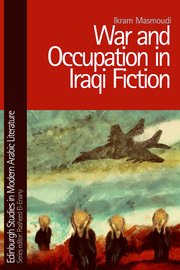
Ikram Masmoudi’s War and Occupation in Iraqi Fiction

Ikram MasmoudiIkram Masmoudi’s most welcome War and Occupation in Iraqi Fiction surveys a remarkable body of fiction that portrays from the inside Iraq’s 30+ year history of war, oppression, invasion, occupation, and sectarian violence beginning with the Iran-Iraq War in 1980. According to Masmoudi, novels authored prior to Saddam Hussein’s overthrow by US forces in 2003 were marked by the Ba’athist regime’s censoring practices, but immediately following 2003 Iraqi authors in numbers uninhibitedly began writing novels that portrayed with critical urgency and imagination both the Iran-Iraq War and the 1991 Gulf War. Very soon, they also began to write novels that depicted the horrendous social turmoil unleashed by American occupation and subsequent sectarian violence. American readers might be somewhat aware of fiction by Hassan Blasim and Sinan Antoon, two expatriate Iraqi authors in the tradition of which Masmoudi writes. Masmoudi touches on both Blasim and Antoon, but the primary focus of her study is a series of mostly-untranslated novels written by authors unable to flee tyrannical power, foreign occupation, and sectarian conflict. Based on Masmoudi’s accounts of these works, one can only hope they are quickly brought into English, for they appear to combine compelling storylines, perceptive insights, and literary craft to a high degree.

War and Occupation in Iraqi Fiction chapters on the novels of the Iran-Iraq War and the Gulf War are full of interest, but of most concern here are two chapters devoted to works set in post-2003 Iraq. In Chapter Three, titled, “Bare Life in ‘New Iraq,’” Masmoudi examines three novels whose protagonists are interpreters working for Americans. The protagonist of each novel begins as a hopeful idealist, mostly secular and not ideologically motivated, and each is brought to ruin by the experience of trying to assist Americans. The protagonist of Shakir Nuri’s The Green Zone (2009) translates for a high-ranking officer in the Coalition Provincial Authority. Appalled by the ignorance and brutality of his American bosses and driven to seek vengeance against them for the death of his wife, Nuri’s protagonist detonates a suicide vest at a Green Zone gathering of CPA and Iraqi leaders. Inaam Kachachi’s The American Granddaughter (2008, with an English translation in 2012) features an Iraqi-American heroine who returns to Iraq to serve as a translator for American forces. Naïve and unassuming at first, she soon realizes that rather than aiding Iraq’s transition to democracy, she is participating in its subjugation to the extent of accompanying US soldiers on raids on the homes of innocent non-combatants. In Baghdad Marlboro (2012), by Najm Wali, an American Gulf War veteran returns to Iraq to seek forgiveness and reconciliation with the families of soldiers he helped kill in 1991. The goodwill quest immediately goes awry; the American is quickly kidnapped and killed and the translator he has retained to help him must flee for his own life from the perpetrators of the murder.

The novels described in Chapter Three of War and Occupation in Iraqi Fiction describe the occupation and individual Americans unflatteringly enough, but do so in the context of a more general Iraqi social deterioration plagued by problems more of Iraq’s own making (though of course connected to the occupation). Fundamentalist, sectarian, and Iraqi criminal violence arguably equal the horrors of American imposition of force for the protagonists of The Green Zone, The American Granddaughter, and Baghdad Marlboro. The novel Masmoudi explores in Chapter Four, however, is much more uncompromising in its indictment of Americans. The chapter, titled “Bare Life in the Camp,” examines at length Shakir Nuri’s The Madmen of Camp Bucca (2012). Nuri here is unsparing in his portrait of the atrocious carceral conditions of the American prison camp named in its title, which housed upwards of 20,000 prisoners in makeshift conditions in a remote desert corner of Iraq. The horrors of Camp Bucca have been amply described in Helen Benedict’s novel Sand Queen (2011), but based on the quotations from The Madmen of Camp Bucca provided by Masmoudi, Benedict didn’t know the half of it. Masmoudi doesn’t offer biographies of the authors she studies, so it’s not clear if Nuri was incarcerated at Camp Bucca (or if he and the other Chapter Three authors worked as interpreters themselves) and thus speaks from first-hand experience. In any case, though, the quoted passages from The Madmen of Camp Bucca are full of damning detail and overlaid with a sense of dismay that the American occupiers are not just brutal, but inept and thoughtless. One passage from Nuri’s novel, for example, takes aim at the ignominy of Camp Bucca being named after a New York City firefighter who gave his life trying to save others at the fall of the Twin Towers:

Oh you, the firefighter whom America committed a crime against, you sacrificed your life to save innocent Americans; America did nothing more than humiliate you by naming after you the worst prison ever in the history of humanity…. Oh my God, does this man deserve to be insulted every day while his soul still hovers above the place of the crime? And to make matters worse, America invited the daughter of this man to visit the camp to bless this quagmire that bears the name of her father.

Camp Bucca has its defenders and apologists–its Wikipedia entry, for example, appears to have been written by a US military public relations team–but those trying to put a shiny face on whatever happened there will be arguing uphill in wake of Nuri’s (and Benedict’s) depiction. But Nuri suggests that a shiny face was never the point of Camp Bucca anyway, as its whole purpose was to inflict humiliation on Muslims equal to the anger felt by Americans about 9/11.  The narrator of The Madmen of Camp Bucca reports:

Every time the guards look at the banner with the name “Bucca” on it, they show their teeth and become even more violent towards us, as if we had exploded the World Trade Center. Cursed is New York who is sending us such people.

Masmoudi resurfaces an interesting statement in this regard by Henry Kissinger found in Bob Woodward’s State of Denial (2006). Woodward writes, “Asked why he had supported the Iraq War, Kissinger replied”:

“Because Afghanistan wasn’t enough” … In the conflict with radical Islam, [Kissinger] said they want to humiliate us. “And we need to humiliate them.” The American response to 9/11 had essentially to be more than proportionate–on a larger scale than simply invading Afghanistan and overthrowing the Taliban. Something else was essential. The Iraq War was essential to send a larger message, “in order to make the point that we are not going to live in the world that they want for us.”

The fiction Masmoudi studies seems perplexed that Iraq’s and America’s national histories have had to have been so intertwined in the first place; from Kissinger’s statement it appears that it was Iraq’s bad luck to be in the way of an angry nation eager to take a swing at it-didn’t-care-who-or-what. Iraqi war fiction takes the measure of individual American soldiers often–many novelists describe their first encounter with actual Americans, as in a passage from The Green Zone: “I did not expect to see them except on a TV screen, and here they were, flesh and blood before my eyes; they never tired of searching us.” Clearly enough the American occupiers are found wanting in most cases, though exceptions occur. Five enlisted Marines in The Green Zone, for example, are portrayed as individuals roughly no worse and no better than one might expect. The dominant response, however, is disappointment: narrators and characters repeatedly report their shock on learning that the military forces that deposed Saddam were not just ignorant of Iraq’s rich history and treacherous social dynamics, not just disdainful of its Islamic religion and culture, and not just arrogant in their belief in their own superiority.

Their biggest problem, one gleans, is that Americans were just lousy at doing what they thought needed doing: untrained, unresourced, without a plan, their on-ground performance wildly out of whack with their vaunted goals, ideals, and standards of competence. To Iraqis, then, the humiliation of being subjugated by boobs adds stinging insult to real injury and abuse. Generous amounts of self-loathing on this count permeate Iraqi war fiction, along with many other forms of guilt and internalized hatred brought about by a sense of ineptitude and helplessness. Iraqi authors use fiction to portray injustice wrought by foreign occupiers, but also to come to terms with their own complicity—both personal and collective—in allowing a proud nation to precipitate its own destruction over the course of thirty torturous years. This complex attitude, sad as it is, enriches and elevates the fiction that documents it and might even be said to account for the body of work. Deprived of all other forms of productive, legitimate, and non-violent citizenship, the authors and characters of Iraqi war fiction resort out of necessity to story-telling to bear witness, call for change, and assert their agency.

Iraq’s post-2003 war fiction, in Masmoudi’s reading of it, privileges the point-of-view of dissidents, deserters, prisoners, suicide bombers, and other marginal figures, to include lowly soldiers given little choice but to obey orders and kill or be killed. Masmoudi sees the Iraqi war fiction corpus as exemplifying the ideas of influential Italian political theorist Giorgio Agamben’s Homo Sacer: Sovereign Power and Bare Life (1998); Agamben terminology such as “homo sacer,” “bare life,” “state of exception,” and “the camp” organizes and deepens Masmoudi’s analysis at many points. Agamben is generally thought to critique Western modes of thought and political organization, so Masmoudi cinches his relevance to the Islamic Middle East milieu of Iraq by linking Agambian notions to post-colonial scholar Achille Mbembe’s concept of “necropolitics”—a social order predicated on technological means of killing—and Frantz Fanon’s analysis of the devastating psychological effects of colonialism on both colonizer and colonized. Lurking behind Agamben, Mdbeme, and Fanon is Michel Foucault’s “biopower”: the exertion of political power through control of the body politic.

These heavy-hitter theorists are handled accessibly and sensibly by Masmoudi; Iraq war fiction titles such as Freedom of the Bagged Heads (Jasim al-Rasif, 2007), The Dead of Baghdad (Jamal Husaya Ali, 2008), Killers (Diya Ali-Khalidi, 2012), The Morgue of Baghdad (Burhan Shawi, 2012), The Corpse Washer (Sinan Antoon, 2010, translated into English in 2013), The Corpse Exhibition (Hassan Blasim, 2013), and Frankenstein in Baghdad (Ahmad Al-Sadawi, 2013) suggest how Mbembe for one is on to something. In any case, Masmoudi’s approach is more thematic than theoretical. We might hope for even more historical and biographical context than she offers. Who are the authors she studies, and are they representative of a large segment of Iraq citizenry or a particularized class of intellectual-artistic dissidents? Were ideologically-motivated Shias and Sunnis publishing fiction? What were the conditions of publication in Iraq during the American years—who was reading, who was publishing, how popular were the works, and what was their influence? What control over media, print, and culture did Americans try to exert (probably none, through either benign or sloppy neglect, but still worth exploring)? Inaam Kachachi, the author of The American Granddaughter, is a woman, but the other authors under examination are men; what else might we learn from fiction written by Iraqi women? Everything Masmoudi offers for consideration is excellent, but leaves me, and hopefully others, wanting more. A logical first step will be the translation into English of all the novels of which she writes.

Ikram Masmoudi is an assistant professor of Arabic Studies at the University of Delaware. War and Occupation in Iraqi Fiction was published in 2015 by Edinburgh University Press as part of its Studies in Modern Arabic Literature series. The translations provided in the passages quoted above are Masmoudi’s.