Canon Wars: 20th and 21st Century War Fiction Authored by Veterans

img_1067

I was asked to compile a list of twentieth and twenty-first century novels and short-story collections about war authored by American veterans. I was limited to ten titles—two for each of our major conflicts—but I broke the rules and chose three each for World War II and the Global War on Terror. Here’s my list:

World War I

John Dos Passos (US Army Medical Corps), Three Soldiers (1919)
Ernest Hemingway (American Red Cross), A Farewell to Arms (1929)

I know Hemingway wasn’t technically in the military, and Dos Passos only served for a short time, but it’s too hard to ignore the connection between their war-time exploits and the books they authored about the war. I was tempted to include F. Scott Fitzgerald’s The Great Gatsby because I’ve always been intrigued by the reference to Gatsby’s service in a “machine gun battalion” in The Great War, and I know Fitzgerald wrote This Side of Paradise while in uniform at Fort Leavenworth. But neither of those reasons are fulsome enough to include either work. I also wish two other WWI veterans who turned out to be estimable writers, E.E. Cummings and Malcolm Cowley, had written fiction based on the war, but it was not to be.

World War II

Joseph Heller (Army Air Corps), Catch-22 (1961)
James Jones (Army), The Thin Red Line (1962)
Kurt Vonnegut (Army), Slaughterhouse Five (1969)

All three works are marvels. Catch-22 and Slaughterhouse Five I read when young and they helped me understand how war might best be described using humor, satire, and irony. The Thin Red Line I read recently and was stunned by how interesting and perceptive it was.

Korea

James Salter (Air Force), The Hunters (1956)
Richard Hooker (H. Richard Hornberger) (Army), MASH: A Novel About Three Army Doctors (1969)

Salter’s novel about Air Force fighter pilots is great; any writer who can write sentences as finely tuned as the following has my respect:

“Flying with him was like being responsible for a child in a crowd.”

“He was not fully at ease. It was still like being a guest at a family reunion, with all the unfamiliar references.”

“It was still adventure, as exciting as love, as terrible as fear.”

“The sky seemed calm but hostile, like an empty stadium.”

MASH: A Novel About Three Army Doctors affects the insouciant air toward military authority and bureaucracy that the popular TV show it inspired excelled at. Honestly, though, MASH-the-novel seems a little thin and, in some aspects, such as its racial humor, dated.

Vietnam

Larry Heinemann (Army), Paco’s Story (1986)
Tim O’Brien (Army), The Things They Carried (1990)

Rereading these two highly-regarded works made me realize how entrenched in their time they are: They privilege the experience and views of the combat grunt and the angry veteran to the point of mythologizing them and they’re obsessed with authority, credibility, authenticity, and right-to-speak issues. Vietnam War fiction badly needs historicizing to measure its preoccupations and how much it really has to say to to contemporary war fiction.

Iraq and Afghanistan

David Abrams (Army), Fobbit (2012)
Kevin Powers (Army), The Yellow Birds (2012)
Phil Klay (Marines), Redeployment (2014)

Cutting things off somewhat arbitrarily at 2014, I’m limiting the contemporary war listings to two National Book Award nominees (The Yellow Birds and Redeployment, with Klay’s short-story collection taking the prize) and one (Fobbit) that might well have been. All of them pay homage to the tradition of veteran-authored war fiction while working changes upon it, commensurate with the changing times and their authors’ unique perspectives.

So that’s my veteran-author war fiction canon for your consideration and debate. It’s a great tradition, all-in-all, and I enjoyed reading or rereading these books and many others over the summer and making my choices. The books that impressed me most were James Salter’s The Hunters and James Jones’ The Thin Red Line. Saving The Hunters for another day, I say a little more about The Thin Red Line below. Considering Jones’ achievement made me wonder why no contemporary veteran-author has yet written a novel about the year-long deployment to Iraq or Afghanistan of a platoon, company, or battalion with the same anthropological overview as Jones. It would seem like a natural. Most soldiers experienced the wars as cogs in complex social organizations artificially and temporarily arranged to both protect them and prepare them to give up their lives. Arguably what was going on around them and outside of them was of more interest and importance—and definitely more various—than what was happening to them and inside of them individually.

****

What People Mean When They Talk About “Panoramic” War Novels:  James Jones’ The Thin Red Line
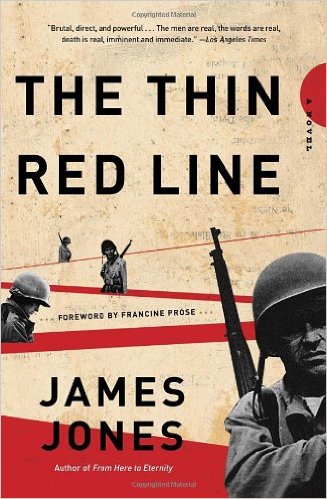
ttrlThe literary artistry of James Jones’ novel The Thin Red Line is hard to define and in some ways hard even to detect. On one level, his account of a US Army infantry company’s exploits from their arrival on Guadalcanal during World War II to their departure proceeds at the level of realistic description that resembles journalism and history. Even when we factor in his attention to the human stories of the members of “C-for-Charlie” Company—their fears, desires, backstories, and emotions—it still seems, in many respects, to aspire to a common sort of long-form non-fiction narrative that embraces both big events and individual profiles.

The particular and peculiar way that Jones manipulates the register between exterior actions and interior views is what is so hard to pin down. That The Thin Red Line is panoramic in a way no contemporary war novel is a testament as much to Jones’ imagination as it is to the fact that he must have taken good notes while he was in the Army. Jones provides extensive accounts of the actions and thoughts of roughly fifteen members of C-for-Charlie, from privates through the four company commanders who lead them on Guadalcanal, and maybe thirty other enlisted soldiers and officers appear as minor characters. He describes the men as they prepare to disembark from their troop transport ship, in their early days on the island as they acclimatize to the jungle climate and prepare to go into battle, a week’s worth of harrowing combat on a hill mass known as The Dancing Elephant, a couple of weeks recouping in a rest area, and then another week of combat to seize a hill named The Giant Boiled Shrimp and a village named Boola Boola, followed by a brief period of recovery before they depart Guadalcanal enroute to another South Pacific island.

Jones, who fought on Guadalcanal, tells us in a forward that the physical geography and battles he describes are imaginary, but surely he wants to relate in as much detail as possible what infantry combat looks like tactically and feels like emotionally, seemingly in a corrective to other authors’ accounts of battle. Tactically, he precisely and compellingly explains how platoons, companies, and battalions go into battle and how the land on which they fight—the hills, dales, dips, furrows, outcroppings, and other geographical features, plus the vegetation—impact the fighting at every turn, both for the bigger units and the individual soldier. He is very interested in what happens when a unit comes under fire, takes casualties, and then collects itself to seize objectives and complete missions. His account of how the dread felt by infantrymen before battle intensifies in combat and threatens to paralyze them until they become hardened to the prospect of their death is especially astute. He is very interested in the fact that some men perform well in combat and others don’t; while some of C-for-Charlie’s heroes are predictably wily, feisty types whom you might think would do well in a fight, not all are, and the distribution of fear and courage is anything but systematic: men brave in one instance, freeze up in another, while some men who know themselves to be cowards find ways to perform well under fire, at least sometimes. Jones is also interested in leadership, how NCOs and officers through some peculiar amalgamation of judgment, decisiveness, words, actions, luck, and circumstance cement their ability to lead troops in combat in the eyes of their superiors, their men, and in their own minds. Three successive commanders of C-for-Charlie, for example, are relieved-for-cause, and it doesn’t always seem fair, but rather than rendering judgment, Jones traces the contours by which faith in their ability ebbs away. Among the enlisted soldiers, a steady rate of attrition opens up opportunities for the most ambitious and combat-capable of underlings to rise to the top in a process that would be almost Darwinian were it not for the fact that death and injury in battle often strike without regard for who’s fittest.

Considered as a social organism, C-for-Charlie in Jones’ portrait seems organized not so much by rank, but by a ruthless jockeying for regard by its members, which is usually framed in terms of manhood—who is toughest, who is most aggressive, who is most cocksure, who is most competitive, who wants whatever he wants the most. In this milieu, men are quick to judge each other as punks, lightweights, and cowards, and are driven by furious impulses toward revenge, jealousy, and entitlement, engendered by sleights and perceived grievances big and small. The camaraderie of men bound by a sense of family is documented, but selfishness and contempt more than love and care define the soldierly bond. The C-for-Charlie family is perverse in other ways, too, most notably by the flux of its membership engendered by death, evacuation for wounds, or reassignment, as in the case of its commanders. Characters are whisked out of the book on nearly every page, rarely to be heard from again, an effect that is as unsettling for readers as it must have been for the unit, and each removal generates a seismic recalibration not just of the official rank structure, but of the homosocial lineaments of C-for-Charlie culture.

Jones’ attitude toward his soldier-characters is part of The Thin Red Line’s curious allure. The odd use of “C-for-Charlie”—a way of referring to an infantry unit I’ve never seen before (yes, I know there are C Companies, often called Charlie Company, in infantry battalions, but consistent use of “C-for-Charlie” is idiosyncratic)—has the effect of anthropomorphizing a military organization, but Jones doesn’t privilege the point-of-view or experiences of any of its individual members. The company first sergeant, a philosophical type with a drinking problem, appears in the novel’s opening and closing scenes, but seems to have changed little from beginning to end and doesn’t loom especially large in the events that befall C-for-Charlie. A second character, a company clerk named Fife, a coward at heart who finds himself at least temporarily capable of battlefield prowess, occupies the most page space in the novel. But he too is whisked off the page short of the conclusion, and The Thin Red Line can hardly be said to be his story.

Jones seems interested in every aspect of C-for-Charlie’s existence on Guadalcanal, so scenes in the rear area receive almost as much attention as scenes of battle, and he also seems very interested in telling a war story without resorting to sentimentalism and sensationalism. Nor does he seem to be telling an “anti-war” story, though its clear enough after reading The Thin Red Line that war is a horrible human endeavor, and the military is a horrible way of organizing people socially. Though dramatic things happen—many of them—drama is never milked for effect—that some soldiers might butt-fuck each other the night before battle is related in the same register as scenes of horrific wounding or tremendous acts of bravery or a drunken brawl in a rest area after battle. And yet the forward pace of the novel proceeds inexorably; Jones’ artistry finds the right word-web to mirror how the propulsive forces of military culture and war shape the little lives of its participants, yet where the military and war disdain human life, Jones manages the tricky feat of inculcating interest in his characters without saturating them and his readers in a goo of sympathetic identification. The soldiers’ lives play out or end on Guadalcanal somewhat as if subject to fate as hypothesized by Shakespeare’s Gloucester, “As flies to wanton boys are we to Gods, they kill us for their sport,” but that implies that men’s lives, precious to the men themselves, are at least of sadistic interest to higher powers. In The Thin Red Line’s cosmos, men live and die more as if subject to James Joyce’s vision of God, one who pares his nails indifferently while looking down on his creations. To search for other analogies in literature, the men of C-for-Charlie seem like the battling ants described by Thoreau in Walden, viewed from on high with forensic interest, but in Jones now endowed with thoughts and personalities. The Thin Red Line not only is not character-driven, it’s not plot-driven, either, and yet still—again, Jones’ artistry at work—it is not just a “one thing after another” chronological narrative. The sense that a novel creates a social microcosm that replicates the cosmic working out of character and event of real life is a tenet of the realist and naturalist novel, which are outdated genres, but The Thin Red Line feels anything but dated—if anything it is a bracing reminder of what supremely talented authors are capable of. It’s hard not to think that no one writes novels like The Thin Red Line anymore because Jones has done it as well as it can be done, but still, I’d like to see contemporary authors try.

Finally, all my praise above would just be moot if it were not for Jones’ greatest gift: his ability to consistently write amazing sentences, to say things in ways that just startled me with their unanticipated aptness. I can’t remember a book that I found myself turning down more page corners to remind myself of passages to which I wanted to return. I could list quite a few, but in the name of even-handedness, there are a few clinkers, too. In the library copy I read, a previous reader circled the words “more good” where Jones might have used “better” and placed a question mark in the margin. Toward the end of the novel, a lieutenant loses part of his hand when a grenade he is throwing explodes prematurely. Jones attributes it to the neglect of the distracted, careless woman who cut the fuse too short in the ordnance factory where it was assembled; the aside seems contrived and crude. Finally, I didn’t like the book’s epigram, in which Jones thanks “war” for providing so much material of interest. The tone is satirical and manic and not a good prelude at all for the cool and laconic prose voice of the novel’s narrative. But those are minor exceptions in a 500-page book that otherwise impresses on every page.

Many thanks to Roy Scranton, Rachel Kambury, and Drew Pham–fellow members of an informal TTRL admiration society.pham-scranton-kambury-molin

Time Now Fiction: Junior and Io, a Guard-Tower Reverie

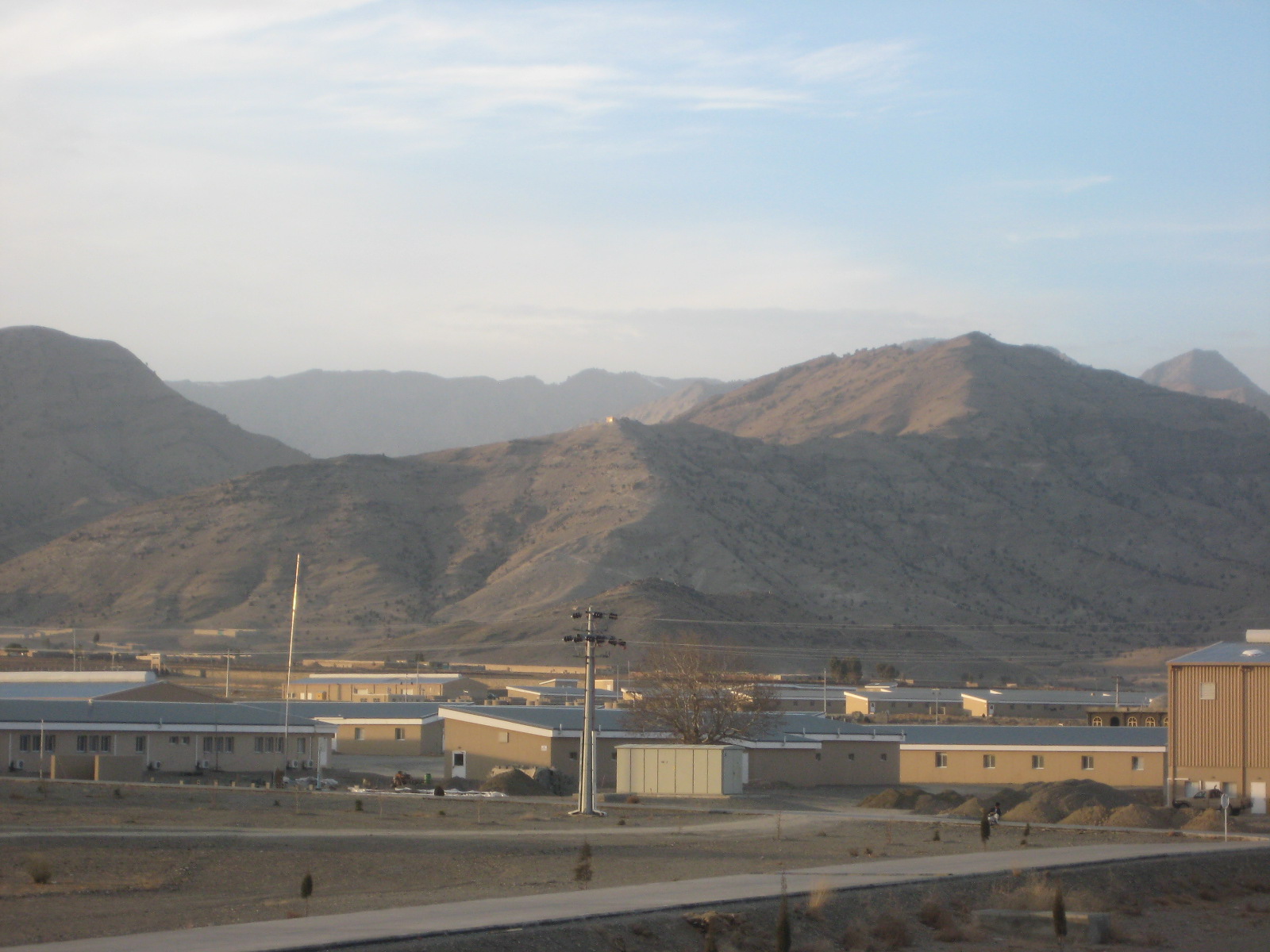
A view from an American FOB guard tower in Afghanistan overlooking an adjacent ANA compound.

Below is another Time Now adaptation of a myth found in Ovid’s Metamorphosis. This one’s based on the “Jupiter, Juno, and Io” legend, in which Jupiter seduces Io, a young woman, and then turns her into a cow to conceal his crime from his wife Juno. That’s not quite how my story goes, but I was intrigued by the myth’s notion of how humans and animals might communicate. My interest in the myth also has two other sources, one military and one literary:  First, many long hours pulling guard duty in the field in Korea and the United States and on deployments to the Sinai, Kosovo, and Afghanistan. Second, a chapter in Matt Gallagher’s memoir Kaboom titled “Dear John,” in which he writes of the devastating effect on his soldiers of learning that their wives and girlfriends had not been faithful. “Dear Johns crushed men of otherwise unquestionable strength and total resoluteness,” Gallagher reports. “In the time they most needed something right and theirs, it was taken away from them.” My story doesn’t involve a “Dear John” act of betrayal, but close enough.

This story joins two other Ovid myths I’ve adapted to modern military circumstances, “Ceyx and Alceone” and “Arachne.” Two more are forthcoming.

****

Junior’s big idea was that pets and domesticated animals were really dead people reincarnated. The thought began as one of a million idle ideas that came to him while pulling guard duty in a tower on his small FOB in Afghanistan. Nothing ever happened on the two-hour shifts, so his mind, racing on dip and Monster drink, had plenty of time to drift. This idea stuck more than most, however, and soon he found himself preoccupied by it. No longer alive as living men or women, household and barnyard animals possessed human-like minds capable of thought, love, and purposeful action. Unable to speak or write, they nonetheless had brains like humans and so they preferred life in proximity to people, especially people they once knew and had loved when they too had been human.

Thus the affection. Thus the loyalty. Thus sad looks begot by eternal misunderstanding and incomprehension.

To Junior the theory made great sense and he couldn’t understand why other people hadn’t already figured it out. Couldn’t they understand why their pets stared at them so? Or curled up at their feet? Why horses and cows were so docile? Why they didn’t lash out at their owners and run away at the first opportunity?

When Junior explained his idea to his girlfriend Io via Skype, she thought he was crazy, and not in a funny, charming way. In fact, it was close to the final straw. She had been disappointed with Junior for some time, and now this. She had already been thinking about breaking things off, but really hadn’t had a good reason to do so except that he no longer thrilled her and she was ready to move on. The deployment had made things worse for them, not better, and she was now impatient about being Junior’s girlfriend.

If Junior ever said this crazy idea out loud in public to any of their friends, that was definitely it. It was bad enough that he asked her to take it seriously. It wasn’t clever. It wasn’t smart. It was just dumb.

Within the week, Io dumped Junior via instant message. Dumping him by IM didn’t make her proud, but she was too irritated to write a letter and she damn sure wasn’t going to tell him over the phone and listen to him plead and moan.

“I need to end things,” she had written, “You’ve changed, and I need space.” Then she blocked him on Facebook and refused to answer any of his emails.

Stunned by Io’s rejection, as well as by awareness of how badly he had blown things, Junior stumbled about camp in a daze. For a week he was useless, and then he turned back to the demands of the mission with a rigor that had not been there before. When his unit returned to the States, he couldn’t completely remove herself from Io’s orbit of friends and venues, but she flat out refused to talk to him, at least in any way that was personal or heartfelt or came near offering an explanation for her actions or giving him a chance to ask for a second chance. She still wouldn’t answer his texts or emails or chat requests, and she definitely didn’t let him be alone with her anywhere.

Desperate to be in her presence, Junior contrived ways to run into Io in person. But when chances came to speak with her, Io offered only pleasantries and generalities. In terms of allowing Junior access to her thoughts or feelings, nothing. After a while, she cut him off completely and would pass by him stone-faced without making eye contact.

Io’s actions caused Junior to reconsider his theory about reincarnation and animals. He decided that people who weren’t open but guarded like Io had become were like the animals he once had thought were so fond of humans. Instead of being full of affection and yearning, though, he now thought they had no interior life whatsoever and were mostly just there. If they didn’t share, or wouldn’t share, that was precisely what it meant to be non-human. And there was no possibility for restoration, either—nothing was going to make an animal talk and nothing was going to make Io like Junior again. It was clear beyond question that wasn’t going to happen.

Junior realized all this with certainty one evening when he found himself at an off-post bar and Io walked in. She was gorgeous, her face glowing and her shining hair splayed across her shoulders. Io was with girlfriends, not another guy, so Junior approached, hoping against hope for a friendly conversation. He said hello, and then a few other things, but Io just stood there placidly. In the middle of one of Junior’s sentences, she looked over his shoulder to say hi to someone, and a smile broke out on her face and her eyes once more danced. Then she turned her attention, dull and flat, back to Junior, and Junior stammered on, trying to be pleasant and unconcerned. As he stood there talking, though, Io began to grow fuzzy in detail and rubbery in shape. At first Junior couldn’t tell why his vision was distorted—was it him or was it her? Within seconds, though, he realized Io was no longer even human. She still stood in front of Junior, not now a person but a cow, four legs and hooves and big round eyes, standing silent, gone forever.

Bangerz: All Killer, No Filler Contemporary War Fiction

3rd Brigade, 101st Airborne "Rakkasans" on a hilltop in Afghanistan. Photo by Bill Putnam.
3rd Brigade, 101st Airborne Division “Rakkasans” on a hilltop in Afghanistan.              Photo by Bill Putnam.

War writing, particularly fiction, redefined itself during the Global War on Terror. World War II and Vietnam War stories relentlessly focused on the combat experience of young men. The exploits of soldiers other than infantrymen and fighter pilots, adventures other than combat, and the travails of life after war, subjects that are central to contemporary war writing, were then on the periphery. I’m not speaking of war pulp fiction, either, the kind that sensationally portrays combat and glorifies fighting prowess. That genre, which formerly was plentiful, now is rare, and exists in refashioned form mainly in the “kill memoir” genre authored by snipers and special operators. My subject is work considered “literary”—fiction written by well-educated writers whose works are published by major publishing houses and high-brow journals and which compete for critical attention and book awards. The James Jones, Norman Mailers, Tim O’Briens, and Larry Heinemanns, to name names, of yesterday. The Ben Fountains, Phil Klays, and Brian Turners of today.

The old era has largely passed, but the allure of combat narratives has not completely vanished. Whether written by a veteran trying to explain “what it was like” or a civilian author exercising fantastical powers of imagination, sensational scenes of bullets flying, bombs exploding, and soldiers fighting still make war writing vivid and generate intense emotional responses. And why not? People are curious about exotic events and surely one of the tenets of fiction is to present readers with descriptions of aspects of life they are unlikely to have seen personally. In Billy Lynn’s Long Halftime Walk, Ben Fountain has Billy Lynn wonder, “How do you describe the worst day of your life?” but many contemporary war writers have not shied from the challenge. Surveying the field briefly, I easily recall the great battle scene that opens Joydeep Roy-Bhattacharya’s The Watch, the taut face-offs on Baghdad streets described in David Abrams’ Fobbit (as well as a beautiful passage written from a mortar round’s point-of-view), and the brief description of combat tersely rendered by Atticus Lish in Preparation for the Next Life. One of the best and longest descriptions of men fighting comes in Aaron Gwyn’s Wynne’s War, the last half of which unabashedly and reverently pays homage to movie and pulp fiction Westerns by portraying a group of Special Forces soldiers (on horseback, no less) fighting it out over a period of days–not exactly my own experience of combat, or anything that probably happened often in Iraq or Afghanistan, but very exciting to read. The post-IED strike battle thrillingly described in Matthew Hefti’s A Hard and Heavy Thing, on the other hand, replicated experiences similar to ones I have lived through, and I’m sure many other veterans as well, and consequently triggered in my mind memories and comparisons. But still… though passages describing combat occupy some 50% of Wynne’s War’s page space, the percentage is probably less than 10 or even 5% of Billy Lynn’s Long Halftime Walk, A Hard and Heavy Thing, Preparation for the Next Life, Fobbit, and The Watch.

Short fiction about the wars in Iraq and Afghanistan abounds, but as I recollect stories about soldiers set entirely or mostly “outside the wire” and which depict soldiers, as the mission of the infantry states, “closing with and destroying or capturing the enemy,” not-so-many examples present themselves. To repurpose terminology from the world of club music describing a song that is “extremely tight or just unbelievably awesome” and radiates “unbelievable swell or swag” (Urban Dictionary), in a way that seems right given we’re talking about gunshots and explosions, here’s a short list of contemporary war short fiction “bangers.” Or, to give it the cool modern flair of a Miley Cyrus album title, “bangerz”:

Nathan Bethea, “Agincourt” (published under the headline “Whatever You Do Someone Will Die: A Short Story About Impossible Choices in Iraq” on The Daily Beast). Short quote from the beginning: “This will be the worst day of your life. In years to come you will recount the most intricate details to yourself with obsessive precision, as if tracing the wood grain of a childhood bunk bed from memory. It is not a healthy kind of remembrance.”

Ted Janis, “Raid” (from the Fire and Forget anthology). One of the first modern stories to portray military special operations forces, in this case Army Rangers, in action. Also one of the few stories to describe American soldiers grievously wounded in battle.

Gavin Ford Kovite, “When Engaging Targets, Remember” (from the Fire and Forget anthology). Maybe the first and definitely one of the best of many modern war stories to play dialogically with the rhetoric of official Army documents and manuals.

Kyle Larkin, “Minarets” and “The Night Before Christmas” (both published on the Military Experience and the Arts website). In the former, an infantry platoon in Iraq wakes up to the sound of Islamic prayer, and in the latter, death, not Santa, comes calling for an American soldier.

Katey Schultz, “The Ghost of Sanchez” (from Flashes of War).  I could have chosen a number of excellent stories by Schultz, the only non-veteran and only woman on the list, but this one rocks hardest. Set in Afghanistan, which raises the question–why are there so few stories portraying Operation Enduring Freedom?

Roman Skaskiw, “Television” (from the Fire and Forget anthology). I don’t know why this story is called what it is, but OK, it’s a great and maybe the first portrait of a common subject in Iraq and Afghanistan war fiction: a lieutenant who is challenged by a tougher, more aggressive NCO.

Brian Turner, “The Wave That Takes Them Under” (from the Fire and Forget anthology). A speculative fiction war narrative complement to Turner’s great poem “To Sand” in Here, Bullet. And because you can never get enough Brian Turner, the passage titled “The Soldiers Enter the House,” from My Life as a Foreign Country, published as a stand-alone story on Medium.

Brian Van Reet, “Eat the Spoil” (originally published in The Missouri Review). A tank platoon dismounts to chase insurgent mortarmen through an Iraqi insane asylum and into a swamp. Also, perhaps the craziest “we shot dogs” story ever.

Honorable Mention–stories about artillerymen who wield death and destruction by firing big guns from inside FOB walls:

Phil Klay, “Ten Kliks South” (from Redeployment). An earnest, clever, and cute (a rare combination) story about an artilleryman who tries to calculate his share of the responsibility for the deaths caused by the rounds he helps fire.

Will Mackin, “Kattekoppen” (first published in the New Yorker). Selected for inclusion in Best American Short Stories 2014. More please, Will Mackin, it’s been too long.

I don’t want to canonize these stories, overly privilege their authors, or suggest they are the best tales yet written about the wars. Rather, I just want to give them their due as a body of work, while wondering why there aren’t more, and propose we read them alongside Jones, Mailer, O’Brien, and Heinemann to judge just how writing about combat in the 21st century resembles or differs from writing about combat in the 20th century.

The Dirty South: Odie Lindsey’s We Come to Our Senses

OD LindseyOdie Lindsey’s collection of short stories We Come to Our Senses is the first contemporary war fiction title released by Norton, one of the most prestigious publishing houses going. Lindsey, a veteran of the First Gulf War, teaches at Vanderbilt and has placed a number of his stories in estimable journals. One, “Evie M.,” was selected for inclusion in Best American Short Stories 2014, where, as it happens, it sits next to Will Mackin’s excellent story of war in Afghanistan “Kattekoppen.” Befitting the impressive resume, the stories in We Come to Our Senses are very together: mature, surprising, and deft in all the right ways and measures. Though Lindsey is a veteran and We Come to Our Senses a first book, the stories don’t burn with the white-hot intensity of narratives by young men or women just back from Fallujah or Helmand and now eager to impress themselves upon the literary world. Instead, they illustrate how an author from a slightly older generation might depict early middle-aged veterans connecting the dots leading back from lives that have come unhinged to things that seemed reasonably innocent when lived through while young. We Come to Our Senses thus suggests usefully and beautifully what Iraq and Afghanistan war fiction might look like when contemporary veterans have let their deployment experiences simmer for a few more years, while gaining confidence and skill as writers–“we come to our senses,” indeed.

Many We Come to Our Senses stories arrive in sets linked by recurring characters, a fashion in short-story collections that works to good effect here. Several, including “Evie M.,” track a group of men and women who deploy to the First Gulf War as members of an Alabama National Guard unit. Far from the frontlines, the soldiers burn shit, get drunk, and pair off in short or long term relationships as best and often as they can. On return, with no battlefield exploits to speak of, untouched by notions of patriotism and service, and unprepared by the military to do anything of significance, they stumble-and-bumble along for the next decade or so. No horrors of combat derail them, but their minds, as was their service, are preoccupied by the romances, flings, and crushes that served as cushions against the stress of deployment. The men drift in perpetual states of wistful mopiness that seems to operate mostly as a blissful narcotic for them, but the aftermath of lusty military youth is far more dire for the women, even fatal. Evie M., whose relationship with a fellow soldier went to shit in Iraq, is suicidal, as is the eponymous protagonist of “Colleen,” who has been perversely abused by a creepy fellow soldier while deployed. Another set of stories features a young woman named Darla who carries a deadly infectious disease, the result of a one-night-stand with a soldier.

One of the best stories in We Come to Our Senses, “Chicks,” is set in Hollywood, but most of the others take place in the South, in particular that scruffy cultural space where the lingering remnants of white trash Dixie bump up against shiny new prosperity and respectability, with a verdant natural world of hot sun and creepy-crawly non-human things, along with lots of drinking and guns and odd encounters with the parallel social world of African-Americans, adding further regional color, as if the milieu had been suggested by 1000s of hours listening to the great Drive-By Truckers. My favorite, “So Bored in Nashville,” is about a young man’s last night on the town with his best friend before enlisting. Lindsey’s typical prose voice is sparse in the manner of Richard Price or maybe deadpan ironic like Chuck Palahniuk’s, but “So Bored in Nashville” accelerates into a razzed-up register that reminds me of T.C. Boyle:

Bars and booze and lacquer and glass and smoke and teevee and tourists and shots, and pit-stop at Randall’s to chop up a Xanax, to snort then smoke then back to the bars. In this city, through the bars, we wind up packed in a room full of ads. Living ads, that is, sexy and skinny young women ads. New England or Oklahoma transplants, wannabe country stars clad in fishnets and bra tops, hot pants and logos, and who proffer shots of some dye-injected Extreme Liquor product. A temp job, they swear, they serve you straight out of their navels, wherever, no problem. For ten bucks a pop they make ten bucks an hour, while your lips suckle shots of their amazing young stomachs. And they’re dying to sing, will do anything to demo. (All of this action in a Vandy sports bar, not an airport strip club, let alone a music industry hang.) And tomorrow I leave, for Forts Jackson then Benning. Signed the contract when the Army offered me 11B, Option 4: Airborne Infantry. I am twenty-six and terrified. Yet I felt compelled to follow through after the recruiters told me how difficult it was to secure this assignment. How rare it is these days to earn Option 4, Airborne, war on and all.

Hoo-ah! they barked. You tha man!

Randall and I depart that bar, we drive on. He says zero about my deployment.

Easily bored, wildly reckless, and scandalously sacrilegious, a hot mess after being dumped by a woman he still pines for, and now eager for the approval of more assured men such as his friend Randall and his recruiters, the narrator will be just fine. In fact, he’s just what they’re looking for in the airborne, and pretty much like every other young man already there, in my three years and 40+ jumps worth of experience. Perfect.

All in all, it’s a bleak vision, at points comically rendered but mostly driven home on the strength of Lindsey’s eye for detail and the right word at the right time. He hugs his characters close, but not on the terms we’re commonly asked to appreciate veterans. Forget thanking them for their service, because their service was basically nothing, and don’t bother trying to support any of his troops, unless you are personally prepared to deal with a whole lot of heartbreak and anguish.

****

Here, Benjamin Busch reviews We Come to our Senses, along with Whitney Terrell’s The Good Lieutenant, Harry Parker’s Anatomy of a Soldier, and Luke Mogelson’s These Heroic, Happy Dead, for the New York Times.

Julia Lichtblau’s review for The Common, “War Stories for the PTSD Generation,” commends We Come to Our Senses for its realistic and empathetic portraits of women. “In its warm heart, We Come to Our Senses loves women,” Lichtblau writes.

Odie Lindsey, We Come to Our Senses. Norton, 2016.

Right on Time, Five Years Later: Roy Scranton’s War Porn

War PornRoy Scranton’s Iraq war novel War Porn, out this week, by all accounts was substantially complete by 2011. Indeed, Scranton reports that he began writing War Porn while he was still in the Army in 2005, about the time of the events he portrays in the novel. That War Porn now appears in 2016 raises interesting questions. According to a 2011 The Atlantic article by Matt GallagherScranton could not at the time find a publisher. As Gallagher points out, no major house had yet put out a novel about Iraq or Afghanistan, and Scranton at the time was a fledgling, far-from-established author. Six years later, however, much has changed. War writing as a publishing genre has grown exponentially, and Scranton has compiled an impressive body of work. No doubt these factors help explain why War Porn now sees the light-of-day, but almost certainly there’s more.

In conversation a couple of years back, Scranton stated that he had maintained a “consistent line-of-thinking” throughout his writing ventures, which include editorial oversight and a contribution to the war story anthology Fire and Forget, a striking essay published in the Los Angeles Review of Books on the war literature “trauma hero,” the end-of-the-world treatise Learning How to Die in the Anthropocene, a PhD dissertation on post-WWII poetry, and numerous essays and articles in both the popular press and scholarly journals. Be that as it may, if we read War Porn as a 2011 novel it’s one thing: not just a topical novel about matters of extremely recent national interest and not just a work that anticipated major themes Scranton would revisit often, but a missed opportunity, historically, that might have significantly influenced the wave of war novels to follow, which by Scranton’s lights consistently fell into a trap of over-extending sympathy toward US soldiers with bruised feelings. If we read War Porn as a 2016 novel, it’s a look backwards at an era and events rapidly vanishing from public memory, and it also comments retroactively on the slew of Iraq and Afghanistan war novels written since 2011. But it also announces new approaches and inflections, better late-than-never, that might significantly impact war writing to come. How to reconcile the two possibilities?

War Porn consists of three interrelated storylines. One is narrated by an American soldier, Specialist Wilson, and describes Wilson’s service as a Humvee driver in Iraq in the war’s early years. Wilson is arguably no-better-and-no-worse than he should be as a person or soldier, but his banal complicity in the Army’s military occupation of Iraq illustrates how the military dehumanizes even those “just doing their duty.” The consequential damage on Iraqi civil society of an occupation force made up of 100,000+ men-and-women much like Wilson are illustrated in a second storyline depicting an Iraqi US Army interpreter named Qasim al-Zabadi. Things end badly for Qasim, and though he is more victim than victimizer, with far less options than Wilson, and no escape at the end of a year’s deployment, he too has made at least one disastrous choice and must now must endure the consequences of foolishly trusting Americans. The third storyline involves a group of liberal, late-20-something residents of Utah, whose comfy life and beliefs are upset by the arrival to their Columbus Day barbecue of an Iraq War vet named Aaron. Aaron has been a guard at a US military detention facility, and he has a thumb drive full of photos to prove it—the “war porn” of the novel’s title. Aaron even more than Wilson is unrepentant about his involvement in war atrocity and not above using his stash of prison photos to titillate the other party-goers. Far from being “traumatized” and equally far from being a dedicated citizen-soldier ennobled by his time in service, Aaron’s roguish familiarity with evil intimidates the hell out of his male host while dizzying up his host’s wife’s libido. Linking the three storylines are prose-poem interludes in which Scranton channels a collective unconscious voice declaiming the amalgamated collection of fables, lies, half-truths, myths, delusions, and anxieties that underwrote the Iraq War in the American and Iraqi cultural climate.

It’s a lot to take in, but the storylines, scenes, and episodes are carefully integrated, while also serving the purpose of providing a kaleidoscopic view of war experience without privileging the perspective of any one participant, particularly that of a twenty-year-old American male combatant. The prose-poems can be a little polemical, though the one I like best, an hallucinogenic deconstruction of the allure of movie war heroes, worked beautifully when read by Scranton at War Porn’s book launch last week in New York. In contrast to the fired-up prose-poems, Scranton’s narrative prose voice is understated, somehow millennial slacker-ish, focused on acts and words rather than thoughts and emotions, a textural effect that schmoozes the reader into underestimating the grimness of Scranton’s vision until the book’s concluding pages. The chapters featuring Qasim portray Iraqi discourse as laden with Islamic parables and platitudes, which I guess has some relation to the way Muslims really speak in their native languages, though it may also be as much a Western literary mode of representing exotic speech as anything. A passage such as the following, on the other hand, which describes Qasim’s short stay in Scotland as a student, shows Scranton’s talent as a lyrical prose stylist:

Qasim had been north only a few gloomy months–cold, humiliating months full of unnerving lessons in the limits of his talent; dismal months of constipation, headaches, and a constantly running nose; lonesome months where the English he so struggled to master always seemed to bend back on his tongue into gibberish; nightmare months where he wandered the streets in a muddle, baffled and awed by the strange stone city around him and the cruel, doughy faces of the Scots who lived there; despairing months where each night, curled under his duvet with the door shut against his roommates, he struggled desperately to keep from weeping, to keep them from hearing him weep, despondent for home and exhausted from working so hard and falling behind and the unending gray skies pissing rain–when at last the phone rang and his mother told him in a stern, quiet voice that his father was ill and the doctors did not expect him to survive the winter.

The chapters featuring Wilson and Aaron are heavily conversational, and Scranton’s ear for distinguishing between characters by the shape and flavor of their speech rings true to me. The characters banter and parry with each other in that way that signifies cleverness and relaxed conviviality from the inside, but from the outside seems like just a lot of aggressive posturing, as if so-called pals were really “frenemies” who secretly hated and were in competition with each other–which they do and which they are.

All the characters are interesting, even charismatic to a degree, but War Porn’s final scenes makes clear that Scranton’s not interested in giving any of them, save Qasim, a break. The word “choice” appears often in the mouths of the novel’s characters, and the accumulated effect makes the point that if you are an American, your attitude and ideas about Iraq, as well as your actions, whether you served there or not, are the result of decisions, and not just things you drifted into unwittingly when you were young and thus easily excusable. Once stained by the war in Iraq, the American veterans in War Porn in the name of honesty pretty much stop trying to be good people, as they learn just how capable they are of sadistically manipulating and dominating those over whom they hold authority. Much as the civilians at the Utah barbecue must recalibrate their ideas about Iraq when troubled by Aaron and his photos, so the novel’s readers will also have to perform mental gyrations to reestablish their moral equilibrium in regard to a war most experienced only second-hand–pornographically?–through the words and images of those who have fought.

So why wasn’t War Porn published in 2011? At his book launch, Scranton offered a couple of reasons that went beyond the facts that he was a young unknown and war novels were not yet a thing. 2011, he reminded the audience, was a time when “supporting the troops” and “thanking soldiers for their service” was all the rage. War Porn, alas, offers precious little grounds for thanking any of its soldier-characters for anything. Further, Scranton continued, a tenuous truce characterized Iraq circa 2011, which made it not the time for unremittingly bleak novels about a failed invasion, populated with unredeemable characters. Instead, the national literary appetite pined for stories about sensitive soldiers buffeted by service and combat, the sentiment against which Scranton’s “trauma hero” essay seethed. In War Porn, Scranton spends little time tracing the psychology and mental processes of his characters, as if to make a statement that it’s by one’s acts and words that one’s character and morality must be judged, not by some impossible-to-prove literary sketch of a person’s interior landscape.

In the last three years, the rise of ISIS and the disintegration of peace in Iraq have created space for more skeptical looks at the Iraq War, especially the early years, when the ethical rottenness and intellectual ineptitude, in addition to the practical difficulty, of the occupation was on display for anyone who cared to look closely. Also, the simplistic sanctimony of uncritically thanking guys like Wilson and Aaron for their service has begun to wane, making unflattering literary portraits of veterans possible in the name of somehow working toward a more even-handed consensus on what it actually means to be a veteran. Scranton’s notion that war “dehumanizes” its participants might be said to be as much a trope as the idea that it “traumatizes” them, and critics will object that Scranton himself lacks a basic humane attitude toward his characters and that he willfully neglects the sacrifice, patriotism, courage, and real suffering of young Americans sent to war. Let it happen–the conversation needs to take place, and Scranton’s literary skill and fierceness of vision make him a stout antagonist for anyone who wants to take him on. War Porn, written in the 00s, finds its moment in 2016, five-to-ten years late, but also right on time. Here’s to Scranton for reminding us not to repeat the military mistakes of 2003-2005 nor replicate the publishing trends of 2011-2015, though we probably will, as these things go, in both cases, despite his fine warning.

Roy Scranton, War Porn. Soho, 2016.

The War Writing Rhetorical Triangle

The concept of a “rhetorical triangle” is well-known to graduate students of composition, rhetoric, and communications. A way of imagining any particular act of communication, but especially that of public speakers and authors in the act of argument and persuasion, the rhetorical triangle attempts to depict the relationship between speakers and authors, their subjects, and their audiences. Graduate students ground their academic interest in the rhetorical triangle in Aristotelian definitions of ethos, pathos, and logos, each linked to a specific corner of the triangle, and put their understanding to practical use in undergraduate composition classes. There, the rhetorical triangle helps students understand the importance of author and speaker subject positions and the notion of intended audiences. Often, the rhetorical triangle is embellished in textbooks and slide presentations with the addition of circle that envelops the triangle, meant to represent “context”—why a particular subject is under discussion at all, what outside pressures bear on it, what underlying assumptions impact the effort being made at communication, etc. Figures A and B below depict the rhetorical triangle and the rhetorical triangle + contextual circle as they typically are represented.

Slide1

Slide2

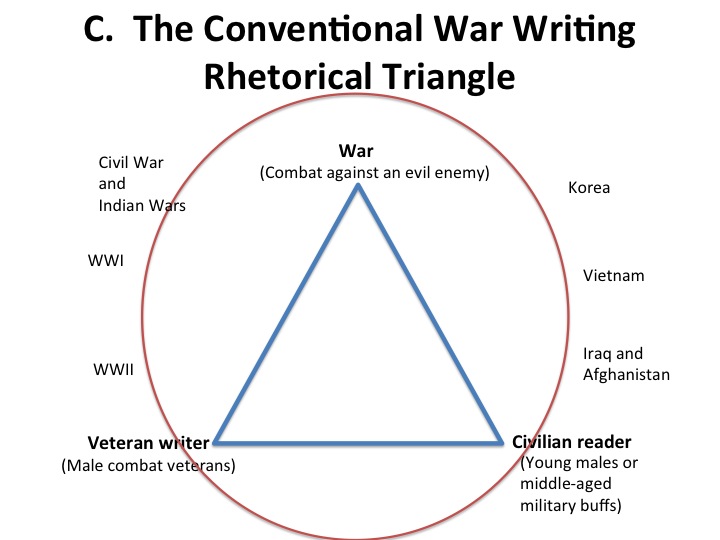
All good, but I’ve long thought that the typical rhetorical triangle, as it exists as a visual metaphor, was a little too rigid, unsubtle, and unimaginative to portray the complexity of any “communicative situation,” to borrow another phrase from the rhetoric-and-composition world. My misgivings crystallized as I began thinking about how the rhetorical triangle might apply to war writing, by which I mostly mean fiction and poetry about war authored by veterans of war, though not without application to memoir, non-fiction, and veterans-in-the-classroom scenarios, as well as works written by journalists, historians, and civilian authors of imaginative literature who have studied war closely. Still, if we retain the basic equilateral triangle and round circle shapes of the standard rhetorical triangle + contextual circle, we might enhance it as follows in Figure C to portray what traditionally might be said to be the relationship of veteran-writers, war, and civilian readers who have not been to war:

Slide3

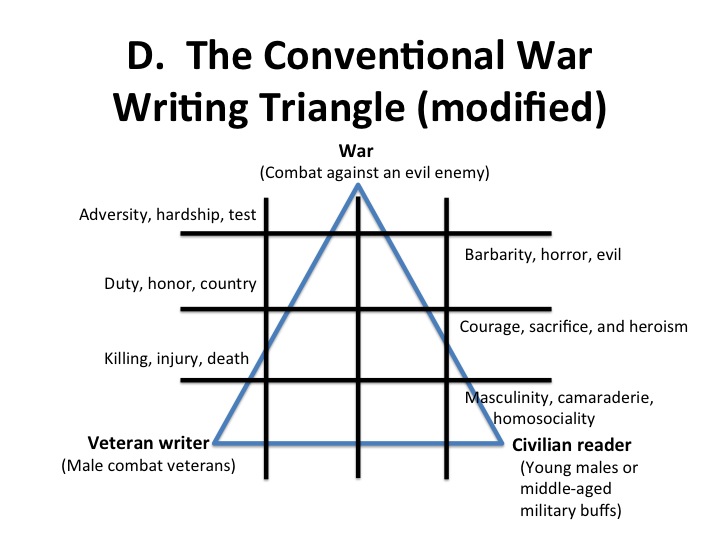
As my thinking about this pictorial representation of war writing dynamics proliferated, or perhaps festered, I began to question whether the circle representing context adequately conveyed what is most salient about the attempt to render the experience of war to readers who had not seen combat. Rather than a benign circle hovering on the outskirts of the acts of writing and reading, I thought that a grid imposed over the top of the triangle might better depict how war writing as a genre is forcibly shaped by an array of recurring events, attitudes, themes, tropes, scenes, and expectations, as well as reliance on a short list of time-honored antecedents as literary models, that together harmfully solidified the relationships of writer, subject, and reader into hardened positions, perilously close to cliché, stereotype, “confirmation biased” patterns of cause-and-effect, and self-prophecizing conclusions. Figure D shows my effort to portray context as an imposed grid:

Slide4What might be a work of literature, or a movie, that could be given as an example of war writing that conforms to the Figure D model? There’s no perfect example—the diagram is a cartoon, after all—but let’s for the sake of argument posit works such as Stephen Crane’s The Red Badge of Courage and Erich Maria Remarque’s All Quiet on the Western Front as the ur-novels of modern warfare: stories that concern themselves not just with describing the “horrors of combat” and the possibility of transcending them, but the psychological effect of witnessing and enduring the horrors. Yes, I know Crane was not a veteran, but he ventriloquized one admirably, and like I said, the examples are not perfect. What’s important is that many many works of fiction, as well as memoirs and movies, have repeated, with various amounts of skill, motifs and manners-of-treatment originating or advanced in exemplary fashion by Crane and Remarque.

But as war writing evolved and permutated over the course of the 20th century, differences in style, perspective, and approaches also emerged. A very common refrain found in Vietnam War writing is the idea that “the truth of war cannot be conveyed,” sometimes expressed as “you had to be there to understand it,” notions that would seem to undermine the whole effort of writing about war. They didn’t, however, and in practice the sentiment seems to operate more as a marker of authenticity than a confession of ineptitude. The arch-expression of the idea is Tim O’Brien’s well-known “How to Tell a True War Story,” which compellingly dramatizes a veteran-author’s difficulty in conveying to civilians the essence of what fighting in Vietnam was all about. O’Brien’s famous last line, “It’s about sisters who never write back and people who never listen,” drives home the point that in the narrator’s mind at least one corner of the rhetorical triangle, that of the audience, is drastically estranged from both the veteran-author and whatever might be said to be the truth and reality of war.

A post-9/11 war reiteration of the fractured war-writing rhetorical triangle appears in Matt Gallagher’s novel Youngblood. In the Prologue, the narrator-veteran describes several instances of difficulty connecting with civilians who ask him what Iraq was like. He ends by stating,

What was it like? Hell if I know. But next time someone asks, I won’t answer straight and clean. I’ll answer crooked, and I’ll answer long. And when they get confused or angry, I’ll smile. Finally, I’ll think. Someone who understands.

Here, Gallagher’s narrator’s hoped-for “communicative situation” is marked by frustration and distortion, which, if only those miserable qualities could be attained, would stand as a great improvement on the incomprehension and indifference that have so far governed his attempt to describe war.

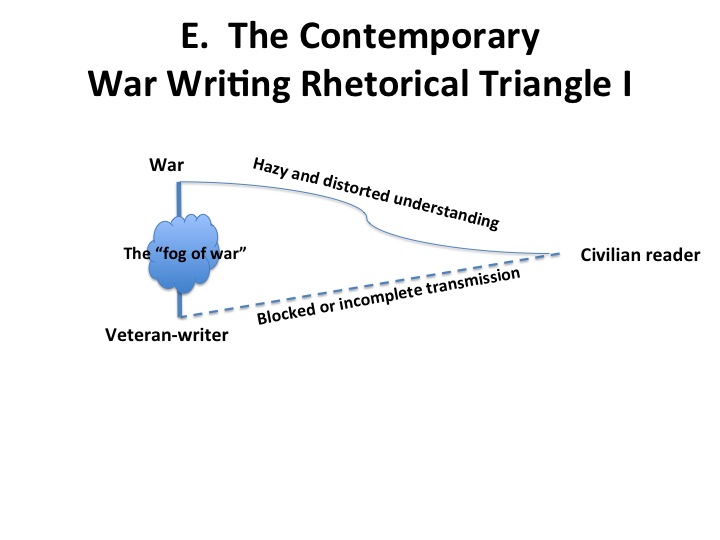
The contemporary emphasis on “failure to communicate” might be reflected in the following variation on the war-writing rhetorical triangle (Figure E):

Slide5

Features of the contemporary model include:

  1. The veteran-author’s personal relationship to his or her subject of war is intense and intimate, as represented by a thickened, shortened line, but the connection is obfuscated by that very closeness, as well as the more general difficulty of apprehending the truth or reality of combat described as “the fog of war.”
  2. The civilian reader’s relationship to the veteran-writer, and vice-versa, is distant and beset by communication difficulties, as portrayed by the long, broken line.
  3. The civilian reader’s understanding of war is also remote, indistinct, and untrustworthy, as depicted by the thin, wavering line.

In Figure F below, I have added in a contextual circle that names what I think are the most important contemporary social, political, cultural, and technological influences on war, the men and women who go to war and then write about it, and the nation-at-large. I’ve also noted some changes in the composition of the corners of the triangle to reflect modern trends.

Slide6

I won’t take time here to explain these factors or how they put pressure on the legs and corners of my war writing rhetorical triangle. Many are obvious or self-explanatory, and none are beyond the ken of readers who have made it this far and who now choose to roll them around in their minds to consider their relevance. I might well have portrayed them as a grid, as in Figure D above, but for the sake of clarity, mostly, I haven’t. Taken together, the diagram suggests a contemporary war writing field characterized by multiple variables, full of complexity, ambiguity, perspectival variations, and tenuous, arguable intersections joining war, writing about war, and readers.

Might the broken-and-distorted contemporary war writing rhetorical triangle be as much a trope, or even a cliché, as anything that’s come before? Some very good veteran-authors have taken up the question. Benjamin Busch, in “To the Veteran,” his introduction to the veteran writing anthology Standing Down: From Warrior to Civilian, states, “We often feel there is a certain authenticity lost somewhere, that language cannot completely express our experience to those who do not share it,” but ultimately he concludes that the stories in Standing Down “prove that transference of experience is possible with language.” Similarly, Phil Klay in a New York Times essay titled “After War, A Failure of Imagination,” writes, “Believing war is beyond words is an abrogation of responsibility — it lets civilians off the hook from trying to understand, and veterans off the hook from needing to explain.” Busch and Klay are formidable writers, but I’m not sure everyone, including many veterans, agrees that veterans can express the reality of war in a way that is perceived as meaningful and reasonably fulsome by civilians. The fact that Busch and Klay have to assert their case proves the sentiment they hope to rectify is both real and a problem. Whether their perception is an enduring and truly true structural feature of war writing or merely a passing truism-of-the-day remains to be seen.

Many thanks to the organizers and participants of the 2016 Veterans in Society seminar at Virginia Tech, where I first presented on the “War Writing Rhetorical Triangle.”

LGBT MIA in War Lit No More: Scott D. Pomfret’s You Are the One

YouThe contemporary war lit corpus of poetry, fiction, and memoir has covered a lot of ground, but has had little to say so far about the presence of gay men and women in uniform. Jesse Goolsby’s I’d Walk With My Friends If I Could Find Them contains a gruesome male-on-male rape scene, and Matt Gallagher’s Youngblood features a cameo appearance by a closeted company commander, but that’s about it in terms of fiction published by big-name publishing houses. Poetry, nothing comes to mind, either, though an exhaustive search of vet writing anthologies and web publishing sites would surely turn up something. Jeffrey McGowan’s memoir One Gay Man’s Life in the Don’t-Ask-Don’t-Tell Military, published in 2005, is interesting, but McGowan left the Army in 1998. Playing by the Rules, by gay former Marine Justin Elzie, was published in 2010, but Elzie was out of the Marines long before 9/11. Amazingly, as far as I can tell, no book-length memoir by a gay or lesbian Iraq or Afghanistan veteran has yet appeared. Please, somebody, tell me that I’m wrong.

Maybe what I’m describing is a good thing. Everyone’s more accepting now, right, and Don’t Ask Don’t Tell has been repealed and gay Americans can finally serve openly. There’s nothing about a service member’s sexual orientation that would by itself make it an interesting subject for fiction, verse, or memoir, correct? No war writer I know is a homophobe (or misogynist or racist), so I’ll bet if you asked them about the absence of gay characters in their works they would say it just didn’t occur to them, given the story they were trying to write. Heck, hetero-normative soldier sexuality has barely been touched in published fiction, save for, on the crude side, passing references in a number of works to FOB port-a-pottie coitus, and on the deft side, the short fiction of Siobhan Fallon and the under-the-grandstand quickie flamboyantly described by Ben Fountain in Billy Lynn’s Long Halftime Walk. Maybe that’s fair—too much relationship and erotic stuff and a war novel becomes something other than a war novel, the way these things are probably understood by those most interested in writing and reading war stories. Romance, maybe, or erotica, or least interesting of all, women’s fiction, whatever that phrase means in the minds of book buyers and readers.

Whether all the above is a result of publisher decision-making or authorial disinclination to address Don’t Ask Don’t Tell-related issues, I don’t know. But these musings bring us to Scott D. Pomfret’s You Are the One, which came out earlier this year. Pomfret is a many-times-published author in the thriving gay literature underground; You Are the One is one of six books he’s written for gay-oriented publishers. You Are the One contains thirteen stores published in gay literary journals between 2005 and 2015, four of them directly portray gay military members before, during, and after deployment to Iraq or Afghanistan and all interestingly open up heretofore unexamined vistas on the lives and worldviews of soldiers that both help describe modern sexual behavior and transcend the merely prurient sexual. In “You Are the One,” a super-femme civilian narrator finds himself in strange cahoots with his lover’s company commander to guard the sexual orientation of the narrator’s lover. In “Transport,” a battle-hardened sergeant preys on one of his junior enlisted soldiers while on mission in Iraq. “Swagger” describes a bar hook-up between a special operator and the son of a Vietnam veteran. In “The Casualty Assistant,” a gay casualty assistance officer consoles the widow of a soldier killed overseas.

All are interestingly conceived and plausible enough, given what I’ve seen and read over the years. Though Pomfret is not a veteran, he gets the details right and his stories engage on many levels beyond the erotic; he is a fine writer in terms of his eye for nuance and ability to craft a quality sentence. All the stories, save “The Casualty Assistant,” contain graphic sexual scenes, which though cool in terms of frankness and cheap voyeurism, distract somewhat from the larger tales being told. In “The Casualty Assistant,” on the other hand, we learn that the narrator is gay, and it matters in terms of his perspective on things, and because the story is not about seduction and getting off, it speaks more clear-mindedly to what gay soldiers must have always already been noticing about the hetero-dominant culture in which they furtively served during the days of Don’t Ask, Don’t Tell. As such, it hints at what insights we might garner from other LBGT-authored stories, should they ever make it into print.

Scott D. Pomfret, You Are the One. Ninestar Press, 2016.

Graphic Novel: Maximilian Uriarte’s The White Donkey

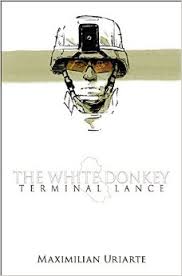
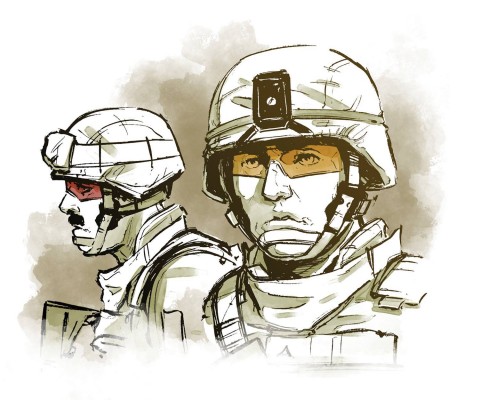
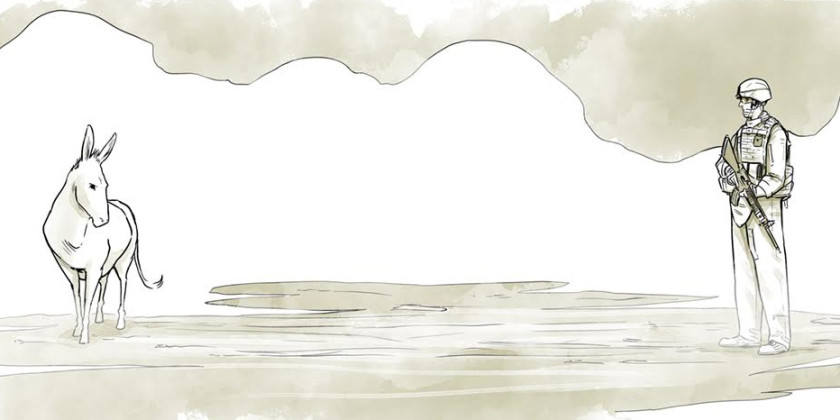
White Donkey 1I’ve haven’t read a bad word yet about Maximilian Uriarte’s graphic novel The White Donkey, and you won’t find one here, either. It would be hard to top Charlie Sherpa’s review of The White Donkey on Red Bull Rising, so I’ll keep things short. The story of a young Marine, morose and purposeless to begin with, disillusioned by the military in general and traumatized specifically by combat in Iraq, The White Donkey plot recoups many scenes and characters now commonplace in contemporary war writing. The protagonist, Lance Corporal Abe Belatzeko, is a listless and adrift young man who had hoped that the Marines might provide the purpose and motivation he couldn’t muster as a civilian. That doesn’t happen, however, as Abe finds life in the Marines mostly dull and senseless, frequently miserable, and rarely inspiring or rewarding. His lack of gung-ho spirit is quickly perceived by his peers and sergeants, who either are “all in” or better able to “fake it until they make it.” As The Valley author John Renehen (an Army veteran) described the Semper Fi Do or Die ethos to me in an email, “I remember realizing in Ramadi that the typical Marine is not some jarhead muscle man but a clean-scrubbed eager-beaver kid who looks like he’s 15 and just wants you to tell him to do something, anything, so he can do it 110% and have you tell him he did a good job.”

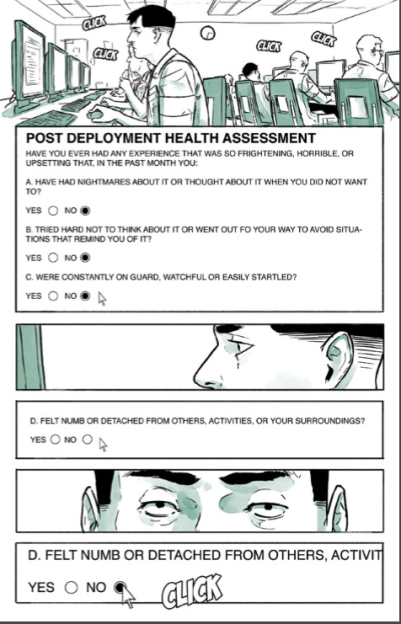
Abe can’t muster that level of commitment, and foolishly he thinks that his constant complaining and emotional distance constitutes a worthy critique of USMC dysfunction. When his best friend Garcia rips him a new one for his slacker attitude, however, Abe realizes how off-putting his belly-aching and ass-dragging have become. He resolves to get his act together, but unfortunately, things completely unravel when his truck hits an IED while on mission and Garcia is killed. The IED strike occurs as the men are singing along to The Killers’ “All These Things That I Have Done”—“I got soul, but I’m not a soldier”—the chant, known by all who deployed to Iraq and Afghanistan, getting very near to the heart of contemporary civ-mil split identity: willing to wear the uniform, willing to go to war, but refusing to accept total indoctrination into the warrior way asked for by service, and in fact commenting ironically on the incongruity of hapless boy-men, raised on Call of Duty and South Park, now armed to the teeth and on behalf of their nation heading into battle with ruthless Islamic radicals. The disaster that befalls Abe precipitates further decline and provides proof positive of Stacey Peebles’ articulation of the defining story line of Iraq and Afghan War memoirs and narratives: a young man who trusts that his upbringing and his branch-of-service will protect him from the worst of war, only to learn the hard way how badly he has miscalculated.

Uriarte’s majestically simple narrative and drawings distill stock war story elements and artistically re-invigorate them. Above all, he makes Abe worthy of sympathy, in contrast to some other portraits of alienated veterans who come off as unlikeable louts. Frankly, many similar narratives, of which there are by now dozens, seem crude and tedious in comparison, though they try much harder, while The White Donkey storyline effortlessly pulls readers forward, even as they may be tempted to linger on each page to marvel at Uriarte’s ability to portray story, scene, and character through image. Perhaps the graphic novel–unable to render complex adult interiority and extended authorial commentary–is a form ideally suited to portray a young man’s experience of war and redeployment. But that notion shortchanges Uriarte’s achievement, to say nothing of the interior life of young men. A veteran of tours in Iraq as both an infantryman and a combat artist, Uriarte also possesses a degree from the California College of Arts, a potent blend of experience and education. For years Uriarte has authored the cartoon strip Terminal Lance, which features sardonic looks at military life from the viewpoint of fictional junior enlisted Marines, including Abe and Garcia. Terminal Lance is excellent, but only hints at the imaginative enhancements Uriarte has wrought on the cartoon’s characters, subjects, themes, and sensibility in The White Donkey, as if its larger canvas sought to expose the limits of junior enlisted sarcastic wise-assery. What The White Donkey forgoes in terms of the Terminal Lance cartoon’s humor, it more than makes up for on the strength of its strong storyline, poignant perspective, and evocative artwork.


White Donkey Heads

The White Donkey 3


White Donkey Form

Maximilian Uriarte, The White Donkey/Terminal Lance. Little, Brown, and Company, 2016.

Elizabeth Marro’s Casualties: What’s a Mother to Do?

CasualtiesMothers figure prominently in Kevin Powers’ The Yellow Birds and Ben Fountain’s Billy Lynn’s Long Halftime Walk, though the portraits are focalized through the eyes of their soldier sons and the view is not especially appealing—the moms are withered, negligible figures battered by life and exercising little influence over their children. Roxana Robinson’s Sparta fulsomely portrays the thoughts of a much more vital mother as she observes the deterioration of her beloved son, a Marine Corps officer home from Iraq. Unfortunately, however, her efforts to understand and help her son are ultimately as futile as those of the mothers in Powers’ and Fountain’s novels. Masha Hamilton’s What Changes Everything and Lea Carpenter’s Eleven Days depict “proactive” (military-speak, apologies) mothers who travel to Afghanistan to investigate the circumstances of their sons’ injury and death, respectively. Their Tiger/Helicopter Mom impulse is understandable in concept if far-fetched in probability, but even these Herculean or Amazonian efforts to remain important in the lives of their military-minded sons are useless practically, though important emotionally in terms of closure.

Outside of fictional portraits, a passage from Benjamin Busch’s memoir Dust to Dust describes his mother’s response to the news that he has joined the Marines:

My mother took a deep breath, her hands clamped to the edge of the table as if she were watching an accident happen in the street. Her father had been a Marine, had gone to war and almost not come back.

A New York Times essay by Matt Gallagher’s mother, Deborah Scott Gallagher, captures her anguish at seeing her son go off to war:

“I will be stalwart,” I had said to myself on the drive home from the airport the morning I said goodbye to him. “I will be steadfast. I will read and listen to the reputable war reporters, and I will write my senators and congressmen, but I will not lose faith in my country. I will concentrate on sustaining my son rather than myself, and I will not confuse self-pity with legitimate worry and concern over him and his men. I will be proud, justifiably proud, but I will not be vainglorious! And I will never, never, never let him know how frightened I am for him.”

But, within moments of returning home, I had broken all but one of these promises to myself. I was doing laundry and, as I measured detergent into the washer, the Christmas carol CD I was playing turned to Kate Smith’s magnificent contralto, singing, “I Heard the Bells on Christmas Day.”

“And in despair, I bowed my head,” she sang. “There is no peace on earth, I said. For hate is strong and mocks the song of peace on earth, good will to men.”

And, at that moment, for only the third time in my adult life, I began to sob — not cry, not weep — but sob uncontrollably, sitting on the floor of my laundry room, surrounded by sorted piles of bed linens and dirty clothes.

Siobhan Fallon describes a trip to Walter Reed to meet soldiers recovering from wounds and their families:

And there were mothers. Unlike the military members and their spouses, who somehow all seemed in great and hopeful spirits, the mothers looked stunned. They seemed to be trying to grip their emotions tightly, but their faces hid nothing. Their faces said: “Why did this happen to my beautiful boy?”

Taken together, the portraits suggest that one of the deepest fissures in the civil-military divide is the one separating mothers from their soldier, sailor, Marine, and airman male children.

This brief survey of mothers in contemporary war literature brings us to Elizabeth Marro’s 2016 novel Casualties, about a woman named Ruth Nolan whose son Robbie commits suicide after returning from a tour in Iraq with the Marines. As it happens, Ruth, divorced from her son’s father, is a senior executive for a large defense contractor, so she’s part of the money-making apparatus more-or-less complicit in her son’s death. As Robbie sinks downward following redeployment, so too does Ruth’s career, as she is out-maneuvered by a wily colleague gunning for her job. After losing both her son and her position, the benumbed Ruth begins driving cross-country from her home in San Diego, but gets only as far as Nevada before further calamity ensues. Following a parking lot accident, Ruth is fleeced by a one-legged Gulf War veteran. Next she drinks herself blind and is subsequently relieved of her credit and bank cards, and then is saved from sexual assault by the same peg-legged con man who just connived her out of a couple of thousand dollars. Ruth and her rescuer, Casey MacInerney by name, then strike an unlikely partnership to travel cross-country together in search of…. what? For Ruth, reunion with her brother and parents in rustic, grounded New Hampshire, and for Casey, reconnection with an abandoned daughter in New Jersey. Ruth and Casey’s relationship, at first frosty, go figure, warms as they travel. Getting to know each other’s stories, solving a few financial and logistical problems together (the money he’s scammed from her is quickly gone), a common interest in Melville, a little booze, a little weed, and soon they aren’t just surly fellow-travelers, but lovers, at least for a night or two.

Sketched so schematically, the lost-soul characters and road-trip plot seem a little contrived, but Marro’s deft telling redeems the creaks. I found a lot to like about Ruth—I sympathized with a woman within shouting distance of my own age who is both life-tested and life-scarred, and who now must endure an extremely rough patch. Not to be prurient, but the portrait of a powerful middle-aged woman who gets blotto drunk by herself in public and later sleeps with a man from a far different station in life made me wonder. I don’t know how these things might happen in real life, but in Casualties’ novelistic world, Marro’s weaving of character and circumstance generates a sequence of events that seem not just plausible but inevitable, in the way that fate and character organically intertwine in good fiction. Ruth has had for years misgivings about her performance as a mother and for months ignored threats to her job. Like many might, she foregoes dealing with these festering issues until they blossom like twin flowers of evil, at the worst possible time and with the most consequential damage.

Casey’s portrait is more uneven; in the early scenes he appears as a dangerous lout without potentially redeeming qualities, so his transformation into an American version of JK Rowling/Robert Galbraith’s Cormorant Strike—a grizzled, one-legged veteran whose gruff integrity appeals like catnip to women searching for something real—is a stretch. But once past the unpromising start, Casey too comes alive as a character and his shared journey with Ruth in search of emotional connection believable. Even better, I found Marro’s portrait of Robbie very compelling and even moving. Robbie reminded me of many young white California men I’ve known or observed, guys who lose interest in school and home by age 15 and subsequently drift into the alternative worlds of surfing, skateboarding, punk rock, or, as in Robbie’s case, off-road racing, accompanied by nascent alcohol and drug abuse. Distressed veterans populate virtually every novel about war in Iraq and Afghanistan, but Marro is among the few authors who dare bring their heroes to actual suicide. Though Robbie’s death comes one-half of the novel in and occurs off-page, before he dies Marro offers many astute, empathetic glimpses of a confused man-child already lost before joining the Marines and whose time in service speeds his unraveling.

He didn’t know who or what he was when he enlisted. He just knew what he wasn’t. He wasn’t the college kid like Ruth wanted. He wasn’t headed for any corner office like she had with a secretary and a bunch of people running around while she cracked the whip. He was no surfer, no skinny golden boy like her boss’s kid. It used to scare the shit out of him when he tried to imagine what he wanted or who he was supposed to be and nothing came to him. Nothing that mattered.

The Marines didn’t care, though. They were going to make him part of something bigger than whatever the hell he thought he was.

Even more commendable than the portrait of Robbie is Casualties’ rendering of the basic lack of humanity undergirding corporate war profiteering. Like suicide, defense industry maleficence and hypocrisy has been left largely untouched by war novelists, perhaps because they struggle to find ways to dramatize big money shenanigans as they impact the lives of common soldiers. Perhaps also, they, confused by their own moral authority, are ambivalent about war sins of which they too are guilty when they are writ large in the American money-making landscape. Ben Fountain’s portrait of Norman Oglesby, the richy-rich Dallas Cowboys owner featured in Billy Lynn’s Long Halftime Walk is a notable exception to the rule. Marro’s depiction of Don Ryland, the wolfish impresario of RyCom, the defense contractor for whom Ruth works, lacks Fountain’s satirical and stylistic élan, but is more direct and damning. While Ruth tries to welcome Robbie home, at work she is dealing with charges that RyCom has not adequately insured the contracted workers it has sent into the Iraq war zone:

Ruth looked from the names on the single page in front of her to the eleven-inch stack of files Sylvia had dumped on her desk. The “pending” files. Some of the claims had been “pending” for eleven months. Some longer. Ruth had opened the files before she stopped, rattled by the juxtaposition of ordinary job descriptions and extraordinary injuries: interpreter, double amputee; truck driver, quadriplegic; medical technician, brain trauma. She tried not to read the names but they were right there, on the first page, their stories crammed into small boxes below: Ahmed Hazazi, born in Detroit, fluent in Arabic, IED blast. Marissa Albertson, age twenty-seven, caught when a newly built clinic she was working in collapsed after a nearby explosion; the truck driver, Clayton Massey, spinal cord severed after his caravan was ambushed.

Each name clawed at her in a way she’d never expected.

Ruth soon learns that RyCom has no intention of admitting guilt or compensating the wounded contractors, and her efforts on their behalf are perceived as soft and disloyal by Ryland and the hard-hearted, self-serving lacky who uses Ruth’s vulnerability following the death of her son to instigate her dismissal. What can a mother do when the military-industrial beast that has comfortably supported her professional ambition bares its blood-and-lucre stained teeth? Not much apparently, except run like hell.

Elizabeth Marro, Casualties. Berkley Books, 2016.

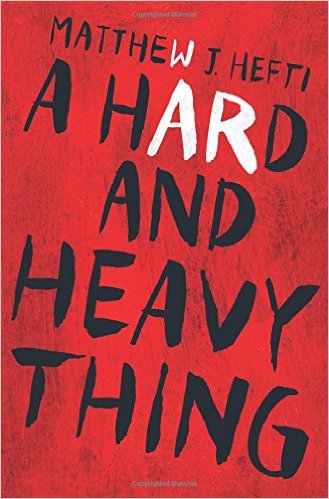
On Wisconsin: Matthew J. Hefti’s A Hard and Heavy Thing

A Hard and Heavy ThingIt’s been hard not to notice the recent flury of writing and art by Wisconsin veterans. Matthew J. Hefti’s novel A Hard and Heavy Thing, about two childhood friends from Wisconsin tested by battle in Iraq, arrived in January of this year. Kyle Larkin’s short stories “Minarets,” originally published on the Military Experience and the Arts website, and “The Night Before Christmas,” which I have read in manuscript, are two of the best war stories set in-country and focused on the experience of infantrymen I’ve read lately. Just last week, Larkin published a provocative essay on Military Experience and the Arts titled “Post Traumatic Narrative Disorder,” in which he argues that frustration, confusion, and ambivalence, not trauma, might better serve as the defining characteristic of veteran-redeployment stories. David Chrisinger, a veterans program administrator at the University of Wisconsin-Stevens Point, has published an eloquent collection of veteran-student narratives titled See Me For Who I Am: Stories of War and Coming Home and Chrisinger also keeps an affiliated website, also remarkable, called Stronger at the Broken Places: Student Veterans and the Long Walk Home from WarSinger-songwriter Jason Moon has been around longer—I first posted his excellent return-from-war lament “Trying to Find My Way Home” a couple of years ago—but I’ve only recently become acquainted with his organization Warrior Songs, which promotes music by and about veterans, and a recent radio interview sparkled with insights about his own struggle with PTSD and his efforts to help others so afflicted.

Chrisinger is not a veteran, but the works of the other Wisconsin residents I’ve named are born of extensive military experience. Hefti deployed twice to Iraq and twice to Afghanistan as an Explosives Ordnance Disposal technician, while Larkin and Moon deployed to Iraq as an infantryman and combat engineer, respectively, in the Wisconsin National Guard. Taken together, the Wisconsin warrior artists are mostly interested in the earthy world of fighting men and the crucible of combat, though the narratives collected by Chrisinger represent a broader range of service and viewpoints. Further judging from their work and comments, it appears, sadly, that war and deployment mostly stunned them and then sent them stumbling for years afterwards. A feeling of pride persists, though, an attitude that may be roughly summarized as, “Whatever else you might say, we answered the call, and now it’s our right or obligation to bear witness.” The perceptive Brian Castner, in his forward to See Me For Who I Am, writes that the veteran students anthologized there-in sometimes seem to wear “a sense of superiority on their sleeve,” and then immediately recalibrates the impression to note the authors’ honesty: “’Here are my warts, they say, where are yours?’” All the writing that I’ve seen, both fiction and memoir, also emits a strong sense of Wisconsin place: a tight-knit homogenous culture organized around loyalty to family and community and other sturdy, sensible values, but one in which residents cope with oppressive expectations by drinking heavily and lashing out at ones they love most. “Trying to find my way home,” indeed….

All these sentiments are on display in Hefti’s A Hard and Heavy Thing. The novel’s two protagonists, Levi and Nick, come-of-age in a small town near LaCrosse, where they are the singer and guitar player, respectively, in a popular punk band. Levi is coarse and Nick is sensitive, but both are well on their way to alienation, misanthropy, and alcoholism even before joining the Army in the wake of 9/11. Service in the active Army and then the Guard brings them a few years later to Iraq, where Nick’s truck is blasted by an IED that kills the other occupants and leaves Nick badly injured and pinned inside the wreckage. Levi rescues his friend and then fights off an insurgent counterattack, for which he is awarded a Silver Star. Levi holds himself responsible for the events leading to the IED strike, however, and thus the award he receives feels more like an albatross around his neck than a decoration. Several years later, Levi returns to Wisconsin, and now out of the Army, moves in with Nick and his wife Eris, a cool hometown beauty with trauma issues of her own. Nick, dealing with his wounds, and Eris, trying to stay sober, have crafted lives of rigid conformity and routine to keep themselves straight, at the cost of any youthful promise and happiness. The arrival of Levi, hell-bent on self-destruction and pining for Eris, who has repressed feelings for him, too, quickly undoes the fragile stability.

Much is of interest in A Hard and Heavy Thing. I found the battle scene, for example, exciting, especially since it reflected aspects of my own experience of being trapped in a truck rocked by explosion with casualties onboard. There’s not much of LaCrosse as a social milieu or the Army as a culture, but what Hefti portrays of LaCrosse’s townie bars and family folkways and Regular Army and National Guard distinctiveness intrigues. The novel is narrated in third-person, primarily through Levi’s point-of-view, and a series of bracketed asides reveal that the narrative’s author is Levi himself and the third-person story is an amalgamated love song to Nick/suicide note-mea culpa (adding to the literary razzle-dazzle is a minor character named Matthew Hefti). In neither the main narrative nor the bracketed asides, however, is Levi particularly subtle about what ails him nor observant about the world around him, in part because, by his own telling, he drinks heavily and continuously in the years after his discharge.

In two key aspects of his story, Levi doesn’t just recount his life’s struggle through the fog of alcohol, but is evasive and even disingenuous. Specifically, he is coy about revealing whether he really tried to commit suicide while in the Army (the perception that he did being the cause of his discharge) and whether, at novel’s end, he attempts to seduce or actually does seduce Eris. The ambiguous bedroom scene comes at the end of a long day in which Levi gets drunk with his father and berates him for being a stupid jerk (he’s already grievously insulted his mom and sister), gets even more drunk with Nick and brawls with him in a park, and then arrives at Nick’s house and gets Eris drunk, too. Though everyone he meets tells him he needs help, Levi doesn’t hold himself very accountable for his malaise or the turmoil he causes, even as his narrative constitutes a plea for understanding and forgiveness. Why should he? Lead singer of a popular band, the recipient of a Silver Star, the object of desire of the prettiest woman in town, he’s got what every guy wishes he had.

We’re meant to understand that these accomplishments don’t mean much to Levi, but an equally dominant impression is that they fuel his self-image as an iconoclastic rogue whose boorish behavior serves as a catalyst for making less honest people own up to truths they’d rather not face. Not especially curious or sympathetic about others, or even very forthright himself, Levi wields his disdain for people, places, and events like a badge of honor. In other words, his “sense of superiority” is in full-on collision with openness about his “warts,” and it’s not just for his family and friends that he’s a handful. Somewhere beyond a hot mess and trouble-with-a-capital-T, Levi’s tough to deal with for readers, too, who are going to have to decide whether they love him or hate him. The same is true of the very aptly titled A Hard and Heavy Thing as a whole. Does it reinstantiate the rapidly coalescing “trauma hero” motif in contemporary war literature, or is it a compelling, realistic, and self-aware narrative about young men who go to war and the damage that ensues? That’s a go-to question important, ethically and aesthetically, not just in Wisconsin, but everywhere, though more sharply defined by Badger State veteran writers and artists than elsewhere.

Matthew J. Hefti, A Hard and Heavy Thing. Tyrus Books, 2016.