Comp Lit, ComiCon, and Contemporary Iraqi War Fiction

At the American Comparative Literature Conference last week in Seattle, I participated in a seminar titled “What Does War Look Like? Visual Trauma and Representation.” Organized by Brenda Sanfilippo, a UC-Santa Cruz professor whose husband is a former paratrooper, the seminar explored the ethics and aesthetics of photographs, films, comic books, and graphic novels depicting war, conflict, and violence. My own contribution was a discussion of an Israeli theorist of photography named Ariella Azoulay. In The Civil Imagination: A Political Ontology of Photography (2012) and two previous works, Azoulay advances a concept called “the photographic situation.” Properly understood, “the photographic situation” expands our understanding of how we might interpret photographs, while suggesting that photography, as a visual medium, uniquely and importantly engages us with the modern world. Heady stuff for sure, but I’ll save the detailed explanation for another post.

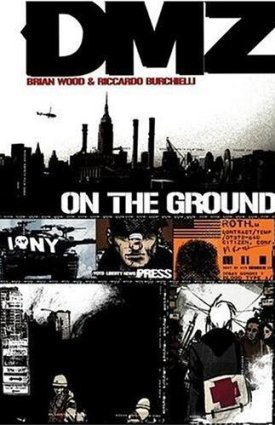
Most of the other presentations focused more specifically on actual photographs or other popular culture artifacts. Two presentations that especially interested me were on comic book series, one by Spencer Chalifour on the Hellblazer series and the other by Najwa Al-Tabaa on DMZ. I didn’t know either Hellblazer or DMZ, each of which address war in Iraq or a generalized state of emergency post-9/11, or much really about comic books at all, but am perfectly willing to consider that comic books, graphic novels, cartoons, and comic culture directly or indirectly channel the zeitgeist that envelops the hearts and minds of soldiers who fought in Iraq and Afghanistan. If we expand our definition of comic culture to include video gaming, role-playing games, and animated movies, I know it. Among a million other data points, I could point to Chris Kyle’s admission in American Sniper of his love for playing Command and Conquer, a shooter-killer video game, in-between real-world sniper missions in Iraq. He wasn’t the only soldier whose entertainment choices—more visual than textual—blurred and blended with his or her experience of combat.
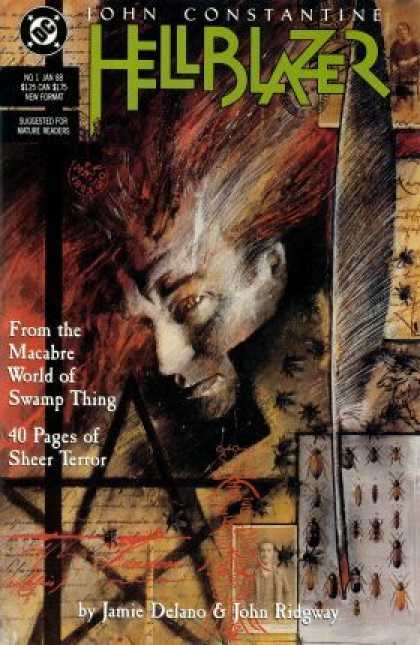
Hellblazer

DMZ

As it happened, next door to the ACLA conference, the Emerald City ComiCon, or “ECCC,” was taking place at the Washington State Convention Center. Needless to say, ECCC’s attendance dwarfed ACLA’s, and its attendees looked like they were having a hell of a lot more fun. The Convention Center grounds swelled with thousands of comic culture nuts, costumed to the hilt, gathered to celebrate their favorite comic book, animé, cosplay, sci-fi, fantasy, and role-playing-game works, heroes, authors, and creators. It was impossible not to be jazzed by the explosion of imaginative energy and cheerful sociability. There was a critical edge, too, of a sort, to ECCC, though quite unlike the super-serious tone of ACLA. “How to Make Beer Money with Your Comic or Zine,” ran one panel title that caught my eye. Noticeably absent from the ECCC agenda, however, were testosterone-soaked shooter games such as Call of Duty and action-adventure games such as Grand Theft Auto, the likes of which soldiers in Iraq and Afghanistan by the hundreds of thousands enjoyed. The ComiCon crowd is not shy about its fascination with darkness, perversity, evil, and violence, but it is a very stylized engagement—very girly and geeky and progressive–that eschews militarism and modern war, not that that’s a bad thing….
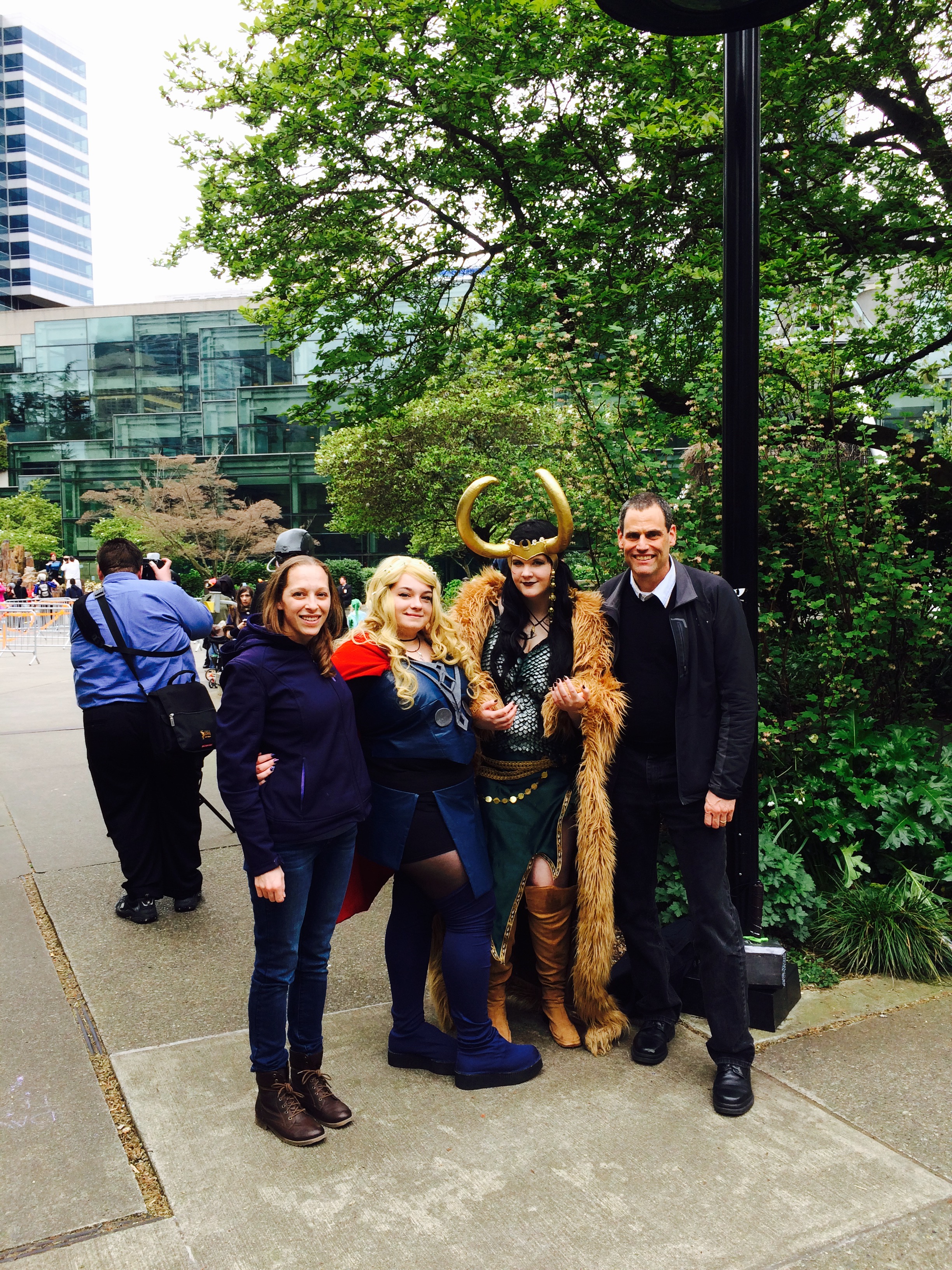
Fellow ACLA attendee and US Army major and Iraq veteran Deborah Dailey and me at Emerald City ComicCon, 2015.

Meanwhile, back at ACLA, I was delighted to listen to a paper titled “The Spread of the Camp: Power, Law, and the ‘New Democracy’” given by a University of Delaware professor named Ikram Masmoudi at a panel on contemporary Arabic literature. Masmoudi, as if in answer to a question I never asked because I didn’t know who the heck to query, catalogued a number of novels published in Iraq since 2003 that portrayed “Operation Iraqi Freedom” from the perspective of Iraqis. Specifically, Masmoudi examined representations in recent Iraqi fiction of American “camps,” or what we might call more often a FOB:  armed enclaves of foreigners that spread parasite-like across the country in the 2000s after the American invasion and, as these things happen, now are being replicated by Iraqi factions themselves as new-fangled communal living spaces organized to meet the demands of civil war.

Masmoudi’s presentation was very exciting to me. I know well the achievement of Hassan Blasim and am somewhat aware that Sinan Antoon’s The Corpse Washer and Ahmed Saadawi’s Frankenstein in Baghdad lurk out there waiting to be read. Now, thanks to Masmoudi, I know that other Iraqi fiction writers have been busy, too. A short list includes:

Madmen of Camp Bucca, by Shakir Noori
Green Zone, by Shakir Noori
The Freedom of the Bagged Heads, by Jassim al-Raseef
The American Granddaughter, by Inaam Kachachi
Beyond Love, by Hadiyya Hussein
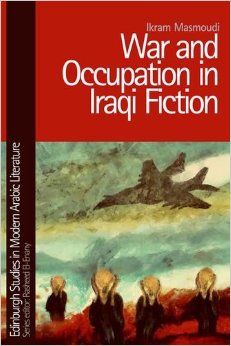
War and OccupationA translated version of The American Granddaughter exists and is available for purchase on-line, while Masmoudi herself is translating Beyond Love. The first three await translation from Arabic, but based on Masmoudi’s account of them at ACLA, they have much to offer American readers interested in seeing what the war looked like from the other side. Masmoudi also has an academic study coming out later this year called War and Occupation in Iraqi Fiction (Edinburgh University Press). Now who would have predicted a full-length scholarly study of Iraqi war fiction would appear in English before one examining war novels written by our own citizens? Let’s get busy, ye fellow American literature scholars.

Thanks to Brenda Sanfillipo and Najwa Al-Tabaa for organizing our ACLA seminar and inviting me to participate, and thanks to everyone who presented. I haven’t finished thinking about your papers yet.

A Yik Yak Prose-Poem, Found Near Fayetteville, NC, Outside Fort Bragg, Home of the 82nd Airborne Division

First Yak:

Appreciation Yak: Only thing I like about Fayetteville is all the eye candy. Military men are the best men. I’m in heaven every time I come home from school.

Subsequent Yaks:

I’m the opposite. They’re not really my type, but so many of them message me on dating sites (sad I know, but it’s convenient) since so many live around here.

Really… I feel like most military guys are super sweet, plus they stay in shape… Which is greattt.

My type is more like, k-pop boy band kinda guy lol.

Haha, they’re cool too.

I dunno, I guess something just kinda scares me about masculinity. At least you have plenty to be happy about in this city lol.

That’s about the only thing.…

Yep nothing else pretty much. Like I’m trying my hardest to think of something to do here other than shopping.

I’ve been watching Netflix like it’s my job.

Except when their PTSD does something bad to you.

That’s not always the case…. Can’t be afraid of people because of possibilities.

I can be afraid of anything I want, thank you very much. And PTSD scares me. I know from first hand.

First replier here, I agree the PTSD can be potentially very harmful for both in a relationship, but another reason for me is, I wouldn’t be able to handle the times he has to go off and fight.

That is such a good point! My friend’s boyfriend just got deployed for nine months.

Yeahh… loneliness, lots of worrying., and trust issues on my part (or his part, too). It wouldn’t really work out for me I think.

YikYak

The Wild, Wild East: Elliot Ackerman’s Green on Blue

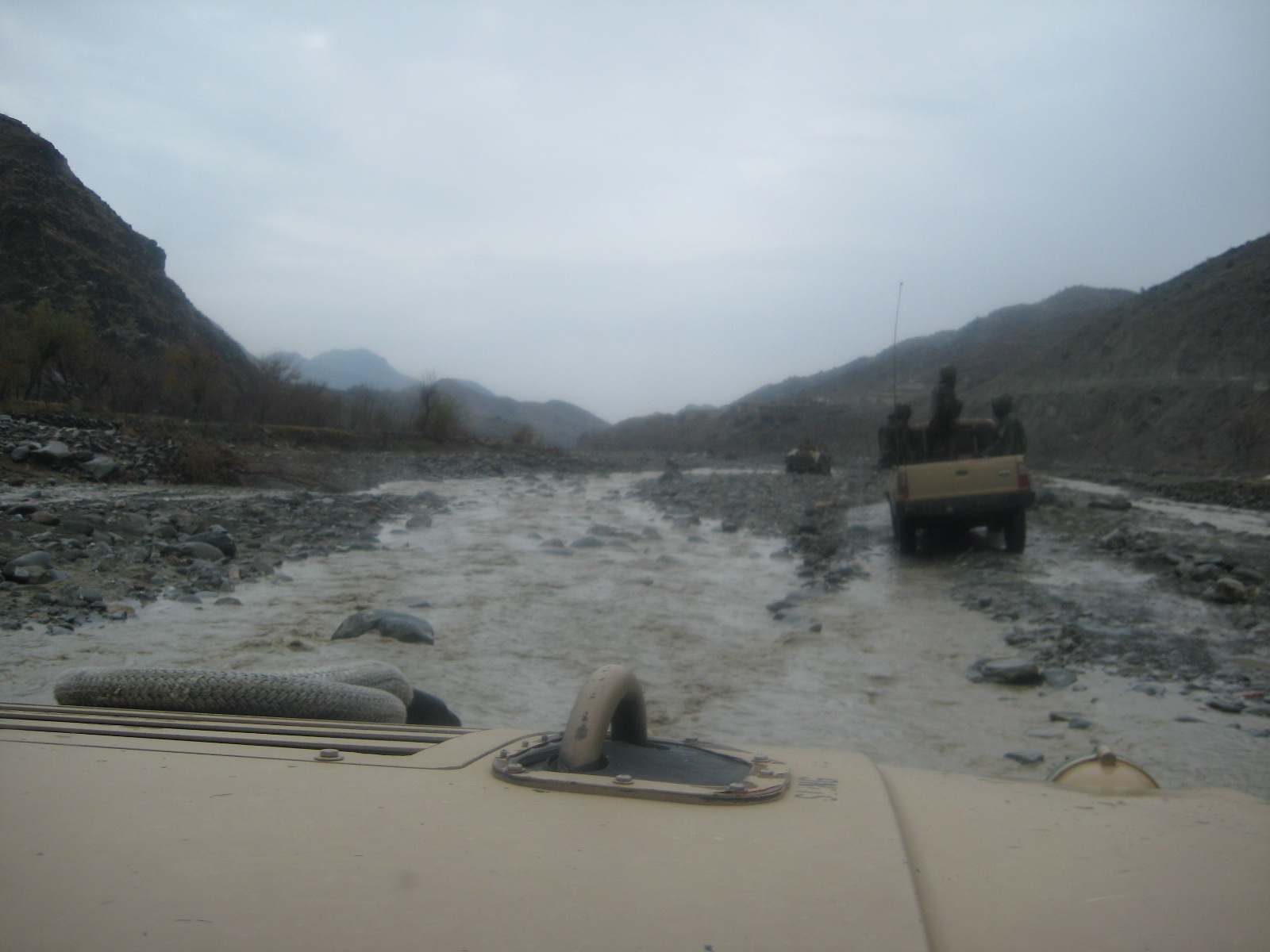
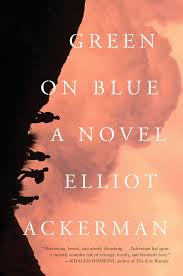
Green on BlueUSMC veteran Elliot Ackerman’s novel Green on Blue describes events that ring true to my own deployment experience in east Afghanistan. As an advisor who daily spent hours in the company of Afghans with loaded weapons, a “green on blue” incident—the murder of an American by an Afghan army member–was always a possibility. Ackerman’s descriptions of torturous truck journeys down narrow wadis and on the edge of cliffs brought back memories, too. As I’ve written elsewhere, for every story of combat in Afghanistan, I have five involving crazy vehicle escapades. The portraits of village shuras and life behind kalat walls in Green on Blue mirrored dozens of my own engagements with Afghans, often with me being the only American in a room full of turbaned and bearded Pashtun men.

For all that, as I began to read Green and Blue I was prepared to be disappointed, for I knew it might be hard not to quibble with Ackerman’s rendering of combat on Afghanistan’s eastern border with Pakistan. Happily, though, Ackerman gets all the above right and whole lot more, too. Through the audacity of its imaginative reach, as well as the acuity of its insight into what war in Afghanistan is about, Green on Blue significantly expands the borders of contemporary war literature.

The story’s protagonist is Aziz, a young Paktika province Pashtun who signs on as a member of a militia to revenge the death of his parents and the loss of a leg by a beloved older brother. The militia he joins is led by a ruthless, mysterious, and charismatic leader named Commander Sabir. Sabir, aided and funded by an American advisor named “Mr. Jack,” battle with a clan led by a wizened tribal warrior named Gazan for control of a middle-of-nowhere village called Gomal. Gomal has no tactical, political, or economic significance, but Aziz, Sabir, Gazan, and other Afghans in the story fight over it in an endless cycle of violence rooted in personal vendettas and dreams of war profiteering. As the novel unfolds, Ackerman drives home the point that war in Afghanistan, as it is experienced by actual Afghans, is only circumstantially concerned with the American intervention. Even the green on blue murder that gives the book its title is more a matter of circumstance than an act motivated by hatred and global politics.

Ackerman, who served as I did as an advisor, suggests that pashtunwali codes of nang and badal—honor and revenge, respectively—motivate Pashtuns to ceaselessly seek retribution against each other for wrongs inflicted on family members. And as if nang and badal weren’t fuel enough to keep the fighting going for another thousand years, Sabir and Gazan are well aware that their place in the bigger conflict keeps the local economy going. Not only do they stand to profit personally by siphoning off war-related lucre, their followers and their families’ livelihood depend on it, too. Commander Sabir explains:

All are caught up in this, he said. The question is whether you’ll be a victim or prosper in it. What justice is there for you if Gazan, who crippled your brother, prospers in peace with the Americans? What justice is there if we lose control of him and never build our outpost [in Gomal]? Yes, there will be peace for Gomal and Gazan, but us, what of us? The Americans will no longer need us. How do we survive then?

Every warzone has its characteristic look, feel, and pace, or at least our mental pictures of them do. I saw American Sniper this weekend and the many scenes portraying Marines and SEALs clearing houses in urban areas resonated in my mind as sui generis Iraq combat. I enjoyed Sebastian Junger’s movies Restrepo and Korengal very much, but their endless scenes of soldiers on outposts blasting away at remote hillsides with their machine guns didn’t do much for me in terms of characteristically representing war in Afghanistan (and I was responsible for a very similar outpost, Spera COP, in my own sector). For me, most vividly, Afghanistan entailed vehicle movements deep into remote districts and enclaves. Combat action was always possible and sometimes occurred, but the long drives there and back felt like something epic even when there was no battle. Ackerman’s descriptions of treacherous truck movements through Afghanistan wadis and mountains are frequent and rich:

We rushed past Shkin village, where cooking fires glowed inside the few mud-walled homes. We drove on towards the darkness of the southern mountains. At the base of the range, our convoy slowed to a crawl. Here the north road continued south, but we turned off and traversed the uneven ground to a wet ravine tha rolled out like a sloppy tongue. I watched Commander Sabir’s HiLux ease itself into the ravine’s mouth. It took the first bend and was swallowed by the mountain. Issaq’s HiLux followed and then, quickly, the rest of us. And our convoy disappeared.

The mountains closed around us. We drove through them like children playing in a window’s long curtains, chasing each other, all of us near, hidden in the fold….

But Green on Blue‘s most interesting feature is its first-person narration in Aziz’s voice. War novels such as Joydeep Roy-Bhattacharya’s The Watch and Michael Pitre’s Fives-and-Twenty-Fives admirably feature Afghan and Iraqi characters, but Ackerman’s feat surpasses those with its plausible and engaging rendering of a life experience as foreign as an American might imagine. Such acts of ventriloquism are not without risk; an easy criticism would be that rather than a feat of empathetic representation, it bespeaks an act of literary imperialism bankrupt in principle and doomed to fail practically. Ackerman could well have told the story from Mr. Jack’s point-of-view or presented the story as memoir, for surely many of its events are close to those he experienced or heard about on deployment. But we have already have portraits of American army captains in Afghanistan in The Watch and Aaron Gwyn’s Wynne’s War, so kudos to Ackerman for approaching his story from a different direction. Green on Blue sympathetically makes us privy to Aziz’s dawning awareness of just how complicated and bleak is the world he inhabits.

Ackerman renders Aziz’s voice simply and directly; rarely, for instance, does Aziz envelop his thoughts in Islamic platitudes or verses from the Koran. Instead, nang and badal and various Pashtun proverbs are the constants in his mental flow:

Once, in Sperkai, an older child had split my lip in a fight. When my father saw this, he took me to the boy’s home. Standing at their front gate, he demanded that the father take a lash to his son. The man refuse and father didn’t ask twice. He struct the man in the fact, splitting his lip just as his son had split mine. Before the man could get back to his feet my father left, the matter settled. On the walk home, my father spoke to me of badal, revenge. He told me that a man, a Pashtun man, had an obligation to take badal when his nang, his honor, was challenged. In Orgun, every stranger’s glance made me ache for a time when my father might return and take badal against those who’d pitied his sons.

Once in while, the register shifts into ‘murican-Injun’ picture-speech, as when Aziz says, “We turned wrenches until our shadows were made long by the late-afternoon sun.” And in a couple of places, Aziz sounds suspiciously like a young American MFA-trained author, as in a passage where he considers the feel of a pistol in his hand:

Its heft sunk into my palm, and I felt the permanence of its metal. A pistol’s purpose was the same as a rifle’s, but achieved it so casually. A rifle requires the whole body to fire it. Laying the buttstock into the shoulder, leaning against the recoil, concentrating on the sights, all of this draws from every part of the shooter. But with a pistol, just a flick of the wrist and a light twitch with an index finger delivers a hard bullet.

Overall, though, Aziz’s voice is fine. Ackerman lets the events of the story pull the narrative forward by having Aziz relate them without much stylistic overlay. His thoughts and actions seem motivated by what anyone would conceive of as plausible human nature, leavened by pashtunwali. When I arrived in Afghanistan, an American told me that working with Afghans was much like working with Americans, except that Afghans possessed two great fears that Americans didn’t worry as much about: one, they might die at any moment, and two, their families would be left destitute as a result. The statement served me well as I watched the Afghans I knew make choices and express their beliefs. Now, reading Green on Blue, the claims seems true also for Aziz, whose ability to choose is constrained everywhere by the proximity of death and poverty, and animated only by dreams of nang and badal. His war, like my war, was not just flying bullets and exploding mines, but complex local social dynamics characterized by grudge, worry, feud, and angling for advantage.

On the wadi road to Spera, Khost province, Afghanistan, January 2009.

Elliot Ackerman, Green on Blue. Scribner, 2015.

Life During Wartime, On the Other Side: Nadeem Aslam’s The Blind Man’s Garden

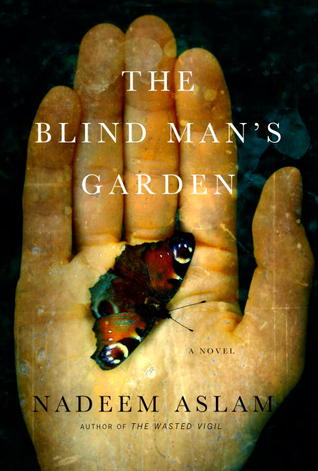
Blind Man's GardenEx-Marine Elliott Ackerman’s novel Green on Blue is out this week and I’m eager to read it. Green on Blue’s point-of-view—it’s told through the eyes of an Afghan young man who serves in a native militia attached to US forces in an eastern Afghanistan province—and Ackerman’s sympathy for the Afghans with whom he served jibes with my own experience. As an advisor in eastern Afghanistan, I dealt not just with official Afghan National Security Forces such as the Army, the National Police, and Border Police, but with various arbaki: quasi-official tribal fighting forces raised from local ranks of military-aged-males. Arbakis ranged from functionary gate-and-tower guards on US FOBs to kick-ass killers affiliated with Other Government Agencies such as the CIA. Generally they were considered more reliable and competent than ANSF units, within the scope of their missions. Their hatred of the Taliban and war-mongering bandits (or, “dooshmen”) seemingly sincere and battle-tested, the fact remained that an arbaki’s real loyalty was not to Americans but to the regional overseers–let us say “warlords”–who organized them and sold their services to US occupiers.

Green on Blue awaits, but by chance this winter I came across British-Pakistani author Nadeem Aslam’s novel The Blind Man’s Garden, which treats similar subjects. Published in 2013 to acclaim in England but little notice in the United States, The Blind Man’s Garden is actually Aslam’s second novel portraying conflict in contemporary Afghanistan through the eyes of natives; an earlier work, The Wasted Vigil, appeared in 2008. The protagonists of The Blind Man’s Garden are Mikal and Jeo, Pakistani brothers-by-adoption who cross into Afghanistan to render aid to civilians injured by American invaders after 9/11. Mikal and Jeo are not Taliban, but thoughtful young men eager to defend the integrity of a neighboring country bound by culture and religion. Their first night in Afghanistan, however, is a disaster: they are seized by mercenary arbaki fighters and then caught in conflict between competing arbaki, one of which is aligned with US Special Forces. Jeo is killed and Mikal is captured, has his trigger fingers amputated to prevent further resistance, and then ransomed to Americans by a profiteering warlord.

Scenes illustrating Mikal’s treatment by interrogators at Bagram Air Force Base are unstinting in their portrait of American brutality. If you don’t think Americans physically tortured suspected opponents in the early days of the war on terror, well, Aslam does. American propensity for sadistic violence, to say nothing of their inclination to wage their own version of jihadist war on Islamic nations, is a given in the minds of Aslam’s Pakistani characters. Aslam-the-author’s take is more complicated. His portrait of the Koran-saturated belief systems and ways of life of contemporary Pakistanis is a badly-needed detailed representation of a world Americans basically spent a decade fighting without knowing much about. For those interested, The Blind Man’s Garden offers a nuanced portrait of the conflicting attitudes toward the West held by those who waged war against us and those whom the wars affected. Many scenes and passages in The Blind Man’s Garden portray a rich, venerable culture, wise and deeply connected to nature, education, faith, family, and history. The Pakistani folkways and circuitries of thought that Aslam holds up for admiration make American culture typified by Burger King and TMZ appear as superficial as it is often accused of being.

But Aslam also suggests that Pakistan is trapped, to the point of poison and doom, by its deep entanglement with a religion that drives devout believers not just to jihad against the West but to conflict with each other. A passage seen from the perspective of Kyra, a Pakistani military officer who resigns his commission rather than be a part of an organization tainted by its support of the West, illustrates. Here Kyra is gazing at a traditional non-militant religious academy he intends to turn into a madrassa he will use to transform young men into jihadists:

Nine-Eleven. Everything about it is a lie, he is beginning to believe. A conspiracy. Flying large aircraft at low altitudes in an urban sky is not a simple thing. There had to be something manipulating air traffic control. There had to be somebody who switched off the warning system for the Pentagon. From what he has read and heard it seems that the air force did not scramble for more than an hour. Kyra is a military man so he knows about such basic things. It was all staged, to invent an excuse to begin invading Muslim lands one by one.

He looks toward the arch above Ardent Spirit’s front gate. It was removed from the entrance of the original building and brought here when the school changed premises. When Rohan [the school’s founder and Mikal and Jeo’s father] and his wife founded it, the arch had read “Education is the basis of law and order.” Soon the word “Islamic” was added before “Education” by Rohan himself, apparently against his wife’s wishes. Over the years it has been amended further, going from “Islamic education is the basis of law and order” to “Islam is the basis of law” and then to “Islam is the purpose of life,” while these days it says “Islam is the purpose of life and death.”

Under Ahmed the Moth [another school supervisor], Ardent Spirit had developed links with Pakistan’s intelligence agency, the ISI. Pupils were selected to be trained in combat at jihadi camps run by the ISI, and ultimately sent to carry out covert operations in Kashmir…. Kyra could have maintained the connection but he feels nothing but revulsion at the army and the ISI for abandoning Afghanistan. The Arden Spirit pupils now belong to him alone and through them he’ll set his plans in motion, molding them to be warrior saints, brilliant in deceit against the West and its sympathizers here at home.

The business about the changing sign hints at humor, and in another passage a character cracks that the easiest way to break up an anti-US protest in Pakistan is to announce that US visas are being handed out around the corner. But levity is in serious short supply elsewhere in The Blind Man’s Garden; Aslam calls contemporary Pakistan a “heartbroken and sorrowful land.” An austere dignity is the most any Pakistani can hope for in the face of Islamic extremism inspired by a hatred, fear, and envy of the West that tears apart families, divides generations, and inflicts grievous harm on good people. But even moderate Islamic belief in the novel’s view makes many adherents—particularly women and anyone who has gotten a sniff of the West’s cultural diversity and opportunities—miserable. Mikal’s chief Bagram torturer is hardly the most heinous character in The Blind Man’s Garden, and neither is a Special Forces captain who, late in the novel, crosses into Pakistan on a one-man solo mission to find and kill Mikal after his release from American custody. The Americans in The Blind Man’s Garden aren’t drawn in enough detail to be more than minor characters, but that’s OK. The novel’s excellence lies in its depiction of a Pakistani society that appears, from the outside-looking-in, to despise itself and to be making its members terribly unhappy. The title refers to a garden dear to Rohan, the original peace-loving patriarch of the Ardent Spirit school. Rohan is blinded midway through the novel, and his disability accelerates his marginalization from contemporary mainstream Pakistani life and thought. Rohan once dreamed of recouping the glorious years of Islamic ascendency, when Islam, dominant from India to Spain, made other belief systems look weak and tawdry in comparison to the majesty of its purpose and achievement. The garden now grows neglected and Rohan is helpless to prevent its decline or enjoy what beauty it still possesses.

The novel goes slightly awry in its last third when Mikal joins with the Special Forces officer in a desperate effort to save the officer’s life, played out in barren desert and mountain landscapes. The saga is a little too contrived and dependent on coincidence, and reads like something out of Cormac McCarthy–not a bad thing sometimes but here less interesting than The Blind Man’s Garden‘s deeply-textured portraits of Pakistan social life. The saga’s not really even needed, frankly,  because by the point it begins in the novel Aslam’s work–humanizing America’s enemies–has already long been done and done well.

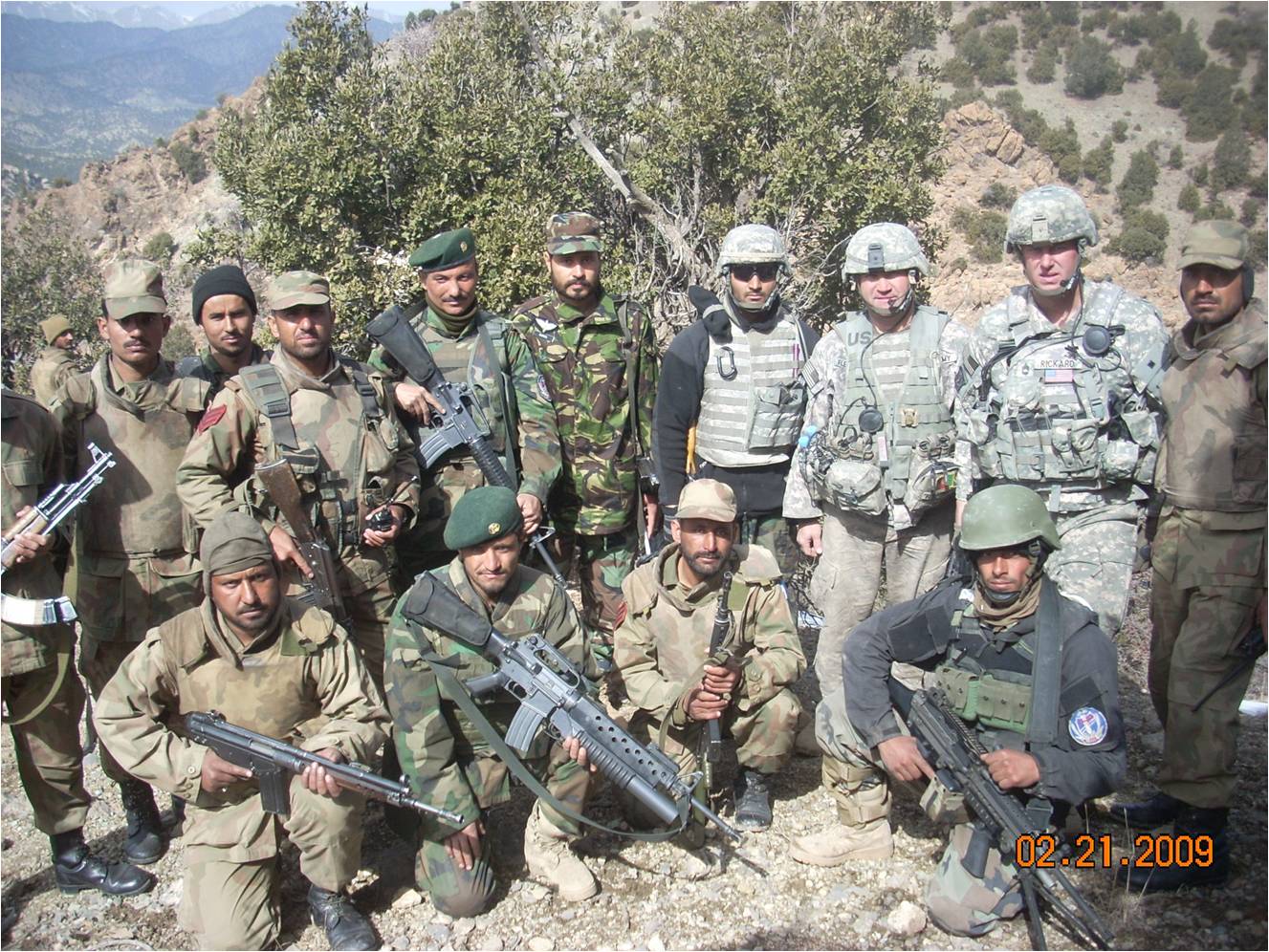
US, Afghan, and Pakistan forces on the Afghanistan-Pakistan border, Khost Province, 2009

A Los Angeles Review of Books review of The Blind Man’s Garden here.

Nadeem Aslam, The Blind Man’s Garden. Knopf, 2013.

Roy Scranton, Phil Klay, and the American Trauma Hero

Roy Scranton set the war writer community abuzz this week when the Los Angeles Review of Books published his essay  “The Trauma Hero: From Wilfred Owen to “Redeployment” to American Sniper, a takedown of the ethos and practice of contemporary war narrative. As Scranton’s co-editor of the seminal Fire and Forget anthology, Matt Gallagher, put it on Twitter: “Well @RoyScranton goes full provocative here….” Those who know Scranton understand cantankerous is often the way he rolls. Fiercely proud of his iconoclast status, he is more than capable of biting hands that feed him and precipitating his dismissal from clubs that might let him join. The club, in this case, though, is one he helped form: the third cohort of contemporary war writers, with those who published prior to 2011 being the first, the bumper crop of circa-2012 fiction authors the second, and the third being the NYC-and-MFA crowd–Phil Klay, Andrew Slater, Mariette Kalinowski, and Brian Van Reet among them–selected by Scranton and Gallagher and offered to the public in Fire and Forget. Scranton, with Gallagher, conjured that third wave into being, but now he seems to want to be the agent of its dismantling. “First I’m going to make it, then I’m going to shake it ’til it falls apart,” as the lyrics to a great song go.

Some of us like Scranton all the more for who he is, but, skipping past inside-war-writer-circle dramatics, what about the charges Scranton levies against war narrative? Is the general import of war literature from the World War I onward to glamorize “trauma heroes”—young (almost always male) veterans who seem a little bit too satisfied with their status as brutalized survivors of war? Do such representations really distract us from profound consideration of the political and moral costs of war, not to forget the injuries and deaths we have inflicted on our enemies and noncombatants? Is that what American Sniper does? And is that what Phil Klay’s “Redeployment” does, too? Really? Phil Klay either no more aware or just as craven as the makers of American Sniper?

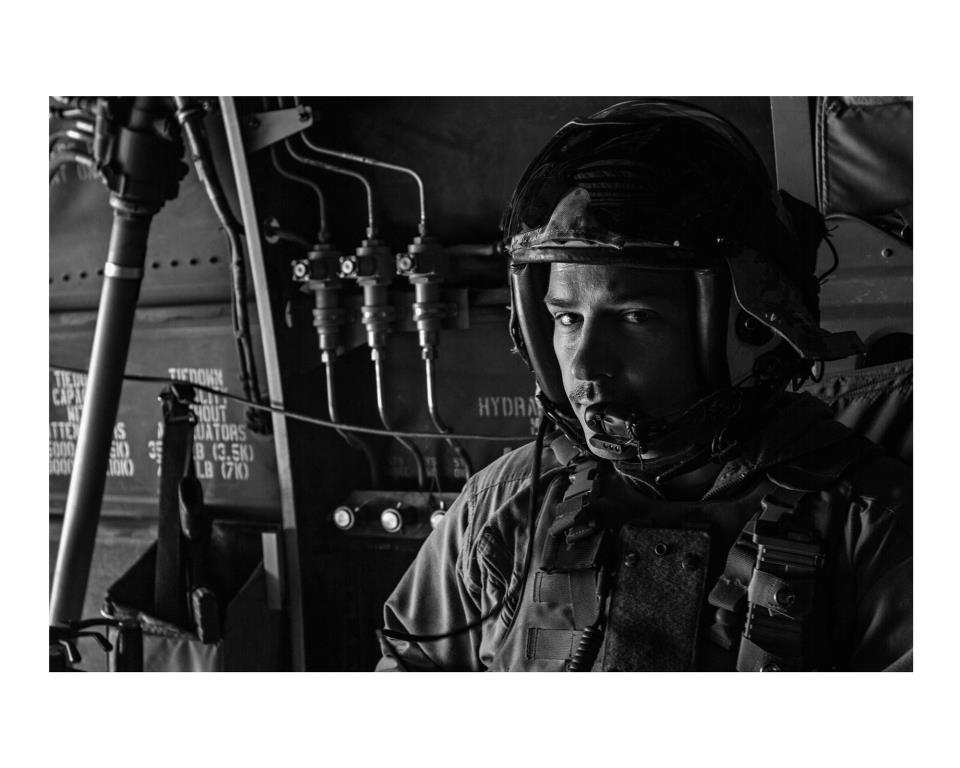
Is war lit all about the angst of young white males?  Photo of a helicopter crewman by Bill Putnam.
Is war lit all about the angst of young white males? Photo by Bill Putnam.

I haven’t seen American Sniper yet, so I’ll forego commenting on it and focus my comments on Redeployment, the National Book Award winner for 2014. Klay’s collection of short stories are not above criticism, a bit of which was brought forth in the Twitter book chat I participated in this past week. No stories in Redeployment are told through the eyes of Iraqis, and only “Money as a Weapons System” features Iraqi characters. But “Money”–my favorite story in the collection–is a funny satire of US war aims and execution, as well as the obliviousness of the American people and government, so Klay can’t be accused of totally ignoring “the bigger picture.” A certain male-veteran-voice perspective is privileged in Redeployment, and many of the tales revolve around vets who participated in killing whose brooding thoughts about the matter are now being aesthetically rendered for our perusal. We gape at the inner devastation wrought on Rodriguez, a hardened killer who hates Iraqis, in “Prayer in the Furnace” and we ache or are even amused by the narrator of “Ten Kliks South,” a naive artillerymen obsessed with measuring his culpability for the deaths inflicted by rounds he helps fire.

The beauty of the stories is their nuance in playing with the details of the “myth of the trauma-hero,” not their crushing conformity to a mold. And overall, I’ll suggest Klay interrogates the myth as much as he might unwittingly instantiate it. Or, more specifically, stories such as “After Action Report” and “War Stories” dramatize and problematize what it means to live in the midst of the myth’s creation during war and afterwards. In “After Action Report,” for example, the narrator claims credit for a unit’s first kill in Iraq as a favor to the actual killer who doesn’t want to live with the stigma. In recounting how the narrator is newly perceived by those who don’t know better, the story portrays ironically the processes and implications of being identified as a combat killer, a pressure so real that even the narrator begins to internalize it. In “War Stories,” it’s not that war-damaged veterans especially want to be seen as traumatized heroes, it’s that civilians push them into playing the role, a role that proves irresistible, especially when there’s a chance that doing so might persuade pretty young women to join them in bed–a dynamic that leaves Jessie, a war-wounded woman veteran in the tale, in an awkward limbo as she watches swirls of erotic energy shape the actions and attitudes of her male vet friends. In the title story, the one at which Scranton aims most of his ire, I see a complexity that Scranton does not. The narrator doesn’t facilely privilege the killing of his own dog, or an Iraqi dog, over the deaths of actual Iraqis. Instead, for me, the story recounts the first-person narrator’s growing apprehension that his moral balance is out-of-skew, with Klay the author asking readers to use their distance from the narrator to understand their own ethical imbalances and blind spots.

But Scranton’s a smart guy, and he wouldn’t say what he did without being on to something. His concern certainly has more to do with how Klay’s stories are conveniently understood by undiscriminating readers than with the tales themselves. And other writers have told me that they do struggle with writing stories that don’t feature stereotypical war-damaged vets. I’ve read a draft of Scranton’s novel War Porn and know how hard he has tried to avoid enveloping his war vet protagonist in sentimental shrouds of pity and dark romance. But the trauma hero myth is insidious, by its own internal logic—how dark would you have to paint a vet to make him or her beyond sympathy? Brian Van Reet couldn’t have made the protagonists of his Fire and Forget story “Big Two-Hearted Hunting Creek” any more despicable, and I love them to death, go figure. Same with Hassan Blasim’s most memorable characters. The only solution, I’m thinking, is to portray vets as stupid unlikeable jerks who were jack-asses while deployed and tedious pains to be around afterwards. Lauren, the traumatized protagonist of Cara Hoffman’s Be Safe I Love You is the fictional character I’ve seen who comes the closest to this “ideal,” though as I discuss in my Time Now review, I’m not sure if that is by Hoffman’s design or not. I’m also thinking that someone will soon write a book about Iraq and Afghanistan vets that portrays them as complete buffoons–perhaps the only way the excesses of self-seriousness might be exposed, ridiculed, and deflated to sensible, manageable proportions. I’m having  lunch with Scranton later this week and look forward to talking these things out. And I plan to watch American Sniper soon, too.

Grillin’ Chillin’ and Killin’ with the Military 1%: Aaron Gwyn’s Wynne’s War

Lea Carpenter’s Eleven Days and Aaron Gwyn’s Wynne’s War are the first two contemporary novels to portray United States Special Operations forces at work in the post-9/11 wars. As it happens, both are set in Afghanistan: Carpenter’s featuring a Navy SEAL who goes missing-in-action on a mission that takes place the same night another SEAL team executes the raid that resulted in Osama Bin Laden’s death, and Gwyn’s describing a rogue Army Green Beret “Operational Detachment Alpha” (ODA) mission on horseback across the Afghanistan-Pakistan border. Carpenter’s novel is not without interest, but concerns primarily the angst of the missing SEAL’s mother while she waits to learn her son’s fate, while Gwyn offers extensive portraits of the ODA on its outpost in Nuristan province and outside-the-wire in search of a Taliban stronghold. Saving discussion of Eleven Days for another post, I’ll claim here that Wynne’s War effectively dramatizes many of the strengths, weaknesses, and persistent questions surrounding Special Operations in Afghanistan and Iraq, while also suggesting the possibilities of fiction for bringing these issues to light.

The role Special Operations played in Iraq and Afghanistan is, we know, “hotly debated,” to use a cliché of student writing. Never fully acknowledged while the wars were raging, a conglomeration of elite units—Green Berets, Army Rangers, SEALs, Delta Force, CIA (or as we were taught to call them “Other Government Agencies” (OGAs)) nightly executed countless raids to seize “High Value Targets” for detention and interrogation. Operating primarily on the basis of signal intercepts of insurgent telephone calls, the raids may well have broken the backs of terrorist organizations such as Al Qaeda, the Taliban, and the Haqqani network. In other words, they saved American and coalition lives on the ground in Iraq and Afghanistan and forestalled terrorist attacks in America and the West. I believe that, but it’s not exactly clear that it is the case, especially since the wars in Iraq and Afghanistan can hardly said to have been “won.” Well documented in books such as Jeremy Scahill’s The Dirty Wars (2013) are the negative aspects of darkside operations: Lack of coordination with conventional units. Incongruence with stated counterinsurgency and nation-building goals. Faulty execution that resulted in deaths of innocent noncombatants and seizure of individuals friendly to American forces and the legitimate governments of Iraq and Afghanistan. Divergence of important resources (particularly intelligence and helicopter assets) from mainline units. A general lack of accountability all-around. Speaking from my own experience in Khost province, Afghanistan, I frequently had to do damage control, with limited information, with my Afghan Army partners the morning after nighttime operators laid waste to a kalat, seized an important local official, or shot up Afghan security forces by mistake. These were not once-in-a-while occurrences, either; as Scahill explains, by fall of 2009, General Stanley McChrystal had ordered Joint Special Operations Command—the organization to which special operators of all services reported–to execute at least 90 raids a month in Afghanistan alone.

Whether effective or not, the mystique of Special Operations soldiers and missions dominates popular fascination with the war and, indeed, operates powerfully within the military imagination, too. Every soldier worth his or her salt wonders about the grueling selection procedures and the extensive training programs that turn work-a-day soldiers into Rambo-like purveyors of destruction. Within the range of military units, special forces operate most free of the petty rules and restrictions that make life in conventional units miserable—a freedom flaunted by special operators who appeared to some to spend most of their days pumping iron, firing exotic weapons, and growing beards while line dogs pulled tower guard and rode around in the back of armored vehicles waiting to hit IEDs. Or, as portrayed in Zero-Dark-Thirty, SEAL Team 6—the elite of the elite in the hierarchy of special units, according to their own publicity, at least—barbecued steaks and played horseshoes while waiting for the night’s mission to come down from higher. Grillin’ and chillin’, in other words, and then some killin’.

Gwyn gets a lot of these dynamics into Wynne’s War, even a Green Beret who cooks the best hamburger the protagonist, Elijah Russell, is said to have ever eaten. Russell is an Oklahoman cowboy who gains notoriety by saving a horse caught in a crossfire in Iraq between his Ranger unit and local bad guys. Now famous for his horsemanship under fire, Russell and his best friend Wheels are detached from the Rangers and assigned to an ODA in Afghanistan commanded by a charismatic and ferocious combat leader named Captain Carson Wynne. A two-time high school state champion football quarterback, a Princeton graduate, and a successful Wall Street hedge fund trader before giving it up to become a man-o-war (horse pun alert), Wynne has established what is in all respects an independent command on the Afghanistan-Pakistan border. Occupy that, brothers and sisters! Barely responsive to his Green Beret bosses, Wynne plans and executes missions as he sees fit, one of which now includes using horses to discover a Taliban lair rumored to house captured American soldiers, stolen Afghan lucre, or both. Snapping his fingers to obtain in a second what a conventional unit full-bird colonel couldn’t requisition in a million years, Captain Wynne has twenty American riding horses, four mules, and two soldier-horsemen—Russell and his battle buddy Wheels—serving in another theater flown in to help execute the mission. The rationale is that horses give Wynne’s ODA quieter, more dependable mobility in tough mountainous terrain than helicopters or vehicles—which is kinda sorta true, but just the kind of quixotic (second horse pun) approach that gives Special Forces a reputation, not for being the best-and-brightest warriors, but for being crackpot dreamers of enormously expensive and non-replicable ways of waging war.

Gwyn does very well by his material. Too savvy—he’s a college professor—to write pulp fiction, Gwyn instead pays homage to the real world mission in which Green Berets rode into battle on horses described in Doug Stanton’s Horse Soldiers and literary antecedents such as Cormac McCarthy’s All the Pretty Horses and Blood Meridian. No one could miss the parallels to Heart of Darkness and Apocalypse Now, either, with Captain Wynne playing the role of Kurtz and Russell that of the half-entranced/half-horrified witness to Wynne’s half-genius/half-madness. Russell, a junior enlisted soldier, is smart and self-assured, but still young and not privy to the insider culture of the older Green Berets, nor does he have access to all the mission information they possess, so he must make sense of things as they come. A scene in which the Green Beret outpost and its adjoining FOB come under rocket fire illustrates (and brings back memories):

It had taken a while, but the hostiles had finally found positions from which they could range in their mortars, their rockets, and Russell emerged from his bunker into a bedlam of scrambling soldiers and smoke. He followed three men down an earthen trench toward the command bunker, which he saw, once he came onto the packed ground at the center of camp, lay in a smoldering rubble of sandbags and concrete and aluminum sheeting. A young soldier sat in the snow with his rifle across his lap like a child’s toy, head shaved, eyes wet, saying “You got no idea. You got no idea. “ There were men already searching the debris for survivors, and Russell fell in and began to heft bits of broken rock toward a pile that was forming several yards from where the bunker had stood. They’d just uncovered the first body when a man in his observation post called “Incoming!” and they dove behind what cover they could find and waited for oblivion.

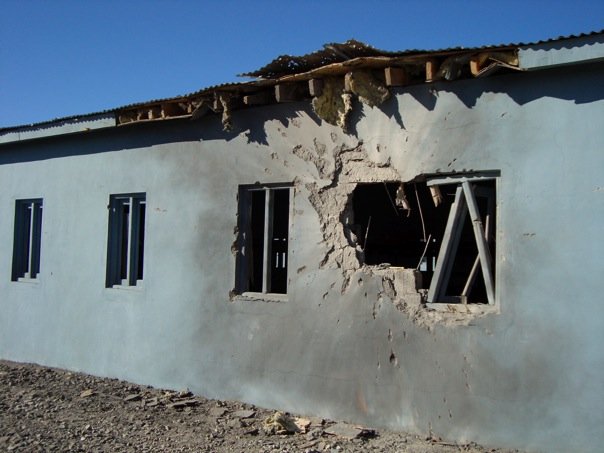
A Camp Clark "B-hut" after being hit by a 107mm rocket fired by insurgents in Khost province, Afghanistan, 2008.
A Camp Clark “B-hut” after being hit by a 107mm rocket fired by insurgents in Khost province, Afghanistan, 2008.

Scenes in which Russell observes friendly Afghans decapitate an informer and in which Russell first sees combat with the Green Berets are equally vivid and well-described. So too is a romance Russell sparks up with a pretty medic—that she would give herself to him and not one of the brawny older warriors on the COP stretches things a little, but their junior enlisted youthful chemistry seems right once Russell’s expert horsemanship is acknowledged. But Wynne’s War really accelerates and excels once Captain Wynne, Russell, and the other Green Berets leave their compound in search of the Taliban stronghold:

They rode out of camp in the blue light before dawn, thirteen riders, four mules, six riderless horses bringing up the rear in the remuda. It was the first week of March, and there was still snow in the shadows of the trees and in the stony draws on the northern slopes, but by noon the air was warm enough for shirtsleeves. The horses stepped briskly, vapor rising from their nostrils like steam from a grate….

From this point, about halfway through the novel, to the end, the narrative is a pure rush of story-telling bravado, energy, and skill. Wynne’s War is too recently published to give away plot details here, but nothing I’ve read in the contemporary war lit canon matches the last 120 pages of Gwyn’s novel in terms of harrowing escapades, mounting suspense, interesting developments, and tense human drama. The novel’s preoccupation with horses fades, and the real action becomes a series of running fire fights with wily Taliban foes, battles that generate conflict among the Green Berets and increasing moral uneasiness on the part of Russell. Gwyn’s story-telling snap, crackle, and pop supersedes niggling about military details—it’s inconceivable that the Green Berets wouldn’t have “TACSAT” radios and satellite phones to help them out of their jams, for example—and war story and cowboy movie clichés. As a reading experience Wynne’s War goes where no contemporary war novel has yet ventured: extended scenes of soldiers fighting for their lives, each scene placed in order of increasing intensity culminating in the novel’s climactic gun battle.

Wynne’s War may not be the greatest story ever told, but it is way beyond hokum and malarkey. It confounds literary representation of Iraq and Afghanistan in much the same way that Special Operators themselves confounded thinking about how we went about winning the real wars on the ground. Though Gwyn is ultimately skeptical of Captain Wynne’s mad mission, the author’s writing chops enroute to the novel’s denouement render his Green Beret and Ranger characters fascinating and their story enthralling. Gwyn has figured out that war fiction might, just might, contain exciting events compellingly described. More brooding and contemplative war literature will have to account for the energetic new arrival on the scene.

Wynne’s War by Aaron Gwyn. Houghton-Mifflin, 2014

War Lit 2014: Where It’s Been, Where It’s Going

On Christmas, the New York Times published two articles on contemporary war literature by Michiko Kakutani, the paper’s premier book critic. One article, titled “A Reading List of Modern War Stories,” lists 38 books about Iraq and Afghanistan that Kakutani claims are most worth attention. In the second article, titled “Human Costs of the Forever War, Enough to Fill a Bookshelf,” Kakutani surveys a number of 21st-century war texts, measures their concerns, and generally celebrates their achievement. Though Kakutani’s focus encompasses war memoir and reportage in addition to fiction and poetry, much of the article and most of the accompanying pictures are devoted to authors of literature. The way these things go, Kakutani’s articles will constitute near-definitive pronouncements about post-9/11 war literature, so let’s chitter-chat about them now.

Darul Aman Palace, Kabul, Afghanistan, as seen from a US Army compound.

Everything on the booklist is worthy, but even so it is possible to quibble and argue—that’s the nature of such lists, right? For starters, why 38 books and not 37 or 39, let alone a round number like 35 or 40? The number seems both arbitrary and precisely exact at the same time, as if Kakutani either grew tired of reading at 38 or determined that no way her 39th favorite book about the wars was going to make the final cut. In any case, the list tilts to the recently published or soon-to-be-published, with only occasional citations of books published before 2010. Curiously, her list includes no poetry, specifically no Here, Bullet or Phantom Noise by Brian Turner, the first of which in my opinion is the most important contemporary war lit text of them all and Phantom Noise remaining the second best book of post-9/11 war poetry going (Here, Bullet being first). Kakutani does include Turner’s memoir My Life as a Foreign Country, no argument there, but overall her list includes seven first-hand accounts of service in Iraq and only one of Afghanistan, and the novels on Kakutani’s list about Afghanistan include three that have not even been released yet—Elliot Ackerman’s Green on Blue, John Renehan’s The Valley, Ross Ritchell’s The Knife. Omitted, though, is Joydeep Roy-Bhattacharya’s 2012 The Watch, which presciently portrayed life on a remote Afghanistan combat outpost, as does a novel that makes Kakutani’s list, Paulo Giordano’s The Human Body, an Italian work only recently published in America. Another Kakutani choice, Lea Carpenter’s novel Eleven Days, portrays Special Operations forces, as do Ackerman’s and Ritchell’s novels, thus contributing to the glamorizing of dark-side operators at the expense of line soldiers who constituted 95% of the deployed military. Finally, Kakutani’s list includes Hassan Blasim’s The Corpse Exhibition, which is great, but as several Times and Twitter commenters have noted, the list is otherwise deficient of Iraq, Afghanistan, or dark-skinned American perspectives.

If Kakutani’s list is idiosyncratic–probably more a compendium of suggestions from friends than the product of a ruthless critical regimen–her essay is excellent—generous, insightful, and eloquent. Kakutani succinctly itemizes the “particularities of the conflicts in Afghanistan and Iraq” as “changes in technology, the increased presence of female soldiers and, most importantly, the all-volunteer military, which has opened a chasm between soldiers (‘the other 1 percent’) and civilians.” By “changes in technology,” we might think of new weaponry such as IEDs, drones, and armored vehicles. Or means of surveillance, such as the pervasive use of signal intercepts by the intelligence community. Or, the communication platforms such as Skype and social media that have allowed deployed service members to remain much more in touch with the homefront than ever before. In regard to the depiction of these things in war fiction, none have been portrayed all that well or extensively and the journalistic coverage hasn’t been so good either, which means there’s a lot of opportunity for future war authors to help us understand them better. The “increased presence of female soldiers” on the battlefield has certainly been a salient component of contemporary war, though, oddly enough, not so much in the fiction Kakutani directs us toward. She also might have said a bit more about the “increased presence” of women in the formerly male-dominated preserve of war-writing itself. Siobhan Fallon, Kayla Williams, Elizabeth Samet, and Lea Carpenter are on Kakutani’s list, and they, along with Katey Schultz, Roxana Robinson, Helen Benedict, Hilary Plum, Cara Hoffman, Mariette Kalinowski, and others, constitute a significant new cultural phenomenon that complements the shifting nature of military demographics. But Kakutani is right on the money by asserting that the all-volunteer military and the civil-military chasm have been huge abiding concerns in the American war effort and the literature written about it. The issue goes way beyond simple fretting over how to thank soldiers for their service or worrying about PTSD, though those are important subjects oft written on. As Stacey Peebles argues in Welcome to the Suck, the story of every contemporary soldier saga is that of internal battle between competing senses of soldierly and civilian identity: How does being a soldier—killer, cog-in-the-machine, hero, patriot—jibe with the softer and more fluid civilian values and characteristics one brings into the military, never fully abandons while in, and then attempts to reclaim when out? The ailment Peebles diagnosed in a small number of works in 2011 is the essential tribulation defining almost every title in Kakutani’s literary corpus.

A section titled “Capturing a War’s Rhythm” is full of claims central to war literature. For instance, Kakutani explores the attraction of the short story for contemporary war writers. She writes, “Short stories, authors have realized, are an ideal form for capturing the discontinuities of these wars, their episodic quality, and so are longer, fragmented narratives that jump-cut from scene to scene.” She then traces a geneology of war lit that starts with the death-soaked collapse of idealism of World War I poets, the black humor of World War II authors Joseph Heller and Kurt Vonnegut, the charred stoicism of Michael Herr and the magical realism of Tim O’Brien, Vietnam-era authors read by everyone writing war lit today, and finds its modern voice in Iraq blog-writing by Colby Buzzell and Matt Gallagher. Kakutani also grounds the modern war lit boom in the MFA program and veterans support workshop scenes—both being fruitful incubators for storytelling talent. Finally, she ponders whether war fiction has adequately responded to larger political and ethical questions. How have authors represented Afghan and Iraqi “others” in a new global era marked by respect for diversity and concern for “nation-building,” impulses that have been met with implacable contempt by our opponents and soiled by our own nation’s new found regard for torture? These are all subjects and ideas I’ve toyed with in Time Now, but Kakutani has brought an outsider’s eye to the body of evidence and incisively and concisely articulated its importance.

Kakutani’s list and essay join two other great surveys of contemporary war literature published in 2014: George Packers’ New Yorker article “Home Fires: How Soldiers Write Their Wars” and Brian Castner’s Los Angeles Review of Books essay “Afghanistan: A Stage Without a Play.” Read them all, again, bookmark them on your computer, and let’s use them as guides as we consider the war fiction, poetry, memoir, and reportage 2015 will bring us.

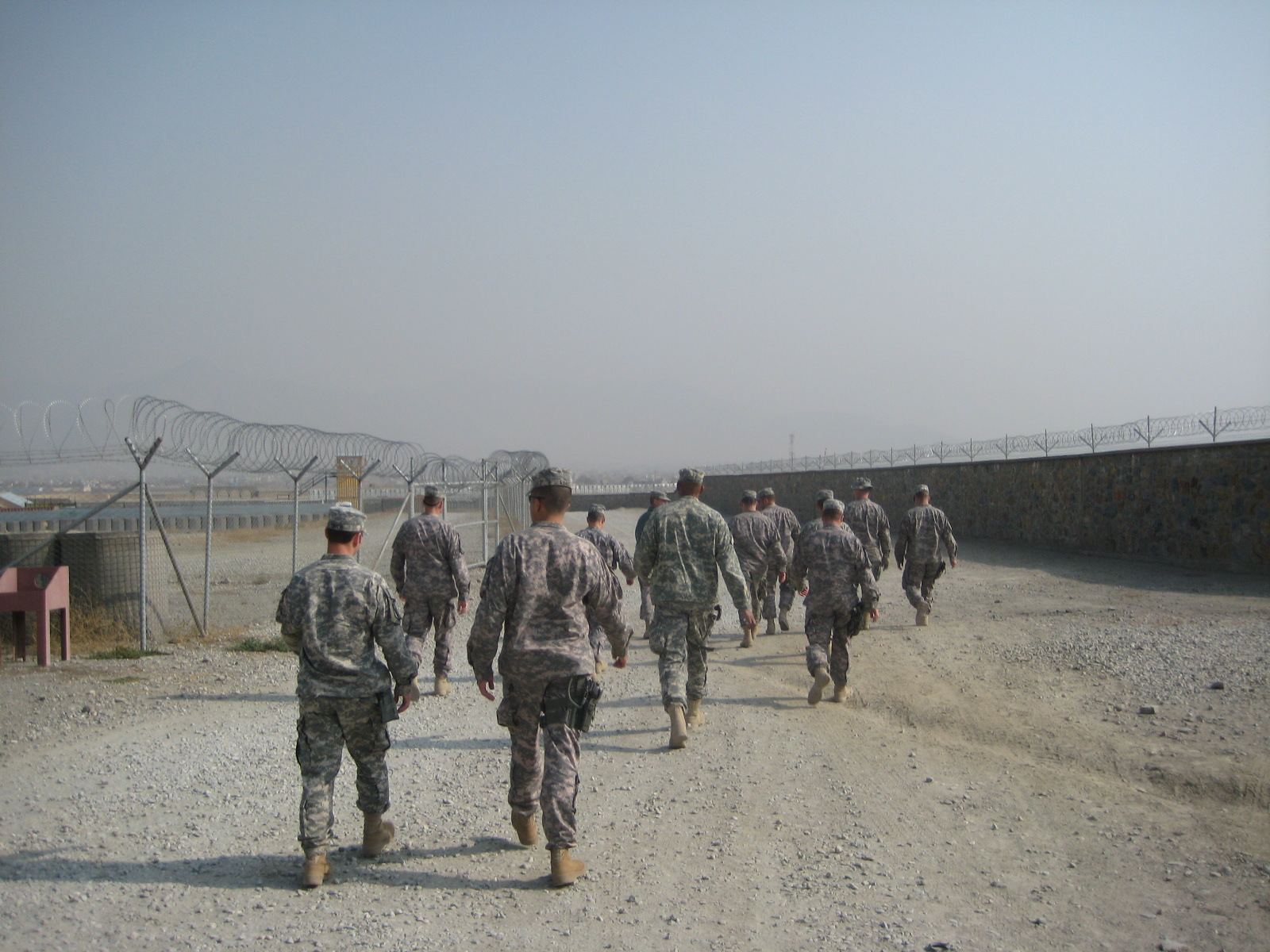
A US Army advisor team, Afghanistan, 2008.

War Lit 2014: Here Here! But What’s the There There?

Here here to war lit 2014, a year that brought us Phil Klay’s Redeployment, Hassan Blasim’s The Corpse Exhibition, and Brian Turner’s My Life as a Foreign Country, among many excellent others. The Iraq and Afghanistan wars, ferocious as they were at times, never captured the nation’s undivided attention. Now nine years after Fallujah, five full years after my own redeployment, fighting in Iraq flickers back to life while conflict in Afghanistan drizzles on. Time will tell what recent events mean in terms of American soldier boots on the ground, but the wars now seem to burn more hotly in the nation’s literary imagination than they ever did in its political awareness. War lit has established itself as a steady persistent presence in the minds of authors, publishers, critics, and readers. Not the biggest deal going, by any means, but book people seem far more willing now to give the wars their due than when 20 American soldiers a week were dying.

Phil Klay and Hassan Blasim
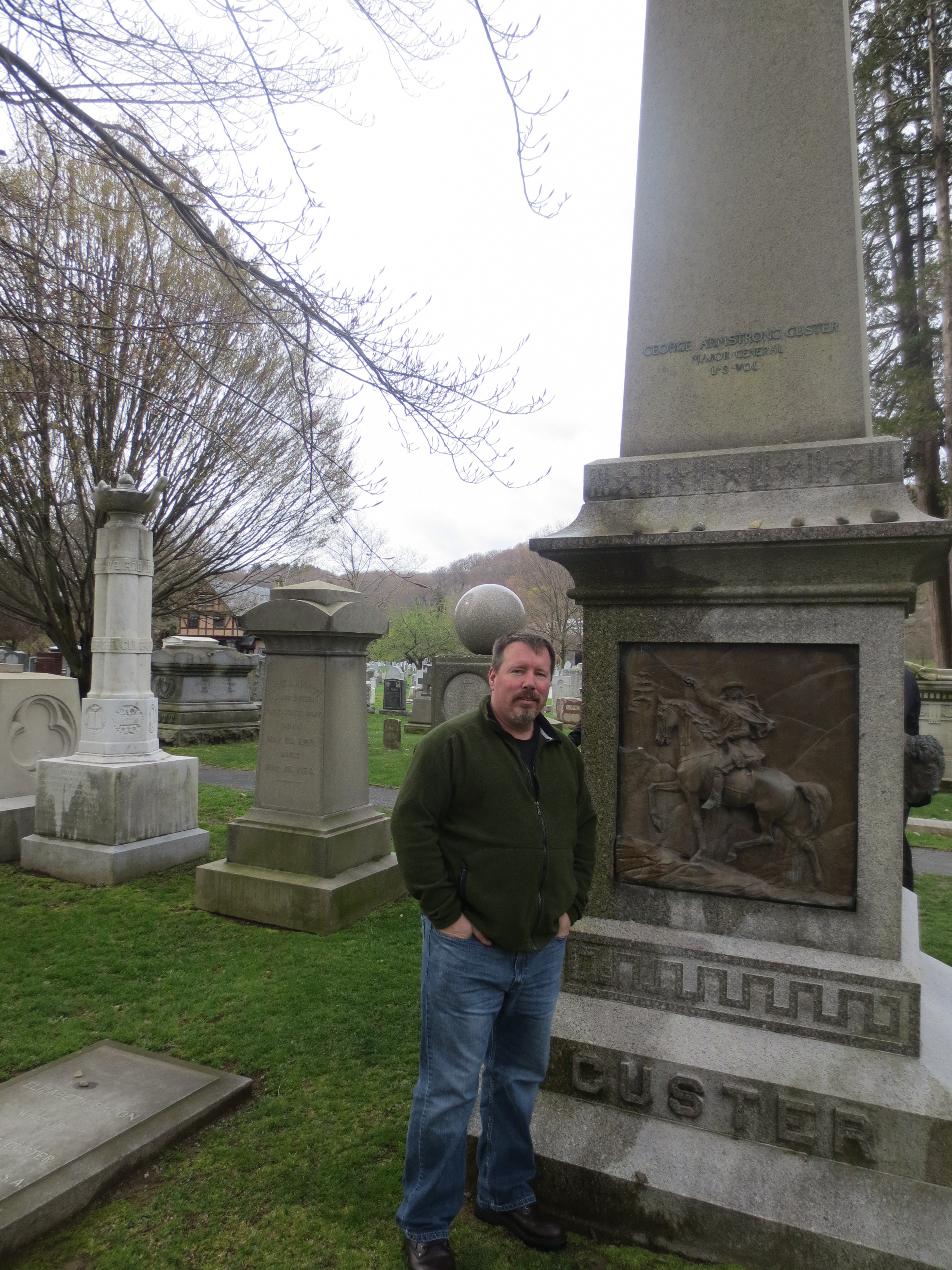
Brian Turner at Custer's grave, West Point, New York.
Brian Turner at Custer’s grave, West Point, New York.

What is the right relationship of high-minded war literature and the nation at large? In World War II and even more so Vietnam, war literature, or at least a lot of it, acted subversively to question and undermine official pronouncements and stabs at controlling speech and thought. But in the 2000s and current decade, there seems to be no “there there” in terms of a dominant narrative or popular consensus against which our most sensitive and imaginative authors might set themselves, no greater truth on whose behalf they wield their words and stories. Leaving Blasim, an Iraqi expatriate, out of it, Klay and Turner, good as they are, rarely mock the wielders of power, so it’s hard to say how dangerous they are to the status quo. What government policy, cultural understanding, or body of literature, art, and film do they resist or subvert? Official sanctioning of torture and cross-border drone strikes? The “support the troops” ethos and the caricature of the troubled vet? The Navy SEAL and sniper memoir and Hollywood war sagas such as Zero Dark Thirty, Lone Survivor, and Fury? Yes to all, but the best might be to come. War lit doesn’t need to more polemical, just more expansive. Its focus on the lived life of individual soldiers and the plight of veterans, noble as it is, also feels somewhat preparatory, as if the genre in toto might be waiting for even more acute and impassioned observers to capture in the most accurate proportions the vexed connectivity of soldier experience, the wars at large, and the national mood.

The novel would seem to be the medium for just such a project, and we might remember the excitement of 2012 when The Yellow Birds, The Watch, Billy Lynn’s Long Halftime Walk, and Fobbit lit up the war lit scene. 2013 and 2014 seem not to have delivered the same wallop, but I’ve probably missed a thing or two. In the coming weeks I’ll turn my attention to a slew of 2014 (and older) releases. Waiting on my shelf are Lea Carpenter’s Eleven Days, Masha Hamilton’s What Changes Everything, Aaron Gwyn’s Wynne’s War, Atticus Lish’s Preparation for the Next Life, and Nadeem Aslam’s The Blind Man’s Garden. And 2015 will bring Elliot Ackerman’s Green on Blue, Jesse Goolsby’s I’d Walk with My Friends If I Could Find Them, and Matt Gallagher’s Young Blood. Ackerman, Goolsby, and Gallagher combine significant war experience and impressive writing talent, so as I pitch into my New Year’s reading, my hopes are high, very high. I hope yours are, too.

Iraq by the Numbers: On the Road with Michael Pitre’s Fives and Twenty-Fives

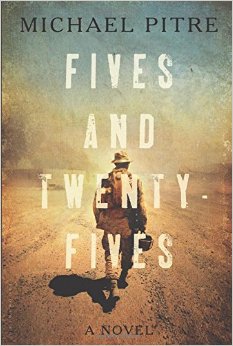
PitreMichael Pitre’s Iraq War novel Fives and Twenty-Fives blends elements of Roxana Robinson’s Sparta and Joydeep Roy-Bhattacharya’s The Watch. Similar to Sparta, Fives and Twenty-Fives features a disaffected war-ravaged ex-Marine Corps officer apathetically making his way through graduate school while frustrating the concern—not to forget the desire—of a smart, beautiful woman many times too good for him. As in The Watch, Pitre’s novel’s narration is multi-voiced and non-linear. Besides Peter Donovan, the alienated Marine Corps officer, Fives and Twenty-Fives relates events through the eyes of an enlisted medic named Lester Pleasant and an Iraqi interpreter named Kateb al-Hariri, nicknamed “Dodge,” who both served in Donavan’s platoon in Iraq. Not only are an officer, a medic, and an interpreter dominant characters in The Watch, but narration in Fives and Twenty-Fives, as it does in The Watch, skips around among the three principals and back-and-forth between events transpiring in-theater and in America afterwards. As if these nods to literary predecessors weren’t enough, the climatic action of Fives and Twenty-Fives repurposes events writ large in American military history over the past two decades. Not to give away anything, but think wounded and surrounded American soldiers, helicopter rescue missions, and enemy Rocket Propelled Grenades.

Unoriginal as it may be in some ways, Fives and Twenty-Fives in other ways beautifully expands the range and deepens the texture of contemporary war fiction. For one, it features as much or more of a plot as we’ve seen from any contemporary war novel. Pitre forges characters and unfolds events in ways that seem plausible, artificed, unpredictable, and inevitable all at the same time. Donovan’s platoon is charged with filling potholes created by IED blasts on the “main supply routes” between Baghdad and Ramadi. But the deadly Groundhog Day-like routine of the mission is upset by personality conflicts within the platoon and the press of new missions, and then spills over into the post-war lives lived by Donovan and Pleasant in Louisiana and Dodge in Tunisia during the time of the Arab Spring uprisings.

The interesting storyline is the least of Fives and Twenty-Fives’s virtues, however. For example, each pothole Donovan’s Marines fill is booby-trapped with another IED, which adds to the danger of the platoon’s mission and necessitates the careful vigilance of always checking first five meters out, then twenty-five, that the Marines employ when they are on-the-ground, outside-the-wire. Here, and at many other places, Pitre describes how military duty and danger mandates new, carefully controlled, much more precise ways to perceive the world. Combat, we surmise, not only requires reorganization and regulation of typical speech patterns and the adaptation of new, non-standard lingo—as in radio transmissions and commands given during crisis—but demands the same of watching, listening, smelling, and mentally processing all sensory perceptions.

Fives and Twenty-Fives also excels in its descriptions of Donovan’s platoon as they execute their missions driving dangerous Iraq roads in their armored trucks. Contrary to what any Sebastian Junger film or any Navy SEAL or sniper memoir would tell you, the characteristic experience of combat for most in Iraq and Afghanistan was not battle on a combat outpost, a midnight raid, or a helicopter air assault. Rather, it was the “CONOP,” or convoy operation: movement in tactical formation in military vehicles whose names–Up-Armored HUMVEEs, MRAPS, and Cougars—mean little to the general American public, but were the world in which 1000s of fighting men and women lived most intensively while in Iraq and Afghanistan. One can get a sense of what French intellectual smarty-pants Pierre Bourdieu would call the habitus—the lived experience of everyday life—of tactical military vehicle movement by watching Bomb Patrol, an Esquire channel series about a Navy Explosives Ordnance Detachment in Afghanistan that features in-truck camera shots of the unit’s members as they roll down the road toward IEDs and ambushes. Or, one might read retired Lieutenant General Dan Bolger’s Why We Lost, which includes a long, detailed description of a CONOP in western Afghanistan. Why it takes the Esquire channel and a 3-star general to tell the world these things, I don’t know, but their accounts ring true to hundreds of hours I spent in armored vehicles on the roads in Afghanistan. War novelists have taken a while picking up on this, but Pitre thankfully everywhere is alert to the procedures of tactical vehicle movement as well as the material feel of it, to say nothing of the ambiance binding the occupants within a vehicle and with those in other vehicles in the formation.

Another correspondence to my own deployment experience came in the form of a fourth character in Fives and Twenty-Fives—one not given the benefit of her own speaking voice, unfortunately, though she looms large in the recollections of other characters. Sergeant Michelle Gomez is the de facto leader of Donovan’s platoon. Though the only woman, she is by far more experienced, decisive, and determined than Donovan and his weak-unit gunnery sergeant. Sergeant Gomez’s take-charge ability, in my experience, makes her not atypical but typical of the military women I met downrange, especially the sergeants, all of whom that I saw had no problem asserting their willpower over the soldiers under them or gaining the respect of the chain-of-command. In the hubbub of debate about the victimization of women in the military—and I’ve heard many first-hand accounts, so do not underestimate the problem—the ability of strong, strident women such as Sergeant Gomez to prosper in uniform is often overlooked. Adding to my interest in Sergeant Gomez was the descriptive detail that she was a Texan. I’m not sure how these things came to pass, but for a while in Afghanistan I was on a FOB with three Mexican-American women, each a sergeant, and each from a different Rio Grande valley town. All three possessed a good-natured competence that was so far above the norm it was almost unfathomable—a fact that immeasurably increased my respect for whatever’s cooking in the cultural stew of places like McAllen, Del Rio, and El Paso.

But Pitre’s greatest accomplishment in Fives and Twenty-Fives is the Iraqi interpreter Dodge. Initially somewhat of a cartoon figure, what with his goofy nickname and love for heavy metal and Huckleberry Finn, over the course of the book he grows exponentially in terms of interest and complexity. Pitre’s feat here to fully imagine a history for Dodge pre- and post-experience working with Americans that is both haunted and resonant with connections and implications. The war begins with Dodge, the son of a Saddam government bureaucrat, on the run from Shia death squads and Al Qaeda killers, and ends with him in Tunisia at the outbreak of the 2011 Arab Spring uprisings. What Pitre is suggesting by having his hero, the rebellious America-loving son of Baathist insiders, meet defeat in his own country only to become one of the avatars of Arabian democracy is hard to fathom. Is there a thought process that connects the aborted stab at freedom in Iraqi and the promise of true freedom in another country? I’m not sure, but the beauty of Pitre’s characterization is generated not so much by political symbolism, but by intimate portraits of Dodge’s relationship with his family and friends and the edge (or lack of edge) that his education in American literature gives him in the face of dealing with real Americans.

Donovan doesn’t bring much new to the brooding, erratic war-veteran table, but instead reliably mopes about until restored to life by reconnection with Pleasant and Dodge, and the kindling of a romance with a grad school compadre named Paige (nice play-on-words, you clever writing guy author!). Paige, pretty, smart, and totally together, foregoes her preppy rich New Orleans crowd for Donovan, which seems a stretch, but so it often goes in the fantasy realm of novels. Describing the connection between Donovan and Paige, Pitre writes in words that most vets will understand:

She knew just what to say. Just how to get me telling stories. This is a problem.

It’s not smart for me to tell stories. Makes people uncomfortable. But with a few bourbons in me, everything takes on a gallows humor and I just want to share, share, share. It’s why I drink alone, mostly. I don’t have the discipline to drink around people and answer their simple questions without saying something awful. Even the memories that seem funny in my head come out sounding like the summer vacation of a psychopath.

It’s even worse, though, when I just sit there quietly and refuse to discuss the war all. People get the impression that I’m the stereotypical brooding vet. That’s why I always keep two or three stories on deck, harmless and cute, to distract and move the conversation elsewhere.

Sand Queen author Helen Benedict, in her review of Fives and Twenty-Fives for the British paper The Guardian, asserts that there are only two questions that matter about any war novel. Is it honest, one, and does it glorify war, two? Benedict generally approves of Fives and Twenty-Fives, but with reservations. In Benedict’s thinking, honesty acknowledges that native Iraqis and Afghans suffered far more than Americans, and glorification is the result of schmoozy authorial love for military jargon, gear, tactics, and obsessive male concerns such as glory, patriotism, bravery, and soldierly camaraderie. Benedict’s points are good ones, though perhaps a bit dogmatic and restrictive. But honestly, I don’t think you could write a war novel grim enough to convince a young man, or nowadays, a young woman, to not enlist who wasn’t already disinclined to serve. A writer even shrewder than Benedict, the 18th-century Englishman Samuel Johnson, proclaimed that “no one ever regretted serving as a soldier or a sailor.” Johnson seemed to be blissfully dismissive of those killed or grievously maimed in battle, but his pronouncement rings true nonetheless. “Get some” the saying goes, or, as Jimi Hendrix asked, “Are you experienced?”  The force of those phrases’ application still applies today to those possessed by the itch to see combat, those who want to write about it, those who want to read about it, the characters in Fives and Twenty-Fives, and I’m betting Pitre himself, no matter how harrowing the ride.

Michael Pitre’s Fives and Twenty-Fives. Bloomsbury, 2014. Thanks to Adam Karr for lending me his copy of Fives and Twenty-Fives.  Karr’s own review of the novel can be found here, at the Make Literary Magazine website.

Run Silent, Run Deep: Greg Baxter’s The Apartment

The ApartmentThe press blurbs on my copy of Greg Baxter’s novel The Apartment describe it as “unshowy” and “understated,” and compared to the stylistic and thematic pyrotechnics of war novels by authors such as Ben Fountain and Hilary Plum, the descriptions fit. The story of a day-in-the-life of a Navy veteran of tours in Iraq both in uniform and as a contractor as he searches for an apartment in an unnamed European city, The Apartment’s prose surface rarely calls attention to itself. Nor does much dramatic happen in the course of the day, although the first-person narrator eventually does find a place to live. Nothing seems to have much consequence, which is definitely the way the narrator wants it, but Baxter’s own thoughts about the matter are more inscrutable. As we contemplate the narrator’s effort to lose himself in his new identity as an unremarkable expatriate in a bland, far-off land, a new take on the subject of life after war seems to emerge. While service has not made the narrator dysfunctional, he is deeply disenfranchised. Twenty years in the Navy and after have left him nothing to be proud of, while filling him with contempt for the nation he served. But not inclined to make a fuss of anything, he seeks only to be left alone while he disappears from view.

The narrator is said to have been a submariner, a detail that resonates personally with me. On my tiny landlocked FOB in Afghanistan were several Navy submariners, plopped among us by the idiosyncrasy of the military manning system, and they impressed me as quiet, regimented, and very precise individuals. Frankly, I think they looked at us Army types as dangerous cowboys who were making everything up as we went along, which wasn’t exactly wrong, and I’m sure the qualities they possessed, as does The Apartment narrator, served them very well on long tours in tight quarters under the ocean. The narrator’s job in Iraq was as a staff intelligence analyst, with, on the first tour at least, some duty as an intel liaison to ground troops. Missions outside the wire showed him the face of combat, while duty inside the wire taught him that he might turn military service into big bucks as a contractor back in the warzone following retirement. His thoughts about the filthy crosshatching of lucre and patriotism offer some clues to his disillusionment. A fellow contractor tells him, “I mark my prices up one thousand per cent.” The narrator himself says, “The way I estimated my fees for the Army—I worked for the Army more than anybody else—was to dream up a figure that seemed unreal and add a zero.” The remark is just one of several scathing indictments of the military:

“From the bottom to the very top, the one thing all American leaders had in common was an unpreparedness for the very thing they’d wake up to face the next day.”

“A lot of the guys I met in Iraq were insufferable nerds, idiots, bullies, or bureaucrats who could not function in the civilian world, where some degree of creativity is required. But I also encountered the calm, stoic intelligence of the men who seemed less like human beings and more like discrete manifestations of the immortality of violence.”

Well, ouch, but poking holes in the structural lash-up of the American war effort is as easy as shooting fish in a barrel, and not even the narrator’s main concern. Whatever his thoughts about contractor perfidy and military pathology, the narrator takes the money he earns in Iraq and runs away, as far away as he can get. More pressing than political critique is a disgust with himself that borders on self-hatred, and the remedy is oblivion: “In a year I’d like to be invisible,” he states, “I’d like to have a life where people don’t monitor my movements, even accidentally.” Friends, family, and somebody to talk to mean little to him, and the business of finding somewhere to live is more of an annoyance than a means to solidify his place in the world. As it happens, he is accompanied on his search for an apartment by two cool and pretty younger women, but for the narrator even the desire for a relationship and the flames of lust burn dimly. Two scenes in which he and one of the women change clothes in front of each other, for example, come and go with nary a flicker of erotic heat.

The upshot of the narrator’s strange dream of a life and Baxter’s strange dream of a novel is as hard to fathom as the course of the submarines on which the narrator served. Baxter has imagined into existence an Iraq veteran of a different breed, and given us few hints whether he thinks his vet narrator’s plight is exemplary or representative, or whether things will end well or not for him. The Apartment exerts an alluring pull, but like the deep vasty ocean it doesn’t give up easily the mysteries that may lie beneath its enigmatically flat surface.

Greg Baxter’s The Apartment, Penguin, 2012.

PS:  Run Silent, Run Deep, by Commander Edward L. Beach, Jr., a novel of World War II submarine action published in 1955, is the first war novel I remember reading, way back in fifth or sixth or seventh grade. Thanks, Grandma Lulu!