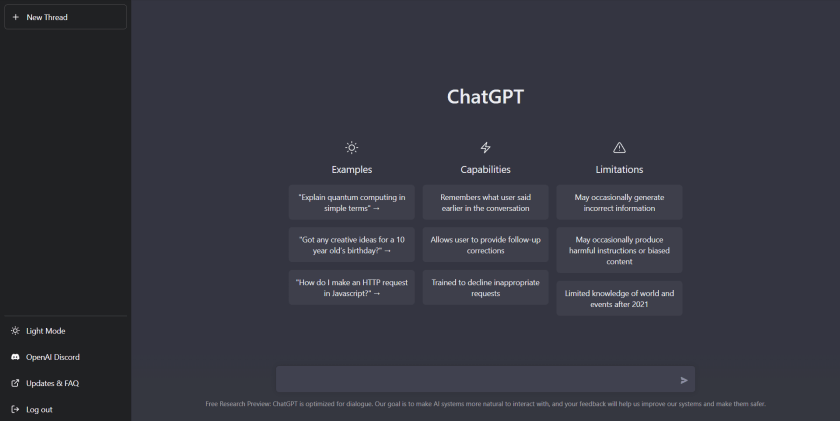
ChatGPT, a sophisticated artificial-intelligence text-producing application, launched in November 2022. Immediately, a flurry of reviews and articles appeared, many of them wondering what might be the import of ChatGPT for academic-writing. The possibilities for cut-and-paste plagiarism seemed bountiful, as ChatGPT not just coughed-up instantaneous chunks-of-information, a la Wikipedia and Google, but was capable of rendering judgment and organizing responses into arguments, “written” in bland-but-serviceable Standard Academic English.
I teach a college research-writing class, so I tried out ChatGPT on some of the subjects my students were writing on this semester. Xenotransplantation—the use of animal organs to replace human ones—was the subject of a couple of papers, so I plugged in the following question:
Question: How can xenotransplantation become more popular?
ChatGPT Response: Xenotransplantation can become more popular by increasing public awareness of the potential benefits and safety of the procedure. Education campaigns can raise awareness of the potential clinical uses of xenotransplantation, as well as the safety of the procedure. Additionally, research and development of xenotransplantation should be supported to ensure that the procedure is conducted in a safe and ethical manner. Furthermore, international regulations and protocols should be established and implemented to ensure that xenotransplantation is used in a responsible and ethical manner. Finally, governments should provide incentives for medical professionals and organizations to use the procedure.
My teacherly opinion is that such writing (and thinking) is not as fluid or nuanced as my best students produce, but far superior to that of less-accomplished ones. In the context of a research-paper, the passage could certainly be usable, especially if supplemented with evidence and quotations, or its ideas developed and complicated in ensuing paragraphs.
Oh well, the implications for the classroom will work themselves out as they will. Thinking about my interest in war-writing, I began musing about how ChatGPT could aggregate what might be said to be the hive-mind on a subject and give it the force of authoritative expression. In other words, what is the potential of ChatGPT wisdom to become the constituted collective wisdom on any given subject?
Pushing on, I tapped-in the following question:
Q1. What are the three best novels on war in Iraq and Afghanistan?
ChatGPT Response: 1. The Yellow Birds by Kevin Powers 2. The Good Soldiers by David Finkel 3. The Forever War by Dexter Filkins
That response can immediately be seen as problematic. Only The Yellow Birds is a novel, while The Good Soldiers and The Forever War are journalistic non-fiction. I next asked ChatGPT the following:
Q2. What is the best novel on war in Iraq and Afghanistan?
ChatGPT Response: The best novel on war in Iraq and Afghanistan is The Yellow Birds by Kevin Powers. This award-winning novel is a powerful telling of two young soldiers’ wartime experiences and the difficult moral choices they must make. It captures the psychological toll of war for soldiers, their families, and those left in the wake of the conflict.
This is more promising, and also intriguing. How was ChatGPT able to spit that out in less than 10 seconds? I’m certain there’s no preexisting databank of responses, so somehow the program was able to canvass a fair amount of reviews, articles, and book-jacket blurbs to offer a sensible, though still fairly generic, response. Next I asked the following:
Q3: What is the reputation of Phil Klay’s Redeployment?
ChatGPT Response: Phil Klay’s Redeployment is a highly regarded work of fiction that has received widespread critical acclaim for its portrayal of the experiences of soldiers during and after the Iraq War. The book, which is a collection of short stories, was published in 2014 and won the National Book Award for Fiction the same year.
Redeployment has been praised for its immersive and realistic depiction of the psychological and emotional toll of war on soldiers, as well as for its nuanced exploration of the complex moral and ethical toll of war surrounding the Iraq War. Klay, who served in the US Marine Corps in Iraq, brings a unique perspective to his writing and his portrayal of the lives of soldiers has been praised as both sensitive and insightful.
In addition to the National Book Award, Redeployment has received numerous other awards and accolades, including the John Leonard Prize, the Chautauqua Prize, and the National Book Critics Circle Award for fiction. It has also been included on numerous “best books” lists and has received widespread coverage in the media. Overall, Redeployment has a strong reputation as a powerful and poignant work of fiction that offers a unique and valuable perspective on the Iraq War and its aftermath.
What to make of this? Though largely fact-based, the response organizes and articulates its response coherently, fluidly, and reasonably thoroughly, as if the product of an intelligent, no-nonsense author. Some of the language is obviously boiler-plate, but it’s not copied from any Internet source I could find. Determined to push ChatGPT even harder, I submitted the following:
Q4: What are the best qualities of Roy Scranton’s novel War Porn?
ChatGPT Response: 1. Thoughtful exploration of trauma: Roy Scranton’s War Porn touches on many difficult subject matters, ranging from addiction, PTSD, and the psychological effects of war. He explores these issues in a sensitive and nuanced manner that helps to provide a greater understanding of how war and its aftermath can shape a person’s life.
2. Emotional depth: Despite its light-hearted title, War Porn dives deep into the emotional tolls of war and how they linger in our lives even after the fighting is over. Scranton captures the complexities of war, humanizing those affected by it in order to emphasize the intense psychological and emotional trauma caused by conflict.
3. Innovative storytelling: With its unique blend of short stories, poems, and vignettes, War Porn is an innovative collection. It combines a variety of forms to create an engaging, immersive experience that often leaves the reader stunned and deeply moved.
4. Unflinching insight: War Porn also has an unflinching look at the devastation of war, particularly in the lives of those who are forced to bear witness to it firsthand. Roy Scranton provides an honest and often heartbreaking commentary on the effects of warfare on both individuals and a wider population.
I’ve organized the response into the 1-2-3-4 categories listed, but otherwise this response is verbatim. Much of it could be generic description of many war novels—and readers who know Scranton’s “The Trauma Hero” essay will chuckle at the description of War Porn as “thoughtful exploration of trauma”—but it also seems written from a place of some familiarity with the novel. In particular, #3 “Innovative storytelling,” though not exactly accurate in terms of “short stories, poems, and vignettes,” is alert to the blended stylistic quality of War Porn, which combines two distinct narratives with poetry passages. On display is a great weakness of ChatGPT as it currently exists: its inability to incorporate quotes from the text under discussion or from secondary-sources. But one could easily imagine taking the four categories of “thoughtful exploration of trauma,” “emotional depth,” “innovative storytelling,” and “unflinching insight” as start-points for one’s own examination of War Porn, even if to argue that it doesn’t do those things especially well; the categories get the conversation going as well as anything.
With my question about War Porn, my ChatGPT free trial ran out. Further experiments and thoughts to follow as they occur….




 In terms of military actualities, the set-up that drives the action of the 2009 film Brothers is intriguing, if not preposterous. On his fourth tour overseas, US Marine Captain Sam Cahill and Private Joe Willis are the only survivors when their helicopter is shot down by the Taliban. Both are quickly taken prisoner, but the Marines unwittingly declare Captain Cahill and Private Willis dead, leaving their wives in grief and despair. The peremptory announcement seems like an egregious breach of military protocol, which would be loathe to declare service members dead in the absence of absolute proof, but is necessary in terms of the plot as it unfolds. Then, while in captivity, Captain Cahill cracks and on orders of the Taliban bludgeons Private Willis to death. This seems excessive, too, not just in terms of what might actually happen but in terms of pinpointing a reason why Captain Cahill is so tormented by guilt when he is rescued and returns home. Such a deed would per force break almost any man, making any semblance of mental equilibrium and re-socialization fraught forever after.
 Time Now: The Wars in Iraq and Afghanistan in Art, Film, and Literature