This month for The Wrath-Bearing Tree, I’ve created a 30-question quiz covering the war-writing scene I’ve followed closely here on Time Now. The quiz is meant to be light-hearted, so have some fun with it, but my hope is that it also serves as a historical record of many of the major authors and fiction, poetry, and memoirs that have marked post-9/11 / GWOT writing.
Tag: War literature
Strike Through the Mask! #9
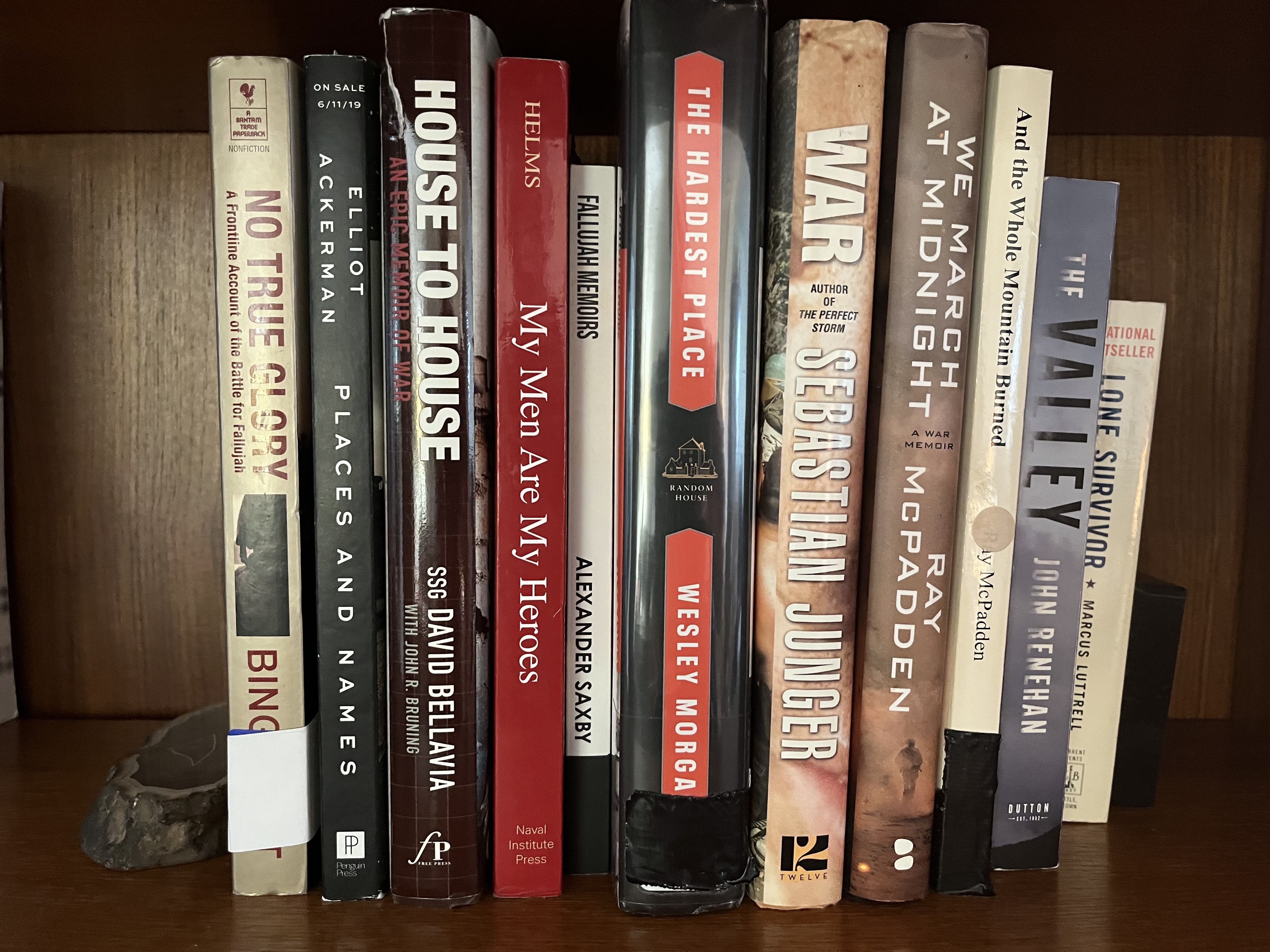
This month for The Wrath-Bearing Tree my column is called Fallujah-Korengal/Korengal-Fallujah. In it, I explore how books and movies about the two GWOT battlegrounds mentioned in the title don’t just describe events but help create a near-mythic aura. Check it out!
Strike Through the Mask! #6
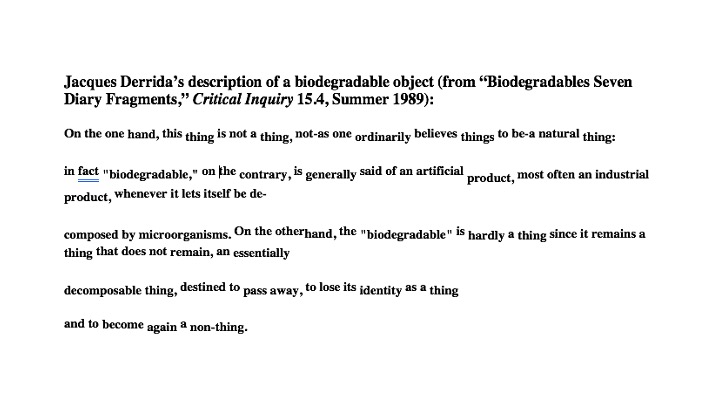 This month for The Wrath-Bearing Tree I’ve written on a subject in which I’ve long been interested: the lifespan of public popularity and critical acclaim of newly-published books and movies in the days, weeks, months, and years after their release. Everyone has an informal sense of how these things go. Some books are acclaimed immediately, but their reputations fade over time. Others are unnoticed upon release, but gain popularity and acclaim in later years. Some are pronounced great early on and attain and maintain “classic” status afterwards. Sometimes an idea, or passage, or character contained in a prose-work or film retains resonance, even as the original work is more-or-less forgotten.
I think there should be a more formal way of analyzing these processes and phenomena. Maybe it’s been done, but I’ve got a PhD in English Literature and haven’t discovered THE study that systematically and structurally explains the cultural reception and historical reckoning of artworks.
In this month’s Strike Through the Mask! I explore the subject by considering GWOT literature and film using the concept of “cultural biodegradability” as proposed by the French proponent of “deconstruction” Jacques Derrida.
The column is subtitled “The Afterlife of Words and Deeds.” It’s a serious subject, but nonetheless one I hope you enjoy exploring along with me.
Strike Through the Mask! #5
This month for Wrath-Bearing Tree I’ve conducted interviews with two heroes of the contemporary vet-writing publishing scene: Tracy Crow of MilSpeak Books and Randy Brown of Middle West Press. Their stories and insights about military-themed writing and publishing are lively and shrewd, so please give the article a read and give Crow and Brown and their authors your support. The entire July issue of Wrath-Bearing Tree is full of good things by good people, so be sure to check out the other articles and reviews as well.
War Writing 2022
As memories of ground combat in Iraq and Afghanistan fade into history, so too slows the pace of narratives that depict fighting men and women in post-9/11 combat action. From what I observe, the large American publishing houses have little interest in publishing novels about war in Iraq and Afghanistan, nor does there appear to be a mass reading audience clamoring for such fare. The big three vet-authors who have undeniably made it as professional writers—Phil Klay, Matt Gallagher, and Elliot Ackerman—are moving on to other subjects and writing identities not strictly identified with their formative years deployed on Operations Iraqi and Enduring Freedom. The same might be said of some of the vet-poets who were prominent a decade or so ago. A number of other vet-writers and affiliated civilian-authors in the war-making scene appear to have gone fallow or given up. New lights might shine for a season, but sustained achievement and acclaim await.
And yet… and yet….
On a smaller scale, fiction and poetry in which Iraq and Afghanistan figure, or serves as a backdrop, or as the genesis for the writing impulse keeps coming. Here’s to the authors, to the readers, and most of all to the publishing houses who keep war-and-mil writing alive. More than just alive, really, but expanding and developing. It’s not enough to tell an old story in an old way, and new perspectives and story-lines aplenty are on display in the titles I survey below.
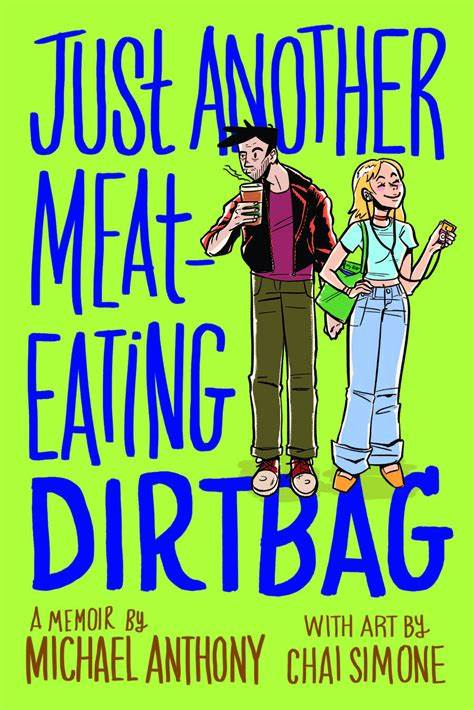
Michael Anthony, with art by Chai Simone, Just Another Meat-Eating Dirtbag. Street Noise Books, 2022.
Anthony’s memoir Civilianized is one of the best traumatized-and-dysfunctional vet sagas going, and now his graphic-memoir Just Another Meat-Eating Dirtbag spins the story of his long journey back from war in unexpected and completely original directions. Finding love with a vegan animal rights activist, the title character, named Michael, grapples with his own ideas and beliefs about the subjects and discovers they are more deeply seated in his war experience than he cares to confront. Though packed with vegan and animal-rights polemics, Just Another Meat-Eating Dirtbag manages to avoid preachiness while also telling a very human story about strained relationships and the redemptive power of love.
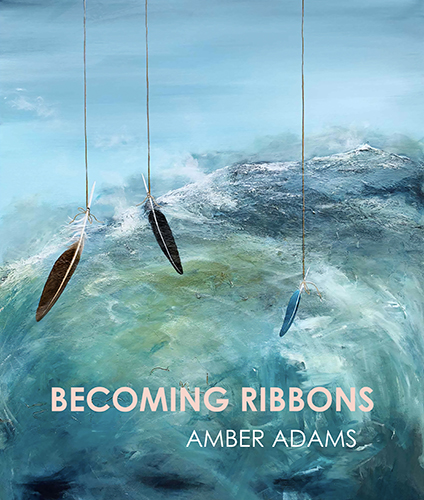
Amber Adams, Becoming Ribbons. Unicorn Press, 2022.
Becoming Ribbons features several poems about Adams’ own deployment as an Army reservist, but the bulk of the poems relate the story of her long-term relationship with a Marine spouse. Looking back at high school and courtship, then exploring marriage in the midst of multiple deployments, moving on to her spouse’s wounding and rehabilitation, and then followed by divorce, her ex-husband’s suicide, and then her own new love, Becoming Ribbons covers a lot of narrative ground, even as each individual poem stands on its own as a unique, discreet verse. Adams’ poetry is deft and mature, while also being remarkably open about fraught events and vexed emotional responses.
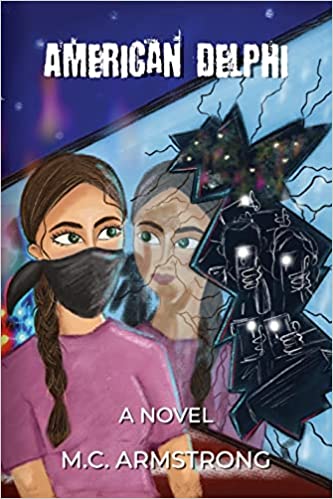
M.C. Armstrong, American Delphi. Family of Lights Books, 2022.
Armstrong is not a vet, but he crafted a perceptive and finely-wrought memoir about a short-stint as a journalist with a Special Forces team in Iraq titled The Mysteries of Haditha. Now comes American Delphi, a Young Adult novel about a troubled adolescent girl and her troubled combat-veteran father. I haven’t read American Delphi yet, but as Time Now has regrettably not paid much attention to GWOT YA, I hope to soon. Bonus points for what American Delphi promises are futuristic tech-y elements and a trenchant engagement with social-media-based political activism.
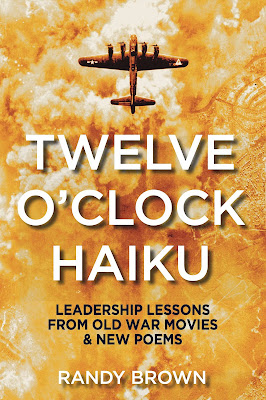
Randy Brown, Twelve O’Clock Haiku: Leadership Lessons from Old War Movies and New Poems. Middle West Press, 2022.
The war-writing scene knows well Randy Brown under his nom-de-plume Charlie Sherpa. Whatever name he goes by, Brown combines his own writing talent with endless support of other vet-authors. Now comes Twelve O’Clock Haiku, an ingenious amalgamation of critical reflections on the WWII Air Force classic-movie Twelve O’Clock High, haikus on the same, and a sampling of previous published verse. Avoiding cant, bromides, and tired wisdom about military leadership, Twelve O’Clock Haiku delights with insights that hit first as clever, and then as poignant and profound.
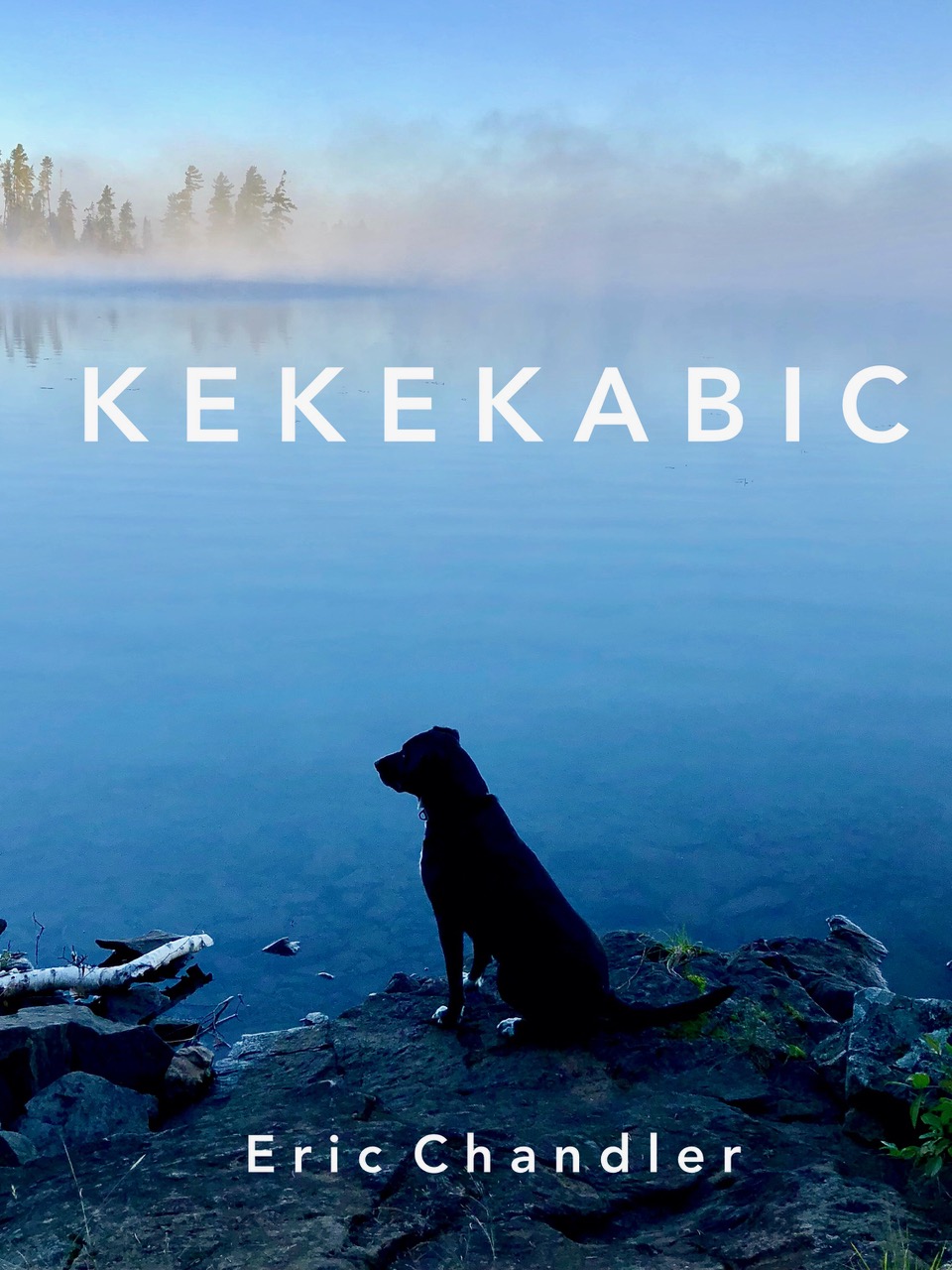
Eric Chandler, Kekekabic. Finishing Line Press, 2022.
Chandler, a retired Air Force pilot, wrote at length about war in his first book of poetry Hugging This Rock. War is barely mentioned in his latest collection Kekekabic, but lurks everywhere. Nominally a set of poetic meditations on a year spent running-and-hiking, the taut poetic forms Chandler employs—haibun and haiku—bespeak the “blessed rage for order” of a combat vet still simmering down from overseas war, even as cultural wars and politicized violence burns ever hotter on the home-front. The calm, observant wisdom on display in Kekekabic is the farthest thing imaginable from the overheated discourse of today’s public sphere, and all the better for it.
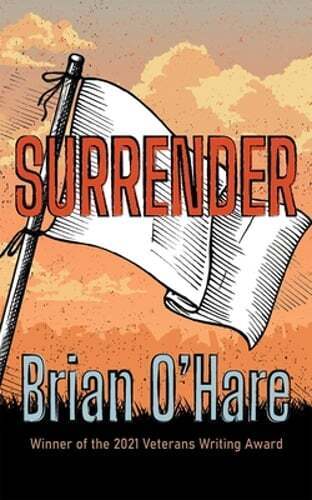
Brian O’Hare, Surrender. Syracuse UP, 2022.
O’Hare’s Iraq was Operation Desert Storm, not Iraqi Freedom, but the sensibility binding the linked stories featuring a disenchanted Marine lieutenant in Surrender will be very familiar to GWOT vets. Taking aim at toxic paternal authority, whether in the form of an overbearing combat-vet father, a tyrannical high-school football coach, or an incompetent and delusional Marine battalion commander, Surrender’s stories are remarkably varied, even, and accomplished. It took O’Hare thirty years to find his voice; his debt to GWOT war-writing is prominent in Surrender, which he well admits in this astute essay for Electric Lit titled “9 Books That Take Aim at the Myth of the American Hero.”
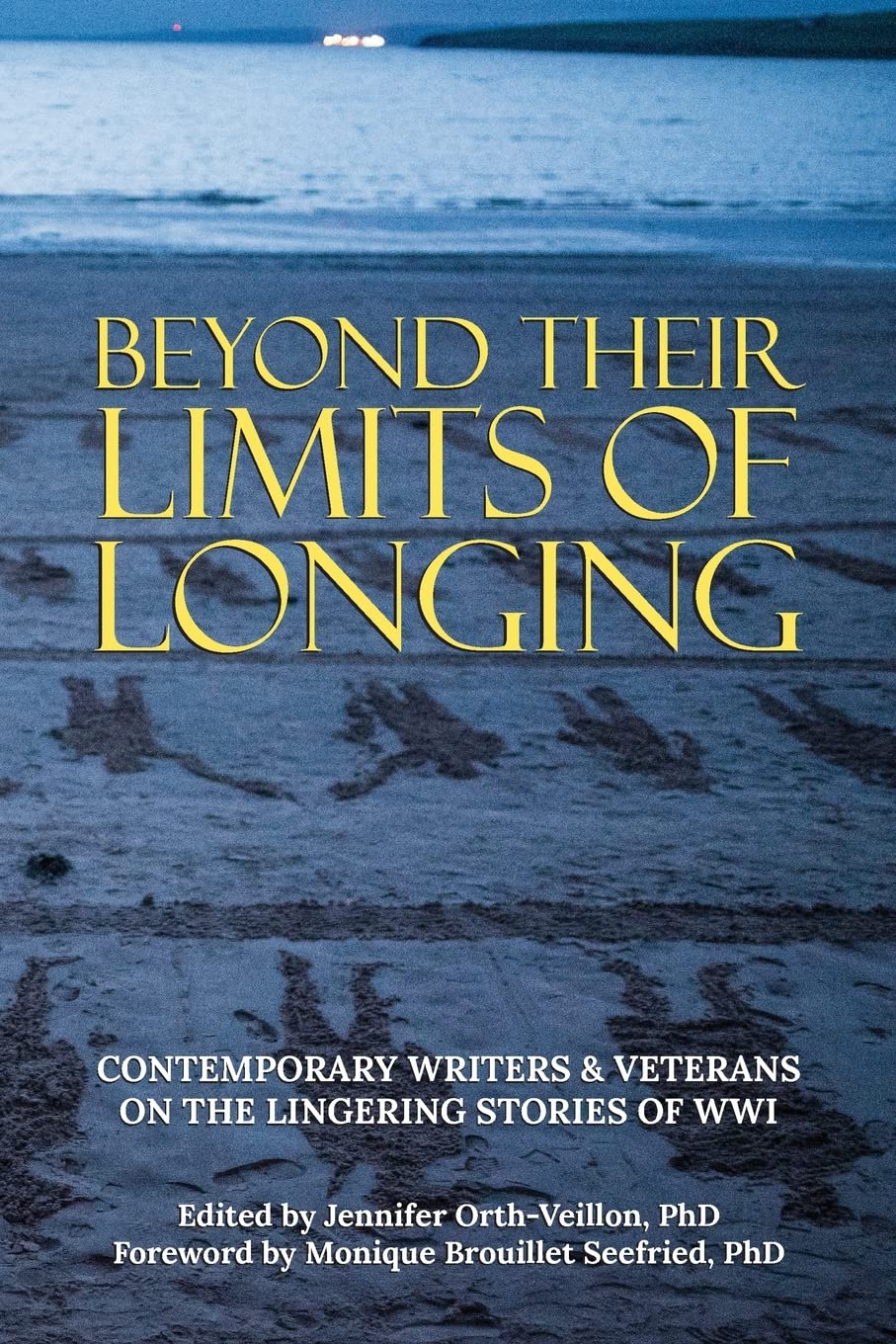
Jennifer Orth-Veillon, editor, Beyond Their Limits of Longing: Contemporary Writers and Veterans on the Lingering Stories of World War I. MilSpeak Books, 2022.
Featuring a who’s-who of contemporary war-writing authors, Beyond Their Limits of Longing asks its contributors to ruminate on an aspect of World War I that is personally meaningful and not generally well-known. Combining scholarship, personal essays, fiction, and poetry, there’s not a mundane piece among the 70+ chapters. Editor Jennifer Orth-Veillon astutely discerned that GWOT vet-writers’ connection to World War I—both the battlefields and the literature that resulted—might be profound, and Beyond Their Limits of Longing rewards that intuition in spades.
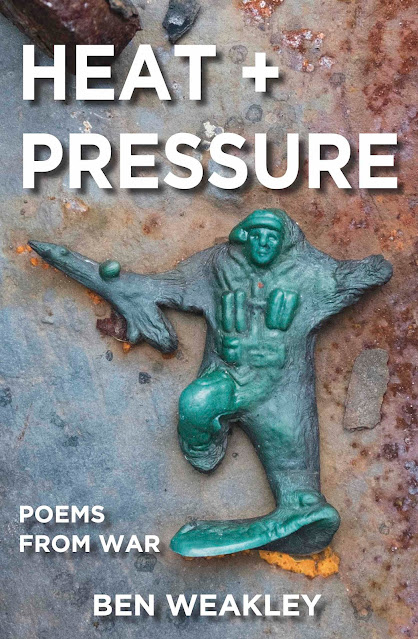
Ben Weakley, Heat + Pressure: Poems from War. Middle West Press, 2022.
I’ve yet to read Heat + Pressure, but if it’s published by Randy Brown’s Middle West Press and blurbed by Brian Turner, it’s got to be good. Its Amazon page relates that Weakley, an Army combat vet, found his inclination to write in post-service vet-writing workshops. That’s a story right there—one of the great through-lines of the vet-writing scene, now in its fifteenth year or so, is how writing workshops have encouraged writing initiative and created opportunity for talent to flourish.
War, Literature & the Arts Conferences, 2010 and 2018
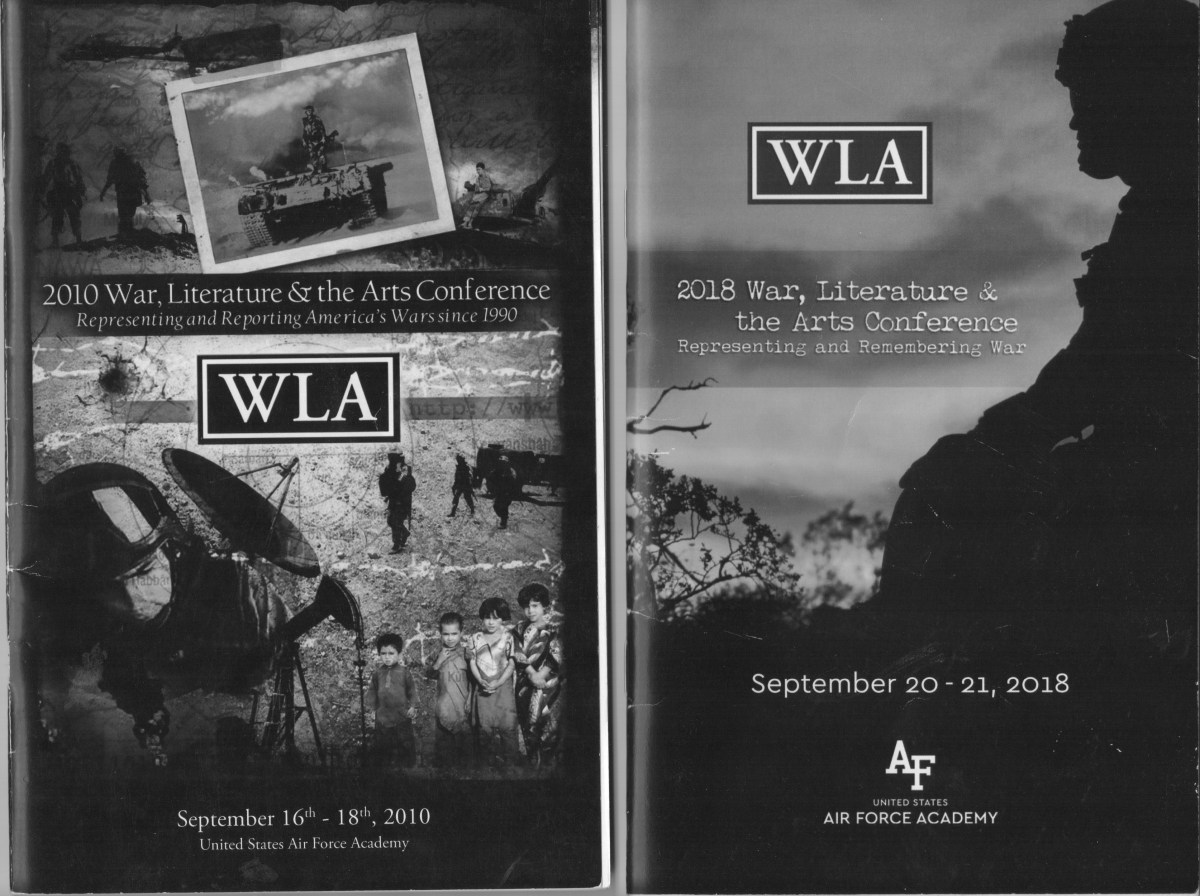
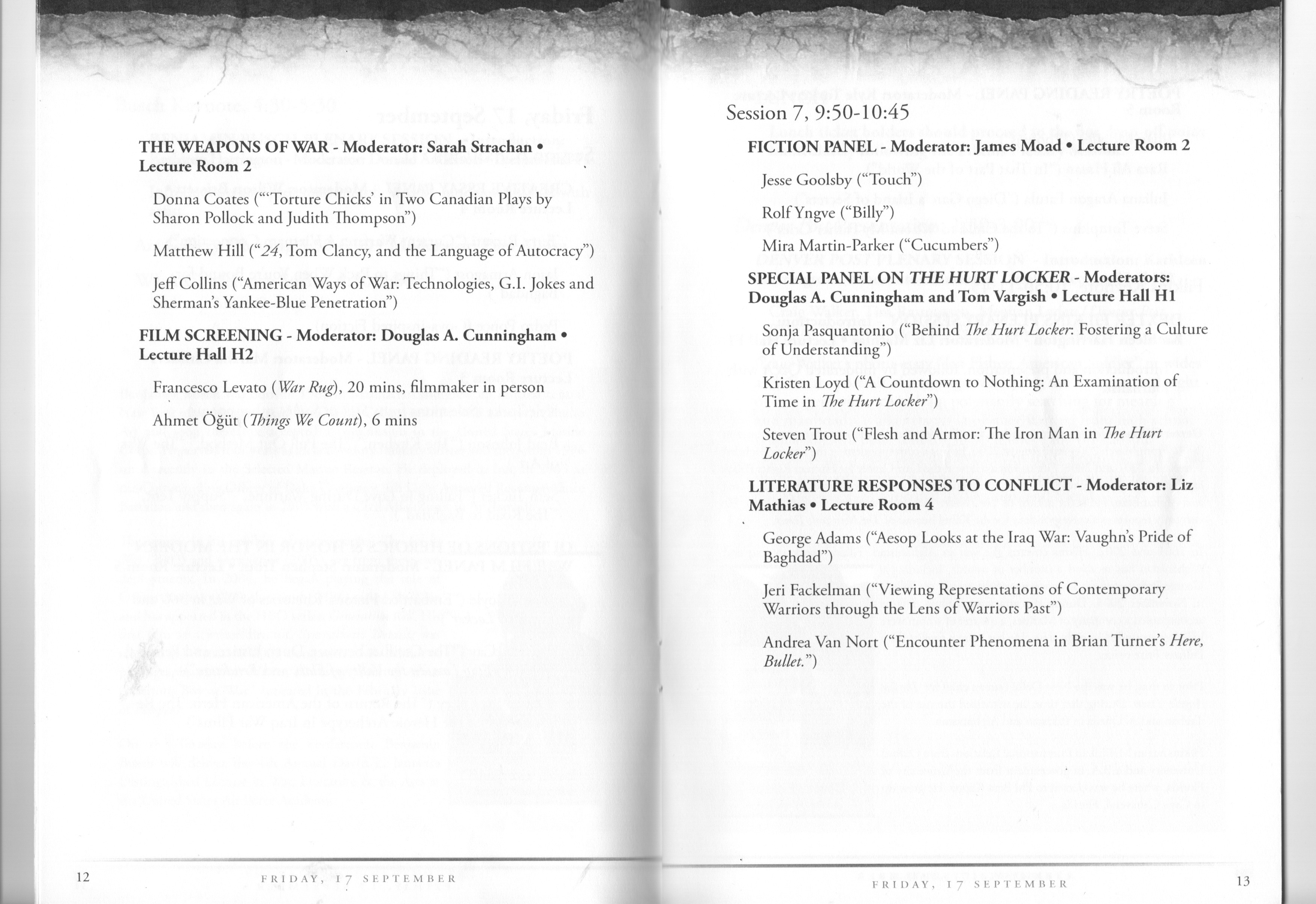
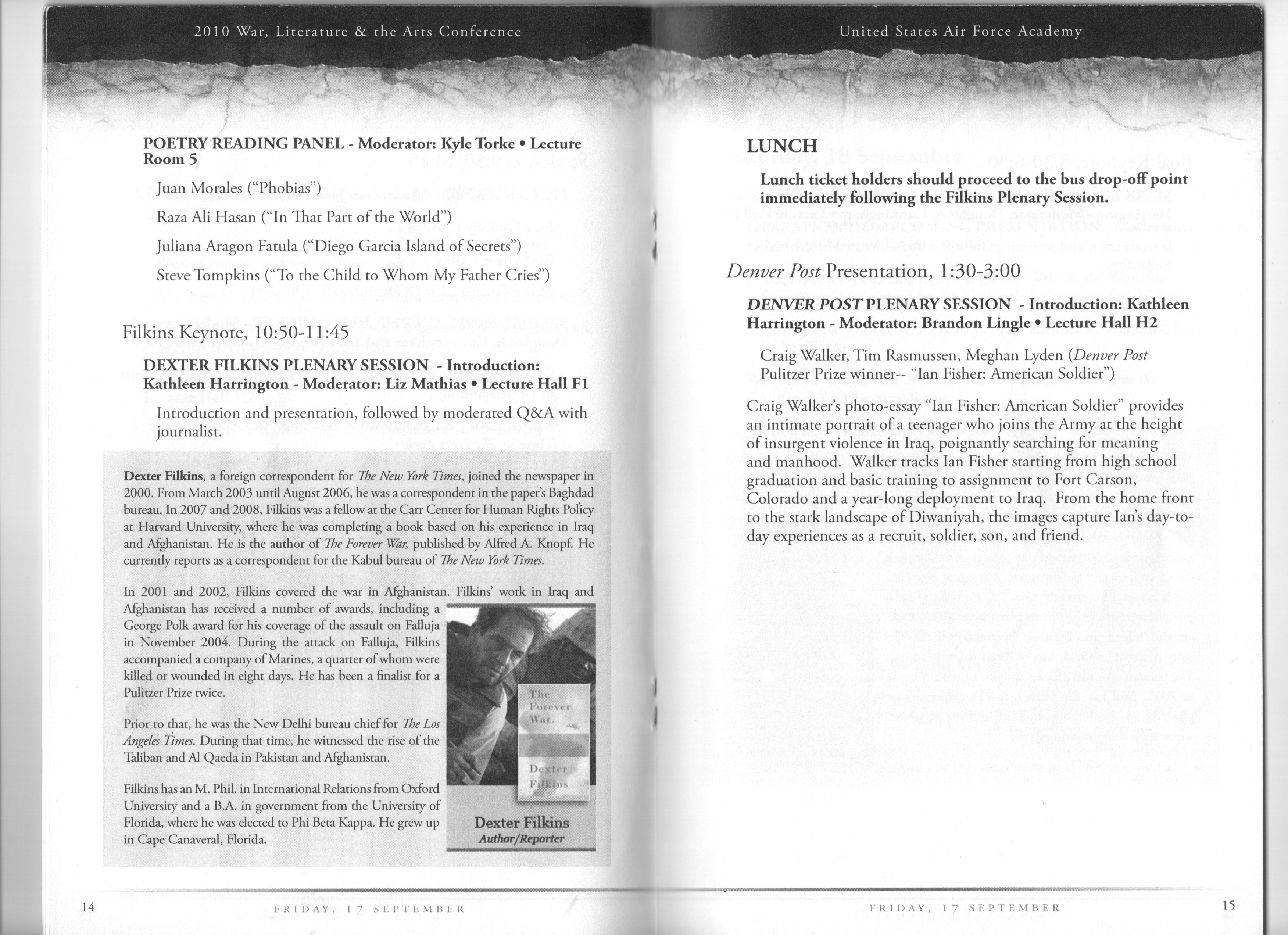
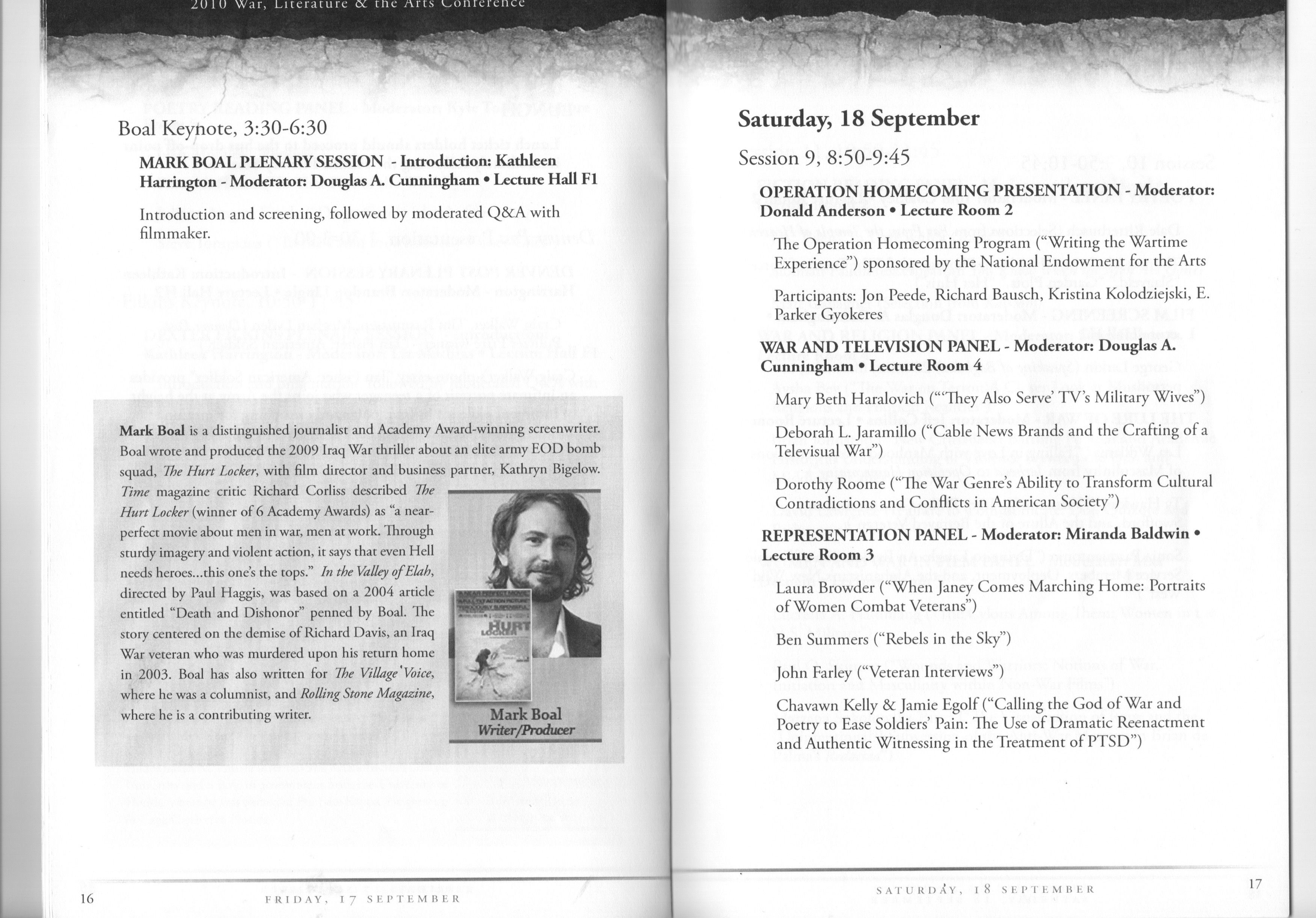
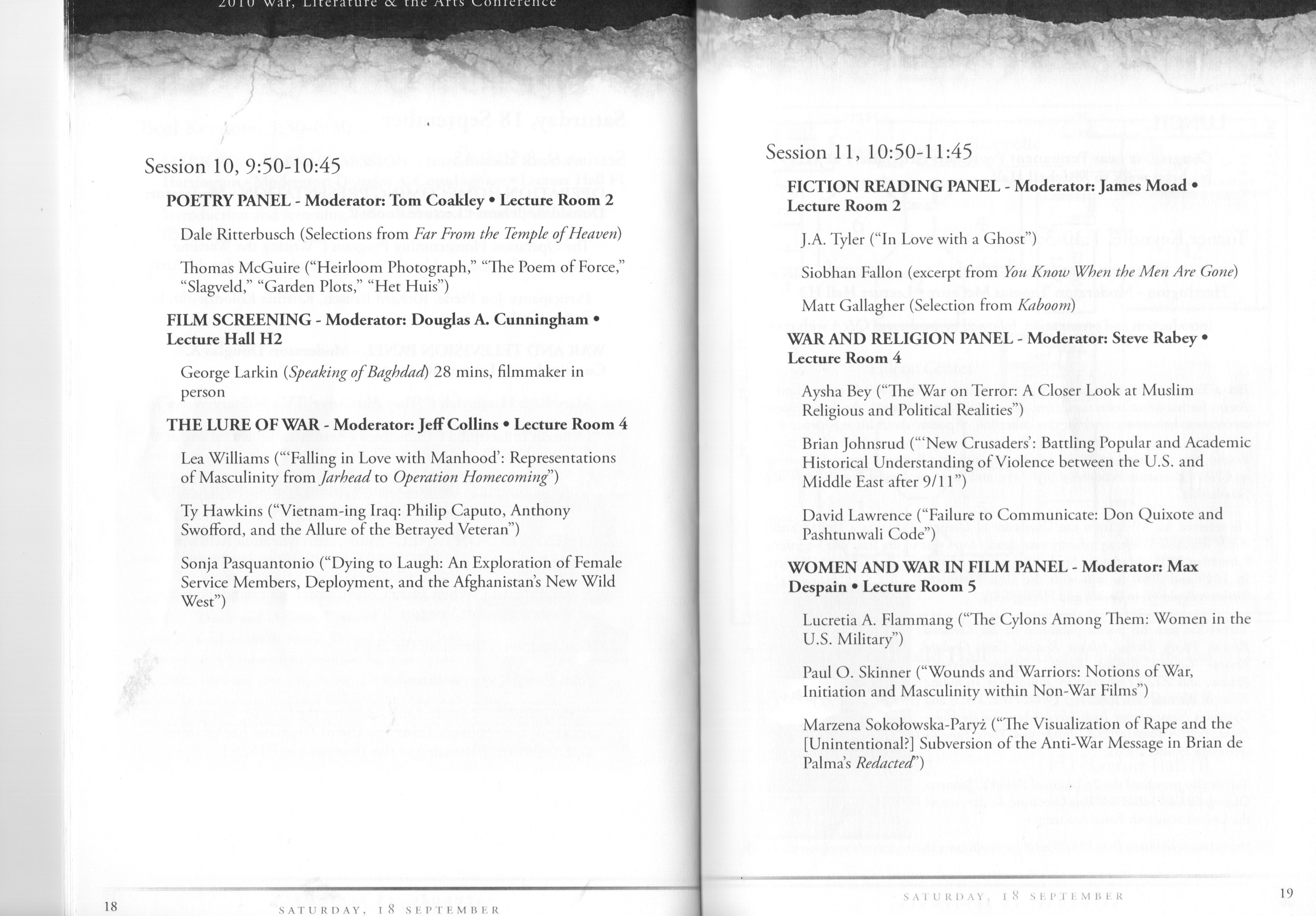
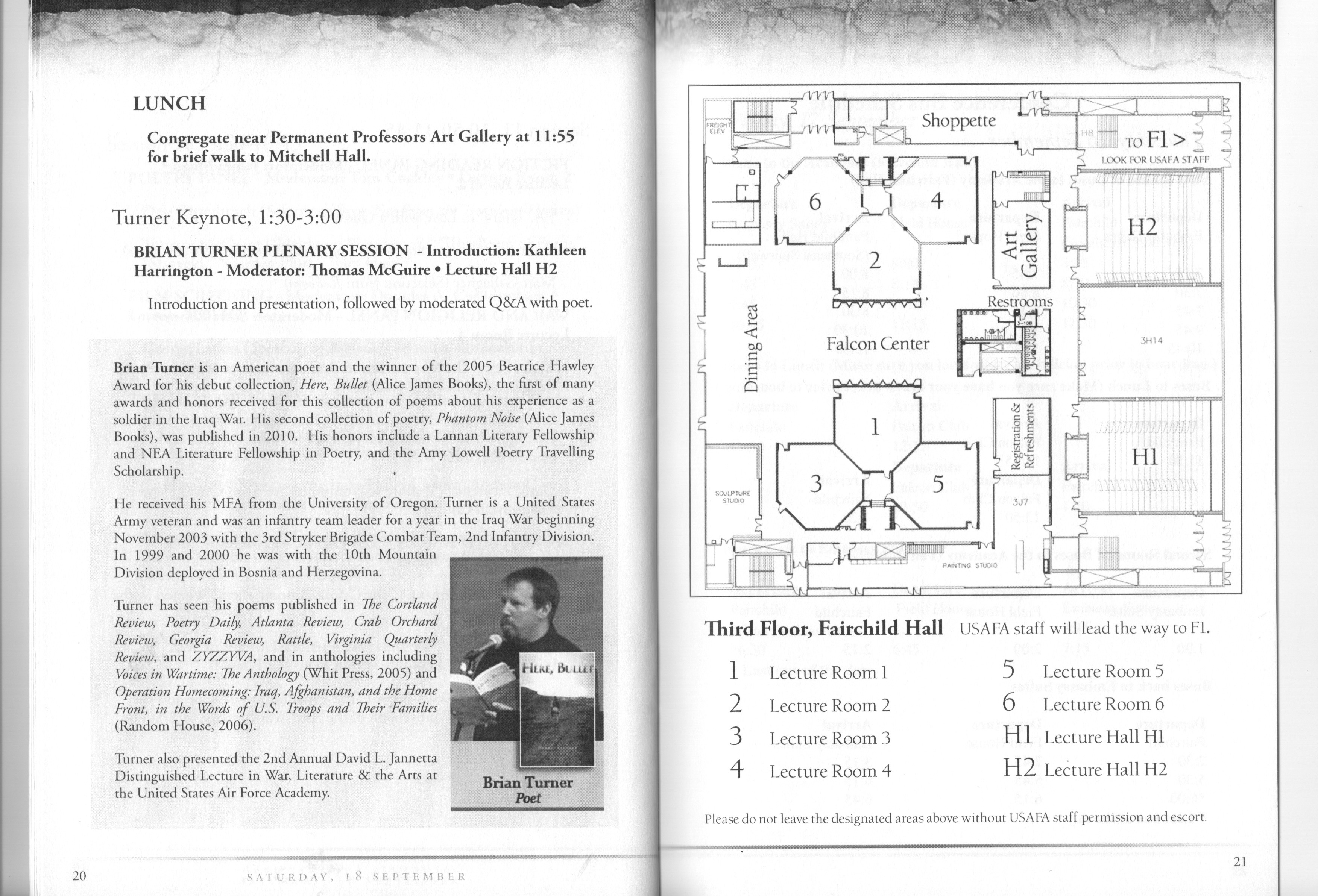
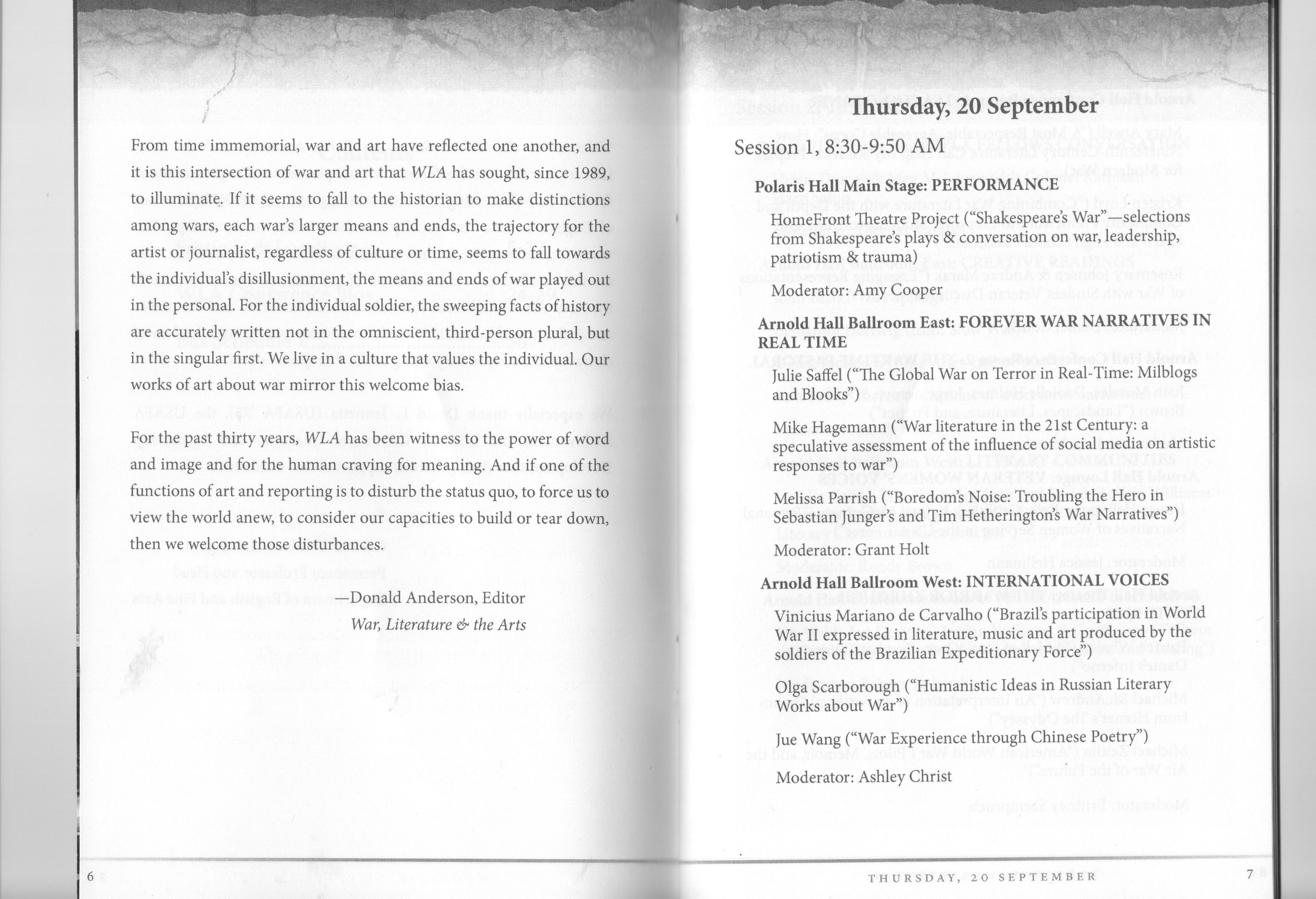
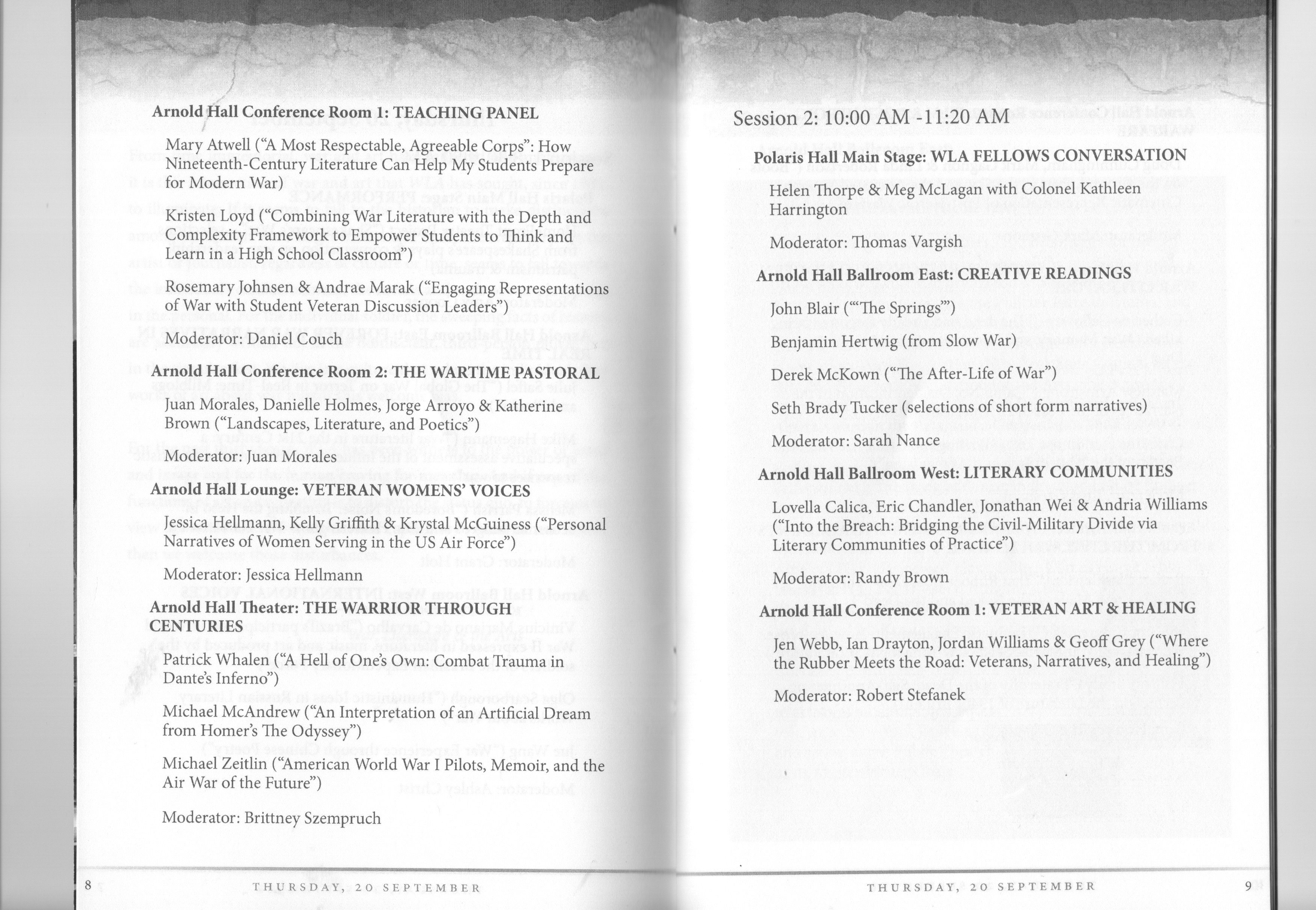
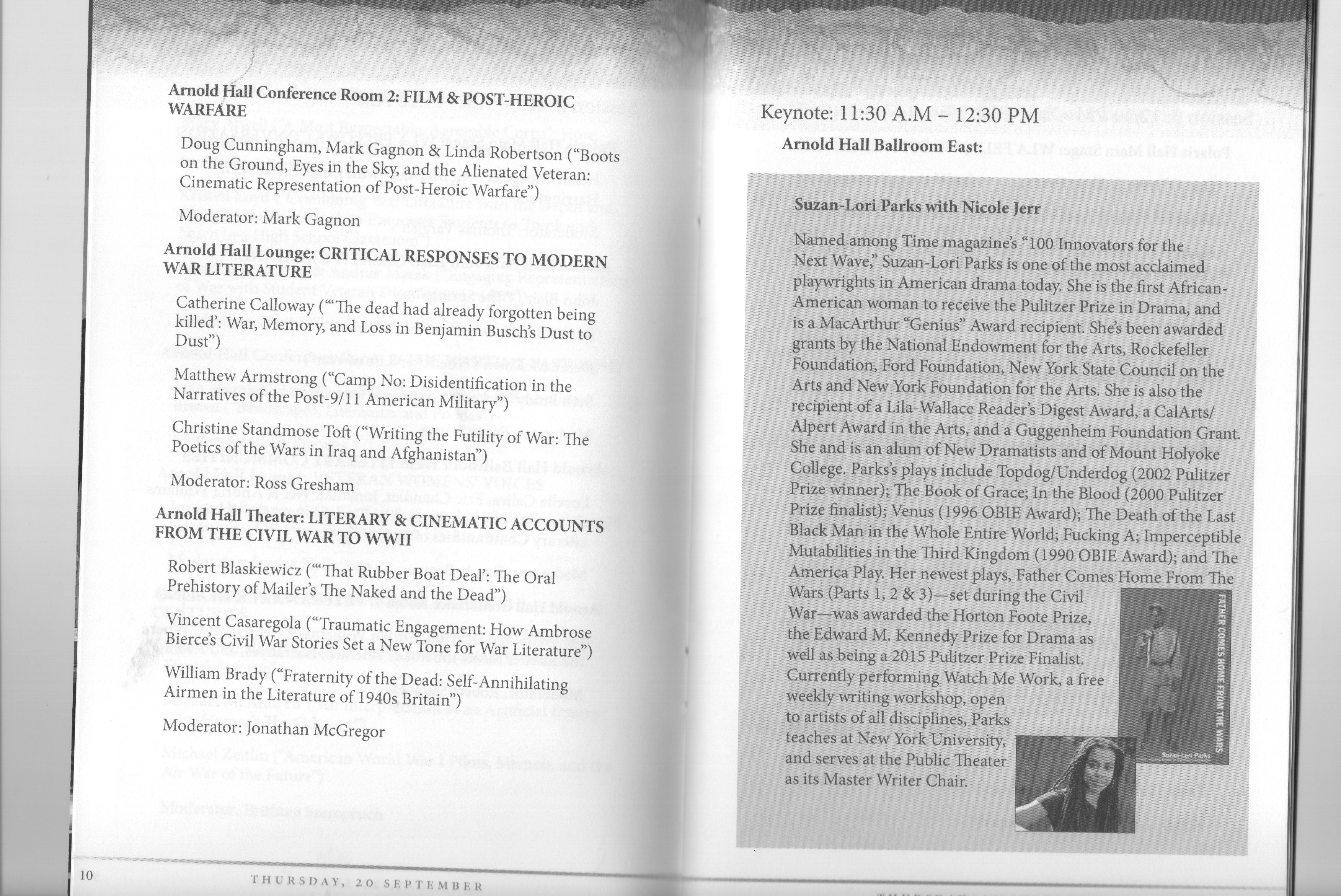
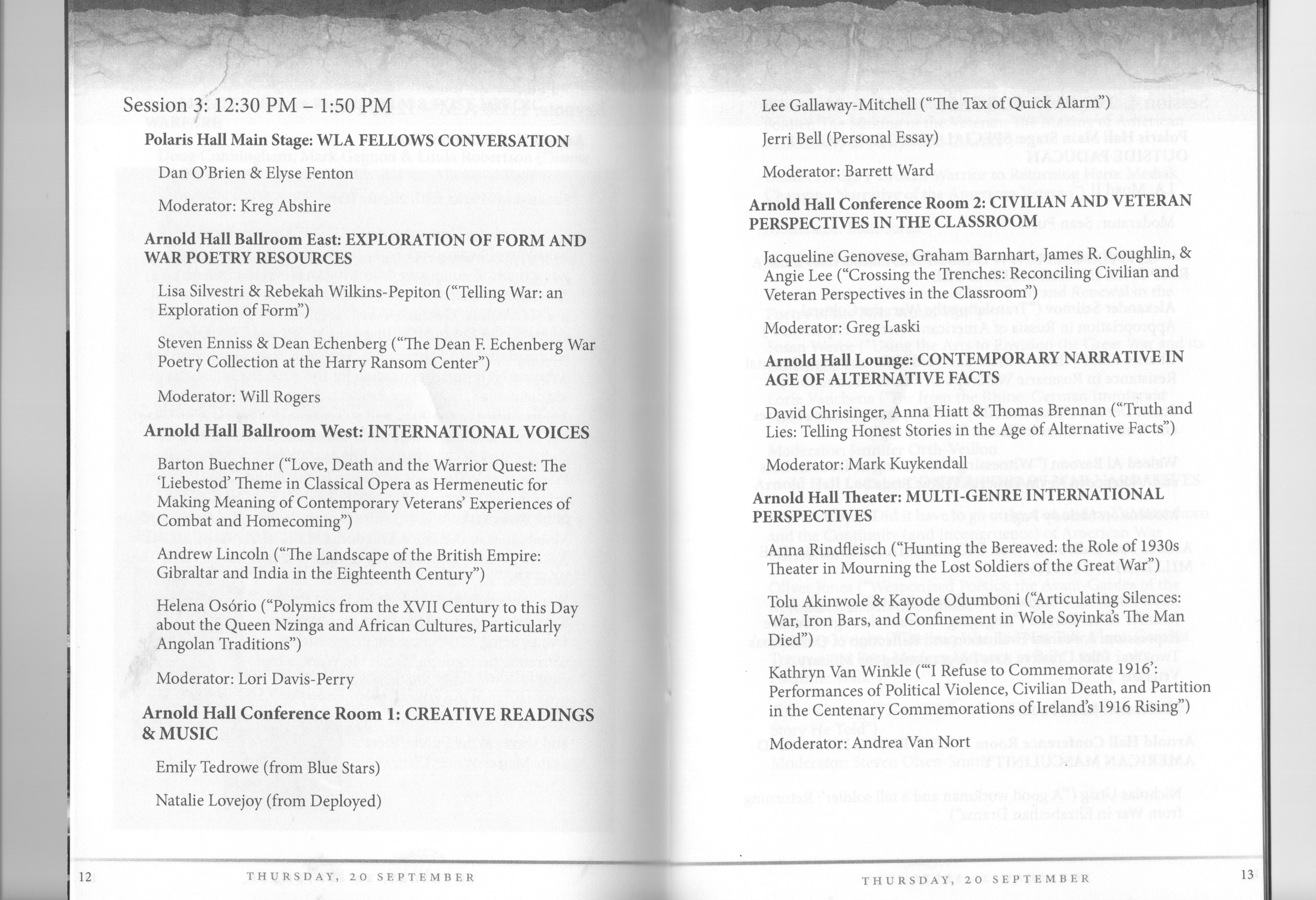
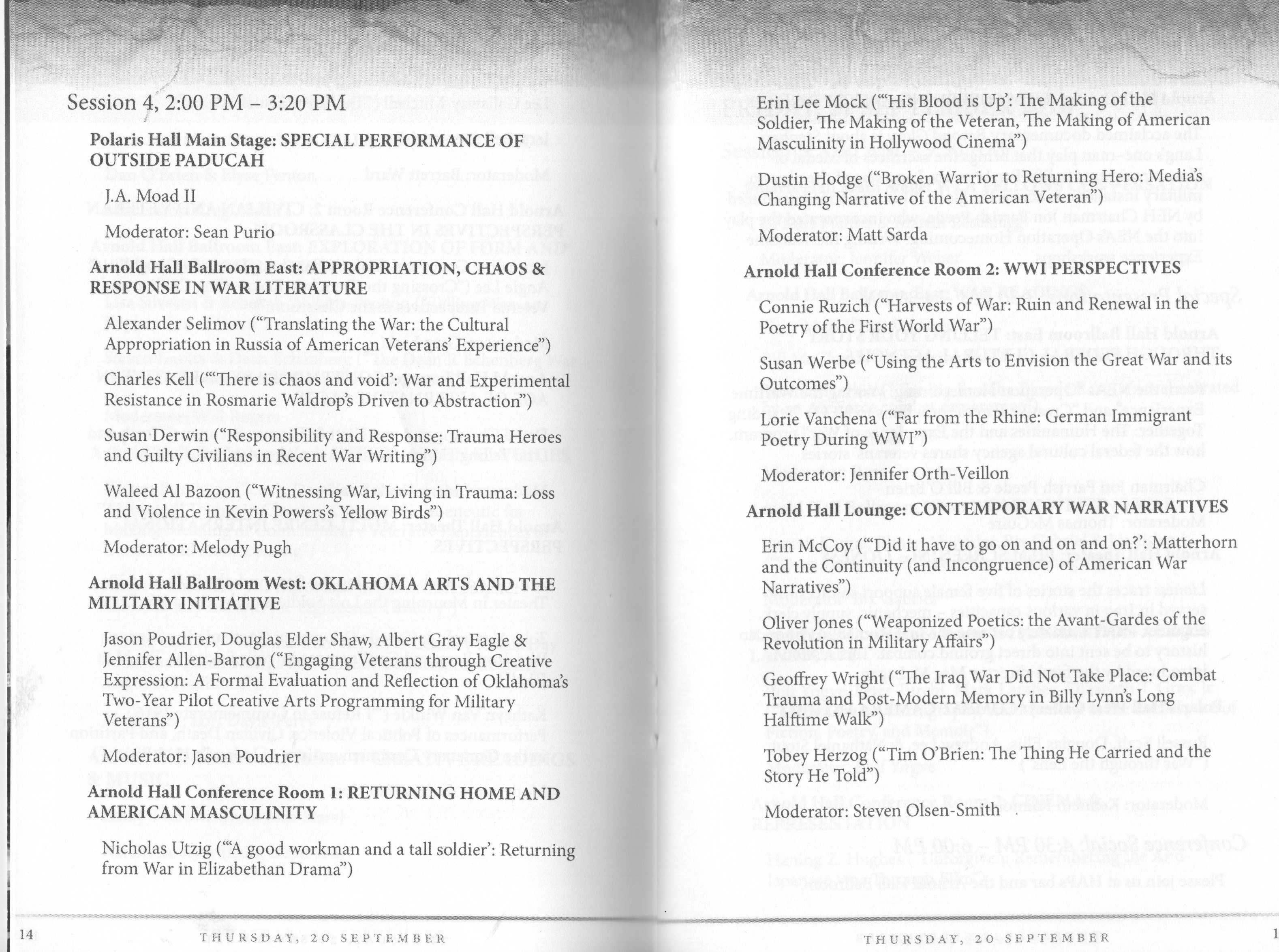
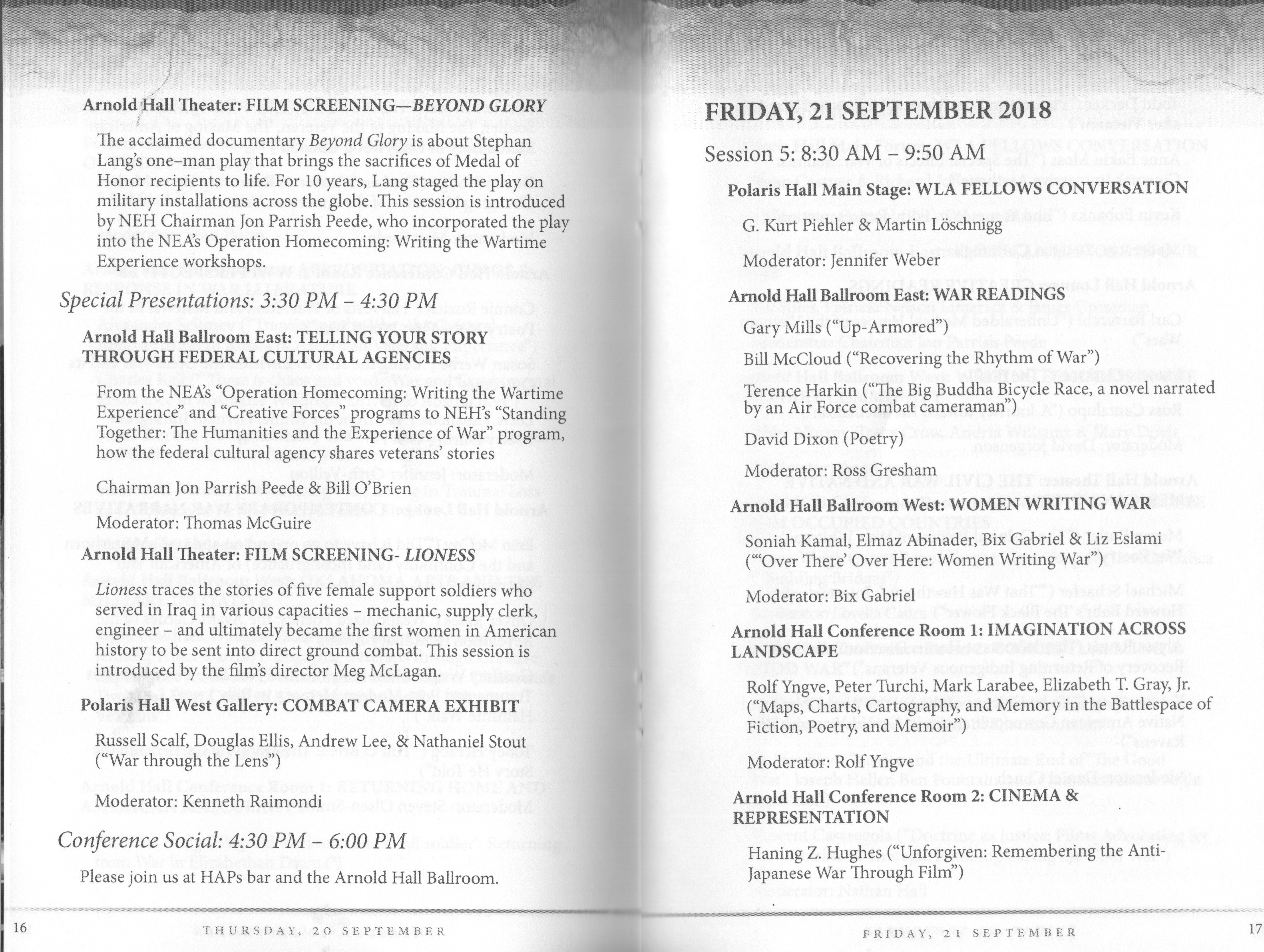
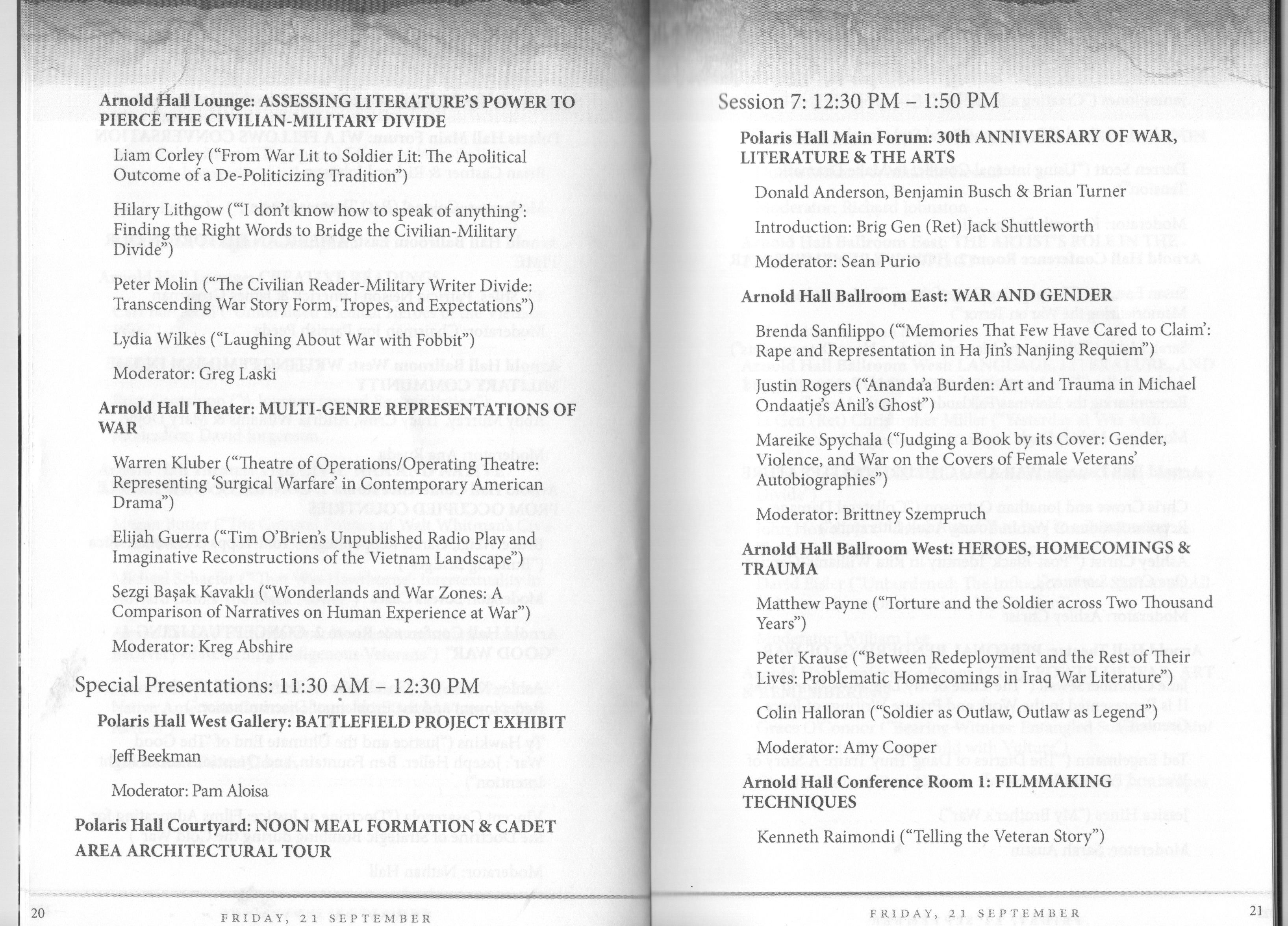
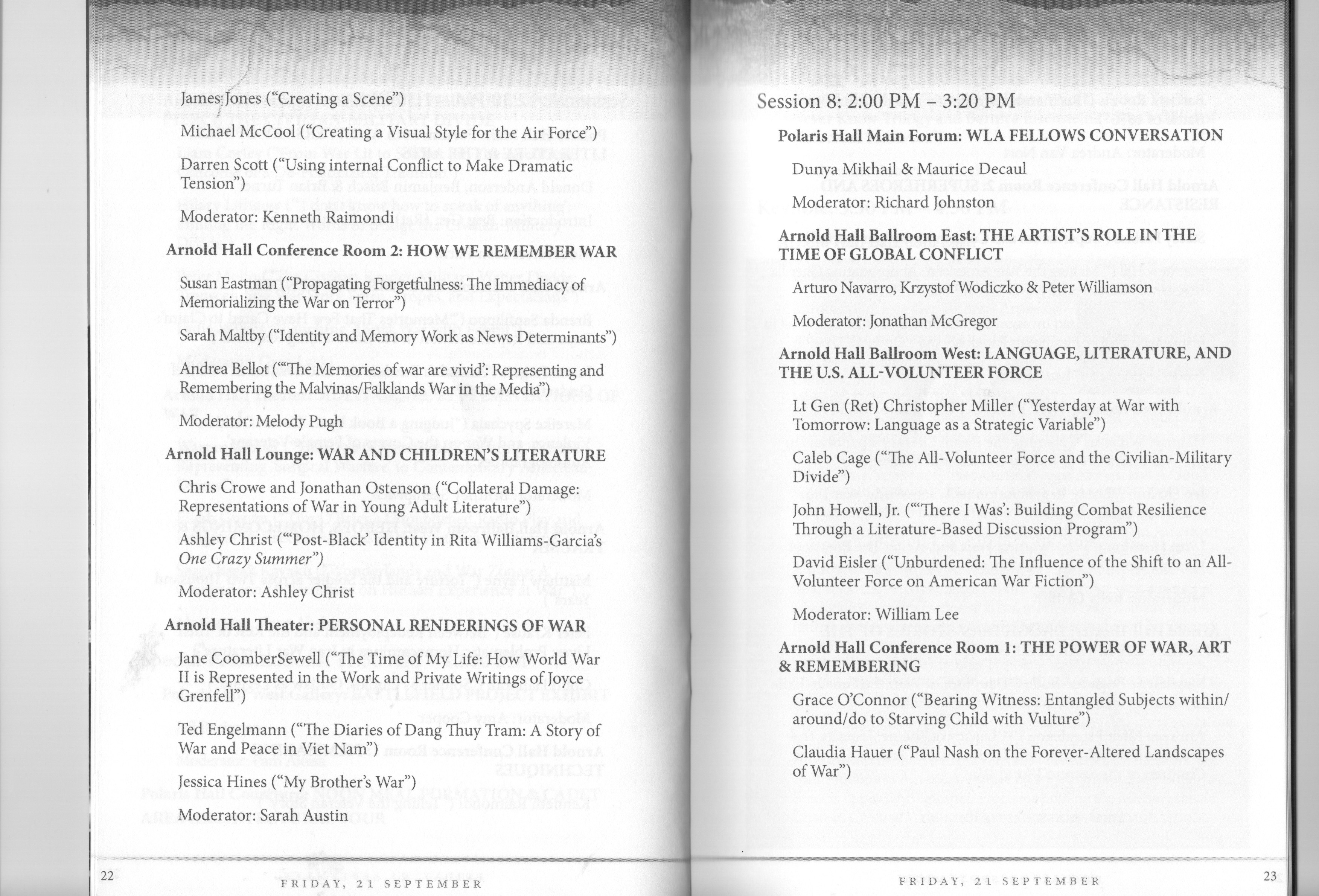
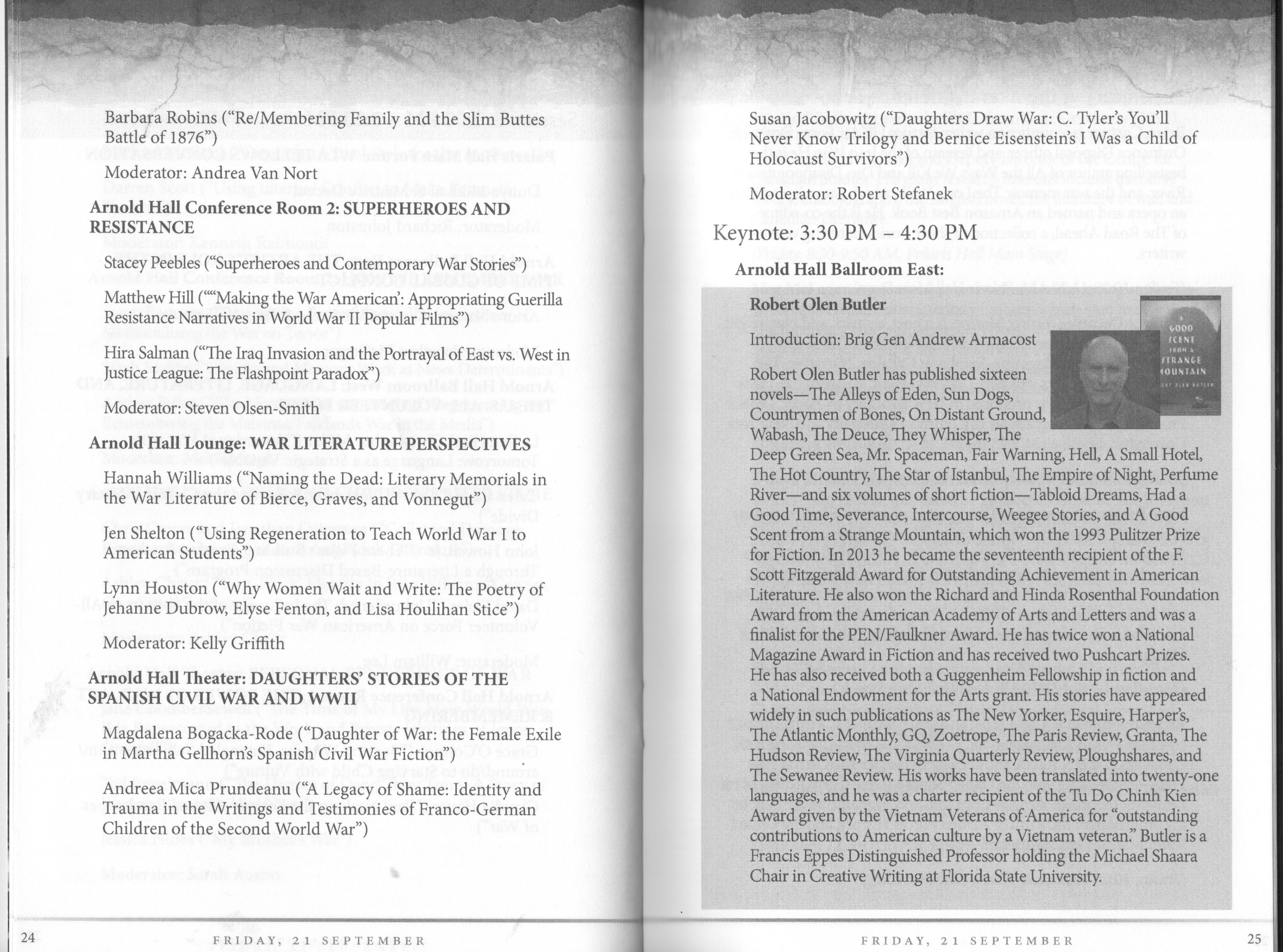
Below are the schedules of presentations taken from the programs for the War, Literature & the Arts (WLA) conferences held at the United States Air Force Academy in 2010 and 2018.
The 2010 WLA conference marked the beginning of a very fertile period in GWOT vet-mil writing. I was lucky enough to attend in those pre-Time Now days. I already knew Brian Turner, but almost every other artist and presenter was new to me. It was all very inspiring; from chance conversations with poets Elyse Fenton and Victor Inzunza on the shuttle-bus from the conference hotel to the Air Force Academy grounds to a great panel featuring Matt Gallagher and Siobhan Fallon, where the idea for Time Now hatched while I was listening to them read, and everything in-between. I don’t think I met Gallagher, Fallon, or Benjamin Busch–one of the featured speakers–at the time, but I was later able to invite all of them to read at West Point, where I taught until 2015.
Looking at the 2010 program now, it’s remarkable how many names are obscure now. The same can’t be said about the 2018 WLA conference; stacked with writers, artists, and academics in the now-robust contemporary war-lit scene, along with selected speakers and readers and scholars from pre-9/11 wars, it was an embarrassment of riches. If you missed so much as a day, you missed a lot, and choice panels competed with each other for attention. And it, too, like the 2010 conference, was enormously generative in terms of sowing the seeds for future writing projects and collaborations.
Read the programs below if you please, and if you have thoughts or questions about any of the presentations, let me know in the comments and we’ll talk it up.
Kudos to the Department of English and Fine Arts at the United States Air Force Academy for sponsoring both conferences. It was very prescient and magnanimous of them to have done so. Colonel Kathleen Harrington, the head of the department in both 2010 and 2018, deserves major thanks, as does Donald Anderson, a member of the faculty, the editor of War, Literature & the Arts, and a fantastic memoirist in his own right. Helping out behind the scenes at the first conference as members of the Department of English and Fine Arts were war-lit mainstays Jesse Goolsby, Jay Moad, and Brandon Lingle, among others.
The current head of the Department of English and Fine Arts is Colonel David Buchanan, the author of Going Scapegoat: Post-9/11 War, Literature, and Culture (2016), one of the few book-length studies of contemporary war-literature out there. Hope he has it in mind to host another WLA conference under his tenure.
2010:


2018:

Time Now Shorts
Some things old, some things new, some things borrowed, some things blue….
Lions for Lambs. I finally caught up with Lions for Lambs, a 2007 film directed by Robert Redford and featuring Redford, Tom Cruise, and Meryl Streep. Thinking about its celebrity cast and the year of its release, it occurred to me that Hollywood, with Generation Kill, The Hurt Locker, and Brothers all released about that time, was far in advance of the nation’s literati or the waves of vet-authors to-come in artistically portraying war in Iraq and Afghanistan. Checking out the reviews of Lions for Lambs as I tuned in, I was surprised how scathing they were. How could a movie starring Cruise as charismatic conservative Senator with a plan to win the war in Afghanistan, Streep as a cynical liberal journalist, and Redford as a well-seasoned college professor go wrong? The performances of the Big Three are good, and surprise surprise the action scenes set in Afghanistan are not bad either, particularly the ones set in a battalion command post and on-board a Chinook flying into battle. But it’s not hard to see what didn’t impress the reviewers. The movie consists of three storylines, each told in spurts, that connect thematically in terms of staging a debate about Army strategy in Afghanistan and the life possibilities of young men with and without privilege, but there’s little intertwining of the three storylines, nor much of a plot at all. Instead, in the scenes featuring Redford and those featuring Cruise and Streep there’s lots of snappy fast-talking dialogue in the manner of The West Wing that resolves nothing on the home-front, and a jimmied-up action sequence in Afghanistan is far-fetched, to put it mildly, and which (spoiler alert) does not end triumphantly for two former students of the Redford character. One review says it best for me by calling it “the movie equivalent of an off-Broadway play” that hopes to be saved by the luminance of its cast. I like The West Wing and off-Broadway plays as much as anyone, but movie-goers, to include this one, might also not unreasonably expect more narrative effort and imagination stitching together disparate storylines than Lions for Lambs delivers.
The military episode in Lions for Lambs involves two soldiers who survive a fall out of a Chinook and the effort to rescue them—much like Brothers, which was released two years later. NYU professor Patrick Deer has written a scholarly article that argues that recovery of “missing bodies” is a dominant motif of Post-9/11 narrative; Deer doesn’t discuss Lions for Lambs, but he might have.
Catch-(20)22
Matthew Komatsu, an Air Force pararescue jumper, has twice now published articles reflecting his love for Joseph Heller’s satirical World War II novel Catch-22. Both pieces argue that Catch-22, great in-and-of-itself, especially resonates for Iraq and Afghanistan vets by accurately reflecting the inanity of military bureaucracy and the self-serving incompetence of senior military officers they themselves observed on deployments. In other words, Komatsu believes that as much as looking back at World War II, Catch-22, published in 1961, anticipates the devolution of America’s military from a world-beating titan to a force expert at perpetuating wars ad infinitum, but never winning them. The proverbial self-licking ice-cream cone….
It’s an argument hard-to-argue with, at least the part that pertains to actual US Army military endeavor in Vietnam, Iraq, and Afghanistan. I encourage you to read both of Komatsu’s articles; if you have served, you will certainly find many parts to which you can relate.
Why ‘Catch-22’ Is The Closest Thing To The Truth About The War
Somewhere in The Great Beyond, Joseph Heller is Having a Bitter Laugh About ‘The Afghanistan Papers’
Not as easily available is an essay on Catch-22 I contributed to a student study-guide anthology published in 2021 by Salem Press. The guide, titled Critical Insights: Catch-22, is part of a series aimed at undergraduates and advanced high-school students. My piece, co-authored with Iraq and Afghanistan vet J. M. Meyer, is titled “Yossarian bleated faintly: Catch-22 and Military Experience in the New Millennium.” In the volume Introduction, editors Laura and James F. Nicosia write, “This essay is an eye-opening contribution by scholars who have first-hand experience in and knowledge of the military.”
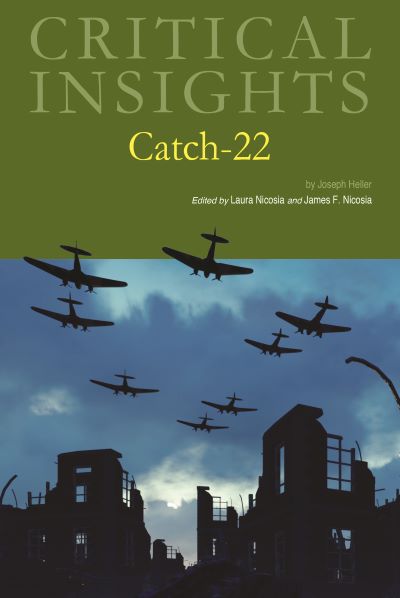
My contribution to “Yossarian bleated faintly” is a run-down of reasons Iraq and Afghanistan veterans continue to reference Catch-22 to describe their own wars. I reference Komatsu’s “Somewhere in the Great Beyond” Catch-22 article, and I also explore some of the war-lit authored by vets that clearly pays homage to Catch-22. From there, Meyer mounts a more ambitious, trenchant argument about how Catch-22 relates to larger matters of contemporary culture and political discourse.
There’s no digital version of the chapter available (yet), and it’s still too soon post-publication to just reproduce it for free here, so I’ll summarize my contribution and offer a couple of passages.
On rereading Catch-22 last year, I was struck by how dark and grim much of it is. In my memory were all the funny bits lampooning military absurdity and dysfunction. Also in mind was a notion of the protagonist/anti-hero Yossarian riding above the fray, his anti-authoritarian cleverness keeping him one-step ahead of the madness. That’s there, but there’s a lot I didn’t remember as well, such as how genuinely shaken is Yossarian by what befalls him, to the point, by the end of the novel, of mental instability (an instability that is reflected in increasingly hallucinogenic scenes and episodes, as well as in the prose style). In the essay, I invoke two au courant words, trauma and PTSD, and consider their relevance to Catch-22:
The unpleasant consequence of Yossarian’s psychological turmoil, grounded in moments of real terror in the sky, is trauma, which adds emotional resonance experienced personally to the larger critique of military dysfunction in ‘Catch-22.’
Toward the end of my section, I try to reconcile Yossarian the traumatized war-victim with Yossarian the insubordinate provocateur, and then link those traits to the jaded-and-wounded outlook of many Iraq and Afghanistan junior enlisted and junior officer vets:
His colorful contempt for military bureaucracy and the chain of command, as well as his acuity in knowing how to push the buttons of stuffed shirts and uptight frauds, are generally humorous to behold and arguable safe to indulge in even by soldiers who volunteered for service.
Reconciling the insubordinate mischief-maker with the death-shaken traumatized victim of war is central to understanding Yossarian’s enduring influence, especially among twenty-first century soldiers and veterans of Iraq and Afghanistan. In response to nonsensical wars, a modern soldier sensibility has emerged that blends elements of Yossarian’s dominant characteristics and and given them contemporary expression, primarily by using humor to convey a righteous moral and intellectual superiority that has brought soldiers to war on ludicrous premises and then ineptly organized itself to fight. The sentiment accounts for the emergence of two distinct cohorts of disgruntled soldiers and junior officers prominent within the modern soldier-and-veteran community. Known respectively as the “E4-Mafia” and the “jaded junior officer,” these unofficial cohorts constitute most evidently the spirit of ‘Catch-22’ in the modern military. The E4-Mafia (or, as they are know in the Marines, “Terminal Lances”; thus the title of Maximilian Uriarte’s satirical comic strip) consists of soldiers in the rank just below that of sergeant who, in the manner of ‘Catch-22”s ex-PFC Wintergreen, claim to be the true agents of military daily duty, adept at pulling strings and making things happen in the name of making the bureaucracy run, while all-the-while possessing jaundiced contempt for the military that makes them defer [obsequiously] to superior officers. The jaded junior officer motif refers to lieutenants and captains exasperated by military rigamarole and incompetent senior officers. Feeling marginalized and unappreciated, veterans of this stripe have turned to memoir, fiction, and the Internet to exact their vengeance….
In other words, ridicule, satire, and laughter serve as dominant modes of expression for soldiers who don’t like what they see, and in fact may be really hurting, but also understand they damn well volunteered for it. I have much more to say on the issue, to include a breakdown of contemporary war lit works that most directly reflect the spirit of Catch-22, but this is all I’m going to give away here. If you really want to read more, and I know you and like you, write me an email, and I’ll share a PDF of the entire piece. Otherwise, Critical Insights: Catch-22 is available for sale online and might be available in your local school or college library.
Critical Insights: ‘Catch-22.’ Edited by Laura Nicosia and James F. Nicosia. Salem Press, 2021.
Vet Writing’s Not Dead! AWP22
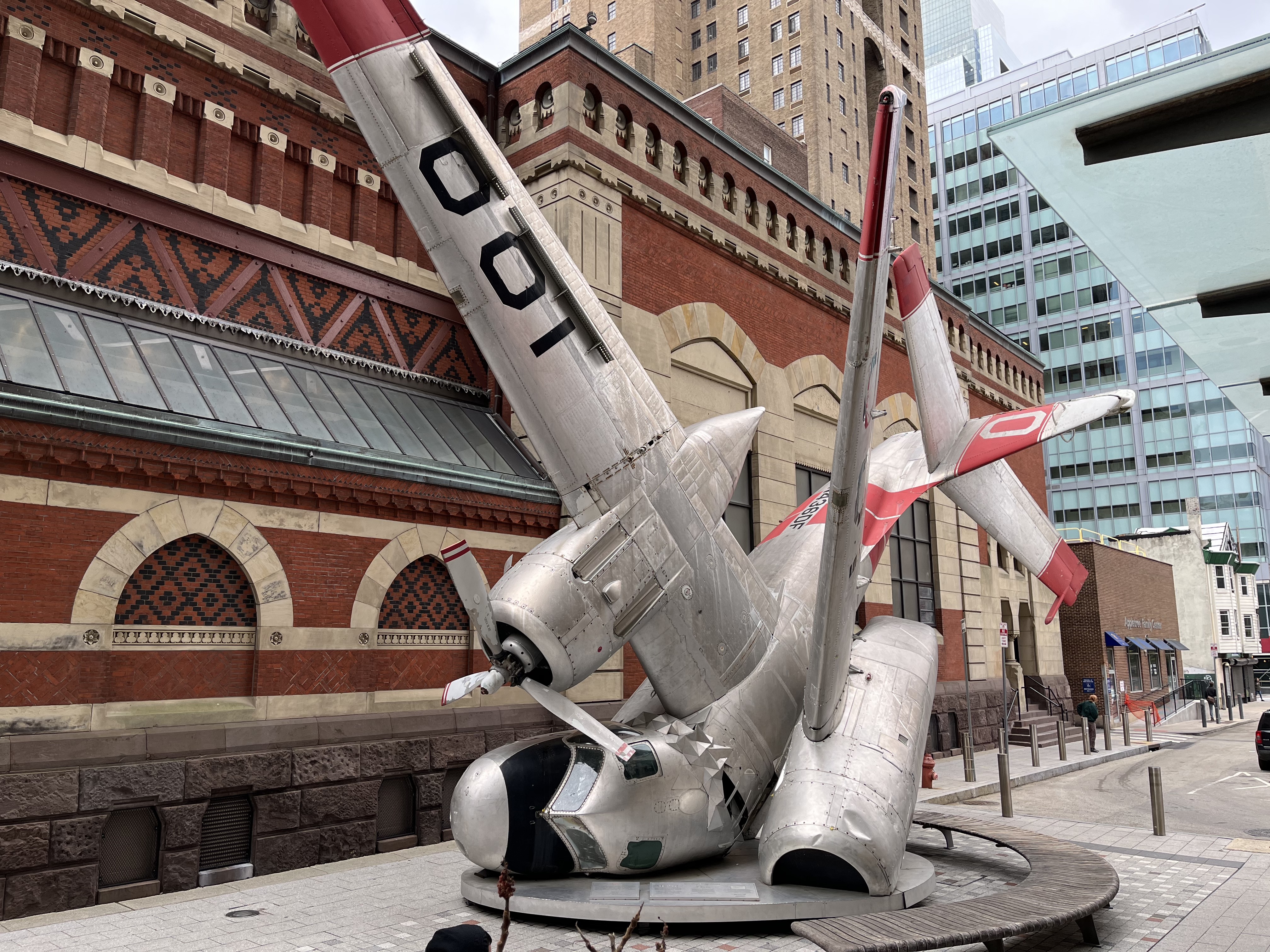
Driving to Philadelphia for this year’s Association of Writers and Writing Programs (AWP) conference, I wondered what I would find. I was on two panels, one as a speaker and one as moderator, but they were the only two panels in the program that specifically targeted vet writers and war-mil-conflict subjects. Several vet-writing mainstays I know had begged out of attending, and others I hadn’t heard from. There was little buzz on social media—especially ominous since the panel I was moderating—Veterans Online—was fueled by the proposition that much of the action these days in the vet-writing world takes place in the virtual realm. Also distressing, there was no signs-of-participation from Warrior Writers, a Philadelphia-based writing collective I think of as synonymous with Philadelphia vet writing and usually prominent players at AWP. What was up? Even the conference keynote speakers were unknown to me—another sign of that AWP was shaping up to be a curiously-diminished, minor-key affair.
Fortunately, such brooding and misgivings proved very misleading. The site of the conference, the Pennsylvania Convention Center, bustled with writers and writer wannabees of all stripes, including lots of vet-writers and fellow-travelers, old and new. Attendance at my two panels was solid, as these things go, and my fellow panelists were in fine form. Even more heartening, at the book-fair tables dedicated to war-and-vet writing the foot-traffic was steady, as far as I could tell. Every time I stopped by the table of, say, the Wrath-Bearing Tree, Collateral, or the Veterans Writing Project, I ran into a familiar face or met an “emerging” writer, as the new term for literary tyros and aspirants has it. Capitalizing on the high spirits and good cheer, we quickly organized a vet-writers social where everyone had a blast (or at least I did) and various lunches, dinners, readings, and special events channeled the same vibe.
A quick roll call of old-hand war-lit writers in attendance and/or presenting at this year’s AWP includes Adrian Bonenberger, Jerri Bell, Ron Capps, Dario Dibattista, Rebecca Evans, Teresa Fazio, Mariette Kalinowski, Kara Krauze, Abby E. Murray, Jennifer Orth-Veillon, Drew Pham, Suzanne Rancourt, Connie Ruzich, Seth Brady Tucker, Brian Turner, and Jeremy Warneke. Hugh Martin, Olivia Kate Cerrone, and Pamela Hart were also around, according to the program, but unfortunately I didn’t run into them (and apologies for anyone whose name I’ve left out).
As good as it was to hang with old friends, it was also great to meet for the first time at least six writers who were either veterans or were working on fiction featuring veterans, and I know the journal editors working the tables met many more. Good luck to them all, and I’ll mention two who are already in print and whom I highly recommend keeping an eye on:
Brian O’Hare is a former Marine whose short-story collection Surrender will come out this fall. O’Hare is the winner of the Syracuse Veterans Writing Award in 2021, read about him here:
Bettina Hindes is an Army veteran currently living in Germany. Her excellent reminiscence “Adjustment Disorder” can be found in Wrath-Bearing Tree:
The panel I moderated was titled “Veterans Writing Online: A Field Guide for Negotiating the Digital Writing Sphere.” Soldier blogs, online vet-writing journals, online vet-writing workshops, digital publishing possibilities, and social-media striving for popularity and reputation were our subjects, and to help me explore them were Ron Capps, Kara Krauze, Jennifer Orth-Veillon, and Teresa Fazio. It was a big subject and we barely got going, but Ron’s, Kara’s, Jennifer’s, and Teresa’s comments were on-point and trenchant and provocative, as I knew they would be. The online print sphere is a new structural element for writers to manage, negotiate, and exploit, and cannot be ignored even if you wanted. No doubt writing for online publication seeps into the bones of the writing itself, but exactly how? Is the medium the message? It seems to me there is a heightened level of performativity and audience awareness at play, but exactly how so remains to be worked out.
I also participated on a panel titled “Family Heritage, Violent History: WWI’s Lost Transversality in War Poetry Today,” organized by Jennifer Orth-Veillon. All of us on the panel presented versions of articles previously published on Jennifer’s fantastic WWrite Blog, selections from which will be published in book form later this year. Listening to poets Seth Brady Tucker and Drew Pham and scholar Connie Ruzich spin word-webs about their connections to World War I and its literary tradition transported me into an extremely pleasant haze of contemplation about the relation of war, words, and history as they percolate in individuals with their own unique experiences and outlooks. For my part, I spoke about poet Aline Kilmer; the highlight was being approached afterward by an audience member (an aspiring vet-writer) who told me that he thought Kilmer’s verse was very “metal.” I laughed, and he wasn’t wrong!
I have fought with stars in their courses
and dreamed I have won,
I have charged full tilt with my levelled lance
straight into the flaming sun
And because of the darkness that swallowed me I
have dreamed that the fight was done.
What to make of this rekindled energy and interest? Not sure, exactly. There was definitely an eagerness to reconnect and get back into circulation on the part of the old hands. There was definitely an eagerness on the part of younger writers to be part of something bigger than themselves. All to the good, and now the question becomes how to keep the party going in Seattle for 2023. I won’t be there, as AWPs so far from my New Jersey home are just “too much,” but there are plenty of possibilities. Two non-mil panels I attended this year seem naturals for adaptation by the vet-writing community.
“Emotional Pacing in the Trauma Narrative” explored literary techniques for framing trauma-based stories so they avoid overwhelming readers with melodramatic excess. The panelists kept it mostly at the level of craft, which was great, but just as interestingly they spoke of the difficulty of life after publication after revealing and recounting harrowing, enormously disturbing private events and thoughts. All aspects of the subject, to my mind, would be a great for exploration by a panel composed of veteran memoirists, if they dare.
“Craft Lessons from the Submission Queue: Writing and Editing Short Fiction” featured the editors of four online journals that publish literary fiction. The editors passed on guidance for successfully placing stories in their journals, while also recounting lessons learned from reading thousands of submissions they have applied to their own writing. The panelists were full of interesting tips, observations, and anecdotes and the huge audience hung on their words as if they were gospel. How cool would it be if Veterans Writing Project, Military Experience and the Arts, Wrath-Bearing Tree, Consequence, The War Horse and/or Collateral teamed up for a similar panel for the war-writing crowd (hint/hint, foot-stomp/foot-stomp)?
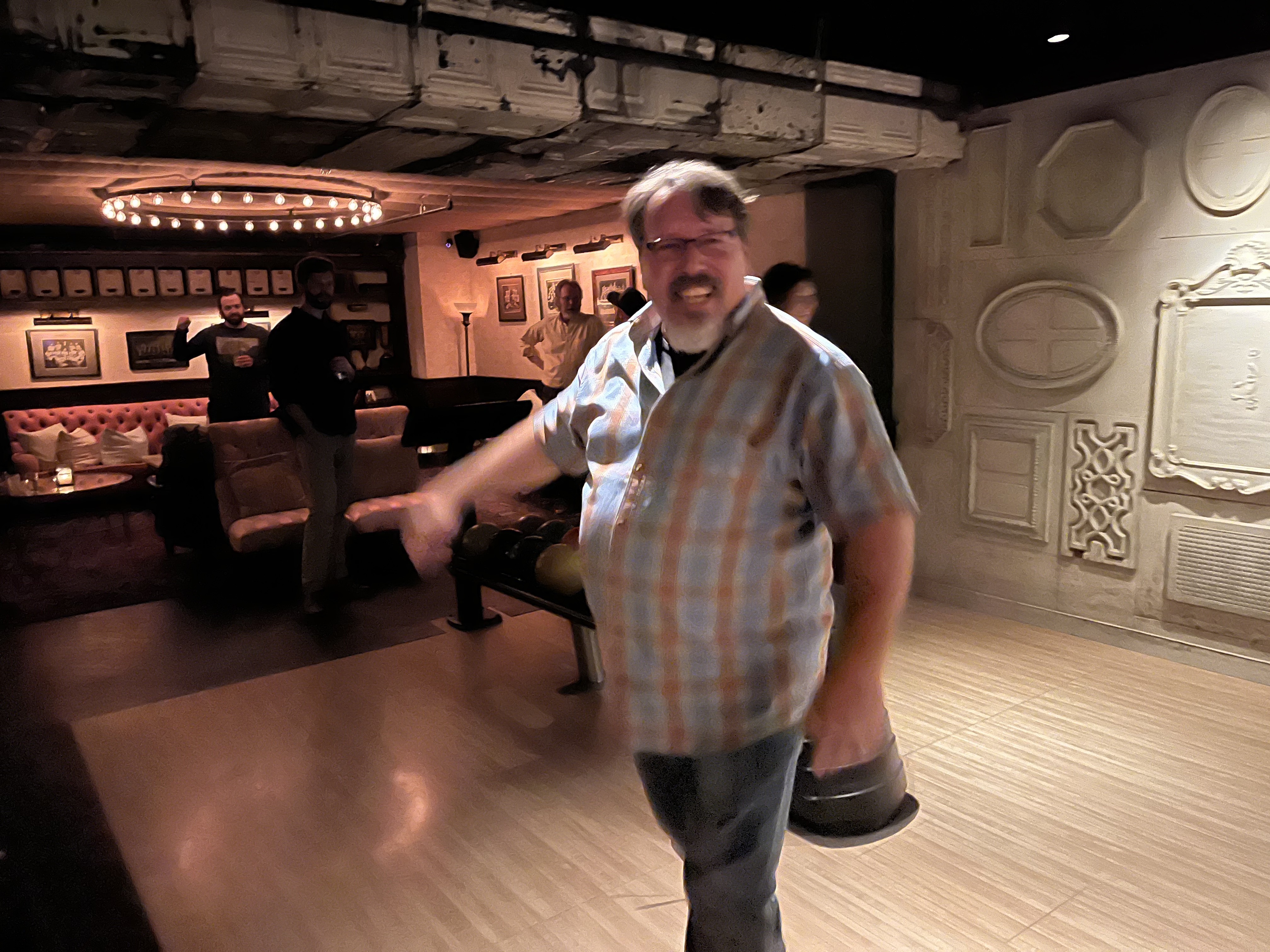
Special AWP shout-outs to Ron Capps and Jennifer Orth-Veillon. It was great to see Capps and the Veterans Writing Project back in action and specifically thanks to Ron for forking out the smackers to reserve a two-lane bowling alley at the war-writers social bar where we held an impromptu first-ever War-Writers Bowling Tournament. For her part, Jennifer was my stalwart ally organizing two panels that helped put vet-and-war-writing back on the map at AWP. It was a close-run thing, and victory was never assured, but we did pretty well with it, I’d say, and I don’t think either of us could have done it alone.
Now, onward to Seattle!
Coming in October 2022: Beyond Their Limits of Longing: Contemporary Writers on the Lingering Stories of World War I. Edited by Jennifer Orth-Veillon, forward by Monique Brouillet Seefried. MilSpeak Books.
War-Mil-Vet Writing at AWP22
I’ll be on two panels at the upcoming Association of Writers and Writing Programs (AWP) conference this week in Philadelphia.
I’m moderating one panel titled “Veterans Writing Online: A Field Guide for Negotiating the Digital Writing Sphere.” Here’s the program blurb:
Iraq and Afghanistan military-and-veteran writers have enthusiastically embraced the internet to amplify their voices and build audiences through blogging, online publishing, remote workshopping, and social media promotion, and as a bridge to traditional print publication. The members of the panel, all accomplished authors, online journal editors, and teachers in the veteran-writing field, offer a range of perspectives regarding best online publishing practices, lessons learned, and future possibilities.
And a little more:
The vibrant veterans online writing realm emphasizes its commitment to new voices, diverse and radical perspectives, post-trauma growth, building communities, and bridging the civil-military divide. The panel explores how online writing supplements and serves as an alternative to traditional print publication by encouraging literary expression by new authors, women, non-binary, minority, and dissident veterans, as well as concerned-citizen writers, family members, and non-combatants.
After a little jockeying, the panel line-up has solidified in exciting ways: Ron Capps, Teresa Fazio, Kara Krauze, and Jennifer Orth-Veillon.
Showtime is Saturday, March 26, 10:35-11:50am in Room 124 in the Pennsylvania Convention Center.
I’m also participating on a panel sponsored by Jennifer Orth-Veillon titled “Family Heritage, Violent History: WWI’s Lost Transversality in War Poetry Today.” I’m honored for the chance to talk about World War I poet Aline Kilmer’s relevance to the current war-writing scene alongside panelists Seth Tucker, Connie Ruzich, and Drew Pham. Here’s the blurb:
WWI’s Centennial offered chances for today’s war writers to reflect upon literary debts owed to 1914-1918 poets in blogs, articles, and new work. This panel fuses history, literary analysis, and creative writing to explore this phenomenon. Members include veteran poets addressing issues of religion, family, sexuality, gender, and PTSD through WWI’s lens. WWI poetry and contemporary war literature experts propose insight into the intersections of personal experience, history, and literary craft.
WWI represents one of the first times in history poetry was responsible for exposing the new complexity of war wounds to the public. WWI elicited responses from diverse voices on the home front and battlefield that opened artistic spaces expressing war’s horrors in innovative ways. This panel reaches far beyond the traditional WWI canon and explores how these poets not only shaped civilian responses or crafted legacy but how they also set precedents for writers confronting today’s conflicts.
We’re meeting on Thursday, March 24 from 1:45 to 3:00pm in Room 121A in the Pennsylvania Convention Center.
Looking forward to it all, and join us please if you will be at AWP. I’m not seeing any other panels on the program that directly address contemporary war-writing, which has me thinking. The conference used to be an important locus for the GWOT war-writing community, with many panels each year on war-and-vet writing and much socializing. That luster was beginning to fade even before Covid, and nothing I know of has replaced it (everything’s online!), but I’m hoping we can rekindle the spirt a little.
 Time Now: The Wars in Iraq and Afghanistan in Art, Film, and Literature